Quantum Search Algorithms, Quantum Wireless,
and a Low-Complexity Maximum Likelihood
Iterative Quantum Multi-User Detector Design
PANAGIOTIS BOTSINIS (Student Member, IEEE), SOON XIN NG (Senior Member, IEEE), AND LAJOS HANZO (Fellow, IEEE)School of Electronics and Computer Science, University of Southampton, Southampton, SO17 1BJ, U.K.
Corresponding author: P. Botsinis ([email protected])
This work was supported in part by the RC-UK, India-UK Advanced Technology Centre (IU-ATC), EU, under the Concerto Project, and the European Research Council Advanced Fellow Grant.
ABSTRACT The high complexity of numerous optimal classic communication schemes, such as the maximum likelihood (ML) multiuser detector (MUD), often prevents their practical implementation. In this paper, we present an extensive review and tutorial on quantum search algorithms (QSA) and their potential applications, and we employ a QSA that finds the minimum of a function in order to perform optimal hard MUD with a quadratic reduction in the computational complexity when compared to that of the ML MUD. Furthermore, we follow a quantum approach to achieve the same performance as the optimal soft-input soft-output classic detectors by replacing them with a quantum algorithm, which estimates the weighted sum of a function’s evaluations. We propose a soft-input soft-output quantum-assisted MUD (QMUD) scheme, which is the quantum-domain equivalent of the ML MUD. We then demonstrate its application using the design example of a direct-sequence code division multiple access system employing bit-interleaved coded modulation relying on iterative decoding, and compare it with the optimal ML MUD in terms of its performance and complexity. Both our extrinsic information transfer charts and bit error ratio curves show that the performance of the proposed QMUD and that of the optimal classic MUD are equivalent, but the QMUD’s computational complexity is significantly lower.
INDEX TERMS Bit-interleaved coded modulation, computational complexity, EXIT chart, Grover’s quan-tum search algorithm, BBHT quanquan-tum search algorithm, Dürr–Høyer algorithm, iterative decoding, multi-user detection, quantum amplitude amplification, quantum amplitude estimation, quantum computation, quantum entanglement, quantum mean algorithm.
NOMENCLATURE
ACO Ant Colony Optimization
APP A PosterioriProbability
AWGN Additive White Gaussian-distributed Noise BBHT Boyer-Brassard-Høyer-Tapp
BER Bit Error Ratio
BICM Bit-Interleaved Coded Modulation
BS Base Station
CF Cost Function
CIR Channel Impulse Response
COMP Cooperative Multi-cell Processing
DHA Dürr–Høyer Algorithm
DS-CDMA Direct-Sequence Code Division Multiple Access
EPR Einstein-Podolsky-Rosen
EXIT Extrinsic Information Transfer
GA Genetic Algorithm
ID Iterative Decoding
IQFT Inverse Quantum Fourier Transform
LLR Log-Likelihood Ratio
MBER Minimum Bit Error Ratio
MC Multi-Carrier
MF Matched Filter
MFAA Multi-Functional Antenna Array MIMO Multiple-Input Multiple Output
ML Maximum Likelihood
MMSE Minimum Mean Square Error
MSE Mean Square Error
MUA Multi-input-approximation
MUD Multi-User Detection
MUI Multi-User Interference
NSCC Non-Systematic Convolutional Code
OFDM Orthogonal Frequency-Division Multiplexing PSO Particle Swarm Optimization
QAA Quantum Amplitude Amplification
QAE Quantum Amplitude Estimation
QAM Quadrature Amplitude Modulation
QCA Quantum Counting Algorithm
QCR Quantum Control Register
QD Quantum Domain
QET Quantum Existence Testing
QFR Quantum Function Register
QFT Quantum Fourier Transform
QGOA Quantum Genetic Optimization Algorithm
QIR Quantum Index Register
QMA Quantum Mean Algorithm
QMUD Quantum Multi-User Detection
QoS Quality of Service
QR Quantum Register
QSA Quantum Search Algorithm
QWSA Quantum Weighted Sum Algorithm
SDMA Spatial Division Multiple Access
SF Spreading Factor
SISO Soft-Input Soft-Output
SM Spatial Multiplexing
SNR Signal to Noise Ratio
TCCC Turbo Coding relying on Convolutional Codes
UWB Ultra-Wide Band
I. MOTIVATION
The history of wireless communications, the evolution of standards and a host of popular enabling techniques was detailed in [1]. These solutions paved the way for inching closer to the Shannonian channel capacity limits. However, these ultimate limits may only be approached for a sin-gle user link subjected to pure Additive White Gaussian-distributed Noise (AWGN) under Shannon’s idealized simplifying assumptions of using random Gaussian transmit signals. However, in practical state-of-the-art systems we employ digital, rather than Gaussian transmit signals. Fur-thermore, no quantitative statements were made by Shan-non as regards to the system’s delay and complexity, whilst in practice only the family of powerful and hence high-complexity, high-delay channel coded systems might be capa-ble of approaching these limits and even then only under perfectly synchronized conditions. Regretfully however, per-fect synchronization at near-capacity Signal-to-Noise Ratios (SNR) is again, a real challenge. Hencethe myth of operating in the vicinity of Shannon’s capacity limit in practical systems was dispelled in [2], where it was quantitatively demonstrated with the aid of painstakingly meticulous measurements that only a fraction of the theoretically attainable capacity is actually achieved by the standardized systems.
Another limitation imposed on the operational standard systems is that a single link’s Shannonian capacity is limited by the logarithmic Bit/Hz normalized capacity formula of C/B=log2(1+SNR), which only allows the capacity to be
increased logarithmically with the SNR, i.e. with the transmit power, whereBis the available bandwidth. Nonetheless, we hasten to add that whenBtends to infinity, like in Ultra-Wide Band (UWB) systems for example, this capacity formula also tends to a linearly increasing function of the SNR. By contrast, provided that we can construct a sufficiently high number of parallel streams and additionally, we are capable of conceiving low-complexity full-search-based detection tech-niques, the throughput of wireless systems may be increased linearly, rather than logarithmically with the transmit power, leading to the concept of power-efficient ‘‘green’’ communi-cations systems, which was the motto of the book [3].
Given this motivation, let us briefly elaborate on the potential techniques of creating parallel streams in wire-less systems and then embark on conceiving high-efficiency quantum-processing techniques for creating powerful detec-tors for them!
A. LARGE-DIMENSIONAL HOLISTIC OPTIMIZATION IN WIRELESS SYSTEMS
1) The family of multi-stream wireless systems, such as for example the single-carrier Direct-Sequence Code Division Multiple Access (DS-CDMA) [4], [5] scheme of the operational third-generation wideband-CDMA systems are capable of increasing the throughput lin-early with the transmit power - provided that we assign multiple superimposed spreading codes to each of the Kusers supported.
2) Similarly, the pan-American Multi-Carrier (MC) DS-CDMA [5]–[7] cdma2000 system supports a multiplic-ity of users by allocating unique, user-specific spread-ing codes to them, which are also often referred to as user signatures. The throughput of MC-CDMA may also be increased linearly with the transmit power, since we can create superimposed parallel streams in both the time-domain and frequency-domain. Hence it may be anticipated that MC-CDMA systems will play a promi-nent role in future generations of wireless systems. 3) As a further dimension for creating superimposed
par-allel streams, the spatial domain of parpar-allel transmit and receive antennas was proposed in the context of Multi-Functional Antenna Arrays (MFAA) [1]:
• To elaborate a little further, firstly, MFAAs are capable of achieving a multiplexing gain by trans-mitting independent parallel streams, which may be separated at the receiver, provided that we can estimate the unique, antenna-specific Channel Impulse Responses (CIR) sufficiently accurately at the receiver. This scheme is termed as Spatial Multiplexing (SM).
• Secondly, the MFAAs are also capable of
sup-porting the uplink transmissions of multiple users instead of transmitting multiple streams for a sin-gle user, which is referred to as Spatial Division Multiple Access (SDMA) [8]–[10]. Similarly to separating multiple streams in spatial multiplexing,
in SDMA the separation of users is achieved with the aid of the accurately estimated unique, user-specific CIRs.
• The third key function of MFAAs is the
provi-sion of diversity gain for the sake of mitigating the deleterious effects of the wireless channel’s fading imposed by the sometimes constructively, sometimes destructively superimposed multiple propagation paths. Naturally, the multiplicity of propagation paths contribute further towards the gradually escalating number of parallel streams, which may be coherently combined with the aid of maximum ratio combining for the sake of miti-gating the effects of fading. It is important to note however that in order to achieve the maximum attainable diversity gain, the MFAA elements have to be sufficiently far apart for experiencing inde-pendent fading.
• The MFAAs are also capable of attaining
angu-lar selectivity, hence potentially mitigating the effects of interference amongst the users, which is termed as co-channel or Multi-User Interfer-ence (MUI) - provided that the interfering sig-nals arrive from angles outside the beamformer’s main transmit/receive beam. These beamformers typically employ MFAA elements, which are half-the-wavelength apart, because in contrast to the independently fading signal components of the transmit diversity schemes, they aim for transmit-ting/receiving appropriately phase-combined sig-nal components for creating maxima in the desired user’s direction and minima towards the interferers.
• Finally, all the above-mentioned design
objec-tives of MFAAs may be combined in the inter-est of benefiting from all of these desirable per-formance improvements—again, provided that low-complexity multi-stream detectors may be conceived.
Similarly to MC-CDMA, all the above-mentioned concepts are also applicable to the fourth-generation Multiple-Input Multiple Output (MIMO) aided Orthog-onal Frequency-Division Multiplexing (OFDM) sys-tems [11]–[13], where the users convey their informa-tion to and from the Base Stainforma-tion (BS) over multiple subcarriers.
4) However, so far we have only alluded to the multiple streams generated by multiple users and the MFAAs within a single cell. In reality one of the most severe performance limitation of wireless systems is con-stituted by the MUI imposed by the adjacent cells, because this can only be mitigated with the aid of Coop-erative Multi-cell Processing (COMP). More explicitly, the basic philosophy of COMP is that the base-stations are linked with the aid of either optical fibre or by a point-to-point microwave link and this way they
exchange all their information, including all the uplink and downlink data of all the users, as well as their CIRs. 5) Albeit the COMP concept imposes a huge amount of data exchange amongst the BSs, as a benefit, no MUI is experienced, because all the energy received by all receivers is useful signal energy and hence directly contributes towards achieving the best possible holistic system performance. As a result, the theoreti-cally best possible multi-user, multi-cell performance constituted by an idealized system, where the only per-formance impairment is the AWGN may be asymptoti-cally approached - again, provided that low-complexity parallel processing aided receivers may be constructed. Expanding the multi-cell, multi-user optimization con-cept [14], [15] yet another step further, accurate near-instantaneous power control is required at the COMP-aided BSs in order to minimize the transmit power, while maintaining the required Quality of Ser-vice (QoS) constraints for each of the K users [16], [17]. In the operational standardized systems this is achieved by carefully optimizing both the step-size and the instants of power-updates as a function of the vehicular speed, but these step-by-step sequential power-adjustments do not necessarily approach the optimum, especially not for high velocities. Hence a near-instantaneous ‘‘direct-dial-style’’ parallel power-adjustment of all transmitters would be desirable across the entire system.
Additional large-dimensional optimization algorithms processing numerous parallel streams in wireless com-munication systems involve message-routing across large cooperative and multi-hop networks [18]–[22], where the specific multi-hop routing path having the minimum overall length, or the minimum num-ber of hops or alternatively, the maximum received power between two predetermined nodes has to be found. These techniques may be readily combined with sophisticated message-scheduling and resource allocation [23], [24], as well as with cognitive radio techniques relying on efficient channel- and power-allocation designed for the primary user [25], [26]. Moreover, soft information exchange between the sig-nal detector and the channel-decoding stages is required in the green communication systems of the future, where holistic optimization is pursued [27] as well as in massive MIMO systems [2], [11], [28], [29] where the computational complexity of the optimal full-search-based algorithms is potentially excessive.As a remedy, in the next section we propose quantum-domain paral-lel processing techniques for implementing the above-mentioned massive parallel processing tasks.
B. MULTI-STREAM DETECTION IN LARGE-DIMENSIONAL WIRELESS SYSTEMS
As argued above, the employment of algorithms impos-ing a low computational complexity is essential, since
low-complexity algorithms impose a low power-dissipation, which hence requires desirably low-weight, potentially solar-charged or kinetically-solar-charged batteries for the shirt-pocket-sized wireless handsets.
A plethora of both Multi-User Detection (MUD) and multi-stream detections techniques has been proposed in the litera-ture, as detailed for example in [4], [5]. In simple physically tangible terms we may argue that provided all the K users’ signals in the above-mentioned holistically optimized system arrive at the base-station synchronously and they transmit M-ary signals, then the optimum full-search-based receiver has to tentatively check all the MK symbol combinations, in order to reliably detect each of the K user’s symbols. More specifically, this is achieved by identifying the most likely transmitted M-ary symbol of all the K users of the entire multi-user, multi-cell system by evaluating a carefully chosen Cost Function (CF), which may be the Mean Squared Error (MSE) or the Bit Error Ratio (BER), etc. Suffice to say, however that when using 64-level Quadrature Amplitude Modulation (QAM) for example at an airport, where say 10 000 users would like to use their phones/tablet computers, it is entirely unrealistic to evaluate the CF 6410 000times. . .
This is where Quantum Computing may be employed in the above-mentioned systems for reducing the complexity of the above-mentioned processes by exploiting its inherent parallelism as illustrated in Fig. 1. Assuming that only one of the eight keys unlocks the box in Fig. 1, serial computing would have to perform consecutive trials until the correct key is found, requiring a long time for solving this problem. By contrast, parallel computing would recreate the box eight times and try all the keys in parallel, which is more efficient as far as the required time is concerned, but it requires more hardware resources. Quantum computing on the other hand is capable to try all the keys at the same time in the context of a single box.
Following the above low-paced tutorial exposure, in the rest of this treatise we will expedite the speed of developing
our ideas. We continue by reviewing the family of quantum search algorithms that may be used in the above-mentioned large-dimensional wireless systems and then conclude by providing a radically new quantum-MUD DS-CDMA design example.
II. INTRODUCTION
The employment of MUD facilitates achieving a near-single-user performance with the aid of joint iterative detection and decoding, exchanging extrinsic information in the form of Log-Likelihood Ratios (LLR) between the receiver com-ponents. The complexity of the optimal Maximum Like-lihood (ML) MUD [30] exhibits an exponential increase with the number of users, which prohibits its employment when many simultaneous users are supported by the sys-tem. Hence reduced-complexity solutions have been devel-oped, such as the decorrelating and the Minimum Mean-Square Error (MMSE) MUDs [31], the iterative linear MMSE MUD [32], as well as the successive interference cancellation aided detector [33] and the family of iterative interference cancellers [34]. Following an approach, where the aim is to directly minimize the system’s BER, the Minimum BER (MBER) detector was conceived [35], [36]. MUDs that can be integrated into an iterative receiver, providing soft deci-sions for the decoder, while accepting soft estimates from the decoder, have also been proposed [6], [37], [38].
Bio-inspired heuristic algorithms have also been conceived for shrinking the search space by performing a random-guided search, which are capable of near-optimal MUD. For example, Genetic Algorithm (GA)-based MUDs have been proposed in [39]–[41]. Furthermore, an Ant Colony Optimization (ACO) algorithm-based MUD was proposed for the uplink of a synchronous MFAA-assisted MC DS-CDMA system in [7], while its soft-output version, termed as the multi-input-approximation (MUA)-assisted soft output-ACO MUD, was presented in [42]. By exploiting the sheer power of Particle Swarm Optimization (PSO) algorithms,
FIGURE 1. Comparison between classic serial, parallel and quantum computing. Assuming that only one of the eight keys unlocks the box, by employing serial computing we have to try each of the keys sequentially until one succeeds to unlock it. Classic parallel computing creates as many boxes as the available keys and tries all of them at once, requiring a large amount of resources. With quantum computing we are able to try all the keys in parallel on a single box. The box corresponds to a function, while the keys represent the legitimate inputs of the function. The key that unlocks the box is the input of the function which will lead to a desired output. By employing quantum computing, the function may be evaluated for the inputs in parallel, as in parallel computing, with the computational cost of a single evaluation, as in serial computing.
PSO-based MUDs were proposed in [43], [44], while further low-complexity suboptimal MUDs were presented in [45], [46].
With the size of a single transistor constantly shrinking according to Moore’s law, it is expected to reach the atomic scale in a few years, where the postulates of quantum mechan-ics replace the laws of classic physmechan-ics. The transition to quantum computing will unlock capabilities that a conven-tional classic computer is inherently incapable of [47]–[50]. For instance, quantum computing allows parallel evaluations of a function at a complexity equivalent to that of a single classic evaluation. An astonishing example of the power of quantum computing is the Quantum Amplitude Amplifica-tion (QAA) algorithm analysed in [51] employed in Grover’s Quantum Search Algorithm (QSA) [52], [53], which per-forms search in an unsorted database havingNelements and finds a single solution1 at a complexity order of O(
√
N), in contrast to its classic optimal counterpart imposingO(N) operations. Boyeret al.[54] proposed the so-called Boyer-Brassard-Høyer-Tapp (BBHT) QSA, which is also based on quantum amplitude amplification and manages to perform search in an unsorted database even when the number of solutions is higher than one and even if the exact number is not known a priori. The Dürr–Høyer algorithm (DHA) presented in [55] manages to find the index of the minimum entry in a database by activating the BBHT QSA multiple times.
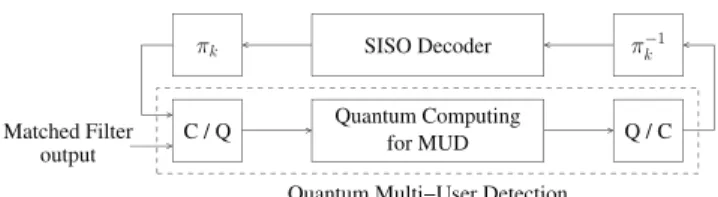
In addition to the breakthroughs in quantum error correc-tion [56], [57] and quantum cryptography [58], [59], a sub-stantial amount of research has been devoted to the quantum search-based MUD field by creating quantum-assisted MUDs (QMUD) [48], [60], where classic algorithms are combined with quantum-processes. It should be noted that the commu-nications systems we investigate operate in the classic domain and only the QMUD processes are performed in the Quantum Domain (QD). The inputs and outputs of the QMUD are in the classic domain, as presented in Fig. 2. A represen-tative example of a quantum-assisted MUD was proposed in [60], [61], where the Quantum Counting Algorithm (QCA) of [62] is employed. Quantum-inspired MUDs have also been proposed, adopting quantum-domain attributes in the classic domain. Representative examples of quantum-inspired MUDs are the combinations of the heuristic algorithms combined with quantum principles, such as the quantum PSO-based MUDs of [63]–[65], the quantum GA-optimized neural network employed for signal detection in [66], and the quantum GA-based MUDs of [67]–[69].
Our novel contributions are:
1) We have proposed a Maximum Likelihood Quantum-assisted Multi-User Detector (ML QMUD), where all the legitimate combinations of the users’ transmitted symbols are taken into consideration at the receiver. The ML QMUD matches the performance of the classic
1A solution is an index of the database the entry of which satisfies the
search problem.
FIGURE 2. Block diagram of soft-input soft-output quantum-assisted multi-user detection, where the input/output signals are converted from/to the classic domain (C) to/from the quantum domain (Q), while the inner operations are performed in the quantum domain.
ML MUD, while achieving a quadratic reduction in computational complexity.
2) We have designed the first Soft-Input Soft-Output Quantum-assisted MUD (SISO QMUD) for forwarding the bit LLRs to the decoding stage in the classic domain and for processing the decoder’s soft outputs as a priori information also in the classic domain, making it emi-nently eligible for integration into an iterative receiver. 3) We have provided EXtrinsic Information Transfer (EXIT) charts [4], [70] for the proposed QMUDs, com-paring them with those of the ML MUD.
Based on the QD algorithm of estimating the mean of a function [71], also termed as the Quantum Mean Algo-rithm (QMA), we conceived an algoAlgo-rithm for estimating the weighted sum of a function. Explicitly, we propose an algorithm termed as the Quantum Weighted Sum Algorithm (QWSA) for estimating the LLRs. This is achieved by com-puting the numerators and denominators of the LLRs, which involve the summations of conditional probabilities. These operations represent the CF evaluations, while the corre-sponding a priori probabilities act as the weights of the con-ditional probabilities, as detailed in Section VII.
The rest of the paper is structured as follows. We will apply the proposed QMUD scheme in a communications system presented in Section III. A review of QSAs and their applications is offered in Section IV. The relevant theoretical background on quantum computing is provided in Section V, while Section VI introduces Grover’s QSA, the BBHT algo-rithm and finally the DHA, which will also be exploited in our proposed QMUD. Section VII introduces the QMA and proposes the measures required for the transfiguration of the QMA into the QWSA. Section VIII states the CF normaliza-tion issues and the resultant computanormaliza-tional complexity of the QWSA-based MUD, while the performance of our system employing both Bit-Interleaved Coded Modulation (BICM) relying on Iterative Decoding (ID) and on turbo codes is presented in Section IX. Finally, our conclusions are offered in Section X.
III. SYSTEM OVERVIEW
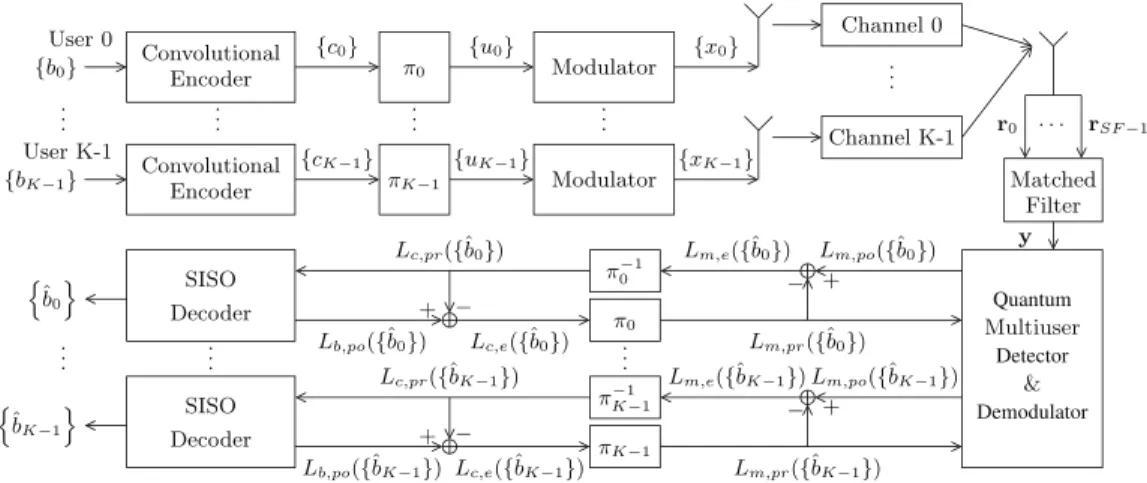
BICM-ID will be used in our uplink communications sys-tem presented in Fig. 3. The information bit stream{bk}of
each user is encoded into the stream{ck}by a convolutional
encoder, which is passed through pseudo-random bit-based interleavers. Then, the interleaved bits{uk}are spread by the
FIGURE 3. BICM-ID system’s block diagram withKusers and quantum-assisted multi-user detection with soft-input and soft-output.
are modulated onto the symbols{xk}, which are transmitted
over uncorrelated Rayleigh channels overT time slots. The channel matrixHis assumed to be perfectly estimated at the BS. Moreover, the DS-CDMA codebookC=[c0, . . . ,cK−1] storing ck = [ck,0. . .ck,SF−1]T employed by the individ-ual users having a specific Spreading Factor (SF) is known at the BS. On the other hand, the thermal noise imposed at the receiver, along with the time delay introduced dur-ing the propagation is unknown. However, since we assume non-dispersive Rayleigh fading, only the noise levels are unknown.
The classic optimal MUD that accepts soft inputs and provides soft outputs is the one that computes the bit LLRs of every bit of every symbol of each user. Let us consider a multi-user system supportingK users and employing anM -ary modulation scheme. Omitting the time superscript, the Matched Filter’s (MF) outputs during a single time slot are described by
y=CHCHx+CHn
=Rx+ ˜n (1)
wherey = [y0, . . . ,yK−1]T includes each user’s MF output during the same time slot,x=[x0, . . . ,xK−1]T is the multi-level symbol,n = [n0, . . . ,nSF−1]T contains the complex-valued thermal noise at the BS, where we haveR=CHCH andn˜ =CHn=[n˜0, . . . ,n˜K−1]T.
The bit-based metric computed at the MUD is the a posteriori information of the encoded, interleaved bits, presented in terms of the LLRs as [4]
Lm,po b(km)=ln P b(km)=0|y Pb(km)=1|y =log " P x∈χ(k,m,0) P(y|x)P(x) # /P(y) " P x∈χ(k,m,1) P(y|x)P(x) # /P(y) (2)
where the subscript k is the index of the specific user k ∈ {0, . . . ,K − 1} the bit belongs to, the superscript m∈ {0, . . . ,log2(M)−1}denotes the index of the particular bit the LLR is computed for in the symbol of thekth user,Mis the size of the modulation constellation,χ(k,m,v) is the set of multi-level symbols for which the klog2(M)+m
th bit is equal tov,P(x) is thea prioriprobability of the symbolx, P(y) is the model’s likelihood, which reflects the probability of receivingyas [4]
P(y)=X x
P(y|x)P(x) (3) P(y|x) is the CF, which represents the probability of having receivedy, given that the multi-level symbolxwas transmit-ted [4]
f(x)=P(y|x)=exp− ky−Rxk2/2σ2 (4) whereσ2is the noise variance. Assuming the independence of the bits in a symbol, thea priorisymbol probability is equal to the product of thea prioribit probabilities that the symbol was created from, i.e. we have
P(x)=P(b(0)0 )·. . .Pb(log2(M)−1) 0 ·. . .Pb(log2(M)−1) K−1 . (5) It should be noted that MK/2 CF evaluations are required in the summation in each of the numerator and denominator of (2).
The extrinsic LLRs are passed to the K Max-Log A Posteriori Probability (APP) decoders [4], which in turn feed the QMUD with symbol probabilities, given the received encoded soft sequence. These iterations are continued for a specific number of iterations. During the first iteration, or if the MUD is not part of an iterative procedure, as in non-iterative BICM, all the symbols have equala priori probabil-ities, since no extrinsic information is available.
IV. ORIGINS OF QUANTUM COMPUTING
Research on Quantum Mechanics initiated in 1923 by the renown physicists Planck, Bohr, Heisenberg, Einstein and
Schrödinger. Even though arguments have been arisen against quantum mechanics being a compact and complete theory of describing nature, quantum mechanics is considered to be the superset of physical theories describing both the microscopic and macroscopic worlds, while abiding by the laws of the Newtonian theory.
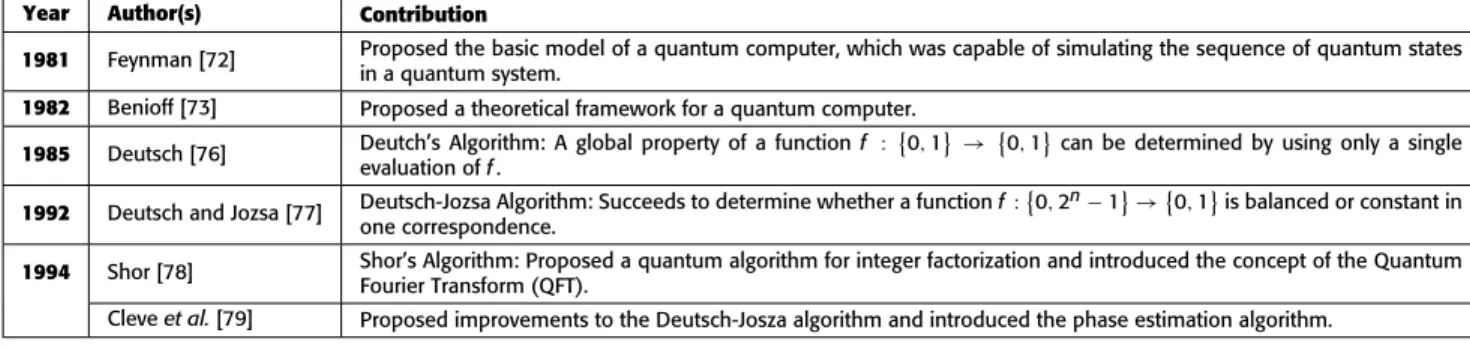
By using the principles of quantum mechanics in order to improve intelligent computational systems, the field of Quantum Computing emerged. In 1981, Feynman introduced the concept of a quantum computer, which would be able to accurately simulate the evolution of a quantum system [72]. It was only a year later when Benioff presented a complete theoretical framework of the quantum computer concept [73]. The structural element of a quantum computer is a quantum bit, orqubit, that, in comparison to the classic bit, has values that are not limited to 0 and 1. Quite the contrary, it can have any of these two values like a spinning coin in a box, which will only assume the value of ‘‘Heads’’ or ‘‘Tails’’ upon observing it when it stopped. This phenomenon is also often referred to as being in a superposition of the two orthogonal states, 0 and 1 [47]. The reason for this superposition of states being seemingly absent in the macroscopic world is related to the observation of the qubit. When a qubit is observed or ‘‘measured’’, any superposition of states that it might have assumed ‘‘collapses’’ to the classic states of 0 or 1, as stated by the so-called Copenhagen interpretation [74], introduced by Bohr and Heisenberg in 1924. As a further terminology, Everett in 1957 proposed the ‘‘Many-World’’ or ‘‘Parallel-Universes’’ interpretation [75], where an observation of a quantum state creates parallel universes that carry on with a different observation outcome taking place in each.
Quantum computing exploits a range of astonishing, non-intuitive characteristics of quantum mechanics, such as quan-tum parallelism, a term coined by Deutsch in 1985 [76], and entanglement [80] to accomplish computational tasks of stunningly high complexity, which would be deemed excessive in the classic computing world. Entanglement is a mysterious connection that can be established between qubits, where the observation of one of the entangled qubits allows instantaneous knowledge to be obtained for the other qubit. Einstein, Podolsky and Rosen challenged the valid-ity of using quantum mechanics for describing nature by presenting a thought experiment which leads to a paradox (EPR paradox) [81]. Their thought experiment is based on the entanglement between particles. Assume that there are two particles, A and B, which interact with each other and then they are moved to different locations. Quantum theory and Heisenberg’s uncertainty principle state that it is impossible to have knowledge of both the position and the momentum of a particle. According to the EPR thought experiment, if a mea-surement of A’s position is made, then the position of B can be calculated. Therefore, the same statement can be made for B’s momentum, and hence A’s momentum can be calculated. Therefore, both the position and the momentum of particle B become known, resulting in a paradox. Hence Einstein’s belief was that quantum mechanics was not a complete theory
of nature. As a further advance, in 1966 Bell showed that at least one of the initial assumptions of Einstein, Podolsky and Rosen, namely locality and reality, was flawed, which was encapsulated in Bell’s inequalities in [80].
Quantum parallelism is the ability to evolve the qubits of a quantum system in parallel, saving a large amount of com-putational complexity, when compared to classic computing. Quantum parallelism was first exploited by Deutsch in 1985, who proposed a quantum algorithm [76] based on the princi-ples of quantum parallelism and quantum interference, which is also part of quantum mechanics. By applying Deutsch’s algorithm to a functionf : {0,1} → {0,1}, a global property can be determined by relying on a single evaluation off. This property is the determination of whether the functionf is an one-to-one mapping function, hence whetherf(0)⊕f(1)=1, or not, resulting inf(0)⊕f(1)=0. In the context of a classic apparatus two evaluations of f would be required, one for each legitimate input.
In 1992, Deutsch and Jozsa [77] generalized Deutsch’s algorithm of [76]. This algorithm was used to solve the so-called generalized Deutsch problem [77]. Converted into a real life scenario for better intuition, two persons are con-sidered, Alice and Bob, with Alice classically transmitting a numberx to Bob withx ∈ {0,2n−1}andn ∈ N. When Bob receives this number, he evaluates a functionf(x) and sends the resultant value back to Alice, which may be either 0 or 1. The function that was used by Bob is either a constant function, in which case the output is fixed to a single value, namely to 0 or 1, regardless of the input, or balanced, which means that for half the possible inputs the outcome is 0 and for the other half it is 1. Alice’s goal is to determine whether the function that was used by Bob is a constant or balanced, which she intends to find out by iterating the above procedure. More explicitly, by applying the Deutsch-Jozsa algorithm [77], Alice could achieve her goal in a single cor-respondence, while in classic computing 2n−1+1 enquiries would be required in the worst case scenario, which includes f being a constant and hence reaching this conclusion after evaluating just over half of the legitimate inputs. The best case scenario in classic computing may occur when f is balanced and its first two evaluations output different values. The Deutsch-Josza algorithm was further improved by Cleve, Ekert, Macchiavello and Mosca in [79], where the phase estimation quantum algorithm was introduced.
In 1994 Shor proposed a number of algorithms for quan-tum computation [78], such as for example a quanquan-tum algo-rithm conceived for integer factorization. Furthermore, Shor introduced the concept of the Quantum Fourier Transform (QFT) [78]. A range of techniques for constructing unitary transformations in the form of matrices, which are used for describing the time-domain evolution of any quantum system, i.e. its consecutive states as a function of time were also presented. During the same year, Simon managed to solve a black-box problem by using on the order of O(n) queries to the black box, compared to the optimal classic algorithm, which uses(2n/2) queries for the same task [82]. The black
boxUf implements a functionf : {0,1}n → {0,1}n, which
constitutes the input to the problem and has the property that f(x) = f(y) if and only ifx = yor x⊕y = s, for some s∈ {0,1}n, wherex,y∈ {0,1}n. Simon’s algorithm succeeds in finding thissthat satisfies the function’s above-mentioned property.
In the mid 1990’s the field of quantum-domain search and quantum-assisted optimization of intelligent computa-tional systems started gaining substantial momentum based on the Deutsch-Jozsa algorithm [77] and Shor factoring algo-rithm [78]. The quantum algoalgo-rithms touched upon are sum-marized in Table 1. The rest of this section continues by intro-ducing the quantum search algorithms along with their appli-cations in the field of wireless communiappli-cations. Nevertheless, this does not limit the applications of the quantum algo-rithms, since at the time of writing substantial research efforts are devoted into quantum-based communications, where quantum information is conveyed over quantum channels [95]–[97], with particularly attractive applications in the field of optical communications [98], [99].
A. ORIGINS AND APPLICATIONS OF QUANTUM SEARCH ALGORITHMS
In 1996 Grover proposed a quantum mechanical algo-rithm for performing quantum search in an unsorted clas-sic database [52], [53]. Grover’s QSA finds the index of the desired entry in the classic database, assuming that the desired value appears only once in the classic database, or, in other words, when there is only one solution in the classic database. During the same year, Boyer, Brassard, Høyer and Tapp (BBHT) in [54] generalized Grover’s QSA to the case, where the desired value appears in more than one entry in the classic database. In the same paper, they proposed the BBHT algorithm, which yields the index of an entry having the desired value, provided that the number of identical desired entries is unknown a priori. Furthermore, they derived a closed-form mathematical expression for quantifying the suc-cess probability of Grover’s QSA in identifying the desired entry. Grover’s QSA is essentially an amplitude amplification process that allows the retrieval of the desired search outcome after a specific numberLof tentative evaluations in the clas-sic database [51]. The computational complexity of search-ing an unsorted classic database of size N by employing
classic computing isO(N), whereas by using Grover’s QSA isO(
√
N).
In July of 1996 Dürr and Høyer proposed the DHA for finding the minimum entry in a classic database with∼100% probability, based on the BBHT QSA [55]. Furthermore, Bennettet al.in [83] proved that Grover’s QSA is asymptoti-cally optimal, by formally showing that there exists no quan-tum algorithm that can satisfy the search problem in fewer than O(
√
N) computational steps. In 1997, Zalka provided the mathematical proof that Grover’s QSA is optimal in terms of maximizing the success probability of obtaining the index pointing to an entry having the desired value [84].
In 1998, Brassard, Høyer and Tapp proposed the Quantum Counting Algorithm (QCA) based on Grover’s QSA and Shor’s quantum algorithms in [62]. The concept of QCA was conceived by the same authors in [54]. The QCA is capable of providing the number of entries in a classic database that are equal to the desired value, or, in other words, the number of solutions in the database. The QCA may be viewed as an amplitude estimation process, which is capable of estimating the number of desired entries in the classic database [51]. In 1999, Ahuja and Kappor also presented a similar QSA to the DHA that was capable of finding the maximum entry in a database [87]. During the same year, Longet al.introduced the generalized version of Grover’s QSA by using arbitrary unitary operators and phase rotations in Grover’s quantum circuit [86], replacing Grover’s proposed operators [52].
When considering applications, where the entries of the database are related to each other, Hogg presented a heuris-tic QSA [88], which manages to find the specific index that corresponds to the minimum entry. Since this quantum algorithm is heuristic and application-based, no theoretical limits were provided. Then, Brassardet al.proposed a mod-ification in the last part of Grover’s QSA in order to suc-cessfully conclude the search with 100% probability [51]. In 2002, Imre and Balázs proposed an MUD scheme for a DS-CDMA system employing the QCA [60], [61]. The main process relies on creating symbol-specific quantum databases containing all the potential faded and noise—as well as interference—contaminated received signals corresponding to each user’s hypothesized transmitted symbol and then aims for finding the transmitted symbol of each user relying on the QCA. If the faded and noise—as well as interference—
TABLE 1. Origins of Quantum Computing.
Year Author(s) Contribution
1981 Feynman [72] Proposed the basic model of a quantum computer, which was capable of simulating the sequence of quantum states in a quantum system.
1982 Benioff [73] Proposed a theoretical framework for a quantum computer.
1985 Deutsch [76] Deutch’s Algorithm: A global property of a functionf :
0,1 →
0,1 can be determined by using only a single evaluation off.
1992 Deutsch and Jozsa [77] Deutsch-Jozsa Algorithm: Succeeds to determine whether a functionf:
0,2n−1 →
0,1 is balanced or constant in one correspondence.
1994 Shor [78] Shor’s Algorithm: Proposed a quantum algorithm for integer factorization and introduced the concept of the Quantum Fourier Transform (QFT).
contaminated received signal appeared in one of the symbol-specific databases, then the symbol-specific information symbol this database was constructed on is the most likely symbol to have been transmitted by the corresponding user.
In 2003, Shenvi et al.proposed a quantum random-walk search algorithm applied on graphs [89]. In 2004, Imre and Balázs generalized Grover’s QSA, where arbitrary unitary operators are employed and only a single iteration of the Grover operator is applied [90]. Furthermore, Imre proposed the Quantum Existence Testing (QET) algorithm [48], [92] for replacing the QCA in the above-mentioned QMUD rithm. The difference between the QCA and the QET algo-rithm is that the QET shows whether the faded and noise— as well as interference—contaminated received signal asso-ciated with a specific legitimate transmitted symbol does or does not exist in the quantum database. However, this is achieved without providing any information about the number of occurrences. By contrast, the QCA provides an estimate of the number of solutions in the database. Since in the QMUD proposed in [60] the knowledge required is the existence or non-existence of a solution in the databases, the QET is sufficient and less computationally complex. Moreover, Imre proposed a quantum algorithm for finding an extrinsic value in an unsorted database in [92], provided that the desired value was an integer number and that its approximate range was known a priori. In [91], Zhaoet al.proposed the con-cept of a QMUD based on Grover’s QSA [53] and Imre’s previously proposed QMUD [60]. The main concept was to create a single quantum database for all users, containing the
CF evaluations of all the legitimate multi-level symbols that might have been transmitted, and then to perform quantum search for finding the minimum entry in it.
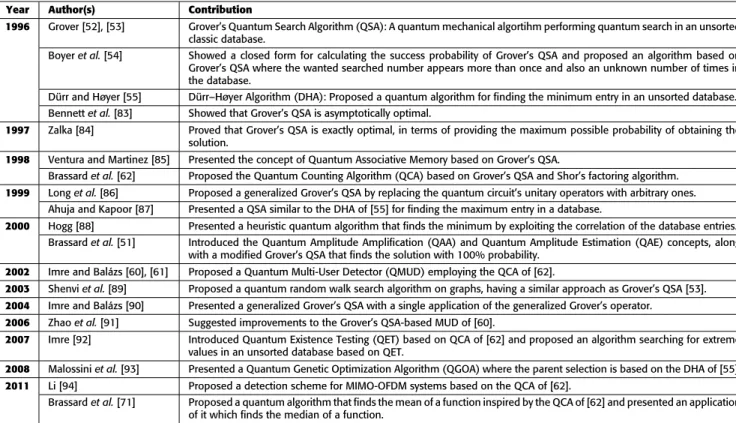
Malossini et al. employed the DHA for creating a Quantum-assisted Genetic Optimization Algorithm (QGOA) [93] that has a performance similar to that of the classic GA, but this is achieved at a lower computational complexity. Briefly, the GAs typically carry out a random-guided search across a large search-space with the goal of finding the desired entry associated with a CF maximum/minimum, while visit-ing only a fraction of the legitimate entries. In 2011, Liet al. proposed a quantum detection scheme for MIMO-OFDM systems by employing Grover’s QSA [94]. Similarly to the QMUD algorithm proposed in [91], a quantum database is created by including evaluations of the CF used for classic detection in MIMO systems for all the possible legitimate inputs. A quantum algorithm based on Grover’s QSA is then employed for finding the minimum of the CF in the resultant quantum database. Brassardet al.proposed in [71] the QMA, which finds the mean of a function with a predefined preci-sion. In the same paper the authors presented an application of the QMA for approximating the median of a function. The major contributions in the field of quantum search along with their applications are summarized gathered in Table 2.
V. FUNDAMENTALS OF QUANTUM COMPUTING
In classic communications the smallest unit of information is the bit, which assumes binary values from the set{0,1}. Its quantum-domain counterpart is the quantum bit orqubit,
TABLE 2. Major contributions to Quantum Search Algorithms (QSA) with their applications.
Year Author(s) Contribution
1996 Grover [52], [53] Grover’s Quantum Search Algorithm (QSA): A quantum mechanical algortihm performing quantum search in an unsorted classic database.
Boyeret al.[54] Showed a closed form for calculating the success probability of Grover’s QSA and proposed an algorithm based on Grover’s QSA where the wanted searched number appears more than once and also an unknown number of times in the database.
Dürr and Høyer [55] Dürr–Høyer Algorithm (DHA): Proposed a quantum algorithm for finding the minimum entry in an unsorted database. Bennettet al.[83] Showed that Grover’s QSA is asymptotically optimal.
1997 Zalka [84] Proved that Grover’s QSA is exactly optimal, in terms of providing the maximum possible probability of obtaining the solution.
1998 Ventura and Martinez [85] Presented the concept of Quantum Associative Memory based on Grover’s QSA.
Brassardet al.[62] Proposed the Quantum Counting Algorithm (QCA) based on Grover’s QSA and Shor’s factoring algorithm.
1999 Longet al.[86] Proposed a generalized Grover’s QSA by replacing the quantum circuit’s unitary operators with arbitrary ones. Ahuja and Kapoor [87] Presented a QSA similar to the DHA of [55] for finding the maximum entry in a database.
2000 Hogg [88] Presented a heuristic quantum algorithm that finds the minimum by exploiting the correlation of the database entries. Brassardet al.[51] Introduced the Quantum Amplitude Amplification (QAA) and Quantum Amplitude Estimation (QAE) concepts, along
with a modified Grover’s QSA that finds the solution with 100% probability.
2002 Imre and Balázs [60], [61] Proposed a Quantum Multi-User Detector (QMUD) employing the QCA of [62].
2003 Shenviet al.[89] Proposed a quantum random walk search algorithm on graphs, having a similar approach as Grover’s QSA [53].
2004 Imre and Balázs [90] Presented a generalized Grover’s QSA with a single application of the generalized Grover’s operator.
2006 Zhaoet al.[91] Suggested improvements to the Grover’s QSA-based MUD of [60].
2007 Imre [92] Introduced Quantum Existence Testing (QET) based on QCA of [62] and proposed an algorithm searching for extreme values in an unsorted database based on QET.
2008 Malossiniet al.[93] Presented a Quantum Genetic Optimization Algorithm (QGOA) where the parent selection is based on the DHA of [55].
2011 Li [94] Proposed a detection scheme for MIMO-OFDM systems based on the QCA of [62].
Brassardet al.[71] Proposed a quantum algorithm that finds the mean of a function inspired by the QCA of [62] and presented an application of it which finds the median of a function.
which is denoted as|qi, where |·iis termed as aket [100]. A unique and rather unusual feature of the qubit is that apart from assuming the classic{0,1}states, it also may assume the superposition of them, as encapsulated in:
|qi =a|0i +b|1i (6) where we have|a|2+ |b|2=1, witha,b∈C. If eithera=0 orb=0, then we have|qi = |1ior|qi = |0i, respectively. If neitheranorbis equal to 0, then the qubit is in a superposition of states, implying that it is in both states at the same time, until this somewhat strange state is perturbed by external interference, such as an attempt to ‘‘measure’’ or observe it. The probability of finding a qubit being in the state |0i
after observing it is|a|2and in state|1iis|b|2. The physical interpretation of a qubit was elegantly illustrated by Brassard in [101] by presenting a scenario where an atom with an electron orbiting on the ground state receives half the needed energy to excite it to a higher energy level orbit. The atom with the two allowed energy levels that the electron can occupy is presented in Fig. 4. Quantum mechanics do not allow the electron to be observed in an intermediate state, even though it is simultaneously in both the excited and ground state.
The non-intuitive phenomenon of quantum mechanics may be better appreciated by imagining a coin spinning within a black box. Until it settles down and someone opens the box to observe it, it is considered as being 50% ‘‘Heads’’ and 50% ‘‘Tails’’, simultaneously. Hence the state of a spinning coin may indeed be deemed to be a superposition of states and its state may be described by
|qi =a|0i +b|1i = √1
2
|0i + √1
2
|1i (7)
where|0i =‘‘Heads’’ and|1i =‘‘Tails’’, while|a|2+ |b|2=
0.5+0.5=1.
When the spinning coin settles down and an observer approaches it, there is an|a|2=0.5 probability of observing the ‘‘Heads’’ side of it and|b|2=0.5 probability of observ-ing its ‘‘Tails’’ side. When an ‘‘observation’’ reminiscent of
FIGURE 4. An atom with one electron orbiting around the nucleus having two legitimate energy levels (solid orbits). Quantum mechanics allow the electron to be in an arbitrary superposition of these two energy levels (dashed orbit), but when it is observed it may only be found in one of the two legitimate orbits.
observing the spinning coin takes place in a quantum system, the observed qubits ‘‘collapse’’ to a classic state according to the so-called Copenhagen interpretation [74], where this classic state is the observed one. In our example, if the coin is observed to be in the|0istate, naturally it will remain in this state, until an operation is applied to it. In a quantum communication system, a qubit’s state is decided to be in a specific classic state upon its observation. According to the No-Cloning Theorem [47], a qubit being in an unknown, unobserved state cannot be copied, which is in contrast to the case of classic bits, which represent known, observed states.
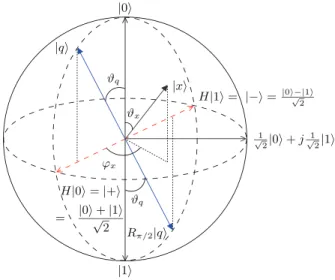
A qubit |xi = ax|0i +bx|1i may also be interpreted as
a vector on a unit sphere, termed as the Bloch sphere [47], where the positive z-axis represents the state|0iand the state
|1i is mapped to the negative z-axis, as depicted in Fig. 5. The relationship between the anglesϑx,ϕx and the quantum
state’s amplitudesax andbx is
ax =cos ϑ x 2 , bx=eiϕxsin ϑ x 2 (8)
where 0 ≤ ϑx ≤ π and 0 ≤ ϕx < 2π. From (8), we may conclude thatax ∈R+0 andbx ∈C. The quantum amplitude axof|0imay always be made real by applying a global phase
rotation to the qubit, without essentially changing its quantum state [47]. A qubit in the quantum state|qi =a|0i +b|1iwith a,b ∈ Rhasϕq =0 andϑq =2 cos−1(a) =2 sin−1(b), as
illustrated in Fig. 5.
A. COMPOSITE QUANTUM SYSTEMS
Naturally, a quantum system may involve several qubits. For instance, a two-qubit state in a superposition of equiprobable
FIGURE 5. Geometrical representation of a qubit
|xi =ax|0i +bx|1i =cos(ϑx/2)|0i +ejϕxsin(ϑx/2)|1iwithax∈R,
bx∈C, 0≤ϑ≤πand 0≤ϕ <2πon the Bloch sphere, along with the computational basis{|0i,|1i}, the sign basis{|+i,|−i}and the Hadamard
Hoperator. The rotationRπ/2operator is applied on a qubit
|qi =a|0i +b|1i =cos(ϑq/2)|0i +ejϕqsin(ϑq/2)|1iwithϕq=0 and hencea,b∈R.
states is described by |qi =a0|00i +a1|01i +a2|10i +a3|11i, 3 X i=0 |ai|2=1 (9)
where again, the square of the coefficients represents the probability of finding the two-qubit register in the corre-sponding state upon its observation.
A 3-qubit quantum system in a superposition of states may be described as |qi = 1 2 √ 2 |000i + 1 2 √ 2 |001i + √ 3 2 √ 2 |100i + √ 3 2 √ 2 |101i (10) where we havea2=a3=a6=a7=0 andP2
3−1
i=0 |ai|2=1.
In practice, a specific scenario where this system may be found in this particular superposition of states is when unitary operators have been applied to the three qubits, which alter their state.
In this example, the second qubit is in the state|0i, since the probability of finding it in|1iis zero. The third qubit can be considered to be in the superposition of equiprobable states, i.e.|q3i = √1
2|0i + 1
√
2|1i, since the probability of observing it in either of the states is the same according to (10). Finally, the first qubit may be considered to be in the state of|q1i =
1 2|0i +
√
3
2 |1i, indicating a probability of 75% to retrieve|0i and 25% to observe|1i. Hence, (10) is derived by
|qi = |q1i|q2i|q3i = 1 2|0i + √ 3 2 |1i |0i 1 √ 2 |0i +√1 2 |1i = 1 2 √ 2 |000i + 1 2 √ 2 |001i +0|010i +0|011i + √ 3 2 √ 2 |100i + √ 3 2 √ 2 |101i +0|110i +0|111i. (11) This system’s state can be equivalently represented in a vec-torial form as |qi = " 1 2 √ 2, 1 2 √ 2,0,0, √ 3 2 √ 2, √ 3 2 √ 2,0,0 #T . (12) For an arbitraryn-qubit register, its state may be denoted as |qi =[a0,a1,a2, . . . ,a2n−2,a2n−1]T, 2n−1 X i=0 a2i =1 (13)
where|a2|2is the probability of observing the system in the state |2i = |010i and|aj|2 is the probability of observing
the system in the state|ji, withj = 0,1, . . . ,2n −1. The formulation in (13) will be used in algebraic manipulations in the following discussions. The states|0iand|1i, that an 1-qubit system can be found in, may be represented in vectorial form as |0i = 1 0 , |1i = 0 1 . (14)
The Hermitian counterpart of (13) is referred to as a bra[100] and it is denoted as
hq| = |qi†=[a∗0a∗1a∗2 . . . a∗2n−2a ∗ 2n−1], 2n−1 X i=0 a∗i 2 =1 (15) where the superscript †denotes the conjugate transpose of
|qi. It may be readily verified that the inner product obeys
hq||qi = hq|qi =1 and the outer product becomes
|qihq| = |a0|2 a0a1∗ · · · a0a∗2n−1 a1a∗0 |a1|2 · · · a1a∗2n−1 ... ... ... ... a2n−1a∗ 0 a2n−1a∗ 1 · · · |a2n−1|2 . (16)
B. EVOLUTION OF QUANTUM SYSTEMS
Unitary operators are employed to evolve a quantum system, altering the amplitude of its superposition of states ai, but
keeping the sum of the probabilities for the system to be observed to one of the superimposed states, to unity. An operator U is a unitary operator if it obeys U−1 = U†, where the superscript †denotes the conjugate transpose or the Hermitian adjoint matrix ofU. Since a quantum system may be described by its quantum state|qi, the application of a unitary operator will transform it into the quantum state|q0i
as in
|q0i =U|qi. (17)
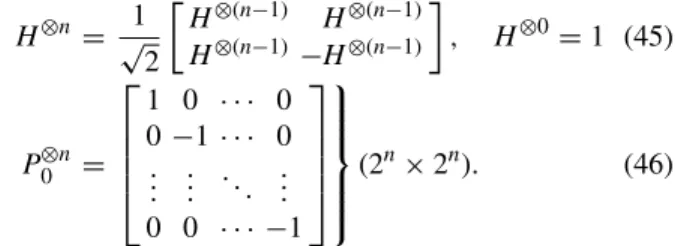
Two unitary operators that will be employed in our QMUD are the Hadamard operatorHand the Rotation oper-ator Rθ [47], with their one-qubit matrix representations being [47]: H = √1 2 1 1 1−1 ,Rθ = cosθ −sinθ sinθ cosθ . (18) Their effect may be interpreted as in Fig. 6, whereRθrotates
|qibyθanti-clockwise on the unit circle, whileHcreates an equiprobable superposition of the computational basis states, as encapsulated in |0i −→H √1 2( |0i + |1i) (19) |1i −→H √1 2( |0i − |1i). (20) The representation of a quantum state portrayed in Fig. 6 is only applicable whenb∈R. Comparing it to the portrayal of the quantum state as a vector on the Bloch sphere, we may conclude that the plane consisting of the computational basis
{|0i,|1i}and the sign basis{|+i,|−i}on the Bloch sphere is mapped to the right half circle of Fig. 6. In the case where a rotation operatorRθ results in the quantum state’s vector lying on the left-hand plane in Fig. 6, the resultant quantum state may be equivalently represented by applying a rotation gate associated with θ = π. The application of a rotation gate with θ = π does not affect a quantum state, since it may be considered as applying a global phase to it, which
FIGURE 6. Geometrical interpretation of a qubit|qi =a|0i +b|1iwith
a,b∈R, on the computational basis{|0i,|1i}and the sign basis
{|+i,|−i}, along with the HadamardHand rotationRπ/2operators.
is unobservable [47]. For example, the unitary rotation gate Rπ/2applied to|qi =a|0i +b|1iin Figs. 5 and 6 results in the stateRπ/2= −b|0i +a|1i, which is equivalent to the state
|q0i = −(b|0i −a|1i)=ejπ(b|0i −a|1i). The quantum states Rπ/2|qiand|q0ion the Bloch sphere of Fig. 5 are represented by the same vector, since the amplitude of|0ihas to be real and non-negative.
In contrast to H and Rθ, the Controlled-NOT (CNOT) operator [47] acts on two qubits jointly forming a Quantum Register (QR)2, with the first qubit|cibeing the control qubit and the second qubit|tithe target one. More specifically, if
|ci = |1i, then the state of|tiis flipped, otherwise it remains intact, as encapsulated in
|ci|ti−−−→ |CNOT ci|c⊕ti. (21) The QD unitary operatorUf does not have a classic
coun-terpart and it is capable of evaluating the functionf with the input qubits simultaneously representing multiple arguments of the function, which is achieved by taking advantage of the superposition of states. More explicitly, it accepts two QRs as inputs, with the first QR|xicontaining the argument, while the second QR is formed by the specific number of bits Z that we desire the function’s evaluation to be approximated in. This second QR is initialized to the all-zero state|0i⊗Z3, as depicted in Fig. 7, where the numeric kets subscripts distinguish the QRs employed. Assumingnqubits in the QR
|xi1 = H|0i⊗n
1 and having initialized it in an equiprobable superposition of states by applying a Hadamard gate, the system’s quantum state before the application ofUf would
be
2A QR is formed by any number of qubits and it exists only to underline the
purpose of a set of qubits. The state of a two-qubit QR may be equivalently represented as|q1i ⊗ |q2i ≡ |q1i|q2i ≡ |q1q2i.
3The Z-element tensor product is defined as: |0i⊗Z = |0i ⊗ |0i ⊗ · · · ⊗ |0i | {z } Z = |0i|0i. . .|0i | {z } Z = |00. . .0i | {z } Z
FIGURE 7. Unitary operatorUfentangling thefevaluations with the corresponding input argument. The subscripts of the kets are used to distinguish the QRs throughout a circuit analysis.
|ψ1i = |xi1|0i⊗Z 2 =H|0i ⊗n 1 |0i ⊗Z 2 = 2n−1 X q=0 1 √ 2n|qi1 |0i⊗Z2 = 2n−1 X q=0 1 √ 2n|qi1|0i ⊗Z 2 (22)
where the integer values in qcorrespond to their respective binary values as for example in |qi = |5i = |101i. The unitary operatorUf will evolve the system into
|ψ2i = Uf 2n−1 X q=0 1 √ 2n|qi1|0i ⊗Z 2 = 2n−1 X q=0 1 √ 2n|qi1|f(q)i2 . (23) TheUf operator creates a strange connection between the two
QRs. If only the first QR shown in Fig. 7 is observed in the QD and|xi1= |0i1is obtained, then the second QR seen in Fig. 7 will be in the|f(0)i2state with 100% probability. Similarly, if we have|f(x)i2= |f(1)i2after an act of QD observation, then we have |xi1 = |1i1 with 100% probability. This peculiar connection is referred to as entanglement, as detailed in [47]. Any classic circuit may be converted to an equivalent circuit in the QD by using the unitary operatorsH,Rθ and CNOT [47]. Additionally, any classic circuit may become reversible in the QD in the sense defined in [47] with the aid of the Toffoli gate, or equivalently by using the Controlled-Controlled-NOT (CCNOT) gate, and auxiliary qubits [47]. Hence, the implementation of Uf will be based on the QD
equivalent of the classic circuit that computesf : {0,1}⊗n→ {0,1}⊗Z. The time required for a single application of Uf
compared to that for a single classic evaluation of f will depend on the technology used for creatingUf. In our analysis
we will assume that these times are equal.
C. MEASUREMENT OF QUANTUM STATES
When stating the terms of ‘‘measurement’’ or ‘‘observation’’, so far we have been referring to measurements with respect to the computational or standard basis{|0i,|1i}. If an 1-qubit quantum system is observed, its state after the measurement would be either |0i or |1i, depending on the observation’s result. However, measurements may be performed in a diverse base. In fact, the number of different bases that a qubit may
be observed in is infinite [47]. A commonly used alternative basis the qubit may be measured in is the Hadamard or sign basis{|+i,|−i}portrayed in Figs. 5 and 6, where we have:
|+i = √1 2 |0i +√1 2 |1i (24) |−i = √1 2 |0i −√1 2 |1i. (25)
The specific reason for using a particular basis depends on the application. For example, if the intention of the observation is to determine which specific part of the Cartesian plane the qubit|qi = a|0i +b|1i lies on, then a measurement on the Hadamard basis would resolve whether we havea·b>0 ora·
b<0, hence again determining the particular part of the plane the qubit exists on. By contrast, if an observation was made on the computational basis for the same purpose, then the resultant state would be mapped to one of the coordinate axes seen in Figs. 5 and 6, hence providing us with no particular clue as to its quadrant.
The representation of a qubit|qion the computational basis is|qi =a|0i +b|1i. In order to convert its representation to the sign basis, we exploit the fact that
|0i = |+i + |−i√
2 (26)
|1i = |+i − |−i√
2 . (27)
Hence, the same qubit may be represented in the sign basis as
|qi = a√+b
2
|+i +a√−b
2
|−i (28)
and the probability of getting the state |+i or |−i after a potential observation on the Hadamard basis is |a+b|2 2 and
|a−b|2
2 , respectively. If the observation’s outcome is|+i, then the state of the system after the observation will be|+i =
1
√
2(|0i + |1i). Similarly, if the observation’s outcome is|−i, then the resultant system’s state will be|−i = √1
2(|0i − |1i).
1) PARTIAL MEASUREMENT OF QUANTUM STATES
As far as a multiple-qubit system is concerned, the mea-surement procedure is similar to the one analysed for a single-qubit system. For example, when considering a 2-qubit system, its general quantum state is presented in (9). As in any quantum system, a potential measurement will only be able to reveal as many bits of information as the number of qubits in the system. In the 2-qubit system considered a measurement of the two qubits would yield the result|00iwith probability
|a00|2, or the state|01iwith probability|a01|2or in general the bit strings ∈ {0,1}2with probability|as|2. The state of
the quantum system after the measurement would be|si. However, it is possible to measure only a subset of the qubits that a quantum system consists of by performing a partial measurement. Let us assume that in our example of a 2-qubit system we intend to observe only the second qubit.
The probabilities of obtaining the second qubit in the state of
|0ior|1iare
Pq(x0)=Pq(00)+Pq(10)= |a00|2+ |a10|2 (29) Pq(x1)=Pq(01)+Pq(11)= |a01|2+ |a11|2. (30) In other words, the probability of obtaining the second qubit in the state of |0i upon its measurement is equal to the probability of observing the full system in the states that have the second qubit equal to|0i.
The main difference of the partial measurement compared to the full measurement of a quantum system lies in the gravity of the perturbation imposed on the system’s original state and the resultant state. Following the same example, let us assume that the result of the second qubit’s observation was
|0i. The new state of the system after the partial measurement will include all the states that are consistent with the measure-ment’s specific outcome. Hence we have
|qnewi =a00,new|00i +a10,new|10i (31) where a00,new and a10,new are the new amplitudes of the legitimate remaining states. The new amplitudes will be the normalized versions of the corresponding amplitudes of the original states before the measurement, resulting in
|qnewi =
a00|00i +a10|10i p
|a00|2+ |a10|2
. (32) Any following measurement of the second qubit in the new quantum state |qnewi will result in the state |0i with 100% probability.
D. ENTANGLEMENT
The new state after the partial measurement may be written as |qnewi = a 00 p |a00|2+ |a10|2 |0i + a10 p |a00|2+ |a10|2 |1i |0i = a00,new|0i +a10,new|1i⊗ |0i. (33) As seen in (33), the resultant quantum system consisting of two qubits may be decomposed in a way, where the composite quantum states are represented by the tensor products of the qubits. Another example is the 3-qubit quantum state pre-sented in (10) which may be decomposed as seen in (11). The information that can be gained by the decomposition of (11) is that the first qubit of the system is in the state 12|0i +
√
3 2 |1i, regardless of the states the rest of the qubits are in. Similar knowledge may be obtained for the second and third qubit. The quantum system is referred to as being ‘‘unentangled’’, if it is able to be decomposed i.e. it is decomposable.
However, this decomposition is not possible for every quantum state. Let us consider for example the quantum state of a 2-qubit system, which is initially in the state|ψ0i = |00i, as seen in Fig. 8. Once the first qubit passes through the Hadamard gate, the system’s state becomes
FIGURE 8. Quantum circuit for generating the entnagled Bell state 1 √ 2 |00i + |11i . |ψ1i =(H|0i1)|0i2 = 1 √ 2 |0i1+√1 2 |1i1 |0i2 = √1 2( |00i + |10i) . (34)
When the two qubits pass through theCNOT gate, the first qubit|ψ1i1 = √1
2(|0i + |1i)acts as the control qubit to the second qubit |ψ1i2 = |0i, which is the target qubit. The transfer matrix of theCNOT gate relying on the first qubit acting as the control qubit and the second qubit as the target qubit may be formulated as
CNOT = 1 0 0 0 0 1 0 0 0 0 0 1 0 0 1 0 . (35) The final state of the system after passing it through the CNOT gate becomes
|ψ2i =CNOT · |ψ1i = 1 0 0 0 0 1 0 0 0 0 0 1 0 0 1 0 · √1 2 1 0 1 0 = √1 2 1 0 0 1T = √1 2( |00i + |11i) . (36) The resultant state |ψ2i = √1
2(|00i + |11i) cannot be decomposed into a state representing the first qubit and a state corresponding to the second qubit. This may be readily shown by attempting to decompose|ψ2iinto separate states. Let us assume that the state of the first qubit is |ψ2i1 =
a10|0i +a11|1iand the state of the second qubit is|ψ2i2 = a20|0i +a21|1i. The resultant composite system of these two qubits would become
|ψ2i1⊗ |ψ2i2=(a10|0i +a11|1i)(a20|0i +a21|1i)
=a10a20|00i +a10a21|01i
+a11a20|10i +a11a21|11i. (37) In order for the state in (37) to be equal to|ψ2i, the ampli-tudes of |00i and |11i should be non-zero. This leads to
a10,a11,a20,a21 6= 0. At the same time, the amplitudes of
|01iand|10ishould be equal to 0, leading to eithera10 =0 ora21=0 and at the same timea11=0 ora20=0. The latter constraints contradict the former one, making it impossible for the quantum state|ψ2ito be decomposed.
A system that is not possible to decompose to separate states corresponding to its constituent qubits is termed as ‘‘entangled’’. When one of the two qubits of the state|ψ2i
is observed, the outcome might be|0iwith a probability of 1/2 or|1iwith a probability of 1/2. If the outcome is 0, then a potential measurement of the second qubit will yield 0 with a probability of 1. Symmetrically, if the outcome of the first qubit’s observation is 1, then a measurement of the second qubit will surely result in 1. It seems that a connection exists between these two qubits, relating them to each other, regard-less of their spatial distance. This non-intuitive relationship between two entangled qubits was referred to by Einstein as a ‘‘spooky action in a distance’’ [102].
In fact, the state|ψ2iis one of the four Bell basis states, named after John S. Bell [47], which are constituted by the following four entangled states
|8+i = √1 2( |00i + |11i) (38) |8−i = √1 2( |00i − |11i) (39) |9+i = √1 2( |01i + |10i) (40) |9−i = √1 2( |01i − |10i). (41) As for any other orthonormal basis defined overC4, a 2-qubit
system may be measured on the Bell basis. None of the states of the Bell basis can be decomposed to the separate states constituted by each qubit.
VI. QUANTUM SEARCH ALGORITHMS
For the case of providing further in-depth intuition we will proceed by investigating Grover’s QSA [53], the BBHT QSA [54] and the DHA [55] in the context of a simple DS-CDMA scenario supporting K = 2 users employing the BPSK modulation scheme associated withM =2 states. The channel coefficients are assumed to be perfectly estimated and Gold spreading codes [5] are used which have a spreading factor of SF = 31 chips. The CF evaluations in (4) would bef : {0,1,2,3} → [0,1] and the size of the search space is N = MK = 4, since we have four possible two-bit combinations at the BS’s receiver. Let us assume that the CF outputs are
[f(0), f(1), f(2), f(3)]=[0.24, 0.16, 0.38, 0.27] (42) which represent the probabilityP(y|x) of receiving the signal y in (1), given that the 4-level two-user signalx was trans-mitted. Due to the nature of the CF in (4), the smaller the Euclidean distance of a legitimate noise-free 4-level symbol