Besides general features, the role ofmetastable statesof plasma atoms and ions, which are often observed in most of plasmas and play a key role in plasma formation, is considered. Thenon-lineareffects observed for heavy particle collisions, such as thedensity effectandmultiple-electronionization, are also considered. In addition, the isotope effects are briefly discussed related with electron capture in collisions of alpha particles with hydrogen and its isotopes (D and T).
c
2010 The Japan Society of Plasma Science and Nuclear Fusion Research
Keywords: ionization, multiple ionization, electron capture, cross section, metastable state, density effect, hydrogen isotope
DOI: 10.1585/pfr.5.S2012
1. Introduction
Charge-changing processes including electron cap-ture, ionization, three-body recombination, dielectronic re-combination, arising in collisions between probe-beam and plasma particles, as well as between plasma particles them-selves, play a key role in many aspects of plasma physics (see, e.g., [1–5]). In the present work, the main attention is paid to electron capture,
Xq++A→X(q−1)++A+, (1) target ionization
Xq++A→Xq++A++e−, (2a) and projectile ionization
Xq++A→X(q+1)++ ΣA+e−, (2b) processes for collisions of Xq+ions with neutral atoms A
whereqdenotes an ion charge. To calculate effective cross sections, several atomic codes are used: ARSENY [6], CDW [7] and CAPTURE [8] for electron capture, and AR-SENY, DEPOSIT [9], ATOM [1] and LOSS [10] for ion-ization. A brief description of the codes is given in [11]. The atomic units (a.u.) are used,me = e = =1 where
meandedenote the electron mass and charge, respectively,
andthe Planck constant.
2. General Features
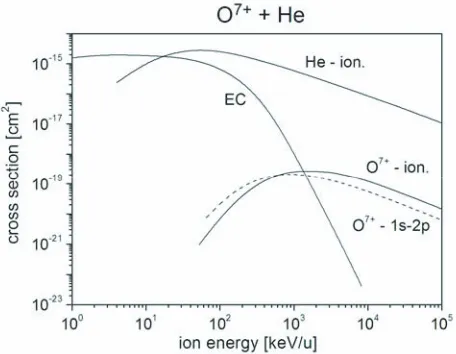
A typical behavior of the charge-changing cross sec-tions as a function of the ion energy E is shown in Fig. 1
author’s e-mail: [email protected]
Fig. 1 Calculated ionization and capture cross sections in O7++ He collisions: EC – total electron-capture cross section, He-ion. - ionization of He by O7+, O7+-ion. - ionization of O7+by He, and O7+-1s-2p (dashed curve) - excitation of transition 1s-2p in O7+by He impact.
for O7++He collisions. Capture and ionization cross
sec-tions are denoted as EC and O7+-ion, respectively. As is
seen from the figure, electron capture is important at E <1 MeV/u meanwhile ionization of O7+atE >1 MeV/u.
At ion energies between 500 keV/u and 3 MeV/u, the cross sections of both processes are important. For comparison, cross sections for ionization of He by O7+and excitation
cross section (transition 1s-2p) of O7+ions by He atoms are
also shown. Different behavior of the electron-captureσec
and ionizationσion cross sections as a function of the ion
velocity is due to their different dependencies on atomic c
Fig. 2 Calculated ionization sections of He+ions by He-plasma particles: electrons (e), He atoms (He) and its ions (He+, He2+) as a function of He+ energy; EC denotes electron-capture cross section in He+ + He(1s2) colli-sions. Electron-impact ionization cross section (e) is given in the equivalent energy units showing its thresh-old behavior.
parameters: σec ∼
Z5q5
v11n3, NTvσec ∼ NTZ
5q5/(v10n3),
(3)
σion ∼
Z2n2
q2v2 lnv, NTvσion ∼ NTZ 2
n2/(vq2), (4) wherevdenotes the relative velocity,Zthe effective charge of the target,NTthe target density,nthe principal quantum
number of the active electron and<vσ> the rate coeffi -cient, i.e., the productvσaveraged over a Maxwellian ve-locity distribution of plasma particles. Formulae (3) and (4) are given for relatively high collision velocities.
Interaction cross sections of He+ions with He-plasma particles are shown in Fig. 2. The largest ionization cross section of He+ions is for collisions withα-particles (He2+)
due to theZ2 dependence (Z =2 in this case). Cross
sec-tions for collisions with He and He+are nearly of the same size. For comparison, electron-capture (EC) cross section in He+ + He(1s2) collisions is also shown in the figure;
this symmetric EC is a dominant charge-changing process at energyE<50 keV/u.
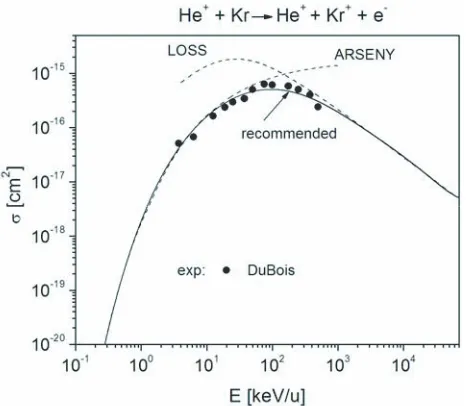
Usually various methods of cross-section calculations are applied either at low or high collision energies. In the intermediate energy range, which is often of a high inter-est, only a few methods exist which can be used for very limited atomic systems like quasi-molecular treatment for one electron in the field of two Coulomb centers (see, e.g., [12]). In such cases, one can apply a well-known formula which uses the known cross-section values at low and high energies and averages them at intermediate energy range:
1 σrec
= 1
σlow
+ 1
σhigh
, (5)
Fig. 3 One-electron ionization cross sections of Kr atoms in col-lisions with He+ions: experiment - solid circles [14], the-ory - ARSENY code (low energy), LOSS code (high en-ergy), solid curve - recommended cross section, eq. (5).
whereσlow andσhighdenote the cross sections calculated
at low and high energies, respectively. In Fig. 3, a typi-cal example of such procedure is shown for single-electron ionization of Kr atoms by He+ions. At low and high ener-gies two computer codes are applied, ARSENY and LOSS, respectively, which, however, are not valid at intermediate energiesE = 20 keV/u-300 keV/u. The solid curve rep-resents results of application of eq. (5) which gives quite good agreement with experimental data [13] and can be recommended for the whole energy range considered.
3. Special Features
In this section, some special features of atomic pro-cesses involving heavy particles are described such as role of excited (metastable) states of atoms or ions in a plasma or in a probe beam, the density effect, i.e., influence of collision frequency in a high-density plasma, and multi-electron ionization processes. These features can be impor-tant for interpretation of experimental results and plasma modeling.
3.1
Role of excited metastable states
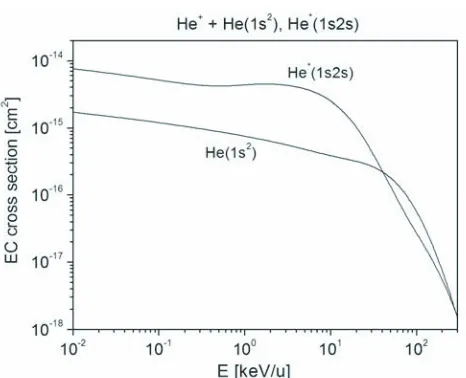
The presence of atoms or ions in the excited and, es-pecially, in metastable (long-lived) states in a plasma or a probe beam can change dramatically the interaction cross sections and corresponding rate coefficients. As an exam-ple, Figure 4 displays electron-capture cross sections for collisions of He+(1s) ions with the ground-state He(1s2)
and metastable helium atoms He∗(1s2s). In the latter case, one has to take into account electron capture from two shells, 1s and 2s, meanwhile in collisions with He(1s2)
Fig. 4 Calculated electron-capture cross sections in collisions of He+(1s) ions with He atoms in the ground (1s2) and ex-cited metastable (1s2s) states. In the case of the ground-state He target, the calculated data practically coincide with experimental data [13].
states. In the case of the ground-state He target, the calcu-lated data practically coincide with experimental data [13]; for He∗(1s2s) target, experimental data are absent. AtE <50 keV/u, electron-capture cross section for He∗(1s2s) target is about 4 times larger than that for He(1s2) target
because of a larger contribution from capture into excited states, (2s-2s) and, therefore, even a small amount of he-lium atoms in the metastable state can strongly change this charge-changing channel.
Similar comparison of ionization cross sections for the ground-state and excited metastable He atoms by He+ ions (Fig. 5) also shows an importance of the presence of metastable atoms in a plasma. It is interesting to note that the difference (by 30-40 %) between two ground and metastable state atoms at high energies is due to the con-tribution of 2s electron which has a low ionization energy resulting in a high ionization efficiency.
3.2
Density e
ff
ect
In general, the charge-changing cross sections also de-pend on the plasma densityN: withNincreasing, the elec-tron capture cross sectionsσec decrease, meanwhile
ion-ization cross sectionsσion increase and, as a result, the
mean charge<q>= ΣiqiFi of an ion beam after passing
through a plasma increases whereFiis the beam
equilib-rium charge-state fraction with the chargeqi. This effect is
called thetarget-densityorgas-solideffect which depends on the atomic structure of colliding particles, relative col-lision velocity and the plasma density (see, e.g., [15]). In some cases the effect is very large: it decreasesσecvalues
up to more than one order of magnitude and increasesσion
values up to a factor of 2.
For electron-capture (1), the cross section is given by a sum over all possiblen-states
Fig. 5 Calculated ionization cross sections of He(1s2, 1s2s) atoms in collisions with He+ions as a function of He+ energy. In the case of the ground state He, the calculated data practically coincide with experimental data given in [13].
σec =
ncut
n=n0
σec(n), (6)
where σec(n) denotes the partial cross section for the
electron capturing into n quantum state to form excited X(q−1)+∗(n) ion, n
0 the ground-state number and ncut the
maximum quantum number for which X(q−1)+∗(n) ions are
not ionized through a series of the successive collisions with plasma particles. For low-density plasmas,ncut1,
the usual formulae for electron capture and ionization cross sections can be used. However, for high density plas-mas,ncutis strongly reduced and can be even closer to the
ground-state valuen0.
The excited ion X(q−1)+∗(n) can be ionized by the
tar-get particles via two channels: by direct ionization or by step-by-step excitation to a certain level also followed by ionization. Correspondingly, two formulae can be applied for estimation of the maximum principal quantum number ncut[15, 16]:
ndcut ≈q
1018
Z2N T[cm−3]
1/7
v2
10q2
1/14
(7) and
nscut≈q
5·1016
Z2N T[cm−3]
1/9
25v2
q6
1/18
. (8)
Certainly,ns<nd, and bothnsandndvalues give the lower
and upper limits of the maximum quantum number con-tributing to electron capture, respectively.
Similar consideration leads to the formula for ioniza-tion cross secioniza-tion depending on the plasma density (see [15] in detail).
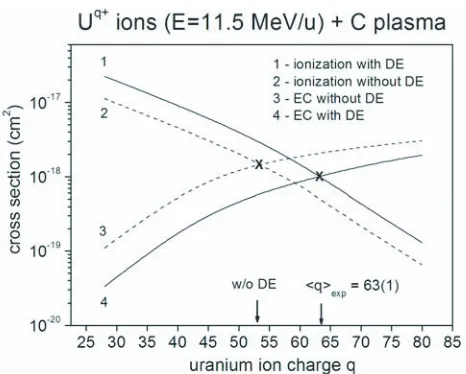
Fig. 6 Ionization and electron-capture cross sections of 11.5 MeV/u Uq+ ions passing through a carbon plasma
with the temperature T = 3.5 eV and density N =
5×1019cm−3as a function of uranium ion charge: solid curves - calculated with the density effect (DE), eq. (7), and dashed curves - without DE,ncut=∞. Crosses show the positions of the mean charge of uranium ions:<q>=
53 for calculations without DE and<q>=62 with DE accounted for. Experimental value is<q>=63±1 [17].
a carbon plasma with a temperature of T = 3.5 eV and density 5×1019cm−3. Theoretically the mean charge of
an ion bean<q>is found from equality between electron capture and loss cross sections at a certain chargeq. From Fig. 6 it is seen that the inclusion of the density effect leads to increasing of ionization cross sections by a factor of 2, meanwhile decreasing of capture cross sections by a factor of 4 and, thus, increasing of the mean charge of uranium ions from 53 to 62 units which is in good agreement with experimental value<q>=63±1 [17]. Generally, when the mean (equilibrium) charge is established, the ioniza-tion and electron capture cross secioniza-tions are expected to be nearly equal as is seen in Fig. 6 with arrows and crosses.
3.3
Multi-electron ionization of heavy ions
If heavy, many-electron ions are involved into plasma atomic collision processes, e.g., as impurity ions or in a probe beam (including heavy negative ions), multi-electron ionization (MI) of both the incident and target particles can be significant even at low-energy regime (see, e.g., exper-imental works [14], [18]). For example, single-, double-and triple-electron ionization cross sections of U+ions col-liding with Ar atoms at energy E =1.3 keV/u (v=0.23 a.u.) are 3.2, 1.3 and 0.35×10⁻¹⁶cm2 [18], respectively,
indicating that more than a half of the total cross section originates from MI.
Figure 7 represents calculated total ionization cross sections of W+ ion, which at present is one of the most interesting subjects for plasma impurity, by electrons, pro-tons, H and He atoms. It is seen that at low energies,
ion-Fig. 7 Calculated total (a sum of single-, double-, triple- etc. ionization cross sections) ionization cross sections of W+ ions by electrons (e), protons (p), H and He atoms as a function of W+ energy. Experiment: solid circles -from [19]. Theory: e - electron-impact ionization cross section, ATOM code; p - proton impact, LOSS code, H and He - ionization by H and He atoms, respectively, DEPOSIT and LOSS codes. Electron-impact ionization cross sections are shown as a function of equivalent elec-tron energy for comparison.
Fig. 8 Calculated electron detachment cross section of negative Ge−ions by Ar atoms as a function of Ge−ion energy, DEPOSIT code; solid circles - experiment [20]. Note that 1 a.u. of velocity corresponds to energy of 25 keV/u.
ization by H and He prevails and the corresponding cross sections are extremely large. Influence of electron and pro-ton components is important at rather high energies. At low energies, the main contribution to ionization is due to close collisions and the cross-section value is defined by overlapping volume of electron densities of two colliding particles. At high velocities, ionization cross section de-pends mainly on the Coulomb field created by target nu-cleus and electrons.
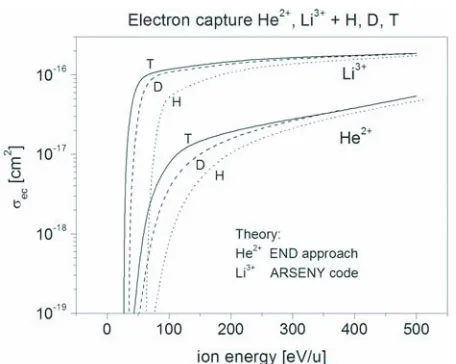
Fig. 9 Calculated electron-capture cross sections for collisions of He2+and Li3+with H, D and T. He2+projectile: the END approach [21]; Li3+projectile: preliminary calcula-tions by ARSENY code, present work (see text).
sections of heavy negative ions, which are also relatively large, are required for analysis and interpretation of the beam-attenuation experiments in plasma probing [23].
4. Isotope E
ff
ects
For controlling and modeling the D-T plasma, it is highly desirable to know the cross sections and rates for collisions of alpha particles with D and T atoms. Calcu-lations of the quasi-resonant electron-capture cross sec-tions σec for He2+ ions colliding with H, D and T
tar-gets at ion energiesE =30-1000 eV/u [21] showed that the use of different hydrogen isotopes leads to the large difference in the cross-section values, particularly at low energies. These data were obtained on the basis of the electron-nuclear-dynamics approach (END) by solving the time-dependent Schr¨odinger equation. The largest dif-ference was found between hydrogen and tritium tar-gets at around 30-50 eV/u where the cross-section ratio is σec(T)/σec(H)∼1000 (Fig. 9). The difference found was
explained by isotope effects in the rotational coupling of the quasi-molecule during collision.
In order to compare this influence of isotopic effects for heavier projectile, in the present work the electron-capture cross sections for Li3++H, D and T were
calcu-lated using the ARSENY code (Fig. 9). The code is based on the adiabatic approximation for one-electron transitions in the two-Coulomb-centre system by determining the hid-den crossings of the quasi-molecular energy terms. From Fig. 9 it is clearly seen that the isotope effects for Li3++H,
D, T collisions are also very prominent.
5. Rate Coe
ffi
cients
Rate coefficients, or simply, rates of various atomic processes occurring in laboratory and astrophysical
plas-tionF(v,vP,T) depending onvPand given by
vσ= ∞
0
vσ(v)F(v,vP,T)dv (9)
with
F(v,vP,T)=
M 2πT
1/2 v
vP
exp
−M
2T(v−vP)
2
−exp
−M
2T(v+vP)
2 .
(10) Herevdenotes the velocity of an incident particle beam rel-ative to plasma particles, and M the reduced mass of collid-ing particles. This ‘new’ Maxwellian distribution function F(v,vP,T) is normalized to unity:
∞
0
F(v,vP,T)dv=1. (11)
Formula (10) was obtained in [2] and considered further in [23].
At low projectile velocityvP→0, theF(v,vP,T)
func-tion, eq. (10), turns into a usual Maxwellian distribution function and at low plasma temperature, 2T/M → 0, one has:
F(v,vP,T)=δ(v−vP), (12)
and
vσ(v) ≈vσ(v). (13) Equation (13) is commonly used in plasma physics for es-timating rate coefficients when the projectile velocity is much higher than the thermal plasma velocityvT, i.e.,vP
vT(see, e.g., [24]) where the thermal velocityvT
corre-sponds to the maximum of a Maxwellian distribution func-tion:
vT≈1.13
2T/M. (14)
In eq. (13),vis the relative velocity given as v≈
v2
P+v 2
T. (15)
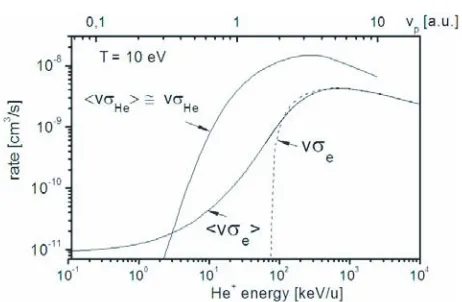
Fig. 10 Calculated rate coefficients for electron-impact (labeled by e) and He-impact ionization of He+ ions passing through He plasma with a temperatureT =10 eV as a function of He+energy: solid curves - exact formulae for
<vσ>, eqs. (9)-(10); dashed curve - approximate formula,
vσ, eq. (13). The corresponding helium-ion velocityvPis displayed in the upper scale. In the case of He impact, the rates obtained with the exact and approximate formu-lae practically coincide.
should be used.
Figure 10 shows the rates for ionization of He+ions by He atoms (labeled by He) and electrons (e) when He+ ions with velocityvPpenetrate He plasma with a
temper-atureT =10 eV. In the case of He target, the thermal ve-locity vT(He) ≈0.01 a.u.,vP vT in the whole range of
vP and ionization rates calculated by eqs. (9) or (13) give
practically the same results,<vσHe>≈vσHe.
In the case of ionization by electron impact, the sit-uation is different because the electron-impact ionization cross sectionσeof He+has a sharp threshold on electron
energy atEth=I(He+)≈54.4 eV corresponding to
thresh-old velocityvth ≈2 a.u. From eq. (13) it follows that at
projectile velocitiesvP<2 a.u. one hasσe=0 and,
there-fore, the rate given by the productvσe=0. But due to the
exponential tail of the distribution function (10), the av-eraged rate<vσe>is not zero even forvP < 2 a.u. This
difference is seen in Fig. 10 by comparing two curves for ionization rates induced by electron impact: for projectile velocitiesvP<2 a.u. there is a big difference between rates
given by approximate, eq. (13) and by exact, eqs. (9) and (10) formulae. In general, eqs. (9) and (10) give the exact expression of the rate coefficients for an arbitrary projectile velocity and plasma temperatures.
6. Conclusion
Charge-changing atomic processes in plasmas are considered in terms of effective cross sections and rate coefficients with a Maxwellian velocity distribution func-tion. Some general features have been demonstrated for the cross sections (dependencies on velocity, ion charge and target charge) as well as specific properties (role of metastable states, multi-electron ionization, density effect)
which are illustrated by computer calculations performed using available computer codes. It is also pointed out that the isotope effects are expected to be large in electron-capture cross sections among hydrogen isotope targets (H, D and T) at very low collision energiesE<200 eV/u.
Special attention is paid to the case when an ion beam penetrates a plasma with a certain temperature and it was shown that one has to use the exact general formula for the rate<vσ>averaged with a ‘new’ Maxwellian function depending on the beam velocityvP. In calculating the
ef-fective cross sections at low collision energies, one has to take into account the isotope effects, i.e., dependence on the reduced mass of colliding particles.
Acknowledgments
This work is partially supported by the NIFS/NINS project of Foundation Network for Scientific Collabora-tion.
[1] L.A. Vainshtein and V.P. Shevelko,Atomic Physics for Hot plasmas(IOP, Bristol, 1985).
[2] R.K. Janev, W.D. Langer, K. Evans and Jr., D.E. Post, El-ementary Processes in Hydrogen-Helium Plasmas: Cross Sections and Reaction Rate Coefficients(Springer, Berlin, 1987).
[3] Y. Itikawa,Molecular Processes in Plasmas: Collisions of Charged Particles with Molecules(Springer, Berlin, 2007). [4] I.Yu. Tolstikhina, P.R. Goncharov, T. Ozakiet al.,Electric Charge State Changing Collisions of Hydrogen and He-lium with Low-Z Impurity Particles, Report NIFS-DATA-102 (NIFS, Toki, Japan, 2008).
[5] H.-J. Kunze, Introduction to Plasma Spectroscopy
(Springer, Berlin, October 2009).
[6] E.A. Solov’ev, Sov. Phys. - Uspekhi32, 228 (1989). [7] Dˇz. Belkic, R. Gayet and A. Salin, Comput. Phys.
Com-mun.23, 153 (1981);ibid.32, 385 (1984).
[8] V.P. Shevelko, O. Rosmej, H. Tawara and I.Yu. Tolstikhina, J. Phys. B37, 201 (2004).
[9] V.P. Shevelko, M.S. Litsarev and H. Tawara, J. Phys. B41, 115304 (2008) ; V.P. Shevelko, D. Kato, M.S. Litsarev and H. Tawara, J. Phys. B43, 215202 (2010).
[10] V.P. Shevelko, I.Yu. Toltikhina and Th. St¨ohlker, Nucl. In-strum. Meth. B184, 295 (2001).
[11] V.P. Shevelko, D. Kato, M.-Y. Songet al., Nucl. Instrum. Meth. B267, 3395 (2009).
[12] E.A. Solov’ev, Sov. Phys. - Uspekhi32, 228 (1989). [13] R. Ito, T. Tabata, T. Shirai and R.A. Phaneuf, Report
JAERI-M-117 (Japan, 1993).
[14] R.D. DuBois, Phys. Rev. A39, 4440 (1989).
[15] V.P. Shevelko, H. Tawara, O.V. Ivanovet al., J. Phys. B38, 2675 (2005).
[16] I.Yu. Tolstikhina and V.P. Shevelko, 22nd SPIG, AIP Conf. Proc. Vol.740(2004) pp.59-66.
[17] H. Wahl, M. Giessel, A.A. Golubevet al., Short. Commun. Phys.8, 28 (Lebedev Institute, Moscow 2001).
[18] H.H. Lo and W.L. Fite, At. Data1, 305 (1970).
[19] H. Tawara and M. Kato, NIFS-DATA-51 (NIFS, Japan, 1999).
[20] H. Luna, F. Zappa, M.H.P. Martineset al., Phys. Rev. A63, 052716 (2001).