22
COMPUTER AIDED SYSTEM FOR BRAIN
ABNORMALITIES SEGMENTATION
Shafaf Ibrahim, Noor Elaiza Abdul Khalid, Mazani Manaf
Faculty of Computer and Mathematical Sciences Universiti Teknologi MARA, Shah Alam, Selangor, Malaysia.
Tel: +6019-2692717, Fax: +604-5941023, E-mail: [email protected]
Abstract.
Detection of abnormalities in brain tissue area in different medical images is inspired by the necessity of high accuracy when dealing with human life. A Variety of diseases occur in brain tissue area such as brain tumour, stroke, infarction, haemorrhage and others. At the present time, the current method that is used for diagnosing those diseases is using a well known digital imaging technique which is Magnetic Resonance Imaging (MRI), though the brain diseases are still difficult to diagnose due to certain circumstances. Thus, Computer Aided System (CAS) is significantly useful due to the fact that it could enhance the results of humans in such domain. It is also important that the false negative cases must be kept at a very low rate. This paper proposes a development of a CAD that implement image processing techniques for segmenting any kind of abnormalities that occur in human brain tissue area. The system is able to determine the patterns and characteristics for each part of particular brain tissue in order to identify any brain abnormalities. The behind idea is that the local textures in the images can reveal the characteristic of abnormalities of the biological structures. Therefore, the system is expected to detect threats in patients and planning for early treatment strategies in the future.Keywords-Computer Aided System (CAS; Image processing; Medical imaging; MRI
1.
Introduction
The rapid development of imaging techniques such as X-ray, Computed Tomography (CT) scan, Ultrasound and Magnetic Resonance Imaging (MRI) has enabled the investigations of domains that are far out of reach of the naked eyes. These techniques make it possible to explain the structures of organs and cells, enable the observation of the way they function, permit abnormalities or dysfunction detection as well as assisting in the pathology diagnosis (Way et al., 2006).
One of the most complex, less accessible and prone to complex abnormalities human organs, the brain is the primary beneficiary of these medical imaging techniques (Pitiot et al., 2007). Its complexity is expressed at variety of scales. Therefore, a deeper understanding of the brain anatomical structures could play a crucial role in the search for more efficient brain lesions and diseases detection such as brain tumour, infarction, haemorrhage, stroke and others.
Segmentation is an important step in many applications, being also important in those that deal with medical images. When a brain MRI image is segmented to detect abnormalities, it is
Computer Aided System for Brain Abnormalities Vol. 1, Issue 1, 2010 Segmentation
__________________ ISSN 2231-7473
23
essential for the segmentation to produce accurate results since it relates with a human life. Presently, various imaging modalities techniques have incarnated as a tool for the doctors and radiologists to help them in diagnosis. While these are most accurate and fast, they still require a competent radiologist for the proper interpretation. Thus, computer aided system are significantly useful due the fact that it could enhance the results of humans in such domain (Balafar et al., 2010; Pietka et al., 2010).
At the moment, brain diseases are detected by imaging only after the appearance of neurological or nervous system symptoms. Schmidt and Levner (2005) stated that no early brain diseases detection strategies can diagnoses individuals that are known to be at risk for particular types of brain disease just from their genetic makeup.
Zizzari et al. (2001) in his work found that a medical doctor usually detects the size of a tumour which also called gross tumour volume (GTV) and designs its borderlines manually on the medical images. However, this procedure affects the consequent planning target volume of irradiation, whether if it is decided by the same medical doctor or by an automatic supporting system. Manual segmentation process require at least three hours to complete (Mancas et al., 2005) and the traditional methods for measuring abnormalities volume are not reliable and error sensitive (Dong-Yong et al., 1993; Zhu & Chen, 2009). Moreover, high speed computing machines capable to observe the volume and the location of the abnormalities visually (Masroor & Dzulkifli, 2008). Nishimura et al. (2000) claimed that the brain diseases are not easily detected by radiologist and neurologist even though the patient had gone through the imaging process. This is caused by the similar texture of brain abnormalities which leads to the difficulties during the differential diagnosis. Consequently, the radiologist and neurologist used an invasive method to overcome this problem. It is done by injecting some kind of contrast medium such as gadolinium into the patient’s body in detecting the brain abnormalities (Singh & Daftary, 2008).
In consequence, the involvements of information technology in development of various applications have completely changed the world. The noticeable reasons for the introduction of computer systems are reliability, accuracy, simplicity and ease of use (Balafar et al., 2010; Masroor & Dzulkifli, 2008). Moreover, it has become almost compulsory to use computers to assist radiological experts in clinical diagnosis and treatment planning due to the increasing use of imaging for diagnosis, treatment planning and clinical studies (Sharma & Aggarwal, 2010; Dubey et al., 2010). In past several years, computer aided system has widely applied for many range of application such as brain tumour (Logeswaran, 2010; Masroor & Dzulkifli, 2008), lung cancer (Sammouda et al., 2005) and breast cancer (Phukpattaranont, 2009; Way et al., 2006; Xian-Fen et al., 2010).
24
2.Methods
Good understanding of the appropriate research approaches for producing good findings on which to build new and relevant knowledge are vital in particular research activities. To make these activities manageable, research framework is used. A research framework defines the categories of outputs that research can produce. It also defines a set of different research activities, and what kind of research activities can be used to produce specific outputs. Figure 2.1 gives a brief overview of the phases involved in the proposed research framework.
Figure 2.1: ProposedResearch Framework
25
collection which consists of the image acquisition task. The output for this phase is the MRI brain images, which will be the input for the next phase which is Data analysis.
Data analysis is then performed where the feature extraction of texture characteristic of the brain components will be defined by identifying the minimum, maximum and mean of grey level values. This task produced a preliminary result of reference table which will be used as a point of reference for the segmentation purpose in the next phase.
The forth phase is Algorithm design and system construction. The segmentation of brain abnormalities segmentation is done in this phase. The steps involve brain slices selection, detection of brain cortical region, removal of brain cortical region and finally are Particle Swarm Optimization (PSO) segmentation. Consequently, any presence of abnormalities region will be detected and segmented by the segmentation process which will produce a segmented brain tissue abnormalities.
The final phase is Result analysis. This phase is very important since it is used to analysed and evaluate findings being obtained. It is also used to quantify the accuracy for each of the processing outcomes which make this research more reliable.
2.1
Phase 1: Preliminary Study
Preliminary study is referring to a process of gathering information on the brain images that will be collected known as knowledge acquisition. In making this study more reliable, there are specific patient’s criteria that need to be fulfilled. The criteria involve inclusion and exclusion which are:
a) Inclusion Criteria
For inclusion criteria, adult male and female patients with the ranging age from 20 to 60 years old are acquired. It covers normal and abnormal brain images.
I. Normal brain images
a. All patients’ brain must be in normal condition and free from any diseases
that may affect the brain tissue area such as brain tumour, infarction, haemorrhage, bleeding or others.
II. Abnormal brain images
a. All patients’ brain images must be in abnormal condition which affects the brain tissue area.
b) Exclusion Criteria
The exclusion criteria for this study are the MRI brain images of the male and female patients with the age below 20 years old and above 60 years old. This is because of the brain structure for the patients within these ages are found to be inconsistent and inappropriate in turn to produce a proper result in the future.
2.2
Phase 2: Data Collection
26
2.3
Phase 3: Data Analysis
Texture is regarded as one of the most important features when classifying images. There are numerous variations among natural textures including the brain. MRI brain images that will be obtained need to be analysed using several texture extraction techniques. It is used to determine the image pattern and characteristics for each part in brain tissue area. This process is known as prior knowledge since the findings obtained will be used as an input in the classification process afterwards.
The area of region of interest from the MRI brain images are extracted for distinguishing the patterns and characteristics of each part in brain tissue area. A region of interest or frequently abbreviated as “ROI” refers to a selected subset of samples within a dataset identified for a particular purpose. There are several ROI categories of brain component that need to be analyzed for each MRI brain image which are:
1. Ventricles 2. Membrane
3. Light Abnormality 4. Dark Abnormality
Figure 2.2 shows the area of ROI categories in the brain that represents all the three regions as mentioned above:
Figure 2.2: Proposed Areas ofBrain ROI
2.4
Phase 4: Algorithm Design and System Construction
Ventricles Membrane27
Segmentation of medical images holds an important position in the area of image processing. It is used to extract information from complex medical images and it has wide application in medical field.
The main objective of image segmentation in this study is to partition an image into specific regions such that each region of interest is spatially contiguous and the pixels within the region are homogeneous with respect to the predefined function.
A system model is a working model that demonstrates interaction between processing and input/output blocks. It is essential in troubleshooting any potential problems in the design process. It also allows the developers to quickly test the parts of the designs that are most likely to have problems, solve those problems, and build the complete design. The proposed system model for the brain tissue abnormalities segmentation consists of three stages as illustrated in Figure 2.3.
28
As depicted in Fig. 3, four main stages of the proposed brain abnormalities segmentation algorithm are brain slice selection, detection of brain cortical, removal of brain cortical region and segmentation of brain abnormalities.
a) Stage 0: Brain slice selection
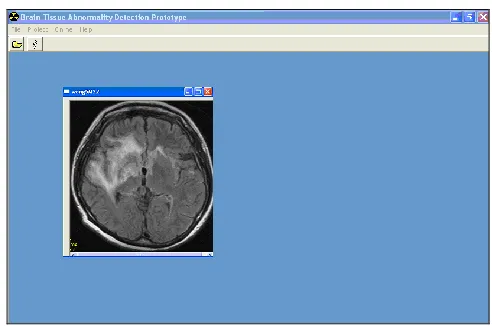
A pre-processing stage in image acquisition works is used to select the brain slices that contain abnormalities. Slices that are free from abnormalities are not processed further. Figure 2.4 illustrates the process of brain slice selection where the selected brain images that displays existence of abnormalities is load into the system.
Figure 2.4 : Brain Slice Selection
b) Stage 1: Detection of brain cortical region
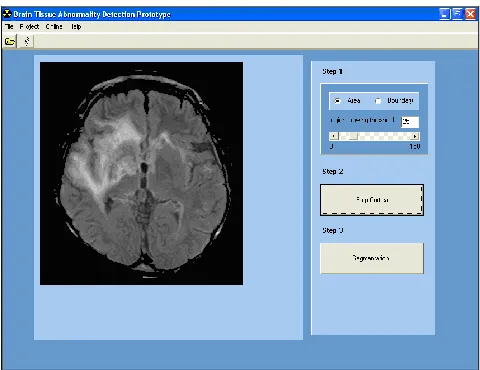
Detects the region of brain cortical using Region growing technique. The MRI brain image contains the skull tissues. These tissues are known as brain cortical and it is defined as non-brain elements. Thus, they should be removed since presence of this component might lead to misclassification and ultimately affect the brain tissue abnormalities segmentation outcome. As depicted in Figure 2.5, the brain cortical region is marked as red elliptical ring.
29
c) Stage 2: Removal of brain cortical region
Removes brain cortical region detected by Stage 1 previously. Regions found to be brain cortical are removed. The outer brain cortical should be removed in order to avoid the chances of misclassification. By removing this object, we will get rid of non-brain tissues and the only areas remain are soft tissues or called as membrane as shown in Figure 2.6. This process is also known as ‘skull stripping’.
Figure 2.6: Cortical Removal
d) Stage 3: Segmentation of abnormalities
This stage implements Particle Swarm Optimization (PSO) technique for abnormalities segmentation respectively. It completes the abnormalities segmentation by segmenting the region of abnormalities detected.
30
Table 2.1: PSO ParametersParameters Description
Particle candidate solution to a problem
Velocity rate of position change
Fitness the best solution achieved
pbest best value obtained in previous particle
gbest best value obtained so far by any particle in the population
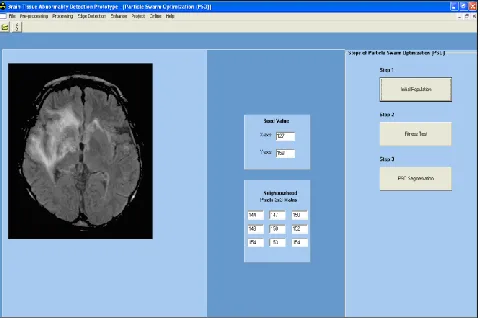
The proposed PSO consist of four main steps that is the initial generation swarm of particles, the fitness function, the position and velocity update and finally the termination criterion. The pictorial representation of the proposed PSO interface design is illustrated in Figure 2.7.
Figure 2.7: PSO Interface Design
i) Generation of Particles
31
Figure 2.8: Initial Populationii) Fitness Examination
Each particle’s fitness are then examined with the fitness function based on the minimum, maximum and mean grey level pixel value of the ventricles, membrane, light abnormality and dark abnormality, as contained in the reference table produced in phase three which is Data analysis. A particular particle is considered as fit (lbest) if and only if it matches all these three values. Otherwise, the particle will be automatically ignored and removed. As displayed in Figure 2.9, the blue-crossed symbols represent the (lbest) particles for light abnormalities, while the red-crossed symbols signify the dark abnormalities.
Figure 2.9: Fitness Examination
iii) Position and Velocity Update
32
Figure 2.10: Proposed Principle of Updating VelocityThe maximum velocity is limited to the whole region of each MRI brain images. It is chosen for facilitating global exploration of particle’s position since too low maximum velocity region might leads the difficulties of particles in exploring the optimal regions.
iv) Termination Criterion Determination
The proposed technique termination criterion processes of fitness examination, velocity and position update are performed iteratively until the termination criterion is met. Therefore, theprocess will stop and return the result when there are no unprocessed lbest particles in the maximum velocity regions. Otherwise, the process will continue to start the fitness examination, velocity and position update processes for the next particles. Figure 2.11 depicted the final segmentation result for the particular MRI brain image where the blue segmented regions signified the light abnormalities, though the red segmented regions reflect the dark abnormalities. Further samples of PSO segmentation results are tabulated in Table 2.2.
Figure 2.11: PSO Segmentation
Table 2.2 : Samples of PSO Segmentation
33
2.5 Phase 5: Result AnalysisThe final phase of the proposed research framework for this study is Result Analysis. This process is vital since it is used to quantify the accuracy of the abnormalities segmentation and classification produced in the study.
34
Table 2.3: Background ImagesBackground Intensity Min Max No of pixel
Low 30 114 12144
Medium 39 145 12144
High 56 202 12144
Testing images of light and dark abnormalities of different shaped ROI are cut and pasted onto the background as shown in Table 2.4. This is used to test out the performance and accuracy of the PSO segmentation.
Table 2.4: Testing Images
Background
High Medium Low
Abnormality
Light
Dark
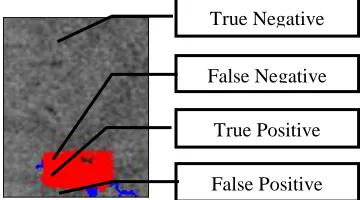
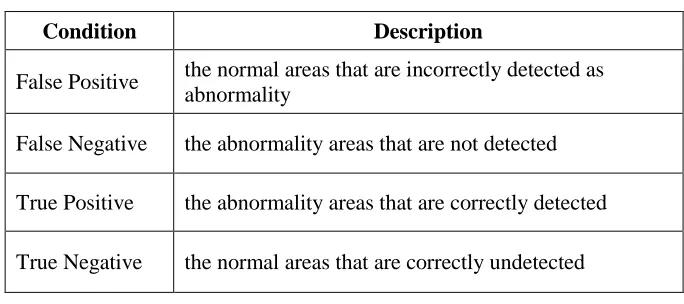
Four conditions areas of false positive, false negative, true positive and true negative are illustrates in Figure 2.12.
Figure 2.12: Sample of Testing Image of Dark Abnormality within Medium Background Grey Level Value after Segmentation
The four primary conditions are used for quantifying the qualities of segmentation are explained in Table 2.5.
True Negative
False Positive False Negative
35
Table 2.5: Conditions of AccuracyCondition Description
False Positive the normal areas that are incorrectly detected as abnormality
False Negative the abnormality areas that are not detected
True Positive the abnormality areas that are correctly detected
True Negative the normal areas that are correctly undetected
3.
Results and Discussions
The numbers of pixels of the raw MRI brain images are compared with the PSO segmented abnormality area. The PSO segmentation accuracy results are then measured by considering the percentage value of false positive, false negative, true positive and true negative as illustrated in Table 3.1. Then, every percentage value is evaluated by relating the results to any certain circumstances.
Table 3.1: Experiments of PSO
Abnormalit y
B/Groun d
Testing Image
PSO Segmentatio
n
Light
High
Medium
Low
Dark
High
Medium
36
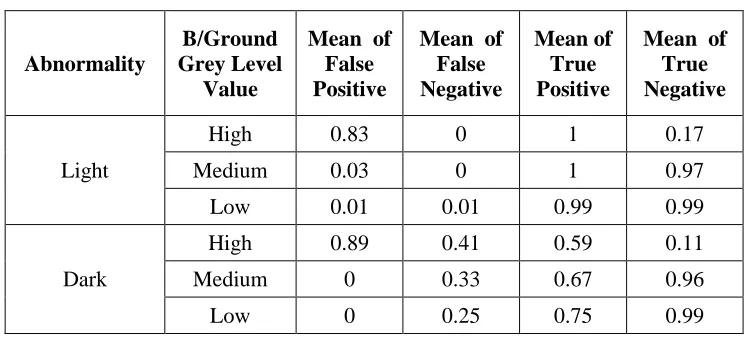
Table 3.2 tabulates the summary of Receiver Operating Characteristic (ROC) analysis for PSO segmentation results which includes four primary conditions which are mean of false positive, false negative, true positive and true negative. These statistical values are used to quantify the PSO segmentation quality and the level of accuracy for dark and light abnormality in three different types of background which are high, medium and low background grey level value.
Table 3.2: Summary of ROC Analysis for PSO
Abnormality
B/Ground Grey Level
Value
Mean of False Positive
Mean of False Negative
Mean of True Positive
Mean of True Negative
Light
High 0.83 0 1 0.17
Medium 0.03 0 1 0.97
Low 0.01 0.01 0.99 0.99
Dark
High 0.89 0.41 0.59 0.11
Medium 0 0.33 0.67 0.96
Low 0 0.25 0.75 0.99
As seen from the Table 3.2, PSO shows the most excellent segmentation result in low background grey level value for light abnormality. The statistics show that the combination of light abnormality within the low background grey level value produced the highest mean percentages for both true positive and true negative which are the most important condition in producing good quality of segmentation. This proved that the PSO segmentation results showed some potential as the mean percentage of false positive and false negative are kept at a very low rate too. The combination of light abnormality within the medium background grey level value also cannot be underestimated since it produced high mean percentages for both true positive and true negative. However, small occurrence of mean percentage of false positive is observed. The combination of light abnormality within the high background grey level value is seen to produce poor performance as it appears the highest mean percentage of false positive compared to the medium and low background grey level value. This is found to be caused by the texture similarity for both light abnormality and high background grey level value that leads the neighboring pixels to grow beyond the abnormality areas.
37
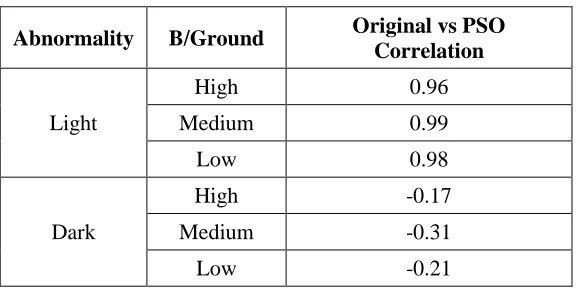
The Pearson correlation value between the original abnormalities area vs PSO segmentation pixels value are measured as represented in Table 3.3.
Table 3.3: Correlation of PSO Segmentation
Abnormality B/Ground Original vs PSO Correlation
Light
High 0.96
Medium 0.99
Low 0.98
Dark
High -0.17
Medium -0.31
Low -0.21
From the table above, it clearly noticed that PSO correlation values are almost excellent in light abnormalities segmentation. However, the correlation values of the dark abnormalities show negative values regardless of background.
4.
Conclusion
This paper has presented the development of computer aided system for brain tissue abnormalities segmentation. The experimental results found that the system produced promising segmentation outcomes and produces potential solutions to the current difficulties in detecting and segmenting the brain tissue abnormalities.
Acknowledgments
Million thanks to Hospital Kuala Lumpur (HKL) that had given full cooperation during the collection of MRI brain images. Thanks to the Board Director of HKL, Dr. Hjh Zaleha bt Abdul Manaf who acts as the Head of Radiology (Diagnostic Imaging) Department, and also to all the Diagnostic Imaging staffs.
References
Balafar M. A., Ramli A. R., Mashohor S., 2010. Edge-preserving Clustering Algorithms and Their Application for MRI Image Segmentation, Proceedings of the MultiConference of Engineers and Computer Scientists 2010, Volume 1, IMECS 2010, Hong Kong.
Dong-yong D., Condon B., Hadley D., Rampling R., Teasdale G., 1993. Intracranial deformation caused by brain tumors: assessment of 3-D surface by Magnetic Resonance Imaging, IEEE Transactions on Medical Imaging, Volume 12, Issue 4, 1993, 693 - 702.
38
Kennedy J., Eberhart R., 1995. Particle Swarm Optimization, Proceedings of IEEE International Conference on Neural Networks, 1942-1948.Logeswaran R., 2010. Computer Aided Medical Image Analysis for Intra-Operative Low-Field MRI in Neurosurgery, Unpublished article. Universiti Multimedia Malaysia.
Mancas M., Gosselin B., Macq B., 2005. Segmentation Using a Region-Growing Thresholding, Proceedings of Image Processing, Algorithms and Systems IV, Volume 5672, 388-398.
Masroor M. A., Dzulkifli M., 2008. Segmentation of Brain MR Images for Tumour Extraction by Combining Kmeans Clustering and Perona-Malik Anisotropic Diffusion Model, International Journal of Image Processing, Volume 2, Issue 1.
Nishimura A., Sawada S., Ushiyama I., Tanegashima A., Nakagawa T., Ikemoto K., 2000. Postmortem diagnosis of brain disorders, Anil Aggrawal's Internet Journal of Forensic Medicine and Toxicology, Vol. 1, No. 2, July-Dec 2000.
Phukpattaranont P., Limsiroratana S., Boonyaphiphat P., 2009. Computer-Aided System for Microscopic Images: Application to Breast Cancer Nuclei Counting, International Journal of Applied Biomedical Engineering, Vol.2, No.1.
Pietka E., Kawa J., Badura P., Spinczyk D., 2010. Open architecture computer-aided diagnosis system, The Journal of Knowledge Engineering, Volume 27, Issue 1, 17-39.
Pitiot A., Totman J., Gowland P., 2007. Null Point Imaging: A Joint Acquisition/Analysis Paradigm for MR Classification, Medical Image Computing and Computer-Assisted Intervention – MICCAI 2007, ISBN: 978-3-540-75756-6, 759-766.
Sammouda R., Hassan J. A., Sammouda M., Al-Zuhairy A., ElAbbas H., 2005. Computer Aided Diagnosis System for Early Detection of Lung Cancer Using Chest Computer Tomography Images, GVIP 05 Conference, December 2005, CICC, Cairo, Egypt.
Schmidt M., Levner I., Greiner R., Segmenting brain tumors using alignment-based features,2005.Proceedings of Machine Learning and Applications, Fourth International Conference.
Sharma N., Aggarwal L. M., 2010. Automated medical image segmentation techniques, Journal of Medical Physics, Vol. 35, Issue 1, 3-14.
Singh J., Daftary A., 2008. Iodinated Contrast Media and Their Adverse Reactions*, Journal of Nuclear Medicine Technology, Volume 36, Number 2, 69-74, ©2008 by Society of Nuclear Medicine, Teleradiology Solutions, Bangalore, India.
Way T. W., Lubomir M. H., Berkman S., Heang-Ping C., Philip N. C., Ella A. K., Naama B., Chuan Z., 2006. Computer-aided diagnosis of pulmonary nodules on CT scans: Segmentation and classification using 3D active contours, Journal of Medical Physics, Vol. 33, Issue 7, 2323–2337.
Xian-Fen D., Xin-Yu Z., Tian-Fu W., Si-Ping C., Ying Y., Ling Z., 2010. Highly Sensitive Computer Aided Diagnosis System for Breast Tumor Based on Color Doppler Flow Images, Journal of Medical Systems.
Zhu H., Chen H., 2009. A Quantitative Evaluation of Image Segmentation Quality, ASPRS 2009 Annual Conference, Maryland, March 8-13.
39
Assoc. Prof Dr Mazani Manaf is a lecturer in University Technology MARA, Shah Alam, Malaysia. He holds respected position at Faculty of Computer Science and Mathematics as Deputy Dean (Student & Alumni), with various professional and community activities and program assessor. Hisresearch interest covers Image Processing, Pattern Recognition & Machine Intelligent and Mobile & Distributed Computing.Dr Noor Elaiza Abdul Khalid is a lecturer in University Technology MARA, Shah Alam, Malaysia. She holds a PhD in Computer Science (2010) from University Technology MARA, a Master in Computer Science (1992) from University of Wales and a Bachelor’s Degree of Computer Science (1995) from University Science Malaysia. Her research interests are Swarm Intelligence, Evolutionary Computing algorithms, Fuzzy techniques and Medical Imaging. Shafaf Ibrahim is a second semester student of PhD in Science in University Technology MARA, Shah Alam, Malaysia. She holds a Master in Computer Science (2009) and a Bachelor’s Degree of Computer Science (2007), all from University Technology MARA. Her research interest covers Image Processing, Medical Imaging, Computer Vision, Artificial Intelligence and Swarm Intelligence.