Coordinative Unsaturation versus Oxophilicity:
ansa
Dimethylsilyl
Oxo-Bridged Uranium Metallocenes. Synthesis, Structures, and
Unexpected Catalytic Activity with Alkynes and Silanes
Jiaxi Wang,
†,‡Ylia Gurevich,
†Mark Botoshansky,
†and Moris S. Eisen*
,†Schulich Faculty of Chemistry and Institute of Catalysis Science and Technology, Technion-Israel Institute of Technology, Haifa, 32000, Israel, and Institute of Polymer Science and Engineering, Hebei
UniVersity of Technology, Tianjin, 300130, People’s Republic of China
ReceiVed May 9, 2008
The tetrachloride salt of uranium reacts with 1 equiv of the lithium ligand Li2[(C5Me4)2SiMe2] in
DME to form the complex [η5
-(C5Me4)2SiMe2]UCl2·2LiCl·2DME (1), which undergoes a rapid hydrolysis
either in DME with equimolar amounts of water to give the coordinatively unsaturated bridged monooxide and monochloride uranium lithium salt complex { [η5-(C5Me4)2SiMe2]UCl}2(µ-O)(µ-Cl)·Li(DME)3·DME
(2) or in toluene to yield the dimeric bridged monochloride monooxide lithium salt complex [{[η5
-(C5Me4)2SiMe2]UCl}2(µ-O)(µ-Cl)·Li·1/2DME]2(3). Alkylation of either complex2or3with BuLi in
DME gives the monobridged dibutyl complex {[η5-(C5Me4)2SiMe2]UBu}2(µ-O) (4). Complex 2 was
characterized by solid state X-ray analysis. Complex 4 was found to be an active catalyst for the disproportionation metathesis of TMSCtCH and the cross-metathesis of TMSCtCH or TMSCtCTMS
with various terminal alkynes. To shed some light on the possible mechanistic scenario, different alkynes, TMSCtCH, TMSCtCTMS, or TMSCtCPri, were reacted in the presence of complex4with PhSiH3,
producing a myriad of products in addition to the unexpected TMSH and SiH4(caution), indicating the
cleavage of the trimethylsilyl group from the alkyne and the formation of a uranium-silyl intermediate. Complex4was also found to be an active catalyst for the phenyl cleavage metathesis of PhSiH3to form
Ph2SiH2and Ph3SiH. In C6D6solutions, the C-D activation of the aromatic ring takes place, forming
C6D5SiH3. Plausible mechanisms for all the catalytic processes are presented.
Introduction
During the last two decades, the chemistry of electrophilic d0/fn actinide compounds has been the source of intense
investigations and reached a high level of sophistication.1The
broad interest of these compounds originates from their unique structure-reactivity relationships and their remarkable perfor-mances in homogeneous catalysis.2It has been well established
that the stability and reactivity of almost all the organometallic complexes of the d- and especially of the f-elements are exceedingly sensitive to the ancillary ligands that are bonded
to the metal center.1-4 The usefulness of the
pentamethylcy-clopentadienyl ligation in affording simple actinide complexes with advantageous solubility, thermal stability, and resistance to ligand redistribution has been recognized in the last two decades.1,3However, in order to open the actinide coordination
sphere while preserving the frontier orbital of these advantageous ligands, the actinide coordination chemistry of the bridged ligation Me2Si(C5Me4H)2has been explored.4 Organometallic
complexes of the f-elements are known to be especially sensitive to moisture, and the decomposition products are generally assumed to be oxo-bridged derivatives. These compounds are normally difficult to prepare owing to the difficult control of * Corresponding author. E-mail: [email protected].
†Technion-Israel Institute of Technology.
‡Hebei University of Technology.
(1) (a) Barnea, E.; Eisen, M. S.Coord. Chem. ReV.2006,250, 855. (b) Barnea, E.; Andrea, T.; Berthet, J.-C.; Ephritikhine, M.; Eisen, M. S. In Recent AdVances in Actinide Science; Alvarez, R.; Bryan, N. D.; May, I.; Eds.; RSC Publishing: Manchester, UK, 2006; pp 163-167. (c) Barnea, E.; Moradove, D.; Berthet, J.-C.; Ephritikhine, M.; Eisen, M. S. InRecent AdVances in Actinide Science; Alvarez, R.; Bryan, N. D.; May, I.; Eds.; RSC Publishing: Manchester, UK, 2006; pp 234-236. (d) Burns, C. J.; Eisen. M. S. InThe Chemistry of the Actinide and Transactinide Elements, 3rd ed.; Morss, L. R.; Edelstein, N.; Fuger, J.; Eds.; Springer: Berlin, 2006; pp 2799-2910. (e) Burns, C. J.; Eisen, M. S. InThe Chemistry of the Actinide and Transactinide Elements, 3rd ed.; Morss, L. R.; Edelstein, N.; Fuger, J.; Eds.; Springer: Berlin, 2006; pp 2911-3012. (f) Andrea, T.; Eisen, M. S.Chem. Soc. ReV.2008,37, 550. (g) Sharma, M.; Eisen, M. S.Struct. Bonding (Berlin)2008,127, 1–85. (h) Lam, O. P.; Feng, P. L.; Heinemann, F. W.; O’Connor, J. M.; Meyer, K.J. Am. Chem. Soc.2008,130, 2806, and references therein. (i) Evans, W. J.; Kozimor, S. A.; Ziller, J. W.Scienec 2005,309, 1835. (j) Hayton, T. W.; Boncella, J. M.; Scott, B. L.; Palmer, P. D.; Batista, E. R.; Hay, P. J.Science2005,310, 1941. (k) Summerscales, O. T.; Cloke, F. G. N.; Hitchcock, P. B.; Green, J. C.; Hazari, N.Science 2006,311, 829.
(2) (a) Bruno, J. W.; Smith, G. M.; Marks, T. J.J. Am. Chem. Soc. 1986,108, 40. (b) Smith, G. M.; Carpenter, J. D.; Marks, T. J.J. Am. Chem. Soc.1986,108, 6805. (c) Lin, Z.; Marks, T. J.J. Am. Chem. Soc.1990, 112, 5515. (d) Gillespie, R. D.; Burwell, R. L., Jr.; Marks, T. J.Langmuir 1990,6, 1465. (e) Chen, Y. X.; Metz, M. V.; Li, L.; Stern, C. L.; Marks, T. J.J. Am. Chem. Soc.1998,120, 6287. (f) Jia, L.; Yang, X.; Stern, C. L.; Marks, T. J.Organometallics1997,16, 842. (g) Wang, J. X.; Dash, A. K.; Berthet, J. C.; Ephritikhine, M.; Eisen, M. S.J. Organomet. Chem.2000, 610, 49. (h) Andrea, T.; Barnea, E.; Eisen, M. S.J. Am. Chem. Soc.2008, 130, 2454.
(3) Mark, T. J.; Streitwiser, A., Jr. In The Chemistry of the Actinide Element, 2nd ed.; Katz, J. J., Seaborg, G. T., Morss, L. R., Eds.; Chapmen and Hall: London, 1986; Chapter 22.
(4) (a) Fendrick, C. M.; Mintz, E. A.; Schertz, L. D.; Mark, T. J.; Day, V. W.Organometallics1984,3, 819. (b) Jeske, G.; Schock, L. E.; Swepston, P. N.; Schumann, H.; Marks, T. J.J. Am. Chem. Soc.1985,107, 8103. (c) Fendrick, C. M.; Schertz, L. D.; Day, V. W.; Marks, T. J.Organometallics 1988,7, 1828. (d) Schnabel, R. C.; Scott, B. L.; Smith, W. H.; Burns, C. J. J. Organomet. Chem.1999,591, 14. (e) Dash, A. K.; Gourevich, I.; Wang, J. Q.; Wang, J.; Kapon, M.; Eisen, M. S.Organometallics2001,20, 5084.
the partial hydrolysis for a given precursor.5 Rarely those
complexes are just formed from their recrystallization in the presence of useful trace amounts of water.5While bridging
oxide uranium(IV) complexes are still relatively rare,6it would
be very interesting to know their structural and, if possible, their catalytic properties for these bridged f-complexes due to their expected highly open coordination sphere. It has been pointed out that molecular compounds with a M-O-M skeleton (M) metal) may serve as a model for oxide-supported heterogeneous organometallic catalysts or metal-oxide-containing catalysts.7
The presence of metal-oxide bonds usually reduces the sensitivity of these complexes toward oxygen and moisture. For neutral organoactinides, catalyzed reactions were first limited to C-H activation and hydrogenation. Hence, for example, the hydrogenation performed with alkoxylated organoactinide com-plexes has been found to have much lower reactivity as compared to the corresponding hydride complexes.8
During the last decade we have considered new catalytic reactions using organoactinides. Hydroamination,9
oligomer-ization,10selective dimerizations,11hydrosilylation of alkynes,12 coupling of isonitriles with alkynes,13 and the unexpected
polymerization of lactones14comprise part of these processes. Interestingly, the oxygen-bridged dibutyl uranium complex has
been found to be an active catalyst for the disproportionation metathesis of TMSCtCH and the cross-metathesis of TMSCtCH
or TMSCtCTMS with various terminal alkynes.15
In this contribution we present the synthesis and X-ray diffraction studies for an oxide-bridged uranium complex,2, and the catalytic activity of the corresponding oxide-bridged dibutyl uranium complex, 4, obtained from either complex2
or 3 upon its reaction with butyllithium. Unique metathesis reactions of this active complex with internal and terminal silylalkynes with PhSiH3 produce a myriad of products in
addition to TMSH, SiH4, Ph2SiH2, and Ph3SiH. The reaction
of complex4with PhSiH3is also presented in different solvents,
and a C-D activation is observed in C6D6. Plausible
mecha-nisms for the formation of the different compounds are proposed.
Results and Discussion
Synthesis of Oxo-Bridged Uranium Complexes 2 and 3.
The reaction of UCl4with the lithium salt Me2Si(C5Me4)2Li2
in DME yields the organouranium chloride complex1(eq 1), which was isolated as an air- and moisture-sensitive orange powder. The complex was prepared following the protocol published for the synthesis of a similar dark red uranium complex containing diethyl ether, thf, or TMEDA instead of DME.4dInterestingly, the spectroscopic analysis of both (DME
and diethyl ether) complexes was found to be almost identical.
The oxo-bridged organouranium complex 2 and the oxo-bridged organouranium complex3were obtained from planned reactions of complex1in either DME or toluene, in the presence of stoichiometric amounts of water, respectively. When sto-ichiometric amounts are used, no free ancillary ligand is observed in solution; however, if larger amounts of water are used, the free ligand is detached from the metal center and mixtures of compounds are obtained. The1H NMR spectrum
of complex2is peculiar, consisting of two fully discrete sets of isotropically shifted, narrow resonances for C5Me4and Me2Si
(a total of 10 different methyl signals). Furthermore, the13C
NMR of complex2shows, unexpectedly, only one signal for each methyl for the four C5Me4 moieties and one signal for
both methyl groups in the two Me2Si groups. This result is an
outcome of the paramagnetic shift effect of the uranium, having two f-electrons that influence the ligand hydrogens strongly as compared to their corresponding carbons.16For complex3the 1H and13C NMR are extremely broad presumably due to the
(5) (a) Lukens, W. W.; Beshouri, S. M.; Blosch, L. L.; Andersen, R. A. J. Am. Chem. Soc.1996,118, 901. (b) Zalkin, A.; Beshouri, S. M.Acta Crystallogr., Sect. C: Cryst. Struct. Commun.1988,C44, 1826. (c) Brianese, N.; Casellato, U.; Ossola, F.; Porchia, M.; Rossetto, G.; Zanella, P.; Graziani, R.J. Organomet. Chem.1989,365, 223. (d) Berthet, J. C.; Ephritikhine, M.; Lance, M.; Nierlich, M.; Vigner, J.J. Organomet. Chem.1993,460, 47. (e) Evans, W. J.; Seibel, C. A.; Forrestal, K. J.; Ziller, J. W.J. Coord. Chem. 1999,48, 403. (f) Spirlet, M. R.; Rebizant, J.; Apostolidis, C.; Dornberger, E.; Kanellakopulos, B.; Powietzka, B.Polyhedron1996,15, 1503.
(6) (a) Rebizant, J.; Spirlet, M. R.; Apostolidis, C.; Kanellakopulos, B. Acta Crystallogr., Sect. C: Cryst. Struct. Commun.1992,C48, 452. (b) Berthet, J. C.; Le Marechal, J. F.; Nierlich, M.; Lance, M.; Vigner, J.; Ephritikhine, M.J. Organomet. Chem.1991,408, 335. (c) Cramer, R. E.; Bruck, M. A.; Gilje, J. W.Organometallics1988,7, 1465. (d) Herrmann, W. A.; Anwander, R.; Kleine, M.; Oefele, K.; Riede, J.; Scherer, W.Chem. Ber.1992,125, 2391. (e) Berg, D. J.; Burns, C. J.; Andersen, R. A.; Zalkin, A.Organometallics1989,8, 1865. (f) Schumann, H.; Palamidis, E.; Loebel, J.J. Organomet. Chem.1990,384, C49. (g) Beeckman, W.; Goffart, J.; Rebizant, J.; Spirlet, M. R.J. Organomet. Chem.1986,307, 23–7.
(7) (a) Evans, W. J.; Grate, J. W.; Bloom, I.; Hunter, W. E.; Atwood, J. L.J. Am. Chem. Soc.1985,107, 405, and references therein. (b) Eisen, M. S.; Marks, T. J.J. Am. Chem. Soc.1992,114, 10358. (c) Eisen, M. S.; Marks, T. J.Organometallics1992,11, 3939. (d) Eisen, M. S.; Marks, T. J.J. Mol. Catal.1994,86, 23.
(8) Lin, Z.; Marks, T. J.J. Am. Chem. Soc.1987,109, 7979. (9) (a) Haskel, A.; Straub, T.; Eisen, M. S.Organometallics1996,15, 3773. (b) Straub, T.; Frank, W.; Reiss, G. J.; Eisen, M. S.J. Chem. Soc., Dalton Trans.1996, 2541. (c) Eisen, M. S.; Straub, T.; Haskel, A.J. Alloys Compd.1988,271-273, 116. (d) Straub, T.; Haskel, A.; Neyroud, T. G.; Kapon, M.; Botoshansky, M.; Eisen, M. S.Organometallics2001,20, 5017. (e) Stubbert, B. D.; Marks, T. J.J. Am. Chem. Soc.2007,129, 4253. (f) Stubbert, B. D.; Stern, C. L.; Marks, T. J.Organometallics2003,22, 4836. (10) (a) Straub, T.; Haskel, A.; Eisen, M. S.J. Am. Chem. Soc.1995, 117, 6364. (b) Haskel, A.; Straub, T.; Dash, A. K.; Eisen, M. S.J. Am. Chem. Soc.1999,121, 3014. (c) Wang, J.; Dash, A. K.; Kapon, M.; Berthet, J. C.; Ephritikhine, M.; Eisen, M. S.Chem.-Eur. J.2002,8, 5384. (d) Wang, J. Q.; Dash, A. K.; Berthet, J. C.; Ephritikhine, M.; Eisen, M. S. Organometallics1999,18, 2407. (e) Dash, A. K.; Wang, J. Q.; Berthet, J. C.; Ephritikhine, M.; Eisen, M. S.J. Organomet. Chem.2000,604, 83. (11) Haskel, A.; Wang, J. Q.; Straub, T.; Gueta-Neyroud, T.; Eisen, M. S. J. Am. Chem. Soc.1999,121, 3025.
(12) (a) Dash, A. K.; Wang, J. Q.; Eisen, M. S.Organometallics1999, 18, 4724. (b) Eisen, M. S. InThe Chemistry of Organosilicon Compounds; Appeloig, Y., Rappoport, Z., Eds.; John Wiley: Chichester,Vol. 2,Part 3, 1998; p 2038. (c) Eisen, M. S.ReV. Inorg. Chem.1997,17, 25. (d) Wang, J.; Gurevich, Y.; Botoshansky, M.; Eisen, M. S.J. Am. Chem. Soc.2006, 128, 9350.
(13) (a) Barnea, E.; Andrea, T.; Kapon, M.; Berthet, J. C.; Ephritikhine, M.; Eisen, M. S.J. Am. Chem. Soc.2004,126, 10860. (b) Barnea, E.; Andrea, T.; Berthet, J.-C.; Ephritikhine, M.; Eisen, M. S.Organometallics (in press).
(14) Barnea, E.; Moradove, D.; Berthet, J. C.; Ephritikhine, M.; Eisen, M. S.Organometallics2006,25, 320.
(15) Wang, J.; Gurevich, Y.; Botoshansky, M.; Eisen, M. S.J. Am. Chem. Soc.2006,128, 9350.
combination of the strong paramagnetic shifts obtained by the four different uranium (f2) metal centers.15,16
Molecular Structure Characterization for {[η5-(C 5Me4)2 -SiMe2]UCl}2(µ-O)(µ-Cl)· Li(DME)3·DME (2) and [{[η5 -(C5Me4)2SiMe2]UCl}2(µ-O)(µ-Cl)Li·O(CH3)CH2]2(3). The
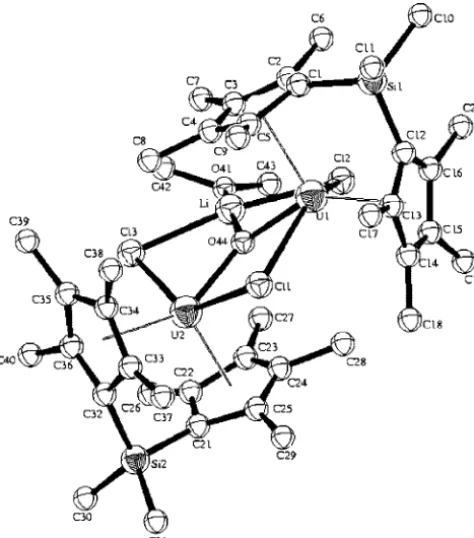
molecular structure of complex2has been confirmed by X-ray single-crystal diffraction studies. The ORTEP plot of the complex is shown in Figure 1, and crystallographic data with structure refinement details and selected bond lengths and angles are listed in Tables 1 and 2, respectively.
In complex 2, the two uranium atoms are bridged by an oxygen atom and a chlorine atom, forming an almost planar
U1O1U2C11 four-membered ring, which is slightly puckered
through the vector O-Cl with a maximum deviation of 0.0126 Å from the ideal plane. In addition, each metal is also bound to one additional chlorine atom. The terminal U-Cl distances of U1-Cl2(2.692(3) Å) and U2-Cl3(2.680(3) Å) are comparable
to typical U-Cl distance (e.g., 2.687(4) Å in LiU2Cl5(CH2
-(C5H4)2)2·2THF,172.681(1) Å in [(C5Me5)2UCl]2O6d). The bond
lengths for the bridged uranium-chloride U1-Cl1(2.838(3) Å)
and U2-Cl1 (2.866(3) Å) are much larger compared to the
[image:3.598.50.548.55.299.2](17) Secaur, C. A.; Day, V. W.; Ernst, R. D.; Kennelly, W. J.; Marks, T. J.J. Am. Chem. Soc.1976,98, 3713.
Figure 1.ORTEP plot of the molecular structure of complex {[η5-(C
5Me4)2SiMe2]UCl}2(µ-O)(µ-Cl)·Li(DME)3·DME (2). The ORTEP
plot of the octahedral Li(DME)3moiety corresponding to complex2was omitted from the figure for clarity, and [{[η5-(C5Me4)2SiMe2]UCl}2(µ
-O)(µ-Cl)Li·O(CH3)CH2]2(3) was drawn at the 50% probability level (methyls at Cp rings are omitted for clarity). In addition, all hydrogen
atoms and DME crystal inclusion molecules were also omitted for clarity.
Table 1. Crystal Data Collection for Complexes 2 and 3
2 3
empirical formula C56H100Cl3LiO9Si2U2 C42H65Cl3LiO2Si2U2
space group C2/c P 21/c
temperature (K) 220(2) 230(1)
unit cell dimensa(Å) 34.896(4) 15.052(3)
b(Å) 9.6010(11) 10.636(2)
c(Å) 39.433(4) 28.982(6)
R(deg) 90 90
β(deg) 103.359(7) 97.33(3)
γ(deg) 90 90
V(Å)3 12854(3) 4601.9(16)
Z 8 4
density(calcd) (mg/m3) 1.615 1.801 absorp coeff (mm-1) 5.244 7.288
F(000) 6192 2396
cryst size (mm) 0.22×0.17×0.04 0.15×0.08×0.08 θrange for data collection (deg) 2.12 to 25.00 1.42 to 25.00
index ranges 0ehe41,-11eke11,-46ele45 -17ehe17,-12eke12,-34ele23 no. of reflns collected 28 640 22 823
no. of indep reflns 11 222 (Rint)0.0590) 7888 (Rint)0.1020)
refinement method full-matrix least-squares onF2 full-matrix least-squares onF2 no. of data/restaints/params 11 222/0/634 7888/0/472
goodness of fit onF2 0.819 0.944
[image:3.598.49.548.362.611.2]terminal U-Cl bond lengths, although comparable to bridging chlorides in other uranium complexes (2.885(3) and 2.853(3) Å in Me2Si(C5Me4)2U(µ-Cl4){Li(TMEDA)}2,4d 2.821(1) and
2.841(1) Å in LiU2Cl5(CH2(C5H4)2)2·2THF. The metal-oxygen
U1-O1(2.127(6) Å) and U2-O1(2.027(7) Å) bond lengths are
similar and are in the range found for other U-O bridging complexes (2.131(4), 2.125(4) Å in [(C5Me5)2U]2O;6e2.053(6)
Å in {U(C5H4SiMe3)2(µ-O)}36c) and almost identical to the
dimeric complex of uranium(IV) [(1,3-(CH3)3Si)2C5H3)2U-O)]2
(2.096(6) and 2.129(5) Å).6a The disposition of the bridging
oxide and chloride atoms is almost symmetrical toward the two uranium metal centers. Complex 2 contains two bridging Me2Si(C5Me4)2 units having four different
tetramethylcyclo-pentadienyl rings (Cp′). To be able to compare each of the Cp′ rings, due to their large asymmetry toward the metals, we have averaged the distance of each of the carbons at each cyclopen-tadienyl moiety to the corresponding metal. Thus Cp1′represents
the ring C(1)-C(5) (span range from 2.719 to 2.919 Å), Cp2′
represents the ring C(12)-C(16) (span range from 2.707 to 2.828 Å), Cp3′, represents the ring C(21)-C(25) (span range
from 2.741 to 2.799 Å), and Cp4′represents the ring C(32)-C(36)
(span range from 2.764 to 2.900 Å). The four different metal-Cp′average distances obtained are U1-Cp1′(2.819 Å),
U2-Cp2′(2.767 Å), U1-Cp3′(2.770 Å), and U2-Cp4′(2.832
Å). Noteworthy to point out is that at each uranium unit one of the Cp′rings of the bridged chelating ligand is closer to the metal than the other Cp′. This result affects the disposition of the terminal chlorine atoms, which are closer to the cyclopen-tadienyl rings Cp1′and Cp4′, causing the asymmetric
environ-ment. The asymmetry is an outcome of the octahedral lithium moieties that are disposed close to these two Cp′motifs through the unit cell.
The molecular structure of complex 3 has been confirmed by X-ray single-crystal diffraction studies. The ORTEP plot of the complex is shown in Figures 1 and 2, and crystallographic data with structure refinement details and selected bond lengths and angles are listed in Tables 1 and 2, respectively. Two different types of chlorine atoms are found in each unit of the dimeric complex3, as found in the X-ray structure (Figure 2).15
A bridging chloride is between two uranium metals, and two additional bridge chlorides are between the uranium metals and the lithium center. In the former bridge, the U-Cl distances U(1)-Cl(1) (2.842(6) Å) and U(2)-Cl(1) (2.824(6) Å) are longer than U(1)-Cl(2) (2.732(4) Å) and U(2)-Cl(3) (2.692(7)
Å) but in the normal range found for other bridging chloride atoms between uranium metals or in complex2.4,17
The molecular structures of both complexes2and3reveal typical bent metallocene complexes in regard to the ancillary cyclopentadienyl ligation. The ring centroid-U-centroid angles in complex 2 (114.68°, 115.45°) and in complex 3 (116.9°, 114.8°) are similar, as well as for other bridged uranium metallocene complexes such as in U(SiMe2(C5Me4)2
)-Cl4Li2·4Et2O (114.1°)4b or in {Me2Si(C5Me4)(C5H4)U(µ
-NPh)}2(115.5°).4dThe average Cp′-U distances following the
number criteria as explained above for complex 3 are Cp1′(C1-C5)-U(1))2.487 Å, Cp2′(C13-17)-U(1))2.529
Å, Cp3′(C21-C25)-U(2))2.454 Å, Cp4′(C32-36)-U(1))
2.492 Å and are in the normal range for otheransa-type uranium complexes but much shorter than in complex2.
Synthesis of the Oxo-Bridged Organouranium Butyl Derivative 4.Alkylation of complex2or3with 2 or 4 equiv of n-butyllithium, respectively, at -78 °C in THF proceeds smoothly to give the alkyl uranium complex4as a dark brown air- and moisture-sensitive solid (eq 2). The complex is slightly soluble in methylcyclohexane, benzene, and toluene and dis-solves readily in THF or other ethereal solvents. The1H NMR
spectrum of this paramagnetic f2uranium complex in THF-d 8
is complex, exhibiting large paramagnetic contact signals for the ancillary ligation Me2Si(C5Me4)2 and coordinated THF
solvent molecules. The signals of the two butyl groups are broad and nonequivalent due to the plausible nonsymmetric coordina-tion formed by the coordinated THF. In benzene, the signals are much better behaved, and it is possible to correlate the signals to the complex. Our attempts to get suitable single crystals of complex 4 for X-ray analysis were until now unsuccessful.
Although the elemental analysis of the complex is excellent, it was extremely important to prove the presence of the two butyl groups. To corroborate the existence of these alkyl moieties, we have reacted complex4 with excess amounts of PhSiH3 (eq 3), producing only2 equiv of the corresponding
PhSiH2Bu. This result corroborates the presence of the two butyl
groups as described in complex4. Any attempts to crystallize the hydride complex or to get an informative NMR have been unsuccessful. Only cryoscopic measurements of the “in situ” solution of the hydride complex in frozen benzene solutions have shown aMw) 1150( 10% (Mw calc for a monomer)
[image:4.598.307.550.417.561.2]1091). It is important to point out that the formation of various complexes of dimeric and/or possible oligomeric nature, as found for other organoactinide hydride complexes, existing in equilibrium and in small amounts, can be the reason for the difference between the correct molecular weight and the found Table 2. Selected Bond Lengths (Å) and Angles (deg) for Complexes
{[η5-(C
5Me4)2SiMe2]UCl}2(µ-Cl)(µ-O)·Li(DME)3·DME (2) and [{[η5-(C
5Me4)2SiMe2]UCl}2(µ-O)(µ-Cl)Li·O(CH3)CH2]2(3)
2 3
Bond Lengths
U1-Cl1 2.838(3) U1-Cl1 2.830(4)
U1-Cl2 2.692(3) U1-Cl2 2.732(4)
U1-O1 2.127(5) U1-O44 2.145(9)
U2-Cl1 2.900(3) U2-Cl1 2.830(4)
U2-Cl3 2.680(3) U2-Cl3 2.709(5)
U2-O1 2.027(5) U2-O44 2.157(10)
Bond Angles
2 3
Cl1-U1-Cl2 142.57(8) Cl3-U2-Cl1 136.87(13)
O1-U1-Cl1 65.53(17) O44-U1-Cl2 76.4(3)
O1-U1-Cl2 84.38(17) O44-U2-Cl3 75.2(2)
O1-U2-Cl1 67.96(17) U2-Cl1-U1 88.24(12)
O1-U2-Cl3 83.72(17)
Cl1-U2-Cl3 143.06(7)
U2-Cl1-U1 85.90(8)
one.18Moreover, the reaction of the in situ hydride complex
(after evaporating PhSiH2Bu under high vacuum and at room
temperature) with D2O produced almost stoichiometric amounts
of HD, which were trapped and measured using a Toepler pump. As we have already recently reported, complex Cp*2UMe2
is a good precatalyst for the hydrosilylation of alkynes and alkenes.4eIt was very interesting to compare the reactivity of
complex 4, having a bridging oxygen group, to the uranium metallocene (theoretically, a slow reactivity was expected), and specifically in its catalytic performance for the hydrosilylation of terminal alkynes. Hence, the reaction of TMSCtCH with
PhSiH3in equimolar amounts or in slight excess of the latter,
promoted by complex4in a THF solution, at room temperature produced, to our surprise, a mixture of compounds depending on time and temperature. At room temperature, TMSH, HCtCH,
and TMSCtCTMS were the major products with trace amounts
of the alkene TMSCHdCHTMS (eq 4). In addition, follow-up
of the reaction shows that at the first stages of the reaction small amounts of the dehydrogenative coupling of the silane product PhSiH2H2SiPh were obtained,2rand as the reaction continues,
this dimer is consumed to form higher oligomers. After prolonged reaction periods, when all the TMSCtCH was
consumed, the ratio TMSH:TMSCtCTMS:HCtCH was nearly
1:3:4. Furthermore, 24% of the PhSiH3 remained in solution
and the reacted 76% was found to benot incorporatedinto the alkyne products but rather transformed to larger oligomers (dimers, trimers, or even Ph2SiH2 was not detected at long
reaction periods).
When the reaction was carried out at 60°C instead of at room temperature, the TMSCtCH was fully consumed, rapidly
producing 30% of the hydrogenation alkene product TMSCHdCH2, 23% of the fully hydrogenated alkane
TMSCH2CH3, and 23% of each of the compounds TMSCtCTMS
and HCtCH. In addition, trace amounts of TMSH and
silicon-incorporated alkane, alkene, and alkyne products TMSCH2CH2
-SiH2Ph, TMSCHdCHSiH2Ph, and TMSCtCSiH2Ph,19
respec-tively, were observed in the GC-MS, and their detection was confirmed when compared to pure analytical materials.20At the
culmination of the reaction when all the TMSCtCH was
reacted, 25% of the PhSiH3still remains unreacted and about
74% of the silane yields oligomers as produced when the reaction was carried out at room temperature (eq 4).
A plausible mechanism explaining the formation of the alkyne part of the different products in the reaction of TMSCtCH in
the presence of PhSiH3catalyzed by complex4is presented in
Scheme 1.15The mechanism presented consists of a sequence
of elementary well-established steps, such as insertions, me-tathesis, and protonolysis-metal involving reactions.15The first
step of the catalytic cycle involves the rapid reaction of the starting complex 4 with the terminal acetylene to form the corresponding uranium acetylide complex A and 2 equiv of butane. A similar reactivity has been found in the oligomer-ization or hydrosilylation of terminal alkynes by different organoactinide complexes.9-12 Complex A reacts in a
four-centered transition state with an additional TMSCtCH, cleaving
the Si-C bond and forming the internal alkyne TMSCtCTMS
and the corresponding U-CtCH complex, as presented in
complexB. The consecutive protonolysis reaction of complex
Bwith another molecule of TMSCtCH regenerates complex Aand forms the obtained acetylene HCtCH. We have already
disclosed this mechanism recently for the σ-bond metathesis of silylalkynes in the absence of silanes.15
On the basis of this mechanism, equimolar amounts of the internal alkyne and acetylene should have been obtained (38% of each one). Consequently, it is reasonable that a second mechanism is operative, in parallel, responsible for the additional equimolar (12%) amounts of the TMSH and acetylene.
If either complexAorBreacts with PhSiH3, complexCwill
be formed, which upon additional reaction with PhSiH3, will
form the corresponding hydride complexD9-11and the
forma-tion of oligomeric products from the dehydrogenative coupling
(18) (a) Fagan, P. J.; Manriquez, J. M.; Maatta, E. A.; Seyam, A. M.; Marks, T. J.J. Am. Chem. Soc.1981,103, 6650. (b) Broach, R. W.; Schultz, A. J.; Williams, J. M.; Brown, G. M.; Manriquez, J. M.; Fagan, P. J.; Marks, T. J.Science1979,203, 172. (c) Manriquez, J. M.; Fagan, P. J.; Marks, T. J.J. Am. Chem. Soc.1978,100, 3939.
(19) The mechanistic pathways for the formation of TMSCH2CH2
-SiH2Ph, TMSCHdCHSiH2Ph, and TMSCtCSiH2Ph have been already disclosed for actinides. See ref 12.
[image:5.598.46.283.43.312.2](20) See Experimental Section. Figure 2.ORTEP plot of complex3showing the planar disposition
of the silanes (Scheme 2). It is important to point out that complexDis also formed from the reaction of complex4and PhSiH3. From competitive studies at room temperature for this
stage alone, we have found that complex4 reacts faster (ca.
×3) with the terminal alkyne than with the silane; hence both mechanisms will complement each other. Therefore, when complexDis formed from complexB, HCtCH is formed and
the consecutive reaction of complex D with TMSCtCH
produces equimolar amounts of TMSH and HCtCH,
regenerat-ing complexB.
At higher temperature (eq 4), the phenylsilane is more active than the terminal alkyne (ca. ×10), which produces more complexD, PhSiH2Bu, and the polysilane. The hydride complex Dprefers to undergo aσ-bond methatesis with a terminal alkyne, allowing the formation of the alkene complex E (almost no TMSH is formed), which reacts with PhSiH3, producing the
alkene and complexC. Upon a consecutive reaction with an additional molecule of PhSiH3, complexCregenerates complex D. When the alkene inserts into the hydride complex Donce again, the metathesis with an additional equivalent of PhSiH3
will produce the fully hydrogenated alkane and regenerate again complexD(Scheme 3). In addition, no hydrogenation products of TMSCtCTMS were observed, indicating that the
hydroge-nation of the TMSCtCH is indeed much faster.
It was conceptually interesting, as well as challenging, to study the reactivity scope of complex 4when the reaction is carried out between internal alkynes (TMSCtCTMS or
TMSCtCPri) as a source of TMS groups and PhSiH3 as the
hydride source for the production of a metal hydride.12Due to the complexity of the reaction, we quantified the products based on the starting material. The reaction of TMSCtCTMS with
PhSiH3(1:2, respectively) promoted by complex4, in refluxing
THF solution, for 47 h, produces 63% oligomers via the dehydrogenative coupling of silanes, 11% Ph2SiH2, and 10%
SiH4 (Caution, extremely flammable compound). In addition,
26% of TMSCtCTMS yields equimolar amounts of TMSH
(26%) and TMSCH2CH3 (26%) (eq 5), and the rest of the
TMSCtCTMS remains unreacted. It is important to point out
that trace amounts of TMSCtCSiHPh212were found using
GC-MS and fully confirmed with the rest of the products by comparison with analytical samples.
WhenTMSCtCPriwasreactedwithPhSiH3(eq6)(TMSCtCPri:
PhSiH3 1:2) in refluxing THF, for 30 h, 68.7% of the
TMSCtCPriconverts to 68% TMSH, 39% HCtCPri, 3.3% i
PrCtCSiHPh2, 13% trans iPrCHdCHSiH2Ph, 9.4% (iPrCt
C)2SiHPh, and 2% iPrCH2CH2SiH2Ph. Regarding the silane,
86.1% of PhSiH3 reacted producing 10% Ph2SiH2, 75% of
oligomers via the dehydrogenative coupling of silane, and trace amounts of Ph3SiH and SiH4(caution).21As can be seen, a
myriad of different products are obtained when the reactions are carried out with internal alkynes; however it is important to point out that all the products were carefully separated, analyzed, and fully confirmed via GC, GC-MS, HPLC-MS, and comparison to pure analytical samples.
(21) Wang, J.; Eisen, M. S. (manuscript in preparation). Scheme 1. Possible Equilibrium Mechanism for the Disproportionation of TMSCtCH Promoted by Complex 4a
A conceivable mechanism for the reactivity of the internal alkynes with PhSiH3promoted by complex 4is presented in
Scheme 4. The hydrogenation products and the hydrosilylation products are obtained in a similar fashion to that already observed for the organoactinide alkyl complexes starting from the corresponding hydride complexD(Scheme 3).2r,9,10,12As
already shown above, when complexDreacts with the internal alkynes, at room temperature, cleaving the TMS group produces complexAand TMSH (Scheme 2). The acetylide complexA
may react with the silane (depending on the regiochemistry), producing either the terminal alkyne and the corresponding complex C (Scheme 4) or the hydrosilylated alkyne PhSiH2CtCR and complex D. When complex Areacts with
PhSiH2CtCR, PhSiH(CtCR)2is produced.
An additional activation pathway that is operative regards when complexCreacts with an additional molecule of PhSiH3, in which
thePh moiety is cleaVed, forming Ph2SiH2and likely complexF,
which upon reaction with PhSiH3regenerates complexCand forms
SiH4(caution: extremely flammable)(Scheme 5). If Ph2SiH2reacts
with complex F, SiH4is again formed along with complex G,
which is like complexC with a SiHPh2moiety attached to the
metal. The reaction of complex G with PhSiH3 will produce
Ph3SiH, cleaving again the phenyl moiety, and regenerates complex Fas observed for TMSCtCPri.
At this stage it is quite clear that the metal-oxiden-butyl complex can react with the silanes, activating either the phenyl or the hydrogen moieties as well as activating the terminal moiety or the triple bond of the alkynes. Hence, this unique catalytic activity of complex4toward the metathesis of internal silylalkynes and their silicon-containing products prompted us to explore the catalytic properties of complex4toward phenylsilane alone. When complex
4was reacted with an excess of PhSiH3in refluxing benzene for
30 h, besides the formation of the 2 equiv of PhSiH2Bu, it produces
Scheme 2. Regeneration of Complexes A and B in the Formation of TMSH and the Oligomeric Silanes
Scheme 3. Proposed High-Temperature Mechanism for the Hydrogenation of Terminal Alkynes Promoted by the Hydride Complex D
Scheme 4. Plausible High-Temperature Mechanism for the Terminal C-H and the Si-C Activation Bonds in Terminal
a dimer, a trimer, dihydrogen, Ph2SiH2, and small amounts of SiH4
(caution) (eq 7).
The unexpected formation of Ph2SiH2in this reaction indicates
that either one of the phenyl rings is transferred/cleaved from the starting material or the solvent is activated by the complex. To elucidate which is the main operative pathway, we decided to run the reaction in perdeuterated benzene (eq 8). The lack of formation of the deuterated SiH3D, C6D5H, or C6D5SiH2Ph indicates that the
perdeuterated benzene is mainly activated by an organouranium silicon complex, as presented in Scheme 6. The lack of formation of deuterated silane compounds (such as PhSiH2D, PhSiHD2, or
PhSiD3) indicates that the scrambling of M-H and M-D is not
operative under our reaction conditions.
When the same reaction was carried out in THF-d8,
dispro-portionation reactions of the PhSiH3 were obtained and the
amounts of the products changed as a function of time. Hence, at up to 22 h two products are mainly formed, and when the reaction was allowed to stand for 110 h, the tertiary silane Ph3SiH was produced (eq 9).
A disproportionation mechanism for the reactivity of complex
4 with an excess of PhSiH3 is presented in Scheme 6. The
mechanism shown is a combination of simple metathesis and protonolytic reactions.15The reaction of the hydride complex
Dwith PhSiH3will produce in the absence of alkynes the silicon
complexCand dihydrogen. ComplexCcan react with one more equivalent of PhSiH3 in two competitive pathways, the first
producing the dehydrogenative coupling dimer and regenerating complex D or inducing the unexpected phenyl metathesis, producing Ph2SiH2 and complex F, containing the U-SiH3
moiety. Complex F can also react with an additional silane molecule, producing the observed SiH4with the regeneration
of complexC, although if reacted with the solvent (C6D6), it
will produce the deuteride complexHand C6D5SiH3. Complex Hreenters the catalytic cycle, forming complexCand HD. The formation of the trimer will be obtained if the dimer compound undergoes a metathesis with complexC.
In conclusion we have presented here the synthesis of two ansa-type organoactinide oxide-bridged complexes. In addition we have characterized an oxygen-bridged dibutyl organouranium complex and studied its unique reactivity toward silanes and terminal and internal alkynes. When comparing the different expected effects for an increased reactivity, from this research
it is quite clear that coordinative unsaturation is the main parameter for the activation of the complexes as compared to the electronic effect that is produced by the nucleophilic effect of the donating oxygen-bridged atom. It is important to point out that with the monomeric actinides of theansa-type metal-locenes no reactivity as shown for complex 4was observed. Hence, the research presented here shows the first steps for the synthesis of extremely active complexes. The design and tailoring of the selectivities keeping the high activities in the activation of other coordinative unsaturated organoactinides is under investigation as well as the reactivity of the alkyl complex
4for the hydrosilylation of alkenes.
Experimental Section
Materials and Methods. All manipulations of air-sensitive materials were performed in a high-vacuum line or in a nitrogen-filled Vacuum Atmospheres glovebox with a high-capacity recir-culator. Ether solvents (DME, THF) were distilled under argon from sodium benzophenone ketyl. Hydrocarbon solvents (toluene, hex-ane) were distilled under argon from Na/K alloy. All solvents for vacuum line manipulations were stored in vacuo over Na/K alloy in resealable bulbs. Deuterated solvents were freeze-pump -thaw degassed and dried over Na/K alloy for 1 h. UCl422and ligand
Me2SiCp′2Li2·2DME23were prepared according to the literature.
Me2SiCp′2UCl2·2DME·2LiCl (1) was prepared according to a
literature procedure.15
TMSCtCH, TMSCtCTMS, Ph2SiH2, Ph3SiH (Aldrich) and TMSH, TMSCH2CH3, SiH4(ABCR) were obtained commercially.
The gases were used as received, and the liquids or low melting point solids were freeze-pump-thaw degassed, distilled or vacuum transferred under argon or reduced pressure, and dried by activated molecular sieves (4 Å) for 2 h. TMSCtCC3H7i,24 Ph2SiHCt CC3H7i,12 and (E and Z)-PhSiH2CdCC3H7i,4,12 were prepared according to the literature.
Physical and Analytical Measurements. NMR spectra were recorded on Bruker 400 and 200 MHz instruments. Chemical shifts for1H and13C are referenced to internal solvent. NMR experiments
on air-sensitive samples were conducted in J. Young Teflon valve-seal tubes. GS-MS analysis was performed on a Finnigan MAT TSQ 70 mass spectrometer. FTIR spectra were registered using a Bruker Vector 22 instrument using KBr plates. Molecular weight determinations were performed using cryoscopic Knauer Cryo equipment, in benzene. Gas measurments were performed on a Toepler pump. Elemental analyses were performed at the mi-croanalysis laboratory of the Hebrew University of Jerusalem.
Low-temperature X-ray diffraction experiments were carried out on a Nonius-Kappa CCD diffractometer with graphite-monochro-mated Mo KR radiation. The crystals were placed in dry and degassed Parathon-N (Du-Pont) oil in a glovebox. Single crystals were mounted on the diffractometer under a stream of cold N2at
230 K. Cell refinements and data collection and reduction were carried out with the Nonius software package.25 The structure
solution was carried out by the SHELXS-9726and SHELXSL-9727
software packages, respectively. The ORTEP program incorporated
(22) Hermann, J. A.; Suttle, J. F.Inorg. Synth.1957,5, 143. (23) Fendrick, C. M.; Schertz, L. D.; Day, V. W.; Marks, T. J. Organometallics1988,7, 1828.
(24) Haddaway, K.; Somekawa, K.; Fleming, P.; Tossel, J. A.; Mariano, P. S.J. Org. Chem.1987,52, 4239.
(25) Nonius2001,KappaCCD Collect Program for data collection, and HKL,Scalepack, andDenzo(Otwinowski & Minor, 2001) software packages for data reduction and cell refinement.
(26) Sheldrick, G. M.Acta Crystallogr.1990,A46, 467.
in the TEXRAY structure analysis package was used for molecular graphics.28Toepler pump data were obtained as described in the
literature.29
Synthesis of Complex {[η5
-(C5Me4)2SiMe2]UCl}2(µ-O)(µ
-Cl)·Li(DME)3·DME (2).A 100 mL round-bottom flask equipped
with a magnetic stir bar and Schlenk frit was charged in the glovebox with 0.9 g (1.03 mmol) of the orange powder of complex 1. The frit was connected to a high-vacuum line, and DME (30 mL) containing 18.56 mg (1.03 mmol) of H2O was condensed onto
it at -78 °C. The exact amount of water was measured by dissolving a much larger amount of water in 1 L of DME and then using the exact needed DME-containing water solution. Then the solution was allowed to warm to room temperature, and the volume of the solvent was next reduced until precipitation had commenced. The brown precipitate was then dissolved with heating, slowly (for 4 h) cooled to-45°C, and left at this temperature for 48 h to obtain 1.21 g (yield)75%) of brown crystals of complex2.1H
NMR (200 MHz, C6D6):δ-83.36 (s, 3H, CH3),-56.05 (s, 3H,
CH3),-29.23 (s, 3H, CH3),-26.30 (s, 3H, CH3), 1.44 (s, 3H, CH3),
2.84 (s, 3H, CH3), 3,18 (s, 24H, DME), 3.60 (s, 16H, DME), 16.90
(s, 3H, CH3), 29.50 (s, 3H, CH3), 29.70 (s, 3H, CH3), 43.75 (s,
3H, CH3).13C NMR (200 MHz, C6D6, DEPT):δ71.4 (CH2, DME),
54.7 (CH3, DME), 25.71 (CH3), -11.78 (CH3), -37.34 (CH3),
-70.11 (CH3),-78.32 (CH3). IR (cm
-1KBr): 1451(m), 1380(m),
1328(m), 1252(s), 1126(m), 1080(m), 1018(m), 842(s), 816(s), 768(s), 675(s), 532(s), 455(s), 435(s). Anal. Calcd for complex2, C56H100Cl3LiO9Si2U2: C, 43.03; H, 6.45; Cl, 6.81. Found: C, 42.96;
H, 6.81; Cl, 6.34. Mp (dec))148-153°C. Cryoscopic studies were measured on crystals washed with benzene to remove all the cocrystallized DME.Mw(calc for C52H90Cl3LiO7Si2U2)1472.80)
found)1348.
Synthesis of Complex {[η5
-(C5Me4)2SiMe2]UCl}2(µ-O)(µ
-Cl)·Li·1/2DME}2(3).A 100 mL round-bottom flask equipped
with a magnetic stir bar and Schlenk frit was charged in the glovebox with 1.8 g (2.06 mmol) of the orange powder of complex 1. The frit was connected to a high-vacuum line, and 45 mL of toluene containing 18.56 mg (1.03 mmol) of water was vacuum transferred condensed onto it at-78°C. The solution turned red-brown when allowed to warm to room temperature. The volume of the solvent was next reduced by vacuum distillation until precipitation had commenced. The precipitate was then dissolved by slow heating (for 4 h) and when a clear solution was obtained cooled to-45°C and left at this temperature for 72 h to obtain 0.87 g (yield 68%) of brown crystals of complex3. Mp (dec)) 117 °C. IR (cm-1 KBr): 1461(m), 1452(m), 1345(m), 1344(m)
1312(m), 1300 (m) 1246(s) 1238(s), 1215(m) 1114(m), 1097(m), 1067(m), 1043(m), 1032(m), 1003(m), 989(s), 845(s), 821(s) 810(s), 798(s), 757(s), 739(s), 656(s), 642(m), 523(s), 518(s), 464(sb), 435(b). Anal. Calcd for complex3, C84H130Cl6Li2O4Si4U4: C, 40.44;
H, 5.25; Cl, 8.53; Li, 0.56. Found: C, 40.79; H, 5.71; Cl, 8.21; Li, (28) ORTEP, TEXRAY Structure Analysis Package; Molecular Structure
Corporation: The Woodlands, TX, 1999.
(29) Tfzielens, G. J.; Malfait, J.J. Sci. Instrum.1965,42, 28.
Scheme 5. Plausible Mechanism for the Formation of SiH4, Ph2SiH2, and Ph3SiH Compounds in the Activation of Internal
Alkynes Promoted by Complex 4
Scheme 6. Mechanistic Scenario for the Formation of the Metathesis Products in the Reaction of PhSiH3 with Complex 4 in
Benzene or C6D6a
0.48. Mp (dec) ) 127-135 °C. Cryoscopic measurements on benzene,Mw(calc))2494.98, found)2195.
Synthesis of Complex (Me2SiCp′2UBu)2O·2THF (4).Under
an argon flush, 3 mL (7.32 mmol) of a solution of 2.44 Mn BuLi in hexane was syringed into a 100 mL two-necked round-bottom reaction flask, which was equipped with a magnetic stirring bar. The hexane was removed in vacuo until dryness at room temper-ature. The flask was introduced into a glovebox, connected to a swivel solid addition tube, which was charged with 2 g (0.801 mmol) of complex3, {[η5-(C
5Me4)2SiMe2]UCl}2(µ-O)(µ-Cl)·Li·1/
2DME}2, and the flask was reconnected to a high-vacuum line. A
25 mL amount of DME was condensed into then
BuLi at-78°C. The solution was warmed to-30°C, and then complex3was added slowly by rotating the swivel tube. The mixture was stirred at-30 °C for 2 h and then allowed to warm to 0°C and stirred for an additional hour. The DME was then removed by vacuum at 0°C (13 h) to yield a black solid. The solid was washed twice with 15 mL of hexane and recrystallized from cold THF to yield 0.820 g (76%). All attempts to get crystals suitable for X-ray analysis failed. Mp (dec))92°C.1H NMR exhibited concentration and solvent
dependence phenomena.1H NMR (200 MHz, C
6D6):δ-6.5 (bs, ν1/2)220 Hz, 2H, CH2-U),-1.7 (bs, 4H, U-CH2CH2),-0.2 (s,
6H, Me2Si), 0.2-2.5 (bs, 10H, CH2CH3), 1.48 (m, 8H, THF), 1.86
(s, 12H, CH3-Cp) 1.96 (s, 12H, CH3-Cp), 3.6 (m, 8H, THF), 12.83
(bs,ν1/2)220 Hz, 2H, CH2-U).1H NMR (200 MHz, THF-d8):δ
-31.75 (bs, ν1/2 ) 50 Hz, 2H, CH2-U), -7.85 (bs, 4H,
UCH2CH2), 0.27 (s, 6H, Me2Si), 1.38 (m, 8H, THF), 1.93 (s,
12H, CH3-Cp), 1.94 (s, 12H, CH3-Cp), 3.52 (m, 8H, THF),
10.14 (bs, 3H, CH3), 12.85 (bs, 3H, CH3), 20.79 (bs, 2H, CH2),
23.75 (bs, 2H, CH2), 38.12 (bs, 2H, U-CH2). 13C NMR (50
MHz, THF-d8):δ6.5, 11.5, 14.5, 29.4 (THF), 74.8 (THF), 106.1,
110.2, 116.2. IR (KBr, cm-1): 1637.3(m), 1551.7(w), 1446(s),
1384.1(s), 1305.9(5), 1249.0(s), 1224.4(m), 1188.6(w), 1113.6(w), 1077.8(w), 1045.2(m), 1025.7(w), 986.6(m), 945.0(m), 918.1(w), 898.6(w), 836(w), 810.6(w), 768.2(m), 732.4(w), 605.3(w), 432.6(m). Anal. Calcd for (Me2SiCp′2UBu)2O·2THF,
C56H94O3Si2U2(1347.573): C, 49.91; H, 7.03. Found: C, 50.19;
H, 6.87. Mp (dec) )135-145°C. Cryoscopic measurements were measured in benzene after washing the complex to remove possibly labile coordinated THF. Mw (calc for C48H78OSi2U2)
)1203.36, found)1156.
The complex is slightly soluble in methylcyclohexane, benzene, and toluene and dissolves readily in THF or other etheric solvents but is insoluble in hexane. The 1H NMR spectrum of this
paramagnetic f2uranium complex in THF-d
8is complex, exhibiting
large paramagnetic contact signals for the ancillary ligation Me2Si(C5Me4)2and coordinated THF solvent molecules. The signals
of the two butyl groups are broad and nonequivalent due to the plausible asymmetry formed by the coordinated THF. In ben-zene the signals are very well behaved, and it is possible to correlate the signals to the complex. To corroborate the existence of these alkyl moieties, complex 4 was reacted with excess amounts of PhSiH3to produceonly2 equiv of the corresponding PhSiH2Bu.
This result corroborates the presence of the two butyl groups as described in complex4.
General Procedure for the Catalytic Reactions.In a typical experiment, a 50 mL Schlenk tube (for low boiling point liquids or gases a heavy duty double-wall Schlenk was used) equipped with a Teflon valve was charged in the glovebox with the amount of needed catalyst4(10 mg, 7.42µmol). On the vacuum line, 5 mL of solvent and the required amount of alkyne or alkynes (and/ or silane) were vacuum transferred into the Schlenck tube (high boiling point liquids and solids were inserted into the glovebox). The progress of the reaction was monitored by GC-MS and GC chromatography and corroborated by1H NMR spectroscopy. Gases
and low boiling point liquids produced in the reaction were vacuum transferred at low temperatures to new J-Young NMR tubes and
sealed to measure the ratio of the compounds. The total amount of gases was measured with a Toepler pump. All the compounds were separated via preparative GC chromatography using a preparative 1/4 in.×4 m OV 101 column or 1/4 in.×4 m Carbowax 20 M equipped with a TCD detector. The separated compounds were measured with GC-MS and NMR comparing to pure analytical samples. The new reaction products’ structures were characterized by1H NMR and13C{H} NMR spectrometry and by GC and
GC-MS chromatography.Caution: SiH4is a flammable gas that reacts in open air! Products for comparison were either prepared in the laboratory following known procedures or commercially purchased.
Reaction of TMSCtCH with PhSiH
3 Promoted by
Com-plex 4.According to the general process 0.79 mL (7.78 mmol) of TMSCtCH reacted with 0. 96 mL (7.78 mmol) of PhSiH3in a 5 mL solution of THF at room temperature for 200 h to yield 20.9 mL (12%) of TMSH, 502.5 mg (38%) of TMSCtCTMS, and 87.2 mL (50%) of HCtCH in addition to 426 mg (76% based on PhSiH3) of oligomeric polysilane. When the same reaction was
carried out at 60°C for 60 h, 232.1 mg (30%) of TMSCHdCH2, 182 mg (23%) of TMSCH2CH3, 304.3 mg (23%) of TMSCtCTMS, and 40.1 mL (23%) of HCtCH in addition to 403 mg of oligomeric silanes were produced.
Reaction of TMSCtCTMS with PhSiH3Promoted by Com-plex 4.According to the general process, 275 mg (1.62 mmol) of TMSCtCTMS reacted with 0.40 mL (3.21 mmol) of PhSiH
3in 5
mL of THF at 66°C for 47 h to yield 9.43 mL (26%) of TMSH and 42.9 mg (26%) of TMSCH2CH3. 84% of PhSiH3gives 219
mg (63%) of oligomers, 65.6 mg (11%) of Ph2SiH2, and 7.25 mL
(10%) of SiH4.
Reaction of TMSCtCPriwith PhSiH3Promoted by Com-plex 4.On the basis of the general process, the reaction of 210 mg (1.5 mmol) of TMSCtCPriwith 0.37 mL (3.0 mmol) of PhSiH3 was carried out at 66°C for 30 h. 68.7% of the TMSCtCPrireacts giving 39.8 mg (39%) of i
PrCtCH, 12.5 mg (3.3%) of i
PrCtCSiHPh234.3 mg (13.%) oftransiPrCHdCHSiH2Ph, 33.8 mg (9.4%) of (i
PrCtC)2SiHPh, 5.3 mg (2%) ofiPrCH2CH2SiH2Ph, and 22.11 mL (67%) of TMSH. 86.1% of the rest of PhSiH3gave
10% Ph2SiH2, trace amounts SiH4and Ph3SiH, and 243 mg (75%)
of oligomeric (PhSiH)x.
Spectroscopic data for (i
PrCtC)2SiHPh:1H NMR (200 MHz, C6D6):δ7.74-7.81 (m, 2H,m-H-Ph), 7.21-7.30 (m, 3H,o-p-H
-Ph), 5.15 (s, 1H, SiHPh), 2.22 (septet,J)6.95 Hz, 2H, CHPri ), 1.10 (d,J)6.95 Hz, 12H, CH(CH3)2).13C NMR (50 MHz, C6D6): δ135.2, 129.9, 128.3 (s,CH-Ph), 132.4 (s,CC5H5), 98.1 (s, CtC), 68.5 (s, CtC), 34.6 (s,CHMe2), 22.8 (s, CH(CH3)2).29Si NMR (79.5 MHz, C6D6):δ9.3 (s, PhSiH). GC-MS:m/z240 (M
+
), 239 (M+-H), 184 (M+-i
Pr-CH), 105 (PhSi+, 100%). HRMS calcd for C16H20Si)240.4155, found)240.4139. Anal. Calcd:
C, 79.93; H, 8.38. Found: C, 79.59; H, 8.11.
Spectroscopic data fori
PrCH2CH2SiH2Ph:1H NMR (200 MHz,
C6D6):δ7.69-7.81 (m, 2H,m-H-Ph), 7.19-7.33 (m, 3H,o-p-H
-Ph), 5.15 (t, J ) 2.77 Hz, 2H, SiH2Ph), 2.18 (m, 1H, CH
CH(CH3)2), 1.34 (m, 2H, CHCH2CH2),1.02 (d,J)6.95 Hz, 6H,
CH(CH3)2), 0.85 (tt,J)6.95 Hz,J)2.77 Hz, 2H, CH2CH2SiH2). 13C NMR (50 MHz, C
6D6):δ135.2, 129.9, 128.3 (s,CH-Ph), 122.4
(s,CC5H5), 37.4 (s, (CH2Ph), 34.6 (CHMe2), 22.8 (s, CH(CH3)2),
10.4 (s, CH2Si).29Si NMR (79.5 MHz, C6D6):δ8.5 (t,J)210
Hz,SiH2). GC-MS:m/z 178 (M
+
), 177 (M+-H), 135 (M+ -CH(CH3)2), 107 (M
+
-iPr, - CH2CH2), 105 (PhSi
+
, 100%). HRMS calcd for C11H18Si)178.1177, found)178.1156. Anal.
Calcd for C11H18Si: C, 74.08; H, 10.17. Found: C, 73.75; H, 9.89.
Reaction of PhSiH3Promoted by Complex 4.Based on the
general process, the reaction of 0.37 mL (3.0 mmol) of PhSiH3
was carried out in refluxing benzene for 30 h, giving 115.6 mg of dimer (18%), 48 mg of trimer (5%), 138 mg of Ph2SiH2(25%),
According to the typical experimental procedure, 0.09 mL of PhSiH3(0.73 mmol) promoted by complex4in refluxing C6D6for
30 h gave C6D5SiH3(2.2%), PhSiH2SiH2Ph dimer (13.8%), trimer
(5.1%), Ph2SiH2(25.8%), C6D5SiH2SiH2Ph (3.6%), and SiH4and
H2/HD.
C6D5SiH3: GC-MS (70 eV, EI, relative intensity)m/e113(18),
99(10), 86(40), 85(58), 84(50), 83(100), 82(50), 81(54), 79(28). C6D5SiH2SiH2Ph:2H NMR (C7H8, 400 MHz)δ7.28, 7.15.
GC-MS (70 eV, EI, relative intensity):m/e218(11), 213(15), 189(22), 183(93), 105(100).
According to the typical experimental procedure, 0.09 mL of PhSiH3(0.73 mmol) promoted by complex4in refluxing THF-d6
for 22 h gave dimer (7%) and Ph2SiH2(30%), for 44 h to give
dimer (8%) and Ph2SiH2(42%), for 66 h to give Ph2SiH2(56%),
and for 110 h to give Ph2SiH2(82%) and Ph3SiH (6%).
Acknowledgment. This research was supported by the Israel Science Foundation Administrated by the Israel Academy of Science and Humanities under contract 1069/ 05.
Supporting Information Available:X-ray diffraction data cif files for complexes2and3. This material is available free of charge via the Internet at http://pubs.acs.org.
![Figure 1. ORTEP plot of the molecular structure of complex {[η5-(C5Me4)2SiMe2]UCl}2(µ-O)(µ-Cl) · Li(DME)3 · DME (2)](https://thumb-us.123doks.com/thumbv2/123dok_us/8138427.244067/3.598.49.548.362.611/figure-ortep-plot-molecular-structure-complex-sime-ucl.webp)
![Table 2. Selected Bond Lengths (Å) and Angles (deg) for Complexes{[η5-(C5Me4)2SiMe2]UCl}2(µ-Cl)(µ-O) · Li(DME)3 · DME (2) and[{[η5-(C5Me4)2SiMe2]UCl}2(µ-O)(µ-Cl)Li · O(CH3)CH2]2 (3)](https://thumb-us.123doks.com/thumbv2/123dok_us/8138427.244067/4.598.307.550.417.561/table-selected-bond-lengths-angles-complexes-sime-sime.webp)