GENERALIZATION IN QUALITATIVE IS RESEARCH
APPROACHES AND THEIR APPLICATION TO A CASE STUDY ON SOA DEVELOPMENT
Matthias Goeken
Frankfurt School of Finance & Management
René Börner
Frankfurt School of Finance & Management
ABSTRACT
In qualitative information systems research, little methodological support has been provided so far for the generalization from empirical data. Generalizability, however, is a major concern in this field. It has been subject to a number of publications in recent years, but commonly accepted conceptualizations of generalizability and methodological guidance for the process of generalization are still missing. In order to address this problem, this paper investigates if and how generalization approaches from the literature and abstraction mechanisms from the field of conceptual modeling can be utilized to generalize from case study data. An explorative single case study on the development of service-oriented architectures provides the raw data for an exemplary application. The paper shows that abstraction mechanisms from the field of conceptual modeling can be used – in conjunction with generalization approaches from the literature – for the generalization of case study data and provides guidance on how to use these mechanisms. This increases transparency, traceability, and reliability of the generalization and might help to improve other qualitative research endeavors as well.
Keywords: Generalization, Case Study, Qualitative Research, Abstraction Mechanisms, Service-Oriented Architectures, Service Identification
INTRODUCTION
Generalizability is widely discussed in different kinds of research. Therefore, it also constitutes a major challenge in qualitative information systems research, and quite a few frameworks and definitions from this and other fields of research exist (Smaling, 2003; Walsham, 1995; Lee and Baskerville, 2003). So far, a widely accepted conceptualization of what generalizability means is missing. As Lee and Baskerville (2003) point out, “qualitative IS researchers (…) have not yet broached conceptions of generalizability appropriate to their own research” (p. 221).
subject in order to explain the findings from a theoretical point of view, to predict future occurrences, or to give guidance in terms of recommendations for similar situations that might occur in the future.
Due to accepted sampling procedures and data analysis methods, quantitative research is often considered more conducive to producing generalizable results (Stoddart, 2004). Babbie (2010) outlines three major problems qualitative researchers are faced with, i.e., the subjectivity of researchers, the small number of researched cases, and doubts about the representativity, and argues that they lead to an endless potential for biased sampling and abstractions.
However, prominent authors (e.g., Walsham, 1995; Lee and Baskerville, 2003; Yin, 2003) contend that generalization is desirable and possible, but that qualitative research must employ special kinds of generalization. In this respect, Williams points out that papers reporting on results of research using qualitative and interpretive methods frequently “will make generalizing statements about findings whilst not commenting upon the basis upon which such generalisations might be justified” (Williams, 2000).
Hence, to achieve status for their work, qualitative researchers should be more explicit about the way of generalization and adopt more formal methods.
In order to better argue for the generalization of case study data and to make traceable the basis upon which generalizations might be justified, this paper investigates various conceptualizations and approaches of generalization in qualitative research and their application in a research project. Furthermore, we propose and apply abstraction mechanisms from the research area of conceptual modeling to provide methodological support for generalization.
This paper will utilize a case study on the development of a service-oriented architecture (SOA) to demonstrate how generalization applying different approaches can be performed to develop several hypotheses and finally three model fragments.
The paper is organized as follows: Section 2 elaborates on case study research as part of qualitative research. Generalization is discussed regarding both qualitative research in general and our case study research in particular. The case analysis is presented in section 3. Section 4 discusses findings and limitations. Finally, section 5 presents the conclusions of this paper.
CASE STUDY RESEARCH AND GENERALIZATION
The Appropriateness of Case Study Research
We suppose that qualitative case study research can make a useful contribution to our research endeavor. Case studies are particularly relevant for research in its “early, formative stages” (Benbasat et al., 1987; Myers, 2009) which applies to the field of SOA (Luthria and Rabhi, 2009; Stebbins, 2001). Furthermore, Benbasat et al. (1987) state that case study research is especially appropriate for the study of information systems development, implementation, and use within organizations.
Our research goal is to understand and to explore how SOA development and service identification in particular are performed in real-life projects and to examine this in a real-life setting.
Darke et al. (1998) distinguish single-case and multiple-case design (p. 277). A single case study might be appropriate for our purpose, but there are limitations to be considered. According to Darke et al. (1998), “where explanatory research is undertaken, a single case may provide the basis for developing explanations of why a phenomenon occurs, and these may then be further investigated by applying them to additional cases in other settings” (p. 281). Hence, in single case study research theoretical or analytical generalization is suitable, where case study results are used to develop theory (p. 278).
In our study the intention was not to generalize to another population but to a theoretical understanding and explanation. This resulted in models representing generic socio-technical processes. Since our case study is explorative in nature, it is well suited to show starting points for further research in this field.
It is intended to produce generalizable results. Hence, we will first outline different notions of generalization in qualitative research from literature (2.2). Thereafter, the approach to and conception of generalization applied in this case study is discussed (2.3) and the research process is described (2.4).
Generalization in Qualitative Research
In the discussion of generalization, we will first refer to the meaning of generalization in a colloquial sense. Thereafter, we are going to develop a framework describing the outcomes of generalization and different conceptualizations and ways to generalize that we identified in the literature. In subsequent sections, the discussion will refer to this framework.
According to Merriam-Webster’s dictionary, “to generalize” means “to derive or induce (a general conception or principle) from particulars.” Lee and Baskerville (2003) quote the Oxford English Dictionary which defines “to generalize” as “to form general notions by abstraction from particular instances.” Hence, abstraction, derivation, and induction are closely linked to the phenomenon of generalization in a colloquial sense. They are typical activities or mechanisms within the generalization process, aiming at the development of general propositions which are “of a different kind from those developed on the first level of common-sense thinking which they have to supersede” (Schutz, 1954) (p. 270).
However, in science, there are different, partially conflicting notions and conceptualizations regarding the questions what generalization means and how to generalize (Byrne and Sahay, 2007). The most significant differences occur when qualitative and quantitative research is compared. Whereas the latter predominantly concentrates on statistical generalization, many authors deem this type of generalization inadequate for interpretative, qualitative research (Yin, 2003; Lee and Baskerville, 2003; Smaling, 2003). Even though Lee and Baskerville criticized researchers in the field of qualitative research (see introduction), sporadic attempts and a handful of approaches to conceptualize and apply generalization in research projects can be found in literature.
In the following, this section will provide a discussion of existing literature that deals with the outcomes and types of generalization (table 1). Throughout the paper, the authors will refer to table 1 where appropriate in order to show how different aspects of generalization are addressed and why some approaches have been chosen for our analysis.
(1985). They argue that transferability depends on the suitability of working hypotheses that represent tentative propositions of situations and their similarities.
Source Major concept
Outcomes of generalization
Geertz (1973) “Thick descriptions”
Lincoln & Guba (1985) “Working hypotheses”
Popay et al. (1998) (Logical generalization to a) “Theoretical understanding”
Walsham (1995) Concepts Specific implications
Theory Rich insight
Types of generalization
Lee & Baskerville (2003) Type EE: Generalizing from data to description
Type ET: Generalizing from description to theory
Type TE: Generalizing from theory to description
Type TT: Generalizing from concepts to theory
Klein & Myers (1999) Contextualization Hermeneutics cycles
Stake (1995) “Naturalistic generalization”
Smaling (2003) “Analogical generalization”
Eisenhardt (1989) Grounded Theory techniques for data analysis; enfolding literature
Yin (2003) “Analytic generalization” / “generalizing to theory”
Stoddart (2004) Generalization about “generic social processes”
Hedström & Ylikoski (2010) and Woodward (2002)
Generalization by detecting “causal mechanisms” / “causal generalizations”
Table 1: Approaches to Generalization
Whereas Geertz as well as Lincoln and Guba are rather critical towards the possibility of generalization from a specific situation to others, Williams (2000) presumes that working hypotheses and thick descriptions at least “take the form of speculative generalisations” (p. 212) and are – what he calls – “moderatum generalisations”. In this type of generalization, aspects of a situation “can be seen to be instances of a broader recognisable set of features” (p. 215). He distinguishes moderatum generalizations from statistical and total generalizations (total generalization means that one situation is an instance of a general deterministic law that governs another situation as well).
point out that in order to reach a theoretical understanding through logical generalization, one needs to apply methods different from the ones in quantitative research.
Along these lines, Tsoukas (2009) refers to Znaniecki and points out that while both forms tend to reach general and abstract truths, quantitative/statistical induction abstracts by generalization, whereas qualitative/logical induction generalizes by abstracting.
Walsham (1995) presents four types of generalization from case studies which are also outcomes in the aforementioned sense: Development of concepts, generation of theory, drawing of specific implications, and contribution of rich insight. They encompass fairly different results that can be obtained from case study data. On the one hand, he is explicit about the characteristics of these outcomes when he points out that they “should be viewed as 'tendencies', which are valuable in explanations of past data but are not wholly predictive for future situations,” and they are “explanations of particular phenomena (…) which may be valuable in the future in other organizations and contexts” (p. 79). On the other hand, he does not elaborate on the process of generalization in his paper and an extension (Walsham, 2006).
Whereas literature provides different descriptions of different outcomes of the generalization process, it does not offer a clear picture of how to generalize. A methodological guidance for the way the mentioned outcomes can be obtained or how to abstract, derive or induce in different situations is missing. However, we can identify hints, and orientation in the related literature that helps to develop a frame of understanding.
In order to structure the ways generalization can be performed, Lee and Baskerville (2003) develop a framework of four different generic types of generalization. On the one hand, empirical statements are generalized to either other empirical statements (Type EE: Generalizing from data to description) or to theoretical statements (Type ET: Generalizing from description to theory). On the other hand, theoretical statements are generalized to either empirical statements (Type TE: Generalizing from theory to description) or to another theoretical statement (Type TT: Generalizing from concepts to theories), respectively.
Klein and Myers (1999) offer a generic description in their principle #4 “The Principle of Abstraction and Generalization:” They describe the way of generalizing as “relating the idiographic details (…) to theoretical, general concepts” (p. 72). To do so, they recommend “contextualization” and “hermeneutic cycles” (their principles #1 and #2) as two important means. Since Klein and Myers’s aim is to propose a useful set of principles, along with their philosophical rationale, there is no detailed description provided.
Even though the principles and generic types are described in some detail and various illustrative examples are given, Lee and Baskerville as well as Klein and Myers do not intend to give guidance in terms of an applicable research method.
Based on the relationship between the reader’s experience and the case study itself, Stake (1995) argues for an empirically-grounded generalization that he calls “naturalistic generalization.” Accordingly, the case data can be understood and interpreted by readers more comprehensively if it matches their experience. In this case, the generalization emerges when the reader recognizes similarities in the case study details and finds descriptions that resonate with his own experience.
based “for the more one knows about similarities and differences between a case that has been researched and one that has not” (p. 55). His approach is partially in line with the notion of Lincoln and Guba (1985) and their idea of transferability and fittingness.
Eisenhardt (1989) provides useful procedural knowledge (a “roadmap”). She describes a process of building theory from case study research. However, regarding the most important step analyzing data she points out: “Analyzing data is the heart of building theory from case studies, but it is both the most difficult and the least codified part of the process” (p. 539). She advocates the application of grounded theory techniques and approaches to qualitative data analysis in order to support the emergence of theoretical categories and concepts. In addition, she recommends “enfolding literature” to improve the generalizability of the research findings by “tying the emergent theory to existing literature” (p. 545).
Accordingly, Yin (2003) suggests an “analytic generalization” with the goal “to expand and generalize theories” (p. 10). He argues that single case studies “are generalizable to theoretical propositions and not to populations or universes” (p. 10). This corresponds with the “Type ET Generalizability” in Lee and Baskerville (2003) and the “logical generalization to a theoretical understanding” of Popay et al. (1998). Following his approach, theory also becomes a vehicle for generalization. This, of course, is only applicable where appropriate theories exist.
Stoddart (2004) criticizes “folk notions of science (…) entwined with the positivist tradition” and advocates the idea of “generic social processes.” Based on previous work by Becker (1990) and Prus (1994), he abandons claims to generalizability about populations. Instead, he focuses on generalizing about “generic social processes” in order to “see how they play out in potentially diverse social settings” (p. 308).
In newer social science, some authors pursue a similar idea (Hedström and Ylikoski, 2010; Tsoukas, 2009). This attempt to generalize is the delineation of causal mechanisms. Generalization occours by “opening up black boxes and making explicit the causal cogs and wheels through which effects are brought about” (Hedström and Ylikoski, 2010) (p. 54). In this approach, researchers attempt to identify possible mechanisms and to turn them into a plausible mechanism through the collection of empirical evidence about the assumed entities, activities, relationships, etc. “What separates proper mechanism-based explanations from mere mechanism-based storytelling is this kind of rigorous checking of the assumptions upon which the mechanism schemes rest” (Hedström and Ylikoski, 2010) (p. 53). In this domain, Woodward (2002) puts forward the idea of “causal generalizations” by providing an account of explanatory relevance.
These ideas seem to be very similar to Bhaskar’s “generative mechanisms” which have been adopted by Walsham (1995) but, interestingly enough, attract considerable interest in modern sociology.
In the following sections, we apply different approaches to generalization presented in table 1. In addition, we introduce techniques from conceptual modeling for methodological guidance in qualitative research.
Research Paradigm and Generalization in Our Case Study
Understanding, which is associated with interpretivism, is conceptualized in a subjective fashion. Researchers should develop an understanding of the subjective understanding of the participants’ own understanding (Lee, 1991). In doing so, he or she is closely connected to the thoughts and motivations of the human objects under study and, in addition, offers an interpretation of and for human conduct (Doolin, 1996), which is also called “interpretive understanding of the subjective understanding.”
In contrast, explanation in positivism refers to an observing researcher’s formal position and is guided by the criteria of the natural science model (Darke et al., 1998; Lee, 1989). Accordingly, the constructs and variables used belong to the researcher and are not part of the subjects’ experience (Hovorka and Lee, 2010). This leads to a positivist understanding, providing explanation of the empirical reality.
Despite these basic differences, scholars argue that the two perspectives can be mutually supportive, rather than mutually exclusive (Lee, 1991) and that the choice of techniques and methods to improve scientific knowledge should be based on their specific strengths and weaknesses (Weber, 2004). For that reason, Hovorka and Lee (2010) and Lee (1991) demonstrate how the two approaches can be integrated and how the linkage between explanation and understanding can be used to improve knowledge creation. Basically, this integration is viable because the interpretative understanding may provide the basis on which to develop the positivist understanding. Thus, the positivist interpretation of the interpretive understanding will lead to a different theoretical explanation.
However, it also has to be mentioned that previously interpretative researchers have already argued in a similar manner: Insofar as research begins with statements of particulars and ends with a general statement (a theoretical explanation), this reasoning process is a form of generalization. “Hence, generalizability is an essential feature of interpretive research that endeavors to provide theory and not just description.” (Lee and Baskerville (2003); with reference to Geertz (1973) and Yin (2003)).
In our case study, we make use of the two perspectives, as they are mutually supportive, to analyze data and elaborate on patterns and mechanisms, and hereby to generalize by formulating hypotheses and designing model fragments. According to Lee (1991), “understanding has at least two specific meanings. In its first sense, understanding refers to “understanding” as the process by which people in everyday life come to interpret and, therefore, to understand and guide themselves in their world. However, the observing social scientist is also one such person, albeit with different cognitive motives” (p. 348). Thus, the subjective meanings that give rise to the behavior of the people that are studied play a significant role in our research process. They are reflected throughout the whole research process and can be traced in section 3. However, with every generalization, the researchers more or less move away from subjective meanings in order to structure the self-perception of the project members.
Our conceptualization of generalization for the case study at hand is as follows: Our goal is to reach a higher level of abstraction by identifying theoretical, general concepts in a first step. This is done by relating the idiographic details and the subjective understanding to concepts in order to get from data to observations and – in a second step – from observations to theory which is in line with Lee and Baskerville’s (2003) approach (table 1). Our notion of theory is adopted from Gregor (2006), who defines theory as “statements providing a lens for viewing or explaining the world” (p. 4).
Instead, we apply techniques of the grounded theory methodology and interpretative techniques; in later phases, we also compare our findings with conflicting and similar literature (see 2.4). This corresponds to logical generalization aiming at the development of a theoretical understanding and a mode of induction described by Znaniecki as “generalization by abstraction.”
Additionally, in search for guidance and methodological support, we identified abstraction mechanisms of conceptual modeling as a helpful means because they aim at identifying “useful abstractions of the similarities of classified phenomena” (Parsons and Wand, 2008), an aim very similar to the one of qualitative research. Abstraction mechanisms are generic relationship types with a defined semantic. This helps with linking data and concepts residing on different levels of abstraction.
We argue that in qualitative research these mechanisms will support the grouping and structuring of details and concepts. Hence, in terms of Eisenhardt (1989), abstraction mechanisms are “structured and diverse lenses” which help to identify concepts and categories and transparently structure “similarities and differences” (Geertz, 1973; Smaling, 2003).
Literature offers a range of abstraction mechanisms (Goeken, 2006; Olivé, 2007; Mattos, 1989; Analyti et al., 2007). Two of them will be applied to the case study data in the following sections:
Classification relates instances with a type, or to be more precise, it consists of determining the types which an object is an instance of (semantic: “has type”/”type of”). Instances have common properties and are assembled into a new entity type for which uniform conditions hold. Hence, a type is an abstraction representing instances on a higher abstraction level.
Aggregation (composition) defines part-whole structures by describing that the whole is a composite formed by parts. Hence, aggregation is an alternative way of forming an abstraction (on a higher abstraction level) with the semantic “part of” (also called meronymic relationship/holonymic relationship).
The application of other abstraction mechanisms that we do not utilize in this paper (e.g., specialization (semantic: “kind of”/“is a”); grouping (semantic: “member of”); roles (semantic: “role of”); materialization (semantic: “materializes”) will be subject of future research.
In the following, we will use aggregation and classification as a means to abstract from idiographic details and concepts to categories. Furthermore, the induction of categories (“types” and “aggregations”) supports inferences about non-observed properties. As they are abstract placeholders, they enable and guide the derivation of alternative concepts that could not be observed in the original data. In doing so, researchers leave the firm empirical foundation. However, by making this procedure as transparent as possible, the creation of abstract types, and thus the generalization by abstraction, becomes traceable and can be justified.
One further goal is to identify generic socio-technical processes - comparable to “generic social processes” and “causal generalizations” (see table 1) - which are abstracted formulations of social behavior and the interplay of social and technical aspects. These can be interpreted as “middle range theories” because they are sufficiently abstract to be applied to different contexts but do not offer a set of general laws (Hedström and Ylikoski, 2010) (p. 61). Middle range theories allow contextual explanations and “lie between the minor but necessary working hypotheses that evolve in abundance during day-to-day research and the all-inclusive systematic efforts to develop a unified theory that will explain all the observed uniformities of social behaviour, social organization and social change” (Merton, 1967) (p. 39).
generalizations” ) “should be viewed as 'tendencies', which are valuable in explanations of past data but are not wholly predictive for future situations” (Walsham, 1995) (p. 79). Subsequently, developed theories should not be seen as “proven statements” but rather as “well founded but as yet untested hypotheses” (Lee and Baskerville, 2003). This parallels the notion of “moderatum generalization” (Williams, 2000 and section 2.2).
Research Process of Our Case Study
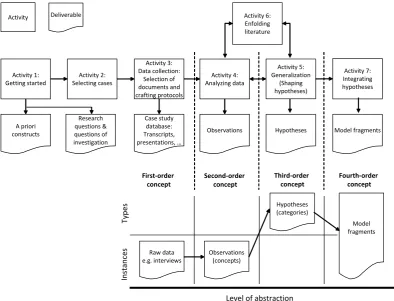
Following Eisenhardt (1989), we designed a research process for the study at hand which is depicted in figure 1.
The process commences with the explication of “a priori constructs.” Furthermore, the first activity includes creating an initial research question and more specific questions of investigation (see section 3.2). This is an important first step to guide the case analysis and focus efforts.
In a second activity, an appropriate case has to be selected. Since the objective of this case study is to enhance understanding and develop theory rather than testing it, the chosen case does not have to be representative. One goal of this study is thus the generation of theory and not its justification through testing. A theoretical sampling though is “particularly suitable for illuminating and extending relationships and logic among constructs” (Eisenhardt and Graebner, 2007). Hence, we intentionally choose an extreme case that will be described in section 3.1. As outlined in table 1, a detailed description and comprehensive background information is important to support the “empirically-grounded” and “naturalistic generalization” promoted by Stake (1995) and to support the principle of contextualization by Klein and Myers (1999).
Multiple data collection methods such as interviews and analysis of documentation are used in the third activity (see section 3.3). In order to have a solid basis to build upon, collected data has to be gathered from multiple sources of evidence to underpin the completeness and correctness of data. This triangulation of data is important for the reliability of the case study’s outcomes (Yin, 2003). Flexible and opportunistic data collection methods allow for reacting to emergent themes by adjusting data collection when necessary (Eisenhardt, 1989).
The fourth activity – analyzing data – begins with the grounding of our observations, as described in section 3.4. This is followed by the shaping of hypotheses through generalization, which is the subject of section 3.5. In the presentation of our research, we distinguish between observations and hypotheses (analyzing data and generalization, respectively) in order to enhance transparency and traceability of the procedure, even though they are closely interwoven.
Activity four is dedicated to properly grounding concepts and relationships. Their identification is conducted by employing techniques from grounded theory (see Eisenhardt (1989) in table 1) and interpretative techniques (see Walsham (1995) and Boland et al. (2010) for hermeneutical exegesis in IS). Even though we do not use the coding techniques to their fullest extent, the general approach and respective tools support the assignment of statements from the interviews and documents to concepts. The goal is to detect relevant particulars within the idiographic details and to discover underlying reasons for why concepts, relationships or patterns exist.
While concepts and observations are still closely linked to the idiographic details, in activity five (generalization), we generate hypotheses consisting of abstract categories. Extending van Maanen’s terminology (1979), we might label these categories, which form hypotheses, third-order concepts, which thus represent abstractions of abstractions of first-order data. We generate these hypotheses by relating concepts described in the observations to categories applying abstraction mechanisms adopted from conceptual modeling. The categories and relationships between them should apply to multiple situations and hereby reach a higher level of generality.
The sixth activity consists of a comparison with related work, so called “enfolding literature” (Eisenhardt, 1989).1 It aims at comparing opinions and positions found in related literature with the observations we made and improving the hypotheses. This results in hypotheses “with stronger internal validity, wider generalizability, and higher conceptual level” (Eisenhardt, 1989). In doing so, we try to turn possible mechanisms into plausible mechanisms (Hedström and Ylikoski, 2010) (p. 52).
Analyzing data (4) and generalization (5) are closely interwoven and both supported by the analysis of literature. According to Gadamer (1976), “the harmony of all the details with the whole is the criterion of correct understanding” (p.117), and in a number of iterations “a complex whole of shared meaning emerges” (Klein and Myers, 1999). This is represented by the iterative layout of activities four to six which accords to the hermeneutic cycles promoted by Klein and Myers (1999). The focus is on constantly comparing hypotheses, data, and competing and similar literature iterating towards a set of hypotheses which closely fits the data (Eisenhardt, 1989).
Finally, activity seven integrates several hypotheses to build model fragments (section 3.6). Through another generalization, these fragments have an even higher level of abstraction and are thus more remote from the first-order data.
Figure 1 illustrates the increase of abstraction with each activity performed moving from left to right. Considering semantic levels, model fragments encompass both the level of instances and the level of types. They incorporate categories used in our hypotheses and also concepts – including those we were not able to observe in our case study.
GENERALIZATION IN AN SOA CASE
Case Description
In the context of the project “Ad-hoc DAta Grids Environments” (ADAGE), researchers at the University of New South Wales (UNSW) implemented a service-oriented architecture for SIRCA, a data provider. The authors of this paper did not participate in the actual SOA implementation project but analyzed data about it ex post as described in the following sections. The project aimed at providing customers an easier retrieval and analysis of heterogeneous data from different sources (grid environment) spontaneously in an ad-hoc fashion. SOAs were not the focus of this software implementation project but service orientation was chosen as the preferred architectural paradigm. Thus, services (and their identification) were used as a means to meet the company’s requirements rather than being the subject of analysis themselves.
SIRCA provides a huge data repository containing historical financial market data such as news and trading data. Its aim is to supply this data to researchers especially at Australian and New Zealand universities. First-order concept Fourth-order concept Third-order concept Second-order concept In sta n ce s Typ es
Level of abstraction
Activity Activity 1: Getting started A priori constructs Deliverable Research questions & questions of investigation Activity 2: Selecting cases Activity 3: Data collection: Selection of documents and crafting protocols Case study database: Transcripts, presentations, … Observations Activity 4: Analyzing data Activity 5: Generalization (Shaping hypotheses)
Hypotheses Model fragments Activity 7: Integrating hypotheses Activity 6: Enfolding literature Raw data e.g. interviews Observations (concepts) Hypotheses (categories) Model fragments
Figure 1: Research Process and Deliverables of the Respective Activities
In ADAGE, services were created based on the available data. This implied a technical understanding of services. The company’s employees were not thinking in terms of business processes, so that no model that could have been analyzed in the course of service identification was delivered. The company’s management, however, had some requirements in mind that should be fulfilled by services. Unfortunately, these were not documented, which makes traceability difficult. Requirements were communicated to the project team in scheduled weekly meetings and workshops. Service candidates were identified on the basis of these meetings and prototyped. In an iterative and incremental approach, the functionality of these candidates was adjusted to finally meet the company’s requirements. A close collaboration between the SIRCA’s research and development department and the university’s project team was a key to ensure the successful identification of services.
(GUI) to customers, enabling them to directly invoke services in an ad-hoc fashion to analyze financial market data. Certainly, SIRCA’s case is not a typical example of service identification projects. Due to its rather extreme character, it helps to identify possible instances of situational factors that usually cannot be found in typical cases.
Since this paper focuses on methodological aspects, we partly omit more detailed descriptions of the case study data. A comprehensive discussion and description including interview guidelines, transcripts, the raw data leading to our observations, etc. can be found in Börner et al. (2012).
Getting Started
As illustrated in figure 1, outlining the theoretical background in the sense of “a priori constructs” is the first step of our research process. Since the research question is the foundation for the analysis of every case study (Eisenhardt, 1989), our research process continues with the formulation of a research question. Shortly after the beginning of the case study, it became obvious that a single focus on service identification might not deliver satisfactory results in the ADAGE case. Thus, we extended the scope of our analysis to the early stages of the SOA lifecycle, namely the design and development of services and the service-oriented architecture in ADAGE.
Some authors have already developed methods to support identification, design, and development of services (for an overview see Börner and Goeken (2009b), Kohlborn et al. (2009b) and Birkmeier et al. (2009)). However, little is known about service identification and the early stages of the SOA lifecycle in real-life projects. Thus, in order to guide us through the analysis, we formulate the following initial research question:
How does SOA development and service identification work in real-life projects?
The rather generic nature of our research question necessitates the formulation of further, more specific questions, the questions of investigation. These help to focus our analysis and support, for example, the hermeneutic analysis of the interview transcripts. The following questions of investigation are reflected by the guidelines used for the conducted interviews.
Which circumstances influence the proceeding of the service identification process?
Did the understanding of services change/develop in the course of the project? Was there a change of the skill level of the project participants?
How was the SOA implemented technically? Which software development techniques had been used?
Data Collection
Written documentation, i.e. various sorts of electronic files, and interviews are major sources of our data collection process. 19 presentations that were held between December 2006 and November 2009 provide a good overview of the general proceeding, achieved objectives, and next steps required at the time of the presentation. Furthermore, official progress reports give a structured overview of how the project was proceeding. Due to their much more formal character, these reports offer fewer insights into actual work practices, such as the identification of services.
In order to retrieve additional information, particularly about the identification of services in the ADAGE project, four interviews are conducted. Three of the interviewees are project team members at the university. All of them were involved in identifying and designing services in the project. Another interviewee is a representative of the company that implemented the SOA.
The interview questions are open-ended. However, guidelines with questions are used in each case. For the three project team members at the university, the same question guideline applies, whereas a different one is used in the interview with the company’s representative. The interviews serve as a valuable means to capture subjective meanings that are essential to our interpretivist approach. All labels of concepts used in our observations are retrieved verbatim from the interviews.
Analyzing Data
Based on the collected case study data, we first strive to investigate the subjective understanding of the project members. From this understanding, observations residing on a higher level of abstraction are induced (second-order concepts). Due to space limitations, we cannot give detailed insight into the subjective understanding. This is done in a working paper (Börner et al., 2012) incorporating a plethora of quotations from documents and interviews.
The ADAGE project members perceived themselves as rather innovative and archaic in a creative environment with little constraints. Due to the project setting, i.e., a public private partnership, the pressure regarding time and budget was comparably low. The developers used their freedom to follow a flexible free-style approach based on their available skills. According to the members’ perception, they were able to compensate for the absence of any formal method in their development process through extensive communication. Furthermore, based on the mainly technical skills of the project members, the proceeding in the project was seen as a creative technically-driven trial-and-error endeavor.
Our observations attempt to structure the subjective meanings that were found in the raw data and support the perception of the project situation. Grounded in document studies and interviews, we arrive at several concepts that we consider as being of importance in the course of the ADAGE project, e.g., we regard the subjective understanding mentioned above as the concept “absence of a formal method.” In doing so, and applying the contextualization principle (see table 1), we seek to present the subject matter in its context “so that the intended audience can see how the current situation under investigation emerged” (Klein & Myers, 1999) (p. 73).
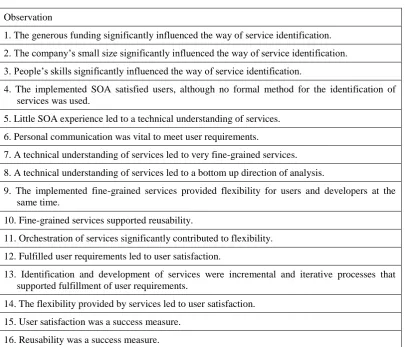
All 16 observations describing the concepts and their relationships are shown in table 2 and are the result of activity four.
Shaping Hypotheses
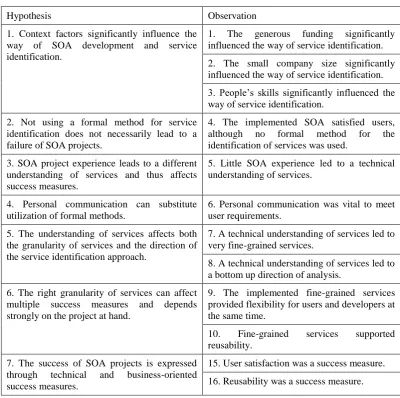
In this next activity we further abstract the observations by generating hypotheses consisting of categories which are based on the concepts observed.
The concepts we identify in the observations can be regarded as instances, and thus we can use abstraction mechanisms to generalize from these observations. The resulting types or compositions form the components of our hypotheses. Hence, by applying abstraction mechanisms, we create abstract categories on the type-level, the ‘third-order concepts’ (figure 1) we have labeled categories (e.g., we can classify the concept “fine-grained services” as an instance of the category “granularity”). In so doing, we utilize mechanisms from conceptual modeling that guide the generalization by abstraction which we regard as a logical generalization.
services.” By incorporating alternative concepts, we clearly move beyond the details observed and further generalize the findings (see section 3.6).
Observation
1. The generous funding significantly influenced the way of service identification.
2. The company’s small size significantly influenced the way of service identification. 3. People’s skills significantly influenced the way of service identification.
4. The implemented SOA satisfied users, although no formal method for the identification of services was used.
5. Little SOA experience led to a technical understanding of services.
6. Personal communication was vital to meet user requirements.
7. A technical understanding of services led to very fine-grained services.
8. A technical understanding of services led to a bottom up direction of analysis.
9. The implemented fine-grained services provided flexibility for users and developers at the same time.
10. Fine-grained services supported reusability.
11. Orchestration of services significantly contributed to flexibility.
12. Fulfilled user requirements led to user satisfaction.
13. Identification and development of services were incremental and iterative processes that supported fulfillment of user requirements.
14. The flexibility provided by services led to user satisfaction.
15. User satisfaction was a success measure.
16. Reusability was a success measure.
Table 2: Observations from the Case Study
Hypothesis Observation
1. Context factors significantly influence the way of SOA development and service identification.
1. The generous funding significantly influenced the way of service identification.
2. The small company size significantly influenced the way of service identification.
3. People’s skills significantly influenced the way of service identification.
2. Not using a formal method for service identification does not necessarily lead to a failure of SOA projects.
4. The implemented SOA satisfied users, although no formal method for the identification of services was used.
3. SOA project experience leads to a different understanding of services and thus affects success measures.
5. Little SOA experience led to a technical understanding of services.
4. Personal communication can substitute utilization of formal methods.
6. Personal communication was vital to meet user requirements.
5. The understanding of services affects both the granularity of services and the direction of the service identification approach.
7. A technical understanding of services led to very fine-grained services.
8. A technical understanding of services led to a bottom up direction of analysis.
6. The right granularity of services can affect multiple success measures and depends strongly on the project at hand.
9. The implemented fine-grained services provided flexibility for users and developers at the same time.
10. Fine-grained services supported reusability.
7. The success of SOA projects is expressed through technical and business-oriented success measures.
15. User satisfaction was a success measure.
16. Reusability was a success measure.
Table 3: Hypotheses Related to Observations
ADAGE Success No Method Used
Generous Funding
Personal Communication
User Satisfaction High Flexibility
Reusability
Orchestration
Technical Understanding Incremental/Iterative
development approach
Little SOA Experience
Observation
O8 Fine-grained Services
Bottom Up Approach Limited Skills
Small Company
O7 O4
O1
O2
O3
O5 Fulfilled User Requirements
O6
O9
O11
O10
Hypothesis
O14
O16
O15 Method Orientation
Communication
Flexibility
Coordination
Understanding of Services Development Paradigm
Experience Granularity
Direction of Approach General Context
H2 H1
Customer Orientation H4 substitute
SOA Success H7
H6
H3 Technical Success Measures
Business-oriented Success Measures
H5
O13
O12
General way of SI/SOA development
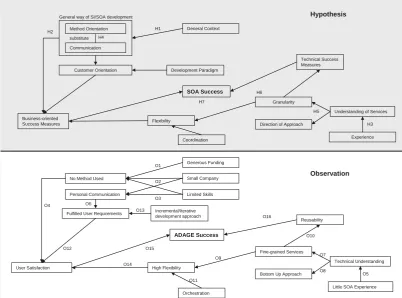
Figure 2: Interrelationships of Observations and Hypotheses
Hypothesis 1: The general context significantly influences the method of SOA development and service identification.
Certainly, there are many factors that affect the approach to service identification in general and the choice of certain methods in particular. Those factors that cannot be influenced by the project team are commonly called context factors (Bucher et al., 2007). We identify generous funding, small company size, and limited skills in ADAGE to be such context factors (observations 1 to 3).
Budget
Company size
Skills
Generous
funding Small
company
Limited skills
General context
ADAGE context is part of
is part of
is part of
is part of
is part of
is part of has
instance
has
instance has instance
has instance
Categories
Concepts
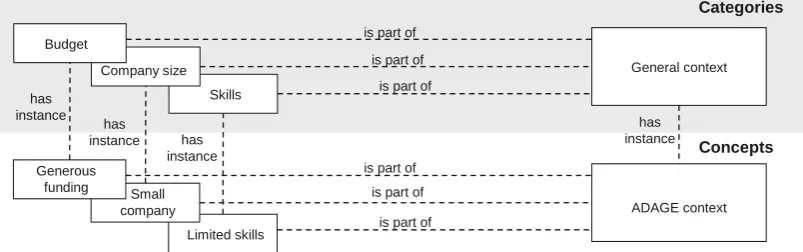
Figure 3: Applying Abstraction Mechanisms to Hypothesis 1
Applying the abstraction mechanism classification, we can generalize our concepts (instances) by determining abstract categories (types). For example, the category company size is the result of classification from the observed concept small company. Thus, there is a has-instance- (instance-of-) relationship between these two. Budget and skills are the other two categories that were directly derived from our observed concepts described in observations 1 to 3. The concept ADAGE context that is created by aggregation is transformed into the category general context by classification. All categories are related to respective concepts by “has-instance” relations. Particularly, the aggregation that sums up several concepts to the ADAGE context necessarily moves away from subjective meanings that served as the starting point for our analysis.
Our observations show that the combination of a small company and employees with limited skills (trumping the opportunities of a generous budget) leads to an absence of formal methods in service identification. This is in line with the subjective understanding of the project members (see 3.4) and certainly an extreme case. However, it seems to be plausible to assume that context factors significantly influence the way of service identification and, in the following, we will discuss the underlying mechanisms. Thus, we can e.g., tentatively hypothesize that large companies with highly skilled employees will use different methods for SOA development and the identification of services.
Hypothesis 3: SOA project experience leads to a different understanding of services and thus affects success measures.
In ADAGE, we observed that little SOA experience accompanied with the dominance of IT specialists resulted in a technical understanding of services (observation 5). Classifying the concepts observed, we assume that the level of experience influences the understanding of services. We therefore hypothesize that companies with a track record of service implementation tend to involve business departments early in the process of service identification. Therefore, the understanding of services is much more process-oriented. Through multiple cause-and-effect relationships shown in figure 2, success measures such as reusability are affected.
or even choose a technical approach if suitable. The most significant difference is that an experienced project team with a broader understanding of SOA is free to choose an adequate approach from a range of options. Unfortunately, this makes a prediction almost impossible. The only cause-and-effect relationship that can be established here is that more experience allows for different opportunities whereas little experience most certainly leads to a technical understanding.
Anderson et al. (2005) argue that the extent to which the enterprise architects, service developers, and operations project staff in the IT department are skilled (i.e., their experience and subsequently their understanding of services) is a critical factor for web service implementation. Looking at our observations 5, 7, and 10, we can further hypothesize that SOA experience indirectly influences reusability of services. This is confirmed by Baskerville et al. (2005), who show that “very few web services could be reused exactly as originally implemented” (p. 7) and thus, experience is essential for SOA implementations. Becker et al. (2009) state that “especially in the early phases of SOA maturity [i.e., with little experience] there is no experience about [what] a reusable service would look like” (pp. 7-8). This is another hint that SOA project experience tends to change the understanding of services and enhances reusability.
Hypothesis 5: The understanding of services affects both the granularity of services and the direction of the service identification approach.
In the ADAGE project, a technical understanding of services led to very fine-grained services and a bottom up approach stressing technical aspects of the underlying (data) infrastructure (see observations 7 and 8).
In order to develop our hypotheses, a classification leads to the abstract categories understanding of services, direction of approach and granularity. The category granularity, e.g., is the abstraction of fine-grained service, the instance that we are able to observe.
Firstly, we can hypothesize that a different understanding of services leads to different granularities. Moving on a scale from technical to business-oriented understanding, the identified services might become coarser-grained along this line. From a business perspective, services should support business processes or at least sub processes. Hence, they encompass more functionalities than an elementary service that, for example, extracts an address from a database. The latter will more likely be the outcome if service identification is conducted from a technical point of view.
Secondly, the direction of the approach is influenced by this understanding. Again, moving along the above scale will result in the application of bottom up approaches on one side and top down approaches on the other side. It is unlikely to end up with a pure instance of any of the approaches. Even in the ADAGE case, a very technical understanding did not result in a pure bottom up approach. However, the share of techniques that are typically assigned to top down approaches (such as strategic analyses) will increase with a business-oriented understanding of services. Accordingly, in their comparison of service analysis approaches, Kohlborn et al. (2009a) differentiate two types of SOA concepts, i.e., understandings of SOA. One of them is rather technical and, thus, delivers so-called software services while the other (business-oriented) one results in business services.
Hypothesis 6: The right granularity of services affects multiple success measures and depends strongly on the project at hand.
measures that constitute hypothesis 6 were developed by classification. They all abstract the instances and concepts observed and, thus, have “is-instance-of” relationships to the concepts fine-grained services, high flexibility, user satisfaction, and reusability.
Whereas the ADAGE case shows clear advantages of fine-grained services, coarse-grained services might be the better choice in other settings. Some customers might not be interested in the flexible composition of services every time they use them. If they simply want to outsource part of a business process, they might prefer a coarse-grained service that encompasses all necessary functionalities and delivers a comprehensive result. Accordingly, Elfatatry (2007) argues that “the appropriate level of granularity for a service and its methods is relatively coarse. A service generally supports a single distinct business concept or process.” (p. 38) In the ADAGE case, fine-grained services enhanced both reusability and user satisfaction, i.e., technical and business-oriented success measures, respectively. In other cases, the granularity of services might be a trade off because effects on these two kinds of measures could be converse.
We argue that, due to different preconditions, the right granularity of a service has to be elaborated depending on the situation at hand. There is no silver bullet for right-sizing a service without considering the context of service implementation. Thus, a situation-specific approach to the choice of methods is important to provide for an adequate granularity.
Integrating Hypotheses
Through generalization of our observations, we create hypotheses as illustrated in figure 2. This is done by applying classification and aggregation, two abstraction mechanisms with a clear semantic (instance-of/part-of). Since they are applied upwards (e.g., a concept ‘is instance-of’ a category), the investigation is based on and refers to observed instances and respective concepts. Hence, both the resulting observations and hypotheses are still closely linked to the primary data we retrieved from documentation and interviews.
In the following, we will describe phenomena that move beyond this data and reach another level of abstraction. By performing another generalization and looking at causal mechanisms between concepts, we arrive at model fragments that were not necessarily obvious beforehand. Due to the fact that the categories are abstract placeholders and the hypotheses show possible and plausible causal mechanisms, we can now reason about further conceivable concepts in terms of alternative instances. This is supported by applying the abstraction mechanisms downwards (a category ‘has instance’ non-observed concept). Since we assume that the hypotheses describe plausible mechanisms and the placeholders as well as the abstraction mechanisms guide the derivation, this is not arbitrary but another generalization by abstraction. Because the observed concepts as well as the categories in the different hypotheses overlap, we are also able to combine the hypotheses in a model or in a small set of model fragments.
Contingency Model (CM)
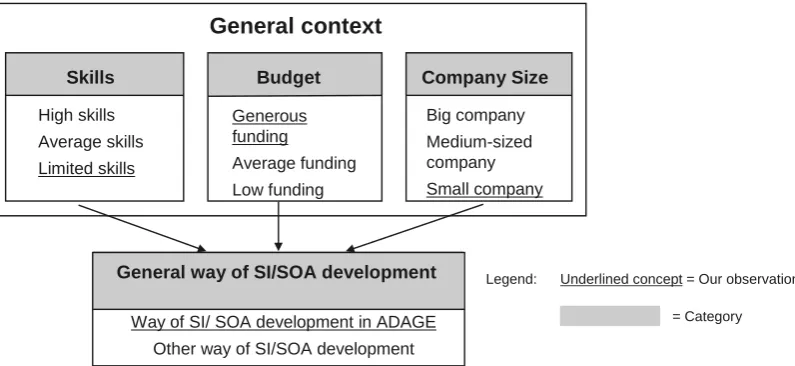
Context factors such as budget, company size, and people’s skills are consolidated in hypothesis 1. All of them (“general context”) influence the application of methods, communication, and the general approach to implementing SOA projects. The contingency model in figure 4 includes our observations from the ADAGE case (underlined concepts) and alternative concepts which are derived by conceivable instantiation of the categories applying abstraction mechanisms. We assume that alternative instances of the mentioned categories will result in different ways of SI/SOA development, as depicted in figure 4.
In our model, the list of categories constituting the contingency model is limited to those we were able to derive from observed concepts. We assume that the category “general context” can also be extended by non-observed concepts and resulting categories. For instance, in a more business-driven SOA implementation project, the choice of a BPM software tool could influence the way of SI/SOA development. Since there is no BPM tool used in our case, we are not able to observe such an impact. Accordingly, the way of SI/SOA implementation will most likely include more categories than method orientation and communication which we are not able to observe.
Budget
Generous funding
Average funding Low funding
General way of SI/SOA development Legend: Underlined concept = Our observation
= Category Company Size
Big company Medium-sized company Small company
Skills
High skills Average skills Limited skills
Way of SI/ SOA development in ADAGE Other way of SI/SOA development
General context
Figure 4: Influence of the General Context on the Way of SI/SOA Implementation (Contingency Model – CM)
The generalization in this contingency model follows Stoddart’s (2004) notion. The general way of SI/SOA development is a socio-technical process and we generalize this process by abstracting from the observed instances. Due to the single case study design, we are only able to observe one way of SI/SOA development, i.e., the one in the ADAGE case. Subsequently, it is difficult to define more instances (concepts) of the category general way of SI/SOA development whereas additional instances for skills, budget and company size are easier to derive.
Model of Soft Factor Transition (MSFT)
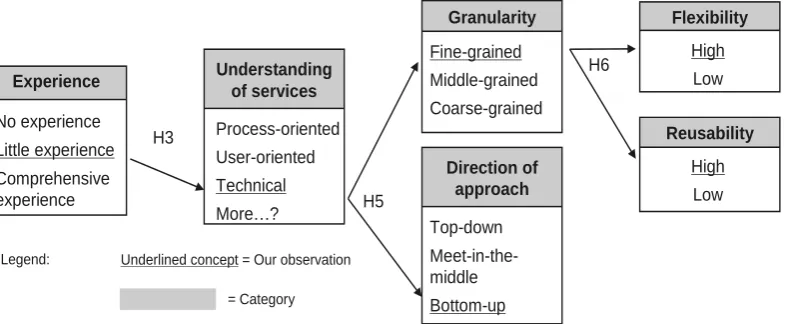
The model fragment which ties together hypotheses 3, 5, and 6 is depicted in figure 5. Our observations (underlined concepts) and the resulting cause-and-effect chain show that a team with only little SOA experience produced a highly flexible service-oriented architecture and highly reusable services. In our hypotheses, experience leads to a distinct understanding of services (H3). This results in different granularities and directions of approaches (H5) and subsequently in a certain degree of flexibility and reusability (H6). Hence, the experience of project teams influences flexibility and reusability as well as the direction of the identification approach through a chain of cause-and-effect relationships as depicted in figure 5.
Understanding of services
Granularity
Experience
No experience Little experience
Comprehensive experience
Process-oriented
User-oriented Technical More…?
Fine-grained Middle-grained Coarse-grained
H3
H5
H6
Flexibility
Reusability High Low
High Low
Underlined concept = Our observation Legend:
= Category
Direction of approach
Top-down
Meet-in-the-middle Bottom-up
Figure 5: Causal Link of Experience and Flexibility/Reusability (Model of Soft Factor Transition – MSFT)
Finding further plausible and alternative instances for this MSFT is easier than in the case of the contingency model. The classification that is used to abstract categories from concepts is now inverted to identify new instances, i.e., concepts that could not have been observed in the case study. Again, as shown in figure 1, this step moves back from the type to the instance level but still increases the degree of abstraction from the raw data.
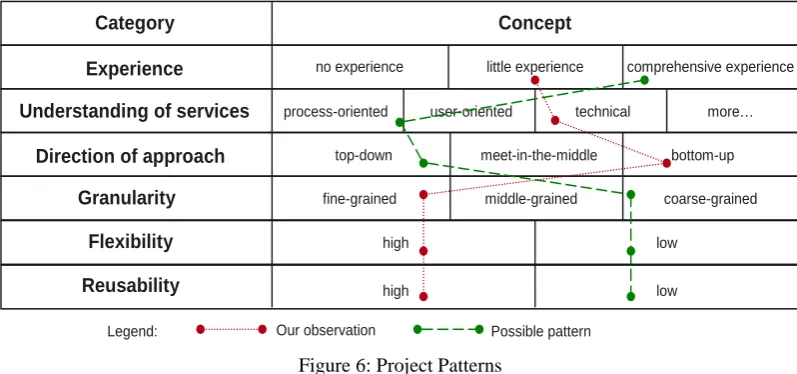
Outlining conceivable and alternative instances, we are able to describe project patterns as shown in figure 6. However, these patterns are not proven theories but rather hypotheses in terms of plausible tendencies. Theoretically, the number of possible patterns equals the number of all combinations of concepts. However, an identification of plausible patterns will be a contribution itself. Certain combinations of concepts might not be found in any pattern due to either conflicting goals (e.g., coarse-grained services and high flexibility) or incompatible preconditions and goals (technical understanding of services and top-down approach for their identification).
Category Concept
Experience
Understanding of services
Granularity
Flexibility
no experience
technical
fine-grained
high
little experience comprehensive experience
process-oriented user-oriented more…
middle-grained coarse-grained
low
Our observation Possible pattern Legend:
Direction of approach top-down meet-in-the-middle bottom-up
Reusability high low
Figure 6: Project Patterns
Teams with little SOA experience and limited knowledge regarding business functions and processes are forced to rely on the experience they have, which is basically technical. We assume that developing an SOA based on the knowledge stemming from experience made with traditional, more technically-driven software engineering paradigms, for example, object-oriented programming or modules, results in fine-grained services. The understanding of services can be seen as the generative mechanism in this model fragment.
We could assume that a very experienced team might have a process-oriented understanding which leads to rather coarse-grained services that provide less flexibility. Since flexibility is regarded to be a big advantage of SOAs, this causal link is counter-intuitive. We would expect an experienced team to be able to reap the benefits of SOAs, including an enhanced flexibility. Figure 6 illustrates our observed pattern (dotted line) and the assumed possible pattern described above (dashed line).
However, we have to keep in mind that more experience does not necessarily lead to one specific understanding of services but enables an adequate choice of approach and understanding, as argued in hypothesis 3. A comprehensive experience, for instance, is not closely knit to a process-oriented understanding and could as well produce middle-grained services. A large number of patterns are thus conceivable. We argue that – depending on situation-specific circumstances in projects – the resulting patterns represent certain types of projects. An identification of such project types could lead to a targeted application of methods supporting SOA development and the identification of services. Project types can define situations in the sense of situational method engineering and would subsequently contribute to a more sophisticated service identification through the use of situational methods (Bucher et al., 2007).
Success Model (SM)
Many observations and hypotheses are bound to the notion of success. Naturally, the primary objective of every project is to be completed successfully. This is also true for SOA implementation projects. But how can you evaluate the success of such a project? Our observations and hypotheses utilize several success measures that are influenced by a number of different concepts in our model illustrated in figure 2. In our observations, we find success factors such as reusability and user satisfaction. They are classified to technical and business-oriented success measures, respectively. Both success factors can be aggregated to the category SOA success. However, they take different view points and usually represent interests of different stakeholders.
On the one hand, reusability is a rather technical aspect. Subsequently, in most cases, it is pursued by the IT department that implements an SOA. The number of business processes that invoke a service and the frequency of invocation can serve as a unit of measurement. If the IT department can prove that a service is reused frequently in many processes, it is easy to argue that maintenance and development of this single service is more cost efficient than having the same functionality provided by multiple applications scattered across the organization.
On the other hand, user satisfaction is clearly a business goal. Users have little interest in cost savings or technical demands on the company’s side. Instead, they appreciate flexibility and a timely satisfaction of their demands. Hence, business processes must be flexible and agile to guarantee a certain degree of user satisfaction. As argued before, a successful SOA can cater to these demands.
A number of success measures can be employed (see, e.g., the framework by Börner and Goeken (2009a)). All of them would serve as further instances of our success categories. Business departments can thus consider flexibility and time-to-market as important factors. From the technical side, autonomous services or a high degree of standardization might be important. In both cases, the measurement of success factors is far from trivial, and appropriate measures will have to be defined to operationalize the measurement of SOA success. To which extent technical and business-oriented success factors are aligned or not is an interesting question that is left to further research. Based on a literature review and expert interviews, Lee et al. (2010) identify 20 critical success factors in SOA implementation. However, their interrelationships and contribution to success are not clear.
FINDINGS AND IMPLICATIONS
In our analysis we identify factors and aspects (concepts and categories) relevant in the ADAGE project. With respect to our research questions our findings for SOA development projects are the following:
We identified circumstances (context factors) that influenced the proceedings of the project. We were able to observe how some of these factors (e.g., funding) affected an SOA project and incorporated these observations into our hypotheses and model fragments.
We found that the understanding of services and related skills significantly influence the way of SOA development. Several hypotheses and our models show that concepts such as granularity or the direction of the identification approach are more or less directly affected by the understanding of services (which is usually subject to change with increasing experience).
Due to the absence of a method for service identification, we were not able to observe a stringent application of software development techniques. Software development was mostly intuitive and bound to few developers because of the limited scope of the project. An astonishing finding is that the “absence of a formal method“ apparently has had no negative impact.
Due to the single case study design, our hypotheses and model fragments are limited and it has to be taken into account, that there are different concepts and categories to consider in more comprehensive models. To extend the models, further research is desirable.
Additionally, the model fragments and hypotheses must be seen as tendencies, explaining plausible mechanisms. Their strength is that they describe possible cause-effect-relationships and give insight into the generative mechanisms at work. They are limited insofar as they are not tested yet. Hence, we neither can be sure that they are representative; nor do we know about the magnitude of relationships of concepts and/or categories.
Using multiple case studies is one possibility to find supporting or contradicting evidence for the generated hypotheses. This would enable a cross-case pattern search and underpin the validity of the results (Eisenhardt, 1989). Further interviews and document examination could be a basis for qualitative or (in large numbers) even quantitative cross-sectional analyses.
In the following, we will discuss key findings and limitations of the models and their possible interplay.
In our contingency model, we capture the influence of a number of context factors on the way of SI/SOA development. An extension of the list of factors, which form part of the general context, will be left to future research and can be achieved for instance through further case studies or expert interviews. Accordingly, more categories (and relating concepts) such as a management commitment (with the possible instances ‘high’, ‘medium’, ‘low’) might be discovered and it should be analyzed, if this influences the way of SI/SOA development e.g. by inducing top down approaches incorporating strategic aspects.
Moreover, based on only one case study, it is impossible to determine the extent to which a single factor contributes to certain outcomes. After conducting more case studies, a factor analysis could help to understand more reliably how the combination of identified factors affects the use of methods. Since there is already a large body of literature that provides a comprehensive list of context factors for domains different from SOA, future research should concentrate on identifying those that have a significant impact on SOA implementation projects and, in doing so, reason about the mechanisms more deeply. Quantitative research should aim at validating the resulting hypotheses and models.
The model of soft factor transition links experience with SOA design and implementation aspects (flexibility and reusability) and provides a description of a generative mechanism which is likely to be at work. One question for future research that arises from this model is if a technical (resp. business-oriented) understanding of services necessarily leads to fine-grained (resp. coarse-grained) services and a bottom up (resp. top down) approach. Most likely, more experience would enable the project team to flexibly adapt granularity, create services on different levels of granularity, or apply a top down (resp. a hybrid) approach. Further case studies would help to shed light on these cause-and-effect relationships.