Twin Research and Human Genetics
Volume 21 Number 6 pp. 538–545 C The Author(s) 2018. This is an Open Access article, distributed under the terms of the Creative Commons Attribution licence (http://creativecommons.org/licenses/by/4.0/), which permits unrestricted re-use, distribution, and reproduction in any medium, provided the original work is properly cited. doi:10.1017/thg.2018.55
A Further Comment on ‘Large-Scale Cognitive
GWAS Meta-Analysis Reveals Tissue-Specific
Neural Expression and Potential Nootropic Drug
Targets’ by Lam et al.
W. D. Hill
Centre for Cognitive Ageing and Cognitive Epidemiology, University of Edinburgh, Edinburgh, UK Department of Psychology, University of Edinburgh, Edinburgh, UK
Lam et al. (2018) respond to a commentary of their paper entitled ‘Large-Scale Cognitive GWAS Meta-Analysis Reveals Tissue-Specific Neural Expression and Potential Nootropic Drug Targets’ Lam et al. (2017). While Lam et al. (2018) have now provided the recommended quality control metrics for their paper, prob-lems remain. Specifically, Lam et al. (2018) do not dispute that the results of their multi-trait analysis of genome-wide association study (MTAG) analysis has produced a phenotype with a genetic correlation of one with three measures of education, but do claim the associations found are specific to the trait of cogni-tive ability. In this brief paper, it is empirically demonstrated that the phenotype derived by Lam et al. (2017) is more genetically similar to education than cognitive ability. In addition, it is shown that of the genome-wide significant loci identified by Lam et al. (2017) are loci that are associated with education rather than with cognitive ability.
Keywords:GWAS, general cognitive ability, nootropics, gene expression, neurodevelopment, synapse, calcium channel, potassium channel, cerebellum
Lam et al. (2018) assert that their use of multi-trait analysis of genome-wide association study (GWAS) (MTAG; Turley et al.,2018) resulted in the generation of associations that were specific to the trait of cognitive ability. They offer four pieces of supporting evidence based on the genetic corre-lations derived using linkage disequilibrium score (LDSC) regression (Bulik-Sullivan et al.,2015) found in Table S14 of Lam et al. (2018).
First, Lam et al. (2018) state that ‘our Table S14 demon-strates the set of genetic correlations for the MTAG data dif-fer from those of educational attainment (from the Okbay et al. (2016) data set) in many cases by an absolute value (forrg) of 0.10 or greater’. This characterization of the
ge-netic correlations in Table S14 of Lam et al. (2017) differing between the MTAG phenotype and education is mislead-ing. This can be shown empirically by first extracting the genetic correlations from Table S14 from Lam et al. (2017). Next, in order to have confidence in the accuracy of the point estimates of the genetic correlations, we extract ge-netic correlations that were significant for at least one of the cognitive phenotypes (Education, the MTAG phenotype, or a GWAS composed of solely cognitive measures labeled as
cognitive ability). This leaves 61 traits that show a nomi-nally significant genetic correlation with one of the cogni-tive traits used by Lam et al. (2017). Next, we test for signif-icant differences between the genetic correlations derived using education and these 61 traits, with the genetic corre-lations derived using the MTAG phenotype and the same 61 traits.
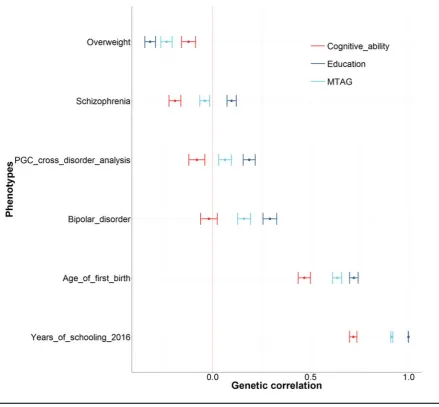
The results of this analysis can be seen inFigure 1, and show the only six instances out of 61 traits where there was a significantly different genetic correlation between the MTAG phenotype and education. Crucially, in each of these six instances, the genetic correlations produced using the MTAG phenotype are also significantly different from those produced using cognitive ability. This indicates that in most
received 16 July 2018; accepted 3 September 2018. First pub-lished online 8 October 2018.
FIGURE 1
(Colour online) An empirical comparison between the genetic correlations produced using the three cognitive phenotypes from Lam et al. (2017). First, genetic correlations were selected when there was at least one nominally significant genetic correlation with any one of the three cognitive phenotypes used in Lam et al. Second, we show that for those traits, there were only six instances where the MTAG phenotype was significantly different from the education phenotype. However, in each of these six instances, the MTAG phenotype was also significantly different from the cognitive ability phenotype. Each point represents a genetic correlation between one of the three cognitive phenotypes (red=cognitive ability, dark blue=education, and light blue=the MTAG phenotype described as trait specific to cognitive ability by Lam et al. (2017)) and the traits presented on they-axis. The dotted red line indicates a genetic correlation of zero. Error bars represent±1 standard error as derived using LDSC regression.
instances there are no differences between education and the MTAG phenotype; however, in the instances where the MTAG phenotype deviates from education, it is also sig-nificantly different from cognitive ability. Thus, the con-clusion of Lam et al. (2018) that their MTAG phenotype is more similar to cognitive ability, because there are in-stances where the point estimates between education and the MTAG phenotype differ, is empirically falsified.
Second, in their response, Lam et al. (2018) draw special attention to the genetic correlations between childhood IQ and their MTAG phenotype, writing that it is ‘vir-tually identical’ to that produced using cognitive ability
W. D. Hill
correlations derived using childhood IQ and each of the three cognitive phenotypes used by Lam et al. (2017) show no significant difference between the education-childhood IQ and the MTAG phenotype-childhood IQ genetic cor-relations (p = .19), the MTAG phenotype-childhood IQ and cognitive ability-childhood IQ genetic correla-tions (p=.90), nor between the education-childhood IQ and cognitive ability-childhood IQ genetic correlations (p=.14). This same trend is again seen when examining infant head circumference. In that case, the following results are found when comparing the same three pairs of genetic correlations: education and the MTAG phenotype (p = .65), the MTAG phenotype and cognitive ability (p= .78), and education and cognitive ability (p= .90). This indicates that far from being counter examples to the arguments put forward by Hill (2018), these phenotypes, selected by Lam et al. (2018) as exemplars indicating the success of their MTAG approach, show no evidence for their claim that their MTAG phenotype is more similar to cognitive ability than education.
The third piece of evidence Lam et al. (2018) use to show that their MTAG analysis is more similar to cognitive ability than to education, is to claim the magnitude of the genetic correlations with education were reported inaccurately by Hill (2018). In their rebuttal, Lam et al. (2018) write that ‘Hill (2018) elides the fact that the calculation method em-ployed by LD score regression is known to sometimes pro-duce values forrg>1, if the variables are so highly
simi-lar as to be self-same (Walters,2016)’. However, Hill (2018) states in his Table 1,Figure 1, and in the publically available scripts used by Hill (2018) to perform his analyses that ge-netic correlations of greater than 1 are being treated as 1. In addition, the same reference (Walters,2016) is used in the rebuttal by Lam et al. (2018) to state this is a known issue of LDSC regression, as is used by Hill (2018) to justify the decision to report genetic correlations of greater than 1 as 1. The relevant text from Walters (2016) on how to interpret genetic correlations of greater than 1 is included verbatim here: ‘Thus, far our interpretation has been that as long as artifacts or instability have been ruled out then this result indicatesrgapprox.=1’.
It should be noted that if one derives a genetic correlation using LDSC regression using the same data set correlated against itself, a genetic correlation of exactly 1 is produced. Genetic correlations of greater than one appear when two highly similar measures of the same phenotype (e.g., years of education vs. college degree coded as a binary variable) are used. Importantly, as shown in the rebuttal by Lam et al. (2018), a genetic correlation derived using the MTAG phe-notype and the GWAS derived only using cognitive tests used in the construction of the MTAG phenotype did not produce this effect. Furthermore, by following the advice of Walters (2016) in reporting genetic correlations of greater than 1 as 1, we avoid the issue of a variable being more similar to a second variable than it is with itself. Together,
this shows that the MTAG phenotype derived by Lam et al. (2017) does indeed show no significant difference in the ge-netic correlations derived with three measures of education compared with genetic correlations between a GWAS of ed-ucation and the same three measures of eded-ucation as shown in Hill (2018),Figure 1.
It should be noted that the magnitude of the genetic cor-relations between the MTAG phenotype and three mea-sures of education are 0.98 (SE=0.03), 0.97 (SE=0.02), and 0.97 (SE=0.03), none of which are significantly differ-ent to 1.Figure 1of Hill (2018) also shows that there was a significant difference between the genetic correlations de-rived using the MTAG phenotype and those dede-rived us-ing cognitive ability, showus-ing that the genetic architecture of these two traits differ significantly with how they over-lap with four measures of education (College completion p=2.29×10⁻⁷, Years of schoolingp=8.14×10⁻⁸, Years
of schooling 2013p=9.15×10⁻⁸, Years of schooling 2016
p=2.70×10⁻²⁵). Neither the fact that the MTAG
pheno-type shows a genetic correlation near 1 with three measures of education (just the genetic correlations between educa-tion and different measures of educaeduca-tion were contested) nor the significantly different genetic correlations between the MTAG phenotype and cognitive ability are disputed in the rebuttal by Lam et al. (2018). Again, then, it appears that the Lam et al. (2017) MTAG phenotype is more similar to education than to cognitive ability.
Fourth, Lam et al. (2018) also believe that the results of their genetic correlations with schizophrenia and bipo-lar disorder highlight a biologically meaningful set of relationships rather than being the result of their MTAG phenotype having a genetic correlation at unity with edu-cation as shown inFigure 1of Hill (2018). Lam et al. (2018) also state that the ‘overall pattern of genetic correlations’ between the three cognitive phenotypes used in Lam et al. (2017) — education, the MTAG-intelligence phenotype, and a GWAS composed solely of tests of cognitive ability — is ‘highly similar’. However, attention was called to the results of bipolar disorder and of schizophrenia by Hill (2018) precisely because genetic correlations between edu-cation with bipolar disorder and schizophrenia are positive (Bulik-Sullivan et al.,2015; Hill et al.,2015; Okbay et al., 2016), whereas for cognitive ability they are negative for schizophrenia and near zero for bipolar disorder (Hage-naars et al.,2016; Hill et al.,2015). This separation provides the ability to examine whether the associations produced by Lam et al. (2017) are indeed trait-specific to cognitive ability as claimed, or are in fact closer to education as shown by Hill (2018).
FIGURE 2
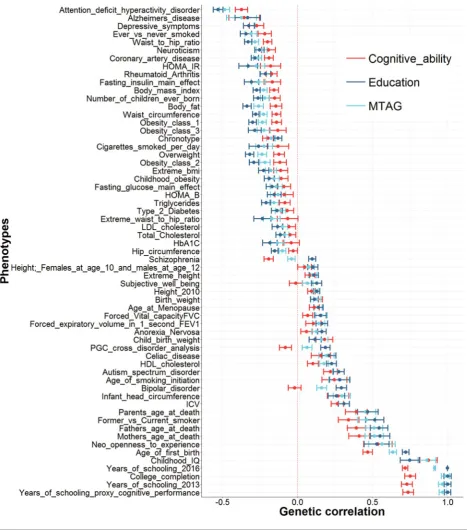
(Colour online) Genetic correlations from Lam et al. (2017) where at least one of the cognitive traits showed a nominally significant genetic correlation with the traits presented on they-axis. Each point represents a genetic correlation between one of the three cognitive phenotypes (red=cognitive ability, dark blue=education, and light blue=the MTAG phenotype described as trait specific to cognitive ability by Lam et al. (2017)) and the traits presented on they-axis. The dotted red line indicates a genetic correlation of zero. Error bars represent±1 standard error as derived using LDSC regression.
traits (Figure 2). As can be seen inFigure 2, there is more similarity between the point estimates of the education and the MTAG phenotype than there is between the point esti-mates of a GWAS composed solely of tests of cognitive abil-ity and the MTAG phenotype.
W. D. Hill
FIGURE 3
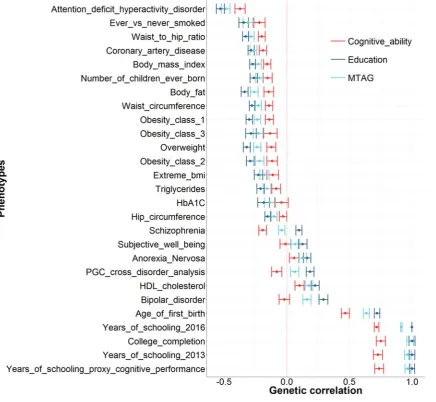
(Colour online) A subset of the traits showed inFigure 2. This shows the 27 traits that are significantly different between education and cognitive ability. Note that in every instance the point estimate of the genetic correlation for the MTAG phenotype is closer to the point estimate of education than it is to cognitive ability. Each point represents a genetic correlation between one of the three cognitive phenotypes (red=cognitive ability, dark blue=education, and light blue=the MTAG phenotype described as trait specific to cognitive ability by Lam et al. (2017)) and the traits presented on they-axis. The dotted red line indicates a genetic correlation of zero. Error bars represent±1 standard error as derived using LDSC regression.
similar between education and the MTAG phenotype than between the MTAG phenotype and cognitive ability.
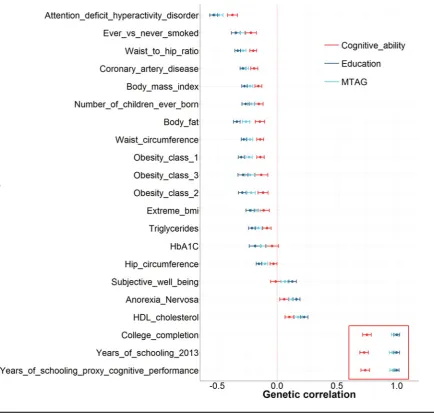
We then test to determine whether there is a significant difference between the genetic correlations derived using education and those derived using the MTAG phenotype. InFigure 4, we see these results show that 21 out of these 27 traits show no evidence of the MTAG phenotype being significantly different from education and, as stated above, each of the six phenotypes that was significantly different from education was also significantly different from cog-nitive ability (Figure 1). Of note are the three phenotypes highlighted in red, showing that the MTAG phenotype has
a genetic correlation of 1 with each of these three measures of education.
FIGURE 4
(Colour online) A subset of the traits showed inFigure 3. This shows the 21 traits that show no significant difference between education and the MTAG phenotype. Note that in every instance where a significant difference was found between MTAG phenotype and education, a significant difference was also found between the MTAG phenotype and cognitive ability as shown inFigure 1. Each point represents a genetic correlation between one of the three cognitive phenotypes (red=cognitive ability, dark blue=education, and light blue=the MTAG phenotype described as trait specific to cognitive ability by Lam et al. (2017)) and the traits presented on they-axis. The dotted red line indicates a genetic correlation of zero. Error bars represent±1 standard error as derived using LDSC regression. The red box highlights the genetic correlations with three measures of education and shows that the MTAG phenotype has a genetic correlation of 1 with each of them.
phenotype is trait-specific to cognitive ability, it is empiri-cally shown here that their MTAG phenotype is more simi-lar to education and significantly different from established measures of cognitive ability. Lam et al. (2018) also state ‘our leave-one-out analyses (Figure 3in Lam et al. ((2017)) demonstrate that prediction of held-out samples, pheno-typed for cognitive ability, are better for MTAG than for ei-ther GWASCOGor GWASEDUalone. This finding supports
our interpretation that MTAG is boosting polygenic signal for cognition, and does not support the conclusion of Hill (2018) that the MTAG polygenic signal is ‘indistinguishable from that of education’’. The phrase ‘indistinguishable from
that of education’ is attributed to Hill (2018) but it is not found in the manuscript of Hill (2018). However, the point raised, that a polygenic risk score derived using the MTAG phenotype explains more variance in cognitive ability than a polygenic risk score derived using education does, is dis-cussed below.
W. D. Hill
levels of education in an independent data set. Alternatively, cross-trait polygenic risk scores can be used, whereby using the summary GWAS data on, for example, cognitive ability is used to predict phenotypic variance for education. Im-portantly, cross-trait polygenic risk scores can only predict phenotypic variance in instances where there is a non-zero genetic correlation between the two traits. However, un-like genetic correlations, polygenic risk scores do not in-dicate the degree to which genetic effects are shared, only that there is a non-zero shared genetic effect across the two traits. In order to empirically quantify the proportion of ge-netic effects that are shared across traits, gege-netic correla-tions are needed. As shown above, by using genetic corre-lations, the MTAG phenotype more closely resembles edu-cation than cognitive ability.
It should be noted that Lam et al. (2018) have now in-cluded the maxFDR rate, as suggested by the authors of MTAG (Turley et al.,2018). The maxFDR was 0.0068, in-dicating that between 0 and 1 of these loci was a false positive. Lam et al. (2018) also claim that ‘the top results (genome-wide significant loci) emerging from MTAG show notable differences from those emerging from GWASEDU,
but are almost a complete superset of those emerging from GWASCOG’. Larger data sets are now available to test this
assertion. Using publically GWAS data from 766,345 indi-viduals who provided information on whether or not they had a college or university level degree (Lee et al,2018) and the largest publically available data set on cognitive ability (n=168,033) that does not also include measures of edu-cation (Davies et al.,2018), we examine the claims of Lam et al. (2018). First, we extract the 82 independent lead SNPs found in Lam et al.’s (2017) Table S1. We find that of the 82 genome-wide significant SNPs reported by Lam et al. (2017), 81 are present in the (Lee et al.,2018) education data set where 65 are genome-wide significant. For the cogni-tive ability data set of Davies et al. (2018), we find that 82 of the genome wide SNPs from Lam et al. (2017) are present. However, only 29 of these are genome-wide significant for cognitive ability. This result demonstrates that the genome-wide significant SNPs of the MTAG phenotype derived by Lam et al. (2017) show a greater overlap with education than with cognitive ability. Table S1 shows the association statis-tics for each of the 82 genome-wide significant lead SNPs from Lam et al. (2017) as well as the association statistics for the same SNP for education (Lee et al.,2018), and for cognitive ability (Davies et al.,2018).
As shown above, the phenotype derived by Lam et al. (2017) using MTAG shows a genetic correlation of 1 with three measures of education (Figure 1of Hill (2018) and Figure 4in the current paper), an issue that is not contested in the response by Lam et al. (2018). Furthermore, where the pattern of genetic correlations differs between education and cognitive ability (27 traits), the pattern of genetic corre-lations derived using their MTAG phenotype shows no sig-nificant differences with those derived using education (21
traits). Where such differences are found between the ge-netic correlations produced using education and the MTAG phenotype, the MTAG phenotype produces genetic corre-lations that are significantly different from those produced using cognitive ability (six traits). Finally, well-powered GWAS are showing that the loci identified by Lam et al. (2017) have more in common with education than with cognitive ability. For these empirical reasons, it is difficult to understand the position of Lam et al. (2017), who claim this phenotype, derived using MTAG, has produced associ-ations that are specific to the trait of cognitive ability; rather, it seems much more likely that these associations have more relevance to education than to cognitive ability.
Acknowledgments
WDH is supported by a grant from Age UK (Disconnected Mind Project).
Supplementary material
To view supplementary material for this article, please visit https://doi.org/10.1017/thg.2018.55
References
Bulik-Sullivan, B., Finucane, H. K., Anttila, V., Gusev, A., Day, F. R., Loh, P.-R., … Neale, B. M. (2015). An atlas of genetic correlations across human diseases and traits.Nature Ge-netics, 47, 1236–1241.
Davies, G., Lam, M., Harris, S. E., Trampush, J. W., Luciano, M., Hill, W. D., … Deary, I. J. (2018). Study of 300,486 in-dividuals identifies 148 independent genetic loci influenc-ing general cognitive function.Nature Communications, 9, 2098.
Hagenaars, S. P, Harris, S. E, Davies, G., Hill, W. D., Liewald, D. C. M., Ritchie, S. J., … Deary, I. J. (2016). Shared ge-netic aetiology between cognitive functions and physical and mental health in UK Biobank (N=112 151) and 24 GWAS consortia.Molecular Psychiatry, 21, 1624–1632. Hill, W. D. (2018). Comment on ‘Large-Scale cognitive GWAS
meta-analysis reveals tissue-specific neural expression and potential nootropic drug targets’ by Lam et al.Twin Re-search and Human Genetics, 21, 84–88.
Hill, W. D., Davies, G., The CHARGE Cognitive Working Group, Liewald, D. C., McIntosh, A. M., & Deary, I. J. (2015). Age-dependent pleiotropy between general cogni-tive function and major psychiatric disorders.Biological Psychiatry, 80, 266–273.
Lam, M., Trampush, J. W., Yu, J., Knowles, E., Davies, G., Liewald, D. C., … Sundet, K. (2017). Large-scale cognitive GWAS meta-analysis reveals tissue-specific neural expres-sion and potential nootopic drug targets.Cell Reports, 21, 2597–2613.
to Hill (2018). Twin Research and Human Genetics1–4. doi:10.1017/thg.2018.46
Lee, J. J., Wedow, R., Okbay, A., Kong, E., Maghzian, O., Zacher, M., … Cesarini, D. (2018). Gene discovery and polygenic prediction from a genome-wide association study of educational attainment in 1.1 million individuals. Nature Genetics, 50, 1112–1121.
Okbay, A., Beauchamp, J. P., Fontana, M. A., Lee, J. J., Pers, T. H., Rietveld, C. A., … Benjamin, D. J. (2016). Genome-wide association study identifies 74 loci associated with ed-ucational attainment.Nature, 533, 539–542.
Turley, P., Walters, R. K., Maghzian, O., Okbay, A., Lee, J. J., Fontana, M. A., … Oskarsson, S. (2018). Multi-trait analysis of genome-wide association summary statistics using MTAG. Nature Genetics, 50, 229– 237.