ISSN: 2149-214X
MUBEM & SAC: STEM Based Science
and Nature Camp
Hasan Zuhtu Okulu, Ayse Oguz Unver, Sertac Arabacioglu
Mugla Sitki Kocman University
To cite this article:
Okulu, H.Z., Oguz Unver A., & Arabacioglu, S. (2019). MUBEM & SAC: STEM based
science and nature camp.
Journal of Education in Science, Environment and Health
(JESEH), 5
(2), 266-282.
DOI:10.21891/jeseh.586326
This article may be used for research, teaching, and private study purposes.
Any substantial or systematic reproduction, redistribution, reselling, loan, sub-licensing,
systematic supply, or distribution in any form to anyone is expressly forbidden.
Authors alone are responsible for the contents of their articles. The journal owns the
copyright of the articles.
DOI:10.21891/jeseh.586326
MUBEM & SAC: STEM Based Science and Nature Camp
Hasan Zuhtu Okulu, Ayse Oguz Unver, Sertac Arabacioglu
Article Info
Abstract
Article History
Received: 17 January 2019
The idea behind the MUBEM & SAC: STEM based science and nature camp was a transformation of scientific knowledge into artifacts using the engineering design process and scientific inquiry. The goals of the camp were developing an integrative science perspective in accordance with the nature of STEM education, supporting career choices of participants for STEM fields, experiencing outdoor learning environments and researches with real scientists, internalizing engineering design process by creating artifacts, and comprehending interaction with nature and science. The participants were sixth and seventh grades gifted students (Male: 14 and Female: 15). STEM attitude scale, researcher notes, artifact, camp, and activity evaluation forms were used as data collection tools. The several disciplines such as astronomy, archeology, music, and mathematics involved the camp. The participants found the opportunity to use telescopes, experience an extensive archaeological excavation, observe the near-nano size object with electron microscopes, construct a bridge like an engineer, and design artifacts like rockets and holograms during the camp. According to results, the science and nature camp supported participants‟ STEM attitudes and participants' views on the science and nature camp were positive. In addition, participants' artifacts were also qualified as STEM artifacts.
Accepted: 29 June 2019
Keywords
STEM education Gifted students Outdoor education Science and nature camp
Introduction
Learning about STEM (Science, Technology, Engineering, and Mathematics) has evolved in the past decade. Nowadays, young learners have opportunities to reach the variety of knowledge resources such as science centers, STEM clubs, after-school activities, museums, online activities, and science and nature camps (National Research Council [NRC], 2015). These informal learning environments are particularly beneficial in creating excitement, interest, and motivation to learn about the natural world. They can enable students thinking themselves as science learners who engage with science and sometimes produce scientific knowledge (Bell, Lewenstein, Shouse, and Feder, 2009). Especially, gifted students‟ education requires differentiated learning experiences about STEM (Lundgren, Laugen, Lindeman, Shapiro, and Thomas, 2011). The MUBEM & SAC: STEM Based Science and Nature Camp is an effort to provide gifted students (sixth and seventh grades) with an out-of-school summer activity which the participants could engage with STEM fields. The Science and Nature Camp's goals were, through scientific inquiry, to expose gifted students to a variety of STEM disciplines, to experience STEM researches with the scientists, and to increase participants‟ attitudes in STEM fields.
STEM Education for Gifted Students
The needs of societies have changed due to the growing technology and global economic competition. Therefore, rising future inventors, innovators, scientists, and engineers is one of the main issues of educational systems all around the world. The concern about the low number of future professionals to fill STEM jobs and careers has been increased the need for STEM education (van Langen and Dekkers, 2005). This workforce who is equipped with 21st-century skills such as critical thinking, creativity, and productivity can create sustainable economic development (Ananiadou and Claro, 2009). Rising above the Gathering Storm Report recommends two main action plans to cope with these global challenges; increasing gifted and talented students pool by improving K–12 STEM education, and identifying and developing the best students (National Academy of Sciences [NAS], National Academy of Engineering [NAE], & Institute of Medicine [IM], 2007). However, as Jolly (2009) mentioned, the gifted and talented population has great potential for future STEM pioneers; this population is still a resource that is not implicitly utilized.
Identification of gifted students does not have commonly accepted criteria. Therefore, gifted, highly able, exceptionally able or talented are commonly used terms to express giftedness (Maltby, 1984). According to United States Department of Education [USDE] (1993), gifted and talented students are defined as children and youths who demonstrate high-performance capability in intellectual, creative and/or artistic areas, possess an unusual leadership capacity, or excel in specific academic fields. Renzulli and Reis (1985) emphasize three areas to identify giftedness such as above average ability, high levels of commitment to tasks, and high levels of creativity. National Association for Gifted Children [NAGC] (2010) proposes a structured area of activity to identify giftedness. The gifted students are those who present outstanding levels of aptitude or competence in one or more domains such as a structured area of activity with its own symbol system (e.g., mathematics, music, and language) and/or set of sensor motor skills (e.g., painting, dance, and sport). In Turkey, identifying gifted students depends basically on the traditional Wechsler Intelligence Scale for Children (WISC-R) test (Tarhan and Kılıç, 2014). The common characteristic of these definitions is that the individual exhibits or has the potential to demonstrate extraordinary performance in a specific domain.
As an institutional out of school program, SACs (Science and Art Centers) serve a very large majority of the identified gifted students in Turkey. The aim of the SACs is fostering primary, middle, and high school‟s gifted students‟ scientific thinking abilities, creativity, productivity, problem-solving ability and social, and aesthetic values. SACs comprise five-stage program; orientation, assistance training, individual skills awareness, special skills development, and project production/management. SACs focus mainly on project and problem-based learning, individually or small group works in the educational process (MNE, 2007). However, SACs do not have a special curriculum for STEM education; they have begun paying attention to STEM education in recent years. In a similar way, several types of educational programs are used for gifted education in the context of STEM such as selective schools, full-time separate classes, distance education, and summer enrichment programs (Olszewski-Kubilius, 2010).
It is advantageous that different options are provided to the gifted students but the main point to be focused is quality of STEM education, particularly disciplinary integration (President's Council of Advisors on Science and Technology [PCAST], 2010). Wang, Moore, Roehrig, and Park (2011) state that teachers who teach different subjects can have different thoughts about effective STEM integration. This situation leads to occur different level implementation of STEM integration such as multi-disciplinary, interdisciplinary, and transdisciplinary. Myers and Berkowicz (2015) describe STEM as a philosophy of teaching and learning that removes borders of the traditional single-discipline courses and demands cross-pollination of several disciplines leading to transdisciplinary levels of integration. The transdisciplinary perspective replaces disciplinary, multi-disciplinary and interdisciplinary practices and is better meet to complex and open-ended problems. This perspective goes beyond separate or interdisciplinary knowledge and applies domain particular knowledge in an integrated framework (Back, Greenhalgh-Spencer, and Frias, 2015). In addition to this, according to the National Research Council [NRC] (2011) effective STEM education should emphasize;
to capitalize on students‟ early interest and experiences,
to identify and build on what student already knew,
to provide students with experiences to engage them in the practices of science,
to sustain students' interest.
science and nature camp as an enriched informal learning environment to improve STEM education for gifted students.
Science and Nature Camps as an Informal STEM Learning Environment
People learn when they interact with their environments. The huge amount of information is obtained from family and peers through individual interactions (Salmi, 2003). Most children spend a limited time in school. Apart from school time, children engage in several activities such as watching movies, playing games, using social media, participating in sports, reading magazines and newspapers, or having a conversation with friends. Furthermore, children can learn via museums, science centers, and out-of-school time (OST) programs which are provided widely by organizations, educational networks, and state-funded programs (NRC, 2015). Majority of these settings are described as informal learning environments. Informal learning environments may have considerable influence on what children learn (Gerber, Cavallo, and Marek, 2001). Particularly, OST programs such as science and nature camps are increasingly viewed as both complementary and supplemental to school learning (Pierce, Bolt, and Vandell, 2010).
Informal learning has often considered as the opposite of formal learning. However, there is no certain consensus in the literature regarding the definition of informal learning (Salmi, 1993). The major problems about the distinguishing informal learning from formal learning are the fact that informal learning can occur within formal settings and differences caused by school systems (Hofstein and Rosenfeld, 1996). Sullenger (2006) defines informal learning as settings outside the classroom where learning occurs. According to Crane, Nicholson, Chen, and Bitgood (1994), informal learning refers to activities that occur outside the school environment, are not developed mainly for school and curriculum, and include voluntary participation. United Nations Educational, Scientific and Cultural Organization [UNESCO] (2012) states that informal learning is a form of learning that non-institutionalized, less organized and less structured than either formal or non-formal education, but it can be intentional or deliberate. These three definitions have different or opposite features, but their common point is emphasizing learning outside the classroom. However, some learning environments such as virtual reality and augmented reality can be part of learning without the need for school or a physical environment (Salmi, Kallunki, and Kaasinen, 2012). Hawkey (2002) and Salmi (2010) state four discrete cells model to categorize the boundaries of real, virtual, formal, and informal learning environments (See Figure 1).
Figure 1. Persistent dichotomies or blurring boundaries? (Adopted from Hawkey, 2002; Salmi, 2010)
As an OST program, science and nature camps are located in the real environment and near the boundary line between formal and informal education. Because the science and nature camps are held away from classroom environments such as nature or national parks. These camps have specific educational tasks given by teachers. In this context, this type of design is highly influential in closing the gap between formal and informal learning (Salmi, Kallunki, and Kaasinen, 2012).
Formal
Informal
Virtual Real
School
Museum
Science Center
Game
Broadcast TV
PC
ICT
VR
AR Zoo
Science and nature camps, in the context of STEM education, are helpful for giving inspiration to students through hands-on and experience-based activities. Supporting students in this scope, some particular activates are proposed such as providing to access unique scientific instruments to enhance students‟ excitement about the STEM fields, and meeting with practicing scientists to change students‟ preconceived ideas about scientific careers (Parliamentary Office of Science and Technology [POST], 2011). Concordantly, science and nature camps give students the opportunity to experience situations that they have not experienced in formal education settings. These experiences directly affect students‟ formal STEM learning (NRC, 2015).
According to POST (2011), these kinds of informal STEM initiatives aim to help students as the following features;
to improve attitudes to STEM,
to change biased ideas about scientists and scientific careers,
to improve behavior,
to allow understanding of how science works,
to improve knowledge of STEM.Different and enriched learning designs and environments can be created to achieve these goals. In this context, STEM education practices which conduct in nature can offer a unique experience to students. Students who participate in STEM practices outside of the school develop positive dispositions toward STEM and create social settings that promote lifelong learning (Dailey, Cotabish, and Jackson, 2018). Learning outside of ordinary learning environments, especially in nature, can revive students‟ sense of curiosity and discovery. STEM education, in nature, effectively connects science, mathematics, social sciences, and art (National Wildlife Federation [NWF], 2015). This integrated approach supports specific skills such as creativity, production, research, design, and holistic understanding of disciplines that are inherent in STEM education.
The aim of this paper is examining the features of a STEM camp for gifted students through project deliverables and learning outcomes. This paper contributes to our understanding of how the project team organizes the camp for gifted students and what activities are involved. MUBEM & SAC: STEM-Based Science Nature Camp is, particularly in Turkey, one of the informal STEM learning environments for gifted students. The Camp is funded by The Scientific and Technological Research Council of Turkey, which is the leading agency supporting the camps under the project call. In the paper, the project deliverables and learning outcomes are examined in the following aspects;
• Participants‟ attitudes towards STEM fields and 21st-century skills during the camp, • Participants‟ evaluations on the camp and the activities,
• Observation notes about the activities, • Assessments of participants‟ artifacts.
Method
Science nature camp utilized an embedded mixed methods research design in order to examine the project deliverables and learning outcomes. The description of the camp, participants, project team, learning environment, camp activities, instrumentation, and data analysis are given respectively.
Description of the Camp
MUBEM & SAC: STEM Based Science Nature Camp was held by an application and research center for science education and science and art center to support gifted students with out of school programs. The camp was organized as a one-week program with participants‟ accommodation. The basic aims of the science and nature camp were;
to develop an integrative science perspective in accordance with the nature of STEM education,
to support participants' career choices for STEM disciplines,
to experience outdoor learning environments and scientific researches with scientists,
artifacts,
to discover the interaction of nature and science, to comprehend the value of universities for the development of science and culture.
In this context, the participants;
conducted planned and prepared inquiry-based STEM activities with experts,
designed scientific knowledge-based artifacts as an individual or group,
experienced the contribution of universities to science and culture in the local region with technical visits,
organized a science fair with created artifacts during the camp.
During 7-day, the participants were engaged in observations, experiments, hands-on and minds-on activities, technical visits, engineering design process based activities, artifact-focused workshops, and organized a science fair. A great variety of disciplines, mathematics, physics, archeology, astronomy, engineering, coding, chemistry, biology, zoology, botany, ecology, painting, music, nanotechnology, material engineering, digital technology, and marine biology were involved the science nature camp. The camp program was developed to comprise the conceptual framework of the nature of science, history of science, and scientific literacy, as well as the integration of these disciplines. It was ensured that participants had fun while learning the whole scientific and engineering processes such as developing research questions, creating design and prototype, collecting and interpreting data, and presenting their research conclusions and artifacts.
Participants
MUBEM & SAC: STEM Based Science Nature Camp was open to all sixth and seventh grades gifted students who attended Science and Art Centers all around Turkey. In order to recruit participants, official invitations and project website address was sent out all Science and Art Centers. More than 200 out of a total of 5719 students applied from 106 Science and Art Centers. All of the applicants filed a form that specifies personal information and participation purposes. Three external referees evaluated the applications according to criteria such as never attending a science and nature camp and living in different socio-economic regions in Turkey. Finally, total 29 (n = 15 female and n = 14 male) students recruited as participants for the science and nature camp.
Project Team
MUBEM & SAC: STEM Based Science Nature Camp team had nineteen staff: seven women and twelve men, sixteen facilitators, and three counselors. There were twelve PhDs, two doctorate student, and two teachers among the facilitators. The expertise of facilitators is inquiry-based science education, physics education, astronomy education, chemistry, music, art, biology, marine science, archeology, technology, material and aquaculture engineering. Facilitators had six to forty years teaching and research experiences and at least one nature and science camp experiences. They had responsibilities for organizing activities and helping the nature and science camp to run smoothly. The counselors were accompanied and assisted participants during the activities and throughout all aspects of their day.
Learning Environments
Moulage museum (includes moulages of Zeus and Alexander the great a prehistoric wall paintings), research laboratories center (includes electron microscopes) natural life park (includes endemic animal species), and aquatic museum (includes one of the most variety and rare aquatic species). These environments are highly contributing to the discovery of the scientific and cultural contribution of the universities for gifted students.
Activities
The activities supported participants with both cognitive (minds-on) and physical (hands-on) activities through scientific inquiry. Basically, inquiry starts with learners' existing ideas and it continues with data collection, data analyze, and evidence interpretation. This process led learners to develop more powerful and scientific ideas to explain new situations (Harlen, 2015). This process is similar to scientific methods and process. Therefore, learners who are engaged in inquiry work as scientists. In this context, scientific inquiry accepted to provoke STEM education by the project team. To support STEM education, the activities of the camp reflected the ideas on scientific inquiry. Additionally, some activities aimed to create artifacts by using engineering design process. We used 5 steps engineering design process suggested by Tayal (2013). These steps were ask, imagine, plan, create, and improve. The activities of the camp are presented below:
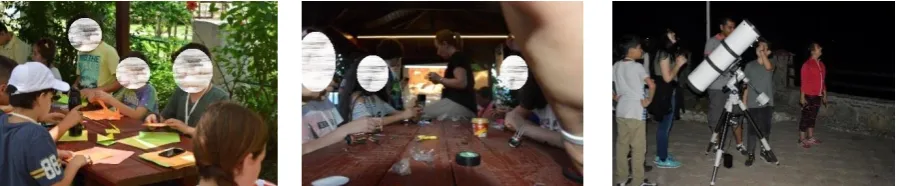
1st Day: On the first day of camp, the students engaged the areas of math, science education, and astronomy. They performed mathematical designs with origami and experienced artifact-oriented works with their peers. With "Designs in the Light of the History: From Invisible Steam to Magnetic Field" activity; students get to know about the Industrial Revolution. They took a step to engineering and experienced construction of an electric motor from the magnetic field in the basis of the history of science process. Therefore, they discovered the process of turning scientific knowledge into artifact using the engineering design process. In the evening, for the purpose of experiencing the out-of-school learning environments that form the basis of STEM education, they met the sky in the atmosphere of Akyaka campsite and performed the first sky observation of the camp (see Figure 2).
Figure 2. First day activities of the science and nature camp
2nd Day: To support participants' career choices for the STEM areas, students engaged astronomy and archeology. With the “My Eyes are Always on Sky” activity, students learned developing strategies to create an artifact and discovering. Using advanced technological tools (telescope), they discovered the scientific knowledge underlying these tools. In addition, they created their own artifacts working with their peers. "The Nature of Science: Archeology" activity followed by "the Typical Day for a Scientist: From Mythology to Archeology" activity, they had a holistic point of view towards science by comprehending the relationship between STEM and social sciences. In the evening, with the activity “Astronomy I", they experienced the using of advanced technological tools and made sky observations with their own handmade telescopes (see Figure 3).
3rd Day:Students experienced History of Science, Biology, Physics, Technology, Engineering, and Astronomy in order to support career choices for STEM areas, which is one of the main objectives of the camp. They comprehend the interaction between nature and science, the advantages that nature bring into society, and how society reflects those advantages in the development of science, by understanding the history of the region. Moreover, they carried out the activities on the Kedriai antique city (Sedir Island) in order to support the learning out of school. In the nature, they found an opportunity to discover endemic flora, fauna, and the special sand of the ancient city of Kedriai by carrying out experiments and observations. When they returned to the campsite in the evening, they created their own design artifacts (holograms) with „Bring Cosmos into the Classroom: 3D Hologram‟ activity (see Figure 4).
Figure 4. Third day activities of the science and nature camp
4th Day: Students worked in the areas of Engineering, Architecture, Physics and Art, and Astronomy STEM to
support career choices for STEM areas. They carried out "The First Step in the Engineering: A Bridge Design" activity that they internalized the engineering design process and created artifacts with their peers. They evaluated the bridges with engineering perspectives, which involves maximum durability, minimum cost, material usage, and aesthetic aspects. Then they talked over scientists and their scientific research in different points of view with the activity on physics and colors in art. In the evening, they brought their astronomy knowledge and experience to a higher level with "Astronomy III" activity (see Figure 5).
Figure 5. Fourth day activities of the science and nature camp
5th Day:Students came together with experts from Art, History, Biology, Materials Engineering, Physics, Atomic Research, and Water Creatures and Information Technologies in their career choices for STEM fields. They had the opportunity of closely observing the laboratories and scientific equipment (scanning tunnel microscope) used by a scientist working in nano sizes in basic sciences and meeting with the scientist and his team. They found the answers to questions they were curious about. On the other hand, they visited the laboratories and collections with the scientists working the underwater creatures. Apart from that, accompanied with experts, they visited Turkey's first indoor moulage museum, Mugla Sıtkı Kocman University Moulage Museum in order to recognize the cultural heritage that the university tries to bring the local people in their university. On the evening of the fifth day, an activity on a holistic point of view towards science and thinking outside of the box is carried out with the students (see Figure 6).
6th Day: This day, in the careers for STEM fields, students involved in Nano-Technology studies, Information and Coding, and Mathematics. They started the day with a design activity that they implemented on Nano-Fabrics in the field of Nano-Technology so that they internalized the engineering design process. They carried out the activity regarding coding and developing a robot (makey kit) in order to work artifact-oriented way with peers, to develop strategies to create artifacts and to learn discover. They experienced writing commands and some basic mathematical codes. In addition to this, they created the required spare parts in their designs with a 3D printer. In the evening, they prepared for the science fest with the project team (see Figure 7).
Figure 7. Sixth day activities of the science and nature camp
7th Day: Participants organized the Science Fair, one of the out of school learning environments that is a basis of the STEM education. Because 7th day corresponded the weekend time, participants had the opportunity to share their works with the people of the region (see Figure 8).
Figure 8. Seventh day activities of the science and nature camp
Instrumentation
In this paper, the camp project deliverables and learning outcomes are examined via qualitative and quantitative instruments. The instruments included STEM attitude scale for participants, camp and activity evaluation forms for participants, researcher notes, and participants‟ artifact evaluation forms.
STEM attitude scale developed by Faber, Unfried, Wiebe, Corn, Townsend, and Collins (2013) and adopted in Turkish by Yildirim and Selvi (2015). STEM attitude scale has a total of 37 items instrument based on a five point Likert scale, ranging from certainly agrees to certainly disagree. The attitude scale administered to gain an understanding of the effect of the camp on students‟ attitude STEM fields and 21st-century Skills. Example scale statements included: I would consider a career in science, I am the type of student to do well in math, and I am confident I can include others‟ perspectives when making decisions. Four dimensions of the instrument are Mathematics, Science, Engineering and Technology, and the 21st Century Skills. The Cronbach‟s alpha reliability coefficients of the Turkish version of the scale are 0.94 for STEM Attitude Scale (37 items), 0.89 for Mathematics dimension (8 items), 0.86 for Science dimension (9 items), 0.86 for Engineering and Technology dimension (9 items), and 0.89 for 21st century skills dimension (11 items). Confirmatory factor analysis fit index values (χ2/df = 4.72, RMSEA = 0.06, GFI = 0.87, AGFI = 0.85, NFI = 0.95, and CFI = 0.96) show that Turkish version of STEM Attitude Scale has a good level of fit (Yildirim and Selvi, 2015). STEM attitude scale was administered the first (pre-test) and last day (post-test) of the camp.
aspects of the activity you do not like?, and what would you like to add to the activity? for each activity. These two forms were administered the last day of the camp.
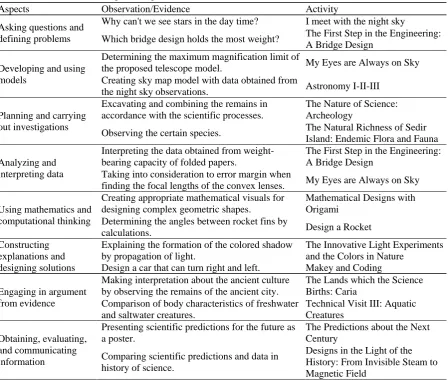
Researcher observation notes were used during the implementation in order to observe directly effect of activities on participants‟ science and engineering practices. Two independent researchers took the notes on what the students were doing while engaged in the activities. Researcher observation notes have written under eight categories included asking questions and defining problems, developing and using models, planning and carrying out investigations, analyzing and interpreting data, using mathematics and computational thinking, constructing explanations and designing solutions, engaging in argument from evidence, and obtaining, evaluating, and communicating information (NRC, 2011).
Artifact evaluation forms were developed by the three experts who have Ph.D. in Science, Mathematics, and Technology Education to evaluate the aspects of the artifacts. There was a unique form for each kind of artifact. These forms are based on the evaluation of common qualities as general evaluation and artifact design and functionality and evaluation of specific artifacts qualities. Common qualities included the criteria of the general evaluation such as "does the artifact involves STEM disciplines?", "related disciplines" etc. In addition, artifact design and functionality qualities included "artifact works properly?" and “artifact can be used as an independent user” etc. Artifact-specific criteria included particular artifact properties.
Data Analysis
Quantitative data obtained from STEM attitude scale were comparatively analyzed. The data checked for normal distribution with Shapiro Wilks test to decide using parametric or non-parametric statistics. According to Shapiro Wilks test results, it was found that data were not normally distributed (pre-test, W = .66, p < .05 and post-test, W = .88, p < .05). In order to compare pre-test and post-test scores of STEM attitude scale, Wilcoxon signed-ranks tests were used. The qualitative data obtained from Camp and activity evaluation forms were analyzed via inductive content analysis (Patton, 2002). Camp and activity evaluation forms were analyzed by two researchers using open coding to code participants‟ responses independently. The researchers discussed the emergent codes to reach a consensus for themes. After this process, themes, sub-themes, and codes were presented as a table with frequency. Researcher notes were analyzed using theory-driven content analysis (Krippendorff, 2004). The initial themes were identified under eight categories specified by NRC (2011) such as developing and using models and planning and carrying out investigations etc. Researchers‟ notes evaluated by two researchers based on the eight categories. Each written note categorized under a theme with a consensus of researchers. Themes and categorized observations were presented as a table. Two researchers from the project team evaluated the artifacts that the participants designed individually or as a group. Unique evaluation forms for each artifact were applied by two researchers and the consistency of the forms was calculated for their artifact to each kind of design. In this context, inter-rater reliability (IRR) of evaluation forms ranged from 92% to 100%.
Results
The Results of Attitudes towards STEM Fields and 21st-Century Skills
learning and concepts. It is important to create enriching learning environments with 21st-Century skills and engineering and technological skills attitudes training qualified and productive individuals in the future. However, a certain process is required for the development of these attitudes. STEM education programs need to be revised to support this process with long term interventions.
Table 1. Wilcoxon signed-ranks tests regarding STEM Attitude Scale pre-test and post-test scores
Dimensions
Pre-test-Post-test n
Mean rank
Sum of
ranks z p
Mathematics
Negative ranks 4 9.00 36.00 -2.96* .00 Positive ranks 18 12.06 217.00
Ties 7
Science Negative ranks 4 11.25 45.00 -3.18* .00
Positive ranks 21 13.33 280.00
Ties 4
Engineering and Technology
Negative ranks 5 10.70 53.50 -1.93* .06 Positive ranks 15 10.43 156.50
Ties 9
21st-Century Skills
Negative ranks 9 12.75 204.00 -1.12* .26 Positive ranks 16 13.44 121.00
Ties 4
STEM Attitude
Negative ranks 5 13.20 66.00 -3.12* .00 Positive ranks 23 14.78 340.00
Ties 1
* Based on negative ranks
The Results of Feedbacks on The Camp and The Activities
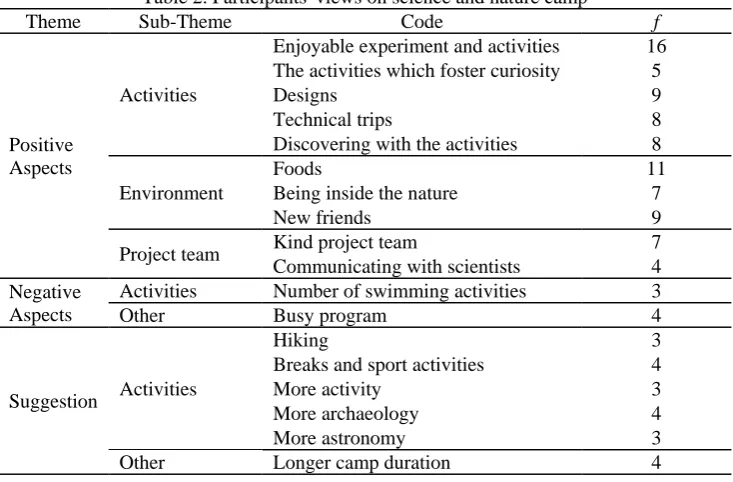
In order to investigate participants‟ views on the science and nature camp, evaluation forms were used. The themes obtained from the camp evaluation forms are positive aspects, negative aspects and suggestions. The themes, sub-themes, codes, and frequency values of codes regarding participants‟ views on science and nature camp are presented in table 2.
Table 2. Participants' views on science and nature camp
Theme Sub-Theme Code f
Positive Aspects
Activities
Enjoyable experiment and activities 16 The activities which foster curiosity 5
Designs 9
Technical trips 8
Discovering with the activities 8
Environment
Foods 11
Being inside the nature 7
New friends 9
Project team Kind project team 7
Communicating with scientists 4 Negative
Aspects
Activities Number of swimming activities 3
Other Busy program 4
Suggestion Activities
Hiking 3
Breaks and sport activities 4
More activity 3
More archaeology 4
More astronomy 3
Other Longer camp duration 4
were positively evaluated by participants. Moreover, it is understood that being inside the nature (f = 7), communicating with a scientist (f = 4), kind project team (f = 7), and new friendships (f = 9) are emphasized when the positive aspects theme of the participants are taken into account. When the negative aspects are examined, low number of swimming activities (f = 3) and busy program (f = 4) codes can be seen. According to participants' suggestions, it is seen that hiking (f = 3) and breaks and sports activities (f = 4) were demanded by participants. Furthermore, participants especially considered that more archeology (f = 4) and astronomy (f = 3) activities should be provided and camp duration (f = 4) should be extended.
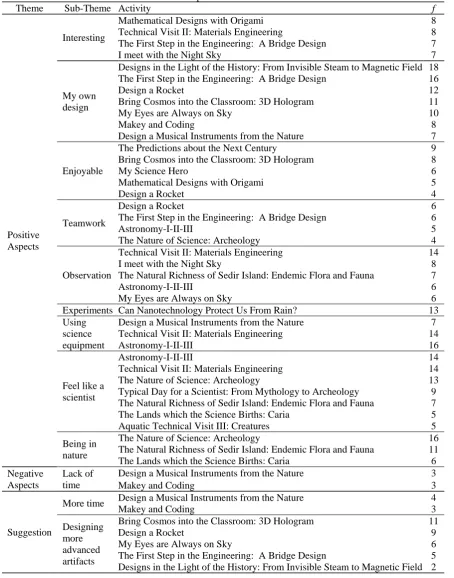
Table 3. Participants' views on the activities
Theme Sub-Theme Activity f
Positive Aspects
Interesting
Mathematical Designs with Origami 8
Technical Visit II: Materials Engineering 8
The First Step in the Engineering: A Bridge Design 7
I meet with the Night Sky 7
My own design
Designs in the Light of the History: From Invisible Steam to Magnetic Field 18 The First Step in the Engineering: A Bridge Design 16
Design a Rocket 12
Bring Cosmos into the Classroom: 3D Hologram 11
My Eyes are Always on Sky 10
Makey and Coding 8
Design a Musical Instruments from the Nature 7
Enjoyable
The Predictions about the Next Century 9
Bring Cosmos into the Classroom: 3D Hologram 8
My Science Hero 6
Mathematical Designs with Origami 5
Design a Rocket 4
Teamwork
Design a Rocket 6
The First Step in the Engineering: A Bridge Design 6
Astronomy-I-II-III 5
The Nature of Science: Archeology 4
Observation
Technical Visit II: Materials Engineering 14
I meet with the Night Sky 8
The Natural Richness of Sedir Island: Endemic Flora and Fauna 7
Astronomy-I-II-III 6
My Eyes are Always on Sky 6
Experiments Can Nanotechnology Protect Us From Rain? 13
Using science equipment
Design a Musical Instruments from the Nature 7
Technical Visit II: Materials Engineering 14
Astronomy-I-II-III 16
Feel like a scientist
Astronomy-I-II-III 14
Technical Visit II: Materials Engineering 14
The Nature of Science: Archeology 13
Typical Day for a Scientist: From Mythology to Archeology 9 The Natural Richness of Sedir Island: Endemic Flora and Fauna 7
The Lands which the Science Births: Caria 5
Aquatic Technical Visit III: Creatures 5
Being in nature
The Nature of Science: Archeology 16
The Natural Richness of Sedir Island: Endemic Flora and Fauna 11
The Lands which the Science Births: Caria 6
Negative Aspects
Lack of time
Design a Musical Instruments from the Nature 3
Makey and Coding 3
Suggestion
More time Design a Musical Instruments from the Nature 4
Makey and Coding 3
Designing more advanced artifacts
Bring Cosmos into the Classroom: 3D Hologram 11
Design a Rocket 9
My Eyes are Always on Sky 6
It should be taken into consideration that learners are "human beings" in the organization of STEM education environments. The concerns of a scientist who studies on living creatures in a laboratory or a doctor who studies with a patient do not harm to a living creature and they try to make him feel comfortable. In a similar manner, the comfort and motivation of the learners should be kept at a high level in learning environments. If you want to develop creative thinking skills, learners should be kept away from nervous environments and a cool environment should be created. Participants' views on science and nature camps are usually focused on the situation that they felt comfortable and happy such as involving enjoyable experiment and activities, making new friends, eating delicious foods, and communicating with scientists. This showed that they were happy about the science and nature camp in general terms. In addition, negative aspects and suggestion about the nature and science camp showed that they desired to create a more comfortable atmosphere for them.
The activity evaluation form used for examining participants' views on activities. The participants' responds gathered under three themes such as positive aspects, negative aspects, and suggestion. The themes, codes, and frequency values of codes regarding participants' views on activities are presented in table 3. Table 3 shows that the participants' views on the activities in the STEM-based Nature Science Camp that are collected under the theme of positive aspects, negative aspects, and suggestions. Majority of the activities considered as favorable by participants. Under the positive aspects theme, there are nine themes such as interesting, my own design, enjoyable, teamwork, observation, experiments, using science equipment, feel like a scientist and being in nature sub-themes. Particularly, design-based activities and activities supporting to work as a scientist were most favorable activities for participants. Under my own design sub-theme, Designs in the Light of the History: From Invisible Steam to Magnetic Field (f = 18) and The First Step in the Engineering: A Bridge Design activities (f = 16) have come to the forefront. For example, a participant (P5) stated “We build a paper bridge and it carried 12 kg. It was very cool.” and another participant (P26) commented, “I created an electric motor and I was the fastest one.” Under feel like a scientist sub-theme, Astronomy-I-II-III (f = 14), Technical Visit II: Materials Engineering (f = 14), and The Nature of Science: Archeology (f = 13), activities were very fascinating for participants. A participant (P19) remarked “I discovered a new constellation like Tycho Brahe.”, another participant (P3) expressed “That day I observed atoms via electron microscopes. I talked with them (physicists) like my colleagues.” one participant (P3) stated “Being an archaeologist is a job that needs to be very careful. If you miss a little part of the remains, it could be very hard to understand the whole remains.” Under negative aspects theme, only one sub-theme can be seen as lack of time. According to some participants, there was not enough time to accomplish Design a Musical Instruments from the Nature (f = 3) and Makey and Coding (f = 3) activities. Finally, it can be seen that suggestion theme includes more time and designing more advanced artifacts sub-themes. Some participants recommend more time for Design a Musical Instruments from the Nature (f = 4) Makey and Coding (f = 3) activities. Especially, for Bring Cosmos into the Classroom: 3D Hologram (f = 11) and Design a Rocket (f = 9) activities, participants desired designing more advanced artifacts such as human-size hologram and a model rocket respectively. As an example, a participant (P25) stated “We could build my hologram in my body size.” and another participant (P8) remarked “I could design a rocket which can reach too high if I generate enough thrust. But I need some chemicals.”
When these results are evaluated in general, the participants‟ views on the activities depended on “how much the activity influenced their senses”. This situation is similar to the participants‟ views on the science and nature camp. The positive aspects of the science and nature camp were overlapped with positive aspects of the activities. Features that are emphasized in positive aspects for activities were interesting, enjoyable, and feel like a scientist. Another noticeable situation about activities is that when the activity contributes to participants existing skills, participants evaluated activity as positive. For example, making their own designs and using science equipment fostered their self-confidence. The negative aspects and suggestion about activities such as lack of time and more time for some activities became prominent. As in popular culture, the individual is involved in the competitive environment by narrowing down the processes that make him happy. This means he makes concessions from he liked. Therefore, learning environments must be organized by extending over a period of time. Organizing a single theme-focused sequential activities such as robotics and artificial intelligence may deal with these participants‟ concerns. In addition, participants were expected to design real-like artifacts. These kinds of artifacts may contribute more meaningful learning.
The Results from Observation Notes about The Activities
Table 4. Example excerpts from researcher observation notes about some activities
Aspects Observation/Evidence Activity
Asking questions and defining problems
Why can't we see stars in the day time? I meet with the night sky
Which bridge design holds the most weight? The First Step in the Engineering: A Bridge Design
Developing and using models
Determining the maximum magnification limit of
the proposed telescope model. My Eyes are Always on Sky Creating sky map model with data obtained from
the night sky observations. Astronomy I-II-III
Planning and carrying out investigations
Excavating and combining the remains in accordance with the scientific processes.
The Nature of Science: Archeology
Observing the certain species. The Natural Richness of Sedir Island: Endemic Flora and Fauna
Analyzing and interpreting data
Interpreting the data obtained from weight-bearing capacity of folded papers.
The First Step in the Engineering: A Bridge Design
Taking into consideration to error margin when
finding the focal lengths of the convex lenses. My Eyes are Always on Sky
Using mathematics and computational thinking
Creating appropriate mathematical visuals for designing complex geometric shapes.
Mathematical Designs with Origami
Determining the angles between rocket fins by
calculations. Design a Rocket
Constructing explanations and designing solutions
Explaining the formation of the colored shadow by propagation of light.
The Innovative Light Experiments and the Colors in Nature
Design a car that can turn right and left. Makey and Coding
Engaging in argument from evidence
Making interpretation about the ancient culture by observing the remains of the ancient city.
The Lands which the Science Births: Caria
Comparison of body characteristics of freshwater and saltwater creatures.
Technical Visit III: Aquatic Creatures
Obtaining, evaluating, and communicating information
Presenting scientific predictions for the future as a poster.
The Predictions about the Next Century
Comparing scientific predictions and data in history of science.
Designs in the Light of the History: From Invisible Steam to Magnetic Field
about the Next Century” activity. The participants communicated about the ideas and methods when they generated particularly in group activities. For example, they presented scientific predictions for the future as a poster with their peers.
Reading a book is a skill. But reading a book regularly is a behavior. Playing the piano is a skill. When the individual plays the piano regularly to develop himself, it is a behavior. In this process, science and engineering practices serve exactly this situation. These eight seen behaviors above are the behaviors that are expected to be observed in the STEM education programs repeatedly. In this context, observing these behaviors in the science and nature camps for STEM education is vital for the development of thinking and working like scientists and/or engineers.
The Results from The Assessments of Participants’ Artifacts
The artifact evaluation forms used to investigate participants' artifacts designed as individually and group. When artifact evaluation forms were examined, it is understood that the majority of the artifacts focused on STEM disciplines and the interaction of STEM disciplines. The artifacts were based on physics, astronomy, mathematics, engineering, technology, archeology, music, coding, and many other disciplines. These designs were created in different disciplines. That contributed to the participants discovering the diversity and integrity of science. Designing artifacts based on different scientific principles and concepts supported design based learning. The inclusion of different variables in the design of each artifact allowed participants to use the process of thinking with variables. In addition to that, the artifacts provided many qualities based on design and functionality criteria such as artifact, ease of use and easy storage. This is an indicator of the transformation of scientific knowledge into functional artifacts through an artifact-oriented approach based on the engineering design process.
The evaluation of the artifacts turns into an ineffective evaluation when it conducted superficially such as successful/unsuccessful or good/bad. On the contrary, dividing artifact evaluation into categories with certain features provides facilitators a scientific assessment to the effectiveness of STEM education. In addition, facilitators who already know these features can enrich the learning environments.
Discussion and Conclusion
Gifted students have great potential to deal with global economic challenges. However, there are no sufficient learning opportunities for these students for STEM education (Jolly, 2009). MUBEM & SAC: STEM Based Science and Nature Camp gave an opportunity to sixth and seventh grade gifted student by engaging STEM concepts in the informal learning environment. The science and nature camp was a unique program shaped and formed the ideas such as to foster holistic science viewpoint and scientific culture, to transfer scientific knowledge into an artifact using curiosity and scientific inquiry, to experience outdoor learning environments and scientific researches with scientists, and to support career choices of participants for STEM fields. For this purpose, it was aimed to support the intellectual development of gifted students and use the skills they possess in the short term. These learning outcomes can serve to bring society closer to scientific and artifact-oriented thinking in the long term.
no significant difference was found in the dimensions of Technology and Engineering and 21st-century skills in the current study. A longer program is needed to improve attitudes in these dimensions.
The integration of STEM disciplines, social sciences and arts contributed greatly to the constitution of a holistic view of science. According to these results, the researcher observation notes and activity evaluation forms also reveals similar evidence. Because the participants experienced various disciplines, they created artifacts on the basis of scientific knowledge and process with the scientists. These artifacts created with variety of disciplines. In addition, the ability to think with variables that shape creative thinking skills constitutes the basis of design activities in particular. Taking into account the artifact evaluation forms, it can be understood that the participants designed different and creative artifacts. According to literature, it is seen that researches about the evaluation of students‟ artifacts are limited (Brozis and Świderski, 2018; Hathcock, Dickerson, Eckhoff, and Katsioloudis, 2015). For example, Brozis and Świderski (2018) evaluated the features of a planetarium designed by university students. The researchers stated that the artifacts were durable, functional and made with simple and inexpensive materials. Hathcock et al. (2015) examined the effects of STEM activities on the student‟s artifacts. The results of the research revealed that the student‟s artifacts were creative.
According to researcher notes, students have developed their thinking skills as a scientist/engineer. Participants gathered with experts from different disciplines during the project to get detailed information about their profession. They have experienced discussing with experts from many different disciplines such as astronomy, material engineering, and archeology. Participants found answers such questions that how does a scientist (an archaeologist, physicist, and engineer, etc.) work? and how does the scientist do research? at first hand. Meeting with the scientist allowed participants to find role models in the selection of professions. With these experts, participants had the opportunity to recognize or use the scientific devices used by scientists such as electron microscopes and telescopes. However, further investigation is needed on gifted students‟ long-term possible pursuit of STEM carriers.
Acknowledgements or Notes
The project funded by The Scientific and Technological Research Council of Turkey (TUBITAK 4004-Project number: 117B227).
References
Ananiadou, K., & Claro, M. (2009). 21st century skills and competences for new millennium learners in OECD countries. Paris: OECD Publishing.
Back, S. M., Greenhalgh-Spencer, H., & Frias, M. F. (2015). The application of transdisciplinary theory and practice to STEM education. In Y. Rosen, S. Ferrara, & M. Mosharraf (Eds.), Handbook of research on technology tools for real-world skill development (pp. 42-67). Hershey, PA: IGI Global.
Ball, C., Huang, K. T., Cotten, S. R., & Rikard, R. V. (2017). Pressurizing the STEM pipeline: An
expectancy-value theory analysis of youths‟ STEM attitudes.
Journal of Science Education and Technology, 26(4), 372-382. doi:10.1007/s109 56-017-9685-1 Bell, P., Lewenstein, B., Shouse, A., & Feder, M. (2009). Committee on learning science in informal
environments. Washington, DC: National Academies Press.
Brozis, M., & Świderski, K. (2018). Students‟ planetarium. Physics Education, 53(3), 035029. doi:10.1088/1361-6552/aab0f8
Bybee, R. W. (2010). Advancing STEM education: A 2020 vision. Technology and Engineering Teacher, 70(1), 30.
Crane, V., Nicholson, H., Chen, M., & Bitgood, S. (1994). Informal Science Learning. Dedham, UK: Research Communications.
Dailey, D., Cotabish, A., & Jackson, N. (2018). Increasing Early Opportunities in Engineering for Advanced Learners in Elementary Classrooms: A Review of Recent Literature. Journal for the Education of the Gifted, 41(1), 93-105.
Damar, A., Durmaz, C., & Önder, İ. (2017). Ortaokul öğrencilerinin FeTeMM uygulamalarına yönelik tutumları
of Multidisciplinary Studies in Education, 1(1), 47-65. Retrived from http://dergi park.gov.tr/jmse/issue/35452/415256
Faber, M., Unfried, A., Wiebe, E. N., Corn, J., Townsend, T., & Collins, T. (2013). Student Attitudes toward STEM: The Development of Upper Elementary School and Middle/High School Student Surveys. Proceedings of the 2013 American Society for Engineering Education Annual Conference & Exposition. Washington, DC: ASEE.
Gerber, B. L., Cavallo, A. M., & Marek, E. A. (2001). Relationships among informal learning environments, teaching procedures and scientific reasoning ability. International Journal of Science Education, 23(5), 535-549.
Guthrie, W. K. C. (1962). A History of Greek Philosophy, The earlier Presocratics and the Pythagoreans. New York, NY: Cambridge University Press.
Harlen, W. (2015). Working with big ideas of science education. Trieste, Italy: Science Education Programme of IAP.
Hathcock, S. J., Dickerson, D. L., Eckhoff, A., & Katsioloudis, P. (2015). Scaffolding for creative product
possibilities in a design-based STEM activity. Research in
Science Education, 45(5), 727-748. doi:10.1007/s11165-014-9437-7
Hawkey, R. (2002). The lifelong learning game: season ticket or free transfer?. Computers & Education, 38(1-3), 5-20.
Hofstein, A., & Rosenfeld, S. (1996). Bridging the gap between formal and informal science learning. Studies in Science Education, 28(1), 87-112.
Jolly, J. L. (2009). Historical perspectives: The national defense education act, current STEM initiative, and the gifted. Gifted Child Today, 32(2), 50-53.
Kennedy, T. J., & Odell, M. R. L. (2014). Engaging students in STEM education. Science Education International, 25(3), 246-258.
Krippendorff, K. (2004). Content analysis: An introduction to its methodology (2nd ed.). California: Sage. Lundgren, D. D., Laugen, R. C., Lindeman, C. A., Shapiro, M. J., & Thomas, J. J. (2011). Schools like ours
realizing our STEM future. Virginia: NCSSS.
Maltby, F. (1984). Gifted children teachers in the primary school. London: Falmer Press.
McDonald, C. V. (2016). STEM Education: A review of the contribution of the disciplines of science, technology, engineering and mathematics. Science Education International, 27(4), 530-569.
Ministry of National Education. (2007). Regulations of Science and Art Centers. Retrieved from http://mevzuat.meb.gov.tr/html/2593_0.html
Mohr-Schroeder, M. J., Jackson, C., Miller, M., Walcott, B., Little, D. L., Speler, L., … Schroeder, D. C. (2014). Developing middle school students‟ interests in STEM via summer learning experiences: See
blue STEM camp. School Science and
Mathematics, 114(6), 291-301. doi:10.1111/ssm.12079
Myers, A., & Berkowicz, J. (2015). The STEM shift: A guide for school leaders. California: Corwin Press. National Academy of Sciences, National Academy of Engineering, and Institute of Medicine. (2007). Rising
above the gathering storm: Energizing and employing America for a brighter economic future. Washington, DC: National Academies Press.
National Association for Gifted Children. (2010). Redefining giftedness for a new century: Shifting the
paradigm. Retrieved from https://www.nagc.org/sites/default/files/Position%20Statement/Redefining%
20Giftedness%20for%20a%20New%20Century.pdf
National Research Council. (2011). Successful K-12 STEM education: Identifying effective approaches in science, technology, engineering, and mathematics. Washington, DC: National Academies Press.
National Research Council. (2015). Identifying and supporting productive STEM programs in out-of-school settings. Washington, DC: National Academies Press.
National Wildlife Federation. (2015). Green STEM: How environment based education boosts student engagement and academic achievement in science, technology, engineering and math. Reston, VA: National Wildlife Federation.
O'Grady P. F. (2016). Thales of Miletus: The Beginnings of Western Science and Philosophy. New York, NY: Routledge.
Olszewski-Kubilius, P. (2010). Special schools and other options for gifted STEM students. Roeper Review, 32(1), 61-70.
Parliamentary Office of Science and Technology. (2011). Informal STEM Education. Retrieved from https://www.parliament.uk/pagefiles/504/postpn_382-informal-science-education.pdf
Patton, M.Q. (2002). Qualitative evaluation and research methods (3nd ed.). Newbury Park, CA: Sage.
President‟s Council of Advisors on Science and Technology. (2010). Prepare and inspire: K-12 education in STEM (science, technology, engineering and math) for America’s future. Retrieved from http://www. whitehouse.gov/sites/default/files/microsites/ostp/pcast-stemed-report.pdf
Renzulli, J. S., & Reis, S. M. (1985). The school-wide enrichment model: A comprehensive plan for educational excellence. Mansfield Center, CT: Creative Learning.
Salmi, H. (1993). Science centre education: Motivation and learning in informal education (Doctoral dissertation). Retrieved from ERIC. (ED363613)
Salmi, H. (2003). Science centres as learning laboratories: experiences of Heureka, the Finnish Science Centre. International Journal of Technology Management, 25(5), 460-476.
Salmi, H. (2010). Bridging the gap between formal education and informal learning: towards evidence based education. In M. Kalogiannakis, S. Stavrou, P. Michaelides (Eds.), Hands-on Science. Laboratory of science teaching (pp. 35-41). Rethymno: Crete.
Salmi, H., Kallunki, V., & Kaasinen, A. (2012). Bridging the gap between formal education and learning in informal contexts. In H. Salmi (Ed.), Implementing Inquiry beyond the school (pp. 5-7). Retrieved from http://fibonacci.uni-bayreuth.de/resources/resources-for-implementing-inquiry.html
Sullenger, K. (2006). Beyond school walls: Informal education and the culture of science. Education Canada, 46(3), 15–18.
Taber, K. S. (2010). Challenging gifted learners: General principles for science educators; and exemplification in the context of teaching chemistry. Science Education International, 21(1), 5-30.
Tarhan, S., & Kılıç, S. (2014). Identification of gifted and talented student and models in Turkey. Journal of Gifted Education Research, 2(2), 27-43.
Tayal, S. P. (2013). Engineering design process. International Journal of Computer Science and Communication Engineering, 1-5.
United Nations Educational, Scientific and Cultural Organization. (2012). International standard classification of education: ISCED 2011. Retrieved from http://uis.unesco.org/sites/default/files/documents/inter national-standard-classification-of-education-isced-2011-en.pdf
United States Department of Education. (1993). National excellence: A case for developing America’s talent. Retrieved from http://nagc.org.442elmp01.blackmesh.com/sites/default/files/key%20reports/National %20Excellence%20%281993%29.pdf
van Langen, A., & Dekkers, H. (2005). Cross‐national differences in participating in tertiary science, technology, engineering and mathematics education. Comparative Education, 41(3), 329-350.
Wang, H., Moore, T., Roehrig, G., & Park, M. (2011). STEM integration: Teacher perceptions and practice. Journal of Pre-College Engineering Education Research, 1(2), 1-13.
Yıldırım, B., & Selvi, M. (2015). Adaptation of STEM attitude scale to Turkish. Turkish Studies - International Periodical for the Languages, Literature and History of Turkish or Turkic, 10(3), 1107- 1120.
Author Information
Hasan Zuhtu OkuluMugla Sitki Kocman University, Faculty of Education 48000 Muğla, Turkey
Contact e-mail: [email protected]
Ayse Oguz Unver
Mugla Sitki Kocman University, Faculty of Education 48000 Muğla, Turkey
Sertac Arabacioglu