IJSRSET1732187 | 15 April 2017 | Accepted : 22 April 2017 | March-April-2017 [(2)2: 678-684]
© 2017 IJSRSET | Volume 3 | Issue 2 | Print ISSN: 2395-1990 | Online ISSN : 2394-4099 Themed Section: Engineering and Technology
678
The Essence of "Temperature" and its Relationship with Thermal state of
the System
1
Utelbayev B. T.,
1Suleimenov E. N. ,
2Utelbayeva A.B.
1Kazakhstan - British Technical University
2
South-Kazakhstan State University named after M. Auezov,
Kazakhstan
ABSTRACT
It is shown the essence of the concept of "temperature" and its connection with the transfer of heat were analyzed between the material objects at the micro-macro level of the system. New fundamental concepts such as heat transfer by its carriers “teplotron”, the possibility forming "combinations" of elementary particles, the "pulsation" of microobjects, etc. can be used to develop modern technologies aimed to creating new materials and rational use of natural resources.
Keywords : Temperature, Chemical Individual, Electron, Teplotron, Photon, Combination of Elementary Particles
I.
INTRODUCTION
Material objects are characterized by the amount of substance (n), and the parameters of the state of volume (V), pressure (P) and temperature (T). The relationship between these quantities for an ideal gas is expressed by the Mendeleev-Clapeyron equation in the form: PV = nRT. Here the temperature is a physical quantity that quantitatively expresses the degree of heating of the system at constant pressure and directly relates to heat [1-12]. Although the named parameters - heat and temperature seem very simple, they require detailed consideration of their physical essence for establishing the fundamental laws of heat transfer between material objects. In this relationship, the word "temperature" arose in those days when people believed that in more heated bodies contains more of a special substance - heat, than in less heated [7]. In the molecular-kinetic theory, which refutes the theory of heat and phlogiston, it is asserted that temperature is the average kinetic energy of the motion of atoms and molecules of the system. In statistical thermodynamics, the temperature of a system is characterized by the distribution of particles over energy levels and their velocities, etc. [3,5,6,10-12]. In general, for a system in thermodynamic equilibrium, when all these parameters are in the same thermal state, they are simply called
temperature of the system [3-6,8,9,12]. Such a difference in the temperature characteristic means the absence of a single scientific concept of "temperature."
This article considers a general approach to explaining the physical and chemical processes of the formation and development of the structure of material objects and the essence of new fundamental concepts, in particular, heat transfer by "teplotrons", the possibility of forming "combinations" of elementary particles and "pulsation" of microobjects.
II.
DISCUSSION
content and the corresponding temperature under the influence of thermal, light energy and other factors, chemical and biochemical reactions occur, in particular, ensuring the vital activity of the living and plant world; there are phase transitions and many other changes in the "chemical individuals" of substances. By "chemical individual" we suggest to understand the primary elementary structure (elementary link), which is responsible for the formation of the structure of macroscopic formation [13]. Consequently, the physical and chemical properties of macrosystem are the function of their microstructure. The structure of microstructures includes various elementary particles, interconnected with each other and each of which is endowed with certain properties, the set of which expresses the corresponding parameters of the state P, V, T and the internal energy of the system.
It is common knowledge that all energy values relate to a certain amount of matter, therefore, "energy" is a property of the matter which characterizes its movement qualitatively and quantitatively, and heat and work are forms of energy transfer [3-6,12]. In a material object heat and work are manifested as a result of the process and cease with the termination of the process [8,9]. However, the movement of the structural elements of the "chemical individual" makes it possible to judge the continuous flow of processes that result in the energy exchange [14], and, therefore, there is an exchange by elementary particles - energy carriers, the magnitude of which is described by the equation of M. Planck:
ε = hv
where h - is the Planck’s constant (6.6261 ∙ 10-34 J ∙ s); v
- is the frequency of the electromagnetic wave, Hz. In this equation, derived for describing the thermal radiation of an absolutely black body, we proposed in [15] the physical essence of the motion of "elementary particles" ("teplotrons", photons, "combinations of elementary particles," etc.). Similarly, elementary particles formed in "chemical individuals" interacting with the components of the environment create a dynamic equilibrium of the corresponding thermal state. Here, "temperature" characterizes the degree of heating of the body (substances) at thermal equilibrium. According to [16], the physical meaning of the thermodynamic temperature is a measure of the average kinetic energy of the thermal chaotic motion of molecules in states of an ideal gas:
ε = 1,5kT
However, we showed in [17] that the discrepancy between the values of the energy of the thermal chaotic motion of water molecules calculated for kinetic energy at 3173K is 39.54 ∙ 103 J / mol and experimentally
determined by thermochemical data of 285.8 ∙ 103 J /
mol (the value of 3173 K corresponds to maximum temperature of combustion of hydrogen in oxygen). An essential difference in the values of heat determined by two different traditional methods means that in addition to thermal motions of molecules, one should also take into account the motion of elementary particles, which is suggested to be considered the internal energy of a material object. Consequently, this requires, along with the translational motion of the molecules themselves, to take into account the motion of elementary particles of constituent atoms and molecules, i.e., elementary particles of "chemical individuals". In this respect, the new elementary particle, the carrier of heat - "teplotron" [14,15,18-23], suggusted by us, brings clarity into the concept of "transfer of thermal energy" and allows to simultaneously consider processes at micro- and macrolevels. The elementary carrier of heat is called "teplotron" - in connection with the absence of strict definitions and terms in the scientific literature that characterize the process of heat transfer at the level of "elementary particles". In statistical thermodynamics at a given temperature, the total kinetic energy of the motion of atoms and molecules is assumed to be ΣxikT.
We assume, that the heat transfer between the structural elements of the system is carried out by "teplotrons", then for these elementary particles the kinetic energy can similarly be assumed:
ε = Σxi kT
where k- is the Boltzmann’s constant (1.3806∙ 10-23J /
K); T - is the thermodynamic temperature of the system, K; Σxiis the total number of the contribution of kT to
equilibrium of the system, the total value of the contributions of the kinetic energy of the elementary particles of the heat carriers should be equal to the energy of the quanta of thermal radiation, i.e, for the same particle, the following equality must hold:
Σxi kT = hv.
In contrast to the frequencies (v) in M. Planck's equations, ε = hv, in the given reasoning v -refers to the frequency of "pulsations" of elementary particles, which creates a picture of a standing wave. To determine the number Σxi, we use the spectroscopic data
of IR radiation. According to existing views, heat transfer in a vacuum is attributed to infrared radiation [25]. In this respect, it is considered that thermal radiation is a process of "propagation of the internal energy of a radiating body". IR radiation depends on temperature and with increasing temperature there is an intense emission of thermal particles, each of which carries a quantum of energy and participates in heat-exchange processes. On the basis of spectroscopic data [25] for a different range of infrared radiation, we can calculate the total number Σxi of the contribution kT. It
follows from the above formula that the temperature of the system is proportional to the frequency of "pulsations" of the elementary particle:
T = hv / Σxik = 6.6261∙10-34∙ v / (Σхi ∙ 1.3806 ∙10-23) =
4.7994∙10-11 ∙ v / Σx i
where v - is the frequency of the "pulsation" of the elementary particle, c-1;
In the theory of the specific heat of a solid in Debye's works for a maximum vibration of atoms, the ratio hvmax
/ k is called the characteristic temperature - the "Debye temperature" [8]. Similarly, in the law of the displacement of Wine, derived using the laws of thermodynamics with respect to electromagnetic radiation, the relationship between temperature and the radiation frequency is expressed [26]:
vmax = αkT / h
where, vmax = c / λmax and c -is the speed of light in
vacuum; vmax and λmax - the maximum frequency and
wavelength of the radiation; h -is the Planck’s constant; k -is the Boltzmann’s constant; α –Wine’s constant equal to 0.002898 m∙ K and T-temperature. The Wine
formula establishes the wavelength (frequency) of the wave, at which the blackbody energy flux reaches its maximum, from the temperature of an absolutely black body. However, the physical meaning of the temperature itself, as one of the state parameters characterizing the thermal equilibrium of the system, is not disclosed in these formulas and in the scientific literature. From the equation T = hv / Σхik for infrared
radiation of the near range at temperatures 4000K and
3620K with frequencies 4∙1014Hz and 3.8∙1014 Hz,
respectively, we determine the total number of the contribution Σxi:
4000 = 4.7994 ∙ 10-11 ∙ 4 ∙ 1014 / Σx i
Σxi = 4.7994 ∙ 4 ∙ 103/4 ∙ 103 = 4.79
3620 = 4.7994 ∙ 10-11 ∙ 3.8 ∙ 1014 / Σx i
Σxi = 4.7994 ∙ 3.8 ∙ 103/3620 = 5.03
For the average range at temperatures of 2070 K and
600K with frequencies of 2.17∙1014 and 6∙1013 Hz,
respectively:
2070 = 4.7994 ∙ 10-11 ∙ 2.17 ∙ 1014 / Σx i
Σxi = 4.7994 ∙ 2.2 ∙ 103/2070 = 5,1
600 = 4.7994 ∙ 10-11 ∙ 6 ∙ 1013 / Σx i
Σxi = 4.7994 ∙ 6 ∙ 102/600 = 4.79
For the long range at temperatures of 290 K and 90 K with frequencies of 3 ∙ 1013 and 1 ∙ 1013 Hz, respectively:
290 = 4.7994 ∙ 10-11 ∙ 3 ∙ 1013 / Σx i
Σхi = 4.7994 ∙ 3 ∙ 102/290 = 4.96
90 = 4.7994 ∙ 10-11 ∙ 1 ∙ 1013 / Σx i
Σхi = 4.7994 ∙ 1 ∙ 102/90 = 5,33
Determine the average value for Σxi:
Σхi = (4.79 + 5.03 + 5.10 + 4.79 + 4.96 + 5.33) /6 = 5.0.
Hence the total kinetic energy of the thermal motion of an elementary particle:
ΣхikT = 5kT
Then for a system in thermal equilibrium with the environment, the following equality holds:
The left-hand side of the equation expresses the total contribution of the kinetic energy of the motion of elementary particles to thermal equilibrium, and the right-hand side characterizes the quantum-mechanical energy of a particle of thermal radiation in this state. Consequently, the equality implies that the temperature of the system depends on the frequency of "pulsations" of elementary particles -v- responsible for the thermal state:
T = hv / Σxi k = 0.959 ∙ 10-11 ∙ v,
where h / Σxi ∙ k = 0.959 ∙ 10-11К ∙ s is the temperature
constant of the elementary particle - the carrier of heat. Consequently, the formula T = 0.959 ∙ 10-11 ∙ v
determines that the temperature characterizes the "intensive", and entropic -extensive properties of the system. From here we can draw a conclusion:
The temperature of the system in thermal equilibrium is determined by the frequency of pulsations of the elementary particles of the heat carriers - the
"teplotrons", and the arrangement of the structural elements of the "chemical individual" is characterized by the entropy factor. When the heat Q is transferred to the system its entropy changes to ΔS, and at the thermal state temperature is equal to T, then:
Q = T ΔS or Q = 0.959 ∙ 10-11∙ v ∙ ΔS
This formula connects the amount of heat with the change of internal arrangement of “pulsation” particles
of the material object describing by entropy, and usually characterizing by temperature, revealing its physical essence for any thermodynamic system.
Consider the process of photosynthesis, where the transfer of heat is effected by the action of sunlight, moisture, carbon dioxide and other factors, where carbohydrates are mainly formed. In plants (in general, fuels and other combustible substances), it is impossible to detect the absorbed "heat" and "light" in an explicit form [22, 23]. However, when burning them, they are back allocated in the form of heat, light, etc. (conditionally for the elementary link):
C6H10O5 + O2 → CO2 + H2O + ΔH + other.
It should be noted, that the amount of oxygen released during photosynthesis is equivalent to being absorbed in the burning of plants. A set of elementary particles with a characteristic frequency of "pulsations" formed at "chemical individuals" of substances under stationary conditions [14,15,22,23], are in thermal equilibrium with the environment perceived as electromagnetic waves (field) or "ether." Impact to the system from outside by energy affects the structural and energy correspondence of "chemical individuals" and change in the number and frequency of "pulsations" of elementary particles [14,15,22,23]. With enough energy, the system goes into a "quasi-atomic-state". As a result of the interaction of nuclei with valence electrons during their displacements, pulsating elementary particles are additionally allocated, which, due to a violation of their equilibrium, tend to create a chaotic effect of heat, light, etc. in the environment [24]. The valent electrons emitted the elementary particles -carriers of heat, light and after it participate in the formation of a new bond by the principle of the greatest difference in chemical potential (Δμ):
Δμ = μ (finite) - μ (initial)
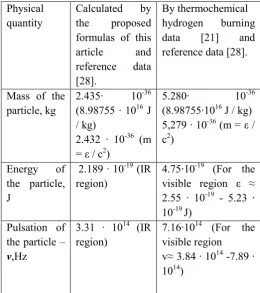
indicate the simultaneous presence of carriers of heat and light (Table 1). The transition from some types of elementary particles to others is expressed in their frequency of "pulsations" . For example, for the maximum temperature of 3173 K under hydrogen combustion [31], according to the formula T = 0.959 ∙ 10-11 ∙ v, the “pulsations frequency” of the heat carrier:
v = T / 0.959 ∙ 10-11.
v = 3173 / 0.959 ∙ 10-11 = 3.31 ∙ 1014Hz
The calculated value of 3.31∙ 1014 Hz is included in the
IR region by the frequency value, and the particle frequency calculated from the thermochemical data by M. Planck's equation in [30] is 7.16 ∙ 1014 Hz and falls
within the visible light range. Similarly, using Planck's formula ε = hv and the total kinetic energy of the thermal motion of the elementary particle ε = Σxi kT, we
calculate the energy of the elementary particle - the heat carrier at a temperature 3173 K and a frequency of 3.31 ∙ 1014Hz:
ε = hv
ε = 6.6261 ∙ 10-34 ∙ 3.31 ∙ 1014 = 2.189 ∙ 10-19J
ε = Σxi kT
ε = 5 ∙ 1.38 ∙ 10-23 ∙ 3173 = 2.189 ∙ 10-19 J
Using the coefficient of transition from mass to energy [28], we calculate the masses of the elementary particles of the heat carrier:
m = 2.189 ∙ 10-19 / 8.98755 ∙ 1016 = 2.435 ∙ 10-36 kg
We determine the same mass of the particle with allowance from the equation:
ε = mс2 ; m = ε / c2;
m = 2.189 ∙ 10-19 / (3 ∙ 108) 2 = 2.432 ∙ 10-36 kg
In the case of combustion of hydrogen in oxygen in [24], the mass of the elementary particle of heat carriers were 5.279∙10-36kg and 5.280∙10-36kg calculated by two
different methods (Table 1). An essence difference in the mass of elementary particles is due to the fact that when hydrogen is burned the heat carriers are the combination of photon and "teplotron" (5.280 ∙ 10-36 kg,
v = 7.16 ∙ 1014Hz) in contrast with "teplotron" (2.432 ∙ 10-36 kg; v = 3.31 ∙ 1014Hz).
Table 1. Comparative data of elementary particles of heat carriers
Physical quantity
Calculated by the proposed formulas of this article and reference data [28].
By thermochemical hydrogen burning data [21] and reference data [28].
Mass of the particle, kg
2.435∙ 10-36
(8.98755 ∙ 1016 J
/ kg)
2.432 ∙ 10-36 (m
= ε / c2)
5.280∙ 10-36
(8.98755∙1016 J / kg)
5,279 ∙ 10-36 (m = ε /
c2)
Energy of the particle, J
2.189 ∙ 10-19 (IR
region)
4.75∙10-19 (For the
visible region ε ≈ 2.55 ∙ 10-19 - 5.23 ∙
10-19 J)
Pulsation of the particle – v,Hz
3.31 ∙ 1014 (IR
region)
7.16∙1014 (For the
visible region v≈ 3.84 ∙ 1014 -7.89 ∙
1014)
The IR region belongs to thermal radiation, where the carriers of heat are the "radiators", and the visible region to the photons. Using the data of table 1 it is possible to determine the individual characteristics of a photon and a "teplotron", where they can participate together in any physical and chemical process.
III.
CONCLUSION
that in the course of physicochemical processes, "combinations of elementary particles" can be formed, in particular, from "teploltrons", photons and electrons [14,15,21-24]. The new fundamental concepts that we published (the transfer of heat by "heat generators", the possibility of forming "combinations" of elementary particles, the causes of "pulsations" of microobjects, etc.) have a high potential for further development in order to use these provisions for developing breakthrough technologies aimed at creating new materials and Rational use of natural resources.
IV.
REFERENCES
[1]. https://en.wikipedia.org/wiki/Temperature [2]. Physics. Great Encyclopaedic Dictionary / Ch.
Ed. A. M. Prokhorov. -M .: The Great Russian Encyclopedia, 1998. - P. 741. - 944 p. Russian [3]. Zalewski K. Phenomenological and statistical
thermodynamics: A short course of lectures / Transl. from Polish. under. ed. LA Serafimova .- Moscow: Mir, 1973. -168 p. Russian.
[4]. www.decoder.ru/list/all/topic_77/ Fundamental interactions of matter and energy. - Decoder.Ru [5]. Sivukhin D.V. General course of physics.
Thermodynamics and molecular physics, vol.2, M .: Nauka, 1990. - 591 p. Russian
[6]. Physical Chemistry / Ed. K.S. Krasnov .- M .: Higher School, 1982.-687p. Russian
[7]. Electronic resource. https://en.wikipedia.org/wiki/Theplorod.
Russian
[8]. Soddy F. Matter and energy. Publishing house "Nature", Moscow, 1913, 182 p. Russian [9]. Voyevodsky A. What is the temperature,
pressure and sound in gases from the point of view of quantum mechanics? 314159.ru/voevodskiy/voevodskiy2.htm
Russian
[10]. R. Kubo. Thermodynamics / Ed. Translation by DN Zubarev, NM Plakida. - Moscow: Mir, 1970.-304 p. Russian
[11]. Kvasnikov, Thermodynamics and Statistical Physics. T. 1, 2002, p. 11. Russian
[12]. Smorodinsky A. Temperature-M.: TERRA-Knizhnyy Klub, 2008.-224p. Russian
[13]. Utelbayev B, Suleimenov E, Utelbayeva A, Zhanabay N. Some Concepts about Substance, Chemical compound and an Element//American
Chemical Science Journal. 2014.4 (2) PP.166-73
[14]. Utelbayev BT, Suleimenov EN, Utelbayeva AB. The nature of the motion of elementary particles and the form of energy transfer// Science and World. International scientific journal.-2016.-No. 9 (37), Vol.1.-PP.32-35. Russian.
[15]. Utelbayev BT, Suleimenov EN, Utelbayeva AB. Results of changes in the structural-energy correspondence in the structure of material objects// Science and world. 2016. No. 8 (36). Vol. I.,pp.12-16 Russian.
[16]. Yavorsky B.M. Seleznev Yu.A. Reference manual on physics for entering universities and for self-education. M .: Nauka.-Gl.red.fiz.-mat.lit., 1989.-576p. Russian.
[17]. Utelbayev BT, Suleimenov EN, Utelbayeva AB. About the transfer of heat between material objects .// Science and World. 2015 vol.1 No.2. 18) p.39-43. Russian
[18]. Utelbayev BT, Suleimenov EN, Utelbayeva AB.. The Hypothesis about Heat Transfer and Nature of its Carrier // PONTE. Florence, Italy, International Scientific Researches Journal .Vol.72.No.2.Feb.2016, pp.18-25.
[19]. Utelbayev BT, Suleimenov EN, Utelbayeva AB. Interconnection of heat and mass changes in the reacting substances at Physical and Chemical Transformations. // J. Chem.Bio. And Phy. Sci. April 2015; Vol.5, No.2; 1783-1790. [20]. Utelbaev BT, Suleimenov EN, Utelbaeva AB
Use of the fundamental Gibbs equations for calculating the mass and velocity of elementary particles-carriers of heat. // Science and World. International scientific journal. 2015.-v.1 №3 (19), p.45-49. Russian
[21]. Utelbayev BT, Suleimenov EN, Utelbayeva AB. The Nature and Mass of Elementary Particles of Heat Carriers // International Journal of Scientific Latest Research in Science and Technology.Vol.5.Issue6: Page No: 6-9, November-December 2016 ISSN (Online) 2278-5299.
[23]. Utelbayev BT, Suleimenov EN, Utelbayeva AB. The Structure of "Chemical Individuals" and the Transfer of Heat // Ijsrm.Human.2017.Vol.6 (1) 53-62
[24]. Utelbayev BT, Suleimenov EN, Utelbayeva AB. The Influence of External Impact in Transfer of the Energy between Material Objects. International Journal of Scientific Research in Science and Technology. Vol.2. Issue5, Print ISSN: 2395-6011.PP.241-245 [25]. https://en.wikipedia.org/wiki/The
visible_radiation. Russian
[26]. https://en.wikipedia.org/wiki/Winter_Warning. Russian
[27]. Nikolis G., Prigogine I. Self-organization in nonequilibrium systems: From dissipative structures to ordering through fluctuations. M .: Mir, 1979, - 512p. Russian
[28]. Feynman, R. QED-a strange theory of light and matter / Trans. With angl.M.: AST, 2014.-194p Russian
[29]. A short reference book of physico-chemical magnitudes. L.: Chemistry.1983.-232p. Russian [30]. Utelbayev BT, Suleimenov EN, Utelbayeva
AB. Temperature is the Parameter of the Structural and Energy State of the System. International Journal of Scientific Research in Science and Technology.Vol.5.Issue6: Page No: 14-16, November -December 2016 ISSN (Online) 2278-5299.