The University of San Francisco
USF Scholarship: a digital repository @ Gleeson Library |
Geschke Center
Doctoral Dissertations Theses, Dissertations, Capstones and Projects
2017
Differentiating Literacy Instruction for Digital
Learners: The Effect of Multimedia Think-Aloud
Worked Examples on Adolescent Analytical
Reading Comprehension
Diana Combs NeebeUniversity of San Francisco, [email protected]
Follow this and additional works at:https://repository.usfca.edu/diss
Part of theEducational Methods Commons, and theReading and Language Commons
This Dissertation is brought to you for free and open access by the Theses, Dissertations, Capstones and Projects at USF Scholarship: a digital repository @ Gleeson Library | Geschke Center. It has been accepted for inclusion in Doctoral Dissertations by an authorized administrator of USF Recommended Citation
Neebe, Diana Combs, "Differentiating Literacy Instruction for Digital Learners: The Effect of Multimedia Think-Aloud Worked Examples on Adolescent Analytical Reading Comprehension" (2017).Doctoral Dissertations. 335.
The University of San Francisco
DIFFERENTIATING LITERACY INSTRUCTION FOR DIGITAL LEARNERS: THE EFFECT OF MULTIMEDIA THINK-ALOUD WORKED EXAMPLES
ON ADOLESCENT ANALYTICAL READING COMPREHENSION
A Dissertation Presented to The Faculty of the School of Education
Department of Learning & Instruction
In Partial Fulfillment
of the Requirements for the Degree Doctor of Education
by
Diana Combs Neebe San Francisco
THE UNIVERSITY OF SAN FRANCISCO
Dissertation Abstract
Differentiating Literacy Instruction for Digital Learners: The Effect of Multimedia Think-Aloud
Worked Examples on Adolescent Analytical Reading Comprehension
Learning by example is nothing new to the education landscape. Research into think-aloud
protocols, though often used as a form of assessment rather than instruction, provided practical, content-specific literacy strategies for crafting the instructional intervention in this study.
Additionally, research into worked examples—from the earliest pen-and-paper studies of algebra
and statistics, to more recent multimedia studies of legal reasoning and writing—shaped the
conceptual framework for the present study by detailing a series of design principles for effective
multimedia worked examples. This study aimed to reimagine the face-to-face, teacher-facilitated
think-aloud as a multimedia worked example, which could be leveraged for differentiated,
blended instruction to support adolescent readers.
The purpose of this study was to investigate how multimedia worked examples that
explicitly model the reading habits of successful readers through teacher think-alouds could
facilitate effective differentiated analytical reading instruction for high school English language
arts students who have access to 1:1 technology. The study tested the worked examples principle
on the ill-defined problem of analytical reading comprehension in the naturalistic setting of a
high school English language arts classroom using the practitioner model of the think-aloud as
guidance. The study considered the effect of multimedia think-aloud worked examples on
In this experiment, an explanatory sequential mixed-methodology study, 34 sophomore
English students were randomly assigned to either the worked examples treatment condition or
the traditional instruction comparison condition. Using a classic treatment-comparison repeat
measures pretest-posttest design, students’ analytical reading comprehension and perceived
mental effort was assessed. Later, in the qualitative phase of the study, the participant experience
was described through interviews and annotations in order to more deeply understand the
quantitative data collected.
Quantitative data were analyzed using a series of t tests between treatment and comparison
groups for each phase of the study, as well as for gain scores from the baseline assessment to
each of the intervention phases and to the posttest. Statistically significant differences were
found between the treatment and comparison conditions for the analytical reading
comprehension dependent variable at the first phase of the intervention and at the delayed
posttest. No statistically significant results were found for the mental effort dependent variable.
Qualitative data were coded and analyzed for emerging themes and patterns. These data revealed
that students in the treatment group included higher quantity and quality annotations on their
passages than did students in the comparison condition. Moreover, interviews revealed that
students perceived the think-aloud process as distinct from their own analytical reading process,
and they expressed that the think-aloud worked example videos increased their attention to
detail, depth of analysis, ease of study, level of focus, and willingness to persist in a challenging
This dissertation, written under the direction of the candidate’s dissertation committee and
approved by the members of the committee, has been presented to and accepted by the Faculty of
the School of Education in partial fulfillment of the requirements of the degree of Doctor of
Education. The content and research methodologies presented in this work represent the work of
the candidate alone.
Diana Combs Neebe______________________ May 5, 2017
Candidate Date
Dissertation Committee
Mathew Mitchell, PhD_____________________ May 5, 2017 Chairperson
Helen Maniates, PhD______________________ May 5, 2017
Acknowledgements
A trailblazer whom I admire once famously quipped, “It takes a village.” And although writing a dissertation is a far cry from raising a child, it indeed took a village to bring this baby into existence. I’ve been blessed with the greatest village a teacher-mom-grad-student could ever dream of. To you, my village, I offer my deepest gratitude:
To my students—the 35 who willingly participated in this study, and the thousand fantastic teenagers who came before you—for inspiring me to ask better questions, collaborating with me to find answers, and sharing your experience to benefit the students who come after you.
To my Sacred Heart family, especially my English department colleagues, Dr. Jennie Whitcomb, Dr. Joy Lopez, Dr. James Everitt, Rich Dioli, Jake Moffat, Stephanie Bowe Ullman, and Barbara Intersimone, for encouraging me to pursue my passion and supporting me with your time, talent, and treasure.
To my esteemed professors, Dr. Heather Lattimer, Dr. Yvonne Bui, Dr. Nicola McClung, and Dr. Ben Baab; my dissertation committee, Dr. Xornam Apedoe, Dr. Helen Maniates, and Dr. Kevin Oh; and my chairperson, Dr. Mathew Mitchell, for challenging me to think deeply and write clearly.
To my sisters in the trenches, Melisa Kaye, Elizabeth Schroeder, and Colette Roche, for motivating me with your own fierce determination and sharp intellect.
To my dear friends, Katie Dunkelberger, Teresa Filice, Emily Liebenberg, Claire Pence, Cori and John Poffenberger, Jen Roberts, Shari Stone, and Christy Utter, for cheering me on and
exhibiting tremendous patience with a long-lost friend who had too much on her plate.
To my work wife, Fehmeen Picetti, for working shoulder-to-shoulder with me as we revised rubrics, scored reading responses, conducted pilot tests, and re-arranged our classroom and calendar to make this study happen. You jumped in and ran beside me when the race was getting long and I was growing weary.
To my grandparents, Ann and Bob Bouchard, and Lee and Brownie Combs, for the sacrifices and commitments you made to ensure that my parents—and I—would have access to a fabulous education.
To my loving family, for unfathomable, unshakable support. From delicious meals and babysitting to pep talks and warm hugs, you’ve made these four years of study and writing possible: Charlie Neebe; Brian and Danielle Combs; Katherine Neebe; my troop of my aunties, uncles, and cousins; Barb and John Daines; Weejy and Alan Neebe; and most especially my parents, Cathy and Steve Combs.
Table of Contents
Dissertation Abstract ii
Signature Page iv
Acknowledgements v
Table of Contents vi
List of Tables viii
List of Figures ix
Chapter I: Introduction 1
Statement of the Problem 1
Purpose of the Study 10
Significance of the Study 11
Theoretical Framework 12
Cognitive Load Theory 13
Worked Examples Principle 20
Worked Examples Principle in Multimedia Learning 22 Technological Pedagogical Content Knowledge (TPACK) 22
Background and Need 25
Analytical Reading Comprehension as a Complex Cognitive Process 26 Improving Analytical Reading Comprehension Through Schema 30
Learning Through Modeling 36
The Need for the Study 38
Research Questions 42
Definition of Terms 43
Chapter II: Review of the Literature 48
Think-Alouds in Literacy Instruction 48
First-Generation Worked Examples Research 55
Seminal Studies 56
Self-Explanation in Worked Examples 64
Implications for Second-Generation Research 66
Second-Generation Worked Examples Research 67
Studies of Worked Examples in Ill-Defined Domains 69
Design Principles for Multimedia Worked Examples 79
Synthesis of Worked Examples and Multimedia Principles 80
Summary of the Literature 83
Chapter III: Methodology 85
Sample 88
Protection of Human Subjects 89
Treatment Description 90
Instrumentation 94
Analytical Reading Comprehension 95
Mental Effort 96
Student Experience 111
Procedures 113
Data Analyses 118
Chapter IV: Results 120
Research Question 1: Analytical Reading Comprehension Results 121
Research Question 2: Mental Effort Results 125
Research Question 3: Student Experience Qualitative Results 127
Passage Annotations 127
Student Interviews 137
Ancillary Results 150
Analytical Reading Comprehension Sub-Scales 151
Struggling Readers 155
Summary of Results 159
Chapter V: Discussion of Results 161
Summary of the Study 161
Summary of Findings 164
Limitations 166
Discussion of Findings 169
Schema Acquisition for Adolescent Literacy 169
Worked Examples with Ill-Defined Problems 171
Differentiation and the Expertise Reversal Effect 173 Literacy Learning in the Zone of Proximal Development 175
Measuring Mental Effort 178
Conclusions 179
Implications for Research 180
Implications for Practice 183
References 186
Appendices
Appendix A: Principal Letter of Support 210
Appendix B: Informed Consent Letter 213
Appendix C: Multimedia Think-Aloud Worked Example Video 216
Appendix D: Traditional Text-Based Questions Video 218
Appendix E: Passage Annotation Handouts 220
List of Tables
Table 1: Qualitative Factors of Text Complexity 28
Table 2: Cognitive Processes in Reading Fluency and Comprehension 31
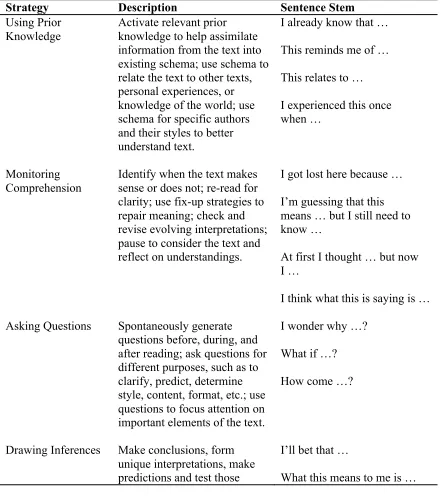
Table 3: Cognitive Strategies to Model in Think-Alouds 53
Table 4: Instruments 94
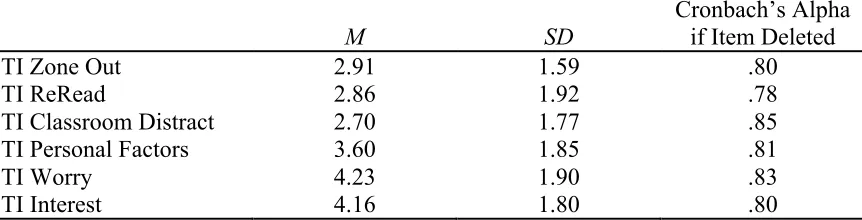
Table 5: Reliability Statistics, Task Irrelevant (TI) Behaviors 106
Table 6: Reliability Statistics, Task Relevant (TR) Behaviors 107
Table 7: Reliability Statistics, Element Interactivity (EI) 107
Table 8: Reliability Statistics, Overall Mental Effort and Understanding (TOT) 108
Table 9: Construct Validity for Task Relevant (TR) Behaviors 108
Table 10: Overview of Procedures by Class Period 115
Table 11: Data Analyses by Research Question 118
Table 12: Analytical Reading Comprehension Results 122
Table 13: Gain Score Results in Analytical Reading Comprehension 124
Table 14: Mental Effort Rating Results 126
Table 15: Student Annotation Coding System 129
Table 16: Student Interview In Vivo Coding System 138
Table 17: Textual Observations Sub-Scale Results 151
Table 18: Inferences Sub-Scale Results 153
Table 19: Broader Implications Sub-Scale Results 154
Table 20: Analytical Reading Comprehension Scores for Struggling Readers 156
List of Figures
Figure 1: Model think-aloud 6
Figure 2: Working memory and cognitive load 17
Figure 3: Technological pedagogical content knowledge 23
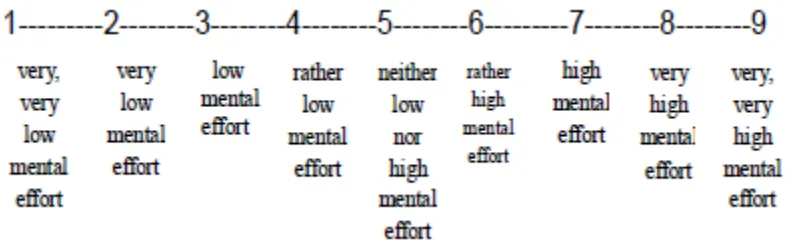
Figure 4: Paas (1992) Mental Effort Rating Scale 62
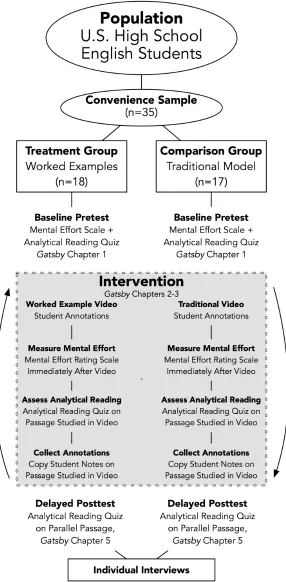
Figure 5: Research design schematic overview 87
Figure 6: Box plot of group demographics for HSPT 114
Figure 7: Line graph of analytical reading comprehension scores 123
Figure 8: Bar chart of quantity of surface-level annotations 131
Figure 9: Bar chart of quantity of mid-level annotations 132
Figure 10: Bar chart of quantity of deepest-level annotations 134
CHAPTER I
INTRODUCTION
Statement of the Problem
Independent analytical reading comprehension is a core competency required for success
inside the classroom and out, and it is one of the best predictors of college readiness, not to
mention long-term success in college or career (Biancarosa & Snow, 2006; Gallagher, 2009;
Lattimer, 2014). Beyond basic comprehension of vocabulary and plot, analytical reading
comprehension is the process of thinking by which students extract and construct meaning from
a text (RAND, 2002), actively building an understanding of the subtextual elements of literature
to include theme and the development of thematic ideas; character development, motivation, and
conflict; denotative, connotative, and figurative meaning of language; structure, pacing, and
organization of a story; and an author’s use of language in relation to tone and a sense of time
and place (Common Core State Standards Initiative, 2012).
Despite its critical importance, many secondary students struggle with this skill, and the
national statistics around proficiency in analytical reading comprehension are grim. When placed
in heterogeneous classes and a one-size-fits-all curriculum, these struggling readers lose access
to valuable instruction and invariably fall behind (Tomlinson, 2014; Tovani, 2000). Even after
years of reading intervention and literacy programs, recent research into the analytical reading
proficiency of American teenagers suggests that an alarming percentage of students, by national
and international measures, do not have the basic skills expected of them by educators and
employers alike (Biancarosa & Snow, 2006; Casner-Lotto & Benner, 2006). Over the past two
reading scores on the ACT dropping 5 percentage points since 1999, the NAEP dropping 5
points since 1992, and the PISA slowly slipping at an annualized rate of -0.3 points per year
since 2003 (ACT, 2006; NCES 2015a; OECD, 2012). In 2015, only 37% of high school seniors
scored at or above the “proficient” mark in analytical reading comprehension on the National
Assessment of Educational Progress exam (US Dept. of Education, 2015; NCES, 2015a). In
California, where the present study took place, a mere 26% of students passed the reading
comprehension subsection of the most recent California High School Exit Exam (California
Department of Education, 2015). These statistics are even more alarming for low-income
students and students of color, whose scores illustrate an ever-widening achievement gap in
analytical reading comprehension and whose experiences point to systemically inequitable
access to high-quality curriculum and instruction (Education Trust, 2013, 2015; Gallagher, 2009;
NCES, 2015b). According to the international scale from the Programme for International
Student Assessment (PISA), the United States ranks 17th in reading comprehension worldwide,
well behind countries of nonequivalent spending on education (OECD, 2012). When it comes to
adolescent reading, this is still a nation at risk (National Endowment for the Arts, 2007).
Over the past 30 years, the direction of adolescent literacy instruction has remained in
alignment with the national push toward educational standards through the Standards and
Accountability Movement of the early 1990s, No Child Left Behind in the early 2000s, and Race
to the Top and the Common Core Initiative in the 2010s (American Institutes for Research,
2013). To date, educators and legislators have determined a rigorous list of 10 comprehensive
and critical skills for adolescent readers of literature to master, highlighting how complex a task
it is for a high schooler to become proficient in analytical reading (Common Core State
1. Cite strong and thorough textual evidence to support analysis of what the text says explicitly
as well as inferences drawn from the text.
2. Determine a theme or central idea of a text and analyze in detail its development over the
course of the text, including how it emerges and is shaped and refined by specific details;
provide an objective summary of the text.
3. Analyze how complex characters (e.g., those with multiple or conflicting motivations)
develop over the course of a text, interact with other characters, and advance the plot or
develop the theme.
4. Determine the meaning of words and phrases as they are used in the text, including figurative
and connotative meanings; analyze the cumulative impact of specific word choices on
meaning and tone (e.g., how the language evokes a sense of time and place; how it sets a
formal or informal tone).
5. Analyze how an author’s choices concerning how to structure a text, order events within it
(e.g., parallel plots), and manipulate time (e.g., pacing, flashbacks) create such effects as
mystery, tension, or surprise.
6. Analyze a particular point of view or cultural experience reflected in a work of literature
from outside the United States, drawing on a wide reading of world literature.
7. Analyze the representation of a subject or a key scene in two different artistic mediums,
including what is emphasized or absent in each treatment.
8. Delineate and evaluate the argument and specific claims in a text, including the validity of
the reasoning as well as the relevance and sufficiency of the evidence [in informational
9. Analyze how an author draws on and transforms source material in a specific work (e.g., how
Shakespeare treats a theme or topic from Ovid or the Bible, or how a later author draws on a
play by Shakespeare).
10. Read and comprehend literature, including stories, dramas, and poems, independently and
proficiently.
In response to declining test scores and increasing federal pressure to “turn around” our schools
and meet the many standards set for our students, educators have implemented myriad
interventions targeting struggling readers: districts have created supplementary curriculum for
remedial readers and launched reading recovery programs; schools have hired literacy coaches
and increased the rigor of their course offerings; and teachers have learned how to implement
higher standards and have applied new instructional strategies to support an ever-changing
student population (US Department of Education, 2015). One specific analytical reading
instructional strategy that has gained traction, particularly in elementary school literacy circles, is
the teacher-led think-aloud, which has become a standard practice in the teaching of reading
(Appleman, 2010; Beers, 2003; Frey & Fisher, 2013; Wilhelm, 2001) and is described by literacy
experts Keene and Zimmermann as “the single most important teaching tactic at our disposal”
(Keene & Zimmermann, 2007, p. 146).
The think-aloud is an instructional strategy for supporting developing readers in which
the teacher models the strategies of a successful analytical reader, such as activating prior
knowledge, decoding text at multiple levels, making predictions, visualizing, summarizing,
asking questions, making connections, and monitoring and clarifying understanding (Appleman,
2010; Wilhelm, 2001). In a think-aloud, the teacher typically begins by stating the purpose for
reads a selection of the text for the students, pausing frequently to literally think out loud, thus
presenting an audible representation of the internal dialogue that takes place between the mind of
a skilled reader and the text (Beers, 2003; Keene & Zimmermann, 2007; Wilhelm, 2001). During
the think-aloud, the teacher provides a verbal or visual cue to signal to students the transition
from reading to thinking, and clarifies how a particular strategy helps the teacher make meaning
in a passage (Beers, 2003; Keene & Zimmermann, 2007). The goal of the teacher think-aloud is
for students to adopt the habits of successful readers by hearing those habits modeled enough
times that they can internalize the cognitive processes required for effective analytical reading
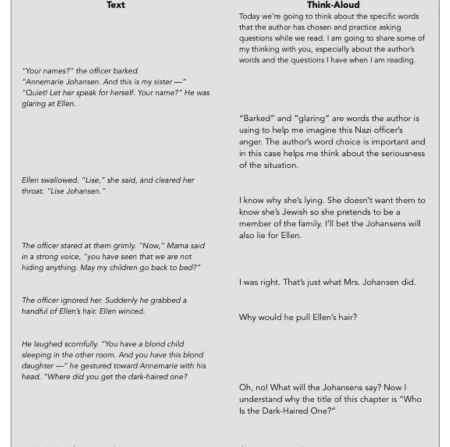
(Frey & Fisher, 2013; Keene & Zimmermann, 2007). Figure 1 presents a classic think-aloud
script (Frey & Fisher, 2013, pp. 21–22), based on the text Number the Stars (Lowry, 1989, pp.
Figure 1. Model think-aloud (Frey & Fisher, 2013, pp. 21–22)
The analytical thinking modeled in Figure 1 moves beyond surface-level comprehension, such as
decoding and vocabulary recognition, into the subtext of the story, such as character motivation,
internal and external conflict, and tone. Instead of focusing on the what of the story, the
As with any instructional strategy, think-alouds cannot solve all problems. Two central
challenges currently limiting the efficacy of think-alouds in the secondary English classroom are
timing and differentiation. First, timing: As students transition from elementary to secondary
school, a parallel transition occurs in the purpose and place of reading. In English language arts
and other disciplines such as social studies and science, this marks the shift from “learning to
read” to “reading to learn,” in which disciplinary knowledge is taught predominantly through
text (Allington, 2002; Conley, 2009; Lattimer, 2010). Teachers often assign content reading as
homework and make use of class time for more hands-on activities, meaning-making, and, of
course, assessment (Burke, 2012; Christenbury, 2006; Milner, Milner, & Mitchell, 2011;
Smagorinsky, 2001). Unfortunately, in this standard model, struggling readers often do not have
the support they need at home to access a challenging text, and instead they spend their time
reinforcing misunderstanding and building frustration (Gallagher, 2004; Miller, 2009). Though
the think-aloud process provides a useful structure for unpacking a complex text, it is not the
just-in-time support that many students need when they are stumbling through independent
reading at home.
Second, the current manifestation of the think-aloud as a tool for differentiation is
limited. In the midst of classes with advanced independent readers, there is invariably a group of
analytical reading “novices” who have difficulty following basic fiction structures and
identifying plot elements in novels and short stories (Lewis & Ferretti, 2009). Often these
students give up and quit reading altogether (Schoenbach, Greenleaf, & Murphy, 2012). Their
challenges pervade across environments and disciplines, as they struggle any time reading occurs
without the explicit guidance of a teacher reading aloud and directing their attention (Griffin,
the think-aloud is an in-class, teacher-presented strategy, it limits the teacher to two instructional
options: either (a) present the lesson to all learners, regardless of their prior knowledge, reading
readiness, or need; or (b) present the lesson to a small group while assigning independent work
to other students, thus making it exceptionally clear which students struggle and which students
excel. To make the think-aloud a more effective instructional strategy, teachers need the
flexibility to do two things: (a) present it only to students who need it, and (b) do so during the
time in which they are reading. The influx of technology into schools provides an opening for
improving a standard classroom practice, because it addresses the limitations of timing and
differentiation.
During the same years in which the national education trend moved toward more rigorous
standards and measurable outcomes for all learners, the education system experienced a dramatic
change with the introduction of instructional technology into schools. As classrooms have
become wired and connected spaces, and the Internet and digital devices have quickly become as
ubiquitous for this generation of students as landlines and printed encyclopedias once were for
their predecessors, today’s educators have been given a unique opportunity to leverage
technology in support of meaningful learning (Casap, 2015; ISTE, 2008). A technology-rich
environment—and, in particular, a one-to-one (1:1) environment in which each student has
access to a laptop, tablet, or smartphone in school and at home—offers teachers a diversity of
options for how they work to meet the needs of all learners, including the potential to present a
lesson in a manner that is both timely and targeted. With 1:1 technology, the teacher-led
think-aloud could be presented digitally as part of a student’s reading homework and discretely
assigned only to those who need the additional scaffolding to be successful. Readers would
Access to technology gives teachers the tools for “differentiation with dignity” (Neebe &
Roberts, 2015, p. 106). Moreover, when all students can make sense of the independent reading
assigned to them, they all can enter class on the same page, prepared to participate and learn.
This model of using video-based technology to deliver some portion of direct instruction as
homework, which frees up face-to-face time for more interactive and/or individualized
experiences, is called “flipped teaching” or “blended learning” (Khan, 2011; Neebe & Roberts,
2015; Sams & Bergmann, 2013; Tucker, 2012).
Technology, of course, is no panacea. Simply placing tools in the hands of educators in
hopes of transforming adolescent literacy instruction would be ill-considered. Indeed, the
promise of change based on cutting-edge technology is nothing new in the education landscape.
Consider the introduction of the motion picture, the Internet, the computer lab, and the classroom
television. Each promised to revolutionize education, and each failed to deliver any significant
improvement in teaching and learning (Mayer, 2009, 2014a). Until the publication of recent
multimedia theories and studies (Mayer, 2005, 2014b), classroom teachers have had to rely upon
trial and error to determine the utility of their blended instruction.
Fortunately, there is a robust body of new research literature that details the design
principles of effective multimedia learning, providing clear guidance to instructional designers in
technology-rich environments. To date, video-based instruction has been used most commonly in
science, technology, engineering, and mathematics education to teach skills and procedures, or to
present worked-out examples of problems and proofs (Mayer, 2014b; Renkl, 2014). Of particular
interest to this study is the multimedia worked example (Renkl, 2014; Renkl & Atkinson, 2010),
a well-researched, statistically effective, multimedia-based instructional strategy that parallels
multimedia worked example presents an expert’s step-by-step thought process to solving a
complex problem for students to study and emulate (Atkinson, Derry, Renkl, & Wortham, 2000).
As evidenced by the list of standards for analytical reading and the current state of adolescent
literacy, analytical reading comprehension is a complex skill for students to master, and teachers
are strapped for solutions. This study aimed to apply a parallel solution to the problem at hand: to
reimagine the face-to-face, teacher-facilitated think-aloud as a multimedia worked example that
could be leveraged for differentiated, blended instruction.
Purpose of the Study
The purpose of this study was to investigate how multimedia worked examples that
explicitly model the reading habits of successful readers through teacher think-alouds could
facilitate effective differentiated analytical reading instruction for high school English language
arts students who have access to 1:1 technology. In this experiment—an explanatory sequential
mixed-methodology study—34 sophomore English students were randomly assigned to either
the worked examples treatment condition or the traditional instruction comparison condition.
Using a classic treatment-comparison repeat measures pretest-posttest design, students’
analytical reading comprehension and perceived mental effort was assessed. This study
addressed the essential quandary that most English language arts teachers face: how to provide
an appropriate level of analytical reading instruction for all learners, support novice readers
without inhibiting advanced readers, and challenge advanced readers without ignoring novice
readers. Currently this problem is being addressed through either individual tutoring, which is
neither time effective nor scalable, or whole-class instruction, which denies stronger readers the
Significance of the Study
Previous research into teacher-led think-alouds as an instructional strategy has centered
on early literacy instruction and almost exclusively featured qualitative case studies of
kindergarten through fifth grade (Baumann, Jones, & Seifert-Kessell, 1993; Beers, 2003; Davey,
1983; Frey & Fisher, 2013; Olshavsky, 1977). Little research has been done using the teacher-led
think-aloud method with adolescent readers, and very little quantitative research has been done
in this area. Conversely, much quantitative research attention has been given to worked examples
of well-defined problems, in areas such as mathematics and science (Atkinson et al., 2010;
Renkl, 2014; Renkl & Atkinson, 2010; Sweller & Cooper, 1985), yet relatively little attention
has been given to applying worked examples to ill-defined problems (Kyun, Kalyuga, & Sweller,
2013; Nievelstein, van Gog, van Dijck, & Boshuizen, 2013; Rourke & Sweller, 2009). There are
no known studies applying multimedia worked examples either to analytical reading
comprehension or to triple-content worked examples (Renkl, Hilbert, & Schworm, 2009) in
which students must contend with three domains: the learning domain (e.g., analytical reading),
the exemplifying domain (e.g., the text being read), and the cognitive strategy domain (e.g.,
heuristic strategies and schema for approaching analytical reading). This mixed-methods study of
multimedia think-aloud worked examples is significant because it bridges the gaps in both bodies
of literature.
This study extends previous think-aloud research by (a) taking the elementary classroom
practice of the teacher-facilitated think-aloud for early literacy instruction and placing it in the
high school classroom setting as a scaffold for analytical reading comprehension, and (b)
reported predominantly through professional development texts and practitioner journals, or as a
measurement protocol rather than an instructional method (Kucan & Beck, 1997).
Moreover, this study extends previous worked examples research by (a) situating the
quasi-experiment in the naturalistic setting of a high school English language arts classroom
instead of the traditional controlled laboratory setting, and (b) applying the model of worked
examples to the ill-defined task of analytical reading to determine if worked examples of
analytical reading effectively support differentiated instruction in English language arts, a rare
triple-content worked example.
Beyond theoretical importance, the present study contributes an innovative,
research-based solution to an age-old practical dilemma. By digging deeply into one instructional move,
this study has the potential to equip educators to become more technologically skilled at their
pedagogical craft. Practitioners in the field of English education specifically, or reading
instruction broadly, should be emboldened to leverage technology, access to which is becoming
pervasive, to support readers of varying readiness levels within a heterogeneous class or beyond
the four walls of the classroom.
Theoretical Framework
Educational theories provide a lens through which to observe a problem or phenomenon.
Certainly there are many ways to consider the challenge of supporting students with analytical
reading comprehension. Of the four predominant learning theories—behaviorism,
socioculturalism, constructivism, and cognitivism—this study takes a cognitivist approach. The
foundation for the present study is Sweller’s (1988, 2010a) cognitive load theory, a
psychological theory and set of instructional design principles based on an understanding of
Sweller & Cooper, 1985; Renkl & Atkinson, 2010), which is the specific instructional method
used in this study to reduce cognitive overload for students engaging in the complex task of
analytical reading. From there, the study builds upon developments made in worked examples
research by considering the worked examples principle in multimedia learning (Renkl, 2014).
Finally, this study situates worked examples within the practitioner context, drawing upon
Mishra and Koehler’s (2006) Technological Pedagogical Content Knowledge (TPACK) model
as a guide.
Cognitive Load Theory
Cognitive load theory (Sweller, 1988, 2010a) is a relatively new psychological theory
that explains the way in which instructional design affects learning by considering how the brain
processes new information and retains knowledge (Moreno & Park, 2010). Human cognitive
architecture is composed of the working memory and the long-term memory. The brain learns by
relying on an information-processing system that can store knowledge, use the knowledge it has
stored, create new knowledge, change existing knowledge to respond to the outside world, and
accomplish all of these functions effectively (Sweller, 2012). Cognitive load theory is based on
three fundamental assumptions about human cognitive architecture that have been consistently
supported by cognitive psychology research.
Working memory. The first assumption of cognitive load theory is that the working
memory—the part of the brain responsible for consciously processing and assimilating new
information—has a fixed capacity and can manage only a finite number of elements at once
(Moreno & Park, 2010). Miller (1956) estimated this number to be “seven, plus or minus two”
independent pieces of information that a person can reliably hold simultaneously (p. 81). For
acknowledge and accommodate for the constraints of students’ working memory. If students are
asked to make sense of a lesson, instructional materials, or content that extends them beyond the
bounds of their working memory, it is unlikely that learning will take place (Sweller, van
Merriënboer, & Paas, 1998). Students attempting to juggle too many competing demands on
their attention will be unable to process the new information and transfer it to their long-term
memory.
Long-term memory. The second assumption is that the long-term memory has a vast,
potentially infinite capacity for storing complex networks of information (Moreno & Park,
2010), in contrast to the working memory, which serves as a temporary holding place for
information as it is being learned. Of particular importance to the instructional designer, the
long-term memory houses a student’s prior knowledge, the concepts and skills that the student
has stored from the process of learning, which support his or her future learning by integrating
new knowledge in the working memory with prior knowledge in the long-term memory.
Educational psychologist David Ausubel (1968) said of the relationship between prior
knowledge and meaningful learning that “the most important single factor influencing learning is
what the learner already knows” (p. iv). From the perspective of cognitive load theory, this is
because prior knowledge determines a student’s level of expertise within a particular discipline
(Kalyuga, Chandler, & Sweller, 1998), and thus it influences the amount of working memory
energy a student must expend to make sense of new information (Plass, Kalyuga, & Leutner,
2010).
Schema. The third assumption of cognitive load theory is that schemas are necessary for
transferring information from the working memory to the long-term memory and thus freeing up
pieces of information in the long-term memory, humans have an associative memory that stores
information in connected webs called schemas (Anderson & Bower, 1983; Kalyuga, 2010).
Schemas make sense of information in complex sets of connected facts that enable a person to
process related information as one element instead of separately as all of its individual parts.
Sweller, van Merriënboer, and Paas (1998) explained schema construction in light of the process
of reading:
A schema categorizes elements into information according to the manner in which they
will be used … When reading, we can derive meaning from an infinite variety of marks
on a page because we have schemas that allow us to appropriately categorize letters,
words, and combinations of words … In early school years, children construct schemas
for letters that allow them to classify an infinite variety of shapes (as occurs in
handwriting) into a very limited number of categories. These schemas provide the
elements for higher order schemas that are combined into words that in turn can be
combined into phrases, and so forth. Ultimately, this process allows readers to rapidly
scan a page filled with a hugely complex array of squiggles and derive meaning from it.
(p. 255)
As with the example of reading, well-developed schemas bypass the working memory and are
processed automatically. The adept reader does not need to think about the process of translating
markings into letters and letters into words. Schema automation makes room in the working
memory for new learning, and it is this process of automation that separates an expert from a
novice.
Research into schema theory started, surprisingly, by studying chess grand masters to
Chess grand masters did not have innately more capacious working memories; instead they had a
robust store of chessboard configuration schemas stored in their long-term memories that
automated their processing when approaching a new game of chess, leaving more working
memory processing power available for problem solving and creative solutions (Kalyuga, 2010).
The difference between expert and novice, therefore, is prior knowledge, or schema. Without any
prior knowledge to help make sense of new information, the natural default for the working
memory is to process that new information through a sluggish, error-prone, guess-and-check
procedure in which the working memory continues to randomly generate and test one solution at
a time until an optimal solution is reached (Renkl, 2014; Sweller, 2012). Clearly, using schema is
a far more efficient approach to learning. The implication for educators is that instructional
design should free the learner to focus on schema acquisition, instead of filtering through other
competing, extraneous cognitive demands (Moreno & Park, 2010). One way to accomplish this
goal in instructional design is through worked examples, which are discussed in the subsequent
section. First, however, it is imperative to clarify how the working memory processes
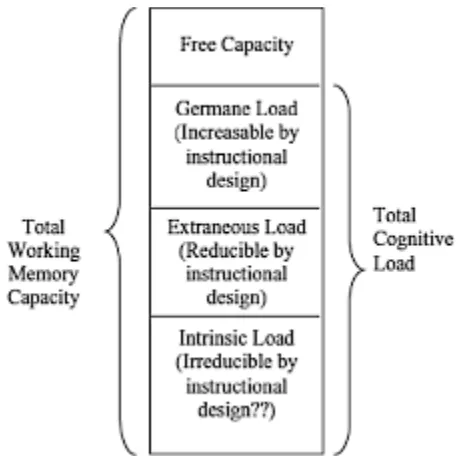
information by exploring the three types of cognitive “loads” on the working memory:
Figure 2. Working memory and cognitive load (Moreno & Park, 2010, p. 18)
Extraneous load. The first of the three loads to take shape in the theoretical model of
cognitive load was extraneous load. This load inhibits working memory capacity by forcing the
learner to attend to unnecessary cognitive demands in the learning process—that is, any demands
that do not lead to the acquisition and automation of schema (Sweller & Chandler, 1994).
Extraneous load is attributed to suboptimal instructional design (Sweller, 2010b) and can be
caused by any of the following four scenarios: (a) instruction or learning materials that do not
properly support a student who may lack sufficient prior knowledge to comprehend the lesson,
thereby triggering random processing in the learner; (b) instruction or learning materials that
ignore preexisting prior knowledge and overteach the content, leading to an overlap in the
learner’s existing schema and the one presented by the teacher, and causing the student to
contend with additional material to process; (c) instruction or learning materials that present too
much information at once; and/or (d) instruction or learning materials that present information in
parts or search for components that belong together, such as graphs and labels that are separate
from one another instead of integrated (Kalyuga, 2010).
Intrinsic load. Intrinsic cognitive load is the amount of load imposed by the inherent
difficulty of the information being learned (Sweller, 1994). Because difficulty can be relative,
intrinsic load comprises both the complexity of the content and the prior knowledge of the
learner (Moreno & Park, 2010). Complexity is credited to the amount of element interactivity in
a given task (Pollock, Chandler, & Sweller, 2002), which is the extent to which understanding
one piece of information depends on understanding another related piece of information, or the
extent to which understanding the “whole” requires understanding a number of subordinate parts.
Given that the working memory can handle only a finite number of elements at once, the amount
of intrinsic load placed on the working memory is determined in large part by the extent to which
those elements interact, and thus, the extent to which the working memory must process multiple
elements simultaneously (Pollock et al., 2002). Though some recent studies suggest that there are
ways to manage intrinsic load by artificially reducing element interactivity (Mayer & Moreno,
2010; Paas, Renkl, & Sweller, 2003), most findings support the notion that intrinsic load is not
something that instructional designers can control (Moreno & Park, 2010). Importantly, intrinsic
load and extraneous load are additive, which means that as material becomes more complex and
carries a higher intrinsic load, the learner has less capacity in the working memory for processing
extraneous load (Sweller & Chandler, 1994). Though the techniques suggested by cognitive load
theorists would be effective when learning low-intrinsic load material, they are crucial for
comprehending high-intrinsic load material, and thus the work of cognitive load theory is
focused predominantly on supporting students learning inherently complex content (Moreno &
Germane load. The third source of cognitive load is germane load, which refers to the
mental effort dedicated to developing and automating schema (Moreno & Park, 2010).
According to cognitive load theory, this is the central goal of learning and therefore most
“germane” to the process of moving knowledge from the working memory to the long-term
memory. Whereas extraneous load and intrinsic load impose a penalty on the working memory,
germane load is beneficial because it improves the learning process (Sweller et al., 1998).
Increasing germane load is the opportunity that teachers create by reducing extraneous load.
Sweller (2010a) explained that “reducing extraneous cognitive load would have little function if
the working memory resources so freed were not used for productive learning” (p. 43). Thus,
effective instructional design should not only reduce or eliminate extraneous cognitive load, but
also direct the learner to integrate new learning with prior knowledge and engage the learner in
creating or borrowing structures and organizational models for making sense of new information.
By understanding the principles of cognitive load theory, educators can design learning
experiences that consider the relative stress that each activity creates and maximize the learning
that happens in students’ limited information processing systems (Sweller, 2010a; Sweller et al.,
1998). Research suggests that students’ working memory capacity is diminished when dealing
with unfamiliar material (Kalyuga, 2006). It is imperative for educators to have a solution for
supporting the learning process and the acquisition of new knowledge, which is often the
preponderance of the work that happens in classroom instruction. Instructional design that
respects this theory seeks to optimize students’ cognitive load by reducing extraneous load,
managing intrinsic load, and increasing schema acquisition, or germane load (Moreno & Mayer,
significant effects for mitigating distracting extraneous load and focusing the learner on schema
acquisition is the worked examples principle (Sweller, 2006).
Worked Examples Principle
Simply stated, worked examples are instructional scaffolds that depict an expert’s
detailed solution to a problem for students to study and emulate (Atkinson et al., 2000). A
traditional worked example presents a problem to be solved in addition to step-by-step written
work that applies a strategy or principle to solve the problem in a systematic way (Sweller,
2006). Students study the worked-out example and then actively process what they have studied
by engaging in a similar problem or procedure to gain feedback on what they understand
(Sweller, 2006). They repeat this process several times with additional problems (Sweller, 1994).
Statistically speaking, worked examples are effective. Educational researcher John Hattie (2009)
reports from his meta-analysis of more than 800 studies that among the many moderating factors
in student achievement, conventional worked examples have a moderate effect size of d = .57.
Effect size is a statistical measure that describes “how big the difference is between group
means, or how impressive the relationship is between variables,” and thus provides a sense of the
practical importance of a given phenomenon (Mitchell, 2015). Effect size is most commonly
measured using Cohen’s d, which—much like a z-score—uses standard deviation units to
quantify the difference between two group means (Cohen, 1988). An effect size of d > .80 (eight
tenths of a standard deviation difference) is considered a large effect; d > .50 (half of a standard
deviation difference) is considered a moderate effect; d > .20 (two tenths of a standard deviation
difference) is considered a small effect; and d < .20 is considered as having no effect.
According to the worked examples principle, worked examples are effective because they
cognitive problems (Sweller, 1994). Worked examples free up cognitive capacity by allowing
learners to focus specifically on the most relevant structural features of a problem, rather than
trying to consider many different solution options or work through all of the additional steps
required to solve a problem beyond the new skill set being learned (Renkl & Atkinson, 2010).
Instead of relying on the brain’s natural, randomized trial-and-error process, which burdens or
overloads the working memory’s capacity, worked examples allow the learner to temporarily
“borrow” the schema of someone more expert, thus reducing extraneous load and returning
working memory function to schema building (Renkl, 2014; Sweller, 2006). Specifically,
worked examples support germane load by increasing natural self-explanation, which is one of
the strongest predictors of student performance (Renkl, 1997).
Research into worked examples started three decades ago with mathematics instruction,
during a time in which the prevailing pedagogy was to give students an abundance of
problem-solving practice. Sweller and Cooper (1985; Cooper & Sweller, 1987) noticed that students in
these conditions continued to use guess-and-check methods despite their repeated practice with
more streamlined strategies. When Sweller and Cooper (1985; Cooper & Sweller, 1987)
introduced the worked example as an alternative method for students to study, they found that
students emulating worked examples were more efficient and more effective. Although the first
generation of worked examples tested the principle with well-defined problems from
mathematics and science in controlled, laboratory-like settings (Atkinson et al., 2000), more
recent research has successfully applied the principle to ill-defined problems such as legal
reasoning (Nievelstein et al., 2013), artistic design (Rourke & Sweller, 2009), rhetoric (Schworm
Worked Examples Principle in Multimedia Learning
Twenty years after the initial worked examples principle was penned, the cognitive
theory of multimedia learning emerged and reinvigorated the principle with multimedia worked
examples (Mayer, 2014a). The updated theory brought two advances to worked examples
research: (a) it expanded researchers’ understanding of human cognitive architecture by
describing the dual-channel nature of the brain, in which people take in information through two
separate channels—a verbal channel and a visual channel (Paivio, 1986; Renkl, 2014); and (b) it
helped to shape the evolution of worked examples by applying them to more complex domains
and ill-defined problems (Renkl, 2014).
The cognitive theory of multimedia learning suggests that students learn best from a
combination of words and pictures, rather than words alone, because this combination maximizes
possible instructional input by using both information processing channels (Mayer, 2014a; Paas
& Sweller, 2014). Accordingly, multimedia worked examples present an expert’s detailed
solution to a problem through a combination of words and pictures. At this point, the majority of
worked examples in complex domains are multimedia worked examples (Renkl, 2014).
Multimedia worked examples are an effective high-leverage practice for scaffolding learning of
ill-defined problems precisely because they more fully support schema acquisition while easing
the working memory demands placed on the learner during active learning.
Technological Pedagogical Content Knowledge (TPACK)
Worked examples represent one very small instructional “move” within an expansive
teaching repertoire. The challenge of contemporary research into worked examples is situating
them within the bustling, organic context of the classroom and within the knowledge bank of
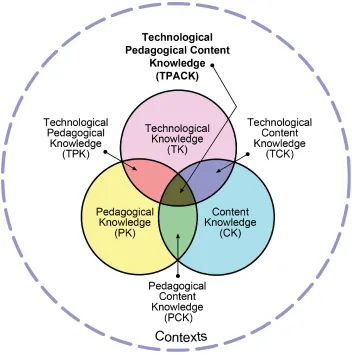
framework to advance discussions around educational technology. The TPACK model is most
often illustrated as a Venn diagram with three intersecting circles (Figure 3) representing the
three bodies of knowledge from which teachers must draw for effective instruction, to include
content knowledge, pedagogical knowledge, and technological knowledge.
Figure 3. Technological pedagogical content knowledge. Reproduced by permission of the publisher, © 2012 by tpack.org
At the center is the synthesis of all three circles, technological pedagogical content knowledge,
an understanding of the representation of concepts using technologies; pedagogical
techniques that use technologies in constructive ways to teach content; knowledge of
what makes concepts difficult or easy to learn and how technology can help redress some
of the problems that students face; knowledge of students’ prior knowledge and theories
of epistemology; and knowledge of how technologies can be used to build on existing
knowledge and to develop new epistemologies or strengthen old ones. (p. 1029)
In short, technological pedagogical content knowledge is a teacher’s understanding of how and
when to use a variety of technological tools to enhance teaching and improve learning within his
or her content area.
Mishra and Koehler’s (2006; Koehler & Mishra, 2009) work builds upon the seminal
studies conducted by Lee Shulman (1986, 1987). Frustrated by the incessant pendulum swing in
teacher education between content (a focus on the teacher’s knowledge of his or her subject
matter) and pedagogy (a focus on the teacher’s knowledge of teaching methodology), Shulman
(1986) called for a “more coherent” approach to identifying effective instruction and requisite
knowledge for teaching (p. 9). Shulman argued that knowledge of what to teach and how to teach
it must not be mutually exclusive. He proposed pedagogical content knowledge as that which
separates mediocre teachers from masterful ones (Shulman, 1987). Pedagogical content
knowledge includes, “for the most regularly taught topics in one’s subject area, the most useful
forms of representation of those ideas, the most powerful analogies, illustrations, examples,
explanations, and demonstrations—in a word, the ways of representing and formulating the
subject that make it comprehensible to others” (Shulman, 1986, p. 9).
Just as Shulman (1986, 1987) identified a problematic cleavage between knowledge of
diagnosed a similar chasm between a teacher’s knowledge of technology and knowledge of
pedagogy and content. They affirmed the image of teachers as skilled craftspeople who draw
upon a varied repertoire of methods and techniques, and who can assess and match the
appropriate method to the learning situation and the learner. As disruptive technologies such as
the Internet and personal computing devices have made their way into classrooms, Mishra and
Koehler (2006; Koehler & Mishra, 2009) contested that knowledge of teaching and knowledge
of technology could no longer remain a dichotomous pair. Just as a major scientific discovery or
breakthrough in research would rightly force an educator to rethink the content he or she teaches,
so too should the arrival of a technological innovation “[force] educators to think about core
pedagogical issues” (Mishra & Koehler, 2006, p. 1029).
The present study is deeply embedded within the practitioner experience and within the
ever-changing landscape of the high school classroom. It builds upon the early theoretical
research into cognitive load and the predominantly clinical research into worked examples. As
part of the natural evolution of research, this study joins with the many others that came before it
to build a bridge between theory and practice. The goal of this study, therefore, is both to add to
the theoretical research base around worked examples and to contribute to classroom teachers’
technological knowledge repertoire to enhance the pedagogical content knowledge they already
possess.
Background and Need
Studies of reading comprehension are some of the oldest in the field of educational
research (Frey & Fisher, 2013; Webb, 1856). So much has been written about the subject of
reading comprehension in the past 160 years that combing through it to tease out connections
reading comprehension as a challenge deeply rooted in the functions and limitations of the
human cognitive architecture. It brings into alignment what is known about why analytical
reading is complex and what habits proficient readers possess with the theoretical framework of
cognitive load theory, element interactivity, and schema acquisition. Furthermore, it connects
think-alouds and multimedia worked examples as similar scaffolds for learning through
modeling and advances the need for the present study.
Analytical Reading Comprehension as a Complex Cognitive Process
Acknowledging the importance of reading comprehension for students and the apparent
gap between desired skill level and actual performance, it is imperative first to explore what
makes analytical reading so challenging for adolescent readers. At the heart of the challenge is
the fact that analytical reading is a complex cognitive task (Appleman, 2010; Frey & Fisher,
2013; National Reading Panel, 2000; Schoenbach et al., 2012) that requires the reader to
creatively build mental structures by “select[ing] relevant information, mentally organiz[ing] it
into a coherent structure, and integrat[ing] it with relevant prior knowledge activated from
long-term memory” (Smagorinsky & Mayer, 2014, p. 611). Analytical reading of literary texts
demands that students have command over the meaning of a text and that they be able to
critically evaluate the message, remember the content, and apply the newfound knowledge
flexibly (Alfassi, 2004). More specifically, true comprehension requires students to have
mastered a set of basic reading fluency skills, such as recognizing phonemes, decoding words,
developing automaticity in decoding, and accessing word meaning from the long-term memory;
to use proficiently a set of more advanced reading comprehension skills, such as activating prior
knowledge, identifying and using prose structures, making inferences, and using metacognitive
genre-specific interpretative strategies (Kintsch, 1988; Smagorinsky & Mayer, 2014; van Dijk &
Kintsch, 1983). Literacy researchers Freebody and Luke (1990) describe this process as the
transition from “code breaker” to “meaning maker” and eventually to “text critic” and “text
user.” For students to be successful in the high school English classroom, they must be able to
engage in all four steps of this critical literacy process (Lattimer, 2010).
Moreover, analytical reading of literary texts requires students to use these cognitive
processes to make meaning of texts with ever-increasing complexity (Appleman, 2010; Common
Core State Standards Initiative, 2012; Frey & Fisher, 2013). From a cognitive load theory
perspective, complexity is attributed to element interactivity (Pollock et al., 2002). In any work
of literature, there are a number of moving parts that are inextricable. Students must monitor
both text and subtext—what a text says and what a text means (Appleman, 2010). Text
complexity arises from factors such as text purpose, levels of meaning, text structure, language
conventionality and clarity, and the knowledge demands that it places on the reader (Frey &
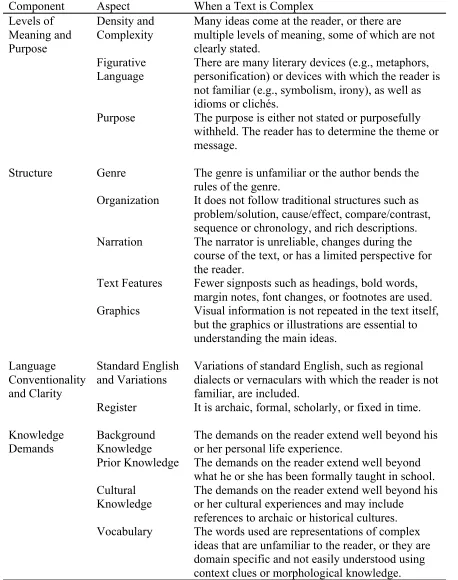
Fisher, 2013). See Table 1 for a comprehensive list of qualitative factors that contribute to text
Table 1
Qualitative Factors of Text Complexity
Component Aspect When a Text is Complex
Levels of Meaning and Purpose
Density and
Complexity Many ideas come at the reader, or there are multiple levels of meaning, some of which are not clearly stated.
Figurative
Language There are many literary devices (e.g., metaphors, personification) or devices with which the reader is not familiar (e.g., symbolism, irony), as well as idioms or clichés.
Purpose The purpose is either not stated or purposefully withheld. The reader has to determine the theme or message.
Structure Genre The genre is unfamiliar or the author bends the rules of the genre.
Organization It does not follow traditional structures such as problem/solution, cause/effect, compare/contrast, sequence or chronology, and rich descriptions. Narration The narrator is unreliable, changes during the
course of the text, or has a limited perspective for the reader.
Text Features Fewer signposts such as headings, bold words, margin notes, font changes, or footnotes are used. Graphics Visual information is not repeated in the text itself,
but the graphics or illustrations are essential to understanding the main ideas.
Language Conventionality and Clarity
Standard English and Variations
Variations of standard English, such as regional dialects or vernaculars with which the reader is not familiar, are included.
Register It is archaic, formal, scholarly, or fixed in time.
Knowledge
Demands Background Knowledge The demands on the reader extend well beyond his or her personal life experience. Prior Knowledge The demands on the reader extend well beyond
what he or she has been formally taught in school. Cultural
Knowledge
The demands on the reader extend well beyond his or her cultural experiences and may include
references to archaic or historical cultures. Vocabulary The words used are representations of complex
Beyond managing the cognitive load created by the text itself, adept readers are in constant
reflective dialogue with the text, making personal connections that help to guide their reading
(Beers, 2003). Alfassi (2004) calls this the dual cognitive process: students first make
connections within the text, such as linking events and character relationships, and then make
connections to their own lives, prior experience, and other texts they have read. The interplay
between these two processes—deconstructing the text and then reconstructing it in connection to
the reader—is where and how students make meaning (Alfassi, 2004). Even novice readers must
simultaneously manage plot sequence, characters, motifs, symbols, archetypes, and themes, all in
connection to one another and the purpose of the text as a whole (Barnhouse & Vinton, 2012;
College Board, 2016). It is for this reason that Langer (2002) refers to analytical reading of
literary texts as “high literacy,” because it requires students to access “deeper knowledge of the
ways in which reading, writing, language, and content work together” (p. 3). Each of these
connected elements places a strain on the working memory and limits students’ capacity for
creating schemas, processing new information, and integrating it with prior knowledge. In short,
analytical reading is a high element-interactivity task and thus carries high intrinsic cognitive
load.
Cognitive load theorists argue that effective instructional design liberates the learner to
focus on schema acquisition instead of sifting through extraneous cognitive demands (Sweller,
1988, 2010a). For the teacher of reading, this means freeing up students’ working memory
capacity by reducing extraneous load. Swanson (1993) asserted that “skilled readers can be
characterized by their ability to retain information in memory while simultaneously processing
other information” (p. 286). He suggested that this quality is important for reading because
or manipulated” (p. 286). Since the working memory is critical to reading comprehension,
strategies that optimize cognitive load are essential for supporting novice readers. By balancing
the load on students’ working memory, educators can equip students to focus on the components
that require maximum attention and alleviate the multiple cognitive burdens of the task of
reading. Much of the research into reading comprehension looks into determining the strategies
employed by more adept readers and considering why those strategies work (Alfassi, 2004;
Cuevas, Russell, & Irving, 2012; Swanson, 1993). What follows is a brief overview of the
cognitive processes needed for developing analytical reading schema at the high school level.
Improving Analytical Reading Comprehension Through Schema Acquisition
Typically, by the time a student reaches a high school English class, he or she has made
the transition from learning to read to reading to learn, or from reading fluency to reading
comprehension (Smagorinsky & Mayer, 2014). Though much of the language acquisition
process occurs naturally outside of the formal classroom setting (Vygotsky, 1930/1978),
school-based instruction around learning to read takes place between kindergarten and third or fourth
grade, during which time students practice making phonemic sounds, decoding or sounding out
syllables and whole words, building fluency in reading aloud, and connecting a word’s sounds to
the word’s meaning (Smagorinsky & Mayer, 2014). After fourth grade, standard literacy
instruction shifts to reading to learn, as students are expected by this point to have automated
necessary schema for reading fluency, thus freeing up working memory capacity for processing
more complex literacy tasks. Research into the intersection of cognitive science and literacy
reveals that four critical cognitive processes occur during reading comprehension for more
making inferences, and using metacognitive knowledge (Smagorinsky & Mayer, 2014; see Table
2).
Table 2
Cognitive Processes in Reading Fluency and Comprehension
Name Example Task
Recognizing phonemes Substitution of first phoneme: You hear the word ball and are asked to change the /b/ sound into a /t/ sound.
Decoding words Word identification: Pronounce the printed word cat. Word attack: Pronounce the printed word blud.
Decoding words fluently Read a paragraph aloud fast and without error.
Accessing word meaning Give a definition for a word and use it in a sentence.
Using prior knowledge Reorganize the material to fit with an existing schema.
Using prose structure Determine what information is important in a passage.
Making inferences Attribute a motive to justify a character’s action.
Using metacognitive knowledge
Find a contradiction in a passage.
Note. See Smagorinsky & Mayer, 2014, pp. 608, 611.
Prior knowledge. First, advanced readers rely on prior knowledge to help them make
sense of new material, using this knowledge “to guide how they select, organize, and integrate
incoming information” with existing schemas (Smagorinsky & Mayer, 2014, p. 611). Activating
prior knowledge often consists of readers making connections between the text at hand and other
experiences they have had, other texts they have read, and observations of the world around
them. Commonly, English teachers help prime prior knowledge by asking for “text to text, text to
prior knowledge, as measured by proxy through prior achievement, accounts for a moderate
effect size of d = .67 (Hattie, 2009; Fisher, Frey, & Hattie, 2016). Prior knowledge is an
excellent predictor of future reading comprehension performance (Fisher et al., 2016; McNamara
& Kintsch, 1996). Readers who possess and use relevant prior knowledge consistently
outperform those who do not (Bransford & Johnson, 1972; Lipson, 1983; Pearson, Hansen, &
Gordon, 1979; Pichert & Anderson, 1977). These readers have a “strong conceptional framework
within which to situate new information and ideas” (Lattimer, 2010, p. 20) and they are much
more likely to successfully register, recall, and retrieve new knowledge (Bransford, Brown, &
Cocking, 2000). Thus, the importance of prior knowledge cannot be overstated. Prior knowledge
acts as a schematic shortcut, linking new information to the long-term memory more efficiently
than the working memory can (Keene, 2010).
Prose structure. Second, advanced readers rely on their knowledge of standard prose
and genre-specific structures and use that knowledge within a new text to outline main points,
summarize, recall, predict events, and evaluate details to determine which ones are most salient
(Smagorinsky & Mayer, 2014). Studies of how disciplinary experts approach a new text within
their field demonstrate that the simple task of reading changes dramatically based on the genre of
the text, and that advanced readers require an additional, more specific form of prior knowledge:
disciplinary knowledge (Shanahan, 2009). Disciplinary knowledge encompasses the formal
rules, generalizations, and traditions of a discipline, and it includes the academic language
germane to that discipline (Shanahan, 2009). In the case of literary reading, disciplinary
knowledge also includes knowledge of specific genres and particular authors’ styles (Keene &
Zimmermann, 2007). For example, advanced readers might begin reading a new novel with a