USF Scholarship: a digital repository @ Gleeson Library |
Geschke Center
Doctoral Dissertations Theses, Dissertations, Capstones and Projects
2018
What Do We Really Know About Grit? A
Multivariate Statistical Investigation on the
Construct Validity of Grit
Christine M. Collaco
University of San Francisco, [email protected]
Follow this and additional works at:https://repository.usfca.edu/diss Part of theHigher Education Commons
This Dissertation is brought to you for free and open access by the Theses, Dissertations, Capstones and Projects at USF Scholarship: a digital repository @ Gleeson Library | Geschke Center. It has been accepted for inclusion in Doctoral Dissertations by an authorized administrator of USF Scholarship: a digital repository @ Gleeson Library | Geschke Center. For more information, please [email protected].
Recommended Citation
Collaco, Christine M., "What Do We Really Know About Grit? A Multivariate Statistical Investigation on the Construct Validity of Grit" (2018).Doctoral Dissertations. 488.
WHAT DO WE REALLY KNOW ABOUT GRIT? A MULTIVARIATE STATISTICAL ANALYSIS INVESTIGATION ON THE CONSTRUCT VALIDITY
OF GRIT
A Dissertation Presented to
The Faculty of the School of Education Learning and Instruction Department
In Partial Fulfillment of the Requirements for the Degree
Doctor of Education
by
Christine M. Collaço San Francisco, CA
iii
Dissertation Abstract
What Do We Really Know About Grit? A Multivariate Statistical Analysis Investigation on the Construct Validity of Grit
The primary purpose of this study was to collect evidence on the construct
validity of grit using convergent, discriminant, and predictive validity principles. To
accomplish this purpose and extend previous research on grit, college students from two
schools completed an instrument comprised of a cognitive ability test, and a
questionnaire. The questionnaire was comprised of existing and multiple measures of
grit, interest, self-efficacy, locus of control, and conscientiousness along with a number
of college success measures. Structural equation modeling was used as the primary
statistical analysis technique. Factor analysis, correlation analysis, and path analysis
were also used.
First, the results from a series of exploratory factor analyses based on four sources
of evidence revealed four different factor structures of grit: (a) two-factor structure
comprised of perseverance of effort and consistency of interest, (b) three-factor structure
comprised of goal attainment, focus, and perseverance, (c) four-factor structure
comprised of perseverance of effort, consistency of interest, harmonious passion and
obsessive passion, and (d) two-factor structure comprised of grit and passion. Second,
the results based on four different path analysis models found conscientiousness to be the
sole predictor of both GPA and long-term college goals. Conscientiousness was an even
iv
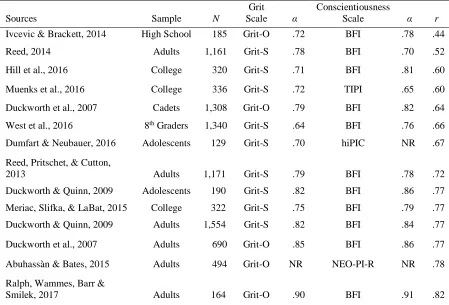
statistically significant strong positive relationship between grit and conscientiousness.
Fourth, the resulting confirmatory factor analysis’ Pearson correlation coefficients
revealed a statistically significant “strong” to “very strong” positive relationship among
all five latent constructs: interest, self-efficacy, locus of control, conscientiousness, and
grit. Finally, results from the structural equation model found interest to be a predictor of
subjective college success and conscientiousness to be the dominant predictor of both
subjective college success and objective college success.
Overall, the results from this study indicate that grit was not only hardly
distinguishable from conscientiousness and other motivational constructs, it disappeared
altogether. The dominant predictor of college success was conscientiousness. The
v
This dissertation, written under the direction of the candidate’s dissertation committee
and approved by the members of the committee, has been presented to and accepted by
the Faculty of the School of Education in partial fulfillment of the requirements for the
degree of Doctor of Education. The content and research methodologies presented in this
work represent the work of the candidate alone.
Christine M. Collaço April 25, 2018
Candidate Date
Dissertation Committee
Robert Burns, PhD April 25, 2018
Chairperson
Mathew Mitchell, PhD April 25, 2018
vi
“If it wasn’t hard, everyone would do it. It’s the hard that makes it great.” Tom Hanks, A League of Their Own.
There have been quite a few days, not discounting today, that I felt discouraged. Testing, analyzing, making additions, modifications … checking and re-checking my work – until finally, all I needed to do was complete the necessary paperwork. Yes, it was hard! I kept reminding myself that “it’s the hard that makes it great.” I was determined to finish what I started. Go ahead, call it “GRIT!”
I know I could not have reached this goal without the support of so many important people – and to all of them, I am forever grateful.
To my chairperson and advisor, Dr. Robert Burns, for believing in me. Thank you for your guidance, direction, and casual conversations about hockey and golf. Every time we met, I walked away with more work to do. I’m not sure how that happened, but it did.
To my esteemed committee members for taking the time to read this dissertation and for providing valuable feedback and insight. Dr. Mitchell, for challenging me and
recognizing where I can add more, or in some cases, less so that in the end my best work is presented. Dr. Gmelch, for being my “biggest fan” – your encouragement, gentle suggestions, and especially your smile added to my “can do attitude.”
To my friends and colleagues, I could not have completed this project without your help in collecting the data. A special “Thank You” to Mariela Vera and Jeff Toney, and all the professors who opened their classrooms to me and offered extra credit to their students for participating in this study.
To my USF, L&I friends, for your continuous encouragement and support, especially when I felt utterly defeated.
To my past, present, and future students for inspiring me to become a better teacher.
To my family, for understanding my “unavailability,” and taking care of Mom when I was in school and working on this project – and to my nephew, Philip Tyson for providing valuable feedback on Chapters I and II.
To my Mom, Angela H. Collaço and Dad, Geraldo B. Collaço for instilling in me the importance of education and hard work. Dad, I will always remember you for taking the time to teach me how to talk, spell, and write. To my Mom, who asked on graduation day – “When did you have time to do this?” I love you, Mom!
Finally, I dedicate this dissertation to my partner, best friend, and wife, Shelly M.
vii
Page
DISSERTATION ABSTRACT ... iii
SIGNATURE PAGE ...v
ACKNOWLEDGEMENTS ... vi
TABLE OF CONTENTS ... vii
LIST OF TABLES ...x
LIST OF FIGURES ... xii
CHAPTER I. STATEMENT OF THE PROBLEM ...1
Purpose of the Study ...5
Significance of the Study ...6
Theoretical Framework ...8
Self-Determination Theory ...8
Self-Efficacy Theory ...12
Locus of Control Theory ...16
Summary ...18
Background and Need ...20
Research Questions ...23
Definition of Terms...24
II. LITERATURE REVIEW ...27
Grit and Its Dimensions ...27
Theories on Grit ...31
McClelland’s Achievement Theory of Motivation and Grit ...31
Self-Regulated Learning Theories and Grit ...32
A Hierarchical Goal Framework and Grit ...34
The Mindset Theory and Grit ...36
Drive Theory and Grit ...37
Additional Theories and Grit ...37
Summary ...40
Studies on Grit ...41
Antecedents of Grit ...41
Construct Validity of Grit ...46
Predictive Validity of Grit ...52
viii
CHAPTER Page
Assessing Grit ...55
Interest...61
Interest Theory ...61
Studies on Interest ...66
Assessing Interest ...71
Summary ...75
Self-Efficacy ...75
Locus of Control ...82
The Big Five ...89
Conscientiousness ...90
Studies on Conscientiousness ...95
Summary ...100
College Success ...100
Summary of Literature Review ...104
III. METHODOLOGY ...106
Research Questions ...106
Research Design...107
Research Question 1 ...110
Research Question 2 ...110
Research Question 3 ...113
Research Question 4 ...113
Research Question 5 ...114
Protection of Human Subjects ...115
Participants ...117
Instrumentation ...118
Demographics ...118
Cognitive Ability Test ...118
Measuring Grit ...119
Measuring Interest ...121
Measuring Self-Efficacy ...123
Measuring Locus of Control ...124
Measuring Conscientiousness ...127
Measuring College Success ...129
Procedures ...131
Preliminary Data Analyses ...133
ix
CHAPTER Page
IV. RESULTS...138
Research Question 1: Factor Structure of Grit ...138
Research Question 2: Path Analysis ...143
Research Question 3: Correlation Analysis ...149
Research Question 4: Confirmatory Factor Analysis ...152
Research Question 5: Structural Equation Modeling...154
Summary ...160
V. DISCUSSION ...164
Summary of Study ...164
Summary of Findings ...168
Limitations ...171
Discussion of Findings ...174
Factor Structure of Grit ...174
Is Grit Better Than Cognitive Ability ...177
Grit’s Relation to Conscientiousness ...179
Grit’s Relation to Similar Constructs ...180
Grit and Other Motivational Constructs’ Prediction of College Success ...182
Conclusion ...185
Implications for Future Research ...186
Implications for Educational Practice ...188
REFERENCES ...190
APPENDIXES ...219
A. IRB Approval Letters ...220
B. Complete List of the Scales and their Items Organized by Construct ...223
C. College Success Survey ...231
D. Correlations Among All 28 Scale Scores ...244
E. Observed Correlations Among Scale Scores for Grit-O, Grit-C, BFI, 10-item IPIP, and AB5C-IPIP ...247
x
Table Page
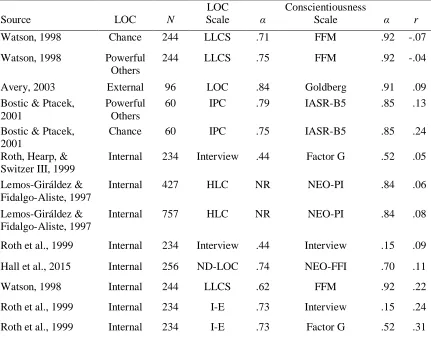
1. Relations Between Grit and Conscientiousness ...51
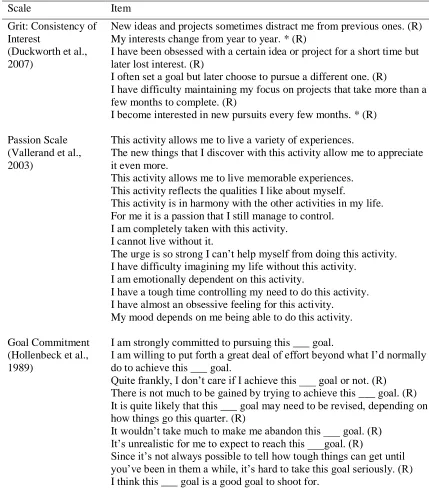
2. Comparable Perseverance of Effort Items ...59
3. Comparable Consistency of Interest Items ...60
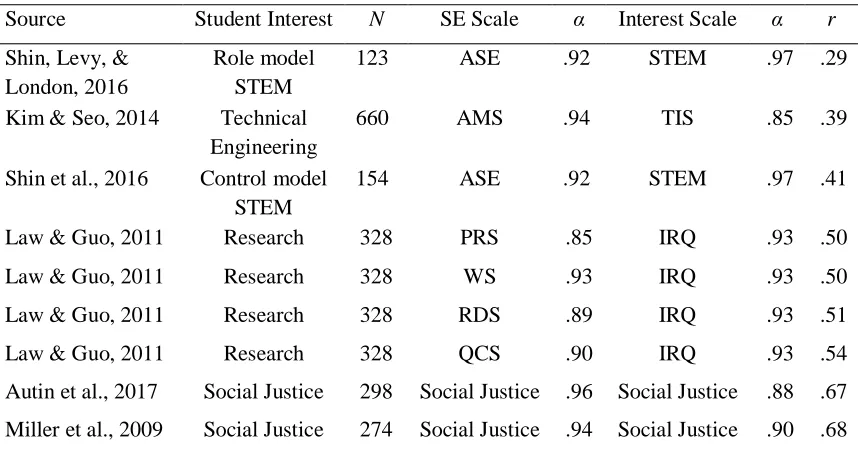
4. Relations Between Self-Efficacy (SE) and Interest ...77
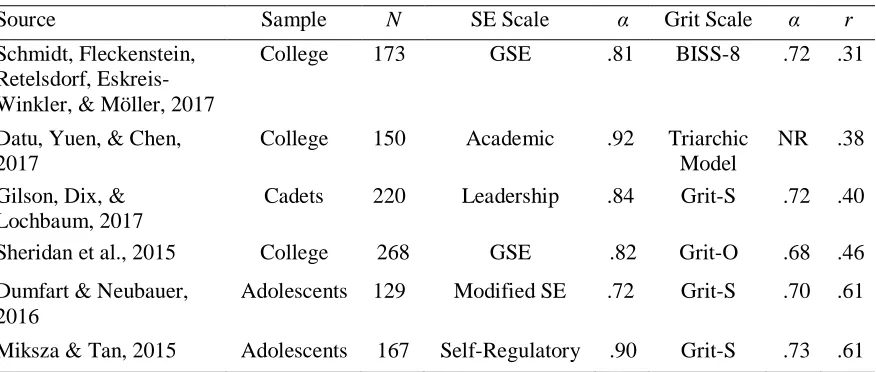
5. Relations Between Self-Efficacy (SE) and Grit...78
6. Relations Between Self-Efficacy (SE) and Conscientiousness ...80
7. Relations Between Locus of Control (LOC) and Conscientiousness ...86
8. Relations Among Conscientiousness and Perseverance of Effort (POE) Dimension and Consistency of Interest (COI) Dimension of Grit ...94
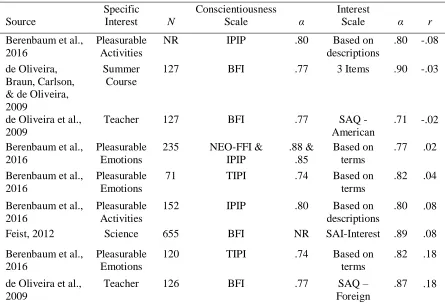
9. Relations Between Conscientiousness and Interest ...96
10.Relations Between Conscientiousness and College GPA ...97
11.Demographic Characteristics of Participants ...117
12.Positively-Worded Consistency of Interest (PCOI) Scale ...120
13.Recruitment Strategies by School ...132
14.Frequencies and Percentages of Missing Values by School ...134
15. Means, Standard Deviations, and Reliability Coefficients for Scale Scores Organized by Construct ...135
16.Data Analyses by Research Question ...137
17. PAF and PCA Factor Matrices: The 12-Item Scores from Duckworth and Colleagues’ (2007) Grit-O Scale ...140
xi
Table Page
19. PAF Factor Matrices: The 12-Item Scores from Duckworth and Colleagues’ (2007) Grit-O Scale with the 14-Item Scores from Vallerand and Colleagues’ (2003) Passion Scale ...144
20. PCA Factor Matrices: The 12-Item Scores from Duckworth and Colleagues’ (2007) Grit-O Scale with the 14-Item Scores from Vallerand and Colleagues’ (2003) Passion Scale ...145
21.PAF and PCA Factor Matrices: Measures of Grit Based on Scale Scores ...146
22. Observed Correlations Among Scale Scores for Grit-O, Grit-C, BFI,
10-item IPIP, and AB5C-IPIP...150
23. Observed Correlations Among Scale Scores for Grit-O, Grit-C, BFI,
10-item IPIP, AB5C-IPIP, and Comparable Measures of Grit ...150
24. Alphas (α) and True Score Correlations Among Scale Scores for Grit-O,
Grit-C, BFI, 10-item IPIP, and AB5C-IPIP ...151
25. Alphas (α) and True Score Correlations Among Scale Scores for Grit-O,
Grit-C, BFI, 10-item IPIP, AB5C-IPIP, and Comparable Measures of Grit ...151
26. Correlation Coefficients Among Latent Constructs Based on Relating Scale
Scores to their Pre-Defined Constructs ...154
27. Latent Constructs’ Factor Loadings Based on Exploratory Factor Analysis
with Varimax Rotation of all 28 Scale Scores ...157
28. Standardized Direct Effects and Indirect Effects for the New Structural
xii
Figure Page
1. A schematic representation of the proposed model ...19
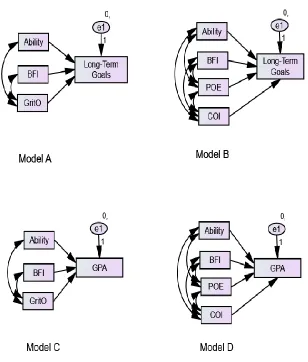
2. A schematic representation of the four path analysis models ...112
3. The latent variable structural equation model ...116
4. Four different path analysis models testing the predictive validity of grit ...148
5. CFA model based on the hypothesized factor analyses structure relating the scale scores to their respective constructs ...153
6. The proposed structural equation model based on the hypothesized factor analyses structure ...156
CHAPTER I
STATEMENT OF THE PROBLEM
“As much as talent counts, effort counts twice.” – Angela Duckworth, Grit
What contributes to a student’s college success? We know that intellectual talent
contributes to a student’s college success, but are there other factors that could possibly
play a larger role? Growing research has suggested that non-cognitive variables are
related to college success (Andretta, Worrell, & Mello, 2014; Duckworth, Kirby,
Tsukayama, Berstein, & Ericsson, 2011; Dumfart & Neubauer, 2016). The growing
interest in these non-cognitive variables makes sense, given that there is the possibility
these variables might be more sensitive to intervention and training programs. These
programs include character-building education (Soutter & Seider, 2013), resiliency
programs (Perkins-Gough, 2013) and growth mindset (Dweck, 2010). One such variable
that is sensitive to these intervention and training programs is grit (Duckworth, 2016;
Fitzgerald & Lauren-Fitzgerald, 2016; Hochanadel & Finamore, 2015).
Duckworth, Peterson, Matthews, and Kelly (2007) introduced the construct of
grit, which is defined as “perseverance and passion for long-term goals” that “entails
working strenuously toward challenges, maintaining effort and interest over years despite
failure, adversity, and plateaus in progress” (pp. 1087-1088). In other words, grittier
individuals remain focused and stay the course toward their goals even when they
encounter setbacks. Duckworth and her colleagues found that grit demonstrated
incremental predictive validity of success measures over and beyond IQ and
conscientiousness. Although their findings have received widespread attention,
remains much to be discovered about grit and its underlying psychological mechanisms.
So what do we really know about grit?
Much of the existing literature has recognized grit as a two-factor structure
comprised of perseverance of effort and consistency of interest (Abuhassàn & Bates,
2015; Credé, Tynan, & Harms, 2016; Duckworth & Gross, 2014; Duckworth et al., 2007;
Duckworth & Quinn, 2009; Ivcevic & Brackett, 2014). These studies have focused on
the predictive validity of grit and/or the two dimensions of grit separately. Although
Duckworth and her colleagues (2007) have indicated that the two dimensions of grit
together were more predictive than either alone, research has revealed that the
perseverance of effort dimension appears to be the dominant predictor of success
(Abuhassàn & Bates, 2015; Bowman, Hill, Denson, Bronkema, 2015; Kelly, Matthews,
& Bartone, 2014). For example, Abuhassàn and Bates found that higher perseverance
was the most important factor in predicting long-term achievements. They indicated that
it is the effortful persistence or “elbow grease” that is unique to grit.
In their seminal work, Duckworth and her colleagues (2007) conducted six studies
with high-achieving individuals and found that grit was positively related to (a)
educational attainment among two samples of adults, (b) higher GPA among students
attending an elite university, (c) success in summer training for West Point cadets, (d)
higher rounds of advancement among participants in the Scripps National Spelling Bee,
and (e) career stability. Results from these studies revealed that grit accounted for an
average of 4% of the variance in success outcomes. Duckworth and her colleagues also
(r = .77) and neuroticism (r = -.38), along with statistically significant relations with
agreeableness (r = .24), extraversion (r =.22), and openness to experience (r =.14),
suggesting significant construct overlap, especially for conscientiousness.
In fact, grit has been criticized as hardly being distinguishable from
conscientiousness (Credé et al., 2016). Conscientiousness is the Big Five personality trait
that includes a number of lower-level traits, such as self-control and perseverance
(MacCann, Duckworth, & Roberts, 2009; Roberts, Chernyshenko, Stark, & Goldberg,
2005), and has been found to be a significant predictor of performance (Furnham,
Chamorro-Premuzic, & McDougall, 2003; Wolfe & Johnson, 1995), academic
achievement (Digman & Takemoto-Chock, 1981), and academic course grades (Poropat,
2009). In response to the criticism, Duckworth stated that perseverance of effort, or
determination is not enough. It is consistency of interest, or “the passion piece” that is
just as important (Dahl, 2016). However, studies investigating grit with
conscientiousness found that grit did not explain any additional variance in academic
success (Abuhassàn & Bates, 2015; Dumfart & Neubauer, 2016; Ivcevic & Brackett,
2014).
Some researchers suggest that grit is a more fine-grained measure of
conscientiousness (Duckworth et al., 2007; Ivceciv & Brackett, 2014; MacCann et al.,
2009). However, grit as a measure of conscientiousness has drawn criticism in the
promotion of grit in education. Conscientiousness is a personality trait, not a skill, and
usually thought not amendable by direct instruction – “nor should it be” (Credé et al.,
2016). Nevertheless, a major implication of grit and the educational programs that have
Other researchers have taken a different perspective and linked grit with
motivation (Almeida, 2016; Duckworth & Gross, 2014; Siegling & Petrides, 2016). For
example, Almeida indicated that the theory of motivational intensity (Brehm & Self,
1989) is useful in connecting grit with motivation (Silvia, Eddington, Beaty, Nusbaum, &
Kwapil, 2013). According to this theory, two factors – the perceived importance and
difficulty of the goal - contribute to the amount and type of effort that a person exerts
(Almeida, 2016, p. 571). Almeida indicated that the importance of the goal and the
degree of effort the person is willing to exert towards that goal, mediated by external
influences, may help determine one’s level of grit. Duckworth and Gross (2014) added
that the individual’s goal must be of compelling and significant interest for the individual
to be inspired and driven towards this lifelong allegiance, despite setbacks, mistakes,
obstacles, and alternatives. Duckworth and Gross indicated that grit is “as much
motivation as volition” (p. 323).
Is grit part-motivation? Is it the motivation aspect of grit that differentiates it
from conscientiousness? There are ultimately two fundamental questions concerning
motivation in the context of individual differences and psychological assessment
(Siegling & Petrides, 2016). They are “why?” and “how much, or to what extent?” The
“why” are the specific reasons for one’s behavior, whereas the “how much, or to what
extent” is the propensity to pursue goals, motives, needs, etc. (Cattell & Kline, 1977). If
grit is part-motivation, the perseverance of effort dimension of grit would be linked to the
propensity or “how much, or to what extent” individuals act on personal motivators, and
the personal motivators would be linked to the consistency of interest dimension of grit.
propels the propensity. The question that remains to the researcher is: “What are the
personal motivators?”
A considerable amount of the current research on grit has been on its construct
and predictive validity (Abuhassàn & Bates, 2015; Bowman et al., 2015; Credé et al.,
2016; Duckworth & Gross, 2014; Duckworth et al. 2007; Duckworth & Quinn, 2009;
Kelly et al., 2014; Ivcevic & Brackett, 2014). Other than the links between growth
mindset (Dweck, 2010), and deliberate practice (Duckworth et al., 2011; Duckworth et
al., 2007), the antecedents of grit are less explored. Only within the last three years have
researchers decided to investigate the plausible antecedents of grit. The problem is that
researchers have not focused on what initiates grit.
Duckworth (2016) wrote that individuals would first need to find their interest in
order to develop and increase their grit. Is it possible that “interest” is the telling factor
that differentiates grit from conscientiousness? Are the conflicting results with the
predictive power of grit and success due to a lack of interest? Could there possibly be
other variables that are mediating factors and have an effect on success via grit? This
study intends to answer these questions. More specifically, this study seeks to shed light
on what initiates grit, what differentiates grit from conscientiousness, and what could be
the reason for the conflicting results with the predictive power of grit.
Purpose of the Study
Duckworth and her colleagues (2007) argue that non-cognitive skills like grit can
be developed, and grit is at least as important as IQ in predicting success. Decisions are
being made to assess this construct as part of students’ evaluations (Zernike, 2016), and
(U.S. Department of Education, 2013). Yet, the research examining grit’s relations to
conscientiousness, and its predictive validity with college success are sparse and/or
contains conflicting results. Furthermore, grit researchers have yet to investigate what
initiates grit. Therefore, the purpose of this study is to (a) examine the factor structure of
grit, (b) determine whether grit is a better predictor of college success than cognitive
ability and conscientiousness, (c) examine the relationship between grit, its two
dimensions, and measures of conscientiousness, (d) examine grit’s relation to interest,
self-efficacy, locus of control, and conscientiousness, and (e) investigate their predictive
validity with college success.
To accomplish this purpose and extend previous research on grit, college students
from a private university and junior college located in Central Valley of Northern
California completed an instrument comprised of a cognitive ability test and a
questionnaire. The questionnaire was comprised of existing and multiple measures of
grit, interest, self-efficacy, locus of control, and conscientiousness along with a number
of college success measures. Structural equation modeling (SEM) was used as the
primary statistical analysis technique. The primary antecedent (interest) was examined as
an exogenous variable. Grit, self-efficacy, locus of control, conscientiousness, and
college success were examined as endogenous variables. Factor analysis, correlation
analysis, and path analysis were also used.
Significance of the Study
This study is significant and justified for several reasons. First, an important
methodological issue that has theoretical ramifications is whether the two subscales of
constructs (Muenks, Wigfield, Yang, & O’Neal, 2016). Both perseverance of effort and
consistency of interest are thought to contribute to success; however, a review of
literature reveals that the perseverance of effort dimension is the primary utility of grit
(Abuhassàn & Bates, 2015; Credé et al., 2016). Given that government agencies are
making recommendations for how educators might work with children to help them
develop the “non-cognitive” skills they need to succeed in school (U.S. Department of
Education, 2013), it is critical to understand where the focus should be in developing the
“non-cognitive” skills’ curriculum. The findings of this study will enhance educators’
and government agencies’ understanding of grit and its two dimensions, and provide
direction for them to take in developing their “non-cognitive” skills’ curriculum.
Second, this study will contribute to the knowledge base on grit by examining the
overlap and distinctiveness of grit with different measures of conscientiousness among
college students. It will extend previous research on the construct validity of grit by
taking into account different measures of conscientiousness, and by using ostensibly
comparable measures of grit. Educators can use the findings from this study to develop
or modify curriculum programs that are targeted to promote grit and/or related
“non-cognitive” skills. At the same time, researchers can use the findings from this study to
continue the “ongoing process of discovery” and “can engage in increasingly informative
evaluations of theories and measures that accompany them” (Smith, 2005, p. 406).
Third, a major contribution from this study is the examination of potential
antecedents of grit. The research on grit has primarily been on the construct and
predictive validity of grit and its two dimensions. It is just as important to focus on the
words, the academic research on what initiates and cultivates grit is very much in its
infancy. The findings of this study will shed light on additional antecedents of grit and
provide educators, government agencies, and interested parties with direction on what
can be done to initiate, promote, and sustain grit.
Finally, the findings of this study will provide educators and researchers with
greater understanding of factors that contribute to success. Greater understanding of
factors that contribute to college success can help educators develop better educational
curriculum. Success in college has been, for the most part, measured by GPA. Including
additional measures of college success in examining grit and its closely-related construct
will provide educators and researchers alike with a more global measure of college
success. After all, success after college is not measured by GPA, or just one factor.
Theoretical Framework
The theoretical framework for this study incorporates Deci and Ryan’s (1985)
self-determination theory, the self-efficacy component of Albert Bandura’s (1986) social
cognitive theory, and Rotter’s (1966) locus of control theory. The three theories have
been researched extensively. Deci and Ryan’s self-determination theory provides a
framework for the study of human motivation and personality. Self-efficacy theory
recognizes the diversity of human capabilities (Bandura, 1997), and locus of control
serves as a motivation determinant (Rotter, 1966). A comprehensive review of each
theory follows, starting with Deci and Ryan’s (1985) self-determination theory.
Self-Determination Theory. According to the self-determination theory, the
central assumption is that all individuals are born with the basic psychological needs for
that individuals are motivated to engage in activities to the extent that the activities are
associated with the satisfaction of these needs (Deci & Ryan, 1985; Sansone & Thoman,
2005). Autonomy refers to “an inner endorsement of one’s action” (Reeve & Jang, 2006,
p. 209). That is, the individual’s motivation emerges from within, and there is perception
of choice and freedom. White (1959) defined competence as “the ability to interact
effectively with the environment” (p. 297). He considered it necessary to treat
competence as having a motivational aspect. Competence serves to enhance the abilities
of the individual. He indicated that individuals will engage in activities simply to
experience competence, and characterized this experience as “a feeling of efficacy”
(p. 329). Deci and Flaste (1995) indicated that the feeling of competence (i.e., being able
to succeed at the activity or goal) is an important aspect of intrinsic satisfaction. They
wrote that “for a positive close relationship to exist between the individual’s competence
and intrinsic motivation, the activity must be interesting and challenging for the
individual” (p. 58). Relatedness refers to the development and maintenance of close
personal relationships (Deci & Ryan, 1985). Hrbackova and Suchankova (2016)
described relatedness as “the individual perceiving a sense of security, confidence, and
satisfaction in interpersonal relationships” (p. 690).
Self-determination theory distinguishes three types of motivation based on the
interaction of individuals’ needs and their environment: amotivation, intrinsic, and
external (Deci & Ryan, 1985; Ryan & Deci, 2000). Amotivation is a form of
non-regulation, in which individuals have no interest in the activity, whereas intrinsic
motivation is a form of self-regulation, in which individuals demonstrate their own
see any value in an activity (Ryan, 1995) or do not feel competent to do it (Deci & Ryan,
1985, p. 71). Individuals who are intrinsically motivated engage in an activity because
the activity is enjoyable and gratifying by itself (Ryan & Deci, 2000).
Between amotivation and intrinsic motivation is extrinsic motivation. Extrinsic
motivation refers to doing an activity for its instrumental value (Ryan & Deci, 2000, p.
60). These individuals engage in an activity because it leads to a reward or outcome
separable from the activity itself.
There are four types of extrinsic motivation that differ based on their regulation
processes: external, introjected, identified, and integrated (Deci & Ryan, 1985). Ryan
and Deci (2000) described each of the four types of extrinsic motivation. External
regulation represents the least autonomous form of extrinsic motivation. These
individuals engage in an activity to satisfy an external demand or obtain an externally
imposed reward. Introjected regulation is a type of internal regulation that is still quite
controlling. These individuals engage in an activity to avoid guilt or anxiety, or to
enhance their egos. Identified regulation is a more autonomous or self-determined form
of extrinsic motivation. These individuals have identified some personal importance
associated with an activity or behavior and have thus accepted its regulation as their own.
For example, a girl who learns how to create a website because she sees it as relevant to
enhancing her communication skills, which she considers important for her career, has
identified with the value of this learning activity. Ryan and Deci wrote that the most
autonomous form of extrinsic motivation is integrated regulation, and “occurs when
identified regulations have been fully assimilated to the self” (p. 62). The more
self, the more their actions become self-determined. Furthermore, they indicated that the
level of motivation also varies, and in some cases, the nature and focus of motivation
varies.
Intrinsic motivation is closely connected with the concepts of conation (Huitt &
Cain, 2005) and drive (Siegling & Petrides, 2016). Deci and Ryan (1985) defined
intrinsic motivation as “based in the innate, organismic needs for competence and
self-determination” that “energizes a variety of behaviors and psychological processes for
which the primary rewards are the experience of effectance and autonomy” (p. 32). They
added that the intrinsic need for competence and self-determination motivates the
individual to continuously seek and conquer optimal challenges, and “they do so
persistently” (p. 33). A wide variety of knowledge, attitudes, and skills comprise the
conative domain, such as defining one’s purpose, having an achievement orientation,
setting goals, regulating behavior, and persevering (Huitt & Cain, 2005). The construct
drive would be concerned with the extent to which a person acts on personal motivators,
whatever these may be (Siegling & Petrides, 2016, p. 1). On the other hand, personal
motivators - such as interest - reflect what a person wants to attain, or reasons for one’s
behavior.
Based on the self-determination theory, interest is analyzed in relation between a
person and an activity (Deci, 2014). Deci wrote that “the self-determination analysis is
concerned with the match between a person’s needs, desires, and capacities, on the one
hand, and the affordances of an activity, on the other hand” (p. 46). Specifically, he
indicated that the individual experiences interest only when his or her needs and desires
the activity that interest develops. He stated that as the individual’s regulation becomes
integrated, he or she will experience greater interest in doing it, though he believed that
the concept of “importance” is more central than interest even to self-determined
extrinsic motivation (p. 55).
Therefore, based on Deci and Ryan’s (1985) self-determination theory, for
individuals to remain committed and driven towards their long-term goals, they must first
develop an interest - something that they “intrinsically enjoy doing” (Duckworth, 2016,
p. 91). Interest is what initially inspires individuals to be driven towards their lifelong
allegiance, despite setbacks, mistakes, obstacles, and alternatives. Interest is what
initiates grit. But is interest, on its own, enough to propel individuals to become “grittier”
and successful?
Self-Efficacy Theory. In Social Foundations of Thought and Action, Albert
Bandura (1986) wrote that theories that seek to explain human behavior solely as the
product of external rewards and punishment present a truncated view of human nature
because people possess a self system that enables them to exercise a measure of control
over their thoughts, feelings, and actions (p. 335). The self system includes abilities to
symbolize, exercise forethought, learn from others, regulate one’s own behavior, and
engage in self-reflection. It is comprised of cognitive and affective structures; whereas,
individuals are able to regulate their behavior through internal standards and
self-evaluation of their own behavior (Bandura, 1986, p. 390). In all, Bandura presents a
portrait of human behavior and motivation, and in this portrait it is “the beliefs that
people have about themselves that are key elements in the exercise of control and
conceptions of their personal efficacy that is considered to be most influential in people’s
lives (Bandura, 1986, p. 390).
Wood and Bandura (1989) defined self-efficacy as “beliefs in one’s capabilities to
mobilize the motivation, cognitive resources, and courses of action needed to meet given
situational demands” (p. 408). Individuals with high self-efficacy exert greater effort and
persevere when obstacles are encountered (Bandura, 1977). These individuals see
“difficult tasks as challenges to be mastered, are more interested in achieving goals,
sustain higher effort at difficult times, and attribute failure to lack of effort or insufficient
knowledge and skill” (Becker & Gable, 2009, p. 6).
Pajares (1996) wrote that perceived efficacy beliefs help facilitate how much
effort individuals will exert, how long they will persevere when confronted with
obstacles, and how resilient they will prove in the face of adversities. In other words,
“the higher the sense of efficacy, the greater the effort, persistence, and resilience”
(p. 544). Individuals with high self-efficacy choose to perform more challenging tasks.
These individuals have greater confidence in these tasks, and they exert greater effort and
persist longer than those low in self-efficacy (Pajares, 1996). It is their belief in their
personal competence that enables them to deal with all kinds of demands (Luszczynska,
Gutiérrez-Doña, & Schwarzer, 2005).
Self-efficacy is not only considered to be an important component of an
individual’s self-concept, but draws close parallels with other expectancy beliefs (Pajares,
1996). Some researchers have even used the terms (self-efficacy and self-concept)
synonymously (Reyes, 1984); the difference resides in the contextual framework. In
level of specificity and includes the evaluation of such competence and the feelings of
worth associated with behaviors in question” (Pajares, 1996, p. 561). Similarly,
self-efficacy and other expectancy beliefs share commonalities in their beliefs about the
individual’s perceived capability, but differ in terms of the contextual framework and
specificity. Self-efficacy beliefs are “more task- and situation-specific,” and the
individual’s self-efficacy beliefs are aligned to some type of goal (Pajares, 1996, p. 546).
For this reason, self-efficacy has been studied in a number of specific domains such as
academics, health, sports, and organizations (Bandura, 1997).
Bandura (1977) indicated that the level and strength of the individuals’ belief in
their personal competence can be altered. That is, “the theory of self-efficacy postulates
that different modes of influence change behavior in part by creating and strengthening
self-percepts of efficacy” (Schunk, 1981, p. 93). Bandura presented four major sources
of information that can influence individuals’ self-efficacy: performance
accomplishments, vicarious experience, verbal persuasion, and emotional arousal. These
four major sources of information are also used by individuals to judge their level of
perceived self-efficacy.
First there is the influence of performance accomplishments. Bandura (1977)
indicated that the individual’s sense of self-efficacy can be increased through
accomplished performance. In other words, through repeated successes the individual’s
sense of self-efficacy increases. Repeated successes are considered to be especially
influential because they are based on personal mastery experiences. With repeated
successes, the individual’s confidence rises. Failures may be experienced; however, the
After self-efficacy has developed and has become stronger, these individuals may find
that occasional failures can be overcome by determined effort, and can even strengthen
their self-motivated persistence (Bandura, 1977, p. 195).
Next, individuals can also increase their sense of self-efficacy by observing
others. By seeing others perform threatening or difficult activities without adverse
consequences, individuals will see that that “they too will improve if they intensify and
persist in their efforts” (Bandura, 1977, p. 197).
The third source Bandura (1977) mentioned was verbal persuasion. Though not
as powerful as repeated successes, individuals’ sense of self-efficacy can also be induced
through verbal persuasion. Individuals are led, through suggestions and other persuasive
means (i.e., exhortation, self-instruction, etc.), to believe that they can successfully
overcome their challenges.
The last source Bandura (1977) spoke to was emotional arousal. He stated
individuals rely partly on their state of physiological arousal in judging their anxiety and
vulnerability to stress (p. 198). By conjuring up fear-provoking thoughts about their
ineptitude, individuals can rouse themselves to increased levels of anxiety and cast doubt
on their personal belief of their competence. Individuals in this state of mind would more
likely not experience success. On the other hand, individuals who are not bedeviled by
these aversive arousals would more likely experience success. That is, anxiety reduction
will strengthen one’s efficacy expectations.
Hence, the individual’s behavior can change through guided exposure, modeling,
persuasion, and anxiety reduction (Bandura, 1977, 1986; Multon, Brown, & Lent, 1991).
conviction that one can successfully execute the behavior required to produce the
outcome” - can be altered (Bandura, 1977, p. 193). Through such diverse methods, the
individual’s efficacy expectations can be increased. These efficacy expectations
determine how much effort individuals will expend and how long they will persist in the
face of adversities. In other words, “the stronger the perceived self-efficacy, the more
active the efforts” (Bandura, 1977, p. 194).
Locus of Control Theory. Julian Rotter (1966) introduced the concept of locus
of control. Locus of control, or internal versus external control of reinforcement, refers
to “the degree to which persons expect that a reinforcement or an outcome of their
behavior is contingent on their own behavior or personal characteristics versus the degree
to which persons expect that reinforcement or outcome is a function of chance, luck, or
fate, is under the control of the powerful others, or is simply unpredictable” (Rotter,
1990, p. 489). Internal control beliefs are associated with vitality, and external control
beliefs are associated with apathy and withdrawal. In other words, locus of control can
be viewed as "a mediator of involved commitment in life pursuits” (Lefcourt, 1982, p.
184).
The concept of locus of control emerged from Rotter’s (1954) social learning
theory. In developing social learning theory, Rotter had departed from instinct-based
psychoanalysis and drive-based behaviorism, believing that a psychological theory
should have a psychological motivational principle. That motivating principle was the
empirical law of effect, which states that “people are motivated to seek out positive
According to Phares (1976), there are six major assumptions of social learning
theory. First, both the individual’s experience and his or her environment must be taken
into account (Mearns, 2017). Next, learned social behavior is emphasized. Third, there
is unity to personality; that is, the individual’s experiences are influenced by the effects
of accumulated knowledge and prior experience. The fourth assumption is that both
general and specific determinants of behavior are emphasized. In other words, both
situational-specific factors and dispositional elements contribute to the individual’s
behavior. Fifth, the individual’s behavior is motivated or said to be goal-oriented.
Finally, behavior is based on expectancy outcomes. In other words, the individual
expects that his or her behavior will lead to the goals being met (Phares, 1976, pp. 11-13).
In sum, Rotter’s (1954) social learning theory provides a framework for
understanding “how choices are made by individuals from a variety of potential
behaviors available to them,” and to predict goal-directed behavior, “one must consider
expectancy, reinforcement value, and the psychological situation” (Phares, 1976, pp.
13-14). The behaviors or actions of individuals are predicted on the basis of their values,
their expectations, and the situations they find themselves in (Lefcourt, 1982, p. 32).
When individuals are presented with more than one choice to be taken, they will choose
the behavior that has the greatest expectancy (probability of reinforcement) and
reinforcement value (or need), and they will choose or act differently depending on their
locus of control (Phares, 1976).
With the locus of control construct, “a person views himself in conjunction with
the things that befall him, and the meaning that he makes of those interactions between
generalized expectations people hold regarding the degree to which they can control their
own fate (Rotter, 1966). Rotter states: “If a person perceives a reinforcement as
contingent upon his own behavior, then the occurrence of either a positive or a negative
reinforcement will strengthen or weaken potential for that behavior to recur in the same
or similar situation. If he sees the reinforcement as being outside his own control or not
contingent, that is, depending upon chance, fate, powerful others, or unpredictable, then
the preceding behavior is less likely to be strengthened or weakened” (p. 5).
Internals believe that an event or outcome is contingent upon their own behavior.
Externals believe that an event or outcome are caused by factors beyond their control
(Rotter, 1966; Weiner, Nierenberg, & Goldstein, 1976). It is their belief, or locus of
control that serves as a determinant in terms motivation (Phares, 1976). In other words,
individuals will exert more effort if they believe that an event or outcome depends at least
somewhat on their own actions or choices in comparison to those who believe that an
event or outcome depends on external factors, such as luck, chance, or powerful people.
Summary. Based on the Deci and Ryan’s (1985) self-determination theory, the
self-efficacy component of Albert Bandura’s (1986) social cognitive theory, and Rotter’s
(1966) locus of control theory, for individuals to exert an extraordinary amount of effort
consistently over time, there must be the initial interest. Individuals must believe in
themselves. They must believe that they are in control of their success. That consistency
of interest, or passion, combined with the sustained belief in oneself are what drive the
effortful persistence, and become “zeal and prodigious energy” (Galton, 1892) that serve
as the predictor of success (Abuhassàn & Bates, 2015; Duckworth et al., 2007;
not assessed in the five-factor model conscientiousness (Abuhassàn & Bates, 2015) and
differentiates grit from conscientiousness?
Figure 1. A schematic representation of the proposed model.
The proposed model (see Figure 1) introduces interest, self-efficacy, and locus of
control as possible antecedents of grit. It is hypothesized that interest would have a
positive direct effect on self-efficacy, locus of control, conscientiousness, grit, and
college success, and a positive indirect effect on grit and conscientiousness through
self-efficacy and locus of control. Self-self-efficacy and locus of control would have a positive
direct effect on grit and conscientiousness, and a positive indirect effect on college
success through grit and conscientiousness. Grit and conscientiousness would have a
positive direct effect on college success.
Deci and Ryan’s (1985) self-determination theory, the self-efficacy component of
theory will be used as the theoretical framework in testing and interpreting the results of
the above fore-mentioned model and findings from this study.
Background and Need
Grit is currently the “hot” buzzword in education. It has also been called the
“new poster child” for non-cognitive variables (Dixson, Worrell, Olszeweski-Kubilius, &
Subotnik, 2016). In 2013, the United States Department of Education indicated that it is
the responsibility of the educational community to design learning environments that
promote grit and its related factors so that students are prepared to meet 21st-Century
challenges (p. v). Educational programs have sprung up in the past few years, and
decisions are being made to assess grit as part of students’ evaluations (Zernike, 2016).
School districts across the United States are reportedly considering “teaching grit” into
their curricula (Cohen, 2015). However, there are some who see grit as nothing more
than something old packaged as something new (Credé et al., 2016; Muenks et al., 2016;
Rimfeld, Kovas, Dale, & Plomin, 2016).
Given the technological advancements in the last 30 years, grit has been making
headlines beyond the common channels of communication. Angela Duckworth’s TED
Talk (2013), “Grit: The power of perseverance and passion,” has been translated in 49
languages and viewed by over 12 million individuals. The popular teaching website,
Edutopia (2017), offers a number of grit videos, blogs, and lesson plans. The Internet has
enabled grit to become a household word. Everyone, including today’s parents, are
talking about grit (Reischer, 2016).
In the first half of 2016, Duckworth published a book – Grit: The Power of
of domains (p. 12). Duckworth wrote that individuals can develop and increase their grit.
She stated that grit is comprised of four psychological assets. They are interest, practice,
purpose, and hope. First, individuals would need to find their interest - something that
they “intrinsically enjoy doing” (p. 91). Next, goals are set, and individuals set out on a
course of deliberate practice. Duckworth and her colleagues (2011) defined deliberate
practice as “engaging in a focused, typically planned training activity designed to
improve some aspect of performance” (p. 174). Individuals set “a stretch goal, zeroing in
on just one narrow aspect of their overall performance,” and they strive to improve
specific weaknesses (Duckworth, 2016, p. 121). Individuals must also find a purpose in
order to maintain that interest. Their purpose and interest must have both a personal
connection and a connection to the well-being of others. And from the beginning to the
very end, individuals must sustain hope (Duckworth, 2016).
At the same time, several researchers have become critical of grit’s popularity.
Credé and his colleagues (2016) conducted a meta-analytic analysis based on 584 effect
sizes from 88 independent samples representing 66,807 individuals and found (a) no
evidence of the higher-order construct, (b) very strong correlations between grit and
conscientiousness, and (c) modest correlations of grit with performance and retention.
Rimfeld and colleagues (2016) investigated the genetic and environmental origins of
individual difference in grit based on the Grit-S scale. Using a sample of over 4,500
16 year-olds, they found that grit did not contribute to the prediction of academic success
beyond the contribution of conscientiousness. All together, these results cast doubt on
Only in the last three years have researchers decided to explore plausible
antecedents of grit. In their seminal work, Duckworth and her colleagues (2007) did find
that grittier competitors outranked their less gritty competitors, at least in part because of
more accumulated and focused practice. The term was later baptized as “deliberate
practice,” borrowed from Ericsson’s thousands and thousands of hours of focused and
goal-oriented practice (Duckworth, 2016). Growth mindset has also been promoted as a
requirement in cultivating grit (Dweck, 2010; Fitzgerald & Laurian-Fitzgerald, 2016).
Individuals with a growth mindset believe that intelligence is not fixed. These
individuals value hard work and effort.
More recently, purpose (Hill, Burrow, & Bronk, 2016), passion (Mueller, Wolfe,
& Syed, 2017), motivational orientations (Suzuki, Tamesue, Asahi, & Ishikawa, 2015;
Von Culin, Tsukayama, & Duckworth, 2014), meaningful relationships (Datu, 2017), and
hope (Vela, Lu, Lenz, & Hinojosa, 2015) were linked to grit. Mueller and his colleagues
found that individuals’ passion plays a central role in how their goals are pursued, and
thus, the degree of grit exerted towards those goals. Other researchers have found that
meaning and engagement were related to grit (Suzuki et al., 2015; Von Culin et al.,
2014). If grit does predict success, investigating the antecedents of grit becomes a
necessity.
Duckworth and her colleagues (2007) had asked, “Why do some individuals
accomplish more than others of equal intelligence” (p. 1087)? What possesses them to
push themselves to their limits? Could the missing initiator be the individual’s personal
or intrinsic interest? Though there may be a number of additional factors that have an
initiates the individual’s propensity to pursue long-term goals with perseverance and
passion.
Is this perseverance and passion that leads to success grit, or a component of
conscientiousness? Duckworth and her colleagues (2007) have argued that the two
dimensions of grit together were more predictive than either alone, and that grit has
instrumental predictive validity of success over and beyond IQ and conscientiousness. In
other words, grit is as good or an even better predictor of success than cognitive ability
(Duckworth, 2013). Yet, the current research has found the perseverance of effort
dimension to be the dominant predictor of success (Abuhassàn & Bates, 2015; Bowman
et al., 2015; Credé et al., 2016; Kelly et al., 2014), and questions the construct validity of
grit (Credé et al., 2016; Muenks et al., 2016; Rimfeld et al., 2016).
Even with these conflicting results and not knowing what initiates grit, the
popularity around grit has continued to grow. Grit has been characterized as the golden
ticket for success. Grit is not only the “hot” buzzword in education - parents, government
agencies, and the popular press are talking about grit. However, this widespread interest
in grit is accompanied by open criticism from prestigious researchers. The responses to
grit’s criticism has led some researchers to believe that grit is a chameleon. Investigating
grit through the lens of motivation and its potential antecedents may help provide clarity.
Research Questions
Therefore, in accordance with this study’s purpose, the following research
questions were asked:
2. Does grit predict college success over and beyond cognitive ability and
conscientiousness?
3. To what extent does grit correlate with conscientiousness among college students?
4. To what extent do interest, self-efficacy, locus of control, conscientiousness, and
grit relate to each other among college students?
5. To what extent do interest, self-efficacy, locus of control, conscientiousness, and
grit predict college success?
Definition of Terms
There are several key terms that need to be defined. These terms are as follow:
Grit is defined as “perseverance and passion for long-term goals,” and “entails
working strenuously toward challenges, maintaining effort and interest over years despite
failure, adversity, and plateaus in progress” (Duckworth et al., 2007, pp. 1087-1088).
Individuals who have grit work hard and stick to their long-term passions and goals
(Bashant, 2014, p. 14).
Perseverance of Effort is defined as the individual’s tendencies to keep working
toward long-term goals despite the hardships that are faced (Duckworth et al., 2007).
Consistency of Interest refers to how steadily individuals keep to their goals
(Duckworth, 2016, pp. 57-58). Consistency of interest is associated with focus, undying
commitment, and passion (Duckworth, 2016; Duckworth et al., 2007), and interpreted as
more goal- and action-oriented and encompasses long-term behavior (Muenks et al.,
Conscientiousness is one of five core personality traits, referred to as the “Big
Five,” and is defined as purposeful, strong-willed, determined, and organized behavior
(Costa & McCrae, 1998).
Motivation reflects “an individual’s intensity, direction, and persistence of effort
toward achieving a goal” (Robbins, Judge, & Campbell, 2010). Motivation is concerned
with the specific reasons for one’s behavior and the propensity to pursue goals,
motivates, needs, etc. (Cattell & Kline, 1977).
Conation refers to the connection of knowledge and affect to behavior and is
associated with the issue of “why” (Huitt, 1999, p. 1). For the purpose of this study,
conation is simply defined as “the striving component of motivation” (Huitt, 1999, p. 1).
Self-Regulation “refers to the way in which individuals control their thoughts and
action” (Renninger & Hidi, 2016, p. 86).
Future Time Perspective refers to “the degree to which and way in which the
chronological future is integrated into the present life-space of an individual through
motivational goal-setting processes” (Husman & Lens, 1999, p. 114).
Interest is defined as a psychological state and a motivational variable. As a
psychological state, interest is construed by “increased attention, effort, concentration,
and affect during engagement,” and as a motivational state, there is a “distinction
between shorter-term or situational interest and long-term or individual interest that is
characterized by reengagement over time” (Renninger & Hidi, 2016, p. 9).
Self-Efficacy is defined as “beliefs in one’s capabilities to mobilize the
motivation, cognitive resources, and courses of action needed to meet given situational
Locus of Control refers to the generalized expectations people hold regarding the
degree to which they can control their own fate (Rotter, 1966). Internals believe that an
event or outcome is contingent upon their own behavior. Externals believe that an event
or outcome are caused by factors beyond their control (Rotter, 1966; Weiner et al., 1976).
It is their belief, or locus of control, that serves as a determinant in terms of motivation
(Phares, 1976).
Deliberate practice entails “engaging in a focused, typically planned training
activity designed to improve some aspect of performance” (Duckworth et al., 2011, p.
174).
Flow is defined as “a psychological state in which the person feels simultaneously
cognitively efficient, motivated, and happy” (Moneta & Csikszentmihalyi, 1996, p. 277).
Hardiness refers to a pattern of attitudes or skills that provides the courage and
motivation needed for enhanced performance in stressful circumstances (Maddi, 2007).
College Success means earning an overall GPA above 3.0, having a happy social
life in college, meeting personal long-term college goals, having confidence in one’s
ability to apply what was learned from college in life, having high expectations to obtain
a job within 6 months of graduation, obtaining skills relevant to employability and
CHAPTER II
LITERATURE REVIEW
Grit is a four-letter word that spells success. True, there is a fairly significant
amount of literature supporting the link between grit and success, and just the same, a fair
amount that states otherwise. But grit, to some, is just something old wrapped as
something new (Credé et al., 2016; Muenks et al., 2016; Rimfeld et al., 2016). The
appetite in grit is that it can be taught (Duckworth, 2016; Fitzgerald &
Laurian-Fitzgerald, 2016), although proponents of grit appear to be ignoring motive (Kohn, 2014).
Grit does not appear to come easy, and it may come with a cost (Lucas, Gratch, Cheng, &
Marsella, 2015). What drives an individual to work hard with an undying commitment
towards one’s long-term goals? And if grit does spell success, what initiates grit? The
widespread enthusiasm for grit as a predictor and determinate of success calls for a closer
investigation of what initiates grit, its relation to conscientiousness, and predictive
validity with success.
In this review of literature, I open with an overview of grit, its dimensions, and
theories on grit. This is followed by a number of relevant studies on grit and assessing
grit. Next, the proposed antecedents of grit are introduced: interest, self-efficacy, and
locus of control. An overview of the Big Five, conscientiousness, relevant studies, and
measuring conscientiousness is then presented. Finally, the review of literature
concludes with a discussion on college success measures.
Grit and Its Dimensions
In 2007, Duckworth and her colleagues originally conceptualized grit within the
passion for long-term goals” (p. 1087). Their hypothesis that grit is essential to high
achievement evolved during interviews with professionals in a variety of occupations
(i.e., investment banking, painting, journalism, academia, medicine, and law). When
these individuals were asked what quality distinguishes star performers in their respective
fields, “these individuals cited grit or a close synonym as often as talent” (p. 1088). Grit
entails working extremely hard, maintaining effort and interest over years despite
setbacks (Duckworth et al., 2007). At its core is “passionate perseverance” (Duckworth,
2016).
According to Dumfart and Neubauer (2016), grit integrates aspects of
achievement striving, self-control, and consistency of interest, and encourages the
realization of existing talents in individuals (p. 8). Abuhassàn and Bates (2015)
characterized grit as a measure of self-control. Other researchers have described grit as
being largely distinct from cognitive ability (Duckworth et al., 2007; Duckworth &
Quinn, 2009; Perkins-Gough, 2013). Grit has also been depicted as a performance
character strength: “the qualities that an individual draws upon in achieving his or her
potential in a given endeavor” (Soutter & Seider, 2013, p. 352). Kelly and his colleagues
(2014) conceptualized grit as “the sustained and passionate pursuit of a given interest or
goal” (p. 329). They indicated that grit emphasizes long-term stamina, where effort and
interest are maintained over several years.
Grit targets elements of “zeal and prodigious energy” (Galton, 1892) that is not
assessed in the five-factor model conscientiousness (Abuhassàn & Bates, 2015). This
“zeal and prodigious energy” resembles the striving component of motivation (Huitt,
long-term goal with a sense of purpose. These “grittier” individuals approach achievement as
a marathon: their advantage is stamina (Bashant, 2014; Duckworth et al., 2007, p. 1088),
and they do not swerve from their goals, even in the absences of positive feedback
(Duckworth & Quinn, 2009, p. 166).
Grit is typically conceptualized as a higher-order personality trait comprised of
two dimensions: “perseverance of effort,” and “consistency of interest” (Duckworth et
al., 2007). Duckworth and her colleagues indicated that the two dimensions of grit
together were more predictive than either alone. However, research has revealed that the
perseverance of effort dimension appears to be the dominant predictor of success
(Abuhassàn & Bates, 2015; Bowman et al., 2015; Credé et al., 2016; Kelly et al., 2014).
For example, Abuhassàn and Bates found higher perseverance as the most important
factor in predicting long-term achievement. They not only distinguished grit from
conscientiousness, they indicated that it is the effortful persistence or “elbow grease” that
is unique to grit. Grit implies hard work with an undying willingness to persist and strive
towards lifelong goals (Bowman et al., 2015). Credé and his colleagues claimed that
perseverance of effort is the primary utility of grit. They indicated that to succeed, one
must persevere.
What role, then does consistency of interest serve? According to Duckworth
(2016), consistency of interest is associated with focus and undying commitment.
Bowman and his colleagues (2015) found that individuals with high consistency of
interest remain committed to their majors and careers. Duckworth and Quinn (2009)
echoed these findings. They found that consistency of interest predicted greater career
were less likely to change careers. In their examination of grit and its sub-dimensions,
Kelly and his colleagues (2014) found that consistency of interest predicted retention.
Duckworth (2016) indicated that consistency of interest does not refer to individuals’
intensity towards their goals, but instead refers to how steadily individuals keep to their
goals (pp. 57-58).
Muenks and her colleagues (2016) interpreted Duckworth and her colleagues’
(2007) conceptualization of “consistency of interest” as more goal- and action-oriented
that encompasses long-term behavior, “rather than reflecting a personal disposition
toward a particular topic (individual interest) or interest that is triggered by a particular
situation (situational interest)” (p. 3). That is just one perspective linking individual and
situational interest with the consistency of interest dimension of grit. Muenks and her
colleagues’ point was that each dimension of grit overlaps to some degree with constructs
already in the literature. That is not to say that interest does not play a role in grit.
Duckworth (2016) wrote that individuals can develop and increase their grit by first
finding their interest - something that they “intrinsically enjoy doing” (p. 91). Interest
was one of the four elements that Duckworth’s paragons of grit had in common.
Almeida (2016) elaborated on the role of interest by presenting an ideal model of
grit. His ideal model of grit encompasses three defining features: (a) having a passionate
interest, (b) preference for long-term goals, and (c) belief that setbacks can be overcome
(p. 568). He claimed that all three components are shaped by factors relating to the
sociocultural context, and given that college students are exposed to a variety of ideas
and information and their experiences are not the same, the level of grit and its three
influenced by a number of factors, though it is their intrinsic interest that is more
consistent with the concept of grit. Moreover, these interests and passions are connected
with the types of goals and goal orientation individuals attach to a particular activity
(Almeida, 2016, p. 570). Interest, and more specifically, intrinsic interest appears to be a
telling element of grit.
Theories on Grit
As mentioned earlier, grit emerged from personality theory. However, a number
of theories have since been used in examining grit and its dimensions. These theories
introduce the reader not only to grit, but include grit’s relations to conceptually similar
constructs. To date, there is not a single repository on the theoretical perspectives of grit.
Based on each of these perspectives, there are implicit, and in some cases explicit
connections made to what initiates grit. This is not an exhaustive list, but it does provide
a number of theoretical perspectives that future researchers can expand upon and use in
their investigation of grit.
McClelland’s Achievement Theory of Motivation and Grit. McClelland’s
achievement theory of motivation (1985) states that “the tendency to achieve success (Ts)
is a multiplicative function of motive to achieve success (Ms), expectancy or probability
of success (Ps), and incentive value of success (INs)” (p. 812). The achieve to success, or
end product of all determinant actions, is also referred to as the term “motivation,” which
became equivalent to “determination” (p. 812). The term Ms X INs can be best
understood as the “attractiveness of success” (p. 813). In other words, individuals who