Q U A N T I T A T I V E
Acceptability and use of coercive methods across differing service
configurations with and without seclusion and/or psychiatric intensive
care units
Sophie A. Pettit
, Len Bowers, Alex Tulloch, Alexis E. Cullen, Lois Biggin Moylan, Faisil Sethi,
Paul McCrone, John Baker, Alan Quirk & Duncan Stewart
Accepted for publication 18 October 2016
Correspondence to: L. Bowers: e-mail: [email protected]
Sophie A. Pettit Msc PhD BSc Research Associate
Institute of Psychiatry, Psychology & Neuroscience, Kings College London, London, UK
Len Bowers RMN PhD
Professor of Mental Health Nursing Institute of Psychiatry, Psychology & Neuroscience, Kings College London, London, UK
Alex Tulloch PhD MRCP MRCPsych Lecturer of Psychiatry
Institute of Psychiatry, Psychology & Neuroscience, Kings College London, London, UK
Alexis E. Cullen Msc PhD BSc Sir Henry Welcome Postdoctoral Fellow Institute of Psychiatry, Psychology & Neuroscience, Kings College London, London, UK
Lois Biggin Moylan PhD CNS RN Professor of Nursing
Molloy College, Rockville Centre, New York, USA
P E T T I T S . A . , B O W E R S L . , T U L L O C H A . , C U L L E N A . E . , M O Y L A N L . B . , S E T H I F . , M C C R O N E P . , B A K E R J . , Q U I R K A . & S T E W A R T D . ( 2 0 1 7 ) Accept-ability and use of coercive methods across differing service configurations with and without seclusion and/or psychiatric intensive care units.Journal of Advanced Nursing73(4), 966–976.doi: 10.1111/jan.13197
Abstract
Aims. The aim of this study was to compare across different service configurations the acceptability of containment methods to acute ward staff and the speed of initiation of manual restraint.
Background. One of the primary remits of acute inpatient psychiatric care is the reduction in risks. Where risks are higher than normal, patients can be transferred to a psychiatric intensive care unit or placed in seclusion. The abolition or reduction in these two containment methods in some hospitals may trigger compensatory increases in other forms of containment which have potential risks. How staff members manage risk without access to these facilities has not been systematically studied.
Design. The study applied a cross-sectional design.
Methods. Data were collected from 207 staff at eight hospital sites in England between 2013 - 2014. Participants completed two measures; the first assessing the acceptability of different forms of containment for disturbed behaviour and the second assessing decision-making in relation to the need for manual restraint of an aggressive patient.
Results. In service configurations with access to seclusion, staff rated seclusion as more acceptable and reported greater use of it. Psychiatric intensive care unit acceptability and use were not associated with its provision. Where there was no access to seclusion, staff were slower to initiate restraint. There was no relationship between acceptability of manual restraint and its initiation.
Conclusion. Tolerance of higher risk before initiating restraint was evident in wards without seclusion units. Ease of access to psychiatric intensive care units makes little difference to restraint thresholds or judgements of containment acceptability.
continued on page 967
Faisil Sethi MRCPsych MBBS MA (Cantab) Consultant Psychiatrist
South London and Maudsley NHS Foundation Trust, London, UK
Keywords: containment, manual restraint, mental health nursing, nursing, psychi-atric care, seclusion
Paul McCrone BA MSc PhD Professor of Health Economics Institute of Psychiatry, Psychology & Neuroscience, Kings College London, London, UK
John Baker MPHIL PhD RMN Professor of Mental Health Nursing School of Healthcare, University of Leeds, London, UK
Alan Quirk BSc MA PhD Senior Programme Manager
Royal College of Psychiatrists, London, UK
Duncan Stewart BA PhD Senior Lecturer
Psychology, Social Work and Human Sciences, University of West London, London, UK
Introduction
Aggressive behaviour is a major concern in acute psychi-atric wards and patients requiring admission often display disturbed behaviour which can put at risk the health and safety of the patient concerned and that of the staff sup-porting them. Concerns for patient and staff safety in acute settings have been expressed worldwide (Abder-halden et al. 2008, Whittington & Richter 2005). One study investigating containment methods for aggressive behaviour in acute psychiatric wards in the Netherlands reported almost one aggressive incidence per day for every 20 patients (Nijmanet al.1997). Another study investigat-ing exposure to threats and violent behaviour in Swedish care settings described prevalence of being assaulted approaching 100% for mental health staff (Menckel & Viitasara 2002). Acute psychiatric wards manage patients whose actions may threaten safety to themselves and
hospital staff by
coer-cive measures such as seclusion or restraint (Bowers et al.
2015). To aid in management, wards may be fitted with a seclusion room and/or have direct or indirect access to a Psychiatric Intensive Care Unit (PICU). The purpose of this study was to examine the use and acceptability to staff of a range of containment methods currently utilized in acute psychiatric wards, as well as exploration of speed of initia-tion of manual restraint, across service configurainitia-tion dependant on access to PICUs and seclusion.
Background
As defined in the revised Mental Health Act (MHA) for the United Kingdom, seclusion refers to the supervised confinement and isolation of a patient in a room that has been specifically designed for seclusion and, importantly, which serves no other function on the ward (Department [The copyright line for this article was
changed on 9 March 2017 after original online publication]
Why is this research or review needed?
There is variation in the management of patients in acute psychiatric wards.
This study considers the association between service configuration and the accept-ability and use of different containment methods in response to an aggressive inci-dence.
Previous studies have not considered the association with access to seclusion and/or psychiatric intensive care units.
What are the key findings?
In service configurations with access to seclusion, staff rated seclusion as more acceptable.
For those without direct access to seclusion, staff members are more likely to approve of and use open area seclusion (seclusion in a side room).
Tolerance of higher risk before initiating restraint was evidence in wards without seclusion units.
How should the findings be used to influence policy/practice/research/ education?
It is possible seclusion units are being overused at sites with direct access to one.
Without seclusion, staff members tolerated higher levels of aggression before initi-ating restraint, perhaps because staff without access to seclusion rate their methods of containment as less effective in resolving emergencies.
of Health 2015). In this study, we use the term ‘seclusion available’ to refer to a defined seclusion room directly available to acute wards on the same ward site. Where risks are higher than the norm for an acute psychiatric ward, patients can be transferred to a PICU. PICUs are services which provide psychiatric intensive care for patients who are in an acutely disturbed phase of a serious mental disorder and may have a loss of capacity for self-control, with corresponding increase in risk which prevents safe treatment in a general acute ward (Department of Health 2002). These units have higher ratios of nursing and other staff and are often built on an open plan design to ease observation and containment (Bowers 2006). Acute wards may have direct access to an on-site PICU or indi-rect access to a PICU, which may be available to the ward but is located on a different site and/or provided by a dif-ferent organization. In this study, by restricted PICU access we mean indirect access to a PICU. The process of trans-ferring a patient to PICU may involve an initial referral, an assessment of the patient by PICU staff and transfer to the unit. Where PICUs are on-site, transfer will often involve calling the rapid response team to aid in physical transfer of the patient. Where PICUs are not on site, trans-fer will involve a team accompanying the patient to the unit via transportation, such as a mini-bus or van. The process of patient transfer to a PICU can take from hours to several days and may be further complicated when the unit is not on site.
The management of acutely disturbed patients during periods of crisis presents the challenge of maintaining the safety of the patient and others whilst providing a safe envi-ronment (Muralidharan & Fenton 2006). Staff act to pre-vent or minimize harm through the use of a variety of containment methods designed to keep patients and staff safe (Bowers 2006). These include the use of tranquillizing medications, increased levels of observation, manual restraint and time out (Bowerset al.2015).
Comparisons of the use of seclusion and restraint in psychiatric hospitals between countries can help to improve clinical practice however data on the use of seclusion and restraint are barely available. Nevertheless, these limited data suggest huge variation in practice of coercive methods between countries (Steinert et al. 2010). One study investigating differences in attitudes to contain-ment methods between the UK, the Netherlands, Finland and Australia showed staff in Finland to express the high-est level of approval for containment methods, with staff in the UK expressing the least (Bowers et al. 2007a). Attitudes towards coercive methods may in part drive the terms of their use and all though methods such as
seclusion and manual restraint have generated controver-sial debates regarding their use in many countries (Lebel & Goldstein 2005, Needham et al. 2002), research sug-gests that it would not be possible to completely abolish the use of such methods (Steinert et al. 2010).
Several studies have reported that staff experience adverse and conflicting feelings when using containment methods (Olofssonet al.1999, Bowers et al.2004) and it has been suggested that this may lead to a preference of not having to use them (Dack et al.2012). Surveys have shown varia-tion in the acceptability of different containment methods, with patients and staff having rated seclusion as one of the least acceptable interventions and PICU care is rated as more acceptable than seclusion, but is still not the most acceptable of interventions (Whittington et al. 2009). Despite the negative connotations associated with seclusion, one study suggested that staff with access to seclusion rated this method of containment as more effective in resolving an emergency than staff from the same hospital (but with-out access to seclusion) rated alternative methods of con-tainment used in resolving the same emergency (Cashin 1996). The study suggests seclusion is regarded as more effective in aiding with emergency situations than other methods of containment, however these alternative methods were not described and it is not yet clear what seclusion may be substituted with, when a seclusion unit is not directly available to the ward. Even less is known about the attitudes towards PICUs and how this may determine their use.
A literature review conducted by Stewart et al. (2009) suggests that, on average, manual restraint is used up to five times per month on psychiatric wards, with each episode lasting approximately 10 minutes. Some forms of manual restraint involve face down restraint, which has been associ-ated with sudden death (Parks & Carson 2008). The strug-gle of the patient to gain control from restraint can itself lead to staff and patient injury (Patersonet al.2003). Infor-mation about the use of manual restraint as a management method in psychiatric hospitals is sparse and little is known about instances where manual restraint might be used and the point at which it will be instigated when risk behaviour is displayed (Stewart et al. 2009). Understanding at what point this method of management might be instigated is important to improve patient and staff safety. This may be associated with a range of factors, including staff percep-tions of, or exposure to, differing levels of risk (Moylan & Cullinan 2011) and the availability of facilities at each ward, such as access to seclusion and the acceptability to staff and use of other containment methods (Lemonidou
The study
Aims
There is variation in the management of patients in acute psychiatric wards and it is not clear how staff members’ perception of the acceptability of these containment meth-ods may be related to their use. Even less clear are the methods of containment being used as a possible substitute when onsite PICU and seclusion are not available. This is the first study to consider the association between service configuration (access to seclusion and PICUs) and: (i) the acceptability of different containment methods typically used in acute psychiatric wards across Europe; (ii) the use of different containment methods typically used in acute psychiatric wards across Europe; and (iii) time-to-restrain in response to an aggressive incident.
Design
The study applied a cross-sectional design.
Participants
Eight hospitals providing inpatient acute psychiatric care took part in this study and data were collected between August 2013 - October 2014. The hospitals were identified in a pur-poseful sample to include two of each of the following: (i) no seclusion and restricted PICU access; (ii) no seclusion and full PICU access; (iii) seclusion available and restricted PICU access; and (iv) seclusion available and full PICU access. To ensure greater national representativeness, half of the sample was drawn from hospitals in the North West of England and half from hospitals in Greater London. Study participants were acute ward staff members (qualified nurses, n=130; healthcare assistants, HCAs, n=69; others=7) who were drawn from the eight hospitals included in the study. Study researchers made frequent visits to the study wards and invited all eligible members of staff on duty to participate, of whom 206 staff from 18 wards took part.
Data collection
Demographic questionnaire
The demographic questionnaire was a self-administered instrument designed to ascertain information on the partici-pant’s age, gender, ethnicity, relationship status, presence of co-habiting dependents and details of work experience. Par-ticipants also completed questions to ascertain the number of years in their current post, years working in psychiatry,
occupation, exposure to mild physical violence during the past year, exposure to severe physical violence during the past year, grade of pay (as an indication of experience) and any prevention and management of aggression training (of at least 3 days). For each question, participants selected a response from a choice of pre-determined items.
Attitude to containment measures questionnaire version two
The attitude to containment measures questionnaire version two (ACMQv2) is a self-administered instrument assessing views on the acceptability of 11 different methods of con-tainment for disturbed behaviour to include: Pro Re Nata (PRN) medication, seclusion, manual restraint, time out, intermittent observation, compulsory intramuscular seda-tion, psychiatric intensive care, mechanical restraint, con-stant observation, net bed and open area seclusion (Bowers
et al. 2004). By open area seclusion, we mean seclusion in a side room that has been emptied to be used for seclusion and may be locked. By net bed, we refer to a net cage that can be secured on top of a patient bed; a method of con-tainment sometimes used in Eastern Europe (Bowers et al.
2007b). Each listed coercive measure is accompanied by a short description and a visual illustration. The participant is asked to rate the acceptability of each method by selecting one response from a five-point Likert scale (ranging from strongly agree to strongly disagree) and to indicate whether he or she has ever used the method of containment (yes or no).
The Moylan progression of aggression tool
The Moylan progression of aggression tool (MAPAT) was designed to identify differences in nurses’ decision-making in relation to the need for manual restraint of an aggressive patient (Moylan 2009). The MAPAT consists of a 300 sec-ond video showing interactions between a nurse and a patient who is becoming increasingly agitated and aggres-sive, culminating in a serious physical attack on the nurse (strangulation at 280 seconds). The participant watching the video is told that he or she is a nurse standing by with a team of other nurses available to assist, should the situa-tion escalate. The participant is asked to push a button when he or she considers that, were this a real situation occurring in the service context where they work, restraint should be initiated.
Procedure
questionnaire and ACMQv2 and the MAPAT was adminis-tered on a laptop computer. Participants were debriefed and thanked for their time.
Ethical considerations
Research Ethics Committee approval was granted by a University Ethics Committee, with National Health Service (NHS) research and development approval obtained at each participating trust. After a complete description of the study, written informed consent was obtained. Staff mem-bers completed the study at their hospital site, on the ward on which they worked. After completion, participants were asked not to discuss the tasks to other staff members to prevent contamination.
Data analysis
Spearman’s rank-order correlations were calculated to determine the relationship between service configuration and the items from the demographic questionnaire. Chi-squared tests were performed to explore the relationships between service configuration and gender, as well as service configuration and prevention/management training. Signifi-cant associations between service configuration and demo-graphic variables were further examined using logistic regression modelling with seclusion provision and PICU provision as predictors.
Spearman’s rank-order correlations were calculated to determine the relationship between service configuration and individual items of the ACMQv2 with significant asso-ciations further tested using logistic regression. A chi-square test of independence was performed to examine the rela-tionship between use of each containment method and ser-vice configuration.
Reactions during the MAPAT had a bimodal distribution and scores were categorized to match their distribution as follows: (i) <=224 seconds, (ii) 225–250 seconds, (iii) >=251 seconds. In time frame one, a patient displays signs of agitation by pacing, fidgeting and becoming agitated when a nurse attempts to verbally de-escalate. In time frame two, the patient displays similar agitation and is ver-bally abusive and threatening to the nurse. In time frame three, the patient hits a piece of furniture, shoves a chair out of the way whilst approaching the nurse, finally attempting strangulation. Spearman’s rank-order correla-tions were run to determine the relacorrela-tionship between MAPAT time-to-restraint and other questionnaires. Chi-square tests were performed to explore the relationships between MAPAT score and use of containment method.
Using ordinal regression, MAPAT score was modelled using seclusion provision and PICU provision as predictors.
Validity, reliability and rigour
The ACMQ has good Face validity and is acceptable to users (Bowers et al.2007b). It has been used in four coun-tries to measure the acceptability of different containment methods (Bowerset al.2007a).
The MAPAT exhibits high test–retest validity (r=089, Moylan 2009) and has shown associations with past experi-ence of violent assault by a patient causing injury (Moylan & Cullinan 2011).
Results
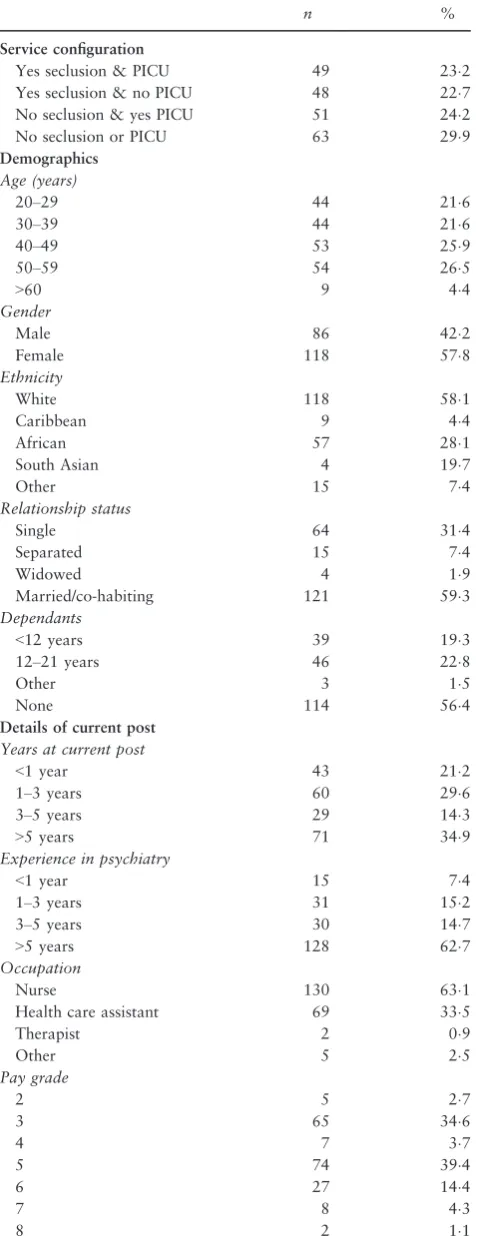
Table 1 summarizes the demographic features of the sample (count and per cent). When tested in a logistic regression model with seclusion as the dependent variable and control-ling for PICU access, seclusion was not associated with any of the demographic information. When tested in a logistic regression controlling for seclusion availability, the absence of an onsite PICU was associated with greater numbers of female staff (P =0034).
ACMQv2
The means and standard deviations of each item from the ACMQv2 are illustrated in (Table 2). Containment meth-ods have been ranked in order of acceptability, starting from most acceptable to least acceptable.
PICU, intermittent observations and PRN medication received the highest approval ratings, while mechanical restraint and net beds received the lowest. Open area seclu-sion, mechanical restraint and seclusion showed the greatest variability in approval scores. Access to a seclusion room was associated with greater acceptability of seclusion as a method of containment (rs=025,n=198,P<0001) and lower acceptability of open area seclusion (rs= 023,
n =199, P =0001). When tested in a logistic regression controlling for PICU access, seclusion acceptability remained significantly associated with seclusion availability (P<0001), however, open area seclusion acceptability was no longer significant.
net beds were used the least. It is likely that the use of net beds is limited to Eastern Europe, where this method of containment is still used (Bowers et al. 2007b). It is also likely that the use of mechanical restraints is limited to forensic settings in acute admission wards.
The availability of a seclusion room was associated with a greater reported use of seclusion (rs=0548, n=196,
P<0001) and time out (rs=0152, n=200, P =0032) and a lesser use of open area seclusion (rs= 0181,
n=201, P=0010). When entered into a logistic regres-sion controlling for PICU access, greater reported use of seclusion (P<0001) and less open area seclusion use (P=0001) remained statistically significant, whereas reported time out use did not (P=0715).
Table 1 Demographic features of the sample.
n %
Service configuration
Yes seclusion & PICU 49 232
Yes seclusion & no PICU 48 227 No seclusion & yes PICU 51 242
No seclusion or PICU 63 299
Demographics
Age (years)
20–29 44 216
30–39 44 216
40–49 53 259
50–59 54 265
>60 9 44
Gender
Male 86 422
Female 118 578
Ethnicity
White 118 581
Caribbean 9 44
African 57 281
South Asian 4 197
Other 15 74
Relationship status
Single 64 314
Separated 15 74
Widowed 4 19
Married/co-habiting 121 593
Dependants
<12 years 39 193
12–21 years 46 228
Other 3 15
None 114 564
Details of current post
Years at current post
<1 year 43 212
1–3 years 60 296
3–5 years 29 143
>5 years 71 349
Experience in psychiatry
<1 year 15 74
1–3 years 31 152
3–5 years 30 147
>5 years 128 627
Occupation
Nurse 130 631
Health care assistant 69 335
Therapist 2 09
Other 5 25
Pay grade
2 5 27
3 65 346
4 7 37
5 74 394
6 27 144
7 8 43
8 2 11
Table 1 (Continued).
n %
Violence related training (past year)
Yes 148 902
No 16 98
Exposure to mild violence (past year)
Occasionally 87 423
Sometimes 48 233
Often 30 146
Frequently 31 150
Never 10 49
Exposure to severe violence (past year)
Occasionally 43 209
Sometimes 16 78
Often 6 29
Frequently 5 24
Never 136 660
PICU, psychiatric intensive care unit.
Table 2 Acceptability score of each containment method, and proportion of staff reporting they had used each method.
Containment method Mean SD nused % used
PICU 446 059 167 848
Intermittent observation 445 077 195 970 PRN medication 437 070 139 739 Constant observations 428 077 194 970
Time out 424 080 173 869
Manual restraint 406 080 179 899
Seclusion 395 096 132 673
Intramuscular medication 394 092 135 689 Open area seclusion 334 102 53 264 Mechanical restraint 191 099 5 25
Net bed 177 089 1 05
The availability of an onsite PICU was not statistically associated with any containment method acceptability score. The availability of an onsite PICU was associated with less reported use of open area seclusion (rs= 0154,
n=201, P=0029). This association remained significant (P =0048) when tested in a logistic regression equa-tion controlling for seclusion availability.
MAPAT
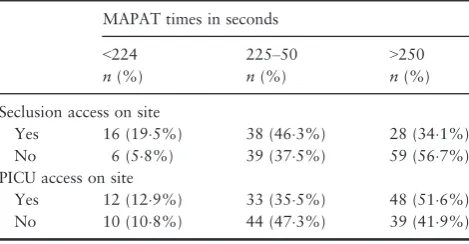
Using Spearman’s rank-order correlation, MAPAT time-to-restraint was not associated with demographic information or details of current post. Table 3 shows the frequency (and per cent) of responses for each of the three time frames during the MAPAT across seclusion and PICU pro-vision.
MAPAT timings were inversely associated with seclusion availability (rs= 0258,n=186,P<0001) but were not associated with PICU availability. Using logistic regression with seclusion availability as the dependent variable, con-trolling for PICU availability, MAPAT times remained highly significant (P<0001). Where there was no seclu-sion room available, staff took longer and allowed a greater degree of escalation before initiating restraint, as indicated by higher MAPAT scores.
MAPAT scores were also explored in relation to ACMQv2 scores. The MAPAT timings were positive associ-ated with participant judgements of mechanical restraint acceptability (rs=0190, n=179, P=0011) and net bed acceptability (rs=0168, n=177, P=0025). A longer time before restraint was initiated was associated with greater acceptability of these containment methods. MAPAT scores were not associated with the reported use of any of the containment methods on the ACMQv2.
Discussion
Acute psychiatric wards such as those taking part in this study manage patients whose actions may threaten safety to themselves and hospital staff. Previous studies evaluating the acceptability and/or use of different containment meth-ods in mental health services (Muir-Cochrane et al. 2009, Whittington et al. 2009, Bowers et al. 2010, Dack et al.
2012) have not considered the association between access to seclusion and/or PICUs and acceptability/use of different containment methods. Those that have considered ratings of acceptability have shown that staff rate seclusion as less acceptable than nearly every other form of containment and PICU care as one of the most acceptable forms of con-tainment (Whittingtonet al.2009). Staff taking part in this study did indeed rate seclusion as less acceptable then PICU, intermittent observations, constraint observation, PRN, time out and manual restraint. PICU was rated as the most acceptable form of containment.
Service configuration is associated with acceptability and use of seclusion, open area seclusion and time out
Acceptability and use of seclusion is related to its access. No such associations were found between PICU access and its acceptability and use. Seclusion use has been shown to increase when a seclusion room is directly available to the ward (consistent with Bowers et al.2012a), suggesting that with first-hand experience of seclusion room use, staff members are more likely to approve of it as a method of containment. Seclusion is regarded as more effective in aid-ing with emergency situations than other methods of con-tainment (Cashin 1996) and those with access to a seclusion room reported that without use of this room, the unit could not operate effectively (Alty 1997). It is therefore likely that with first-hand experience, staff members do consider seclusion to be an acceptable and suitable method of containment in particular situations and this is reflected in its use. Another possibility may be that some form of cognitive dissonance (Festinger 1957) process might under-lie this association, with nurses exposed to and therefore involved in seclusion use shifting their beliefs to fall in line with their behaviour.
One study suggested that the availability of a seclusion room made staff believe they were providing more effective care, with the use allowing staff to become more accus-tomed to it, leading them to rate seclusion as less intrusive to patients than staff who had never secluded a patient on the same site (Harris et al.1989). Alternatively, it is possi-ble that members of staff with strong feelings against Table 3 Frequency of response (and per cent) during the MAPAT
across service configuration.
MAPAT times in seconds
<224 225–50 >250
n(%) n(%) n(%)
Seclusion access on site
Yes 16 (195%) 38 (463%) 28 (341%) No 6 (58%) 39 (375%) 59 (567%) PICU access on site
Yes 12 (129%) 33 (355%) 48 (516%) No 10 (108%) 44 (473%) 39 (419%)
seclusion room use perhaps avoid working at wards with direct access to one. All things considered, it is possible seclusion units are being overused at sites with direct access to one, with evidence that some staff members conform to the use of seclusion rooms when seclusion rooms are avail-able, feeling discriminated against if they suggested alterna-tive methods (Fisher 1995). The concern that seclusion could be abused, for example, by being over used when available, or used as a substitute when staffing levels are decreased has been expressed by some authors (Alty 1997, Wynaden et al. 2002). This has important implications since patient’s rate seclusion as unacceptable compared with other methods of containment (Whittington et al.
2009).
For those without direct access to seclusion, staff mem-bers are more likely to approve of open area seclusion and this method of containment was more commonly used by staff on wards without onsite seclusion and PICU. Open area seclusion is more often referred to as ‘nursing in a side room’ or as the use of an ‘extra care area’. The ACMQv2 defines seclusion as ‘a patient being isolated in a locked room’ and open area seclusion as ‘a member of staff stays in the locked room with the patient’. Both seclusion and open area seclusion fit under the umbrella term of seclusion in recent UK guidance (Department of Health 2015) and it is possible that wards without defined seclusion rooms are simply substituting this for a different type of seclusion.
Seclusion provision and not PICU provision, is associated with time-to-restraint in response to aggressive behaviour during the MAPAT
Time-to-restraint in response to aggressive behaviour during the MAPAT was strongly and significantly associated with seclusion provision but not PICU provision and, in places without seclusion, there was a longer time lapse before staff initiated restraint. In units without seclusion, staff members tolerated higher levels of aggression before choosing to restrain during the MAPAT. Previous studies have sug-gested that staff without access to seclusion rate their meth-ods of containment as less effective in resolving emergency situations (Cahin 1996). This lack of confidence could explain delayed time-to-restraint during the MAPAT. There was no association between PICU access and MAPAT score, although onsite PICU availability leads to increased use (Bowers et al. 2012a). Possibly this is because, unlike seclusion which can be utilized immediately, a transfer to PICU care takes some time to organize and occurs after the immediate crisis is over.
Other findings
There was no association between MAPAT time-to-restraint and manual restraint acceptability or between MAPAT time-to-restraint and use of manual restraint. Thus, it was not the acceptability of restraint which was driving the dif-ference in MAPAT scores, but perhaps more likely a rational calculation about managing outcomes, to which seclusion availability seems to be of influence.
Whilst mechanical restraint and net beds remain the two containment methods with lowest acceptability ratings, greater acceptability was associated with longer time-to-restraint during the MAPAT. Although the reasons for this are unclear, it is possible that staff members who are less judgemental of these methods of containment tolerate more extreme patient behaviours and thus react more slowly.
This study found that initiation of restraint was not asso-ciated with exposure to either mild or severe physical vio-lence. This conflicts with previous research by Moylan and Cullinan (2011) using the MAPAT, where staff members who had suffered from injury at work took longer to initi-ate restraint than those with no history of injury. The authors suggested it was fear itself that delayed the restraint process. Moylan and Cullinan’s (2011) study considered associations between injury and serious injury, where type of injury was clearly defined (evidence of fracture, for example). Our study did not ask participants to be so detailed with their exposure to physical violence and was more subjective in comparison. In addition, the majority of staff included in our study had not experienced severe phys-ical violence over the past year (66%) and only occasional mild violence (423%). Thus, the different methods of investigation between these studies and different levels of exposure to violence between participants taking part in these studies may account for the differences in findings.
Limitations
rigorously developed, the extent to which MAPAT scores correlate with actual restraint use in practice is not known; nor is there any criterion for judging what score represents the optimum, or best for a safe outcome. As such, the valid-ity of the MAPAT is unclear.
Conclusion
Data on the use of seclusion and restraint worldwide are barely available (Steinert et al.2010) and this study offers some insight into the use of seclusion and restraint and the acceptability of these methods, which have generated con-troversial debates regarding their use (Lebel & Goldstein 2005, Needham et al. 2002). Current developments in small observational and theoretical based research cast doubt on the safety of both seclusion and restraint as con-tainment methods on patients and staff (Bowers et al.
2003, Parks & Carson 2008, Bowerset al.2012b) however research suggests that it would not be possible to com-pletely abolish the use of seclusion and restraint (Steinert
et al.2010). In this study, availability of seclusion appears to drive both approval of it and its use. With first-hand experience, staff members are more likely to consider seclu-sion as an acceptable method of managing aggressive inci-dents. Seclusion being a suitable method for managing aggressive incidents is also reflected in the increased use of open area seclusion in the absence of a seclusion room. It should be considered however that seclusion may be over used where it is available.
While this study raises important questions about clinical practice, particularly the links between the availability, approval of and use of seclusion, coupled with the faster use of manual restraint as judged by the MAPAT, none of these findings constitute evidence that seclusion can be safely abandoned. Faster restraint may in fact be safer for staff and patients. Secluding a patient might be safer than not doing so. It is therefore difficult to make any clinical recommendation based on this study alone.
PICU is a more acceptable form of containment to acute ward staff than several other methods, yet staff members in some hospitals do not have easy and speedy access to it when they are managing disturbed high risk patients. Improvements in service configuration might include easier access to a PICU. Absence of seclusion was associated with delayed time-to-restraint during the MAPAT task, yet the nature of this link is somewhat obscure as judgments of the acceptability of seclusion were not related to restraint thresholds. Nor was the acceptability of manual restraint itself linked to that threshold. More research into the
underlying staff psychology of containment evaluations, cognitions, emotions, morality and usage is clearly needed.
Funding
This paper presents independent research part funded by the National Institute for Health Research (NIHR) under its Health Services and Delivery Research (HS&DR) Pro-gramme (11/1024/02), part funded by the National Institute for Health Research (NIHR) Biomedical Research Centre at South London and Maudsley NHS Foundation Trust and King’s College London, and supported by the NIHR Men-tal Health Research Network. The views expressed are those of the author(s) and not necessarily those of the NHS, the NIHR or the Department of Health.
Conflict of interest
No conflict of interest has been declared by the authors.
Author contributions
All authors have agreed on the final version and meet at least one of the following criteria [recommended by the ICMJE (http://www.icmje.org/recommendations/)]:
•
substantial contributions to conception and design, acquisition of data, or analysis and interpretation of data;•
drafting the article or revising it critically for important intellectual content.References
Abderhalden C., Needham I., Dassen T., Halfens R., Hans-Joachim H. & Fisher J. (2008) Structured risk assessment and violence in acute psychiatric wards: randomised controlled trial.The British Journal of Psychiatry193, 44–50.
Alty A. (1997) Nurses’ learning experience and expressed opinions regarding seclusion practice within one NHS trust. Journal of Advanced Nursing25(4), 786–793.
Bowers L. (2006) On conflict, containment and the relationship between them.Nursing Inquiry13(3), 172–180.
Bowers L., Crowhurst N., Alexander J., Eales S., Guy S. & McCann E. (2003) Psychiatric nurses’ views on criteria for psychiatric intensive care: acute and intensive care staff compared. International Journal of Nursing Studies40(2), 145–
152.
Bowers L., Alexander J., Simpson A., Ryan C. & Carp-Walker P. (2004) Cultures of psychiatry and the professional socialization process: the case of containment methods for disturbed patients.
Bowers L., Alexander J., Simpson A., Ryan C. & Carp-Walker P. (2007a) Student psychiatric nurses’ approval of containment measures: relationship to perception of aggression and attitudes to personality disorder.International Journal of Nursing Studies
44, 349–356.
Bowers L., Van Der Werf B., Vokkolainen A., Muir-Cochraned E., Allana T. & Alexander J. (2007b) International variation in attitudes to containment measures for disturbed psychiatric inpatients.International Journal of Nursing Studies44, 357–364. Bowers L., Van Der Merwe M., Nijman H., Hamilton B., Noorthorn E., Stewart D. & Muir-Cochrane E. (2010) The practice of seclusion and time-out on English acute psychiatric wards: the City-128 study. Archives of Psychiatric Nursing 24 (4), 275–286.
Bowers L., Hammond N., James K., Quirk A., Robson D. & Stewart D. (2012a) Characteristics of acute wards associated with the presence of a psychiatric intensive care unit and transfers of patients to it.Journal of Psychiatric Intensive Care8 (2), 66–77.
Bowers L., Ross J., Nijman H., Muir-Cochrane E., Noorthorn E. & Stewart D. (2012b) The scope for replacing seclusion with time out in acute inpatient psychiatry in England. Journal of Advanced Nursing68(4), 826–835.
Bowers L., James K., Quirk A., Simpson A., Stewart D. & Hodsoll J. (2015) Reducing conflict and containment rates on acute psychiatric wards: the Safewards cluster randomised controlled trial.International Journal of Nursing Studies52(9), 1412–1422. Cashin A. (1996) Seclusion: the quest to determine effectiveness.
Journal of Psychosocial Nursing and Mental Health Services34 (11), 17–21.
Dack C., Ross J. & Bowers L. (2012) The relationship between attitudes towards different containment measures and their usage in a national sample of psychiatric inpatients. Journal of Psychiatric and Mental Health Nursing19(7), 577–586. Department of Health (2002) Mental Health Policy
Implementation Guide: National Minimum Standards for General Adult Services in Psychiatric Intensive Care Units and Low Secure Environments. Department of Health, London. Department of Health (2015) Mental Health Act 1983: Code of
Practice. The Stationery Office, London.
Festinger L. (1957) A Theory of Cognitive Dissonance. Stanford University Press, Stanford.
Fisher A. (1995) The ethical problems encountered in psychiatric nursing practice with dangerous mentally ill persons. Scholarly Inquiry for Nursing Practice9(2), 193–208.
Harris G., Rice M. & Preston D. (1989) Staff and patient perceptions of the least restrictive alternatives for the short term control of disturbed behaviour. The Journal of Psychiatry and Law17(2), 239–263.
Lebel J. & Goldstein R. (2005) The economic cost of using restraint and the value added by restraint reduction or elimination.Psychiatric Services56(9), 1109–1114.
Lemonidou C., Priami M., Merkouris A., Kalafti M., Tafas C. & Plati C. (2002) Nurses’ perceptions toward seclusion and use of restraints for psychiatric patients in Greece.European Journal of Psychiatry16(2), 81–90.
Menckel E. & Viitasara E. (2002) Threats and violence in Swedish care and welfare–magnitude of the problem and impact on municipal personnel. Scandinavian Journal of Caring Sciences.
16(4), 376–385.
Moylan L.B. (2009) Construction of an instrument to evaluate nurses’ decision making in relation to the use of restraint in acute care psychiatry. Issues in Mental Health Nursing30(11), 712–717.
Moylan L.B. & Cullinan M. (2011) Frequency of assault and severity of injury of psychiatric nurses in relation to the nurses’ decision to restrain. Journal of Psychiatric and Mental Health Nursing18(6), 526–534.
Muir-Cochrane E., Bowers L. & Jeffery D. (2009) Comparison in attitudes between nursing and other students in relation to containment measures for disturbed psychiatric patients. Nurse Education Today29(1), 83–90.
Muralidharan S. & Fenton M. (2006) Containment strategies for people with serious mental illness. Cochrane Database of Systematic Reviews. Retrieved from http://onlinelibrary.wiley.com/ doi/101002/14651858.CD002084.pub2/full on 30/08/2015. Needham I., Abderhalden C., Dassen T., Haug H.J. & Fische J.E.
(2002) Coercive procedures and facilities in Swiss psychiatry.
Swiss Medical Weekly132(19–20), 253–258.
Nijman H., Allertz W., Merckelbach H., Campo J. & Ravelli D. (1997) Aggressive behaviour on an acute psychiatric admissions ward.European Journal of Psychiatry11(2), 106–114.
Olofsson B., Jacobsson L., Gilje F. & Norberg A. (1999) Being in conflict: physicians’ experience with using coercion in psychiatric care.Nordic Journal of Psychiatry53(3), 203–210.
Parks J. & Carson B. (2008) Sudden death during restraint: do some positions affect lung function? Medical Science and the Law48(2), 137–141.
Paterson B., Bradley P., Stark C., Saddler D., Leadbetter D. & Allen D. (2003) Deaths associated with restraint use in health and social care in the UK. The results of a preliminary survey.
Journal of Psychiatric and Mental Health Nursing10(1), 3–15. Steinert T., Lepping P., Bernhardsgr€utter R., Conca A., Hatling T.,
Janssen W., Keski-Valkama A., Mayoral F. & Whittington R. (2010) Incidence of seclusion and restraint in psychiatric hospitals: a literature review and survey of international trends.
Social Psychiatry and Psychiatric Epidemiology45(11), 889–897. Stewart D., Bowers L., Simpson A., Ryan C. & Tziggili M. (2009) Manual restraint of adult psychiatric inpatients: a literature review.Journal of Psychiatric and Mental Health Nursing16(8), 749–757.
Whittington R. & Richter D. (2005) Interactional aspects of violent behaviour on acute psychiatric wards.Psychology, Crime and Law11, 1–12.
Whittington R., Bowers L., Nolan P., Simpson A. & Neil L. (2009) Approval ratings of inpatient coercive interventions in a national sample of mental health service users and staff in England.
Psychiatric Services60(6), 792–798.
TheJournal of Advanced Nursing (JAN)is an international, peer-reviewed, scientific journal.JANcontributes to the advancement of evidence-based nursing, midwifery and health care by disseminating high quality research and scholarship of contemporary relevance and with potential to advance knowledge for practice, education, management or policy.JANpublishes research reviews, original research reports and methodological and theoretical papers.
For further information, please visitJANon the Wiley Online Library website: www.wileyonlinelibrary.com/journal/jan
Reasons to publish your work inJAN:
• High-impact forum:the world’s most cited nursing journal, with an Impact Factor of 1·917–ranked 8/114 in the 2015 ISI Jour-nal Citation Reports©(Nursing (Social Science)).
• Most read nursing journal in the world:over 3 million articles downloaded online per year and accessible in over 10,000 libraries worldwide (including over 3,500 in developing countries with free or low cost access).
• Fast and easy online submission:online submission at http://mc.manuscriptcentral.com/jan. • Positive publishing experience:rapid double-blind peer review with constructive feedback.
•Rapid online publication in five weeks:average time from final manuscript arriving in production to online publication.