Subtropical Tree Improvement Alliance
– Outcomes of a collaboration development workshop –
Subtropical Tree
Improvement Alliance
Outcomes of a collaboration development workshop held
September 13 & 14, 2010 at the Sunshine Coast University
ii © 2011 Rural Industries Research and Development Corporation. All rights reserved.
ISBN 978-1-74254-224-9 ISSN 1440-6845
Subtropical tree improvement alliance Publication No. 11/039
Project No. PRJ-005009 BBE Program
The information contained in this publication is intended for general use to assist public knowledge and discussion and to help improve the development of sustainable regions. You must not rely on any information contained in this publication without taking specialist advice relevant to your particular circumstances.
While reasonable care has been taken in preparing this publication to ensure that information is true and correct, the Commonwealth of Australia gives no assurance as to the accuracy of any information in this publication. The Commonwealth of Australia, the Rural Industries Research and Development Corporation (RIRDC), the authors or contributors expressly disclaim, to the maximum extent permitted by law, all responsibility and liability to any person, arising directly or indirectly from any act or omission, or for any consequences of any such act or omission, made in reliance on the contents of this publication, whether or not caused by any negligence on the part of the Commonwealth of Australia, RIRDC, the authors or contributors.
The Commonwealth of Australia does not necessarily endorse the views in this publication.
This publication is copyright. Apart from any use as permitted under the Copyright Act 1968, all other rights are reserved. However, wide dissemination is encouraged. Requests and inquiries concerning reproduction and rights should be addressed to the RIRDC Publications Manager on phone 02 6271 4165.
Researcher Contact Details
Name: Jeremy Brawner Address: CSIRO Plant Industry
QBP, 306 Carmody Rd
St Lucia, Queensland 4067, Australia Phone: +61 4 1925 3005
Email: [email protected]
In submitting this report, the researchers have agreed to RIRDC publishing this material in its edited form. RIRDC Contact Details
Rural Industries Research and Development Corporation Level 2, 15 National Circuit
BARTON ACT 2600 PO Box 4776
KINGSTON ACT 2604 Phone: 02 6271 4100
Fax: 02 6271 4199
Email: [email protected]. Web: http://www.rirdc.gov.au Electronically published by RIRDC in April 2011
Foreword
Australia’s forest industry is an integral part of the rural economy. The traditional outputs of timber and paper products are essential in a modern economy and in addition, the forest sector is increasingly playing an important role in emerging industries such as eco-system services and bioenergy.
In 2006, the forestry sector had an annual turnover of around $19 billion, and 120,000 people were employed in businesses that relied on the growing and use of timber. These traditional activities are predominantly carried out in the southern temperate regions.
The opportunity facing Australia, as land use in the southern regions becomes competitive and constrained, is to meet the demand for both traditional forestry products and emerging industries by investing in the subtropical and tropical regions.
However, the challenge facing both investors and researchers is the lack of suitable species for planting in these areas.
Current constraints relating to the suitability of planting stock and the ability of varieties to cope with disease and climate variations, increase investment risk for plantations in the north compared to the southern states, where radiata pine and blue gum dominate the plantation estate.
The development of planting stock suitable for hardwood plantation and farm forestry will reduce the hurdle rate for investors and is expected to result in investment in the northern forestry sector for multiple purposes, including bioenergy.
Initial efforts in tree improvement typically achieve a 30% increase in productivity solely through the identification of the most appropriate seed sources for a given site-type and end product. Therefore, collaboration on subtropical and tropical tree improvement research will be economically significant to the forest industry.
This report outlines the collaborative approach taken thus far by multiple research agencies and industry partners and a proposed collaboration model for future research into subtropical and tropical tree improvement research.
This project was funded from RIRDC core funds, which are provided by the Australian Government.
This report is an addition to RIRDC’s diverse range of over 2000 research publications and it forms part of our Bioenergy, Bioproducts and Energy) R&D program, which aims to assess and adapt
existing Australian and international feedstocks and develop new feedstocks suitable for bioenergy and bioproducts
iv
About the Authors
Jeremy Brawner, Research Scientist with the Commonwealth Scientific and Industrial Research Organisation (CSIRO) Plant Industry Division working in Queensland collaboratively with both Qld and NSW state agencies on tree improvement research.
David Lee, Associate Professor of Plant Genetics at the University of the Sunshine Coast (USC) and a Senior Principal Scientist with the Queensland government’s Department of Employment, Economic Development and Innovation (QLD DEEDI), is actively engaged in developing improved populations of forest trees for use in the Australian tropics and subtropics.
Troy Brown, Tree Improvement Officer with the NSW Department of Industry and Investment, Forests New South Wales (F-NSW), is managing a variety of tree improvement populations in the Australian Subtropics.
Anne Lawrence is a Director of Boardroom Business consulting and past communications manager at CSIRO Forestry and Forest Products as well as recipient of the Gottstein Fellowship on best practice knowledge exchange in science and end-user communities.
Acknowledgments
This was an RIRDC funded workshop. The workshop was held at the University of the Sunshine Coast and we thank them for use of their premises. The people listed below gave presentations on aspects of their work and knowledge in tree improvement research including collaboration models. Their presentations gave valuable background information to the workshop and helped to shape discussions and drive the outcomes. The report represents a commentary of their presentations and discussions
Session Presenters
David Lee – USC / Queensland DEEDI
David Bush – CSIRO
Rob Mann – CSIRO
Contents
Foreword ... iii
About the Authors ... iv
Acknowledgments ... iv
Introduction ... 1
Objectives ... 2
Methodology ... 2
Background ... 3
Focus on subtropical and tropical species ... 3
Industry drivers ... 3
System approach ... 4
Bringing resources together ... 4
Workshop Format ... 5
Workshop Outcomes ... 6
Objectives of potential collaboration ... 6
Types of collaborations possible ... 6
Stakeholders in future collaboration opportunities ... 7
Chosen collaboration model ... 8
Current Genetic Resources ... 8
Intellectual Property ... 9
vi
Executive Summary
What the report is about
This report outlines an opportunity for a collaborative approach towards tree breeding for the subtropical and tropical regions of Australia. The prospect of a research and industry consortium for tree breeding was discussed at a recent workshop and this report documents the outcomes of both the workshop and subsequent deliberations.
Who is the report targeted at?
The primary stakeholders are scientific research organisations and those organisations involved in the forestry and forest products industries, including investors in new and emerging forest products industries such as bioenergy. This report is also targeted at industry groups and organisations involved in assisting and or facilitating the forestry and agribusiness industries in the northern regions of Australia.
Where are the relevant industries located in Australia?
Northern Australia forestry and agribusiness industries are set to benefit from improved tree species. This includes regions in northern NSW as well as regions in the State of Queensland and the Northern Territory. Currently, most of the commercial tree species are incompatible for these regions, and often result in either low growth rates and/or high incidences of pest and disease incursions. This
incompatibility is hampering investment opportunities for forestry and bioenergy projects. By overcoming some of these impediments through collaborative research, the resulting new and improved germplasm will stimulate planting and in turn stimulate regional economies.
Background
Researchers have been collaborating on a project-by-project basis with the goal of improving tree species; however, greater improvements can be made through a more cooperative approach. The workshop held at the University of the Sunshine Coast sought to commence the discussion by addressing opportunities and impediments to various cooperative models.
Aims/objectives
The objective of the workshop was to identify and bring together parties with an interest in tree
improvement for a workshop to discuss opportunities for collaboration. The next step was to document different funding models that have been used by other groups to facilitate long-term tree improvement research and lastly to recommend a process and identify likely participants for tree improvement cooperation.
Methods used
Results/key findings
A robust and frank discussion was had by group participants both during and after the workshop, and led to the formation of a sub committee to progress the conversation further. This sub committee then created draft objectives for a potential collaboration, including further detail on how that collaboration may progress, and circulated these details amongst workshop participants.
The workshop demonstrated a strong desire to collaborate amongst key stakeholders and it was decided that participating research and industry collaborators should use an informal collaboration model, one that doesn’t bind participants into a formal business or legal structure, in the first instance and then grow that collaboration model into a more formal structure over time.
It was deemed important to identify and address intellectual property opportunities and impediments early i.e. during the informal stage of the collaboration, and create a strong partnership approach to research opportunities that addresses collaborative goals and objectives.
This informal collaboration is then expected to develop further over time resulting in a more formal and unified approach to subtropical and tropical tree improvement objectives that maximises intellectual talent and research investment.
Implications for relevant stakeholders
The primary outcome of a research consortium will be the increased supply of quality information and genetic resources available for investment in the subtropical and tropical regions of Australia. This in turn will increase the economic, environmental and social benefits for the communities in those regions.
The development of the forest industry as a part of the regional economies in the subtropics could provide additional sources of revenue through the sale of forest products, timber and carbon offsets as well as provides a range of environmental benefits to land holders. The environmental benefits
associated with the dedicated domestication of native subtropical tree species for bioenergy production are also of significance.
The project is expected to result in a number of social benefits, particularly in regional economies where plantation forest areas are increasing. The primary benefit will come from increases in employment opportunities and the associated increase in income from the utilisation of more productive tree varieties.
Recommendations
Introduction
Queensland based research providers such as Queensland DEEDI, CSIRO and local Universities have been successfully collaborating alongside industry, on individual sub-tropical tree improvement projects over many years. These research projects are funded from various sources and on a project-by-project basis. The projects then often lead to other research opportunities, as tree improvement activities need to be undertaken over extraordinary long periods of time.
The projects have many common elements and address the needs of both the traditional forest industry as well as emerging sectors such as bioenergy. Some of the projects are conducted collaboratively but most have the following challenges in common:
a) The challenge associated with attempting to match species to the wide range of environments b) The challenge associated with selecting for various wood quality traits for different end-uses c) The challenge associated with maintaining and managing long term data and trial sites d) The challenge associated with reliably predicting growth rates across those regions.
The authors saw an opportunity to take a whole of region/industry approach to tree improvement research in order to minimise inefficiencies from the current fragmented approach and maximise outcomes from the pooling of intellectual property and talent. Collaboration on tree improvement in the temperate regions of Australia (predominantly South Eastern Australia) has been successful over the past 50 years, namely via a few different collaboration models involving industry and multiple research providers.
2
Objectives
The primary objective of this project was to hold a workshop to draw together parties with an interest in subtropical tree improvement and during that workshop attempt to reach a consensus on how to structure R&D to achieve the long-term outcome of delivering genetic material to improve the productivity of industrial and farm forestry plantings for multiple purposes, including bioenergy.
More specifically, the objectives were:
1. Identify and bring together parties with an interest in tree improvement for a workshop to discuss opportunities for collaboration.
2. Document different funding models that have been used by other groups to facilitate long-term tree improvement research.
3. Recommend a process and identify likely participants for tree improvement cooperation.
4. Suggest pathways to achieve a long-term funding stream that will facilitate the delivery of improved seed for subtropical forest tree planting.
Methodology
Collaboration is highly dependent upon the prospective partners’ objectives and the alignment of those objectives. Equally important is the identification of any potential impediments to collaboration, then working towards overcoming those impediments. In order to identify prospective partner’s objectives and any impediments the methodology chosen was to conduct a workshop designed to initiate the journey towards long-term subtropical tree improvement research collaboration.
More specifically, the methodology included:
1. Identification of key influencers in the investment in tree improvement research, key forest industry and nursery players, as well as experts in bioenergy feedstock evaluation.
2. Pre-workshop planning: propose the workshop and pre-plan the day through interactions with key influencers to meet their expectations, including the provision of background materials to participants to help the day reach the objectives.
3. Facilitated workshop is held with agreed objectives up front and desired outcomes to achieve at the end.
4. Report is drafted and circulated amongst workshop participants, a subcommittee and then RIRDC.
5. Continued dialogue amongst key stakeholders on the objectives and opportunities regarding collaboration models.
Background
Australian native tree species, especially Eucalyptus, Corymbia, Acacia and Grevillea species, are now of enormous importance as exotic species worldwide for the production of both wood and non-wood forest products. Selected species from these genera have grown vigorously as exotics in other countries, demonstrating tolerance of a wide range of environmental conditions. They have been planted as exotics for over 150 years and can now be found in over 100 countries in the tropical, sub-tropical and warm temperate regions of the world. From an estimated global plantation base of
700,000 hectares in 1955, the areas planted to eucalypts, acacias and grevillea worldwide has increased to over 17 million hectares in 2005. At present, more than 60% of all tropical forest plantations being established at present use genera native to Australia.
Genetic improvement of the key forest plantation species that are being used in these plantations provides the opportunities to improve the resources that they will provide for wood and fibre processing.
Indeed, genetic improvement has been shown to be an extremely cost effective way to increase
productivity and improve quality for solid timber and pulp, paper products and alternative uses such as bioenergy for both the Australian and international timber industries
Focus on subtropical and tropical species
The development of planting material and breeding tools for sub-tropical and tropical plantation for Australian forests is currently insufficient to meet current and expected future industry demands and needs to be optimised for specific products and a range of environments.
Industry drivers
• Relatively large available land area in Northern NSW, Qld and NT at the right price;
• Good potential for commercially acceptable growth rates over large areas of land suitable for forest plantation development;
• Good access to port facilities (and associated export markets);
• Favourable Government policies for plantation development (State and Federal and internationally);
• Substantial international demand for forest plantation expansion (particularly in Asia) – and Australian tree species account for more than 60% of all new tropical plantations being established worldwide.
Industry risks and genetics R&D drivers
4
System approach
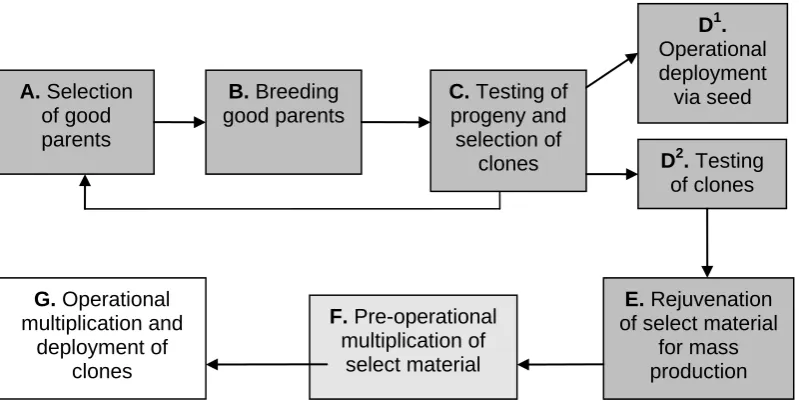
The tree breeding and deployment system can be summarised as shown in Figure 1 – this identifies the key steps in domestication (i.e. taking wild material through improvement to operational deployment of improved germplasm).
Figure 1. Generalised breeding and deployment pathway.
Currently, many of the key plantation species with potential in the sub-tropics and tropics are all at different stages of development. Each step can be a limiting factor and presents a potentially different bottle neck depending on biology of the species of interest. Time to pass through these steps is a critical factor in tree improvement and deployment – in applied forest tree improvement time is of the essence. Each step needs to be addressed at some level in a systems approach in order to optimise the whole cycle for any given taxa.
Bringing resources together
The selection, breeding and propagation focus require collaborative efforts and the bringing together of field and lab resources including:
Field
– comparative field trials (some field trials are already established including species, species-provenance, provenance-family and clone trials);
– genetic resource stands (some already established*); – seed orchards (some already established*); and – clone banks (few already established).
Lab
– facilities for molecular analyses (for examining genetic variation within and among species); – tissue culture facilities.
A substantial resource of comparative trials for a range of species exists. Nevertheless, this network requires strategic addition to fill gaps in the species and site coverage.
B. Breeding good parents
A. Selection of good parents
C. Testing of progeny and selection of
clones D2. Testing of clones
E. Rejuvenation of select material
for mass production
G. Operational multiplication and
deployment of clones
F. Pre-operational multiplication of
select material
D1.
Workshop Format
A workshop was held on Monday the 13th and Tuesday 14th of September 2010 with invited participants from across the research, forestry and bioenergy communities. The workshop was generously hosted by the University of the Sunshine Coast and attracted over 30 participants (see appendix A for list of participants) travelling from various regions.
Monday 13th September 2010: WORKSHOP
The Monday workshop commenced at midday and included four presentations followed by general discussion.
Presentations were made by:
• Jeremy Brawner set the stage by highlighting the strengths and weaknesses or several successful tree improvement collaboration models
• David Lee on Qld DEEDI tree breeding strategies and resources
• David Bush from CSIRO provided a case study on the Australian Low Rainfall Tree Improvement Group tree breeding collaboration model in the temperate regions
• Rob Mann from CSIRO provided an overview of the various types of collaboration models commonly used by research communities and the advantages and disadvantages of each. This overview as supplied to participants prior to the workshop as a background reading
opportunity (Appendix B).
A working dinner was then held with discussions surrounding collaboration objectives and opportunities.
With the conversation on collaboration still in its infancy stages, and many varied opinions being discussed, several key stakeholders volunteered to be part of a sub committee and draft a preliminary report to circulate amongst workshop participants for further feedback. These were: Jeremy Brawner – CSIRO, David Lee – USC & DEEDI, Rohan Allen – Qld DEEDI, Troy Brown – Forests NSW and Anne Lawrence – facilitator for this RIRDC project.
Tuesday 14th September 2010: FIELD TRIP
The Tuesday field trip agenda for participants included a variety of trial sites to view and discuss the current subtropical tree improvement research projects.
6
Workshop Outcomes
The following is a direct output from both the workshop and subsequent conversations and work by the sub committee members.
Objectives of potential collaboration
The primary objective of tree improvement collaboration for subtropical and tropical species as decided by the group was to:
To bring together knowledge and resources in order to overcome the significant challenges facing long-term forest tree improvement for commercial outcomes in subtropical and tropical Australia. Tree improvement challenges include: the management of long-term trials and data, matching species (tree varieties) to sites, understanding growth/impediments to growth of production forests, assessing impediments to growth (pest, disease, nutrition, etc) in order to develop solutions and quantifying various quality traits to allow for an economic assessment of multiple end-uses.
Goals included:
i. Develop and implement germplasm evaluation protocols to standardise collaboration efforts;
ii. Identify and agree on research and development priorities including species and or hybrids and projects needed to advance forest tree improvement in sub-tropical and tropical Australia;
iii. Ensure optimum level of cooperation between interested parties to maximise useful outcomes from available research investment;
iv. Identify and secure funding from government, R&D corporations, industry and other interested sources to implement agreed priority R&D projects; and
v. Support and participate in technology transfer initiatives to assist industry’s awareness and adoption of applicable R&D project outcomes.
Types of collaborations possible
Various types of collaboration models were considered in the full discussion paper created by Rob Mann prior to the workshop and are summarised in appendix B.
The four types of collaboration models discussed in Rob’s paper include:
1. Incorporated Body (formal)
2. Unincorporated Joint Venture (formal)
3. Special Purpose Collaboration i.e. “Centre of Excellence” (formal)
4. Loose Collaboration (informal).
Stakeholders in future collaboration opportunities
Stakeholders in any future collaboration models or opportunities were defined and have been segmented into the following two groups.
1. Scientific research organisations and industry partners
• 1a. Scientific research organisations
o CSIRO
o QLD-DEEDI – Agri-science Qld
o NSW-DI&I
o University of Sunshine Coast
o Southern Cross University
o University of Queensland.
• 1b. Plantation growers /industry partners
o Elders Forestry
o Forests NSW
o Forestry Plantations Queensland Ltd (FPQ)
o African Mahogany Australia (AMA)
o Gunns
o Hyne/PF Olsen Australia
o Santos
o Queensland Gas Company (QGC)
o Arrow
o Ergon Energy (and other power suppliers)
o CO2 Australia
o Tree Crop Technology
o Dendros and Associates
o Timber Qld
o Australia Forest Growers (AFG).
2. Government agencies and R&D funding bodies:
o State Governments
o Regional NRM/Catchment Groups & Authorities
o RIRDC
o FWPA
o DAFF.
8
Chosen collaboration model
Based on the volume of stakeholders involved and the outcomes of the discussion at the workshop, including sub committee deliberations, it is recommended that there be a two staged approach to collaboration.
Stage one: Consensus that the collaboration model going forward will be a loose collaboration with the research community taking the lead first in consultation with industry. To facilitate this, it is recommended that further development of the rules of engagement should be undertaken.
Stage two: If, after a period of time (i.e. 3 years), the loose collaboration model is successful then the collaboration model may be evaluated and changed to a more structured model.
Regarding Stage one, although the collaboration requires a Lead organisation to assume responsibility for coordination, it is unlikely that the progression of this initial collaboration will lead to the
incorporation of a private company or uptake of responsibility by any one government agency at this point in time.
The next steps will be to define the terms of engagement in the form of an MOU.
Current Genetic Resources
There are various current agreements in place between multiple parties on the topic of subtropical and tropical tree improvement research projects, including:
• DEEDI and CSIRO agreement on eucalypts, acacias and grevillea
• DEEDI and NT Government agreement on Khaya
• CSIRO and F-NSW agreement on eucalypts
• DEEDI and F-NSW agreement on eucalypts.
Each stakeholder may have many valuable resources that can be used collaboratively if secured in a collaboration agreement, these can include:
• Trial Data sets
• Germplasm
• Seed stocks
• Trial plantings on own land
• Access to trial plantings on land via agreements
• Species and taxa trials
• Seed orchards and seed production areas
Intellectual Property
Ideally, the management of intellectual property should be managed through reference to contracts that are developed for various relationships that develop germplasm, information or know-how. However, it was repeatedly noted that the development of agreements for the management of intellectual property requires an excessive amount of time and is a serious impediment to ongoing research.
It is recommended that generic collaboration agreement templates are developed to manage intellectual property that is collaboratively developed.
Firstly, a template should be developed to encompass the range of genetic material that has been developed through collaboration between the scientific research organisations. The various
partnerships referenced above would provide various examples for rights and obligations for use of germplasm and information.
Secondly, a template should be developed for use agreements between the scientific research organisations and industry partners. This would allow for a clear path forward when developing agreements with funding bodies.
Outline of STAGE ONE of the proposed collaboration model
• The parties to be involved in the initial collaboration discussions include: Qld DEEDI, CSIRO, Forests NSW, USC, Companies involved in trial plantations, and any other stakeholder showing a genuine interest in the project.
o Minimise the need to overly involve industry partners in the structural details and legal requirements where possible (at the request of industry).
• Draft an MOU for a ‘Consortia’ approach, which outlines the collaboration objectives and operational procedures. Note: This approach will not be a formal legal structure.
• The collaboration intent during stage one is for all research to be done under the umbrella of a consortia– i.e. agreed priorities, non-competition, pooling of resources etc; but delivered on a project-by-project basis through individual agreements and contracts as per the contracting requirements of each organisation.
• Collaboration with the seed producers remains outside scope and done via researchers and managed on a project-by-project basis.
• There is a commitment to manage and maintain trials in a collaborative manner.
10
• Meetings to take place with all consortia members, with the minimum being bi-annual meetings to discuss ongoing projects and future research needs and opportunities, including prioritisation.
• Regular industry wide forums (1 or 2 times a year) to be conducted to develop and prioritise collaborative projects, funding needs and upcoming opportunities.
• An inventory of agreements currently in place to be created and an open discussion of existing IP sharing arrangements will continue.
• There will be a regular demonstration of collaboration benefits and research outcomes to all stakeholders via reports, papers, and other forms of communication.
Outline of STAGE TWO of the proposed collaboration model
• Expand the scope of the initial consortia to include other national and international research organisations and other industry key players in the medium/long term
• Self funding collaboration structure and funding agencies to be determined
• Intellectual Property agreements and relationships formalised within the consortia organisations regarding -
o BACKGROUND VARIETIES: Seed sales and flow of returns (royalties) to cover both i) operational costs and ii) further development
o NEWLY CREATED VARIETIES from
Consortia activities: Seed sales and flow of returns to cover both i) operational costs and ii) royalties, iii) further R&D.
• Collaborative projects are no longer discrete projects and the sharing of data and information across projects is achieved, including a more rigorous approach to prioritising future research opportunities.
• A part-time or full-time coordinator or Secretariat to be funded by the consortia.
Implications
The primary outcome of a research consortium will be the increased supply of quality information and genetic resources available for investment in the subtropical and tropical regions of Australia. This in turn will increase the economic, environmental and social benefits for the communities in those regions.
Economic Benefits
The development of the forest industry as a part of the regional economies in the subtropics could provide additional sources of revenue through the sale of forest products, timber and carbon offsets as well as provides a range of environmental benefits to land holders. Mining historical tree improvement research is a logical first step for a developing a viable bioenergy sector in regional Australia.
Environmental Benefits
Environmental benefits associated with increased productivity in forest plantings include but are not limited to:
• Carbon sequestration and associated climate change mitigation;
• Improvement of productivity and biodiversity on marginal or degraded land;
• Diversification of primary industries use of the landscape;
• Reductions in erosion and soil loss under forest canopies; and
• Improved water quality in affected catchments.
The environmental benefits associated with the dedicated development of subtropical tree species for bioenergy production are also of significance.
Social Benefits
The project is expected to result in a number of social benefits, particularly in regional economies where plantation forest areas are increasing. The primary benefit will come from increases in employment opportunities and the associated increase in income from the utilisation of more
productive tree varieties. Additional benefits from greenhouse gas abatement and improved confidence of business and the community regarding the economics of new forest plantings. Social impacts occur across the lifecycle of plantation forests with three principal phases of impact identified by BRS:
1. Establishment, transition and maturation. During this phase, jobs are created in plantation establishment and management services.
12
Recommendations
It is recommended that the primary stakeholders in this proposed collaboration develop a formal MOU by Late 2011 and build upon the collaborative efforts that have been underway in the recent past.
In order for this to happen, one of the organisations may need to provide professional expertise to assist in the drafting and implementation of the MOU and/or an outside expert may be engaged on behalf of one or more of the stakeholders.
Compilation of existing collaboration agreements and the drafting of generic templates for future project development should be undertaken to facilitate the formalisation of ongoing relationships and provide a smooth transition into Stage two of the collaboration.
Appendices
Appendix A: Table of workshop participants
Name Surname Role Organisation
David Bush Research Scientist CSIRO
Troy Brown Tree Improvement officer Forests NSW
Jeremy Brawner Research Scientist CSIRO
David Lee
Senior Principal Research Scientist /
Associate Professor Qld DEEDI / USC
Merv Shepherd Academic Researcher Southern Cross University
Ian Last R&D Manager Forestry Plantations Qld
Auro Almeida Research Scientist CSIRO
Marie Connett Research Manager Elders Forestry
Robert Henry Director
Queensland Alliance for Agriculture & Food Innovation (QAAFI) Helen Wallace Principal Research Scientist USC
Rob Mann Commercial Mgr CSIRO
Ken Robson Tree Improvement Forester ITC / Elders Dominic Kain Tree Improvement Manager FPQ
Jeremy Burdon Chief, Plant Industry CSIRO
Roslyn Prinsley
General Manager, New and
Emerging Industries RIRDC
Richard Mazanec Research Scientist WA DEC
Roger Meder Research Scientist CSIRO
Rohan Allen Industry Development Officer Qld DEEDI
Mark Dieters Senior Lecturer UQ
Stephen Trueman Associate Professor USC
Jim Burgess Resource and Environment Manager Timber Queensland
Steven Underhill Professor USC
Tim Smith Research Scientist Qld DEEDI
Geoff Smith Tree Improvement Forester Elders
14
Appendix B: Collaboration models paper by Rob Mann
Pre-workshop discussion paper
Research collaboration models
Rob Mann, CSIRO 9th September 2010
General Collaboration Principles
1. Function determines structure, not the other way around. The structure is the last decision when putting together a collaborative arrangement, and should come as a result of determining all the other relevant points.
2. It is never too early to get your IP arrangements right. Many collaborative structures fail to deliver results in part because IP arrangements are unclear and make effective
commercialization decision making impossible. In general, single legal ownership is best no matter what the structure.
3. Always balance risks as well as rewards from any potential structure and be prepared to be honest about them.
4. It is possible to move from structure to structure during the course of a collaboration (e.g. UJV to incorporated entity and back again). This can be easy to achieve if you have set it up from the beginning to facilitate that movement. Think of the whole lifecycle of the collaboration, and the fact that the same structure doesn’t have to be right for the whole lifecycle.
5. The costs associated with running any collaboration from an administrative point of view are always underestimated and increase significantly with complexity and formality of the structure. One party usually ends up wearing that burden without providing for it in initial budgets, and this can prejudice success if it means resources are hard to get when needed. Be honest about these costs and provide for them or face the consequences later.
6. The more formal structures (UJV, company) can be rendered inoperative if there are divergent interests amongst the parties and those haven’t honestly dealt with from the start.
7. As a general rule, the earlier you are in the research lifecycle, the less commonality or
specificity of interest you have between the parties, the less clarity you have on goals, and the less the collaboration is going to be actively engaged in implementation and commercial return, the less formal structures will be appropriate.
Key considerations before looking at structure
- What is this collaboration for? Can it be written down in no more than a few lines that
everyone agrees with? Is it primarily driven by research, implementation , or a mix of the two?
- What are the outputs?
- Is the collaboration going to have a role in implementation, is that going to be left to one or more of the parties, or is implementation going to be by 3rd parties? Is it going to be primarily
research focused, commercial return focused, or both?
- Do you have agreement on the scope of the activity? (size, duration, goals)
- Is that activity in the collaboration going to be exclusive (i.e. will the parties engage in all their activity in a defined space through this collaboration, or is it more an opt in)?
- Do you have clarity about the parties involved. Are these likely to change? Increase or decrease?
- What are the roles of the individual parties? What are their interests?
- Where is the money coming from? Are you dependant on any grants? Will the money come in cash or in kind, and will there need to be further funding at later times to compete the activity
(follow-on funding). If follow on is required, where is that coming from, the existing parties,
commercial returns or new investors? (essentially, what is the business model).
- What is the nature of any IP likely to be generated?
- What is the nature of any background IP? Where is it likely to come from?
Structure examples and key drivers of that structure
The following are some real examples of different structures in which CSIRO has or is engaged, from full incorporated entities to loose collaborations. Some details have to remain confidential. CSIRO has precedent documents for each type and more detail can be provided during question time.
EXAMPLE A) Incorporated body (usually proprietary company limited by shares)
Example: *** Pty Ltd
CSIRO had conducted significant research in a particular area of wheat breeding for some years in conjunction with the GRDC and an agribusiness company. The area of interest was limited to a particular specialty wheat variety suited for low GI applications, and the parties focused the majority of their interest in the space on the collaboration, with the intent of developing specific strains suited for market, getting them through approvals, and releasing to market through licensing to commercial partners including the corporate participant.
16
to take the breeding program through the final stages to commercial release. As part of this, a second corporate investor is being sought to provide capital in exchange for shares.
Things that have worked well for this structure in the current context -
- Small number of participants with clearly defined and specific area of interest.
- Clear IP position including ownership by the company from the outset means real value is retained in the entity
- Combining this with shareholding is seen as the best way to manage fair value return to all parties given their different involvement and interests (company, research partner, RDC)
- Strong board established both clear governance processes but also strong research management processes (later than ideal but better late than never) ensuring focus
- Clear system of working groups involving active participation by all parties have kept all parties both focused and interested through long product development cycle.
- Company structure facilitates new investment, and can be critical for some grant schemes.
- Limitation of liability inherent in the structure.
Risks for this structure
- Costs of running company, including D & O insurance, board costs, audit etc underestimated
- Initially, company structure allowed the research to progress almost on remote as focus was initially on governance rather than outcomes. This had to be speedily addressed. (Out of sight out of mind problem). This is a significant problem with any early stage housing of research activity in a company structure.
- Exit can be problematic in a proprietary limited company and is not well handled here.
- IP tied up and difficult to extract if that is what is wanted.
- Board issues can dominate. Conflict issues need to be dealt with up front or can cripple the entity.
- IP due diligence tends to need to be more stringent for a company, particularly if seeking future investors.
- Self perpetuation.
Necessary work to establish
At least a collaboration agreement, subscription deed and shareholders agreement along with sometimes significant IP due diligence. Legal costs to establish >50k.
Conclusions
Companies work well for very defined areas of interest, clear goals, and particularly where those goals include commercialization. They provide a useful template for benefit sharing if that is not possible any other way, an ability to hold IP in their own right, and inherent governance processes that participants tend to like.
At the early stages of a diverse collaboration with a mainly science focus however they can prove damaging and unnecessarily costly. The formation of a company later in the lifecycle (eg at the time for commercialization) is a potential compromise that gives the best of both worlds.
Most CRC’s are now established as companies, however this is primarily to facilitate governance and the commercialization process at the end of the CRC.
EXAMPLE B) Unincorporated Joint Venture.
Example: ****, a specialist grain crop
CSIRO and two other entities had done work developing a special grain variety. The collaboration agreement provided for the parties to jointly own the project IP, with commercialization to be the responsibility of CSIRO but with consultation from the other parties. There are three participants, with CSIRO the majority interest holder, and ownership determined by inputs. The other participants did not have an interest in taking a license themselves, but rather in returns from commercialization. The collaboration structure essentially ring-fenced the IP in the space for the collaboration.
Initially the parties formed a company, this was dissolved and reformed as a UJV under the
collaboration agreement early on as board dynamics were not working. The UJV was in place for 5 years prior to entry into the market of the variety, during which time R&D was undertaken to develop and prove the varieties for food use with CSIRO as primary research provider. Without a partner actually interested in being the route to market themselves as part of the UJV, the commercialization process has been slower than expected, with one key licensee in place and difficulty getting sufficient volume available to market.
There have been significant questions about the commercialization model, with the UJV structure finding it hard to cope with some commercialization models but perfect for others (eg small number of large licenses, compatible with UJV – larger number of smaller licensees, with UJV potentially filling a breeding need – not compatible).
Things that have worked well for this structure in the current context
- Small number of participants with clearly defined and specific area of interest. UJV’s can particularly suffer from paralysis with large numbers of diverse participants, as you don’t have the disciplines of the corporations act to fall back on to ensure proper board functioning.
- Lower costs compared to company
- Greater flexibility for entry / exit of new parties.
- Clearly defined roles including commercialization, R&D etc.
Risks for this structure
- Generally poorer governance. The UJV in this instance is already effectively operating outside its approved mandate.
18
Necessary work to establish
At least a participants agreement. Legal costs to establish at least 20 - 50k, however also ongoing costs higher (e.g. contracting, delegations etc)
Conclusions
UJV’s are common, and frequently formed without parties realizing it. A common model of some RDC contracts used to provide for an effective UJV for project IP as a standard term. They work well early in some research collaborations where everyone has a clearly defined role, and can be a useful precursor at the R&D stage for a company to handle commercialization.
CSIRO currently has at least 100 large UJV activities on its books, with a level of total investment, liability and future commitment that no-one can actually definitively determine. It also needs to be remembered that the UJV is not a separate legal entity in its own right. The owning parties are ultimately responsible in an open ended way.
As a result of the above (i.e. the opacity / liability issues) UJV’s are becoming less fashionable and are a sore point, contrasting to companies being out of fashion at certain times. If using a UJV, it is important to establish governance and reporting processes effectively from the outset as you cannot rely on the corporations law to assist you, and scientists are usually the natural enemies of governance.
In general, a UJV is a relatively poor way to handle joint ownership / value return issues if that is what it is solely there to do. In this instance the UJV did however provide sufficient flexibility for the R & D program to operate, but probably started to hinder the commercialization process later on. This was the experience with some early CRC’s which found the commercialization process almost impossible to navigate. Clear responsibility for commercialization and clear decision making authority can mitigate these risks.
EXAMPLE C)Special purpose collaboration
Example: Direct Manufacturing Centre
CSIRO obtained funding from the Victorian Govt for a Direct Manufacturing Centre to provide a collaboration hub for research and development on direct manufacturing of metal components. The Structure involved a less formal collaboration, with no formal UJV established. Instead, CSIRO obtained the grant under contract with the Victorian Government then established the centre by agreement , with 10 participating SME’s.
Each SME had a particular unique end use in mind, CSIRO and two other research partners provided common capability and platform IP with individual project agreements covering the project to take the platform IP and develop a specific application for that SME. Given there was no project IP that any more than one participant needed, no UJV or other general ownership structure was needed.
The participants agreement provided for licensing terms that would enable each participant to access their own individual project IP, and the background IP needed to commercialise. Each had specific interests, with a general interest in increasing learnings about direct manufacturing served through seminars and similar activity.
Things that have worked well for this structure in the current context
- Allows each party with quite disparate needs to obtain what it wants without being unnecessarily bound to the others.
- Lower complexity
- Clear roles and rights established at the outset.
- Clear projects established from the outset.
- Potential for ongoing activity but a built in time limit available with continuation possible but not mandated.
Risks for this structure
- Less opportunity for capture of synergistic benefits, and sharing of benefits among all parties.
- Governance still an issue, but at least the project agreements are able to primarily define parties rights and liabilities.
- Issue with potential overlap or conflict between projects developing during the course of the centre is a particular concern. Without central ownership or other mechanisms, need to be up front about how potential conflicts will be managed.
Necessary work to establish
At least a participants agreement. Legal costs to establish at least 20 - 50k, including project agreements up front.
Conclusions
This structure can work well where the interests of the various implementing parties are unique and discrete, and the IP generated is specific application dependent. It provides a central framework for collaboration that covers much of the difficult items (IP rights, commercialization, access to
commonly needed background IP), while leaving each project to be negotiated on its own merits and doesn’t provide common control of commercialization or PIP where effective commercialization is not helped by common control.
It works best when the research program is mostly defined up front, and has a limited time span built in. It also works well where there is general platform IP which needs access but the output will not be platform type IP.
EXAMPLE D) Loose Collaboration
Example: Ensis Collaboration
20
Things that have worked well for this structure
- Maximum flexibility, particularly important if you are unsure at the early stage what your goals or focus are going to be.
- Opt in allows for parties not to feel trapped , therefore may be more flexible in what they are prepared to bring to the table.
- Low cost to establish and maintain.
- Provides at least important confidentiality framework from the start which can be important.
- Collaboration often defined by principles, so can be easy for new parties to join provided they buy in to the principles.
Risks for this structure
- Without at least some initially defined project areas and project agreements, can become a sterile collaboration, where everyone talks about collaboration without ever actually doing any.
- Potential for each individual project to require extensive negotiation as little is mandated thus leading to higher downstream costs.
Necessary work to establish
At least a collaboration agreement with confidentiality provisions. Legal costs to establish usually under 20 k.
Conclusions
This can be a useful first step in establishing a collaboration and community of practice in a particular area with minimal costs and red tape, particularly if you are unclear about scope / focus / goals in the first instance. It can also form the basis for other structures later once clarity on goals has come through early research.
References
Biofuels in Australia – an overview of issues and prospects, RIRDC publication number 07/071 by Dr Deborah O’Connell, CSIRO.
Johnson, I.G. and Stanton, R.R. (1993) Thirty years of eucalypt species and provenance trials in New South Wales. Survival and growth in trials from 1961 to 1990. Research Division, Forestry Commission of New South Wales. Sydney, Australia.
Listyanto, T., Glencross, K., Nichols, J.D., Schoer, L. and Harwood, C. (2010). Performance of eight Eucalypt species and interspecific hybrid combinations at three sites in northern New Wales, Australia. Australian Forestry 73, 47-62.
Nicholls, J. D., Smith, G., Grant, J. and Glencross, K. (2008). Subtropical eucalypt plantations in Australia: a new opportunity and challenge. In Tropical Forestry in Australia: The New Frontier? Proceedings of the Biennial Conference. Australian Forest Growers pp. 96-101.
Research Priorities for Native Species Energy Crops, RIRDC publication number 09/127, by Prof Robert Henry, Southern Cross University.
Contact RIRDC: Level 2 15 National Circuit Barton ACT 2600
PO Box 4776 Kingston ACT 2604
Ph: 02 6271 4100 Fax: 02 6271 4199 Email: [email protected] web: www.rirdc.gov.au
Most RIRDC books can be freely downloaded
or purchased from www.rirdc.gov.au or by
phoning 1300 634 313 (local call charge
applies).
www.rirdc.gov.au
Subtropical Tree Improvement Alliance
– Outcomes of a collaboration development workshop –
By Jeremy Brawner, David Lee, Troy Brown and Anne Lawrence
RIRDC Publication No. 11/039 This report outlines an opportunity for a collaborative approach
towards tree breeding for the subtropical and tropical regions of Australia. The prospect of a research and industry consortium for tree breeding was discussed at a recent workshop and this report documents the outcomes of both the workshop and subsequent deliberations.
The primary stakeholders are scientific research organisations and those organisations involved in the forestry and forest products industries, including investors in new and emerging forest products industries such as bioenergy. This report is also targeted at industry groups and organisations involved in assisting and or facilitating the forestry and agribusiness industries in the northern regions of Australia.
Northern Australia forestry and agribusiness industries are set to benefit from improved tree species. This includes regions in northern
NSW as well as regions in the State of Queensland and the Northern Territory.
Currently, most of the commercial tree species are incompatible for these regions, and often result in either low growth rates and/or high incidences of pest and disease incursions. This incompatibility is hampering investment opportunities for forestry and bioenergy projects. By overcoming some of these impediments through collaborative research, the resulting new and improved germplasm will stimulate planting and in turn stimulate regional economies.