Article
Integer versus Fractional Order SEIR Deterministic
and Stochastic Models of Measles
Md Rafiul Islam1,∗ , Angela Peace1, Daniel Medina2and Tamer Oraby2
1
2
3
4
5
6
7
8
9
10
11
1 DepartmentofMathematicsandStatistics,TexasTechUniversity,2500Broadway,Lubbock,Texas79409; [email protected](MR.I.);[email protected](A.P.)
2 SchoolofMathematicalandStatisticalSciences,TheUniversityofTexasRioGrandeValley,1201W. UniversityDrive,Edinburg,Texas78539;[email protected](D.M.);[email protected](T.O.) * Correspondence:[email protected]
Abstract: Inthispaper,wecomparetheperformancebetweensystemsofordinaryand(Caputo) fractionaldifferentialequationsdepictingthesusceptible-exposed-infectious-recovered(SEIR)models ofdiseases. Inordertounderstandtheoriginsofbothapproachesasmean-fieldapproximations ofintegerandfractionalstochasticprocesses,weintroducethefractionaldifferentialequationsas approximationsofsometypeoffractionalnonlinearbirth–deathprocesses.Then,weexaminevalidity ofthetwoapproachesagainstempiricalcoursesofepidemics;wefitbothofthemtocasecounts ofthreemeaslesepidemicsthatoccurredduringthepre-vaccinationerainthreedifferentlocations. WhileFDEsappearmoreflexibleinfittingempiricaldata,ourODEsofferedbetterfitstotwooutof threedatasets.Importantdifferencesintransientdynamicsbetweenthesemodelingapproachesare discussed.
Keywords: fractionalSEIRstochasticmodel;Caputofractionalorderdifferentialequations;Measles; ParameterEstimation
12
1. Introduction 13
Modeling the spread of infectious diseases before the introduction of vaccines, as well as the 14
validation of these models, has been widely studied since the works of Bernoulli [1], Ross [2], Brownlee 15
[3], Greenwood and Yule [4], Kermack and McKendrick [5], Soper [6], Greenwood [7,8], M . S . Bartlett 16
[9], Bailey [10]. See also Bailey [11] and Anderson [12] for more details about the history of disease 17
modeling. Deterministic models using ordinary differential equations (ODEs) have received great 18
attention [12–16] and wide assimilation by health sciences. See Temimeet al.[17] and the references 19
therein. Other deterministic models such as difference equations are also used to model the spread of 20
diseases; for instance, see Fismanet al.[18]. However, fractional differential equations (FDEs) have 21
been used in the last decade to model the course of epidemics [19–24]. 22
Fractional differential equations are usually used to involve the memory of the process in the 23
dynamics of the systems. There is more than one type of fractional order derivative; most notably, 24
Caputo, Grünwald-Letnikov, and Riemann-Liouville [25]. Here, we study the Caputo fractional order 25
derivative. Integer order derivatives of ordinary differential equations are special cases of fractional 26
order derivatives. It was noted in more than one paper, e.g. [26], that FDEs give a better depiction of 27
the courses of epidemics and natural phenomena than ODEs. Few researchers have fitted their FDE 28
models to data [26,27], however, they lack details on justifying the goodness of fit so as to statistically 29
validate them. This motivated us to compare systems of ODEs and FDEs by fitting them to some actual 30
epidemic data. 31
Measles is a marker disease for virological, epidemiological, clinical, statistical, geographical, 32
mathematical, and humanitarian reasons [28, p.16-21]. Mathematical modeling of measles epidemics 33
dates as far as 1888 by D’Enko and then by Hamer [28, p.19]. Regularity and a large number of cases 34
of measles’ epidemics with major peaks in the pre-vaccination era (before 1964) support the choice 35
of testing models against measles data. Many other researchers formulated measles models and fit 36
them to data, as in Bjørnstadet al.[29], where a time scale of two weeks is recommended fitting the 37
number of cases, and in Yingcun Xiaet al.[30], where a model is used to examine a spatial network. 38
In this paper, we choose to use data of measles infections in the US and UK in two decades of the 39
pre-vaccination era (1944−1964), to compare the goodness of fit of ODEs and FDEs to those epidemics. 40
While ordinary differential equations are well-established as deterministic models of the spread 41
of diseases (see e.g. Greenwood and Gordillo [31] and Vasilyevaet al.[32]), FDE models are sometimes 42
used. However, often these approaches lack mathematical basis or physical interpretation except 43
for exchanging integer differentiation with fractional ones, (see e.g. Almeidaet al.[26] and Aranda 44
et al.[33]). Angstmannet al.[34] and Sardaret al.[35] provided a valid variation by considering the 45
memory of the non-Markovian infection process. The result is a mixed system of integer and fractional 46
derivatives of the Riemann-Liouville type. Saeedianet al.[36] showed how another memory functional 47
of the process can lead to replacing the integer derivatives with Caputo fractional derivatives. In this 48
paper, we show how Caputo fractional differential equations follow naturally from fractional stochastic 49
processes like those introduced in [37–46]. Then we show that for different data sets, FDE models fit 50
the data better for some epidemics whereas ODE models fit better for others. The Akaike Information 51
Criterion (AIC) and Bayesian Information Criterion (BIC) are used to compare between the fittings of 52
the two models to three data sets. For completeness, we will cover all the required background and the 53
relevant definitions in section2. That includes a synopsis of Caputo’s fractional calculus and fractional 54
stochastic SEIR processes. Section2will also include the derivation of the fractional order differential 55
equation depicting the SEIR model from the fractional stochastic SEIR process. It will be followed by 56
the stability analysis of the equilibria of the system of fractional differential equations, which will be 57
then fitted to measles data fitting and simulated. 58
2. Methods 59
In this section we provide a background for fractional differentiation and a fractional birth-death 60
process. We also introduce the integer and fractional differential equations for the SEIR model and 61
analyze the stability of the FDE’s equilibria. 62
2.1. Preliminaries 63
2.1.1. Fractional Calculus 64
LetDnbe the Leibniz integer-order differential operator given by
Dnf = d nf dtn = f
(n),
and letJnbe an integration operator of integer order given by
Jnf(t) = 1 n!
Z t
0
(t−τ)n−1f(τ)dτ, (1)
wheren∈Z+. Let us useD=D1for the first derivative. We will use∂αxF:= ∂ αF
∂xα and use∂xF:= ∂F ∂x. 65
For fraction-order integrals, we use
Jn−αf(t) = 1
Γ(n−α)
Z t
0(t−τ)
wheren−1<α≤n.Now,definetheCaputofractionaldifferentialoperatorD∗αtobe, D∗αf(t)= Jn−αDnf(t),
wheren−1<α≤n,forn∈ N.Itisalsoknownthat lim
α→nD α
∗f(t) = f(n)(t), lim
α→n−1 Dα
∗f(t) = f(n−1)(t)−f(n−1)(0)
(3)
for anyn∈N. We will considern=1 in this work; that is 0<α≤1. In that case, 66
J1−αf(t) =
Z t
0 f
(τ)dgt(τ), (4)
wheregt(τ) = Γ(21−α) t1−α−(t−τ)1−α. That is for eacht, the integralJ1−αf(t)is an area under 67
f(τ), while abovegt(τ)which works as a deformed or slowed time-scale as illustrated by Podlubny 68
[47]. 69
The generalized mean-value theorem for the Caputo fractional derivative is given as
f(x) = f(a) + 1
Γ(α)D α
∗f(c)(x−a)α for some a≤c≤x and for allx∈(a,b]whenever f,Dα
∗f ∈C([a,b]), see e.g. Özalp and Demirci [48] . 70
The Mittag-Leffler is a function that generalizes the exponential function. That function can be written as follows,
Eα(z) = ∞
∑
k=0
zk
Γ(αk+1), α∈R +, z∈
C, (5)
or, more generally using two parameters,
Eα,β(z) = ∞
∑
k=0
zk
Γ(αk+β), α,β∈R +, z∈
C. (6)
The general Mittag-Leffler has the following important property for anyα,β>0
Eα,β(z) =zEα,α+β(z) + 1
Γ(β). (7)
Two important differential properties of the Mittag - Leffler function is that
Dα
∗eλt=t−αE1,1−α(λt) (8)
and
Dα
∗Eα,1(λtα) =λEα,1(λtα) (9)
for anyλ>0. 71
2.2. Fractional Stochastic Process 72
Fix 0 < α ≤ 1. Following Earn et al. [49], we consider a compartmental 73
susceptible-exposed-infected-recovered (SEIR) model to depict the measles transmission dynamics 74
in a closed population. LetX(α)1 ,X(α)2 ,X(α)3 , andX(α)4 be the number of susceptible, exposed, infected, 75
and recovered individuals, respectively, such thatX1(α)+X(α)2 +X3(α)+X4(α)=N, the population size. 76
Figure 1.Schematic diagram of the SEIR model depicting transitions between different compartments.
Here,µis the recruitment and per capita death rate, βis the transmission rate,δis the rate at 78
which exposed individuals become infectious, andσis the recovery rate. 79
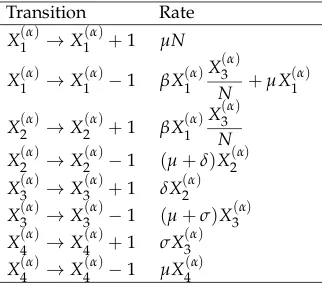
A stochastic SEIR model can be depicted using a continuous time Markov chain (CTMC) like the 80
birth and death process with non-linear rates of transition as those given in table1, see [50, p.22] and 81
[51, p.321]. M . S . Bartlett [9] and Greenwood and Gordillo [31] introduced (integer) stochastic SIR 82
model using CTMC with rates similar to those in the first six rows in table1to show a deterministic 83
SIR model of the ODE type depicting the approximate dynamics of the means of the processes. Here, 84
we introduce a fractional SEIR model using a CTMC of fractional birth and death process on triplets 85
(i,j,k)with rates provided by table1. 86
Table 1.Transitions and their rates for a birth and death process depicting a stochastic SEIR model.
Transition Rate
X(α)
1 →X (α)
1 +1 µN
X(1α)→X1(α)−1 βX(1α)X
(α) 3
N +µX
(α) 1
X(2α)→X2(α)+1 βX(1α)X
(α) 3
N X(2α)→X(2α)−1 (µ+δ)X(2α)
X(α)
3 →X (α)
3 +1 δX (α)
2
X(3α)→X(3α)−1 (µ+σ)X3(α)
X4(α)→X4(α)+1 σX(3α)
X4(α)→X4(α)−1 µX4(α)
Anα-fractional SEIR stochastic process{(X1(α)(t),X2(α)(t),X3(α)(t)): t≥0}for 0 < α≤1 with state probabilities
p(α)(i,j,k)(t) =P((X1(α)(t),X2(α)(t),X3(α)(t)) = (i,j,k)|(X1(α)(0),X2(α)(0),X3(α)(0)) = (i0,j0,k0)
fori,j,k= 0, 1, . . ., such that 0≤ i+j+k≤ NandP((X1(α)(0),X(α)2 (0),X(α)3 (0)) = (i0,j0,k0)) = 1, 87
has a fractional forward Kolmogorov equation of the stochastic SEIR model similar to equation (A1) 88
and is given by 89
Dα
∗p(α)(i,j,k)(t) = µN p(i−(α)1,j,k)(t) +β(i+1) k Np
(α)
(i+1,j−1,k)(t) +µ(i+1)p (α) (i+1,j,k)(t)
+δ(j+1)p(α)(i,j+1,k−1)(t) +µ(j+1)p(i(α),j+1,k)(t) + (σ+µ)(k+1)p(α)(i,j,k+1)(t)
−(µN+βik
N+µi+ (δ+µ)j+ (σ+µ)k)p (α)
(i,j,k)(t) (10)
with p(α)(i,j,k)(t) = 0 if eitheri,j, orkare negative or more than N. See also Di Crescenzoet al.[45]. 90
The classical forward Kolmogorov equation of the stochastic SEIR model follows whenα=1 with 91
functionG(α)(u,v,w,t) = E(uX(1α)(t)vX
(α) 2 (t)wX
(α)
3 (t))of the state probabilities, as the solution of the 93
Cauchy problem 94
Dα
∗G(α) = µN(u−1)G(α)+µ(1−u)∂uG(α)+ (δw+µ−(δ+µ)v)∂vG(α)
+(σ+µ)(1−w)∂wG(α)+βw
N(v−u)∂uwG
(α) (11)
fort>0 andG(α)(u,v,w, 0) =ui0vj0wk0, for−1<u,v,w<1. 95
Note that, the integer or classical stochastic SEIR process is(X(11)(t),X2(1)(t),X3(1)(t))which is 96
simply the case whenα =1. But that leads to another interesting fact that defines the relationship 97
between the fractional and integer stochastic SEIR model; that is, the former process is a random-time 98
subordination of the latter one, as established for other fractional processes like the fractional Poisson 99
process [37,45,52], and the fractional birth and/or death processes [39,40,42,43,53]. 100
Theorem 1. The fractional stochastic SEIR process(X(α)1 (t),X2(α)(t),X(α)3 (t))has the same distribution as the random-time subordinated integer stochastic SEIR process
(X(11)(T2α(t)),X (1)
2 (T2α(t)),X (1)
3 (T2α(t))) for t>0and0<α≤1.
101
The proof is provided in AppendixA. 102
2.3. Measles’ Model via Fractional Differential Equations (FDE) 103
The means of the three discrete-marginal processesX1(α)(t),X2(α)(t), andX(α)3 (t)can be found using∂uG(α)(1, 1, 1,t),∂vG(α)(1, 1, 1,t), and∂wG(α)(1, 1, 1,t), respectively. LetS(α)(t):= N1E(X1(α)(t)), E(α)(t) := N1E(X2(α)(t)), and I(α)(t) := N1E(X3(α)(t)), where N is the total population size and E(x) is the expected value of x. Thus using equation (11), and approximating E(X1(α)(t)X(α)3 (t)) byE(X1(α)(t))E(X3(α)(t))we reach the fractional order version of the system of equations that was used by M . S . Bartlett [9] to model measles,
Dα
∗S(α)=µ−βS(α)I(α)−µS(α)
Dα
∗E(α)=βS(α)I(α)−(µ+δ)E(α)
Dα
∗I(α)=δE(α)−(µ+σ)I(α)
(12)
where S(α), E(α), and I(α) be the proportion of susceptible, exposed, and infected individuals, respectively. With proportion of recovered individuals given by R(α) = 1−(S(α)+E(α)+I(α)), we reach the fractionalαorder SEIR model
Dα
∗S(α)=µ−βS(α)I(α)−µS(α)
Dα
∗E(α)=βS(α)I(α)−(µ+δ)E(α)
Dα
∗I(α)=δE(α)−(µ+σ)I(α)
Dα
∗R(α)=σI(α)−µR(α)
(13)
with a powerαof new parameters; that is,θ∗αin place ofθso the parametersθ∗will have the dimension of time1 and the system becomes the following form:
Dα
∗S(α)=µα∗−β∗αS(α)I(α)−µα∗S(α) Dα
∗E(α)=βα∗S(α)I(α)−(µα∗+δα∗)E(α) Dα
∗I(α)=δ∗αE(α)−(µα∗+σ∗α)I(α) Dα
∗R(α)=σ∗αI(α)−µα∗R(α)
(14)
2.4. Measles’ Model via Ordinary Differential Equations (ODE) 104
The following system of differential equations represents the ordinary differential equation 105
representation of the SEIR model and is the FDE model whenα=1 in equation14. 106
DS=µ−βSI−µS DE=βSI−(µ+δ)E
DI=δE−(µ+σ)I DR=σI−µR
(15)
whereµ,β,δ, andσare the model parameters described above. They all have dimensions given by 107
1
time. The last equation in (15) is redundant sinceR=1−(S+E+I). 108
2.5. Measles’ Model viaα-dependent Ordinary Differential Equations 109
We are interest in comparing the FDE vs ODE modeling approaches. It is important to note that 110
the basic ODE case considersα=1, however in the FDE case,αappears in the derivative as well as the 111
parameter values. In order to better compare these two approaches, here we develop an ODE analoge 112
to the FDE that incorporatesαin the parameter values. We call this new system theα-dependent ODE. 113
By dropping theαorder derivative from the left side andαpower fromS(α),E(α), andI(α)of equation 114
(14), ourα-dependent ODE takes the following form: 115
DS=µα∗−βα∗SI−µα∗S DE=βα∗SI−(µα∗+δ∗α)E
DI=δα∗E−(µα∗+σ∗α)I DR=σ∗αI−µα∗R
(16)
2.6. Model Analysis 116
Analysis of the ODE is almost the same as of the FDE so we include the FDE one here. We start by 117
proving the positive invariance of the region of solutions of the FDE model. Henceforth, we drop theα 118
fromS(α),E(α), andI(α), for brevity. 119
The following two lemmas of asymptotic behavior of FDEs are given here and their proof in 120
appendixAfor completeness. 121
Lemma 1. The closed simplex region M={(S,E,I)∈R3+: 0≤S+E+I≤1}is a positive invariant set 122
for the FDE model in(14). 123
We can find the model’s equilibrium points by settingDα
∗S =0,D∗αE=0, andD∗αI =0. Thus, 124
there are two equilibria to the measles’ SEIR model (14). They are: 125
2. the endemic equilibrium
EE= (s∗,e∗,i∗)≡
1 R0
, µ δ+µ
1− 1
R0
,µ
β(R0−1)
.
where the basic reproduction number isR0:= (µ+σ)(µ+δ)βδ .EEexists only when 1<R0<1+βµ. 127
An equilibrium is locally asymptotically stable if the eigenvalues of the Jacobian matrix of the 128
n-dimensional system, namelyλ1,λ2, . . . ,λn, have the property that|arg(λi)|> απ2, fori=1, 2, . . . ,n, 129
[25, p.158]. Thus, in general, the stability of the ordinary differential equations model implies stability 130
of its fractional counter model. But, here they are equivalent due to the following lemma whose 131
solution could be found in appendixA. 132
Lemma 2. The Disease-Free Equilibrium DFE is locally asymptotically stable if R0 < 1. The endemic 133
equilibrium EE is is locally asymptotically stable if R0>1. 134
Therefore, they have the same asymptotic behavior. Yet, the transient behavior differs as will be 135
seen by simulations below. 136
Moreover, a very important difference is their oscillation behavior is not similar. Letλ`andu`for
`=1, 2, . . . ,Nbe the eigenvalues and their respective eigenvectors of anN×NmatrixA. The general solution of initial value problem consisting of a system ofNlinear fractional differential equations Dα
∗x(t) =Ax(t)such thatx(0) =x0can be found to be
x(t) = N
∑
`=1
c`u`Eα(λ`tα) (17)
for certain constantsc` ∈Cfor`=1, 2, . . . ,Nsuch that∑`N=1c`u`= x0, [25, Theorem 7.13]. In case thatα=1, we recover the known solution of the system of ODEs given by
x(t) = N
∑
`=1
c`u`exp(λ`t).
IfN=3 andAis not a symmetric matrix then at least one of the eigenvalues is a real-valued number 137
and the other two eigenvalues , sayλ2andλ3, are conjugate complex-valued. In that situation,x(t) 138
would oscillate with inter-peak periods, called inter-epidemic period in disease modeling, given by 139
2π(=(λ2))−1[14]. If<(λ`) <0 for all`then the oscillations will be damped to zero. That damped 140
oscillation is clear in the case ofα=1 due to the exponential damping in the superposition of the sine 141
and cosine functions. That behavior, however, is not straight forward for 0<α<1. 142
2.7. Numerical Simulations 143
Since the mean of the subordinator process isE(Tα(t)) = t α
Γ(α+1), we use a method similar to that was introduced in Demirici and Özalp [54] to find approximate solutions to initial value FDE problems. We use that method here to simulate the solution of the FDE measles SEIR model. Consider the initial value problem
Dα
∗x(t) = f(t,x(t)), for 0<t≤T, x(0) =x0,
(18)
for someT>0. A solution of (18) is approximated by the deterministic time subordination
x(t) =y
tα
Γ(α+1)
ofy(s), the solution of the ordinary differential equation dy(s)
ds =g(s,y(s)), for 0<s≤ tα
Γ(α+1) y(0) =x0.
(20)
where
g(s,y(s)) = f(t−(tα−sΓ( α+1))
1
α,x(t−(tα−sΓ(α+1)) 1
α)). (21)
for all 0<t≤T, [54]. 144
We use the subordination of the solution of ODEs to FDEs represented in equations (19) and (20) 145
to numerically simulate solutions of FDEs, see algorithm1. 146
Algorithm 1Numerical solution ofDα
∗x(t) = f(t,x(t))for 0<t<Twithx(0) =x0. Input:α,T,f(t,x(t)),m,nOutput:x(t)
begin
Divide the interval[0,T]intonsub-intervals using
0=t0<t1<. . .<tn =T. fori=1, 2, . . . ,n
Divide the interval[0, t α i
Γ(α+1)]into furthermsub-intervals using
0=s0<s1<. . .<sm= tα
i
Γ(α+1).
Solve the systemDy(s) = f(ti−(tαi −sΓ(α+1)) 1
α,y(s))withy(0) =x0using Euler or Runge-Kutta methods ons0,s1, . . . ,sm.
Retainx(ti) =y(sm). end
Return[x0,x(t1),x(t2), . . . ,x(tn)]. end
2.8. Fitting FDE and ODE models to measles data 147
We use the method of ordinary least squares (OLS) to fit the FDE model to the data by minimizing the objective function
L(α,β,µ,δ,σ) = n
∑
i=1
(Ii(d)−Ii(s))2
forα∈(0, 1], andβ,µ,δ,σ∈(0,∞), whereI(d)is the data of actual proportion of infections andI(s)is 148
the simulated proportion of infections. The valuesIi(s)approximatingI(ti)are found by solving the 149
FDE model using algorithm1. 150
Parameter estimation was conducted using Matlab MultiStart and fmincon functions. MultiStart 151
carries out the optimization procedure using initial points within the parameters’ spaces. It generates 152
some initial points depending on a converging algorithm. The fmincon finds a local minimum for the 153
constrained nonlinear multivariable function. The MultiStart together with fimincon do the global 154
optimization of a nonlinear multivariable function. The MultiStart function uses parallel processing 155
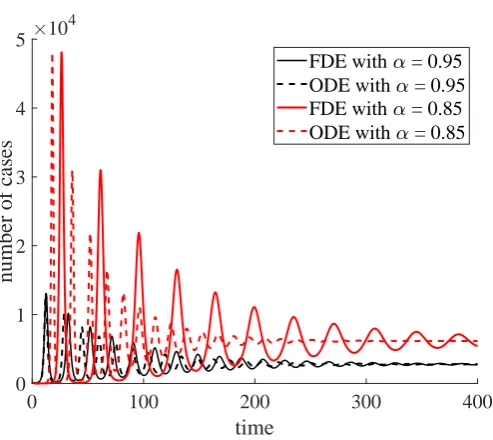
Figure 2.Number of cases using classical ODE model and FDE model with different fractional orders
α. The simulations are done usingµ = µ? =0.0027, β = β? =119.2257,δ = δ? =16.7301, and
σ=σ? =10.1873.
0 100 200 300 400
time
01 2 3 4 5
number of cases
104
FDE with = 0.95 ODE with = 0.95 FDE with = 0.85 ODE with = 0.85
Figure 3.Number of cases using FDEM and its analogous ODEM with different fractional ordersα.
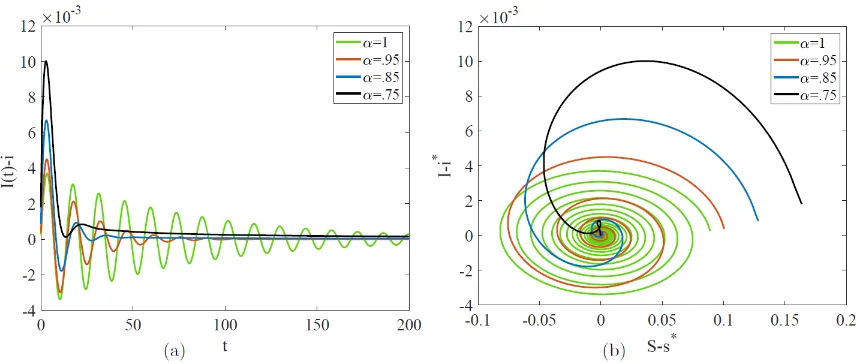
Figure 4.Simulations of solutions of the SEIR FDE centered about the endemic equilibrium (EE) for
α=1, .95, .85, and .75 using equation (17) shows a suppression of damped oscillations asαdecreases.
The simulations are done usingµ? =0.0027,β? =119.2257,δ?=16.7301, andσ?=10.1873.
3. Results 157
We solve the system of FDE (equation14) using algorithm1and the systems of ODE (equations 158
15and16) using the Runge-Kutta method. 159
Simulations of the classical ODE (equation15) and FDE ( equation14), Figure2, shows that 160
the system of fractional differential equations is very sensitive to its order of differentiationα. For 161
smallerα, the peak number of cases of the epidemic is larger but the duration of the outbreak is 162
shorter. The solution of the FDE model converges to the solution of the classical ODE asα→1. To 163
further compare the two modeling approaches, we consider the analogue ODEs derived for specificα 164
values, see equation (16). These comparisons are shown in Figure3. During transient dynamics both 165
models exhibit several peaks in the number of cases. The number of these peaks and their respective 166
amplitudes are similar between models, however there are differences in the timing of these peaks. 167
The transient oscillations of the FDE model are more stretched out than its ODE analogue, and its 168
solutions experience longer inter-epidemic times. Both models approach the same equilibria solutions. 169
Simulations of equation (17) in Figure4shows that disease models of fractional order equations 170
lack the same oscillatory behavior exhibited by systems of ODEs with conjugate complex eigenvalues 171
of the Jacobian matrices calculated at endemic equilibrium. 172
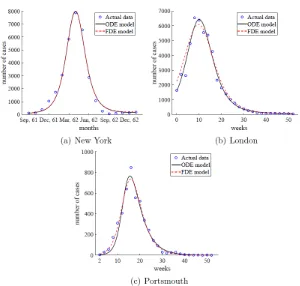
The models were fitted to three measles’ epidemics in the pre-vaccination era in three different 173
cities: New York, London, and Portsmouth. Simulations of the fitted ODE and FDE models are 174
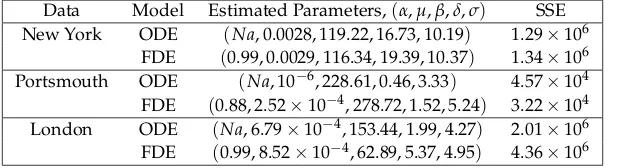
shown in Figure5. See also AppendixBfor the data and the parameter estimates. The estimate 175
ofαare 0.99, 0.99, and 0.88 for New York, London, and Portsmouth respectively. The AIC and BIC 176
are found to be smaller for ODE models for the epidemics in New York and London with values of 177
AIC(ODE)=250.539 and 389.358 and BIC(ODE)=253.872 and 394.541, respectively, while AIC(FDE)= 178
255.360 and 413.275 and BIC(FDE)=259.526 and 419.754, respectively. For Portsmouth’s epidemic, the 179
results are the opposite, AIC(ODE)=277.938 and BIC(ODE)=282.978 while AIC(FDE)=271.920 and 180
BIC(FDE)=278.213. Yet the differences between the fitting of ODE and FDE models are not striking. 181
4. Discussion 182
Replacing first order derivatives with Caputo fractional derivatives has been the practice for 183
many studies using fractional order modeling of diseases. In this paper, we show how those models 184
follow from an approximation to the dynamical system governing the means of fractional stochastic 185
SEIR processes. Moreover, we study ordinary and fractional order systems of differential equations 186
Figure 5.Simulations of ODE and FDE models fitted to measles epidemics in the pre-vaccination era.
pre-vaccination era. It appears that, in some situations, the fractional order differential equation model 188
(FDEM) gives better fit than the ordinary differential equation model (ODEM). 189
Angstmannet al.[34] use the master equation of a continuous-time random walk to derive an 190
FDEM involving Riemann-Liouville fractional derivatives. Power laws are postulated to model time of 191
infectiousness and recovery. That extension from exponential times in ordinary differential equations 192
is a different approach from the mean field approximation of a stochastic process. Saeedianet al.[36] 193
introduced the Caputo fractional differential equations through a memory of the whole process of 194
infection and disease recovery. In our paper, we have considered, for the first time, fractional stochastic 195
SEIR model and have shown how the Caputo fractional differential equations follows as mean-field 196
approximation of the process. 197
Fractional stochastic SEIR model introduced here turns out to be a random-time subordination 198
of a classical stochastic SEIR model. Other real-life systems are modeled using a subordination of a 199
stochastic process. A subordinated process was introduced by Mandelbrot and Taylor [55] to model 200
the logarithm of market prices where the original process is a Brownian motion subordinated by a 201
stochastic time processT2α, which is the same random time process we have found here. In Mandelbrot 202
and Taylor [55], the stochastic time processT2αis called the operational time andtis the physical time. 203
Further study of the fractional stochastic SEIR model might lead to interesting dynamical 204
behaviors. For instance, it can provide more insights into the stochastic oscillations of the disease in 205
a more flexible way than their classical counterparts. Thus, studying the fractional stochastic SEIR 206
model is the next step in this work. 207
5. Conclusion 208
In this paper, we compare two deterministic models of disease: ordinary differential equations 209
(ODE) and fractional differential equations (FDE). We use three different data sets of measles epidemics 210
stochastic SEIR model. Up to our knowledge, this is the first time such a fractional stochastic process is 212
introduced and connected to the fractional order differential equations. 213
While ODE models are regularly used to model epidemics, such as measles, FDEs seem to have 214
the potential to offer improved model fitting. Rates of transition between compartments in that case 215
could be interpreted as rates with respect to an external observer with a different type of clock, may be 216
due to delay in reporting. 217
Author Contributions:Conceptualization, MR.I., A.P. and T.O.; methodology, MR.I., D.M. and T.O.; software, 218
MR.I. and T.O.; validation, MR.I. and T.O.; formal analysis, MR.I. and T.O..; investigation, MR.I. and T.O.; data 219
curation,MR.I. and T.O.; writing–original draft preparation, MR.I., D.M.,A.P. and T.O.; writing–review and editing, 220
MR.I., A.P. and T.O.; visualization, MR.I., A.P., D.M. and T.O.; supervision, A.P. and T.O.; funding acquisition, A.P. 221
Funding:A.P. was partially supported by NSF grant DMS-1815750. 222
Acknowledgments:We thanks Joshua Padgett for his valuable comments. 223
Conflicts of Interest:The authors declare that they have no competing interests. The funders had no role in the 224
design of the study; in the collection, analyses, or interpretation of data; in the writing of the manuscript, or in the 225
decision to publish the results. 226
Appendix A. Some Definitions and Proofs 227
Laplace transform of a functionf(t)is defined as
L(f)(s) = fˆ(s) =
Z ∞
0 e
−stf(t)dt.
The inverse transform is defined by
L−1(fˆ)(t) = 1 2πi
Z
Ce
stfˆ(s)ds
whereCis a contour parallel to the imaginary axis and to the right of the singularities of ˆf. The Laplace transform of the Caputo fractional derivative is given by
L(Dα
∗f)(s) =sαfˆ(s)−sα−1f(0). Fractional Birth and Death Process:
228
Anα-fractional nonlinear birth and death process{Nα(t) : t ≥ 0}for 0 < α ≤ 1 with state probabilities
pα
n(t) =P(Nα(t) =n|Nα(0) =1)
forn≥0 is defined through the forward Kolmogorov (difference-)differential equations Dα
∗pαn(t) =λn−1pαn−1(t) +µn+1pαn+1(t)−(λn+µn)pαn(t) (A1)
forn ≥ 0 [39,43,53]. The ratesλn andµn are non-negative. The classical birth and death process 229
follows whenα=1 with state probabilitiesp1n(t). Whenλn=λandµn =0 for alln, theα-fractional 230
nonlinear birth and death process becomes theα-fractional Poisson process [37,41,46]. There, it has 231
shown thatNα(t)has the same probability distribution asN(Tα(t)), whereN(t)is the classical birth 232
and death process which is independent of a random time processTα(t); that is, a birth and death 233
process subordinated by anα-stable time process. 234
The random time processTα(t)has a distribution given by the folded solution of the fractional diffusion equation∂αtF=∂2xFfor 0<α≤2,x∈R,t>0, and subject toF(x, 0) =δ(x)for 0<α≤2 and∂αtF(x, 0) =0 for 1<α≤2, [43]. We will denote its measure byνα,t(ds):=P(Tα(t)∈ds). It has a Laplace transform
L(να,s)(r) =
Z ∞
0 e −rt
να,t(dt) =r α 2−1e−sr
and momentsE[(Tα(t))k] =Γ(k+1) tkα
Γ(kα+1)fork=1, 2, . . .; [46,56]. 235
Note that, the absolute values of partial derivatives ofGare finite; that is,|∂u(i,,vj,,k)wG|<∞for any 236
i,j,k=0, 1, 2, . . .. That is true since|u|,|v|,|w|<1 and the population size is finite. Thus, switching 237
integrals with derivatives or summations below are valid. 238
239
Proof of the Theorem1 240
We are going to show that Laplace transform of the probability generating function of the process
(X(11)(T2α(t)),X (1)
2 (T2α(t)),X (1)
3 (T2α(t)))
is the same as Laplace transform ˆGof G, that solves equation (11). From there we will conclude 241
that the two probability distributions are the same since the probability generating function of 242
(X(α)1 (t),X(α)2 (t),X(α)3 (t)), by construction, is also a solution to the Cauchy problem in equation (11). 243
From equation (11), the Laplace transform ˆGis the solution of 244
sαGˆ(α)−sα−1ui0vj0wk0 = µN(u−1)Gˆ(α)+µ(1−u)∂
uGˆ(α)+ (δw+µ−(δ+µ)v)∂vGˆ(α) +(σ+µ)(1−w)∂wGˆ(α)+βw
N(v−u)∂uwGˆ
(α) (A2)
LetH(α)(u,v,w,t)be the probability generating function of the state probabilities q(i(α),j,k)(t) =P((X1(1)(T2α(t)),X
(1)
2 (T2α(t)),X (1)
3 (T2α(t))) = (i,j,k)| (X(11)(T2α(0)),X
(1)
2 (T2α(0)),X (1)
3 (T2α(0))) = (i0,j0,k0)). That means that
245
H(α)(u,v,w,t) = E(uX(11)(T2α(t))vX
(1)
2 (T2α(t))wX
(1)
3 (T2α(t)))
=
∑
i
∑
j∑
kuivjwkq(α)(i,j,k)(t)
=
∑
i
∑
j∑
k uivjwkZ ∞
0 p (1)
(i,j,k)(s)ν2α,t(ds) =
Z ∞
0
(
∑
i∑
j∑
kuivjwkp((i1,)j,k)(s))ν2α,t(ds)
=
Z ∞
0 G
(1)(u,v,w,s)
ν2α,t(ds).
Thus the Laplace transform of the probability generating functionH(α)is given by 246
ˆ
H(α)(u,v,w,r) =
Z ∞
0 e
−rtZ ∞
0 G
(1)(u,v,w,s)
ν2α,t(ds)dt = rα−1
Z ∞
0 G
Now, the Laplace transform of the probability generating function of the process 247
(X(11)(t),X2(1)(t),X3(1)(t))also solves (A2) whenα=1 which is 248
sGˆ(1)−ui0vj0wk0 = µN(u−1)Gˆ(1)+µ(1−u)∂uGˆ(1)+ (δw+µ−(δ+µ)v)∂vGˆ(1) +(σ+µ)(1−w)∂wGˆ(1)+βw
N(v−u)∂uwGˆ
(1). (A3)
If we substitute withs=rαin equation (A3) and multiply both sides byrα−1we get 249
rαHˆ(α)−rα−1ui0vj0wk0 = µN(u−1)Hˆ(α)+µ(1−u)∂uHˆ(α)+ (δw+µ−(δ+µ)v)∂vHˆ(α) +(σ+µ)(1−w)∂wHˆ(α)+βw
N(v−u)∂uwHˆ
(α) (A4)
which is the same as equation (A2). This completes the proof. 250
251
Proof of Lemma1 252
Starting on the S-axis whenE(0) =I(0) =0 and 1≥S(0) =S0≥0, then
S(t) =tαE
α,α+1(−µtα)(µ) +Eα,1(−µtα)S0≥0
sinceµ>0 andt≥0. Starting on the E-axis whenS(0),I(0) =0 andE(0) =E0≥0, then
E(t) =Eα,1(−(µ+δ)tα)E0≥0 Starting on the I-axis whenS(0),E(0) =0 andI(0) =I0≥0, then
I(t) =Eα,1(−(µ+σ)tα)I0≥0 Thus, all axes are positive invariant, forS(0),E(0),I(0)≥0. 253
If the solution of the system is leaving through the positive quadrant of the E-I plane, then S(te) = 0, and E(te)and I(te) > 0 for somete > 0 such that S(t) ≤ S(te), for all t > te. But, Dα
∗S|t=te =µ>0. By the generalized mean value theorem S(t) =S(te) + Γ1
(α)D α
∗S(τ)(t−te)α
for somete ≤τ<t, thenS(t)>S(te)contradicting the original statement. The same argument could be used for the positive quadrant of the S-I plane withDα
∗E|t=te =βS(te)I(te)>0 and for the positive quadrant of the E-S plane withDα
∗I|t=te =αE(te)>0.
To show thatS(t) +E(t) +I(t)≤1 for allt>0, ifS(0) +E(0) +I(0)≤1, Dα
∗(S+E+I) =µ−µ(S+E+I)−σI
≤µ−µ(S+E+I)
(A5)
Thus,
S(t) +E(t) +I(t)≤tαE
α,α+1(−µtα)µ+Eα,1(−µtα)(S(0) +E(0) +I(0))
≤tαE
α,α+1(−µtα)µ+Eα,1(−µtα) =1
(A6)
by equation (7). 254
255
For the local stability of a disease-free equilibrium, we must evaluate the Jacobian matrix at DFE≡(1, 0, 0)
J(DFE) =
−µ 0 −β 0 −(µ+δ) β
0 δ −(µ+σ)
The eigenvalues of the matrixJare,
λ1=−µ,
λ2=
−(δ+2µ+σ)−
√
∆
2 ,
λ3=
−(δ+2µ+σ) +
√
∆
2 ,
where∆=δ2+4δβ−2δσ+σ2. From this it is clear thatλ1is negative and since
∆=δ2+4δβ−2δσ+σ2= (δ−σ)2+4δβ>0
thenλ2andλ3are real-valued numbers. Henceλ2<0. But,λ3<0 is true when
−(δ+2µ+σ) +pδ2+4δβ−2δσ+σ2
2 <0
which is equivalent toβδ<(µ+σ)(µ+δ), proving the first part. 257
The Jacobian matrix calculated atEEis given by
J(EE) =
−µR0 0 −βR1 0 µ(R0−1) −(µ+δ) βR1
0
0 δ −(µ+σ)
which has a characteristic polynomial,
−λ3−λ2[(µ+δ) + (µ+σ) +µR0]−λ[µR0(2µ+δ+σ)] +µ(R0−1)(µ+σ)(µ+δ).
Because that polynomial has a degree of 3, we choose to test the Routh-Hurwitz conditions to see ifEEis stable.
a1=µR0+ (2µ+δ+σ)>0 a3=µ(R0−1)(µ+σ)(µ+δ)>0 With these conditions we check that the determinant,D2>0.
D2=a1a2−a3= (µR0+2µ+δ+σ)(µR0(2µ+δ+σ))−(µ(R0−1)(µ+σ)(µ+δ)) =µ[µR20(2µ+δ+σ) + (2µ+δ+σ)2R0−R0(µ+σ)(µ+δ) + (µ+σ)(µ+δ)] =µ[µR20(2µ+δ+σ) + (µ+σ)2R0+ (µ+δ)2R0+ (µ+σ)(µ+δ)R0+ (µ+σ)(µ+δ)]>0 From this, all Routh-Hurwitz conditions are met and all the eigenvalues of the Jacobian matrix at 258
Appendix B. Data Sets and Parameter Estimation 260
Appendix B.1. New York 261
Monthly reported infections of measles from September 1961 to January 1963 in New York city 262
are given in tableA1. Parameter estimation of Measles New York data from September 1961 to January 263
1963 using both ODE model and FDE model. The estimated parameters values for the classical ODE 264
model are(µ,β,δ,σ) = (0.0028, 119.22, 16.73, 10.19)with the sum of square error,SSE=1.29×10⁶ 265
and for the FDE model are(α,µ,β,δ,σ) = (0.99, 0.0029, 116.34, 19.39, 10.37)with the sum of square 266
error,SSE=1.34×10⁶. 267
Table A1.Reported infections of measles from September 1961 to January 1963 in New York, US.
Year Months Cases Year Months Cases Year Months Cases 1961 September 109 1962 March 5839 1962 September 58 1961 October 123 1962 April 7875 1962 October 86 1961 November 383 1962 May 6555 1962 November 125 1961 December 1043 1962 June 2866 1962 December 145 1962 January 1725 1962 July 1075 1963 January 184 1962 February 3056 1962 August 266
Appendix B.2. London 268
Biweekly reported infections of measles in 1961 in London, United Kingdom are given in table 269
A2. Parameter estimation of measles Portsmouth data in 1961 using both ODE model and FDE 270
model. The estimated parameters values for the classical ODE model are (µ,β,δ,σ) = (6.79× 271
10−4, 153.44, 1.99, 4.27)with the sum of square error, SSE= 2.01×10⁶and for the FDE model are 272
(α,µ,β,δ,σ) = (0.99, 8.53×10⁻⁴, 62.89, 5.37, 4.95)with the sum of square error,SSE=4.37×10⁶. 273
Table A2.Biweekly reported measles infections in 1961 in London, UK.
Year Weeks Cases Year Weeks Cases Year Weeks Cases Year Weeks Cases
1961 0 1636 1961 14 5374 1961 28 514 1961 42 89
1961 2 2700 1961 16 4272 1961 30 375 1961 44 87
1961 4 2639 1961 18 2322 1961 32 265 1961 46 73
1961 6 4805 1961 20 1810 1961 34 199 1961 48 70
1961 8 6543 1961 22 1409 1961 36 121 1961 50 59
1961 10 6389 1961 24 1037 1961 38 86 1961 52 45
1961 12 5545 1961 26 767 1961 40 76
Appendix B.3. Portsmouth 274
Biweekly reported infections of measles in 1961 in Portsmouth, United Kingdom are given in table 275
A3. Parameter estimation of measles Portsmouth data in 1961 using both ODE model and FDE model. 276
The estimated parameters values for the classical ODE model are(µ,β,δ,σ) = (10−6, 228.61, 0.46, 3.33) 277
with the sum of square error,SSE=4.57×10⁴and for the FDE model are(α,µ,β,δ,σ) = (0.88, 2.56× 278
10−4, 278.72, 1.52, 5.24)with the sum of square error,SSE=3.22×10⁴. 279
Table A3.Biweekly reported infections of measles in 1961 in Portsmouth, UK.
weeks 2 4 6 8 10 12 14 16 18 20 22 24 26 28 30 32
cases 4 30 58 174 310 407 640 847 555 523 337 242 144 91 29 21
weeks 34 36 38 40 42 44 46 48 50 52
Appendix B.4. Parameter Estimations 280
Table A4.Comparison between the classical ODE model and FDE model using different data sets
Data Model Estimated Parameters,(α,µ,β,δ,σ) SSE
New York ODE (Na, 0.0028, 119.22, 16.73, 10.19) 1.29×10⁶ FDE (0.99, 0.0029, 116.34, 19.39, 10.37) 1.34×10⁶ Portsmouth ODE (Na, 10−6, 228.61, 0.46, 3.33) 4.57×10⁴ FDE (0.88, 2.52×10⁻⁴, 278.72, 1.52, 5.24) 3.22×10⁴ London ODE (Na, 6.79×10⁻⁴, 153.44, 1.99, 4.27) 2.01×10⁶ FDE (0.99, 8.52×10⁻⁴, 62.89, 5.37, 4.95) 4.36×10⁶
281
References 282
1. Bernoulli, D. Essai d’une nouvelle analyse de la mortalité causée par la petite vérole. InMém Math Phys
283
Acad Roy Sci Paris; 1766; Vol. 1, pp. 1–45. 284
2. Ross, R. An Application of the Theory of Probabilities to the Study of a priori Pathometry. Part 285
I. Proceedings of the Royal Society A: Mathematical, Physical and Engineering Sciences1916, 92, 204–230. 286
doi:10.1098/rspa.1916.0007. 287
3. Brownlee, J. Certain Aspects of the Theory of Epidemiology in Special Relation to Plague.Proceedings of
288
the Royal Society of Medicine1918,11, 85–132. 289
4. Greenwood, M.; Yule, G.U. An Inquiry into the Nature of Frequency Distributions Representative of 290
Multiple Happenings with Particular Reference to the Occurrence of Multiple Attacks of Disease or of 291
Repeated Accidents. Journal of the Royal Statistical Society1920,83, 255. doi:10.2307/2341080. 292
5. Kermack, W.O.; McKendrick, A.G. A Contribution to the Mathematical Theory of Epidemics.Proceedings
293
of the Royal Society A: Mathematical, Physical and Engineering Sciences1927. doi:10.1098/rspa.1927.0118. 294
6. Soper, H.E. The Interpretation of Periodicity in Disease Prevalence. Journal of the Royal Statistical Society
295
1929,92, 34. doi:10.2307/2341437. 296
7. Greenwood, M. On the Statistical Measure of Infectiousness.The Journal of hygiene1931,31, 336–51. 297
8. Greenwood, M. The statistical study of infectious diseases. Journal of the Royal Statistical Society. Series A
298
(General)1946,109, 85–110. 299
9. M . S . Bartlett. Some Evolutionary Stochastic Processes. Journal of the Royal Statistical Society . Series B (
300
Methodological )1949,11, 211–229. 301
10. Bailey, N.T.J. The Total Size of a General Stochastic Epidemic.Biometrika1953,40, 177. doi:10.2307/2333107. 302
11. Bailey, N.T.J.The mathematical theory of infectious diseases and its applications; Griffin, 1975; p. 413. 303
12. Anderson, R.M.The Population dynamics of infectious diseases : theory and applications; 1982. 304
13. Hethcote, H.W. The Mathematics of Infectious Diseases. SIAM Review 2005. 305
doi:10.1137/s0036144500371907. 306
14. Keeling, M.J.; Danon, L. Mathematical modelling of infectious diseases, 2009. doi:10.1093/bmb/ldp038. 307
15. Anderson, R.M.; May, R.M. Infectious Diseases of Humans: Dynamics and Control (Oxford Univ. Press,
308
Oxford1991. 309
16. Castillo-Chavez, C.; Blower, S.; van den Driessche, P.; Kirschner, D.; Abdul-Aziz, Y.Mathematical Approaches
310
for Emerging an Reemerging Infectious Diseases; 2002. doi:10.1007/978-1-4613-0065-6. 311
17. Temime, L.; Hejblum, G.; Setbon, M.; Valleron, A. The rising impact of mathematical modelling in 312
epidemiology: antibiotic resistance research as a case study. Epidemiology and Infection2008,136, 289. 313
doi:10.1017/S0950268807009442. 314
18. Fisman, D.N.; Hauck, T.S.; Tuite, A.R.; Greer, A.L. An IDEA for Short Term Outbreak 315
Projection: Nearcasting Using the Basic Reproduction Number. PLoS ONE 2013, 8, e83622. 316
doi:10.1371/journal.pone.0083622. 317
19. Ahmed, E.; Elgazzar, A.S. On fractional order differential equations model for nonlocal epidemics. Physica
318
20. Demirci, E.; Unal, A.; Özalp, N. A fractional order SEIR model with density dependent death rate.Hacettepe
320
Journal of Mathematics and Statistics2011. 321
21. Al-Sheikh, S.A. Modeling and Analysis of an SEIR Epidemic Model with a Limited Resource for Treatment 322
Modeling and Analysis of an SEIR Epidemic Model with a Limited Resource for Treatment Modeling 323
and Analysis of an SEIR Epidemic Model with a Limited Resource for Treatme. Type : Double Blind Peer
324
Reviewed International Research Journal Publisher: Global Journals Inc2012,12. 325
22. Diethelm, K. A fractional calculus based model for the simulation of an outbreak of dengue fever.Nonlinear
326
Dynamics2013. doi:10.1007/s11071-012-0475-2. 327
23. Li, J.; Cui, N. Dynamic analysis of an SEIR model with distinct incidence for exposed and infectives. The
328
Scientific World Journal2013,2013, 1–5. doi:10.1155/2013/871393. 329
24. El-Shahed, M.; El-Naby, F.A. Fractional calculus model for for childhood diseases and vaccines. Applied
330
Mathematical Sciences2014,8, 4859–4866. doi:10.12988/ams.2014.4294. 331
25. Dold, E.A.; Eckmann, B.; Accola, R.D.M.Lecture Notes in Mathematics Springer-Verlag; 1975. 332
26. Almeida, R.; Brito da Cruz, A.M.; Martins, N.; Monteiro, M.T.T. An epidemiological MSEIR model 333
described by the Caputo fractional derivative. International Journal of Dynamics and Control2018, pp. 1–14. 334
doi:10.1007/s40435-018-0492-1. 335
27. Area, I.; Batarfi, H.; Losada, J.; Nieto, J.J.; Shammakh, W.; Torres, Á. On a fractional order Ebola epidemic 336
model. Advances in Difference Equations2015. doi:10.1186/s13662-015-0613-5. 337
28. Haggett, P.The geographical structure of epidemics; Clarendon Press, 2000; p. 149. 338
29. Bjørnstad, O.N.; Finkenstädt, B.F.; Grenfell, B.T. Dynamics of Measles Epidemics : Estimating Scaling of. 339
Ecological Monographs2002,72, 169–184. 340
30. Yingcun Xia.; Ottar N. Bjørnstad.; Bryan T. Grenfell. Measles Metapopulation Dynamics: A Gravity Model 341
for Epidemiological Coupling and Dynamics. The American Naturalist2004. doi:10.1086/422341. 342
31. Greenwood, P.E.; Gordillo, L.F. Stochastic epidemic modeling. InMathematical and Statistical Estimation
343
Approaches in Epidemiology; 2009; pp. 31–52. doi:10.1007/978-90-481-2313-1_2. 344
32. Vasilyeva, O.; Oraby, T.; Lutscher, F. Aggregation and environmental transmission in Chronic Wasting 345
Disease.Mathematical Biosciences and Engineering2015,12. doi:10.3934/mbe.2015.12.209. 346
33. Aranda, D.F.; Trejos, D.Y.; Valverde, J.C. A fractional-order epidemic model for bovine Babesiosis disease 347
and tick populations. Open Physics2017,15, 360–369. doi:10.1515/phys-2017-0040. 348
34. Angstmann, C.; Henry, B.; McGann, A. A Fractional-Order Infectivity and Recovery SIR Model. Fractal and
349
Fractional2017,1, 11. doi:10.3390/fractalfract1010011. 350
35. Sardar, T.; Rana, S.; Chattopadhyay, J. A mathematical model of dengue transmission with 351
memory. Communications in Nonlinear Science and Numerical Simulation 2015, 22, 511–525. 352
doi:10.1016/j.cnsns.2014.08.009. 353
36. Saeedian, M.; Khalighi, M.; Azimi-Tafreshi, N.; Jafari, G.R.; Ausloos, M. Memory effects on epidemic 354
evolution: The susceptible-infected-recovered epidemic model. Physical Review E2017, [1703.03191]. 355
doi:10.1103/PhysRevE.95.022409. 356
37. Laskin, N. Fractional Poisson process2003. 8, 201–213. doi:10.1016/S1007-5704(03)00037-6. 357
38. UCHAIKIN, V.V.; CAHOY, D.O.; SIBATOV, R.T. FRACTIONAL PROCESSES: FROM POISSON 358
TO BRANCHING ONE. International Journal of Bifurcation and Chaos 2008, 18, 2717–2725. 359
doi:10.1142/s0218127408021932. 360
39. Orsingher, E.; Polito, F.; Sakhno, L. Fractional Non-Linear, Linear and Sublinear Death Processes. Journal of
361
Statistical Physics2010,141, 68–93. doi:10.1007/s10955-010-0045-2. 362
40. Orsingher, E.; Polito, F. Fractional pure birth processes. Bernoulli2010,16, 858–881. doi:10.3150/09-bej235. 363
41. Meerschaert, M.M.; Nane, E.; Vellaisamy, P. The fractional poisson process and the inverse stable 364
subordinator.Electronic Journal of Probability2011,16, 1600–1620. doi:10.1214/EJP.v16-920. 365
42. Garra, R.; Polito, F. A note on fractional linear pure birth and pure death processes in epidemic models. 366
Physica A: Statistical Mechanics and its Applications2011,390, 3704–3709. doi:10.1016/j.physa.2011.06.005. 367
43. Orsingher, E.; Polito, F. On a fractional linear birth–death process. Bernoulli 2011, 17, 114–137. 368
doi:10.3150/10-bej263. 369
44. Orsingher, E.; Ricciuti, C.; Toaldo, B. Population models at stochastic times. Advances in Applied Probability
370
45. Di Crescenzo, A.; Martinucci, B.; Meoli, A. A fractional counting process and its connection with the 372
poisson process.Alea2016,13, 291–307. 373
46. Kumar, A.; Leonenko, N.; Pichler, A. Fractional Risk Process in Insurance2018. pp. 1–25,[1808.07950]. 374
47. Podlubny, I. Geometric and Physical Interpretation of Fractional Integration and Fractional Di ff erentiation 375
2008. pp. 1–18,[arXiv:arXiv:math/0110241v1]. 376
48. Özalp, N.; Demirci, E. A fractional order SEIR model with vertical transmission 2011. 54, 1–6. 377
doi:10.1016/j.mcm.2010.12.051. 378
49. Earn, D.J.; Rohani, P.; Bolker, B.M.; Grenfell, B.T. A simple model for complex dynamical transitions in 379
epidemics. Science2000. doi:10.1126/science.287.5453.667. 380
50. Allen, L.J.S.Stochastic Population and Epidemic Models; 2015. doi:10.1007/978-3-319-21554-9. 381
51. Allen, L. An Introduction to Stochastic Processes with Applications to Biology, Second Edition; 2018. 382
doi:10.1201/b12537. 383
52. Di Crescenzo, A.; Meoli, A. On a fractional alternating Poisson process. AIMS Mathematics, pp. 212–224. 384
doi:10.3934/math.2016.3.212. 385
53. Konno, H.; Pázsit, I. Fractional Linear Birth-Death Stochastic Process—An Application of Heun’s 386
Differential Equation.Reports on Mathematical Physics2018,82, 1–20. doi:10.1016/S0034-4877(18)30062-4. 387
54. Demirici, E.; Özalp, N. A method for solving differential equations of fractional order. Journal of
388
Computational and Applied Mathematics2012,236, 2754–2762. doi:10.1016/j.amc.2015.05.049. 389
55. Mandelbrot, B.; Taylor, H.M. On the Distribution of Stock Price Differences. Operations Research1967, 390
15, 1057–1062. doi:10.1287/opre.15.6.1057. 391
56. Piryatinska, A.; Saichev, A.; Woyczynski, W. Models of anomalous diffusion: the subdiffusive case. Physica
392