An extensible, self contained, layered approach to context
acquisition
Dean Kramer
School of Computing and Technology University of West London
London, UK W5 5RF
Anna Kocurova
School of Computing and Technology University of West London
London, UK W5 5RF
Samia Oussena
School of Computing and Technology University of West London
London, UK W5 5RF
[email protected]
Tony Clark
School of Engineering and Information Sciences
Middlesex University London, UK NW4 4BT
Peter Komisarczuk
School of Computing and Technology University of West London
London, UK W5 5RF
ABSTRACT
Smart phones show increasing capabilities for context-aware applications. The development of such applications involves implementation of mechanisms for context acquisition and context adaptation. To facilitate efficient use of the device’s resources and avoid monitoring the same context changes from multiple points, it is necessary that applications share the context acquisition mechanism. In this paper, we intend to develop a generic context acquisition engine which is ca-pable of context capturing, composition and broadcasting. By deploying the engine on a mobile device, context changes are monitored from single point and disseminated to various context aware applications running on the same device. As a proof of concept, the context acquisition engine has been implemented on the Android platform.
General Terms
Design
Keywords
context-awareness, mobile computing
1.
INTRODUCTION
Smart phones in recent years have seen high proliferation, allowing more users to stay productive while away from the desktop. This proliferation has seen the increasing amount of mobile applications being developed and becoming avail-able to consumers through centralised application reposi-tories. It has become highly predictable for these devices to have an array of sensors including GPS, accelerometers, digital compass, proximity sensors, sound etc. Using these sensors with other equipment already found in phones, a wide set of contextual information can be acquired.
This contextual information is consumed by context-aware mobile applications. Context aware applications have been described to beintelligent applications that can monitor the user’s context and, in case of changes in this context, con-sequently adapt their behaviour in order to satisfy the user’s current needs or anticipate the user’s intentions [4]. Thus
context-awareness is composed of two concepts: context ac-quisition and context adaptation. Whilst context adaptation can be considered application specific, context acquisition can be application independent by means of monitoring the same contexts by multiple applications. This is expensive and an inefficient use of resources such as battery, CPU and memory. So there is a need for a single customisable context acquisition mechanism which would monitor, manage and disseminate contextual information to context aware appli-cations running on the same mobile device. As the mecha-nism is used by a wide variety of applications, it should be developed in a generic way. Our goal is to contribute to the design and development of a standalone context acquisition engine capable of monitoring context changes independently from applications and broadcasting context information to various context-aware mobile applications.
In many cases, raw context data is not needed by context aware mobile applications, whereas high-level context infor-mation is more applicable. This information can be cre-ated by composition of several different context data types. Therefore, the context acquisition engine should support composition of captured context events in the way that the composition of contexts fits for purpose of any context aware mobile applications. We address the problem by implement-ing a context hierarchy that supports context fusion in a loosely coupled way.
2.
RELATED WORK
Context-aware research has gained much interest in recent years. The Context Toolkit has been proposed in [6] by Dey et al., a framework for rapid context-aware application pro-totyping. This framework is developed around components includingcontext widgets for context information retrieval,
interpretersfor abstracting context information,aggregators
for combining multiple related context information,services
for executing actions e.g altering activator states, and dis-coverers which maintain a registry of framework existing capabilities.
ContextDroid [9] proposed by Wissen et al. is an expression based context framework for the Android platform. This framework is made up ofcontext entities - a collection infor-mation from context sensors,context conditions- a boolean returned evaluation based on a set of parameters,evaluators
- interfaces for evaluator methods, andcontext expressions -a method of combining contexts. P-articul-arly with contexts e.g light level its simple to think of different levels (dark, medium, bright) as ranges of the lumens. Using this expres-sion engine would require creating higher level contexts to achieve the same goal as you would need to evaluate each end of the range separately. Also the extensibility of this frame-work is achieved by accessing the frameframe-work source code, compared to our approach adding context components in an application and dynamically using them with the engine at runtime.
Dynamic context composition and modularisation has been targeted in [5]. This approach useslayerswithin the Context-Oriented Programming (COP) languageContextL[3] to com-pose aggregated context behaviour. By defining relation-ships between the individual contexts, and their adaptation logic, aggregated context behaviour is created. Composition using this approach can be particularly complex and diffi-cult to understand, especially when composing large context aggregations.
In [10], CAMF was presented by Wang and Ahmad incor-porating machine learning into a context framework on the Android platform, to evaluate how context-aware systems benefit from machine learning, what context support is pro-vided by Android, and how well suited Android is for the development of context-aware systems. The framework itself is based on the layered architectures described by Miraoui and Baldauf [2].
Gonzalez et al. proposed Subjective-C [7] as context ori-ented extension to the Objective-C language. This extension allows for easier complex context interrelation expression comparable to [5] though with additions, and adds the abil-ity to express context-dependent method definitions allow-ing application behaviour adaptation usallow-ing context. Context-dependent method definitions are handled by finding the method implementation needed for the currently active con-text, every time the context changes, calledmethod dispatch. This language extension similar to other COP languages re-quires a custom compiler. This approach though targeting COP issues in Objective-C, sheds little light on the use of sensors, and how contexts are interpreted.
Space on mobile devices, though getting larger can be still
fairly limited. Therefore, it is desirable to not require a framework to be required for each application, but more share a common context engine across an application family.
3.
ARCHITECTURE
In this section, we describe the main conceptual elements of the context acquisition engine and outline a generic context composition mechanism.
Figure 1: Context Engine Infrastructure
The infrastructure of the context engine is based on the idea of self-contained context components that are structured in a tree hierarchy as depicted in Figure 1. This tree software architecture enables building context hierarchy in which low level context components are loosely composed to form high level composite context. The elements of the infrastructure are described in details below.
3.1
Context Component
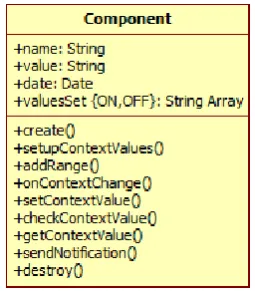
Each context component manages a particular context, where context is ”information that can be used to characterize the situation of an entity. An entity is a person, place, or ob-ject that is considered relevant to the interaction between a user and an application, including the user and applications themselves” [1]. A blueprint of context component is de-picted in Figure 2.
Figure 2: Component blueprint
Key-value model which represents the simplest data struc-ture for context information. This model is complemented by date which refers to last context change. The structured context information is sent to mobile applications which are able to identify the context by its name and obtain context value and date of last change. The valid context values of a component are defined by valuesSet. The default set is composed of valuesON andOFF. This set of valid context values can be changed. For instance, Battery context can have defined a set of the valid values:LOW, OK, FULL.
3.1.1
Context Acquisition
Each component is self-contained and manages particular context. So it needs to be capable of obtaining raw context data from context sources and dealing with a context change. In order to broadcast meaningful and useful context infor-mation, component needs to have an ability to translate raw context data into more meaningful context value. A context change is broadcasted to all listeners if two conditions are fulfilled:
• new context value is an element of predefined set of valid context values;
• new context value differs from previous context value.
For example, if Bluetooth context value set is composed of valuesON andOFF and last context value has beenOFF, context information is broadcasted if and only if the new context value is ON. If context data obtained from Blue-tooth adapter is CONNECTING then this information is not broadcasted further because it is not element of the set of valid values.
3.1.2
Context Translation
Raw context data can be translated into more meaningful context information. This step is significant in case of nu-merical raw context data when infinitely many possible con-text values can be translated into a small finite set of valid values. For example, context data informing about battery level is numerical. In this case, context aware applications are not interested to be informed about every change of bat-tery level, rather they want to obtain more relevant context information such as that battery level is LOW. Therefore, battery context component has to be able to translate nu-merical values into more meaningful context information. For this purpose, ranges have been created to translate nu-meric data within a particular range into context value. In respect to battery context, the range for LOW battery con-text value can be setup as 0% to 10%. Furthermore, by translating raw context data into more meaningful context information, it is ensured that number of context values in the values set is finite. This is an important factor for com-pact context composition and deriving higher level context information as shown below.
3.2
Context Composition
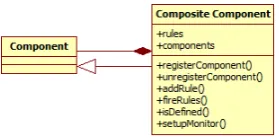
Two or more types of contexts can be loosely aggregated to form high level context. The composed context is managed by a composite component. The constructs of a composite component are shown in Figure 3.
The main role of a composite component is to handle aggre-gated, high-level context information. Composite
compo-Figure 3: A Composite component
nents inherit all constructs of context component. Further-more, each composite component must be aware of contexts it is composed of and rules which drive derivation of high-level context values.
3.2.1
Adaptable composition
Composite components can be constructed, assembled and defined at runtime. Mobile applications may specify and customise high-level context information according to their requirements. This generic approach is driven by rules. The rules are formalized by a function as follows:
Let CC be composite component Let CV be value set of CC
LetC1, C2, . . . , Cmbe context components
LetVi be value set of componentCi, i∈[0, m]
Let CC be composed of componentsC1, C2, . . . , Cn, n<=m
Then rule R can be specified as a function: f: V1×V2×. . .×Vn→CV
Ruler(v1, v2, . . . , vn, f(v1, v2, . . . , vn))wherevi∈Vi
The uniformed rule format enables composition of different types of contexts. Moreover, high-level context information can be defined accurately and precisely. Execution of rules is based on matching of context constants in order to produce the aggregated context value.
3.2.2
Composite Component Behaviour
Figure 4: Composite component behaviour
The behaviour of a composite component is illustrated in Figure 4. There are two states of composite component. The initial state is the state ofdefinition. Definition of compos-ite component involves registering of context components, setting up the relevant context value set and adding rules. Only fully defined composite component can become active. At the moment of leaving theDefinition state, a listener or monitor of context changes is setup. In the Active state, the monitor in the composite component actively listens to context changes broadcasted by registered components.
with the context composition are executed in order to obtain corresponding high-level context value. The new high-level context value is set only if differs from previous high-level context value. If a new value is set, a notification about context change is sent to all listeners.
For example, let us have two contexts -BLUETOOTH and
WIFI, both with value sets {ON,OFF}. Then a compos-ite component with nameDATASYNC has value set{ON, OFF}. BLUETOOTH andWIFI contexts are registered in theDATASYNC component. Rules are added as follows:
R1({ON,ON}, ON) R2({OFF,ON}, ON) R3({ON,OFF}, ON) R4({OFF,OFF}, OFF)
So if the initial set of context values is<ON,ON>, the con-text value ofDATASYNC is ON. A context change in one context component (ON ->OFF) does not change the con-text value ofDATASYNC (ON) and no notification is sent.
3.3
Context Engine Manager
The role of Context Engine Manager is to manage and dis-tribute context information. The main responsibility of the management part is to control life cycles of context compo-nents. Life cycles are defined by the states of compocompo-nents. Components which have entered the active state are stored in a list maintained by the manager. The active compo-nents can be further composed and combined. Keeping the list ensures that each component runs only once.
The distribution functionality of the manager ensures that context information is delivered to multiple mobile applica-tions. There are two ways of delivering context information. In first case, context changes are constantly broadcasted to multiple applications. In thisasynchronouscommunication, each application is informed basically at ad hoc manner and therefore needs to have implemented a mechanism to distin-guish between context information broadcasted by the con-text engine and other broadcasted data. The second way of delivering context information is directsynchronous inter-action. In this case, applications can obtain context infor-mation on request.
Hence the context acquisition engine performs long-running operations and supplies functionality for other applications to use, the managing element should also operate as a ser-vice. To standardise interaction between the context en-gine service and applications, it is necessary to have a well-defined programming interface with method signatures.
3.4
Context Engine Usage
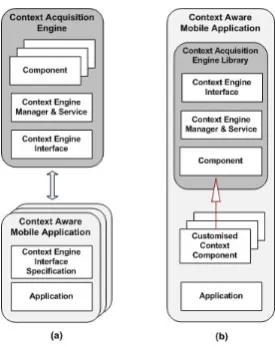
The overall use of the context acquisition engine is depicted in Figure 5(a). The context engine is deployed on a mo-bile device as a service with well-defined interface. Context-aware applications can interact with it by using its interface specification. Typically context acquisition logic is same for various context-aware applications. If an application needs to extend the functionality of the components, the context engine can be used as a library within an application as shown in Figure 5(b).
Figure 5: Usage Scenarios
4.
IMPLEMENTATION
As a proof of concept, the context acquisition engine has been implemented on the Android platform. A simple ap-plication has been developed to test correct functioning of the engine. This section describes the implementation de-tails.
4.1
Component Types
The context component has been designed in an abstract way to give some conceptual standards to its construction. The methods can be customised and adapted for each con-text. We have implemented three abstract context compo-nent types which inherit the methods from the Compocompo-nent: context monitor, context listener and preference listener.
Mobile device platforms such as Google’s Android, Apple’s iOS, or Microsoft’s Windows Phone are evolving at an amaz-ing rate and increasamaz-ingly enable higher-level context ab-straction. Context information gathered from sensors and networks become more semantic for application developers. Thus there is usually a finite set of predefined values for par-ticular context associated with a parpar-ticular mobile platform. For instance, Bluetooth context on the Android platform has predefined valuesON,CONNECTING and OFF. The con-text monitor type has been designed for the concon-texts with a finite set of values. On Android, the context monitor type has implemented a broadcast receiver.
A variety of hardware sensors such as light sensor, accelerom-eter or GPS in mobile phones act as primary sources of en-vironmental context information. The context listener type has been designed to process raw context data captured by sensors. On Android, this component type implements Sen-sorEventListener interface.
4.2
Using Android Interface
The context engine is used by third-party applications and needs to be capable of performing long running operations in background. Thus the managing element has been imple-mented as a service. The service publishes its API through three interfaces declared by using Android Interface Defini-tion Language (AIDL). The interface for context definiDefini-tion enables any mobile application deployed on the same mo-bile device to specify context hierarchy. This entry point allows defining new composite components and identifying all contexts it is composed of, defining context value sets and adding rules. Composite contexts defined by one appli-cation can be used by other appliappli-cations. The appliappli-cations can access the list of active contexts and obtain any context information at runtime.
4.3
Context Broadcast Engineering
Messages informing about context changes must be passed at run-time between context components, components and engine, engine and applications. The messages in Android applications which facilitate run-time binding between ob-jects are called intents. A custom, context engine specific intent has been implemented in the Component class. The custom intent is characterised by its action name as shown below on first line in the code snippet. The intent is defined within the sendNotification method in the Component class as follows: Thus a mechanism is needed for listening to
con-public static finalString CONTEXTINTENT =
uk.ac.uwl.mdse.contextengine.CONTEXTCHANGED;
public voidsendNotification() { Intent intent = newIntent(); intent.setAction(CONTEXTINTENT); intent.putExtra(CONTEXNAME, name); intent.putExtra(CONTEXDATE,
Calendar.getInstance().toString()); intent.putExtra(CONTEXTVALUE, value); sendBroadcast(intent);
}
text updates in a loosely coupled way. To accomplish this, we have usedBroadcast Receivers. A broadcast receiver is registered in each component to capture context informa-tion broadcasted by other components. The broadcasted in-tents contain the structured context information of context name, context value and date. This information structur-ing, broadcasting and receiving form a generic broadcasting mechanism. This mechanism also works for interaction be-tween the engine and applications.
4.4
Dynamic Class Loading
Dynamic class loading (DCL) gives the programmerthe abil-ity to install software components at runtime [8]. Benefits of using DCL include the capability to lazy load classes, reducing memory usage; the ability to instantiate a com-ponent without explicit referencing, allowing more generic code; and finally allow the programmer to add additional context components to the engine without needing to alter or access the engine source code unlike [9]. As shown in fig-ure 5, customised context components can be used by the engine outside of the library. Additionally, as found in An-droid documentation1 there is the possibility to extend this to do DCL across multiple applications.
1
http://developer.android.com/guide/topics/security/security.html
5.
EXAMPLE APPLICATION
To demonstrate the use of the context engine within an ap-plication, a simple context-aware application has been devel-oped. This application has an interest in obtaining context information about data connectivity. Its context hierarchy
Figure 6: Context Composition
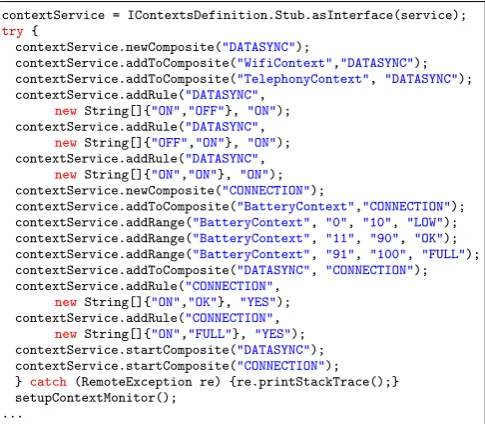
is depicted in Figure 6 and the code snippet for the context hierarchy definition is illustrated as follows:
contextService = IContextsDefinition.Stub.asInterface(service);
try{
contextService.newComposite("DATASYNC");
contextService.addToComposite("WifiContext","DATASYNC"); contextService.addToComposite("TelephonyContext","DATASYNC"); contextService.addRule("DATASYNC",
newString[]{"ON","OFF"}, "ON"); contextService.addRule("DATASYNC",
newString[]{"OFF","ON"}, "ON"); contextService.addRule("DATASYNC",
newString[]{"ON","ON"}, "ON"); contextService.newComposite("CONNECTION");
contextService.addToComposite("BatteryContext","CONNECTION"); contextService.addRange("BatteryContext", "0","10", "LOW"); contextService.addRange("BatteryContext", "11","90","OK"); contextService.addRange("BatteryContext", "91","100","FULL"); contextService.addToComposite("DATASYNC", "CONNECTION"); contextService.addRule("CONNECTION",
newString[]{"ON","OK"}, "YES"); contextService.addRule("CONNECTION",
newString[]{"ON","FULL"},"YES"); contextService.startComposite("DATASYNC"); contextService.startComposite("CONNECTION"); }catch (RemoteException re) {re.printStackTrace();} setupContextMonitor();
...
Basically the application specifies theDATASYNC compo-nent composed of WIFI and 3G. The value sets for all of them are specified as {ON,OFF}. Hence the application wants to be informed about possible data connectivity only in case that battery level is notLOW, it defines the CON-NECTION component as composition ofDATASYNC and
BATTERY contexts. The application defines ranges for the
BATTERY context and rules for composite components. For instance, if the context value of theBATTERY context is equal to LOW, the application is notified that the con-text value of the CONNECTION context is equal to NO. Thus the application alters its behaviour and in this case, the buttons are disabled as illustrated on the screenshot in Figure 7.
6.
DISCUSSION
Figure 7: Connection - NO
information. Although using rules can enhance complexity management, rules should be executed by a well-designed rule engine capable of handling rule conflicts and circularity. In addition, number of rules can be decreased, for instance, by adding conditions such as ALL values or ANY value must match.
As specified earlier, context changes are propagated up the tree and to the application through the use of broadcasted messages. During the testing and debugging phase, we used the logging system to monitor these broadcasts, and found that in certain conditions the context changes are highly fre-quent and it results in a considerable amount of messages broadcasted. Though we observed no obvious slow down in system responsiveness, further analysis to make broadcast-ing more efficient will be required.
Though the use of classloaders has helped separating the engine from each context component and promotes exten-sibility, there are drawbacks of this approach. When dy-namically loading a component, there are assumptions on the class constructor, and any arguments needed, if the con-structor is parameterised. Our component concon-structors re-quire a Android Context2object either from the application or activity, for use with the sensors which could limit the application developer.
Other interesting results found were in the area of security. Android usespermissionsas a way of controlling protected operations. To access sensitive data and access sensors, an application needs the appropriate permission declared in the manifest, which is then used at install time to inform the user of what the application has access to. If the engine is bundled with an application, the permissions needed are added, but if the engine is used externally, then that out-side application wont require the permissions as protected operations will be executed indirectly.
7.
CONCLUSION AND FUTURE WORK
In this paper we have presented an infrastructure of the context acquisition engine. One of our main goals has been separating context acquisition from context adaptation logic
2
http://developer.android.com/reference/android/content/Context.html
in the way that it can be used by multiple context aware applications running on the same mobile device. We have adopted a simple context aggregation approach which al-lows dynamic composition of different types of context. We have implemented the context acquisition engine on the An-droid platform and demonstrated its use by developing a simple mobile application. Our future work will investigate a more precise mechanism for context aggregation based on structured context values. Furthermore, we intend to fully incorporate user preferences as configuration data in order to enforce quality of context aggregation.
8.
REFERENCES
[1] G. D. Abowd, A. K. Dey, P. J. Brown, N. Davies, M. Smith, and P. Steggles. Towards a better understanding of context and context-awareness. In
Proceedings of the 1st international symposium on Handheld and Ubiquitous Computing, HUC ’99, pages 304–307, London, UK, 1999. Springer-Verlag.
[2] M. Baldauf and S. Dustdar. A survey on
context-aware systems.Interational Journal of Ad Hoc and Ubiquitous Computing, 2:263–277, 2007.
[3] P. Costanza. Context-oriented programming in contextl: state of the art. InCelebrating the 50th Anniversary of Lisp, LISP50, pages 4:1–4:5, New York, NY, USA, 2008. ACM.
[4] L. M. Daniele, E. Silva, L. F. Pires, and M. Sinderen. A soa-based platform-specific framework for
context-aware mobile applications. In W. Aalst, J. Mylopoulos, M. Rosemann, M. J. Shaw,
C. Szyperski, R. Poler, M. Sinderen, and R. Sanchis, editors,Enterprise Interoperability, volume 38 of
Lecture Notes in Business Information Processing, pages 25–37. Springer Berlin Heidelberg, 2009. [5] B. Desmet, J. Vallejos, and P. Costanza. Layered
design approach for context-aware systems. Inin 1st VaMoS 07, 2007.
[6] A. K. Dey, G. D. Abowd, and D. Salber. A conceptual framework and a toolkit for supporting the rapid prototyping of context-aware applications.
Hum.-Comput. Interact., 16:97–166, December 2001. [7] S. Gonz´alez, N. Cardozo, K. Mens, A. C´adiz, J.-C.
Libbrecht, and J. Goffaux. Subjective-c: bringing context to mobile platform programming. In
Proceedings of the Third international conference on Software language engineering, SLE’10, pages 246–265, Berlin, Heidelberg, 2011. Springer-Verlag.
[8] S. Liang and G. Bracha. Dynamic class loading in the java virtual machine.SIGPLAN Not., 33:36–44, October 1998.
[9] B. van Wissen, N. Palmer, R. Kemp, T. Kielmann, and H. Bal. ContextDroid: an expression-based context framework for Android. InProceedings of PhoneSense 2010, Nov. 2010.
[10] A. I. Wang, B. Wu, and S. K. Bakken. Camf -context-aware machine learning framework for android. InProceedings of the International