The International Journal of the First Year in Higher Education ISSN: 1838-2959
Volume 1, Number 1, pp. 31-42 July - 2010
Transforming the first year learning experience through
research-based media practice
Denise Wood
School of Communication, International Studies and Languages University of South Australia
Abstract
This paper reports on a case study in which the course coordinator attempted to introduce research into the first year media arts curriculum in an effort to engage students through an enquiry learning approach. The findings from student evaluations conducted over a five year period reveal the challenges as well as the benefits to learners. The increase in student mean scores for evaluation criteria together with student qualitative comments in response to evaluations conducted following redesign of the curriculum, suggest that practice-based research, particularly when connected to “real world” issues, can be an effective strategy for re-engaging the first-year learner through the creative problem-solving process. The paper concludes with a discussion of the implications of the findings from these trials as well as suggestions for further research.
Please cite this article as:
Wood, D. (2010). Transforming the first year learning experience through research-based media practice. The International Journal of the First Year in Higher Education,1(1), 31-42.
This article has been peer reviewed and accepted for publication in Int J FYHE. Please see the Editorial Policies under the „About‟ section of the Journal for further information.
The International Journal of the First Year in Higher Education, 1(1) July, 2010
32
Introduction
Several studies have reported on the increasing evidence of student disengagement (Tinto 2006-2007), particularly apparent from the first year student experience studies conducted by McInnis (2001), Cleary and Skaines (2005), and Kuh, Kinzie, Buckley, Bridges and Hayek (2006). In their review of literature for the Higher Education Academy in the United Kingdom [UK], Harvey, Drew and Smith (2006) note that withdrawal of students in their first year of study results from a complex combination of student characteristics, external pressures as well as institutional factors, and that persistence is related to student satisfaction and prior expectations. Similarly, Yorke and Longden‟s (2008) findings highlight the complexity of causes leading to first year attrition. As York and Longden note, the plurality of first year experiences are a reflection of the diversity of student lives, which Nelson, Kift and Clarke (2008) suggest, impacts on their expectations and can affect the success of their transition into and their engagement with the university (p. 1). Yorke and Longden suggest institutions need to cater for student diversity by optimising the chances of individual success, echoing the recommendations of Harvey et al. who argue for greater attention to building on student strengths and engaging first year learners rather then merely focusing on their inadequacies and issues of retention. Bovill, Morss and Bulley (2008) also emphasise the importance of engaging and empowering first-year learners, acknowledging that this may require “major cultural, philosophical and pedagogical shifts regarding the nature and purpose of the first year” (p. 4). Such a shift, according to Harvey et al., requires matching student expectations with their experience and taking into account students‟ perspectives on
their experience and satisfaction with their first year learning experience.
Kift (2008) advocates a “top-down, bottom-up” approach to enhancing the first year learning experience. Such an approach acknowledges the need for specific programs and practices designed to engage students as well the institutional actions required to provide support for the faculty and staff responsible for such programs and practices (p. 3). Six interconnected, first year curriculum design principles are proposed by Kift which address: 1) transition; 2) diversity; 3) design; 4) engagement; 5) assessment; and 6) evaluation and monitoring (pp. 16-17). Bovill et al. (2008) outline similar suggested strategies for enhancing student engagement in the first year including: making effective use of collaborative and interactive activities, providing a challenging and interconnected curriculum, emphasising self-development and self-directed enquiry, and the use of formative feedback and assessment. Krause, Hartley, James and McInnis (2005) suggest that the effective use of Information and Communication Technologies (ICTs) can help to foster student engagement and Harvey et al. (2006) advocate the incorporation of problem-based learning and practical projects into the first year curriculum. McInnis (2003) suggests that enhancing the teaching and research nexus through strategies designed to involve students in research-based learning activities also has the potential to reconnect disengaged students to the university learning community.
The International Journal of the First Year in Higher Education, 1(1) July, 2010
33
those that have grown out of the amalgamations of art schools and more vocationally oriented colleges (for example Australian Technology Network [ATN] Universities such as the University of South Australia) have faced some challenges in building a research culture (Hazelkorn, 2004), particularly in disciplinary fields that are not well defined. Wood‟s (2009a) findings from studies conducted in the first year media arts curriculum in 2007 and 2008 are consistent with Quin‟s (2006) observation that media studies programs offered by universities have tended to attract students who regard training in media production as “entrée to the media industries” and that attempts to integrate such training with education in media theory and criticism have produced “apparent contradictions and misalignments that are obvious to teachers and students alike” (p. 90). Similarly, Thornham and O‟Sullivan (2004) highlighted these issues in the UK context, citing debates about the pedagogy of media studies raised by Durant (1991) who questioned whether practice can be regarded as “learning a theory, performing critical discourse, analysis, researching an industry or „making films or tapes‟?” (cited in Thornham & O‟Sullivan, 2004, p. 720).
These findings highlight the potential challenges in introducing a research-based focus in the first year curriculum of media studies programs. In this next section of the paper, the challenges experienced in managing the balance between meeting student expectations and providing a challenging curriculum through a research-based approach in a first year media arts course are elaborated upon. The strategies adopted in revising the course in response to student feedback are described and the advantages of the revised approach discussed. Further areas for research are proposed in the final section of the paper.
Case Study: First year digital media course
Methodology
The revisions to the curriculum outlined in the next sections were based on the kind of evidence-based approach advocated by Kift (2008) through an action research process involving cycles of action and reflection as described by Ballantyne, Hughes and Mylonas (2002). This approach involved cycles of review of formal student evaluations using the University of South Australia‟s approved Course Evaluation Instrument (CEI)—an anonymous online survey comprising 10 Likert-scale core questions (on a scale ranging from Strongly Agree to Strongly Disagree), three free-form text fields as well as custom Likert-scale items and free-form questions that can be added by the academic to focus on particular areas of concern. Students completed these evaluations at the conclusion of each offering of the course and changes to the curriculum based on the student feedback were implemented prior to the next offering of the course.
The strategies introduced over the five years of offerings were informed by the literature and by the findings from student evaluations. They include:
increasing the scope and range of interactive activities (Bovill et al., 2008);
providing a challenging (James, 2002) and interconnected curriculum through research-based activities (Bovill et al.);
fostering self-development and self-directed enquiry (Bovill et al.);
introducing formative feedback and assessment (Bovill et al.; Falchikov, 1996; Kift, 2008);
The International Journal of the First Year in Higher Education, 1(1) July, 2010
34
providing opportunities for students to undertake practical projects (Harvey et al., 2006); and
enhancing the teaching and research nexus (McInnis, 2003).
The following sections describe the aims of the first year media arts course, the original curriculum design and the strategies adopted through changes made to the curriculum over a period of five years in response to student feedback. The findings from the student evaluations are reported in tabulated form and the implications of the findings are discussed.
Aims
The overall aim of the course is to introduce students to the fundamental creative design principles, processes, skills and media production techniques required for use within and across a variety of digital media artefacts and interactive digital media forms, including graphics, photography, film, video and sound. Students begin to explore the basic communicative and creative possibilities of graphics, still images, film and video and the Web through an introduction to some of the key conceptual, technical and craft issues related to digital media production.
Curriculum design
The topics covered over the 13 week period of the course include introduction to the theory of design as it applies to all forms of media, basic fundamentals in digital camera techniques and sound production, the use of image editing application and web design. The assignments prior to the changes in the assessment requirements involved: 1) a theory-based visual critique paper; 2) a practical camera task requiring students to demonstrate fundamental skills in camera techniques, framing and composition; and 3) the design of a website.
Revisions implemented in 2007-2008
In the first offering of the revised course (study period 5, 2007), the modules covered in the course remained unchanged, but the assignments were reframed to provide students with the opportunity to demonstrate the same competencies through an enquiry learning approach in a more interconnected curriculum. In this revised version of the course, students chose a research topic relating to the principles and elements of design and visual composition, and were then required to review the relevant literature, undertake the research over the course of the semester and then present their findings in the format of a journal paper and online publication at the conclusion of the course.
The International Journal of the First Year in Higher Education, 1(1) July, 2010
35
Outcomes from 2007 and 2008 offerings
As reported by Wood (2009a), tutors reported that students enrolled in the study period 5, 2007 (50 students) and study period 2, 2008 (140 students) offerings of the course, responded positively to the opportunity to undertake a project of their own choice, though many were clearly overwhelmed by the task, despite several support mechanisms in place including a discussion forum, help sessions and the support of learning advisors from the University‟s Learning and Teaching Unit. Most students had not previously experienced this kind of freedom and were expecting to be given a set topic with less scope for creative thought. Students who made active use of the discussion forum coped much better through the reflective process and were able to revise and more clearly define their topics over the weeks leading up to submission of their first assignment.
An unanticipated finding was the level of resistance to this enquiry learning approach exhibited by students enrolled in the Film and Television major within the program in the second offering of the course. Even though these students were encouraged to choose a research topic focusing on film or television, many of the students expressed concern to their tutors that the course had very little to do with film and television. It was clear from these students‟ comments and qualitative feedback in the course evaluation that some students had enrolled in the program with the expectation that all courses would be practically oriented with only a minimal component of theory within those courses. This finding is consistent with Quin‟s (2006) observations reported in the previous section and Thornham and O‟Sullivan‟s (2004) observations reported from UK studies.
Despite the resistances of the Film and Television cohort of students in the course, tutors reported a high standard of student work, with significant improvements in students‟ ability to think creatively, undertake critical analysis and present a compelling argument being noted. The diversity of topics chosen by students reflects both the breadth of a field of study that is not clearly defined, as well as the creativity in approach that is possible within an enquiry-based curriculum, even at the first year undergraduate level. All but one of the 140 students enrolled in the course responded positively to the peer review process as reflected by the numerous postings to the peer review forum, the willingness of students to peer review more than their required number of student assignments and the number of students who elected to make changes and improved on the quality of their final assignments prior to marking.
Students participating in the peer review process commented on:
the benefits of being able to review their peers‟ assignments and to reflect on their own work;
the value in comparing their work against the assignments of other students and to improve on their work prior to final; and
the communication process which facilitated collaboration among peers.
The International Journal of the First Year in Higher Education, 1(1) July, 2010
36
project in DMT, as it enabled me to explore an area of personal interest, which resulted in a project that I am proud of” and “The emphasis on research in DMT was very valuable, especially when looking at the big picture. DMT helped to build a solid foundation that will undoubtedly benefit me as I further my University career.” This shift in student attitudes by the end of the course lends support to Thornham and O‟Sullivan‟s (2004) finding that when media studies students were offered a different framework, they were more able to successfully negotiate the divide between the “academic” and “vocational” skills required for employment in media related industries. Not all students were convinced however as this student‟s comments reflect: “This subject was not clear at all, it is not a subject that will in any way whatsoever contribute towards my studies. Perhaps it should really just be a minor elective rather than a compulsory subject.” Comments such as these reflect the tensions of the field and the challenges facing academics trying to find a balance between the “academic” and the “vocational” in an applied institutional context.
Redesign of the course for 2009 offering
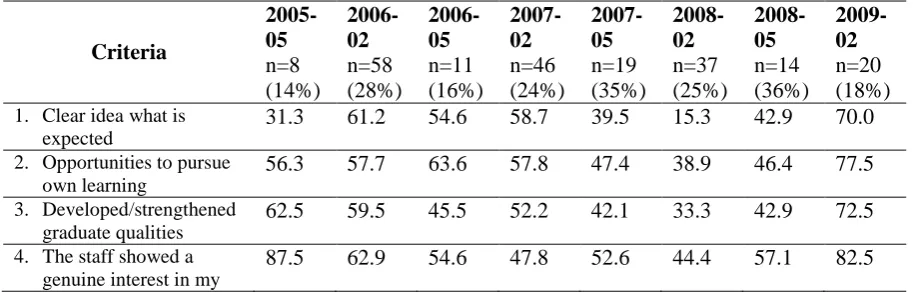
On the basis of student feedback from the 2007-2008 offerings of the course, which indicated that the work load was excessive (see Table 2, criterion 6 which shows ratings ranging from 2.6 to 45.7 on a scale of -100 to +100) and taking into account the comments such as the student cited above indicating not all students saw the connection between the research-based approach and the learning objectives of the course, the curriculum was revised to focus more on media practice informed by and through research. This practice-led approach, as Fewster and Wood (2009) note, has evolved into a key method of investigation within the creative arts over the last decade in the UK and Australia (Haseman, 2006; Piccini, 2002). Such an approach encourages participants to constantly reflect on their practice (Schon, 1995) as they engage in practice-based research through the creative design process. The final artefact derived from the creative process serves as a research “text” within itself; the creative conclusion to the work is the research, which in this case study was the production of a digital story based on a social issue and the development of an online presentation of the students‟ research findings. This situates this practice-led case study as combining traditional qualitative research, relying on written text with the performative, expressed in “still and moving images” (Haseman, 2006, pp. 102-103).
The formative peer review approach described in the previous sections was again integral to the feedback and assessment process and in a subsequent offering to the course, students were also asked to engage in self-review of their assignments in a formative manner. As reported by Wood (2009b), students who elected to improve on their work through the formative review process gained confidence in their ability to accurately assess their own work. This observation was further supported by student comments to the free form text fields included in the course evaluations conducted at the end of the 2007 and 2008 offerings, which indicated that, with the exception of two students, all of the students noted the ways they had improved through their reflection on the feedback.
The International Journal of the First Year in Higher Education, 1(1) July, 2010
37
students were wide ranging, such as youth suicide, anorexia, animal rights, abortion, unemployment and so on. Some students chose to work with community organisations in pursuing research based on a social issue of which their chosen community was concerned.
Outcomes from 2009 offering
At the conclusion of the study period 2, 2009 offering of the course, students completed the same anonymous online course evaluation as applied to the 2007 and 2008 evaluations. There were also additional questions added to the online questionnaire, so there is some data available from this offering of the course for which there is no comparable data from the previous offerings.
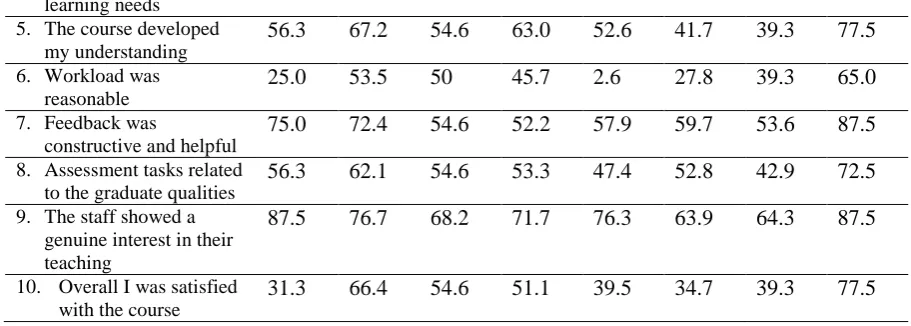
Table 1 below shows the mean course evaluation scores (ranging from -100 to +100) for the 10 core criteria from 2005 through to 2009. As the data indicate, overall student satisfaction for the course was significantly higher in the 2009 offering of the course than in previous offerings, and the scores for most other criteria showing a similar pattern. The only exceptions being criterion 4 (“the staff showed a genuine interest in my learning needs”) which was higher in the first offering in 2005 (87.5) than in the 2009 offering (82.5), and criterion 9 (“the staff showed a genuine interest in their teaching”), which fluctuated according to the mix of teaching staff in the team from 2005-2009, but retained as high a level of student satisfaction in the 2009 offering of the course (87.5).
Table 2 reports the mean scores (ranging from -100 to +100) for custom questions added to the course evaluation, focusing more specifically on the integration of research into the curriculum and the peer review process. While there is no comparable data available across all years for six of the nine custom questions, it can be seen that mean scores for three of the criteria: 1) “I developed a better understanding of research design in media practice”; 2) “I enjoyed the challenge of undertaking my own research” and 3) “I believe that research is a good thing to include in undergraduate courses,” were all much improved from previous offerings in 2007 and 2008. The increase in rating for criteria relating to peer review from 2007 to 2008 suggests that this approach benefited the students and helped them to better reflect on their own learning and to improve on their work. The high scores (77.5 and 81.6 respectively) for the last two criteria (“the course encouraged students to take responsibility for their own learning” and “the course accommodated the difference in student backgrounds”) in the 2009 offering of the courses indicates that the revised offering of the course is encouraging learner autonomy and also catering for student diversity.
Table 1 Mean scores for course evaluations undertaken from 2005-2009
Criteria 2005-05 n=8 (14%) 2006-02 n=58 (28%) 2006-05 n=11 (16%) 2007-02 n=46 (24%) 2007-05 n=19 (35%) 2008-02 n=37 (25%) 2008-05 n=14 (36%) 2009-02 n=20 (18%) 1. Clear idea what is
expected
31.3 61.2 54.6 58.7 39.5 15.3 42.9 70.0
2. Opportunities to pursue own learning
56.3 57.7 63.6 57.8 47.4 38.9 46.4 77.5
3. Developed/strengthened graduate qualities
62.5 59.5 45.5 52.2 42.1 33.3 42.9 72.5
4. The staff showed a genuine interest in my
The International Journal of the First Year in Higher Education, 1(1) July, 2010
38
learning needs 5. The course developed
my understanding
56.3 67.2 54.6 63.0 52.6 41.7 39.3 77.5
6. Workload was reasonable
25.0 53.5 50 45.7 2.6 27.8 39.3 65.0
7. Feedback was
constructive and helpful
75.0 72.4 54.6 52.2 57.9 59.7 53.6 87.5
8. Assessment tasks related to the graduate qualities
56.3 62.1 54.6 53.3 47.4 52.8 42.9 72.5
9. The staff showed a genuine interest in their teaching
87.5 76.7 68.2 71.7 76.3 63.9 64.3 87.5
10. Overall I was satisfied with the course
31.3 66.4 54.6 51.1 39.5 34.7 39.3 77.5
Table 2Comparison of mean scores for custom questions relating to the integration of research
Criteria 2007-05 2008-02 2009-02
I developed a better understanding of research in design 45.8 45.8 80.5
I enjoyed the challenge of undertaking my own project 28.1 40.6 51.3
Research is a good thing to include in undergraduate courses 44.2 45.3 62.1
The peer review process helped me to better reflect on my own work
32.5 61.0
I was able to improve on the quality of my assignments through peer review
29.4 61.4
I gained greater insight into my value positions and assumptions 56.4
I developed a better understanding of social and ethical responsibility
76.4
The course encouraged students to take responsibility for their own learning
77.5
The course accommodated the differences in student backgrounds
81.8
Further evidence of an improvement in student attitudes to the research approach is evident from student qualitative comments in the course evaluation. One student suggested that “I thoroughly enjoyed this topic as it was highly creative and we were given a high degree of creative freedom despite having to work within the limitations set down.” Another student commented “The creativity component challenged my technical ability” and another student reflected on the link between research and creative thinking, “It was more research-based and required a lot of creative thinking.” Creativity and problem solving developed through practice-led research was a commonly recurring theme in most student comments as this student‟s feedback indicates, “Creative idea generation methods ... helped me to think very deeply and come up with alternative and sophisticated solutions to creative problems.”
The International Journal of the First Year in Higher Education, 1(1) July, 2010
39
The findings from the outcomes of student evaluations of a first year media arts course conducted from 2005 to 2009 highlight the difficulties in achieving a balance between student expectations and the need to provide a curriculum that is challenging (James, 2002). The findings also reflect the tensions within a disciplinary field that is not well defined and the challenges associated with finding a balance between the “academic” and the “vocational” in an applied institutional context (Quin, 2006). The increase in overall student satisfaction in the 2009 offering of the course suggests that the revisions described in the previous section went some way to achieving this balance. Moreover, the level of satisfaction reported by students for criteria relating to feedback and assessment suggest that the kind of formative feedback advocated by Bovill et al. (2008) is also an effective strategy for engaging and scaffolding first year learners. The use of ICTs to support the peer review process and engage these students was also found to be a contributing factor (see Wood, 2009b) and is consistent with the recommendations proposed by Krause et al. (2005).
By providing students with the opportunity to choose their own topic and undertake research into the design of their digital media artefact through a reflective process supported by their ideas journal and formative feedback, a balance was achieved between students‟ expectations of a more practically oriented course and the need to challenge them to be autonomous and independent learners through an enquiry learning approach. The reflective approach accommodated student interests and supported the diversity of first year learners; strategies advocated by Yorke and Longden (2008) and Harvey et al. (2006). This finding is further evidenced by the high ratings students in the 2009 offering gave to the criteria “The course encouraged students to take responsibility for their own learning” (77.5) and “The course accommodated the differences in student backgrounds” (81.8).
Finally, the increase in student ratings for all three criteria relating to the integration of research in the curriculum over a three year period suggests that, when an appropriate balance is reached between student expectations, the level of challenge and the feedback and scaffolding provided, enquiry learning through research-based practical activities can enhance the first year learning experience.
Conclusion
The case study reported in this paper illustrates both the challenges and benefits for learners in attempting to strengthen research through an enquiry learning approach in the first year curriculum in a field of study that lacks the strong disciplinary foundations of the more established disciplines. These challenges are particularly evident in the newer universities that have derived from more vocationally focused institutions. Despite these challenges, the findings from trials of a revised curriculum designed to strengthen enquiry learning through practice-led research suggest that students are more engaged and more positive about their learning experience when they see the connection between research and “real world” issues. The practice-led approach informed by students‟ research engaged them in a creative process in which they reflected on the research experience, their own values and their creative approach. Their final artefacts were informed by the research process and were in themselves research texts constituting both a qualitative and creative approach to research.
The International Journal of the First Year in Higher Education, 1(1) July, 2010
40
conducted involving more rigorous evaluation processes over a longer period of time and across different disciplinary fields to determine if the practice-led research approach described in this paper achieves the desired long term learning goals and can be successfully applied in a variety of educational contexts. It is hoped that this paper will stimulate debate about the challenges and potential benefits of an enquiry learning approach designed to engage first year learners through research-based media practice.
References
Ballantyne, R., Hughes, K., & Mylonas, A. (2002). Developing procedures for implementing peer assessment in large classes using an action research process. Assessment & Evaluation in Higher Education,27(5), 427-441.
Bovill, C., Morss, K. & Bulley C. (2008). Quality enhancement themes: The first year experience curriculum design for the first year. The Quality Assurance Agency for
Higher Education. Retrieved June 10, 2010, from
http://www.enhancementthemes.ac.uk/documents/firstyear/Transition%20-%20Final.pdf
Brew, A., & Boud, D. (1995). Teaching and research: Establishing the vital link with learning. Higher Education, 29(3), 261-273.
Brew, A., & Prosser, M. T. (2003). Integrating quality practices in research-led teaching and institutional priorities. In C. S. Nair & R. Harris (Eds.), Proceedings of the Australian Universities Quality Forum: National quality in a global context (pp. 118-121). Melbourne, Australia: Australian Universities Quality Agency.
Cleary, J., & Skaines, I. (2005). Student engagement as a quality indicator at the University of Newcastle. Proceedings of the 2005 Australian Universities Quality Forum: Engaging communities (pp. 50-54). Melbourne, Australia: Australian Universities Quality Agency.
Dochy, F., & McDowell, L. (1997). Assessment as a tool for learning. Studies in Educational Evaluation, 23(4), 279-298.
Elton, L. (2001). Research and teaching: Conditions for a positive link. Teaching in Higher Education, 6, 43-56.
Falchikov, N. (1996, July). Improving learning through critical peer feedback and reflection. Proceedings of HERDSA Conference 1996: Different Approaches: Theory and Practice in Higher Education. Perth, Australia.
Fewster, R. & Wood, D. (2009, November). Performance pedagogy through research in “real” and “virtual” spaces. Proceedings of ASCILITE 2009 Conference: Same places, different spaces. Auckland, New Zealand.
Haseman, B. (2006). A manifesto for performative research. Media International Australia,
118, 98-106.
Hazelkorn, E. (2004). Growing research: Challenges for late developers and newcomers. Paris: OECD.
Harvey, L., Drew, S., & Smith, M. (2006). The first-year experience: A review of literature for the Higher Education Academy. Retrieved January17, 2010, from http://www.heacademy.ac.uk/projects/detail/lr_2006_harvey
James, R. (2002). Students changing expectations of higher education and the consequences of mismatches with the reality. In Responding to student expectations (pp. 71-83). Paris: OECD.
The International Journal of the First Year in Higher Education, 1(1) July, 2010
41
business.” Keynote address, 11th Pacific Rim First Year in Higher Education Conference, “An Apple for the Learner: Celebrating the First Year Experience.” Hobart, Tasmania.
Krause, K.-L., Hartley, R., James, R., & McInnis, C. (2005). The first year experience in Australian Universities: Findings from a decade of national studies. Melbourne, Australia: Centre for Studies in Higher Education. Retrieved April 13, 2010, from http://www.cshe.unimelb.edu.au/pdfs/FYEReport05KLK.pdf
Kuh, G., Kinzie, J., Buckley, J., Bridges, B., & Hayek, J. (2006). Commissioned report for the national symposium on postsecondary student success: Spearheading a dialog on student success. Washington DC: National Postsecondary Education Cooperative. McInnis, C. (2001). Signs of disengagement? The changing undergraduate experience in
Australian universities. Inaugural Professorial Lecture. Research Collections
(UMER). Melbourne. Retrieved February 14, 2010, from
http://eprints.infodiv.unimelb.edu.au/00000094/01/InaugLec23_8_01.pdf
McInnis, C. (2003). Exploring the nexus between research and teaching. In R. Freestone, A. Bagnara, M. Scoufis & C. Pratt (Eds.), The learning community: First explorations of the teaching nexus at UNSW: Reflections and directions from the research-teaching nexus forums in the UNSW Faculties of Built Environment and Science. (pp. 11-15). Sydney: University of New South Wales.
Nelson, K., Kift, S., & Clarke, J. (2008, June). Expectations and realities for first year students at an Australian university. Paper presented at the 11th Pacific Rim First Year in Higher Education Conference, “An Apple for the Learner: Celebrating the First Year Experience.” Hobart, Tasmania.
Piccini A. (2002). An historiographic perspective on practice as research, PARIP. Retrieved August 11, 2009, from http://www.bristol.ac.uk/parip/artexts.htm.
Quin, R. (2006). Media studies: Finding an identity. Media International Australia, 120, 2006, 90-105.
Rowland, S. (2006). The enquiring university: Compliance and contestation in higher education. Berkshire UK: Society for Research into Higher Education and Open University Press.
Schon, D. A. (1995). Knowing-in-action: The new scholarship requires a new epistemology.
Change, 27(6), 26-34.
Sluijsmans, D., Dochy, F., & Moerkerke, G. (1998). Creating a learning environment by using self-, peer- and co-assessment. Learning Environments Research, 1(3), 293-319. The University of South Australia. (2007). The University of South Australia’s teaching and
learning strategy. Retrieved August 20, 2009, from
http://www.unisa.edu.au/teachinglearning/strategy/default.asp
Thornham, S., & O'Sullivan, T. (2004). Chasing the real: “Employability” and the media studies curriculum. Media Culture Society, 26(5), 717-736.
Tinto, V. (2006-2007). Research and practice of student retention: What next? Journal of College Student Retention, 8(1), 1-19.
Yorke, M., & Longden, B. (2008).The first-year experience of higher education in the UK:
Final Report. Retrieved April 14, 2010, from
http://www.heacademy.ac.uk/assets/York/documents/resources/publications/FYEFina lReport.pdf
The International Journal of the First Year in Higher Education, 1(1) July, 2010