CLINICAL REPORT
Psychological Maltreatment
abstract
Psychological or emotional maltreatment of children may be the most challenging and prevalent form of child abuse and neglect. Caregiver behaviors include acts of omission (ignoring need for social interac-tions) or commission (spurning, terrorizing); may be verbal or nonver-bal, active or passive, and with or without intent to harm; and negatively affect the child’s cognitive, social, emotional, and/or phys-ical development. Psychologphys-ical maltreatment has been linked with disorders of attachment, developmental and educational problems, socialization problems, disruptive behavior, and later psychopathol-ogy. Although no evidence-based interventions that can prevent psy-chological maltreatment have been identified to date, it is possible that interventions shown to be effective in reducing overall types of child maltreatment, such as the Nurse Family Partnership, may have a role to play. Furthermore, prevention before occurrence will require both the use of universal interventions aimed at promoting the type of parenting that is now recognized to be necessary for optimal child development, alongside the use of targeted interventions directed at improving parental sensitivity to a child’s cues during infancy and later parent-child interactions. Intervention should,first and foremost, focus on a thorough assessment and ensuring the child’s safety. Potentially effective treatments include cognitive behavioral parenting programs and other psychotherapeutic interventions. The high prev-alence of psychological abuse in advanced Western societies, along with the serious consequences, point to the importance of effective management. Pediatricians should be alert to the occurrence of psy-chological maltreatment and identify ways to support families who have risk indicators for, or evidence of, this problem. Pediatrics 2012;130:372–378
INTRODUCTION
Psychological or emotional maltreatment of children and adolescents may be the most challenging and prevalent form of child abuse and neglect, but until recently, it has received relatively little attention. The American Academy of Pediatrics (AAP) reviewed the topic in a technical report in 2002.1 This clinical report updates the pediatrician on current knowledge and approaches to psychological maltreatment, with guidance on its identification and effective methods of prevention and treatments/intervention.
Roberta Hibbard, MD, Jane Barlow, DPhil, Harriet MacMillan, MD, and the Committee on Child Abuse and Neglect and AMERICAN ACADEMY OF CHILD AND
ADOLESCENT PSYCHIATRY, Child Maltreatment and Violence Committee
KEY WORDS
psychological maltreatment, child abuse, emotional maltreatment, neglect, verbal abuse, development ABBREVIATIONS
AAP—American Academy of Pediatrics NFP—nurse family partnership
This document is copyrighted and is property of the American Academy of Pediatrics and its Board of Directors. All authors havefiled conflict of interest statements with the American Academy of Pediatrics. Any conflicts have been resolved through a process approved by the Board of Directors. The American Academy of Pediatrics has neither solicited nor accepted any commercial involvement in the development of the content of this publication.
The guidance in this report does not indicate an exclusive course of treatment or serve as a standard of medical care. Variations, taking into account individual circumstances, may be appropriate.
www.pediatrics.org/cgi/doi/10.1542/peds.2012-1552
doi:10.1542/peds.2012-1552
All clinical reports from the American Academy of Pediatrics automatically expire 5 years after publication unless reaffirmed, revised, or retired at or before that time.
PEDIATRICS (ISSN Numbers: Print, 0031-4005; Online, 1098-4275).
DEFINITION
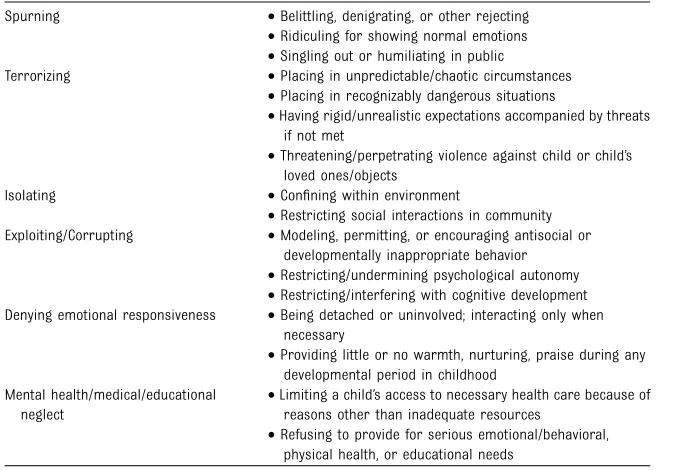
There is no universally agreed definition of psychological maltreatment or emo-tional maltreatment, terms that are of-ten used interchangeably. Psychological maltreatment encompasses both the cognitive and affective components of maltreatment.2One of the difficulties in clearly defining what such maltreat-ment comprises involves the absence of a strong societal consensus on the distinction between psychological mal-treatment and suboptimal parenting.3 Exposure to psychological maltreatment is considered when acts of omission or commission inflict harm on the child’s well-being, which may then be manifested as emotional distress or maladaptive behavior in the child. Psychological maltreatment is difficult to identify, in part because such mal-treatment involves“a relationship be-tween the parent and the child rather than an event or a series of repeated events occurring within the parent-child relationship.”4Isolated incidents of behaviors identified in Table 1 do not necessarily constitute psychological abuse. Psychological maltreatment refers
to a repeated pattern of parental be-havior that is likely to be interpreted by a child that he or she is unloved, unwanted, or serves only instrumental purposes and/or that severely under-mines the child’s development and so-cialization.4 Recent conceptualization5 of psychological maltreatment focuses on the caregiver’s behaviors as opposed to the disturbed behaviors in the child. Such behaviors of the caregiver include acts of omission (ignoring the need for social interaction) or commission (spurning, terrorizing); may be verbal or nonverbal, active or passive, and with or without intent to harm; and negatively affect the child’s cognitive, social, emo-tional, and/or physical development. Table 1 summarizes the different types of psychologically abusive caregivers’ behaviors across 6 main categories.2,5
Although the psychological compo-nents of any form of child maltreat-ment are key to understanding its effects, psychological maltreatment is often not recognized when other forms of maltreatment coexist.3 When psy-chological maltreatment occurs alone, it can be even harder to identify, and
opportunities for intervention may be missed. This form of child maltreatment is possibly the most underreported to authorities.3,6
DISTRIBUTION OF PSYCHOLOGICAL MALTREATMENT
A recent review of the burden and consequences of psychological abuse concluded that, although there were few studies reporting its prevalence, a number of large population-based, self-report studies in the United King-dom and United States found that ap-proximately 8% to 9% of women and 4% of men reported exposure to severe psychological abuse during childhood.7 This review found even higher rates reported in Eastern Europe. A number of US surveys found that psychological and emotional maltreatment were the most frequently self-reported forms of victimization.8
DETERMINANTS OF PSYCHOLOGICAL MALTREATMENT
Although it is recognized that psy-chological maltreatment occurs in a wide range of families, it is more often associated with multiple family stresses9 and, in particular, with factors such as family conflict, adult mental health problems, and paren-tal substance abuse10 that may be co-occurring.11For example, some pa-rental mental health problems are associated with unpredictable and frightening behaviors, and others (particularly depression) are linked with parental withdrawal and ne-glect.12,13Similarly, in terms of family conflict, attacks on a parent almost always frighten a child, even if the child is not the direct target. Threats or actual violence as part of a pat-tern of aggression against one par-ent will sometimes exploit the other parent’s or child’s fears.14,15Children exposed to violence in the home are at disproportionate risk of injury, TABLE 1 Types of Psychologically Abusive Behaviors by Caregivers
Spurning •Belittling, denigrating, or other rejecting
•Ridiculing for showing normal emotions
•Singling out or humiliating in public
Terrorizing •Placing in unpredictable/chaotic circumstances
•Placing in recognizably dangerous situations
•Having rigid/unrealistic expectations accompanied by threats if not met
•Threatening/perpetrating violence against child or child’s loved ones/objects
Isolating •Confining within environment
•Restricting social interactions in community Exploiting/Corrupting •Modeling, permitting, or encouraging antisocial or
developmentally inappropriate behavior
•Restricting/undermining psychological autonomy
•Restricting/interfering with cognitive development Denying emotional responsiveness •Being detached or uninvolved; interacting only when
necessary
•Providing little or no warmth, nurturing, praise during any developmental period in childhood
Mental health/medical/educational neglect
•Limiting a child’s access to necessary health care because of reasons other than inadequate resources
•Refusing to provide for serious emotional/behavioral, physical health, or educational needs
Adapted from Hart et al2and Brassard et al.5
“Intimate Partner Violence: The Role of the Pediatrician” deals with how such issues should be addressed.17Although there is a paucity of literature specifi -cally addressing the issue of parental substance abuse and psychological maltreatment,18substance abuse on the part of one or both parents is associated with high rates of child maltreatment.19,20
ASSOCIATED IMPAIRMENT
Precisely because it interferes with a child’s developmental trajectory, psychological maltreatment has been linked with disorders of attachment, developmental and educational prob-lems, socialization probprob-lems, and dis-ruptive behavior.21,22Research involving institutionalized Romanian orphans demonstrated the effects of severe emotional and sensory deprivation on later IQ, executive function and memory, psychological processing, attachment, and psychiatric disor-ders.23,24 The effects of psychological maltreatment during the first 3 years of life can be particularly profound, because rapid and extensive growth of the brain and biological systems takes place during this period, and this growth is significantly influenced by the young child’s environment and, in particular, the early parenting that he or she receives.25 Psychological mal-treatment also negatively affects the organization of the child’s attachment to important adults in his or her life.26,27 Longitudinal studies have shown that impairment in security of attachment is associated with a range of later problems,27 because early parenting plays a significant role in influencing children’s beliefs about themselves (ie, in terms of the extent to which they are lovable) and about themselves in relation to other people
nalized beliefs can affect children’s later cognitive schemas and, thereby, their psychological adjustment.28
Psychological maltreatment in early childhood is also associated with in-secure attachment in adulthood.29 A recent overview of the evidence found that as the child grows older, such at-tachment problems interfere with a number of aspects of later function-ing, including peer relations, intimacy, caregiving and caretaking, sexual func-tioning, conflict resolution, and rela-tional aggression.29 The findings from longitudinal30 and retrospective28 stud-ies also suggest a strong association with psychiatric morbidity. For example, one longitudinal study found that psy-chological unavailability and neglect in early childhood were associated with increased social problems, delinquency, aggression, and attempted suicide in adolescents and also that most psy-chologically abused children received at least 1 diagnosis of mental illness, with three-quarters having comorbid con-ditions for 2 or more disorders. Factors that may influence the effects of the abuse include early caregiving experi-ences; frequency, intensity, and duration of the abuse; factors intrinsic to the child, such as behavioral and coping strategies, self-esteem, and disposition; and the availability of supportive rela-tionships.31 For example, although the evidence does not relate specifically to psychological maltreatment, 1 study found that boys who experienced abuse that started before 12 years of age had more serious problems (eg, arrests and severity of delinquency) compared with boys who were abused after 12 years of age.32 Without in-tervention, the cycle of abuse is often repeated in the next generation.29
Psychological maltreatment carries a significant burden for society, as can
and health services as a result of poor mental health.
ASSESSMENT
that may be helpful in approaching these issues. The pediatrician needs to be aware of risk indicators for psycho-logical maltreatment, such as parental psychiatric illness, including depression and substance abuse, among others. It is also important to be aware of the psychological maltreatment that can accompany exposure to intimate part-ner violence, although this is consid-ered a separate type of maltreatment and is the focus of a previous AAP re-port as outlined above.17 For children of all ages, major caregivers need to be interviewed (this should be per-formed individually to ensure the parent’s safety when asking about such issues as intimate partner vio-lence), and information should be gathered from teachers or child care personnel. Even brief telephone contact with school or child care personnel can be helpful in assessing a child’s exposure to psychological maltreat-ment. Because this can be time con-suming, ideally, the task of obtaining this information can be shared with another member of the pediatrician’s office staff. Consultation with a pedia-trician who has expertise in assessing child maltreatment or a mental health professional may assist the pediatri-cian in completing an assessment and plan.
Although there are no specific physical indicators for psychological maltreat-ment, it is essential to assess a child’s growth and development, because these can be impaired in association with exposure to psychological mal-treatment. The extent of impairment can vary; severe forms of psychologi-cal deprivation can be associated with psychosocial short stature, a condition of short stature or growth failure for-merly known as psychosocial dwarf-ism.36Observing a child and parent(s) together can provide valuable infor-mation about the quality of their rela-tionship and ability of a parent to
respond to a child, although appropri-ate behavior by a parent in the context of a brief office visit does not rule out the possibility that a child is expe-riencing psychological maltreatment. Conversely, a single interaction that is of concern between a parent and child is generally not diagnostic of psy-chological maltreatment. Close clinical follow-up may be needed to clarify any issues of concern.
As outlined in the earlier technical report on this topic,1 reporting of psychological maltreatment can be difficult. In some jurisdictions, clear indication of impairment in growth and/or development may be neces-sary for a child protective services agency to accept a report; detailed documentation is essential in such situations. It is important that the pediatrician record specific state-ments from the child, the family, and other sources and that the pediatri-cian is systematic in assessing the child’s behavioral, psychological, and physical status in relation to the baseline assessment. For example, the pediatrician who has been providing general pediatric care to a child whose parents become involved in an extremely contentious custody/access dispute can alert the parents to the potential for the child to experience psychological trauma and can be aware of early indicators of impair-ment in the child. If identification for the parents of a child being exposed to potential psychological maltreat-ment does not lead to improvemaltreat-ment in parenting behavior, the pediatrician can then make referrals to such services as mediation, mental health services, or child protective services. Careful follow-up is very important, because parents who are psychologi-cally abusive may not be reliable in providing information about their child’s functioning or their own response to intervention.
PREVENTION
The potential for major impairment associated with psychological mal-treatment during the early years of life underscores the importance of iden-tifying approach to intervention in infancy and toddlerhood. Prevention before occurrence involves both the use of universal interventions aimed at promoting the type of parenting that is now recognized to be necessary for optimal child development, alongside the use of targeted interventions di-rected at improving parental sen-sitivity to infant cues. This would include, for example, the recommen-dation that all routine contact be-tween professionals and parents be used as an opportunity to promote sensitive and attuned parenting using a range of approaches (including media-based strategies, such as leaf-lets, books, and videos, among others) and to observe and identify parent-child interactions that require further in-tervention using targeted approaches. Although it is unknown whether these strategies actually prevent psychologi-cal maltreatment, there is preliminary evidence to suggest that the use of population strategies of this nature show promise in the prevention of child maltreatment generally.37
Targeted programs aimed at prevent-ing early indicators of psychological abuse often focus on infants and younger children.38Much less is known about approaches to preventing psy-chological maltreatment in the older age groups. Specifically, maternal insensitivity to infant cues,39 which is associated with insecure attach-ment, is a significant predictor of socioemotional maladaptation.27A meta-analysis of attachment-based interven-tions that ranged from home-visiting programs to parent-infant psychother-apy, found significant improvements in maternal sensitivity (d = 0.33) and infant attachment insecurity (d = 0.22).40
focus. Maternal insensitivity is an im-portant element of psychologically harmful parent-child relationships; brief focused interventions, such as those involving video feedback and attachment discussion, might improve insensitive parenting, but there is no direct evidence at this time that these interventions prevent psychological maltreatment. Furthermore, interven-tions to date have focused on maternal-child interactions; it is important to address paternal-child interactions as well as other significant caregiving relationships.
One targeted program that has been shown effective in preventing child maltreatment generally is the Nurse Family Partnership (NFP), an intensive home-visitation program provided by nurses to low-income first-time moth-ers beginning prenatally and during infancy.41Because the goals of the NFP include assisting women to promote healthy prenatal behaviors and par-ents’competent care of their children, it is possible that the NFP could pre-vent psychological maltreatment as part of the overall reduction in maltreat-ment, but its effectiveness in preventing this specific type of maltreatment has not been assessed.
TREATMENT
Despite ongoing debate about the role of formal child protection processes for dealing with psychological mal-treatment,42there is agreement about the need to intervene early to mini-mize poor outcomes. It is important to consider what is known about approaches to prevent recurrence of psychological maltreatment and treat associated impairment, once it has been identified. There is a paucity of studies evaluating the effectiveness of approaches specifically designed for
based cognitive-behavioral therapy parenting programs (standard and enhanced models of the Triple-P Pro-gram) aimed at psychologically abu-sive parents.43The standard program focused on child-management strate-gies, and the enhanced model in-cluded components to alter parental anger and misattributions. Both groups made gains, there was no actual control group, and many parents had self-referred, reducing the generaliz-ability of the results. Parents who are psychologically abusive may not be able to recognize their own behavior and self-refer.44 Results of another trial suggest that a preschool child-parent psychotherapy program may be beneficial in improving specific aspects of the mother-child relation-ship, but further research is neces-sary.45A number of innovative methods of working with parents with mental health46 and substance misuse prob-lems have recently been developed and evaluated.47
There is major need for research to develop and test effective treatments for children who have experienced psychological maltreatment, either alone or in combination with other forms of maltreatment.
GUIDANCE FOR THE PEDIATRICIAN
Psychological maltreatment is just as harmful as other types of maltreat-ment. Although little is known about approaches to its prevention or treatment, it is important for pedia-tricians to be alert to its occurrence and consider ways to support families who have risk indicators for this problem. Pediatricians should develop approaches for asking children about their relationships with caregivers, experiences of discipline and feelings of self-worth, safety, and being loved.
assist the pediatrician in the evalua-tion; however, they are not specific to psychological maltreatment.
The pediatrician should encourage par-ents who are experiencing mental health problems, intimate partner vio-lence, or substance misuse to consider the effects of such conditions on their parenting and assist them in access-ing appropriate resources, such as referrals to mental health profes-sionals and substance misuse treat-ment programs. With respect to identification of psychological maltreat-ment, Rees48 suggests that pedia-tricians need to be “as confident in assessing inadequate emotional care as physical and sexual abuse.” This might include an assessment of parent-child interactions through the use of interviews or consultation with other clinicians, such as mental health pro-viders, to assess the child’s feelings and understanding about the situation. As with other types of child maltreatment, children showing signs of behavioral and psychological problems should be assessed to identify specific conditions, such as depression or posttraumatic stress disorder, for which there are evidence-based treatments, such as cognitive-behavioral therapy. Several trauma-specific interviews have been developed to determine whether chil-dren and adolescents presenting with mental health problems have been ex-posed to maltreatment.49To date, such instruments have been used mainly in research settings, but studies are in-creasingly examining their clinical applicability.
suspected, in addition to referring to child protective services in accordance with individual state laws, and follow-up appointments should be made so that the progress of the situation can be monitored.
Another equally important aspect of responding to psychological maltreat-ment is professional communication; collaboration among pediatric, psy-chiatric, and child protective services professionals is essential in formu-lating a management plan for a child at risk for or experiencing psy-chological maltreatment. Specific goals need to be put in place, and in cases where exposure to psychological mal-treatment persists, the pediatrician should advocate for the needs of the child to remain paramount. Although efforts should focus on ways to assist the family with the child remaining in the home, it is important for the pediatrician to be alert to situations in which a child’s needs are better met outside the home, either on a temporary or permanent basis. Consideration of out-of-home care interventions should not be restricted to cases of physical or
sexual abuse; children exposed to psychological maltreatment may also require a level of protection that ne-cessitates removal from the parental home.
Pediatricians are uniquely positioned to educate those working in child welfare, child health care, and the ju-dicial system about the complex needs of children exposed to psychological maltreatment. Because determination of and response to psychological mal-treatment by child protective services can vary considerably across regions, pediatricians can assist child protective services workers in understanding the effects of exposure to maltreatment on the child as well as possible resources for intervention. Because less is known about psychological maltreatment and it has been recognized relatively re-cently compared with other subtypes of abuse and neglect, there is even less standardization of approaches to in-vestigation and intervention by child protective services agencies. The pe-diatrician is well situated to advocate on behalf of the child and can take on an important liaison role with pro-fessionals in the child welfare system.
LEAD AUTHORS
Roberta Hibbard, MD Jane Barlow, DPhil Harriet MacMillan, MD
COMMITTEE ON CHILD ABUSE AND NEGLECT, 2011–2012
Cindy W. Christian, MD
James E. Crawford-Jakubiak, MD Emalee G. Flaherty, MD John M. Leventhal, MD James L. Lukefahr, MD Robert D. Sege MD, PhD
FORMER COMMITTEE MEMBER
Roberta Hibbard, MD
LIAISONS
Harriet MacMillan, MD–American Academy of Child and Adolescent Psychiatry
Catherine M. Nolan, MSW, ACSW– Administra-tion for Children, Youth, and Families
Janet Saul, PhD–Centers for Disease Control and Prevention
STAFF
Tammy Piazza Hurley
ACKNOWLEDGMENT
The authors gratefully acknowledge the assistance of the Family Violence Prevention Unit, Public Health Agency of Canada, in the development of this paper.
REFERENCES
1. Kairys SW, Johnson CF; Committee on Child Abuse and Neglect. Technical report: the psychological maltreatment of children.
Pediatrics. 2002;109(4). Available at: www. pediatrics.org/cgi/content/full/109/4/e68 2. Hart SN, Brassard MR, Binggeli NJ,
Davidson HA. Psychological maltreatment. In: Myers JEB, Berliner LA, Briere JN, Hen-drix CT, Reid TA, Jenny CA, eds.The APSAC Handbook on Child Maltreatment. Thou-sand Oaks, CA: Sage Publications; 2002:79– 104
3. Trickett PK, Mennen FE, Kim K, Sang J. Emotional abuse in a sample of multiply maltreated, urban young adolescents: issues of definition and identification.Child Abuse Negl. 2009;33(1):27–35
4. Glaser D. Emotional abuse and neglect (psychological maltreatment): a conceptual
framework.Child Abuse Negl. 2002;26(6-7): 697–714
5. Brassard MR, Donovan KL. Defining psy-chological maltreatment. In: Feerick MM, Knutson JF, Trickett PK, Flanzer SM, eds.
Child Abuse and Neglect: Definitions, Clas-sifications, and a Framework for Research. Baltimore, MD: Paul H Brookes Publishing Co Inc; 2006:3–27
6. Barnett O, Miller-Perrin CL, Perrin RD. Child psychological maltreatment. In: Barnett O, Miller-Perrin C-L, Perrin RD, eds. Family Violence Across the Lifespan: An In-troduction. 2nd ed. Thousand Oaks, CA: Sage Publications; 2005:151–178. 7. Gilbert R, Widom CS, Browne K, Fergusson D,
Webb E, Janson S. Burden and consequences of child maltreatment in high-income coun-tries.Lancet. 2009;373(9657):68–81
8. Reyome ND. Childhood emotional mal-treatment and later intimate relationships: themes from the empirical literature. J Aggress Maltreat Trauma. 2010;19:224–242 9. Doyle C. Emotional abuse of children: issues for intervention. Child Abuse Rev. 2002;6:330–342.
10. Department of Health, Home Office, De-partment for Education and Employment.
Working Together to Safeguard Children: A Guide to Inter-agency Working to Safe-guard and Promote the Welfare of Children. London, England: The Stationery Office; 2006. 11. Stromwall LK, Larson NC, Nieri T, et al. Parents with co-occurring mental health and substance abuse conditions involved in Child Protection Services: clinical profile and treatment needs.Child Welfare. 2008; 87(3):95–113
13:159–171
13. Foster CJ, Garber J, Durlak JA. Current and past maternal depression, maternal in-teraction behaviors, and children’s exter-nalizing and internalizing symptoms.
J Abnorm Child Psychol. 2008;36(4):527–537 14. Creighton S, Russell N.Voices from Child-hood: A Survey of Childhood Experiences and Attitudes to Childrearing among Adults in the United Kingdom. London, England: National Society for Prevention of Cruelty to Children; 1995
15. Bifulco A, Moran P.Wednesday’s Child: Re-search into Women’s Experience of Neglect and Abuse in Childhood. London, England: Routledge; 1998
16. World Health Organization.World Report on Violence and Health. Geneva, Switzerland: World Health Organization; 2002. Available at: www.who.int/violence_injury_prevention/ violence/world_report. Accessed December 17, 2011
17. Thackeray JD, Hibbard R, Dowd MD; Commit-tee on Child Abuse and Neglect; CommitCommit-tee on Injury, Violence, and Poison Prevention. In-timate partner violence: the role of the pe-diatrician.Pediatrics. 2010;125(5):1094–1100 18. Straussner SLA, Fewell CH. Preface.J Soc
Work Pract Addict. 2006;6:xxi–xxviii 19. Ammerman RT, Kolko DJ, Kirisci L, Blackson TC,
Dawes MA. Child abuse potential in parents with histories of substance use disorder.Child Abuse Negl. 1999;23(12):1225–1238
20. Chaffin M, Kelleher K, Hollenberg J. Onset of physical abuse and neglect: psychiatric substance abuse, and social risk factors from prospective community data. Child Abuse Negl.1996;20(3):191–203.
21. Iwaniec D. An overview of emotional mal-treatment and failure-to-thrive. Child Abuse Rev. 1997;6:370–388
22. Erickson M, Egeland B, Pianta R. The effects of maltreatment on the development of young children. In: Cicchetti D, Carlson V, eds. Child Maltreatment: Theory and Re-search on the Causes and Consequences of Child Abuse and Neglect. New York, NY: Cambridge University Press; 1989:647–684 23. Zeanah CH, Egger HL, Smyke AT, et al.
In-stitutional rearing and psychiatric dis-orders in Romanian preschool children.Am J Psychiatry. 2009;166(7):777–785 24. Zeanah CH, Nelson CA, Fox NA, et al.
De-signing research to study the effects of institutionalization on brain and behavioral
25. Schore AN.Affect Regulation and the Origin of the Self: The Neurobiology of Emotional Development. Hillsdale, NJ: Lawrence Erl-baum Associates; 1994
26. Jacobvitz D, Hazen N, Riggs S. Disorganized mental processes in mother, frightening/ frightened caregiving and disorganized behavior in infancy. Paper presented at The Meeting of the Society of Research in Child Development. Washington, DC: Society of Research in Child Development; 1997 27. Sroufe LA. Attachment and development:
a prospective, longitudinal study from birth to adulthood. Attach Hum Dev. 2005;7(4): 349–367
28. Wright MO, Crawford E, Del Castillo D. Childhood emotional maltreatment and later psychological distress among college students: the mediating role of maladaptive schemas.Child Abuse Negl. 2009;33(1):59–68 29. Riggs S, Kaminski P. Childhood emotional abuse, adult attachment, and depression as predictors of relational adjustment and psychological aggression. J Aggress Mal-treat Trauma. 2010;19(4):75–104
30. Egeland B. Taking stock: childhood emotional maltreatment and developmental psychopa-thology.Child Abuse Negl. 2009;33(1):22–26 31. Iwaniec D, Larkin E, Higgins S. Research
review: risks and resilience in cases of emotional abuse. Child Fam Soc Work. 2006;11:73–82
32. Smith CA, Thornberry TP. The relationship between childhood maltreatment and ado-lescent involvement in delinquency. Crimi-nology. 1995;33(4):451–481
33. Glaser D, Prior V, Lynch M.Emotional Abuse and Emotional Neglect: Antecedents, Oper-ational Definitions and Consequences. York, United Kingdom: BASPCAN; 2001:iii–iv. 34. Hagan JF, Shaw JS, Duncan P, eds.Bright Futures: Guidelines for Health Supervision of Infants, Children, and Adolescents. 3rd ed. Elk Grove Village, IL: American Academy of Pediatrics; 2008:77–107
35. American Academy of Pediatrics, Task Force on Mental Health.Addressing Mental Health Concerns in Primary Care: A Clini-cian’s Toolkit[CD-ROM]. Elk Grove Village, IL: American Academy of Pediatrics; 2010 36. Muñoz-Hoyos A, Molina-Carballo A,
Augustin-Morales M, et al. Psychosocial dwarfism: psychopathological aspects and putative neuroendocrine markers. Psychiatry Res. 2011;188(1):96–101
system population trial. Prev Sci. 2009;10 (1):1–12
38. MacMillan HL, Wathen CN, Barlow J, Fergusson DM, Leventhal JM, Taussig HN. Interventions to prevent child maltreat-ment and associated impairmaltreat-ment. Lancet. 2009;373(9659):250–266
39. Barlow J, Schrader-MacMillan A. Safe-guarding Children from Emotional Mal-treatment: What Works? London, England: Jessica Kingsley; 2010
40. Bakermans-Kranenburg MJ, van IJzendoorn MH, Juffer F. Less is more: meta-analyses of sensitivity and attachment interventions in early childhood. Psychol Bull. 2003;129(2): 195–215
41. Olds DL, Sadler L, Kitzman H. Programs for parents of infants and toddlers: re-cent evidence from randomized trials.
J Child Psychol Psychiatry. 2007;48(3-4): 355–391
42. Glaser D, Prior V. Is the term child pro-tection applicable to emotional abuse?
Child Abuse Rev. 1998;6:315–329
43. Sanders MR, Pidgeon AM, Gravestock F, et al. Does parental attributional retraining and anger management enhance the effects of the Triple P-Positive Parenting Program with parents at risk of child maltreatment?
Behav Ther. 2004;35(3):513–535
44. Boulton S, Hindle D. Emotional abuse: the work of a multidisciplinary consultation group in a child psychiatric service. Clin Child Psychol Psychiatry. 2000;5(3):439– 452
45. Toth SL, Maughan A, Manly JT, Spagnola M, Cicchetti D. The relative efficacy of two interventions in altering maltreated pre-school children’s representational mod-els: implications for attachment theory.
Dev Psychopathol. 2002;14(4):877–908 46. Slade A, Sadler LS, De Dios-Kenn C, Webb
D, Currier-Ezepchick J, Mayes LC. Minding the baby a reflective parenting program.
Psychoanal Study Child. 2005;60:74– 100
47. Dawe S, Harnett P. Reducing potential for child abuse among methadone-maintained parents: results from a randomized controlled trial.
J Subst Abuse Treat. 2007;32(4):381–390 48. Rees CA. Understanding emotional abuse.
Arch Dis Child. 2010;95(1):59–67
DOI: 10.1542/peds.2012-1552 originally published online July 30, 2012;
2012;130;372
Pediatrics
PSYCHIATRY, Child Maltreatment and Violence Committee
and Neglect and AMERICAN ACADEMY OF CHILD AND ADOLESCENT
Roberta Hibbard, Jane Barlow, Harriet MacMillan and the Committee on Child Abuse
Psychological Maltreatment
Services
Updated Information &
http://pediatrics.aappublications.org/content/130/2/372
including high resolution figures, can be found at:
References
http://pediatrics.aappublications.org/content/130/2/372#BIBL
This article cites 32 articles, 3 of which you can access for free at:
Subspecialty Collections
ub
http://www.aappublications.org/cgi/collection/child_abuse_neglect_s Child Abuse and Neglect
abuse_and_neglect
http://www.aappublications.org/cgi/collection/committee_on_child_ Council on Child Abuse and Neglect
http://www.aappublications.org/cgi/collection/current_policy Current Policy
following collection(s):
This article, along with others on similar topics, appears in the
Permissions & Licensing
http://www.aappublications.org/site/misc/Permissions.xhtml
in its entirety can be found online at:
Information about reproducing this article in parts (figures, tables) or
Reprints
http://www.aappublications.org/site/misc/reprints.xhtml
DOI: 10.1542/peds.2012-1552 originally published online July 30, 2012;
2012;130;372
Pediatrics
PSYCHIATRY, Child Maltreatment and Violence Committee
http://pediatrics.aappublications.org/content/130/2/372
located on the World Wide Web at:
The online version of this article, along with updated information and services, is
by the American Academy of Pediatrics. All rights reserved. Print ISSN: 1073-0397.