IJSRST184547 | Received : 01 March 2018 | Accepted : 15 March 2018 | March-April-2018 [ (4) 5 : 305-309]
Themed Section: Science and Technology
305
Ranking Frameworks : A Comparative Study
Ar Kanchan Garg ,Dr. Prof. Prabhjot Kaur
IKG Punjab Technical University, Kapurthala Road, Jallandhar, Punjab, India
ABSTRACT
Ranking frameworks and questionnaires are in practice to assess quality of education imparted and to rank institutes on this basis. Accreditations are also given after assessing the quality of education imparted. This paper is discussing and comparing different assessing indicators, their need and outcome of major assessing institutes/organisations such as QS, THE, NIRF, NAAC,NAAB, NCARB, COA etc. Assessment of any field in any organisation to maintain minimum set standards of quality in education creates interest to be superior than others. Ranking frameworks do not only assess and rank the institutes/universities rather provides transparency in front of the students who are looking for admission in the specific field. India had invented many basic concepts such as zero, decimal etc. in its early time. Quality of architectural education needs to be improved to compete at world level. This paper talks in particular about the ranking frameworks regarding architectural education as no exhaustive ranking frameworks are available for the architectural education.
Keywords: Ranking Frameworks, Accreditation boards, Course Experience Questionnaire, Quality, Architectural Education
I.
INTRODUCTION
Rapid growth of institutes started around 2 decades ago to meet the demands of human being in India. The new institutes were allowed to be run by private firms. Many institutes for the courses of engineering, architecture, MBA etc. came into existence. More institutes means more demand of students and teachers. Among all these demands quality was main parameter to be discussed time to time. Ranking frameworks came into existence to assess the quality of institutes. Concept of Ranking frameworks for universities, institution etc started at the start of 21st century. Ministry of Human Resource development, Govt of India, introduced 1st of its kind of ranking frameworks in 2015.
Basic parameters to evaluate the progress in any field like education, profession or business etc is to work on the quality of the input and output. Consolidation of all the parameters i.e. indicators by providing defined weightage is called ranking frame work. Ranking
Architecture and engineering both deal with technology. The only difference is the creative work done on the basis of calculations as in engineering or on the artistic basis as in architecture. Parameters for ranking framework of architecture education should be based on art, science, consultancy and technological advances etc.
Quality of a building can be assessed by its "Commodity, Firmness and Delight" Sir Henry Wootton and later Alex Reid in architectural terms said it as "Humanity, Efficiency and Delight".[ 1 ] Quality of education can also be assessed by different indicators as defined in many ranking frameworks set by different bodies worldwide. Different parameters to assess the quality of architectural education are either quantifiable and measurable or judged.
The list of the quality assessing bodies for universities/Institutions/Architects is as follows.
NIRF - National Institute Ranking Frameworks
QS - Quacquarelli Symonds
THE- Times Higher Education World University Rankings
NAAC - National Assessment and
Accreditation Council
NAAB - National Architectural Accrediting Board
RIBA - Royal British Institute of Architects
AASA - Australasia Association of Schools of Architecture
ACT - Architect Council of Thailand
ARB - Architects Registration Board of Hong Kong
CAA - Commonwealth Association of Architects
CHED - Commission of Higher Education (Philippines)
1
Tombs, S., 2005. "Quality Indicators in the Design of Schools (QIDS): A tool for assessing school design" Evaluating quality in educational facilities
HEEACT - Higher Education Evaluation and Accreditation Council of Taiwan
HKIA Hong Kong Institute of Architects
IAI Indonesian Institute of Architects
JABEE Japan Accreditation Board for Eng. Education
JPA Public Service Department (Malaysia)
JUAA Japan University Accreditation Association
KAAB Korean Architectural Accreditation Board
LAM (or BAM) Board of Architects Malaysia
NBAA National Board of Architectural Accreditation (China)
PAM Malaysian Institute of Architect
FICCI - Federation of Indian Chambers of Commerce and Industry
NCARB - National Council of Architectural Registration Boards etc.
QS World University Ranking publishes rank place every year. It is surprising to mention that there is no Indian university occupies rank in first one hundred rank places in the world in any of the fields in the year 2017. Indian Institute of Technology got 172nd rank, which is 1st institute in the list of 2017 ranking list. Indian Institute of Madras is the 1st Indian university in the field of Architecture, got 150th rank.[2] Quality education is directly linked with the ranking frameworks. India is lacking in respect of quality of architectural education in particular. " China is one of the few countries in the world where design institutes, attached to schools of architecture that deliver products of high professional quality, already exists"[Tzonis]2014.
Ranking list published accurately is required by students for seeking admission in architecture institutes with options according to their competence. In the current scenario of privatisation candidates
2
https://www.topuniversities.com/university-rankings/world-university-who deserve admission in high ranked institutions might get sidetracked. Many lollipops are being provided to the students to misguide them for admission in the institute with relatively low quality of education in the field.
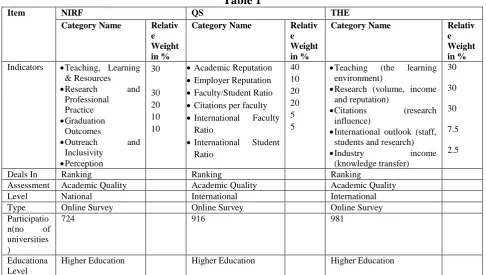
Comparison of indicators followed by some of the top ranking frameworks in the year 2017 is as under:
Table 1
Item NIRF QS THE
Category Name Relativ e Weight in %
Category Name Relativ e Weight in %
Category Name Relativ
e Weight in %
Indicators Teaching, Learning & Resources Research and
Professional Practice Graduation
Outcomes
Outreach and Inclusivity Perception 30 30 20 10 10
Academic Reputation Employer Reputation Faculty/Student Ratio Citations per faculty International Faculty
Ratio
International Student Ratio 40 10 20 20 5 5
Teaching (the learning environment)
Research (volume, income and reputation)
Citations (research influence)
International outlook (staff, students and research) Industry income
(knowledge transfer) 30 30 30 7.5 2.5
Deals In Ranking Ranking Ranking
Assessment Academic Quality Academic Quality Academic Quality
Level National International International
Type Online Survey Online Survey Online Survey
Participatio n(no of universities )
724 916 981
Educationa Level
Higher Education Higher Education Higher Education
Source: https://planning.curtin.edu.au/mir/ceq.cfm, https://www.timeshighereducation.com/world-university-rankings/methodology-world-university-rankings-2016-2017, http://www.naac.gov.in/index.asp, https://www.nirfindia.org/Home accessed on 05.08.17 accessed on 05.08.17
Comparison of Indicators of Assessment and Accreditation bodies is as under:
Table 2
Item NAAC* NAAB**
Category Name Relative
Weight in %
Category Name Relative Weight in %
Indicators Curricular Aspects
Teaching - Learning and Evaluation
Research,Innovations and
Extension
Infrastructure and Learning
Resources
Student Support and Progression
Governance,Leadership and
Management
Innovations and Best Practices
15 20 25 10 10 10 10
Part 1:
Identity and Self-Assessment
Resources
Part 2: Educational Outcomes
And Curriculum
Student Performance-
Educational Realms And
Student Performance Criteria
Curricular Framework
Evaluation Of Preparatory
Education
Public Information
Part 3: Annual And Interim
Reports
Decision by NAAB Board of Directors whether to grant initial accreditation after going through the procedure defined by NAAB
Assessment Academic Quality Academic Quality
Country India United States
Educationa Level Higher Education Higher Education
* last Accreditation, **2014
RCEQ i.e. Review of Course Experience Questionnaire and CEQ i.e. Course Experience Questionnaire are the indicators of performance in higher education governed by Graduate careers council of Australia. CEQ is 1st part of three parts of RCEQ. A study carried out for architecture program being run in the University of New South Wales was to assess the course satisfaction level, quality control and student satisfaction by CEQ and RCEQ respectively [Murray]2002.
Quality in architectural education can be assessed and checked by the combined result of indicators both in ranking frameworks and in RCEQ. Ranking of Indian schools of architecture has been done by Outlook Magazine and The Times of India. Many of the renowned institutes did not participate. While giving ranking participation of maximum institutes should be encouraged, so that actual ranking could be worked out.
Comparison of indicators of CEQ and RCEQ:
Table 3
Particular CEQ RCEQ
Measure Basics
To measure students overall satisfaction with the course
To measure students experience with the course in addition CEQ data
Scales Required Core Scales:
Good Teaching Scale (GTS)
Generic Skills Scale (GSS)
Overall Satisfaction Item (OSI)
Optional Scales:
Clear Goals and Standards Scale
(CGSS)
Appropriate Assessment Scale
(AWS)
Appropriate Workload Scale
(AWS)
Student Support Scale (SSS)
Learning Resources Scale (LRS)
Learning Community Scale (LCS)
Graduate Qualities Scale (GQS)
Intellectual Motivation Scale (IMS)
Divided into 3 parts:
Basic CEQ data
Questionnaire on discipline-specific issues with 5 sections:
Course structure, perception to cope up,
relative importance and weightage
Perception of the opportunities
Design studio Assessment and its
environment
Perception to impact of culture and language,
access to financial resources
Range of employment and practice issue
Demographic data
Outcome Broad Detailed
Sources: https://planning.curtin.edu.au/mir/ accessed on 05.08.2017, Murray, P., 2002. "The CEQ: Is it a measure of Architecture program quality?" HERSDA 2002, pp 472-480
In the past, India was known for imparting quality education. The knowledge of 'Decimal' and 'Zero' provided by India to the world are examples of quality as well as depth of understanding the concepts. Quality in architectural education is being discussed in different seminars, conferences etc. Ranking
II.
CONCLUSION
Ranking and assessment are basic tools for judging the quality of an institute. Maximum participation may be encouraged by the regulatory authorities. Though infrastructure, well qualified and experienced faculty, facilities, curriculum, design studios and assessment, environment etc are an integral part of any assessment yet ranking and accreditation of the institutes may play a vital role in the outcomes for quality education as every institute would like to be at top. Imparting quality education by an institute will provide confidence in their students to prove themselves in the market for better prospectus. If more and more institutes participate for assessment, it will be also helpful to the deserving students to get admission in the better institutes as per their competence. India is one of the fast growing country, lacking in providing quality education especially in architecture. So the authors feel that exhaustive and devoted ranking frameworks for architectural education in India should be in existence to have a check on quality to compete worldwide.
III.
REFERENCES
[1]. Murray, P., 2002. "The CEQ: Is it a measure of Architecture program quality" HERSDA 2002, pp 472-480.
[2]. Tombs, S., 2005. "Quality Indicators in the Design of Schools(QIDS): A tool for assessing school design" Evaluating quality in educational facilities2005, OECD/PEB, pp 68-71.
[3]. Tzonis, A., 2014. "A framework for architectural education" Frontiers of Architectural Research , Elsevier, Open access under CC BY-NC-ND, Vol 3, pp 477-479.Websites Referred
[4]. http://archdesign.vt.edu/architecture/naab accessed on 06.08.2017
[5]. http://www.naac.gov.in/index.asp,
https://www.nirfindia.org/Home accessed on 05.08.17 accessed on 05.08.17
[6]. http://www.naac.gov.in/index.asp,
https://www.nirfindia.org/Home accessed on 05.08.17
[7]. https://planning.curtin.edu.au/mir/ accessed on 05.08.2017
[8]. https://planning.curtin.edu.au/mir/ceq.cfm [9].
https://www.britishcouncil.in/about/press/qs-university-rankings-asia-2014, accessed on 06.04.2017
[10]. https://www.timeshighereducation.com/world- university-rankings/methodology-world-university-rankings-2016-2017
[11].