A SECURITY ALGORITHM FOR IRIS BASED BIOMETRIC SYSTEM
TARACHAND VERMA1
Department of Computer Science and Engineering, PEC University of Technology,
Chandigarh, India [email protected]
PROF. RICHA JINDAL2
Department of Information Technology, PEC University of Technology,
Chandigarh, India [email protected]
PROF. SONIKA JINDAL3
Department of Computer Science & Engineering, Shaheed Bhagat Singh College of Engineering & Technology,
Ferozepore, India [email protected]
1
Master of Engineering (Student), 2,3Assistant Professor
Abstract: Biometrics is a field which is evolving regularly and also incorporated classes of security approaches itself in recent years for user authentication. Proposed approach uses iris recognition as a example to explore an idea to build secure biometric systems. After segmenting and identifying the region of the iris, the process of normalization done. Then uniquely robust features of each person’s iris which have extracted, further used to match with iris template which is already saved in database. In this work we will give a new approach of user authentication which uses both eyes of same user. In order to provide privacy protection and deter unauthorized use of biometric sensitive data, iris feature(s) should be properly encrypted by applying cryptographic techniques and image processing approach jointly. This paper discusses a suitable approach for secure and robust biometric matching.
Keywords: Iris Recognition, Template, Security, Transforming Function
1. Introduction
Biometric systems are very secure, compared to key & card based authentication in which we required to have card or remember the relevant key exclusive or inclusively. The system which are not biometric are error prone and also vulnerable, error may be human, software, hardware, social error, similarly these systems are vulnerable in such a way that external threats can create a problem to legitimate user [2]. In these systems user always have to remember password and carry the needful card. Biometric systems are the solution for this. Everybody have their anatomical and behavioral characteristics which are always with human, and anybody can not left or forgets these. There are many types of biometric traits such as iris, fingerprint, gait, retina, palm-print, lip-reading, voice etc. The system can have one or combination of more than one trait. The security concern is robust in these systems but also some vulnerabilities are there. The threats can be at different level such as at sensor level, network level and database level.
1. Proposed Work
The proposed work gives a new mechanism to secure biometric template, its enhancing the use of single sensor biometric system, in the present iris based system we use single iris of the user to authenticate them. These images taken by the sensor which take infrared based scanning, after that the feature extraction phase come in which the well known specific features extracted with concealing unessential information like eyelids, interference of sclera and noise [6]. After The feature extraction the segmentation and normalization process done. With this biometric information the making of this information vague done by using specific kind of crypto-mechanism, such as using fuzzy vault [5], adding helper data or noise. The process creates secure biometric information to store in database of the system, its called biometric template. The process of generating biometric template may vary by using different methodologies like salting, biohashing, key binding, key generation and so on.
In proposed system we take images of both iris of the same user, though both iris of the same person are always distinct so in enrollment phase it may be beneficial to take both iris images one by one, one as a input for template generation and other as a key to make original biometric information vague or we can say for encoding the original biometric information and store as a secured template.
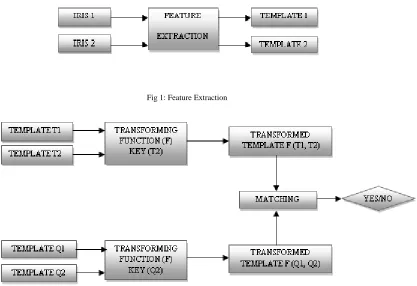
At the enrollment phase iris images taken by sensor and features are extracted from them which created biometric templates for both irises (fig-1). Figure-1 shows the method for feature extraction for both iris images in enrollment and authentication phase. Figure-2 shows the transformation of featured template T1, T2 to transformed template in enrollment phase using T2 as a key. Similarly Q1, Q2 are the query featured template for authentication to generate transformed template which used same transforming function and Q2 as a key. If the both data are same system generate same template after transformation and after matching he/she will authenticate otherwise not.
2. Implementation
At first we convert colored eye image of Iris database into its grayscale equivalent, then matrix formation have done, the matrix parameters will have to set for the given image data set, The image segmentation done by using Hough Transformation but the eyelids remain even after morphological operation and cropping so we do contrasting and binarization of eye image which shows the binary image with eyelids so after contrasting we choose a value (here 16) for occlusion of eyelids if the number of pixel values is greater than 16 in eye image then we neglect its value. After that we do filling of pupil region which have shining part because of image reflections. White pixel denoted by 1 and a black pixel denotes 0. Finally we will get key points in iris region. The same process done with another eye of the same pair then combining both by transformation of featured template. These templates have to be match now for this region we have applying here hamming distance technique for matching.
Fig 3: keypoints Extraction
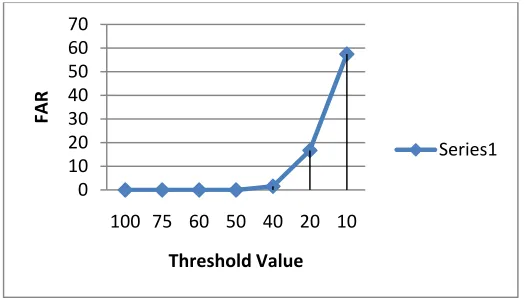
Genuine Acceptance rate is 80%. When threshold value is 100 as shown in below table, we have examined the technique with different threshold values, which performance has given following
False Rejection Rate
Table 1: FRR (False Rejection Rate) with variations in threshold values Threshold FRR%
100 20
Fig 4: Graph between FRR and Threshold Value
False Acceptance Rate
Table 2: FAR (False Acceptance Rate) with variations in threshold values 0
5 10 15 20 25
100 75 60 50 40 20 10
FRR
Threshold value
Series1
0 10 20 30 40 50 60 70
FAR
Series1 Threshold FAR
% 100 0
3. Conclusion
There are many method exists to protect biometric template and to make it unextractable by adversaries , like one is to use multi-biometric traits under a single process, but it need extra sensors setup for each kind of traits, the proposed technique gives an extra edge to such systems which use single type of sensor and give more security. Another thing is that the key used in such systems are not system based it is user based so the missing of required key is negligible. Along with other advantages, in all biometric systems iris based systems are more efficient than other multimodal system, so it minimizes FAR and FRR.
4. References
[1] H. Cevikalp, M. Neamtu, M. Wilkes, and A. Barkana.(2005): Discriminative common vectors for face recognition. IEEE Transactions on Pattern Analysis and Machine Intellgence, 27(1):4–13.
[2] A. K. Jain, A. Ross, and S. Prabhakar (2004): An introduction to biometric recognition. IEEE Transactions on Circuits and Systems for Video Technology, 14(1):4–20.
[3] B. Son, G. Kee, Y. Byun, and Y. Lee. (2003): Iris recognition system using wavelet packet and support vector machines. In Proceeding of International Workshop on Information Security Applications, pages 365–379.
[4] J. Daugman (2004): How iris recognition works. IEEE Transaction on Circuits and Systems for Video Technology, 14(1):21 30.
[5] V.S. Meenakshi. (2010): Securing Iris Templates using Combined User and Soft Biometric based Password Hardened Fuzzy Vault. (IJCSIS) International journal of computer science and information security, Vol 7, No 2.
[6] YE Xueyi, HE Zhiwei (2008): A Data Hiding Method for Improving the Self-security of Iris Recognition, IEEE.