1 | P a g e
LIVE WEATHER PREDICTION USING RASPBERRY
PI 3
Soumitra De
1, Sayan Das
21
(CSE Department, College of Engineering and Management, Kolaghat, India)
2
(CSE Department, College of Engineering and Management, Kolaghat, India)
ABSTRACT
This study aimed to create a proto type system which employs an Embedded System using Raspberry PI 3 for observing the weather changes. This proto type discusses a monitoring system which gives information about environmental conditions on a more local level, the implementation area are categorize by industrial, home and office applications and briefly touches the technological advancements in monitoring the environment and bringing out the new scope in monitoring the current environment problems. The system could monitor surrounding weather conditions including humidity, temperature, and rainfall. This prototype system was found to be comfortable for any place for effectively monitoring the place anywhere at any time, which results cost reduction, asset saving, and productive management. The prototype system is developed using open source hardware Raspberry PI 3 which proves cost effective and having low power consumption. The sensors gather the data of various environmental parameters and provide it to Raspberry PI 3 which acts as a base station. The Raspberry PI then transmits the data using WIFI and the processed data will be displayed on laptop through accessing the server that is on the receiver side.
Keywords:
Raspberry PI 3, Weather, WIFI Data, Humidity, Temperature.
I. INTRODUCTION
For millennia people have tried to forecast the weather. In 650 BC, the Babylonians predicted the weather from
cloud patterns as well as astrology. In about 350 BC, Aristotle described weather patterns in Meteorological.
Later, Theophrastus compiled a book on weather forecasting, called the Book of Signs. Chinese weather
prediction lore extends at least as far back as 300 BC, which was also around the same time ancient Indian
astronomers a developed weather-prediction method. In New Testament times, Christ himself referred to
deciphering and understanding local weather patterns, by saying, "When evening comes, you say, 'It will be fair
weather, for the sky is red', and in the morning, 'Today it will be stormy, for the sky is red and overcast.' We
know how to interpret the appearance of the sky, but we cannot interpret the signs of the times."
Changes of climate and weather conditions have been observed for centuries. Observing the weather
parameters variations is essential to determine the environment changes. There had been always a huge
importance of climate influencing on human life which had motivated to the development of whole scientific
areas on the climate and weather observation. Beginning there was simple and inaccurate instruments used,
which were inadequate for easy reading and storing of measured parameters. Nowadays, there are many
2 | P a g e
parameters continuously for some or the other applications which shows the importance of the weather on theday to day life. Apart from government and non-government organizations the weather forecasted data can also
be used for the fields like agriculture, transportation, construction etc. Apart for the scientific and commercial
applications, weather forecasting systems can be used for educational purposes. The data of the measured
parameters are not useful if they are not transmitted fast and accurate manner to the users. Therefore, transmitted
and processing the measured data is a very important aspect of the modern weather forecast. Transmission of the
measured data could be done by a number of means: WI-FI link, GSM/GPRS link, satellite link direct, wired
link, etc. Weather forecasting has to be reliable and accurate, regardless of its application. Also, it has to provide
simple access to all the measured parameters. The quality of sensors and precision of measurements may vary,
and the location of weather forecasting station can determine the accuracy and reliability of the weather data
collection.
In general user is limited to the options provided by the manufacturer. Even if a slight change in parameter
monitoring or data processing is observed, the commercial devices became inapplicable. For some particular
applications it is required to have flexible and configurable solutions. Not to mention that the commercial
devices could be too expensive for some applications purposes.
The rest of the paper is organized as follows: Proposed weather prediction technique in section II. Goal of
proposed technique in section III. Components description in section IV. Working procedure in section V. Result
of weather in section VI. Conclusion in section VII.
II.
PROPOSED
WEATHER
PREDICTION
TECHNIQUE
2.1 Persistence
The simplest method of forecasting the weather, persistence, relies upon today's conditions to forecast the
conditions tomorrow. This can be a valid way of forecasting the weather when it is in a steady state, such as
during the summer season in the tropics. This method of forecasting strongly depends upon the presence of a
stagnant weather pattern. Therefore, when in a fluctuating weather pattern, this method of forecasting becomes
inaccurate. It can be useful in both short range forecasts and long range forecasts.
2.2 Use of a barometer
Measurements of barometric pressure and the pressure tendency have been used in forecasting since the late
19th century. If the pressure drop is rapid, a low pressure system is approaching, and there is a greater chance of
rain. Rapid pressure rises are associated with improving weather conditions, such as clearing skies.
2.3 Looking at the sky
Along with pressure tendency, the condition of the sky is one of the more important parameters used to forecast
weather in mountainous areas. Thickening of cloud cover or the invasion of a higher cloud deck is indicative of
rain in the near future. High thin cirrostratus clouds can create halos around the sun or moon, which indicates an
approach of a warm front and its associated rain. Morning fog portends fair conditions, as rainy conditions are
preceded by wind or clouds that prevent fog formation. The approach of a line of thunderstorms could indicate
3 | P a g e
2.4 Analog techniqueThe analog technique is a complex way of making a forecast, requiring the forecaster to remember a previous
weather event that is expected to be mimicked by an upcoming event. What makes it a difficult technique to use
is that there is rarely a perfect analog for an event in the future. Some call this type of forecasting pattern
recognition. It remains a useful method of observing rainfall over data voids such as oceans, as well as the
forecasting of precipitation amounts and distribution in the future. A similar technique is used in medium range
forecasting, which is known as teleconnections, when systems in other locations are used to help pin down the
location of another system within the surrounding regime.
III. GOAL OF PROPOSED TECHNIQUE
This project is a model to develop simple, low cost real time remote weather monitoring system with fast and
accurate data transfer using the advantages of Raspberry pi 3 and wireless technologies. This System fetches
weather conditions continuously using various sensors interfaced with Raspberry PI 3 to measure various
weather parameters like temperature, humidity. For the purpose of analysis, authorized users can access whole
weather parameters information from database table by logging into database. Among various techniques of
weather monitoring systems Raspberry pi is the latest and efficient remote weather monitoring technology. This
project is useful for any users who wish to monitor the weather conditions of a location without being physically
present.
IV. COMPONENTS DESCRIPTION
4.1 Components Used
DHT11 Raspberry PI 3
4.2 Components Details
The DHT11 is a basic, ultra low-cost digital temperature and humidity sensor. It uses a capacitive humidity
sensor and a thermostat to measure the surrounding air, and spits out a digital signal on the data pin (no analog
input pins needed). It’s fairly simple to use, but requires careful timing to grab data.
4 | P a g e
The latest Raspberry Pi 3 Model B+ has a faster 64-bit 1.4GHz quad core processor, 1GB of RAM, faster dual-band 802.11 b/g/n/ac wireless LAN, Bluetooth 4.2, and significantly faster 300Mbit/s Ethernet.1.4GHz 64-bit quad-core ARM Cortex-A53 CPU (BCM2837)
1GB RAM (LPDDR2 SDRAM)
On-board wireless LAN - dual-band 802.11 b/g/n/ac
On-board Bluetooth 4.2 HS low-energy
4 x USB 2.0 ports
300Mbit/s Ethernet
40 GPIO pins
Full size HDMI 1.3a port
Combined 3.5mm analog audio and composite video jack
Camera interface (CSI)
Display interface (DSI)
microSD slot
Video Core IV multimedia/3D graphics
5 | P a g e
V. WORKING PROCEDURE
At first we are connecting the Raspberry pi with our laptop using an Ethernet cable. Next we are configuring the
DHT11 sensor with the pi to sense the temperature and humidity. We are using python language in our coding.
The temperature will be sensed within an interval of 1-2hours. After each successful sense the sensed temp. will
be sent to a database. After gathering a data for quite some time we will use artificial intelligence to calculate
the next temperature of the current location.
We are using k-nearest neighbor’s algorithm of Supervised Learning to predict our weather.
We are also using a Google API to cross-check our predicted weather with the current weather.
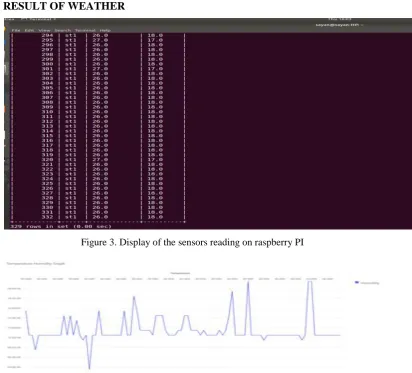
The final result will be displayed in a web page i.e., the predicted weather, the temperature humidity graph will
be displayed in the web page.
VI
.RESULT OF WEATHER
Figure 3. Display of the sensors reading on raspberry PI
6 | P a g e
VII. CONCLUSION
Since the beginning of time, humans have tried to accurately forecast the weather, using historical data and
patterns to infer what might occur in the future. While the most obvious consumer benefit of simply enhancing
convenience (e.g., helping to schedule a vacation so it does not coincide with bad weather or ensuring that the
Little League game is not scheduled for a rainy day), even slight improvements in predicting the weather could
yield significant gains for businesses, government agencies, and other entities that depend on accurate forecasts.
More accurate forecasts could enable farmers to pick the optimal days for planting or harvesting. Train or plane
schedules could be modified to account for expected weather interruptions, with costly assets (e.g., moving extra
labour or equipment into place to manage weather-related disruptions) accurately accounted for in annual
budgets. Businesses that are weather dependent, such as landscaping companies or utility companies that need to
do maintenance, can more accurately match labour and resources to expected weather events.
REFERENCES
[1] A.D. Deshmukh , U.B. Shinde, “ A low cost environment monitoring system using raspberry Pi and
arduino with Zigbee.”, Inventive Computation Technologies (ICICT), IEEE, 2016,1-6.
[2] S.Jindarat, P. Wuttidittachotti , “ April. Smart farm monitoring using Raspberry Pi and Arduino”
Computer. Communications,and Control Technology (I4CT), International Conference on IEEE, ,2015,
284-288.
[3] T.Savić, M. Radonjić, “One approach to weather station design based on Raspberry Pi platform” ,
Telecommunications Forum Telfor (TELFOR), 23rd . IEEE. ,2015, 623-626.
[4] Y.Wang , Z. Chi, “ System of Wireless Temperature and Humidity Monitoring Based on Arduino Uno
Platform. In: Instrumentation & Measurement, Computer, Communication and Control (IMCCC)”, Sixth
International Conference on. IEEE.,2016, 770-773.
[5] H. Saini , A.Thakur, S.Ahuja, N. Sabharwal, N. Kumar, “ Arduino based automatic wireless weather station
with remote graphical application and alerts”, Signal Processing and Integrated Networks (SPIN), 3rd
International Conference on IEEE. ,2016, 605-609.
[6 ] V. S. Srinivasan , T. Kumar, D. Yasarapu, “ Raspberry Pi and iBeacons as environmental data monitors
and the potential applications in a growing BigData ecosystem”, Recent Trends in Electronics, Information
& Communication Technology (RTEICT), IEEE International Conference on. IEEE. ,2016, 961-965.
[7] M. Ibrahim, A. Elgamri , S. Babiker , A. Mohamed, “ Internet of things based smart environmental
monitoring using the raspberry-pi Computer”, Digital Information Processing and Communications
(ICDIPC), Fifth International Conference on. IEEE.,2015, 159-164.
[8] S. C. Folea , G. Mois , “ A low-power wireless sensor for online ambient monitoring”, IEEE Sensors
Journal. 15(2): ,2015,742-749.
[9] S.E. Princy, K.G. Nigel, “Implementation of cloud server for real time data storage using Raspberry Pi”,
Green Engineering and Technologies (IC-GET), International Conference on IEEE.,2015, 1-4.
[10] R.Shete , S. Agrawal, “ IoT based urban climate monitoring using Raspberry Pi”, Communication and