Weighted Parameter Dependent Highly
Reputed Authenticated Routing in
Adhoc Network
Mubashir Moin 1, Aarti Malik 2
P.G. Student, Department of ECE, SVIET, Ramnagar-Jhansla, Banur, Punjab, India1
Assistant Professor, Department of ECE, SVIET, Ramnagar-Jhansla, Banur, Punjab, India2
ABSTRACT: Wireless sensor networks are widely used as a major mean of communication over the internet. This is applicable in various fields such as military, medical, education, business etc. Thus the security of data is the major concern in wireless sensor networks. The security can be maintained by using the advanced routing protocols that considers multiple parameters for relay node selection and HRARAN is found to be one of such techniques. This
study develops Weighted Parameter Dependent Highly Reputed Authenticated Routing in Adhoc Network (WPD-HRARAN) mechanism to ensure the efficient selection of relay node for route creation. The concept of weight
value is utilized to maintain the confidentiality of the transmitted data. In order to ensure the performance efficiency of the proposed work, the comparison analysis is done among HRARAN, ARAN and WPD-HRARAN.
KEYWORDS: Routing protocols, Wireless, Packets, HRARAN and ARAN.
I. INTRODUCTION
WSN stands for wireless sensor network. It consists of a collection of wireless mobile nodes that are capable of
communicating with each other without the use of any centralized administration [1]. It has the ability of monitoring
physically large areas or surroundings, accessing remote places, real-time reacting, and relative ease of use. WSN is used in various fields such as in military activities like reconnaissance, target acquisition, environmental activities such as forest fire prevention, geophysical physical activities such as volcano activity study, biomedical related fields such as
health data monitoring or artificial retina or civil engineering such as structural health measurement [2]. Uses of WSN are increasing day by day without any kind of limitations. Different type of applications have different type of network bearing constraints and features but still most of the issues are common or same which makes them identical. The positions of the sensor node become most sensitive point while the process of deployment of nodes [3].
In the mobile ad hoc networks, to distinguish the routing protocols depend on how the information is captured and maintained in the tables using mobile nodes. Thus there are three types of routing based on mobile ad hoc network routing protocols mentioned below:
1. Proactive routing 2. Reactive routing 3. Hybrid routing
Reactive routing protocols are also referred as “on-demand” routing protocol because the routing paths are defined or obtained at the time of requirement to a particular node. In this process, route determination procedure has been followed in which this procedure terminates when a route has been found or when there is no route available for the communication [7, 8]. The process examines whole the network and then terminates after applying all route permutations in case of no route. In the third hybrid protocol combined merits of proactive and reactive routing protocols and removes the demerits in this approach. This approach exploits the property of hierarchical architectures. First two approaches are divided into different hierarchical levels. Few examples of Hybrid routing are Zone Routing Protocol, Zone-based Hierarchical Link State Routing and last one is Hybrid Adhoc Routing Protocol [9-12].
Out of all existing different protocols we have worked on HARARAN protocol. HRARAN is a highly reputed authenticated routing protocol that is used in MANETs. It is a routing protocol which ensures the route safety by implementing the cryptographic techniques to overcome all attacks. Its main objective is to protect a route from unauthorized access. In this protocol it is mandatory for each and every node to validate its identity before taking part into communication process [13-15].
II. RELATED WORK
P. Annadurai, S. Vijayalakshmi “Highly Reputed Authenticated Routing in MANET” (HRARAN), an ad hoc network is a multi-hop wireless communication network supporting mobile users without any existing infrastructure. Security is an essential requirement in mobile ad hoc network to provide protected communication between mobile nodes by establishing robust and fault free route. Several secure routing protocols like SEAD, SAODV and SRP exists ensuring the three security pillars namely Confidentiality Integrity and Availability. Authenticated Routing for Ad hoc Network (ARAN) fills the void created by deficiencies in other protocols by providing authentication, integrity, and non-repudiation s and confidentiality. The proposed system demands the use of reputation in ad hoc network for efficient trust routers and relays in ARAN by tolerating the overhead caused by communication, computation and storage complexities. Simulation results accurately predict the performance of proposed scheme in terms of packet delivery ratio, end to-end delay, average path length, and average route acquisition and control overhead under varying network conditions.
Adnan Fida, “Communication- and position-aware reconfigurable route optimization in large-scale mobile sensor networks”, Here in this paper, the issues related to the path selection and making the mobile sensor networks more efficient had been studied, sensor network consist of two nodes that were used to transmit the data over the long distance and for transmission various numbers of routers are used in the presence of multiple path fading, interference, path loss. In this paper, the communication and position aware reconfigurable that had increased the efficiency of system and had improved the rate of output in real time situation. In the beginning, the compare selection technique had selected the efficient route by mixing the routing decisions with efficiency of connection. The efficiency of wireless connection had described by the probability of receiving the packets. While the position aware optimization technique had been implemented the path that had been selected was reconfigured to analyze the effects of multipath fading, and movement of the nodes. The effective location to place the router had been determined by utilizing a priori data related to fading in the channels and location of both transmitting nodes and intermediate nodes. The performance had been evaluated through by using the simulation software and it was observed that the projected framework had provided routes for transmission of packets and had efficient performance as compare to ordinary methods.
.A mobile ad hoc network consists of a collection of wireless mobile nodes that are capable of communicating with each other without Centralized administration. So for the communication the Routing is done. Routing means the path for transmitting the data from the source to the destination. As the security of the data is the important for the reliable communication. For this many protocols were used to enhance the security of the network, previously the routing was done with the help of the HRARAN Highly-Reputed Authenticated ad hoc network protocol. In HRARAN, high reputation value and minimum distance was used to select next node to send data from source to the destination. The reputation value is used to check whether the node is co-operative or compromised in ad hoc network. The main objective of the proposed work is first to update route selection parameter on the basis of Packet Drop Rate, reputation and connections. Then evaluation of weight value for the selection of next hop and the last is to perform comparative analysis between traditional and proposed routing approach.
IV. PROPOSED WORK
The existing ad hoc routing protocol has been suffering from the problem of selecting an appropriate node for the transmission of data packets. Considering this fact, new protocol has proposed in this work, where the selection of next node is performed on the basis of three performance parameters such as Packet Drop Rate, Reputation value and Connections. Therefore, the node with minimum Packet Drop Rate, high reputation value and more Connections is considered as a relay node used for the transmission. Moreover, network range will be considered to reduce the delay in the network. If source node and destination node resides in a particular defined range then source node will directly sends its data packet to the destination node without considering any intermediate node
MATHEMATICAL MODEL
a) Packet Drop Ratio: it is evaluated to analyze the packet dropping probability in a network while data transmission. Packet drop ratio varies as per the variations in the distance covered by the data packets.
b) Reputation: The reputation of the node renders the performance level of the node. It is evaluated by using the following equation:
= − (1)
c) Connectivity:
= − (2)
Here in above equation stands for nodes in the range of communication, Depicts the number of connection request and
Defines the total number of available nodes in the network
V. RESULTS
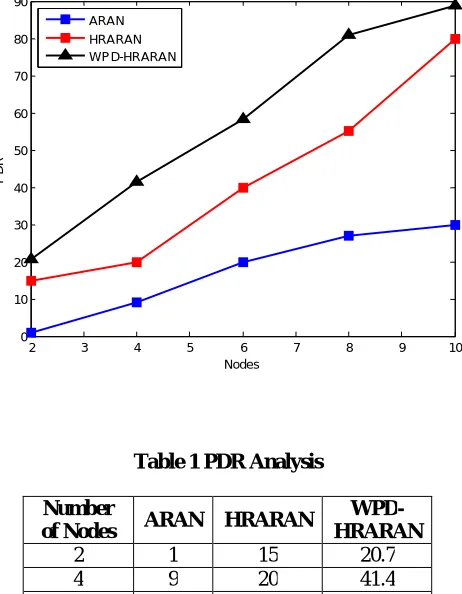
The graph in figure 1 performs the comparison among ARAN, HRARAN and WPD-HRARAN in terms of PDR. The graph proves that the higher PDR of proposed work is 88.8, for HRARAN it is 80 and for ARAN it is 30. 6. Rest of observations is shown in table 1.
Table 1PDR Analysis
Number
of Nodes ARAN HRARAN
WPD-HRARAN
2 1 15 20.7
4 9 20 41.4
6 20 40 58.4
8 27 55 80
10 30 80 88.8
Figure 1 Comparison Analysis of PDR
The packet delivery ratio based on number of packets received successfully and the total number of packets sent in the proposed WPD-HRARAN system uses reputation based scheme that favors the cooperative node to reduce the number of dropped packets thereby boosting Packet Delivery Ratio.
2 3 4 5 6 7 8 9 10
0 10 20 30 40 50 60 70 80 90
Nodes
P
D
R
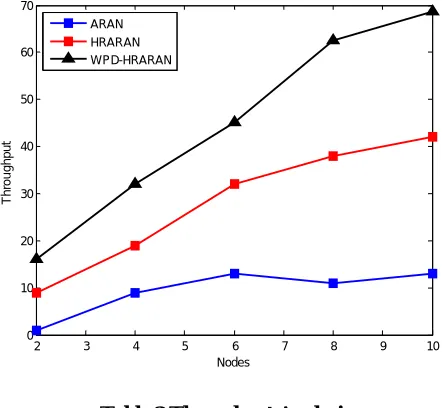
throughput of the WPD-HRARAN is higher with respect to ARAN and HRARAN whereas the throughput of the ARAN mechanism is lowest once. The table 2 shows the throughput of ARAN, HRARAN and WPD-HRARAN with respect to the number of nodes in the network.
Table 2 Throughput Analysis
Number of Nodes
ARAN HRARAN
WPD-HRARAN
2 1 9 16.02
4 9 19 32.04
6 13 32 45.19
8 11 38 62.53
10 13 42 68.72
Figure 2Comparison Analysis of Throughput
The performance is evaluated using reputations along the best path, information to the destination increases thereby improving the throughput of the system. In WPD-HRARAN, packets are now routed via cooperative nodes and hence, the number of packets that reach the destination is much higher.
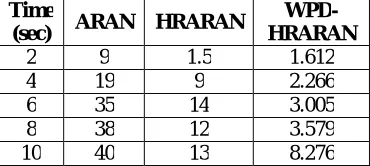
The average path length of WPD-HRARAN, ARAN and HRARAN is compared in figure 3. The curve in blue color depicts the average path length for ARAN protocol, red curve shows the average path length for HRARAN and black color is used to show the average path length of HRARAN mechanism. The average path length of WPD-HRARAN is efficient in comparison to other techniques. The table 3 gathers the facts that are obtained from following
2 3 4 5 6 7 8 9 10
0 10 20 30 40 50 60 70
Nodes
T
h
ro
u
g
h
p
u
t
Table 3 Average Path Length Analysis
Time
(sec) ARAN HRARAN
WPD-HRARAN
2 9 1.5 1.612
4 19 9 2.266
6 35 14 3.005
8 38 12 3.579
10 40 13 8.276
Figure 3Comparison Analysis of Average Path Length (%)
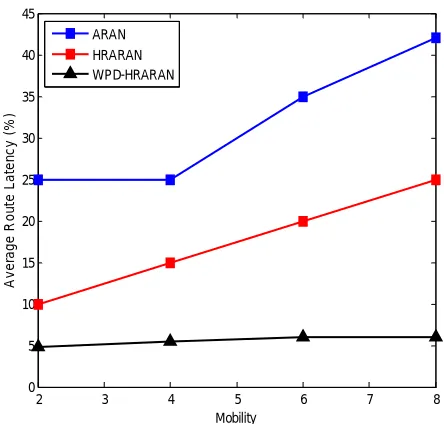
The comparison graph for average route latency is defined in figure 4. The comparison delineates that the average path latency of WPD-HRARAN is effective than the average route latency of ARAN and HRARAN. The table 4 comprised of values for average route latency that is observed from graph below.
2 3 4 5 6 7 8 9 10
0 5 10 15 20 25 30 35 40
Time (secs)
A
v
e
ra
g
e
P
a
th
L
e
n
g
th
(
%
)
Table 4 Average Route Latency Analysis (%)
Mobility ARAN HRARAN
WPD-HRARAN
2 25 10 4.776
4 25 15 5.521
6 35 20 6.013
8 42 25 6.046
Figure 4Comparison Analysis of Average Route Latency (%)
VI. CONCLUSION
The routing is the major task in networking that should be performed effectively to enhance the performance of the network. The routing is done by using various routing protocols that are specifically meant create the shortest path by electing the most of the efficient nodes as a relay node in the network. The selection of relay node depends on various parameters that depict the efficiency of the node. This study develops a novel approach that elects the relay node by considering the connectivity, packet drop ratio and reputation as major factor. Along with this the weight value of the node is also evaluated to evaluate the security of the nodes. The proposed routing protocol (WPD-HRARAN) is inspired from HRARAN routing protocol. The performance analysis of HRARAN proves that the WPD-HRARAN outperforms in comparison to WPD-HRARAN and ARAN routing protocol. The performance evaluation is done in the terms of packet delivery ratio, average path length, average route latency, and throughput. On the basis of the observed results, it is concluded that the WPD-HRARAN is much effective than rest of two protocols. In future the
2 3 4 5 6 7 8
0 5 10 15 20 25 30 35 40 45
Mobility
A
v
e
ra
g
e
R
o
u
te
L
a
te
n
c
y
(
%
)
REFERENCES
[1] Dharma Prakash Agarwal, Carlos de Morais Cordeiro, “Adhoc and Sensor Networks”, World Scientific Publications, Pp 1, 2006. [2] C. Siva Ram Murthy and B.S. Manoj, “Ad Hoc Wireless Networks”, Pearson Education, Pp 12.1.1, 2004.
[3] Mohammad Reza Akhondi, “Application of Wireless Sensor Networks in Oil, Gas and Resource Industries”, 24th IEEE International Conference on Advanced Information Networking and Applications, Pp 941, 2010.
[4] Kavita Pandey, Ashok Swarup, “A Comprehensive Performance Analysis of Proactive, Reactive and Hybrid MANETs Routing Protocols” International Journal of Computer Science Issue, Pp 432, 2011.
[5] Patil V.P, “Reactive and Proactive Routing Protocol Performance Evaluation for Qualitative and Quantitative Analysis in Mobile Ad Hoc Network”, Pp 2, 2012.
[6] Behra Rajesh Umashankar A Comparative Study of Topology and Position Based Routing Protocols in Mobile Ad Hoc Networks, International Journal of Advanced Research in Computer Science & Technology, Pp 72, 2014.
[7] G.Vijaya Kumar, Y.Vasudeva Reddyr, Dr. M. Nagendra, “Current Research Work on Routing Protocols for MANET: A Literature Survey”, International Journal on Computer Science and Engineering, Pp 706, 2010.
[8] Harmandeep Kaur, Jasvir Singh, “Analysis of Hybrid Routing Protocols ZRP, HCR and ANTHOCNET: A Review”, International Journals of Advanced Research in Computer Science and Software Engineering, Pp 642, 2017.
[9] Perkins, C. E., & Bhagwat, P. “Highly dynamic destination sequence-vector routing (DSDV) for mobile computers”, Computer Communication Review, Pp 34–244, 1994.
[10] Dilli Ravilla, Energy Management in Zone Routing Protocol (ZRP), Advances in Computer Science, Eng. & Appl. ,Springer, Pp. 355– 366, 2012
[11] Murthy, “Ad Hoc Wireless Networks: Architectures and Protocols” Pearson Education, Pp 7.6.2, 2004.
[12] Liljana Gavrilovka, Ramjee Prasad, “Adhoc Networking towards Seamless Communications”, Springer, Pp 68, 2006.
[13] Gowda, S. R., & Hiremath, P., “Review of security approaches in routing protocol in Mobile Adhoc Network, International Journal of Computer Science Issues (IJCSI), Pp10(1),2013.
[14] Seema, M., Bhawna, G., & Preeti, N. “Analyzing security of authenticated routing protocol (ARAN)”, International Journal on Computer Science and Engineering. Pp 664–668, 2010.