VALIDATED RP-HPLC METHOD FOR SIMULTAEOUS DETERMIATIO OF DROTAVERIE AD PARACETAMOL AD ITS APPLICATIO I DRUG
FORMULATIO
Navin Raj, Lucky Soni, Chanchal Raj, Sayyed Nadeem, Aparna Venugopal and Kuldeep Chouhan*
Technocrats Institute of Technology-Pharmacy, Bhopal, Madhya Pradesh, India
*Corresponding author
Kuldeep Chouhan, Technocrats Institute of Technology Pharmacy,
Bhopal- 462 001 (M.P.), India, Tel: +91-755-2684535; Fax: +91-0755-2751679 e-mail:[email protected] (Kuldeep Chouhan)
Summary
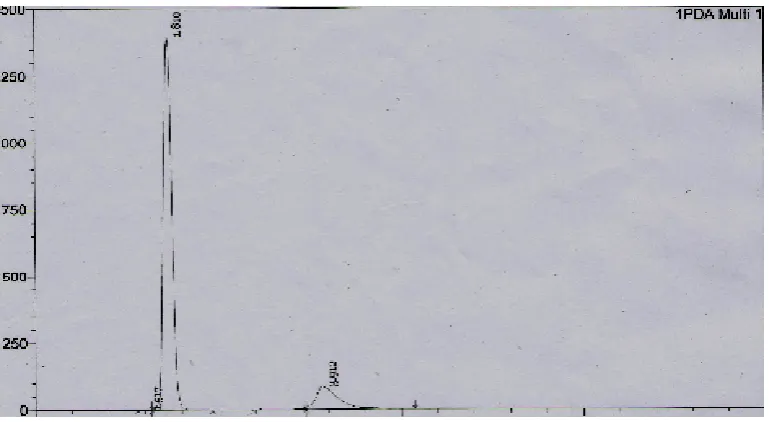
A simple, specific, accurate, precise and reproducible method has been developed and validated for the simultaneous estimation of Drotaverine (DTV) and Paracetamol(PCM) in combined dosage form by RP-HPLC method. RP-HPLC estimation of drugs in selected combination was done using Phenomenex ODS 5µ, C18 column (250×4.6mm) and Methanol: water (65:35) as mobile phase which shows sharp and resolved peak when detected at 230 nm. The linearity range was found to be in concentration range 16-80 µg/mL for DTV and 100-500 µg/mL for Paracetamol. The retention time for DTV and PCM were 3.9 and 1.89 respectively. The correlation coefficient was found to be 0.9989 (for DTV) and 0.9992 (for PCM). The mean percentage recovery was found to be 100.62 and 99.42 for DTV and PCM respectively. The % estimation of the drugs was found near to 100 % representing the accuracy of the method. Validation of the proposed method was carried out for its accuracy, precision, specificity and ruggedness according to ICH guidelines. The proposed method can be successfully applied in routine work for the determination of DTV and PCM in combined dosage form
Introduction
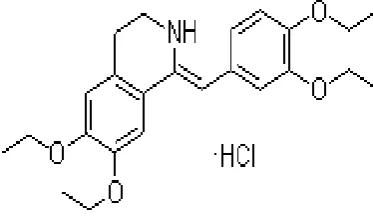
Drotavarine is (1Z)-1-[(3,4-diethoxyphenyl)methylidene]-6,7-diethoxy-1,2,3,4-tetrahydroisoquinoline Drotavarine (INN, also known as drotaverin) is an antispasmodic drug, structurally related to papaverine. DTV is a selective inhibitor of phosphodiesterase 4, and has no anticholinergic effects [1-2].PCM N-(4-hydroxyphenyl)acetamide is non-steroidal anti-inflammatory drug (NSAID) with analgesic and antipyretic properties. Inhibition of prostaglandin production around the body by blocking the cyclooxygenase enzymes known as COX-1 and COX-2 has long been known to be the mechanism of action of PCM and other non-steroidal anti-inflammatory drugs (NSAIDs)[3-4]. Both drugs are insoluble in water and their chemical structures are shown in Fig. 1 (a) and ( b)
Fig 1(a) Chemical structure of DTV
(1Z)-1-[(3,4-diethoxyphenyl)methylidene]-6,7-diethoxy-1,2,3,4-tetrahydroisoquinoline
Fig.1 (b) Chemical structure of PCM N-(4-hydroxyphenyl) acetamide
Materials and methods
Chemicals and reagents
All experiments were performed with pharmaceutical-grade DRO and PCM. HPLC-grade solvents were employed for analysis. Solvents were filtered through 0.45 µm membrane filters. All dilutions were performed in standard volumetric flasks. The pharmaceutical preparations, declaring to contain 80 mg DTM, 500mg PCM and excipients, were obtained from a local drugstore.
Instrumentation and chromatographic conditions
The separations were performed with a Schimadzu R 1100 series liquid chromatograph consisting of quaternary pumps, a injector fitted with a 20 µl loop. Compounds were separated on a 250 mm×4.6 mm C8 column (Luna, Phenomenex, 5µm particle size). The mobile phase was a methanol:water (65:35 ) pumped at a flow rate of 1.0 ml min−1. Chromatograms were recorded employing lab solutions software.
Mix Standard solution
Mix Stock solution containing DTV and PCM was prepared in methanol having concentration 80 µg/mL DTV and 500 µg/ mL PCM. Aliquot of the standard solution was appropriately diluted with the mobile phase containing, methanol and water in the ratio (65:35 v/v) to get the concentration of 40 µg/mL for DTV and 250 µg/mL for PCM respectively.
Procedure
The optimized chromatographic condition mentioned below was kept constant throughout the experimentation and mobile phase was allowed to equilibrate with stationary phase which was indicated by a steady line.
Column - Phenomenex ODS 5 µ C8 column (250 X 4.6mm) Flow rate - 1.0 mL/min
Temperature: Ambient - (28-300 C)
A 20 µL solution of above mix standard was injected through manual injector and chromatogram was recorded using mobile phase containing, Methanol and water (65:35). DTV and PCM were resolved properly with sharp peak and showing reasonable retention time in the above selected
Fig no.1 chromatogram for DTV and PCM
Study of system suitability parameters
After equilibration of column with mobile phase, seven replicate injections of 20 µL solution of mix standard solution was injected through the manual injector and the chromatograms were
recorded and the system suitability parameter were noted and values are shown in Table 1.
Table no. 1 Study of system suitability parameters
Sr. No. A.U.C. of DTV A.U.C of PCM
Mean 25562553 6534226
% RSD 1.3 0.8
Retention time 3.90 1.81
Asymmetry 1.091 1.110
Study of Linearity Range
Fig-2 Linearity calibration curve of DTV
Fig-3 Linearity calibration curve of PCM
Assay in Marketed Formulation
Table no.2 Analysis of tablet formulation
DTV PCM
Mean 99.16 99.08
±SD 0.181 0.262
Validation
Accuracy:
To ensure the reliability and accuracy of the method recovery studies were carried out by standard addition method. A known quantity of pure drug was added to pre-analysed sample and contents were reanalyzed by proposed method and the mean % recoveries were found. The
results are shown in Table 3
Table 3: Results of Recovery Studies
Amt. of pure drug added (mg)
Amt. recovered
(mg) %Recovery
S.No. Wt. taken
(in mg)
PCM DTV PCM DTV PCM DTV
1. 150 100 16 99 16.0 99.0 100
2 150 199 31 198 30.6 99.49 98.7
3 150 301 48 300 47.4 99.16 99.16
4 150 400 64 399 63 99.75 98.43
Mean 99.35 99.07
±SD 0.335 0.692
%RSD 0.337 0.698
Stability studies:
Table 4: Results of specificity studies
% Label Claim S.NO.
Conditions PCM DTV
1. 1 N NaOH 83.3 50.4
2. 1 N HCl 88.2 62.5
3. 10% H2O2 71.07 39.5
4. Light treatment 93.31 68.5
Precision and Intermediate precision
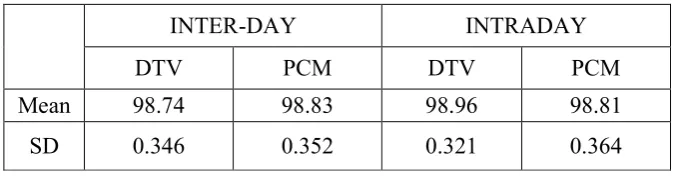
(Intra day and Inter day) shows the % Label claim values within limits (% R.S.D.not more than 2). The method was found to be précised. The ruggedness studies were carried out using different analyst variation. The results of intermediate precision and ruggedness parameter are
shown in Table 6.
Table 6: Results for interday and intraday studies
INTER-DAY INTRADAY
DTV PCM DTV PCM
Mean 98.74 98.83 98.96 98.81
SD 0.346 0.352 0.321 0.364
Limit of detection
Limit of detection for PCM and DTV was found to be 0.062µg/ml and .010 µg/ml respectively.
Conclusion
Acknowledgement
The authors are thankful to the management and Director Dr.A.Balasubramaniam Technocrats Institute of Technology- Pharmacy, Bhopal.
References
[1] The Merck Index, 13th edition, Merck Research Laboratories, 609, 1174
[2] Singh K C, Jain P, Goel N, Saxena A,International Journal of Gynecology and Obstetrics” 2004; 84 (1); 17–22.
[3] British Pharmacopoeia, Vol-I, 2002,1215
[4] KD Rains, Curr Med. Res. Opin,2006; 22 (6); 1161-1170.
[5] Mahaparale S, Telekone R, Raut R, Danle S, Kasture P, Indian Journal of Pharmaceutical Science,2010;72(1):133-136.
[6] Vikram G M, Dipali D T, Kunal D I, Amruta S B, Vishnu P C, Bhanudas S K, International
Journal of Pharmaceutical Science, published jul-aug, 2010;3(1):111-115.
[7] Mahajan V K, Dahivelkar P P, Bari S B, Indian Journal of Pharmaceutical
Science,2007:69(6):812-814.
[8] Vivek S R, Santosh V G, Upasna P P, Mahima R S., Eurasian Journal of Analytical
Chemistry, 2010;4(2):184-190.
[9] Rajesh S, Geetam P, Mishra G P, Sainy J, J.Pharma Sci.and Res.2010;2(12):821-826.
[10]Laxmi K S, and Tintu.T, International Journal of Pharmacy and Pharmaceutical
Sciences,2010;2(4):166-168
[11]Ramesh S, Lokesh B, Rupali J, and Prashant L, Journal of Chemical Metrology, 2010;4(1):
21-27.
[12]Kalra K, Naik S, Jarmal G and Mishra N, Asian Journal Research in Chemistry,2009; 2(2):
93-99
[13]Pathade A, Dakhore A, Fule S, Alaspure R, International Journal of Pharmaceutical Sciences,2010;2(3):904-908.
[14]Prasad K R, and Sharma R, Scholar Indian Journal of Pharmaceutical Science and Research, 2002;131:59-64.
[15]Kabeer A S, Sachin D P, Der Pharmacia Lettre, 2010;2(4):355-364.
[16]Gandhi S, Deshpande P, Ramjane v, Parab J, International Journal of Pharmaceutical
Sciences,2010;4(3):49-52.