A Role Allocation Model For IT Controls
In A Cloud Environment
Shafaq Khan, University of Dubai, UAE Mathew Nicho, University of Dubai, UAE Grahame Cooper, University of Salford, England
ABSTRACT
The rapid adoption of cloud computing by organizations, along with the need to comply with relevant IT governance (ITG) controls, has increased the complexity of governance in the cloud. This transition from a classical data center to a virtualized data center has resulted in the reallocation of roles and responsibilities of IT personnel for managing and accounting for the relevant IT controls. With a lack of guidelines or model for practitioners to choose from, with regard to the allocation of roles and responsibilities, there is a lack of clarity on the responsibilities and accountability for these IT controls.
The purpose of this paper is to propose a theoretical model for assigning roles and responsibilities for IT controls for an organization operating in a cloud environment. The proposed model is based on a strong theoretical grounding and can be used to inform good practice.
Keywords: IT Governance; Cloud Computing; Roles & Responsibilities; Theoretical Model; Criteria
INTRODUCTION
he rapid adoption of cloud computing, through aligning of core IT competencies and putting technology where it belongs, are two out of the seven indisputable trends that will define 2015 (Andriole, 2012). Cloud computing is a complex model with different dimensions covering the deployment model, service level and essential characteristics (Mell & Grance, 2009). Consequently, migration of an organizations’ IT functions to clouds produces challenges, especially in relation to the changing role and responsibilities of the personnel concerned with the governance of the relevant IT controls. Currently, organizations govern IT systems through the use of internal IT controls by assigning roles and responsibilities for them. The IT department is the department that is normally entrusted with the responsibility for the project of migrating relevant services/models to the cloud environment (Repschlaeger, Zarnekow, Wind, & Klaus, 2012). When this restructuring happens, there is a corresponding restructuring of roles and responsibilities relating to changed internal IT controls in the new environment. With hardly any guidance available to IT practitioners from the academic as well as the non-academic forum, such cloud migration projects are fraught with challenges (Rashmi & Sahoo, 2012).
This paper is structured as follows: First a review of the selected IT governance (ITG) models, frameworks and best practices is conducted to identify the research gap. This is followed by a discussion of the underpinning theoretical models and frameworks. The paper concludes with a model that defines the criteria to be used for the allocation of organizational roles and responsibilities for IT controls in a cloud environment.
LITERATURE REVIEW
few general attributes given in ITIL (ITIL - Service design, 2007), no criteria were found in COBIT or ITIL that can be used to allocate roles and responsibilities for IT controls in a cloud environment.
A review of literature in the Association of Information Systems’ (AIS) database also showed a considerable gap in research in this domain. A title search using the words ‘roles and responsibilities’, ‘IT governance’, and ‘cloud computing’ was conducted in the (AIS) journals database (www.ais.com) spanning the years 2008 to 2013. The topics that relate to this domain, from these sources, mainly focus on the critical success factors for the service receiver of IT outsourcing (Hodosi & Rusu, 2013), organizational integration of green IS through specific roles and responsibilities (Loeser, 2013), suggestions to help IT practitioners in organizations look beyond SOX regulations at governance of end-user developed content (Leon, Abraham, & Kalbers, 2010), organizational change resulting from IT innovations (Suo, Techatassanasoontorn, & Purao, 2011), and the importance of adequate IT management capabilities, manifested in IT governance (Kim, Shin, Kim, & Lee, 2011). Thus, there is a lack of clarity in role allocation in a cloud environment. With cloud computing becoming a rapidly growing market (Repschlaeger et al., 2012), there is a need to explore this further through the research question,
What is the criteria for allocating roles and responsibilities of IT controls in a cloud environment?
THEORETICAL FRAMEWORK
In an effort to propose a model with a strong grounding in theory (Lewin, 1945; Gregor, 2006), the authors decided to look at theories employed in ITG (IT controls), organizational design (role allocation), and cloud computing.
Since migrating to cloud is transformation of the IT organization as a whole, or in part, the authors looked at the strategic alignment model of Henderson and Venkatraman (1993) which was found to be focusing more on the role of IT in organizational transformation rather than role allocation. Cloud migration affects both technology and people, especially in an ITG environment. An evaluation of the socio-technical theory of Bostrom and Heinen (1977) revealed that it concentrates only on providing MIS practitioners and researchers with guidelines on system design approach. Moving into a more human resource approach, due to the question of ‘role allocation’, the authors analyzed the human resource framework of Lepak and Snell (1999), but it identifies forms of human capital that can be used as a source of competitive advantage. The task-technology fit model of Goodhue and Thompson (1995) were also evaluated, which provide guidance on the impact of IT on user performance and, hence, could not be used to explain role allocation.
Cloud computing has been considered as the latest trend to outsource some or complete IT operations to run a business from the public cloud (Dhar, 2012). Allocation of responsibilities in the form of a RACI chart has been used not only for outsourcing (Ramakrishnan & Pro, 2008; Simonova & Zavadilova, 2011), but for managing governance in outsourcing (Meng, He, Yang, & Ji, 2007). Rai (2011) employed the Viable System Model in the cybernetics domain to decide on the functions/activities to be outsourced and the necessary supporting systems in an outsourcing engagement.
Cybernetics’, which means ‘to govern’ (MWD), focusses on how systems (including sociotechnical systems, such as organizations) control their actions and how they communicate internally or with other systems (Wikibooks, 2014). Moreover, ITG focuses on control mechanisms (Webb et al., 2006a), and organizations with strong ITG have well developed IT controls, enabling key line managers to define the roles and responsibilities of IT staff (Karimi, Somers, & Gupta, 2001).
Cybernetics (Viable Systems Model)
Beer (1984) conceptualized all viable systems as a network of communication channels bonding five main management functions - operations, co-ordination, control, intelligence, and policy, referred to as Systems 1 to 5, respectively. The main function of System 3 is the internal and immediate control of organization (Hilder, 1995), including the control of resource allocation (Brocklesby & Cummings, 1996). The task of assigning roles and responsibilities for IT controls can thus be positioned in System 3 as it matches its activities of regulating day-to-day activities of the organization’s internal operations (Hilder, 1995), operational planning of the operational units (Davies, 2007) and supervision of control activities by senior management.
Identifying the characteristics of VSM helps in identifying the requirements of a viable organization in terms of resource planning and control functions.
Viability
An organization is considered to be viable if it can survive in a particular sort of environment (Stafford, 1985), while maintaining its independent existence. In a cloud context, customers have concerns over the viability of cloud service providers (CSP) (Gartner, 2013) leading to concerns about their own viability. Organizational viability also depends on addressing regulatory requirements (CSA, 2009) on role allocations.
Homeostasis
For an organization to survive, it must maintain itself in a state of equilibrium (Hilder, 1995). Cloud is bringing in many organizational changes, including changes in jobs, skills, leadership roles and structures (Gartner, 2013). These changes create complexities in defined roles and responsibilities, accountability, and expectations of roles (CSA, 2009). Organizations can maintain homeostasis by canceling these surplus complexities coming from the cloud environment into the operations, by creating variety in the skills and capabilities of the workforce.
Variety
According to the law of requisite variety, an organization should be sufficiently complex to handle the variety of conditions it will meet in its environment (Ashby, 1957). In a cloud computing environment, decision-making involves cross functional and inter-organizational boundaries, thus decision-making clear role-allocation decisions essential and more complex. An organization needs to balance this complexity (Ashby, 1957) by having sufficient variety in terms of human IT skills and capabilities (Garrison, Kim, & Wakefield, 2012).
Autonomy
According to VSM logic, autonomy and independence is ceded to System 1 units (Brocklesby & Cummings, 1996) and is considered to be one of the logical requirements for ensuring effective organization, especially in a rapidly changing environment (Espinosa, Harnden, & Walker, 2008). In a cloud architecture, System 3 (where roles and responsibilities allocation is positioned) needs to break down the silos within IT and other autonomous system1 units, ensuring that they are much more cross functional (Gartner, 2013). This will lead to effective strategic and role-allocation decisions.
Recursion
Transduction
Whenever a message crosses a boundary, it needs to be “translated” to the language of the receiver. In a cloud environment, information crosses the organizational boundaries between cloud providers, brokers and customers. Variety, in terms of people’s skills and inter-operability knowledge to facilitate inter-departmental communications, will be required in a cloud environment (Suo et al., 2011) and the same will form the basis of roles allocation.
Self-Organization
This is the ability of systems to continuously re-create themselves, while being recognizably the same (Hilder, 1995). In a cloud computing environment, IT departments act not only as technology service providers, but as a strategic partner that assumes responsibilities in business technology alignment (Suo et al., 2011). Technical and managerial capabilities within an organization determine how well cloud services achieve the organization’s goals and potential competitive strategy. A self-organizing business in a cloud environment must have IT capabilities to change strategic direction by allocating the right people together quickly around risks or opportunities.
Apart from using above seven characteristics of cybernetics to address the roles allocation in a cloud environment, it has been noticed that organizational design influences the decision-making process (Rowland & Parry, 2009), personnel decisions (Carley, Prietula, & Lin, 1998) and can help in identifying how to reshape and channel organizational structures and roles to meet the new business strategy (Wikipaedia, 2014a). Some researchers have given direct relation between organizational design and structures by suggesting the use of ambidextrous organizational designs (defined by an interrelated set of roles, structures and senior team processes) for executing innovation streams (Tushman, Smith, Wood, Westerman, & O’Reilly, 2010).
Organization Design And Its Impact On Role Allocation
Organizations are composed of individuals and competitive strategies and performance of an organization certainly depends significantly upon its resources and capabilities (Sharma & Vredenburg, 1998). Channeling of these resources can be dictated by organizational design decisions. Nadler and Tushman (1997) explain the relationship between organizational design and the work that people in the organization do, as a set of formal structures and processes and appropriate informal operating environment that gives people the skills, directionand motivation to do the work necessary to achieve the strategic objectives. One of the most widely-used and accepted organizational design frameworks, proposed by Galbraith (1995) and used for around 50 years, is the “Star Model Framework”.
This framework provides tools with which management must become skilled in order to shape resource allocation and other management decisions effectively. This model is based on five design principles which are related to strategy, structures, processes, rewards and people (see Table 1). These principles of Galbraith’s Star Model have been used to study how people’s roles depend upon the strategy, structure and processes in an organization.
Table 1. Roles Allocation Criteria Deduced From Organization Design
Design Principle Implications On Role Allocation
Strategy Identifies IT tasks to be undertaken
Structure Identifies job specialties, number of people required to perform IT tasks and the authority level of these people
Processes - Activities that people will be allocated to;
- Build interpersonal relationships among units and organizations People Must have skills and mind-sets to perform IT tasks
Strategy
Cloud computing is an IT-related strategy of redirecting resources toward core business activities (Garrison et al., 2012). It has been argued that the value of the tasks and the availability of human capital capabilities will define the selection of cloud solutions to complement the business strategy and decision whether to allocate internal or external human resource to these complex IT controls (Arthur, 1992; Snell & Dean, 1992). Organizations require agile leaders to match the agility brought in by cloud strategy (Gartner, 2012) and to achieve self-regulation.
Structures
Structures focus on identifying and distributing IT-related decision-making rights and relate to VSM’s Systems 3, 4 and 5. Roles and responsibility allocation depends upon the structures adopted by the organization to balance the complexity of the cloud environment while providing autonomy to all the VSM System1 units.
Processes
For an organization to be viable, its primary process is to contribute to the viability of the whole, and System 3 is needed to manage this contribution of the primary process (Achterbergh & Vriens, 2011). In terms of ITG, an organization needs processes to control and manage accountability and risk (Sambamurthy & Zmud, 1999; Peterson, 2004; Webb, Pollard, & Ridley, 2006b; De Haes & Van Grembergen, 2008). Senior management in System 3 must ensure that they need to implement procedures to assess the risk and use that as a basis to allocate the roles and responsibilities of the IT controls. This implies that business, as well as IT at various levels (whether strategic, management or operational level (Van Grembergen, De Haes, & Guldentops, 2004) and from various systems (of VSM), are involved in role allocation.
People
Effective ITG necessitates clear and unambiguous definition of roles and responsibilities of involved parties. People in the organization must possess the requisite variety in their skills, capabilities and mind-sets to be able to deal with the variety in the cloud environment. People can be critical sources of competitive advantage if their skills are unique (Stewart, 2007; Wright & McMahan, 1992) and it can be a primary determent of mode of employment for their development (Lepak & Snell, 1999). That means the decision that whether a firm should develop and allocate internal employees to the IT controls or depend on cloud providers for such skills depends upon the uniqueness of an employee’s skills too.
Reward
Rewards are used to motivate people to perform to address organizational goals. At this point, the researchers of this study have not been able to deduce any entities for rewards.
Allocation of roles and responsibilities of IT controls is an ITG decision-making mechanism (Sambamurthy & Zmud, 1999) and ITG is a function of organizational design. IT architecture that supports organizational design complements ITG structures (Tiwana & Konsynski, 2010). Hence, it is a rational decision process to support an organizational design theoretical model with an ITG model for identifying the roles’ allocation criteria.
IT Governance Models
ITG is based on three constructs; namely, structures, processes, and relational mechanisms (Peterson, 2004; Weill & Ross, 2004; Van Grembergen et al., 2004; De Haes & Van Grembergen, 2008).
Table 2. Role Allocation Criteria From ITG Model
Organizational Constructs Implications On Role Allocation
Relational Mechanisms Practices followed by people to build interpersonal and collaborative relationships among units and organizations.
RelationalMechanisms
Stakeholder constituencies (business and IS management) take different lead roles and responsibilities depending on the way IT in an organization is controlled and coordinated (Sambamurthy & Zmud, 1999). A method to build collaborative relationships among IT and business management is through ‘Relational Mechanisms’ (Peterson, 2004).
For any viable organization, communication among the stakeholders from different systems and levels must be transduced. According to VSM, any communication link that crosses a boundary, it must be translated. All five systems in the VSM have their own languages, their own criteria, their own figures-of-speech and their own satisfactions (Stafford, 1985). People who have the capability to translate the information to the cloud provider’s language must be allocated to the cloud integrations and related tasks.
Size
Both the ITG frameworks (COBIT and ITIL) use RACI chart extensively in role allocation for managing the IT controls in an organization. While COBIT does not use any criteria for role allocation, ITIL stipulates five factors related to the roles allocation as skills, attributes, competencies, size and strategy of the organization. All of these factors, except “size of the organization”, have been covered either in Star Model design principles or the ITG framework constructs. Hence, ‘size’ is added as an additional organizational construct to the proposed model. The updated model will have a seventh construct as shown in Table 3.
Table 3. Roles Allocation Criteria Of ITIL
Organizational Constructs Implications On Role Allocation
Size Number of people in the organization
When an organization is geographically dispersed throughout the cloud, system units tend to have greater number of interactions between units to get work done (Lawler III & Worley, 2011). These complex organizations with more “surface area” will not spontaneously self-organize (Galbraith, 1995). Employees in these large and complex organizations are unlikely to be able to gain a broad view to make the right decisions about how units should be configured and who should interact with whom. It is the job of leaders and managers to manage the complexity created by the organization’s size, by having clear roles and responsibilities allocation.
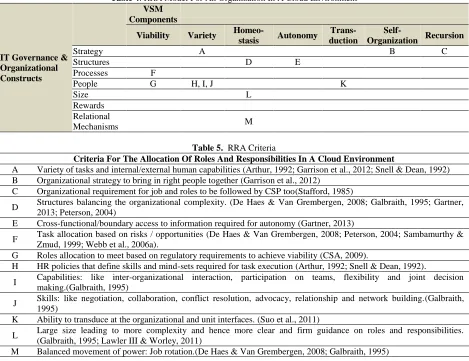
ROLES AND RESPONSIBILITY ALLOCATION MODEL (RRA Model)
Table 4. RRA Model For An Organization In A Cloud Environment
IT Governance & Organizational Constructs
VSM Components
Viability Variety
Homeo-stasis Autonomy
Trans-duction
Self-
Organization Recursion
Strategy A B C
Structures D E
Processes F
People G H, I, J K
Size L
Rewards Relational
Mechanisms M
Table 5. RRA Criteria
Criteria For The Allocation Of Roles And Responsibilities In A Cloud Environment
A Variety of tasks and internal/external human capabilities (Arthur, 1992; Garrison et al., 2012; Snell & Dean, 1992) B Organizational strategy to bring in right people together (Garrison et al., 2012)
C Organizational requirement for job and roles to be followed by CSP too(Stafford, 1985)
D Structures balancing the organizational complexity. (De Haes & Van Grembergen, 2008; Galbraith, 1995; Gartner, 2013; Peterson, 2004)
E Cross-functional/boundary access to information required for autonomy (Gartner, 2013)
F Task allocation based on risks / opportunities (De Haes & Van Grembergen, 2008; Peterson, 2004; Sambamurthy & Zmud, 1999; Webb et al., 2006a).
G Roles allocation to meet based on regulatory requirements to achieve viability (CSA, 2009).
H HR policies that define skills and mind-sets required for task execution (Arthur, 1992; Snell & Dean, 1992).
I Capabilities: like inter-organizational interaction, participation on teams, flexibility and joint decision making.(Galbraith, 1995)
J Skills: like negotiation, collaboration, conflict resolution, advocacy, relationship and network building.(Galbraith, 1995)
K Ability to transduce at the organizational and unit interfaces. (Suo et al., 2011)
L Large size leading to more complexity and hence more clear and firm guidance on roles and responsibilities. (Galbraith, 1995; Lawler III & Worley, 2011)
M Balanced movement of power: Job rotation.(De Haes & Van Grembergen, 2008; Galbraith, 1995)
CONCLUSION
The principles of Stafford Beer’s Viable System Model (VSM) and ITG frameworks were used to build a theoretical model for the allocation of roles and responsibilities of IT controls in a cloud environment. The resulting model, with six organizational constructs to design and seven VSM characteristics, are identified as the criteria that have an impact on the roles and responsibilities allocation of IT controls within an organization. While the constructs are targeted at the IT controls of IT governance, validation will be done for IT controls related to information systems’ standards, as a whole, to generalize the model to the wider industry audience.
AUTHOR INFORMATION
Shafaq Khan is an Assistant Professor at the University of Dubai. Since joining the University of Dubai in 2001, she has received awards, such as ‘Excellence in Teaching’ and the ‘Best Faculty Award from Alumni’. Her educational qualifications include a Masters in ‘Computing and Information Systems’, Masters in Electronics, ‘Post Graduate Diploma in Computer Applications’, Physics Honors, and Bachelors in Electronics. She is a certified cloud infrastructure specialist, certified project management professional (PMP), and a SAP certified ERP foundation consultant. Her research work has been published in several ranked journals and conference proceedings.
in the areas of information systems (IS) security management IS vulnerabilities and mitigation, advanced persistent threats, information security governance, and information technology governance frameworks; namely, COBIT, ITIL, and PCI DSS. His research outputs have appeared in international journals and conference proceedings.
Grahame Cooper recently retired from his position as Professor of Applied Information Systems Engineering at the University of Salford. Originally a physicist, Grahame moved into the area of applied IT in the late 1980s. He has been involved in a large number of funded research projects in the application of IT in the construction industry. After stepping down as Director of the Information Technology Institute, a position he held for nine years, he started working in Information Systems Security approximately eight years ago, building up postgraduate work in the area within the School of Computing, Science and Engineering.
REFERENCES
Achterbergh, J., & Vriens, D. (2011). Cybernetically Sound Organizational Structures II: Relating de Sitter's Design Theory to Beer's Viable System Model. Kybernetes, 40(3/4), 425-438.
Andriole, S. J. (2012). Seven indisputable technology trends that will define 2015. Communications of the Association for Information Systems, 30(1), 4.
Arthur, J. B. (1992). The Link Between Business Strategy and Industrial Relations Systems in American Steel Minimills. Industrial and Labor Relations Review, 488-506.
Ashby, W. R. (1957). An Introduction to Cybernetics.
Beer, S. (1984). The Viable System Model: Its Provenance Development Methodology and Pathology. Journal of the operational research society, 35(1), 7-25.
Bostrom, R. P., & Heinen, J. S. (1977). MIS Problems and Failures: A Socio-Technical Perspective, Part II: The Application of Socio-Technical Theory. MIS Quarterly, 11-28.
Brocklesby, J., & Cummings, S. (1996). Designing a Viable Organization Structure. Long Range Planning, 29(1), 49-57.
Carley, K. M., Prietula, M. J., & Lin, Z. (1998). Design versus cognition: The interaction of agent cognition and organizational design on organizational performance. Journal of Artificial Societies and Social Simulation, 1(3), 1-19.
CSA. (2009). Security Guidance for Critical Areas of Focus in Cloud Computing Cloud Security Alliance. (Vol. 2.1).
Davies, J. (2007). Models of Governance-A Viable Systems Perspective. Australasian Journal of Information Systems, 9(2).
De Haes, S., & Van Grembergen, W. (2008). An Exploratory Study into the Design of an IT Governance Minimum Baseline Through Delphi Research. Communications of the Association for Information Systems, 22(1), 24. Dhar, S. (2012). From Outsourcing to Cloud Computing: Evolution of IT Services. Management Research Review,
35(8), 664-675.
Dowse, A., & Lewis, E. (2009). Applying Organizational Theories to Realize Adaptive IT Governance and Service Management. Information Technology Governance and Service Management: Frameworks and
Adaptations, 313-332.
Espinosa, A., Harnden, R., & Walker, J. (2008). A Complexity Approach to Sustainability–Stafford Beer Revisited.
European Journal of Operational Research, 187(2), 636-651.
Galbraith, J. R. (1995). Designing Organizations: An Executive Briefing On Strategy, Structure, and Process: Jossey-Bass.
Garrison, G., Kim, S., & Wakefield, R. L. (2012). Success factors for deploying cloud computing. Communications of the ACM, 55(9), 62-68.
Gartner. (2012). Gartner Says Program and Portfolio Management Leaders Must Embrace Change and Adapt to the New Normal [Press release]. Retrieved from http://www.gartner.com/newsroom/id/2023015.
Gartner. (2013). Field Research Summary: Public Cloud Adoption. In Gartner (Ed.).
Goodhue, D. L., & Thompson, R. L. (1995). Task-Technology Fit and Individual Performance. MIS Quarterly, 213-236.
Gregor, S. (2006). The Nature of Theory in Information Systems. MIS Quarterly, 30(3), 611-642.
Hilder, T. (1995). The Viable System Model. Retrieved June, 28, 2005.
Hodosi, G., & Rusu, L. (2013). How Do Critical Success Factors Contribute to a Successful IT Outsourcing: A Study of Large Multinational Companies. Journal of Information Technology Theory and Application (JITTA), 14(1), 3.
ITIL - Service design. (2007).
Karimi, J., Somers, T. M., & Gupta, Y. P. (2001). Impact of Information Technology Management Practices on Customer Service. Journal of Management Information Systems, 17(4), 125-158.
Kim, G., Shin, B., Kim, K. K., & Lee, H. G. (2011). IT capabilities, process-oriented dynamic capabilities, and firm financial performance. Journal of the Association for Information Systems, 12(7), 487-517.
Lawler III, E. E., & Worley, C. G. (2011). Built to Change: How to Achieve Sustained Organizational Effectiveness: John Wiley & Sons.
Leon, L. A., Abraham, D. M., & Kalbers, L. (2010). Beyond Regulatory Compliance for Spreadsheet Controls: aTutorial to Assist Practitioners and a Call for Research. Communications of the Association for Information Systems, 27(28), 541-560.
Leonard, A. (2009). The Viable System Model and its Application to Complex Organizations. Systemic practice and action research, 22(4), 223-233.
Lepak, D. P., & Snell, S. A. (1999). The Human Resource Architecture: Toward a Theory of Human Capital Allocation and Development. Academy of management review, 24(1), 31-48.
Lewin, K. (1945). The research center for group dynamics at Massachusetts Institute of Technology. Sociometry, 126-136.
Lewis, E., & Millar, G. (2009). The viable governance model-A theoretical model for the governance of IT. Paper presented at the System Sciences, 2009. HICSS'09. 42nd Hawaii International Conference on.
Loeser, F. (2013). Green IT and Green IS: Definition of Constructs and Overview of Current Practices. Paper presented at the Proceedings of the Nineteenth Americas Conference on Information Systems, Chicago, Illinois.
Mell, P., & Grance, T. (2009). The NIST Definition of Coud Computing. National Institute of Standards and Technology, 53(6), 50.
Meng, F. J., He, X. Y., Yang, S. X., & Ji, P. (2007). A Unified Framework for Outsourcing Governance. Paper presented at the E-Commerce Technology and the 4th IEEE International Conference on Enterprise Computing, E-Commerce, and E-Services, 2007. CEC/EEE 2007. The 9th IEEE International Conference on.
MWD. Cybernetics. Merriam Webster Dictionary. Retrieved 19th June, 2014, from http://www.merriam-webster.com/dictionary/cybernetics.
Nadler, D., & Tushman, M. (1997). Competing by Design: The Power of Organizational Architecture: Oxford University Press.
Peterson, R. R. (2004). Integration Strategies and Tactics for Information Technology Governance In V. V. Grembergen (Ed.), Strategies for Information Technology Governance (pp. 37 - 79). London: Idea Group Inc.
Rai, V. K. (2011). Viable System Model as a Basis for Outsourcing Engagement Models Transformation.
proceedings of PMI NZ.
Ramakrishnan, M., & Pro, V. M. (2008). IT Program Governance in Multi-vendor Outsourcing. GRC Worries? Why, when IT can Help?, 19.
Rashmi, M. S., & Sahoo, G. (2012). A Five-Phased Approach for the Cloud Migration. Int J Emerg Technol Adv Eng, 2(4), 286-291.
Repschlaeger, J., Zarnekow, R., Wind, S., & Klaus, T. (2012). Cloud Requirement Framework: Requirements and Evaluation Criteria to adopt Cloud Solutions.
Rowland, P., & Parry, K. (2009). Consensual commitment: A grounded theory of the meso-level influence of organizational design on leadership and decision-making. The leadership quarterly, 20(4), 535-553. Sambamurthy, V., & Zmud, R. W. (1999). Arrangements for Information Technology Governance: A Theory of
Multiple Contingencies. MIS Quarterly, 23(2), 261-290.
Snell, S. A., & Dean, J. W. (1992). Integrated Manufacturing and Human Resource Management: A Human Capital Perspective. Academy of Management Journal, 35(3), 467-504.
Stafford, B. (1985). Diagnosing the System for Organizations: John Wiley & Sons, West Susses.
Stewart, T. A. (2007). The Wealth of Knowledge: Intellectual Capital and the Twenty-First Century Organization: Random House LLC.
Suo, S., Techatassanasoontorn, A. A., & Purao, S. (2011). The Interplay Between Cloud-Based SOA and IT Departments: Research Directions.
Tiwana, A., & Konsynski, B. (2010). Complementarities Between Organizational IT Architecture and Governance Structure. Information Systems Research, 21(2), 288-304.
Tushman, M., Smith, W. K., Wood, R. C., Westerman, G., & O’Reilly, C. (2010). Organizational designs and innovation streams. Industrial and Corporate Change, 19(5), 1331-1366.
Van Grembergen, W., De Haes, S., & Guldentops, E. (2004). Structures, Processes and Relational Mechanisms for IT Governance. Strategies for information technology governance, 2(004), 1-36.
Webb, P., Pollard, C., & Ridley, G. (2006a). Attempting to Define IT Governance: Wisdom or Folly? Paper presented at the 39th Hawaii International Conference on Systems Sciences, Hawaii.
Webb, P., Pollard, C., & Ridley, G. (2006b). Attempting to Define IT Governance: Wisdom or Folly? Paper presented at the System Sciences, 2006. HICSS'06. Proceedings of the 39th Annual Hawaii International Conference on System Sciences.
Weill, P., & Ross, J. (2004). Don’t Just Lead, Govern: Empowering Effective Enterprise Use of Information Technology. Harvard Business School Press, Boston.
Wikibooks. (2014). Systems Theory/Cybernetics. Retrieved 22nd April, 2014, from http://en.wikibooks.org/wiki/Systems_Theory/Cybernetics.
Wikipaedia. (2014a). Cybernetics. Retrieved 22nd April, 2014, from http://en.wikipedia.org/wiki/Cybernetics. Wright, P. M., & McMahan, G. C. (1992). Theoretical Perspectives for Strategic Human Resource Management.
Journal of management, 18(2), 295-320.