Antecedents and Performance Outcomes of Strategic Planning in Nigerian Public Universities
Ade Oyedijo (Department of Business Administration and Management Technology Lagos State University, Ojo, Lagos, Nigeria)
448 Author (s)
Ade Oyedijo
Department of Business
Administration and Management
Technology Lagos State University,
Ojo, Lagos, Nigeria.
Eamil: [email protected]
Antecedents and Performance Outcomes of Strategic Planning in Nigerian Public Universities
Abstract
This study examined the organizational and environmental antecedents and performance outcomes of strategic planning practices in 46 federal and state owned universities in Nigeria. We used a multiple – informant survey research method to obtain information on the extent to which the strategic planning practices of the respondent universities conform with established normative criteria of vision and mission development, external environmental analysis, setting of long-term objectives, the development of action plans and implementation guidelines, and the existence of a planning and budget department. The results of the Pearson correlation tests show the universities whose planning practices approximate the ideal strategic planning model respond to external environmental pressure better than those whose practices are distant from the ideal model of strategic planning. The first category of universities also performed better on several indices of performance including goal driven and attainment behavior, priorities setting, fund allocation, external fund acquisition, internal revenue generation, as well as innovation and staff commitment among others. Furthermore, the study found that the size and complexity of a university, the amount of environmental pressure, the rate of internal growth and resource munificence positively and significantly correlated to and are the key factors influencing the strategic planning effort of a university. The study concludes that the use of strategic planning is becoming increasingly recognized by Nigerian public universities and is a response to the shift in the forces in the environment within which the universities are operating. The universities that have adopted this management paradigm appear to be getting value for their efforts enabling them in particular to redefine their vision and mission and to align themselves with the realities of their changed environment and improve their resource allocation process.
Introduction
The university education system in Nigeria has witnessed phenomenal changes, expansion and reforms in the last fifteen years. Principal among these changes are the liberalization of the university education space leading to the private ownership of some universities (or what Levy calls the private challenge to public The university education system in Nigeria has witnessed phenomenal changes, expansion and reforms in the last fifteen years. Principal
449 At many different fora, the concern for the
responsiveness of Nigerian public universities to these challenges is voiced by key stakeholders. The institutional management practices and competence of higher education managers in Nigeria have been called to question frequently. Questions have always been posed about the performance of these institutions. These have often emerged from crises in service provision (e.g. admission and enrolment scandals) or underperformance of university products in the labour market. For instance, in a study of the labour market for university graduates commissioned by Nigeria‟s National Universities Commission (NUC) and the World Bank in mid-2000, substantial evidence was found that many Nigerian firms view university staff as horribly out of date and their students ill-prepared to work in the demanding environment of today‟s competitive, productivity – driven market place (Dabalen and Oni, 2000). The relevance and global competitiveness of such practices have remained a vexed issue and calls have been made for fundamental shifts in university management paradigms to address the problems of funding, global competitiveness and national relevance. Against the backdrop of issues which are affecting the development process in both rich and poor countries alike particularly the crises which these countries are facing in the areas of employment, education, health and urban agglomeration, the higher education sector has been targeted by its major funding source – namely governments – to scrutinize its social objectives and managerial practices in order to make the sector contribute more effectively to society in the 21st century (Ferrant and Fielden, 1996). As a result of the problems posed by the great demand for university education in a climate of drastically reduced government funding, there has been an increased need for Nigerian universities to develop the capacity to respond to these fundamental changes and challenges. Among the private sector based management practices that are assumed to be capable of helping universities to respond to these challenges and to make positive contributions to higher education administration is strategic planning (Martin 1992, Asika 2006). Despite claims such as this, the attitude of Nigerian higher
education administrators to these management techniques has not received adequate research attention when compared to the volume of work done on the use and efficacy of these approaches in classic profit-oriented business organizations (e.g. Nmadu 2007, Nasser and Oyedijo 1991) even though many of the works done on this subject that focus on Nigerian business organizations are entirely prescriptive and normative rather than instructive or evaluative.
In a study of Nigerian universities carried out in 1994, Fielden (1994, 1995) suggested some reasons for the limitations to the use of strategic planning in Nigerian universities. These included:
1. Universities‟ perception and thinking that there was little point in undertaking strategic planning since the National Universities Commission (NUC) effectively determined what their budget would be and how it would be spent. 2. The virtual absence of discretionary
funding in universities because of the tight financial situation prevailing throughout the public sector for more than a decade with government frequently unable to provide the funds indicated in the budgets for universities. This created an environment of great funding uncertainty which undercut the validity of strategic planning activities. Planning subsequently became viewed as an activity applicable only to “extra funds” and since extra funds were seldom forthcoming, the value of planning became less apparent.
3. The inadequacy of training in the value and methods of strategic planning by those who would have been responsible for developing and implementing strategic plans in the universities.
450 Since the Fehnel report was written in 1995,
several major changes have taken place in the general operating environment of Nigerian universities. For instance, the government‟s new policy on university autonomy has reduced the budget setting and management authority of the National Universities Commission and put these responsibilities back into the hands of the institutions (Fehnel, 2000). While government remains the primary source of funding, universities are now provided with block grants with university councils taking the responsibility for their allocation. Thus, the lack of university discretion over the use of their own funds is addressed by specifically requiring councils to make these choices. Furthermore, the government‟s new policy on university autonomy encourages institutions to generate additional revenues and use them as they like. In addition to the above considerations, some other environmental factors that might have affected the attitude of Nigerian universities to strategic planning have come into existence. They include:
The return of democracy to Nigeria, and with it, an expected resurgence in the economy of the country.
The emergence of private universities in Nigeria.
The growing pressures to develop greater information and communication technology infrastructure and capacities in universities.
According to Fehnel (2000), these changes will have profound effects on universities because they represent significant shifts in the higher education environment that will have an impact on the resources available to universities, the mission of universities, and the way in which they operate. The emergence of private universities in Nigeria together with the opening of “corporate universities” or high talent training programmes are a cause for administrators and academic staff in public universities to take notice that competition has emerged in the sphere of higher education. In short, the current environment in Nigeria suggests that the circumstances have become more conducive and predisposing to strategic
planning activities by universities than it was fifteen years ago.
Now that the environment has changed dramatically, empirical research is considered necessary in this area in order to assess the current trends and state of strategic planning in Nigerian universities so that the universities can be assisted to assess, compare and improve the quality of their management systems. The questions that are raised in this study are: What is the attitude of Nigerian universities to strategic planning and management? Do Nigerian public universities that plan strategically and implement their plans perform better than those which do not or which do just a little of these things? Does the performance of a university improve as its level or degree of strategic planning increases? What are the causal antecedent factors that predispose a university to adopt the strategic planning paradigm? Answers to these questions have become pertinent for academics and policy makers and university administrators because strategic planning is assumed to be a tool that Nigerian university leaders could use in the light of the new policies for university autonomy to plot a viable course towards greater accomplishments in the future (Fehnel, 1995). Literature Review
451 environment in terms of the extent of its
dynamism, complexity, competitiveness and uncertainty or turbulence (Shrader, Mulford and Blackburn, 1989; Matthews and Scott 1995; Yusuf and Saffu 2005) the organization‟s size (Stonehouse and Pemberton, 2002), the type of industry (Shrader, Mulford and Blackburn, 1989), the business life-cycle/stage of development (Berry, 1998) and leadership and resources (Gibbons and O‟Connor, 2005) are the key variables.
With respect to performance, empirical literature has shown that strategic planning is generally more common in better performing organizations with such organizations achieving higher sales growth, higher returns on assets, higher margins on profit and higher employee growth (Bracker, Keats and Pearson, 1988; Berman, Gordon and Sussman, 1997; Carland and Carland, 2003; Gibson and Casser, 2005).
In a study of the way strategic planning is being applied at certain United States Universities, the Business Week (1980) found that certain universities were gaining a competitive advantage by a careful use of modern strategic planning. The report cited Carnegie-Mellon as an example of a university where a strategic plan prepared to seek academic excellence in areas of comparative advantage achieved significant results in at least four academic departments. The problem of rising costs, falling government aid for students and research and the first decease in the number of high school graduates in US history were found to be a part of the stimulus for embarking on strategic planning by these universities. A study of strategic planning practices in African Universities by Ferrant and Fielden (1996), found a mixed result. While some of the universities were found to display a positive attitude to this management approach, others were found to display a negative attitude to it. However, some positive benefits of strategic planning were found among the adopters of this approach in terms of its impact on resource utilization, acquisition of funds, performance monitoring, and improved coordination between the various operational units.
Conceptual and Theoretical Framework Many definitions of strategic planning exist in the literature. According to Martin (1992), strategic planning is a framework for long-term decision making. It is defined by Steiner (1997) as „the systematic and more or less formalized effort of a company to establish basic company purposes, objectives, policies and strategies to achieve these objectives and purposes.
Chandler (1962) defines a strategy as the determination of the long-term goals and objectives of an enterprise and the allocation of resources necessary for carrying out these goals. Strategic planning is defined by Quinn (1980) as the development of a plan that integrates an organization‟s policies and action sequences into a cohesive whole. Dubrin (1997) defines strategic planning as the process of formulating an organization‟s plan or comprehensive programme for achieving its mission and long-term goals. According to Thompson, Strickland and Gamble (2008), strategy is the management‟s action plan for achieving the organization‟s chosen objectives. . . a blueprint which specifies how the organization will be operated and run, and what important entrepreneurial, competitive and functional area approaches and actions will be taken in pursuing organizational objectives and putting the organization into the desired position for sustained success. Strategic planning therefore is, essentially a systematic process in which an organization assesses its basic reason for being (i.e. its purpose or “missions”), what its strengths and weaknesses are, and what opportunities and threats it might face in the immediate and foreseeable future while proceeding from this point of analysis to decide whether to make changes in what it does, how it does it and with whom it interacts in order to fulfill its purpose (Fehnel, 2000). In short, a strategic plan is the key link between what the organization wants to achieve and the policies adopted to guide its activities.
452 organizational performance and
competitiveness. According to this perspective, in order to survive and prosper, all organizations must cope with external competitors and threats and opportunities. The essential task and purpose of strategy formulation or strategic planning is to develop approaches that allow the organization to use its resources in such a way that it can develop and maintain a differential advantage over other firms or surpass its own previous performance. This differential advantage or improved performance may result from knowledge base, geographical location, timing of product introduction or market entry or the quantity and quality of resources and the way the resources are utilized. Consistent with this perspective, strategic planning is predicted to improve organizational performance because it helps to focus resources efficiently; it generates adequate awareness among members of staff about what the organization is working towards; it helps in the identification and appraisal of threats and opportunities; it unifies members of staff so that they can work towards a common result; it propels effort towards a predetermined end result.
Based on the above literature review and the theoretical framework, we hypothesize as follows:
1. Among the universities that adopt the strategic planning approach, the levels of performance will vary with the level or quality of the strategic planning system in existence in a university.
2. Universities will adopt the strategic planning approach following a period of environmental pressure, internal growth and resource munificence. 3. The predisposition of a university to
practice strategic planning will vary with and be influenced by its size and complexity.
Operationalisation and Measurement of
Strategic Planning and Performance Strategic planning was operationalised in
terms of the existence of a vision and mission statement, the setting of long-tern objectives in the key performance areas of a university, the
amount of efforts made to analyse external factors and demands affecting objectives and possible programmnes, the development of short-term action plans and implementation guidelines, the monitoring and evaluation of performance in the key operating units and horizontal functions, the existence of a planning and budget department and the locus of planning in a university. These dimensions address most of the elements that have been used in previous studies (e.g. Barringer and Bluedorn, 1999), and reflect the broad nature and the essence of the strategic planning process. The dimensions were measured through a Likert type scale. Performance was operationalised and measured using twelve dimensions, namely: the extent of environmental pressure absorption, the emphasis placed on priorities setting, the efficiency of fund allocation, utilization and cost saving; fund acquisition; effectiveness of performance monitoring; effectiveness or quality of interdepartmental communication and programme coordination;the volume of internally generated revenue (IGR); the extent of goal and target accomplishment within defined time frame; the rate of growth and expansion in programme development and student population; staff commitment; rate of innovation and overall performance.
These measures are well supported by the literature and theory on performance. A psychometric Likert scale was used to measure these variables.
Methodology
453 generally comprised the Vice-Chancellor,
Registrar, the DVC, the Librarian, the Bursar, the Director of Budget and Planning, and the Director of Academic Affairs in each University. The choice of these officers was based on the fact that they were the most suitably placed to provide the information required to answer the questions addressed in this study. Covering letters were sent with questionnaires in which the prospective respondents were informed about the purpose of the study and assured of absolute confidentiality in the treatment of their responses. The letter outlined the purpose of the project and requested answers to a series of questions about the nature of any planning each University had undertaken. Forty-six universities responded to the survey with properly completed questionnaires giving a response rate of 85%. The demographic analysis for each University category is presented in Table 1.
The Research Instrument A self-report survey instrument was used to collect our data. The instrument tagged “Strategic Planning in Nigerian Public Universities Questionnaire (SPQ) was divided into four parts. The first part contained questions about the historical profiles of the Universities. The second section focused on questions designed to identify the environmental and organizational impetus and factors that predispose a University to adopt the strategic planning paradigm. The third section focused on questions designed to assess the strategic planning practices of the respondent Universities. The fourth section contained questions that are related to the perceived performance profiles of the Universities. The respondents were asked to indicate their agreement or disagreement on the items in the questionnaire based on their experience.
Validity of The Research Instrument A pilot study was conducted to check the reliability and validity of the measures used in the study. In the test, eighteen top management staff drawn from five Universities whose schedules had included budgeting and planning and management services and five
strategic planning experts drawn from the academia and the industry were asked to comment on the relevance, adequacy and clarity of questions contained in the instrument. The 18 university officers who formed the sample used for the pilot test were not included in the final sample for the study. The instrument yielded a correlation coefficient of 0.78 obtained by means of product moment correlation statistics. The measures used in the pilot study were then revised based on the comments and observations of the panel members with some of the questions changed, worded, re-ordered or deleted to make them more meaningful and theoretically useful.
Data Analysis
Descriptive Analysis of Variables The data collected were analysed using
descriptive statistics (such as mean and standard deviation) and Pearson correlation test. We embarked upon the analysis of the individual study variables to know their association with the study constructs. Cooper and Schindler (2001), Osuala (2001) and Ezirim and Nwokah (2009) are all of the opinion that it is most appropriate to commence the initial analysis of the data for a study by considering the various variables and their dimensions or measures. Our main construct for the study included: (1) Strategic Planning (SP–Predictor variable) (2) Public Universities Performance (Pup-criterion variable). The predictor and criterion variables have their dimensions and measures attached to them respectively.
454 1.43 and 2.67. Table 3b shows the results of
the test of hypothesis one. According to Table 3b, Nigerian public universities that practised strategic planning at a low level had a lower level of performance compared to those that adopted strategic planning at medium and high levels with progressively higher levels of performance respectively. The mean values of performance indicators for the Nigerian universities that adopted strategic planning at high and medim levels are higher than those that adopted strategic planning at a lower level. This finding is consistent with results of previous studies of the practice of strategic planning in developing countries (Akinyele and Fashogbon, 2007; Oyedijo and Akinlabi, 2009).
Hypothesis one was further tested by correlating the scores of strategic planning questionnaire items and the scores on the questions on performance of universities. As shown in Table 4, a significant positive correlation exists between the components of strategic planning in public universities and the twelve (12) performance indicators used for the analysis. The findings in table 4 show that there is a significant positive relationship between strategic planning and (i) environmental pressure absorption (r = 0.62, P<0.01), (ii) internal growth (r = 0.53, P<0.01), (iii) goal driven and attainment behaviour (r = 0.56, P<0.01) (iv) priorities setting (r = 0.58, P< 0.01), (v) effectiveness of funds allocation (r = 0.64, P<0.01) (vi) internal revenue generation (r = 0.52, P<0.01) (vii) external resource funding (r = 0.54, P<0.01), (viii) performance evaluation and monitoring (r = 0.51, P<0.01) (ix) interdepartmental communication and coordination (r = 0.62, P<0.01), (x) staff commitment (r = 0.57, P<0.01) (xi) overall performance (r = 0.68, P<0.01) and (xii) rate of innovation (r = 0.69, P<0.01). Hypothesis two is therefore supported. This finding is consistent with previous studies of Malik and Karger, (2000), Everet (2000), Akinyele and Fasogbon (2007). Where: SP = Strategic Planning, EPA = Environmental Pressure Absorption, IG = Internal Growth, GDB = Goal Driven and Attainment Behaviour, PS = Priorities Setting, EFA = Effectiveness of Funds Allocation, IRG
= Internal Revenue Generation, ERF = External Resource Funding, PEM = Performance Evaluation and Monitoring, SC = Staff Commitment, OP = Overall Performance, INN = Rate of Innovation, IDC = Interdepartmental Communication and programme coordination.
Hypothesis two was tested by correlating the scores on the strategic planning component of the strategic planning questionnaire items and the scores of the universities on environmental pressure, internal growth and resource munificence which were assumed to be the variables that predispose a university to adopt the strategic planning paradigm. The results of the Pearson correlation tests are shown in Table 5. The results show that there is a moderate to strong association between the predisposition to strategic planning and environmental pressure (r = 0.67, P<0.01) strategic planning and internal growth (r =0.55, P < 0.01), and strategic planning and resource munificence (r = 0.58, P < 0.01). These findings indicate that strategic planning is positively and significantly correlated to the three variables that predispose a university to adopt the strategic planning paradigm.
Where: SP = Strategic Planning, EP = Environmental Pressure, IG = Internal Growth, RM = Resource Munificence
Hypothesis three was tested by correlating the scores on the strategic planning component of the strategic planning questionnaire items and the scores on the size and complexity of the university. The results of the Pearson correlation tests are shown in Table 6. The results indicate that there is a moderate to strong association between the number of students and the propensity for strategic planning (r = 0.69, P < 0.01), the number of programmes and strategic planning (0.57, P < 0.001), the number of departments and strategic planning (r = 0.55, P = 0.01) and the number of staff and strategic planning (r = 0.54, P = 0.01).
455 of size of universities. These findings therefore
support hypothesis three.
Where: SP = Strategic planning, NOS = Number of students, NOP = Number of programmes, NOD = Number of departments, NOST = Number of staff.
Discussion Of Findings
The results of the study show that Nigerian public universities engage in long-term strategic planning. 25 or 54.3% of the universities practised strategic planning at a high level. Nigerian universities that practised strategic planning at a high level tended to perform better than those that practised strategic planning at a low level. A moderate to strong association was also found between the predisposition of a university to strategic planning and environmental pressure, internal growth, resource munificence and the size and complexity of a university.
The increasing predisposition of Nigerian public universities to strategic planning and the moderate to strong association between this predisposition and environmental pressure and resource munificence can be explained in terms of the critical challenge facing contemporary higher education institutions in Nigeria which is how to create the commitment and capacity to observe, analyze and understand their local environmental forces and to act in response to them. These environmental forces include the range of organizations that look to higher education to produce the inputs (people and ideas) they need to carry out their mission. The environment includes the organizations and sectors of society that institutions of higher education look to for their inputs and with whom they compete for these resources. The environment further includes the general rules or policies of government that control or influence the ways in which organizations interact and which provides incentives, opportunities or constraints to their pursuit of resources or their production of goods and services (Fehnel, 2000). In order to meet the challenges posed by these environmental forces, many institutions of higher education have turned to strategic planning a tool once
found primarily in the private sector of Nigeria‟s economy. The reason for the widespread use of this management tool is that many institutions now find themselves in circumstances where old methods of planning and management are no longer effective in dealing with the future. The use of strategic planning allows universities to respond more quickly, more appropriately and in a more disciplined way to these environmental challenges. In other words, strategic planning has become a necessary tool because of the reality of persistently scarce resources combined with the rapidly changing environment within which higher education institutions now operate. The findings of this study are consistent with results obtained in similar studies in Africa and elsewhere in the world (e.g. AAU, 1995, Fry and Utui, 1999, Task Force, 2000).
The association between a high level practice of strategic planning and superior performance of a university may be ascribed to the role that strategic planning plays in organizations that use it and the common benefits which it gives them. These include a more efficient and effective allocation and management of institutional resources at all levels, the provision of university stakeholders and managers with a clear picture of how a rapidly changing environment affects the critical decisions that their university faces, and the development of a sense of control over the financial future of an institution especially where strategic planning and financial planning are integrated. A further explanation for this result is the fact that strategic planning helps reshape and redefine the institutional cultures, visions and missions of universities which ultimately makes them to become more efficient, more cost effective, more goal-driven, more enterprising and more aware of what their activities cost.
456 their expansive programme portfolio. Thus,
where the number of faculties and departments are many and the programme mix is highly diversified, complexity increases and the multi-divisional structure of organization develops. Consequently, the integration of strategies, tactics and policies and the allocation of resources become critical issues which are best handled through an effective strategic planning system. The result suggests that a higher level of strategic planning is a managerial response to critical coordinative needs which increase with the growth in size and complexity of all organizations including public universities.
Conclusion and Suggestion for Further Studies
From the analysis of data obtained from the field survey, it may be concluded that the use of strategic planning is becoming increasingly recognized by Nigerian public universities. The shift in environmental forces appears to be significantly responsible for this change of management paradigm. It also appears that the
universities that have adopted this management tool are getting value for their efforts enabling them in particular to redefine their vision and mission and to align themselves with the realities of their changed environment. It also appears that the universities that have adopted long-term strategic planning at a high level are better able to link their resource allocation processes and other key decisions to the outcomes of their strategic planning.
Further research on this subject can look at the current situation of strategic planning in Nigeria‟s private universities. This will provide data which can form the basis for comparative analysis. The substantive strategies of universities in both sectors such as their funding strategies, their academic strategies and their human resource strategies can also be examined and compared. This will provide a broader perspective and a deeper understanding of the internal management practices of the universities and their performance impact and relevance in the external context.
Table-1 Demographic Analysis of Respondent Universities by category (September, 2011) 1. Number of Students Frequency Mean Percentage
a. Less than 10,000 3 1.69 6.5
b. 11,000 – 20,000 11 2.46 23.9
c. 21,000 – 30,000 19 4.78 41.3
d. 31,000 – 40,000 8 2.06 17.4
e. Above 5 1.96 10.9
Total 46 -- 100%
2. Number of Staff
a. Less than 1000 16 4.59 34.8
b. 1001 – 2000 23 4.97 50.0
c. 2001 – 3000 7 2.14 15.2
d. Above 3000 -- -- ---
Total 46 -- 100%
3. Number of Faculties
a. 1 – 6 14 3.79 30.4
b. 7 – 12 19 4.67 41.3
c. Above 12 13 3.98 28.3
Total 46 -- 100%
4. Number of Departments
a. 1 – 15 12 2.94 26.1
b. 16 – 30 18 4.67 39.1
457
d. Above 45 6 1.24 13.0
Total 46 -- 100%
5. Number of Programmes
a. 1 – 20 16 3.06 34.8
b. 21 – 40 25 4.98 54.3
c. 41 – 60 5 1.07 10.9
d. Above 60 -- -- --
Total 46 -- 100%
6. Number of Campuses
a. 1 – 2 28 7.12 60.80
b. 3 – 4 12 2.78 26.10
c. Above 4 6 1.74 13.10
Total 46 -- 100%
7. Year of Establishment
a. 1 – 20years 18 4.74 39.1
b. 21 – 40years 24 5.08 52.2
c. 41 – 60 years 4 1.02 8.70
d. Above 60years -- --- ---
Total 46 -- 100%
Source: Research (SPSS frequencies) Data 2011.
Table-2 Strategic Planning Periods of Nigerian Public Universities
Period Frequency Mean Percentage
a. Under 2years (short term) 16 4.59 34.7 b. 2 – 3years (medium term) 2 1.62 4.5
c. 3years (long term) 28 4.82 60.8
d. Not certain -- -- --
Total 46 -- 100%
Source: Research (SPSS frequencies) Data 2011.
Table 2 above shows the responses of the Principal Officers from various public Universities in Nigeria on the strategic planning periods.
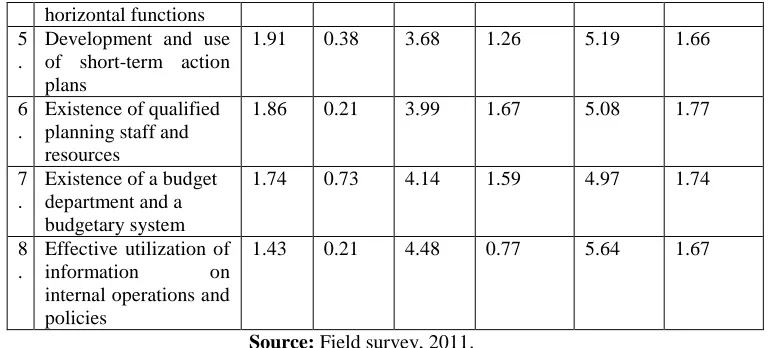
Table 3a. Level of Usage of Strategic Planning by Nigerian Public Universities Strategic planning
dimensions/variables
Low strategic planning n = 6 of total
Medium strategic planning n = 15 of total
High strategic planning n = 25 of total
X SD X SD X SD
1 .
We have vision and mission that we follow
2.67 1.06 4.41 1.72 5.86 1.86
2 .
Setting of long-term objectives in key performance areas
1.82 0.74 4.82 1.48 5.72 1.92
3 .
Analysis of external environment
2.98 1.19 4.72 1.67 5.69 1.76
4 .
Monitoring and evaluation of performance in key operating units and
458 horizontal functions
5 .
Development and use of short-term action plans
1.91 0.38 3.68 1.26 5.19 1.66
6 .
Existence of qualified planning staff and resources
1.86 0.21 3.99 1.67 5.08 1.77
7 .
Existence of a budget department and a budgetary system
1.74 0.73 4.14 1.59 4.97 1.74
8 .
Effective utilization of information on internal operations and policies
1.43 0.21 4.48 0.77 5.64 1.67
Source: Field survey, 2011.
Table 3b Performance of Nigerian Public Universities by Level of Strategic Planning
Performance Variable Low strategic planning n = 6 of total
Medium strategic planning n = 15 of total
High strategic planning n = 25 of total
X SD X SD X SD
EPA (environment pressure absorption)
2.11 0.62 3.62 1.06 5.96 1.69
IG (internal growth) 1.86 0.41 3.14 1.21 5.18 1.78
GDB (goal driven & attainment behavior)
1.92 0.66 3.89 0.99 4.97 1.76
PS (priorities setting) 1.62 0.48 2.98 1.41 5.62 1.68
EFA (effectiveness of funds allocation)
1.42 0.91 3.64 1.32 4.49 1.89
IRG (internal revenue generation)
1.64 0.72 3.72 1.16 4.67 1.87
ERF (external resource funding)/fund acquisition
1.72 0.49 3.14 1.29 5.89 1.80
PEM (performance evaluation & monitoring)
1.02 0.32 3.69 0.96 5.69 1.96
SC (staff commitment) 1.72 0.28 3.72 1.37 4.74 1.47
IDC (interdepartmental communication)/programme & policy coordination
1.42 0.91 3.64 1.32 4.49 1.89
INN (innovation) 1.71 0.11 3.41 1.64 4.99 1.56
OP (overall performance) 1.48 0.61 3.84 1.56 5.52 1.32
459 Table- 4 Correlation and descriptive statistics for the study variables
Variable Mean SD 1 2 3 4 5 6 7 8 9 10 11 12
SP 4.60 0.64 1 EPA 4.50 0.72 0.62 1 IG 4.20 0.56 0.53 0.42* 1
GDB 4.60 0.49 0.56 0.51 0.47 1 PS 4.22 0.62 0.58 0.48* 0.56 0.7 1
EFA 4.69 0.69 0.64 0.59 0.41 0.81* 0.50 1 IDC 4.50 0.72 0.62 0.58 0.49 0.82* 0.70* 0.60 1
IRG 4.86 0.77 0.52 0.61 0.72* 0.47 0.80* 0.41 0.61 1 ERF 4.11 0.82 0.54 0.49* 0.67 0.57 0.50 0.48 0.59 0.64 1
PEM 4.09 0.69 0.59 0.43 0.54 0.61 0.40 0.56 0.49 0.41* 0.74** 1 SC 4.62 0.76 0.61 0.56 0.66 0.46* 0.60 0.59 0.42 0.46 0.61 0.63 1 OP 4.96 0.74 0.57 0.49* 0.71** 0.58 0.80** 0.52 0.71** 0.51 0.71 0.58 0.64 1 INN 4.76 0.89 0.69 0.64 0.56 0.64 0.70** 0.61 0.81** 0.52 0.54 0.42* 0.61 0.63 1
Note: **P<0.05 and *P<0.01
Table-5 Correlation and Descriptive Statistics for propensity/predisposition for strategic planning and environmental pressure, internal growth and resource munificence
Variable Mean SD SP EP IG RM
SP EP IG RM
4.64 4.80 4.51 4.67
0.69 0.54 0.48 0.63
1 0.67** 0.55** 0.58*
1 0.66** 0.59**
1
0.63** 1
460 Table- 6 Correlation and descriptive statistics for strategic planning and size and complexity of
universities
Variable Mean SD 1 2 3 4 5
SP NOS NOP NOD NOST
4.62 4.82 4.36 4.69 4.44
0.68 0.52 0.48 0.59 0.66
1 0.69** 0.57** 0.55** 0.54**
1 0.63** 0.57** 0.55**
1 0.52** 0.47*
1
0.60** 1 Note: *P<0.05 and **P<0.01
References
Adeyemi, S.C.D. (1992) “Strategic Management in the Banking Industry: A Case Study of UBN, UBA and First Bank” Unpublished Ph.D. Thesis, Department of Management Science, University of Ilorin. Akinyemi, S.T. and Fashogbon, O.I. (2007) “Impact of Strategic Planning or Organizational Performance and Survival” Research Journal of Business Management Vol.1, No.1, pp. 62 – 71.
Al-Shammari, L. Hussam, A. and Hussein, R.T. (2007) Strategic Planning – Firm Performance Linkage: Empirical Investigation from an Emergent Market. Advances in Competitiveness Research. Vol. 8/02.
Asika, N. (2006) Strategic Planning as a Tool for Enhancing the Quality and Effectiveness of Higher Education Management in Nigeria in Oyedijo, A. and Odediran, N.O. (eds) Globalization, Information Technology and Higher Education Management in Nigeria, NIEPA/SMCC, Ibadan, pp. 50 – 62.
Association of African Universities (AAU). Report of the AAU/UNESCO/CHEMS Workshop on Strategic Planning in African Universities. Accra, Ghana. AAU 1995. Barringer, B. R. and Bluedorn, A. C. (1999) “The Relationship between Corporate Entrepreneurship and Strategic Management” Strategic Management Journal, Vol.20, pp.421 - 444.
Berman, J.A. Gordon, D.D. and Sussman, G. (1997) “A Study to Determine the Benefits Small Firms Derive from Sophisticated Planning versus Less Sophisticated types of Planning” Journal of Business and Economic Studies Vol.3, No.3, pp.1 – 11.
Bracker, J.S., Keats, B.W. and Pearson, J.N. (1988) “Planning and Financial Performance among Small Firms in a Growth”
Industry Strategic Management Journal, Vol.9, No.6.
Business Week (1980) How Academia is taking Lessons from Business, Business Week 27 (Aug).
Carland, J.C. and Carland, J.W. (2003) „A Model of Entrepreneurial Planning and Its Effect on Performance‟, Proceedings of ASBE Annual Conference – Building Bridges to the Future, Houston, Texas.
Chandler, Alfred, D. (1962) Strategy and Structure: Chapters in the History of American Industrial Enterprises. Cambridge, M.A: MIT Press p. 41.
Dabalen, A. and Oni, B. (2000) “Study of External Efficiency of Higher Education in Nigeria” Report to National Universities Commission and the World Bank.
Dubin, A.J. (1997) Essentials of Management, Ohio, South-Western College Publishing, p. 416.
Ezirim, A.C. and Nwokah, N.G. (2009) “Firms Entrepreneurial Orientations and Export Marketing Performance in the Nigerian Non-oil Sector” Ebonyi Journal of Scientific Research Vol.35, No.3, pp.318-336.
Farrant, J. and Fielden, J. (1996) Strategic Planning in African Universities, Paris, UNESCO, p. 3.
Fielden, R. (2000) Strategic Planning and the Nigeria University System Innovation Project, Discussion Paper for Participants in the Nigeria University System Innovation Project (NUSIP), Sept.
Fielden, R. (2000) Thoughts on Sustainable Innovation in the Nigerian Federal University System: or How to Awaken a Giant, Report of a Study Submitted Nigeria‟s National Universities Commission (NUC).
461 Fielden, T. (1995) “Management
Strengthening Component: Some Outline Proposals” Report to the World Bank. Nov. Fry, P. and Utui, R. Promoting Access, Quality and Capacity Building in African Higher Education: The Strategic Planning Experience at Eduado Mondlane University. Association for the Development of Education in Africa. Working Group in Higher Education. 1999. Gibbons, P.T. and O’Connor, T. (2005) “Influences on Strategic Planning Processes among Irish SMEs” Journal of Small Business Management, Vol.43, No.2, pp. 170 – 186. Gibson, B. and Casser, G. (2005) “Longitudinal Analysis of Relationship between Planning and Performance in Small Firms” Small Business Economics Vol.25, No.3, pp. 207 – 222.
Karger, D.W. and Z.A. Malik (1975) “Long Range Planning and Organizational Performance” Long Range Planning Vol.8, pp.60-64.
Levy, D.C. (1986) Higher Education and the State in Latin America: Private Challenge to Public Dominance. Chicago: The University of Chicago Press.
Martin, M (1992) Strategic Management in Western European Universities: Issues and Methodologies in Educational Development. 9, Paris: International Institute for Educational Planning.
Matthews, C.H. and Scott, S.G. (1995) “Uncertainty and Planning in Small and Entrepreneurial Firms: An Empirical Assessment” Journal of Small Business Management, Vol.33, No.4, pp.34 – 52. Nasser, M.L. and Oyedijo, A. (1991) Strategic Planning in Nigerian Organizations. in Nasser M.L. and Omole T. Nigerian Administration Beyond Year 2000 A.D. Faculty of Administration, Obafemi Awolowo University, Ile-Ife/Strategic International Press Ltd. Lagos, Nigeria.
Nmadu, T.M. (2007) “Strategic Management in some Nigerian business: A Business Reality” Journal of Management Research and Development, Vol. 5, pp. 17 – 23.
Ofoegbu, O.E. (1991) The Role of Strategic Management in Organizational Performance:
A case Study of Some Nigerian Organizations. Unpublished Ph.D. Dissertation, Department of Management Science, University of Ilorin. Osuala, E.C. (2001) Research Methods in Behavioural Sciences, Onitsha, Cape Publishers International Ltd. P. 61.
Oyedijo, A. and Akinlabi, A. (2008). “Relationship between the Intensity of Strategic Management and Corporate Financial Performance in Nigeria Banks” International Journal of Multi-disciplinary Research, Vol. 1 No.1, pp. 52 – 61.
Porter, M.E. (1980) Competitive Strategy: Techniques for Analyzing Industries and Competitors, New York; Free Press (1985) Competitive Advantage: Creating and Sustaining Superior Performance, New York, Free press.
Robinson, R. Jr. (1992) “The Importance of Outsiders in Small Firm Strategic Planning” Academy of Management Journal, 25, No.1, march, pp. 76 – 88.
Schindler, D.R. and Cooper, P.S. (2001) Business Research Methods, 7th Edition, New York, McGraw-Hill.
Shrader, C.B., Mulford, C.L. and Blackburn, V.L. (1989) “Strategic and Operational Planning, Uncertainty and Performance in Small Firms” Journal of Small Business Management Vol. 27, No.4, pp. 45 – 60.
Steiner, G.A (1998). Strategic Management, New York, The Free Press. P. 21.
Stonehouse, G. and Pemberton, J. (2002) “Strategic Planning in SMEs – Some Empirical Findings” Management Decision, Vol.40, No.9, pp.853 – 861.