N A N O E X P R E S S
Open Access
Round-robin test on thermal conductivity
measurement of ZnO nanofluids and comparison
of experimental results with theoretical bounds
Wook-Hyun Lee
1, Chang-Kyu Rhee
2, Junemo Koo
3, Jaekeun Lee
4, Seok Pil Jang
5, Stephen US Choi
6*,
Ki-Woong Lee
1, Hwa-Young Bae
1, Gyoung-Ja Lee
2, Chang-Kyu Kim
2, Sung Wook Hong
3, Younghwan Kwon
4,
Doohyun Kim
4, Soo Hyung Kim
4, Kyo Sik Hwang
5, Hyun Jin Kim
5, Hyo Jun Ha
5, Seung-Hyun Lee
5, Chul Jin Choi
6and Ji-Hwan Lee
6Abstract
Ethylene glycol (EG)-based zinc oxide (ZnO) nanofluids containing no surfactant have been manufactured by one-step pulsed wire evaporation (PWE) method. Round-robin tests on thermal conductivity measurements of three samples of EG-based ZnO nanofluids have been conducted by five participating labs, four using accurate measurement apparatuses developed in house and one using a commercial device. The results have been compared with several theoretical bounds on the effective thermal conductivity of heterogeneous systems. This study convincingly demonstrates that the large enhancements in the thermal conductivities of EG-based ZnO nanofluids tested are beyond the lower and upper bounds calculated using the models of the Maxwell and Nan et al. with and without the interfacial thermal resistance.
Introduction
Nanofluids, a new class of fluids engineered by uniformly dispersing nanostructures such as nanoparticles, nano-tubes, nanorods, and nanofibers, in base fluids, have heat and mass transport properties that are far superior to those of the base fluids. For example, a number of research groups presented surprising experimental findings that nanofluids significantly enhance thermal conductivities [1-8], convective heat transfer coefficient [9-13], and heat absorption rate [14]. Therefore, these novel nanofluids have the potential to become next-generation coolants and working fluids for innovative applications in industries such as energy, bio and pharmaceutical industry, and che-mical, electronic, environmental, material, medical and thermal engineering among others [15,16]. Nanofluids have thus attracted considerable interest worldwide. Hun-dreds of research groups, in both academia and industry, are exploring nanofluids. Most recently, the European Commission launched Nanohex [17], the world’s largest
collaborative project for the research and development of nanofluid coolants, bringing together 12 partners from academia and industry, ranging from small- and medium-sized enterprises (SMEs) to global companies such as Siemens and Thermacore.
Of all the properties of nanofluids, thermal conductivity has sparked the most excitement and controversy. The anomalous enhancement of measured thermal conductiv-ity [1-8], as compared with the predictions of the classical models, has generated excitement in both academia and industry. However, these data became controversial years later when no anomalous enhancement in thermal con-ductivity was observed [18-20]. These contradictory data have generated another controversy regarding the mechanisms of enhanced thermal conductivity in nano-fluids. For example, a number of investigators proposed that new mechanisms are needed to explain anomalous enhancement [21-26]. However, some others [27-29] show that the thermal conductance mechanism in nanofluids is no different from that in binary solid composites or liquid mixtures, and that thermal conductivity data lie between the well-known effective medium bounds of the Hashin and Shtrikman (H-S) [30]. But, Murshed [31] pointed out
* Correspondence: [email protected] 6
Mechanical and Industrial Engineering Department, University of Illinois at Chicago, Chicago, IL, USA
Full list of author information is available at the end of the article
that more systematic and careful investigations are needed to resolve the controversy over the mechanism of the enhanced thermal properties. Moreover, Schmidt et al. [32] showed that the thermal conductivity of nanofluids is greater than the Hamilton-Crosser model [33].
These contradictory thermal conductivity data high-light the need for more controlled synthesis and accu-rate characterization of nanofluids. One way to reduce data inconsistencies due to differences in sample quality, such as particle size and size distribution including agglomeration, is to conduct round-robin tests using identical test samples. Recently, Buongiorno et al. [34] launched an International Nanofluid Property Bench-mark Exercise (INPBE) to resolve the inconsistencies in the database. They reported that the nanofluids tested in INPBE exhibit thermal conductivity in good agree-ment with the predictions of the effective medium the-ory for well-dispersed nanoparticles.
There are several reasons for the good agreement. First, the nanofluids used in the INPBE were manufac-tured by two-step method with surfactant (Set 1) and chemical reduction method with several electrolytes (Set 2) or commercial products with various surfactants and electrolytes (Sets 3 and 4). Second, measurement uncer-tainty analysis is essential because the measured thermal conductivity data may have biases and random variation. However, most organizations using transient hot wire method (THWM) for measurement of the thermal con-ductivity did not perform the measurement uncertainty analysis.
So we thought that it would be interesting to produce nanofluids by a one-step physical method with no sur-factant, perform measurement uncertainty analysis, and measure the thermal conductivity of the nanofluids using very accurate thermal conductivity apparatuses.
The objectives of this study are to conduct a round-robin test on thermal conductivity measurements of three samples of EG-based ZnO nanofluids and compare the experimental results with theoretical bounds on the effective thermal conductivity of heterogeneous systems.
Different methods of sample preparation or even small differences in the sample preparation process can cause large differences in sample properties. Therefore, in this study, one laboratory synthesized all three samples of ZnO nanofluids using one-step pulsed wire evaporation (PWE) process to be described in“Synthesis of ZnO nanofluids”section. The round-robin exercise involved five test-laboratories that have extensive experience in the thermal conductivity measurement of nanofluids. Each participant received identical samples of ZnO nano-fluids and was asked to conduct the test within 2 weeks of receipt of samples. The five participating laboratories measured the thermal conductivity of the samples of ZnO nanofluids over a temperature range from 20 to
90°C using the THWM. The results were collected, ana-lyzed, and plotted for comparison with several theoretical bounds [30,35,36] on the effective thermal conductivity of heterogeneous systems.
Based on the results of these round-robin tests using identical test samples synthesized by one-step PWE method and accurate thermal conductivity apparatus with measurement uncertainty <1.5%, we clearly show that the large enhancements in the thermal conductivity of the EG-based ZnO nanofluids are beyond the lower and upper bounds of both the Maxwell model [35] with and without the interfacial thermal resistance and the Nan et al. model [36].
Experiments
Synthesis of ZnO nanofluids
Various synthesis procedures have been used for produc-tion of nanofluids. The PWE method is one approach to fabricate nanoparticles [37]. In this study we used the PWE method mainly because the process is simple to use, and it is not time consuming to produce nanofluids samples in enough quantity for the round-robin measurements.
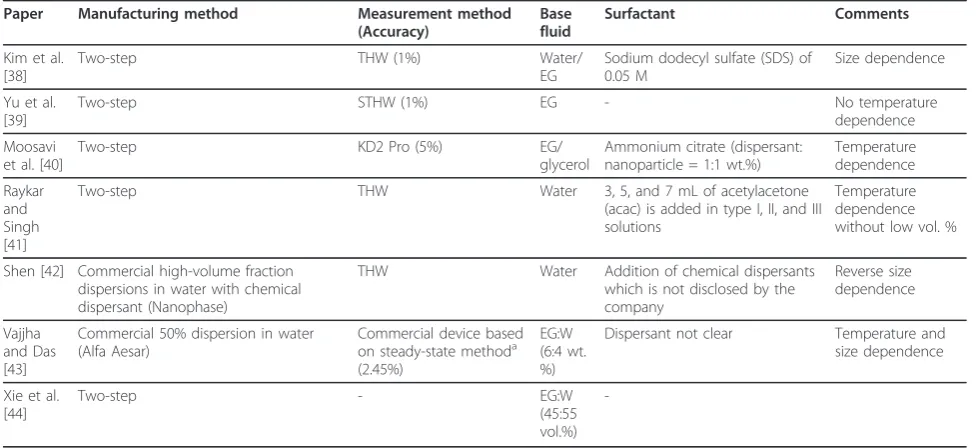
Although the thermal conductivity of suspensions of ZnO nanoparticles in water or EG was studied, the pre-vious studies [38-44] used nanofluids manufactured by the two-step method or commercial products with sur-factants, as shown in Table 1. However, in this study, the EG-based ZnO nanofluids are manufactured by a one-step physical method using PWE [37] and do not contain any surfactant. Therefore, the ZnO nanofluids studied in this work are different from the previously studied ZnO nanofluids [38-44].
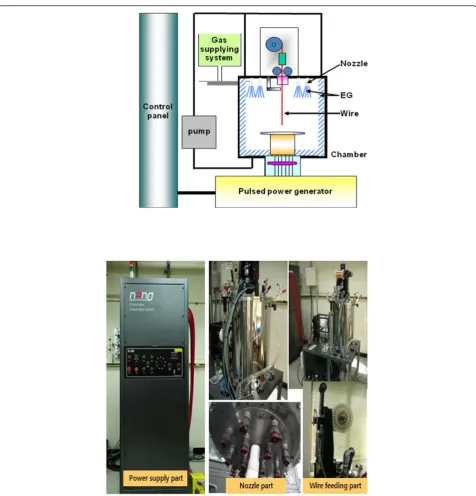
As shown in Figure 1, the PWE system for synthesis of EG-based ZnO nanofluids consists of three main compo-nents which are the pulsed power generator, the control panel, and the evaporation chamber with continuous wire feeding and fluid nozzle subsystems. Pure Zn wire of 99.9% with a diameter of 0.5 mm was used as a start-ing material and the feedstart-ing length of the wire into the reaction chamber was 100 mm. When a pulsed high voltage of 25 kV is driven through a thin wire, non-equilibrium overheating induced in the wire makes the wire evaporate into plasma within several microseconds. Then the high-temperature plasma is cooled by an inter-action with an argon-oxygen mixed gas, and evaporated Zn gas is condensed into small-sized particles and spon-taneously immersed into EG-stained chamber. The Ar:O2
atmosphere in the evaporation chamber facilitates forma-tion of the zinc oxide phase. More details of the PWE method and system are given in [45].
ZnO nanoparticles with an average diameter of 70 nm is shown in Figure 2.
Thermal conductivity measurements and uncertainty analysis
In this study, four of the labs used a THWM developed in house to measure the thermal conductivity of EG-based ZnO nanofluids, and one of the five labs per-formed the thermal conductivity measurements using a commercial apparatus, LAMBDA (LAMBDA F5 Tech-nology, Germany) with 1% error.
In order to obtain the accuracy of the transient hot wire apparatus, the measurement uncertainty analysis of the apparatus was performed by each laboratory as follows:
The thermal conductivity of fluids is calculated by Equation 1,
k= q
4π
dT
d(lnt) (1)
wherek, q,ΔT andtare the thermal conductivity, the input power per unit length, the temperature rise of hot wire, and the measurement time, respectively. The ther-mal conductivity of fluids can be obtained if the input power unit length and temperature rise of hot wire are measured as a function of temperature. Therefore, the measurement uncertainty of the apparatus [46] is given by Equation 2,
uk=
∂
k
∂quq
2 +
∂
k
∂TuT
2
(2)
whereuk, uq, anduΔTare the measurement uncertain-ties of thermal conductivity, the input power per unit length, and the temperature rise of the hot wire, respec-tively. Equation 2 shows that the measurement uncer-tainty of the thermal conductivity using the transient hot wire apparatus consists of the measurement uncer-tainties of input power per unit length, q, and the tem-perature rise of hot wire, ΔT. Here the measurement uncertainties ofq andΔTin accordance with 95% confi-dence interval [47,48] are expressed by Equation 3,
ui=
B2+tλ,95%P
2 1/2
i=q, T (3)
whereui, B, andtl,95%Pare the measurement uncer-tainty ofi, bias error, and estimate of the precision error in the repeated measurement data at 95% confidence. In addition,lis the degree of freedom given by,
λ=N−1 (4)
[image:3.595.55.544.100.324.2]whereNis the data size. Using this method, the mea-surement uncertainty of transient hot wire apparatus manufactured by each lab was determined to be less than 1.5%. In order to verify the accuracy and the relia-bility of this experimental system, the thermal conduc-tivity was experimentally measured using deionized water and EG. As shown in Figure 3, a typical THW apparatus calibration with the reference fluids demon-strates that it is possible to measure thermal conductiv-ities with less than 1.5% error, verifying the estimated measurement uncertainty of 1.5%. In Figure 3, the hol-low symbols represent the calibration data and the solid Table 1 Previous studies on EG/water-based ZnO nanofluids
Paper Manufacturing method Measurement method (Accuracy)
Base fluid
Surfactant Comments
Kim et al. [38]
Two-step THW (1%) Water/
EG
Sodium dodecyl sulfate (SDS) of 0.05 M
Size dependence
Yu et al. [39]
Two-step STHW (1%) EG - No temperature
dependence
Moosavi et al. [40]
Two-step KD2 Pro (5%) EG/
glycerol
Ammonium citrate (dispersant: nanoparticle = 1:1 wt.%)
Temperature dependence Raykar and Singh [41]
Two-step THW Water 3, 5, and 7 mL of acetylacetone
(acac) is added in type I, II, and III solutions
Temperature dependence without low vol. %
Shen [42] Commercial high-volume fraction dispersions in water with chemical dispersant (Nanophase)
THW Water Addition of chemical dispersants
which is not disclosed by the company Reverse size dependence Vajjha and Das [43]
Commercial 50% dispersion in water (Alfa Aesar)
Commercial device based on steady-state methoda (2.45%)
EG:W (6:4 wt. %)
Dispersant not clear Temperature and size dependence
Xie et al. [44]
Two-step - EG:W
(45:55 vol.%)
-a
symbols are the average value of the calibration data. The solid and dashed lines represent the thermal con-ductivity of water and EG, respectively [49].
Results and discussion
Results of the round-robin study and statistical treatment of data
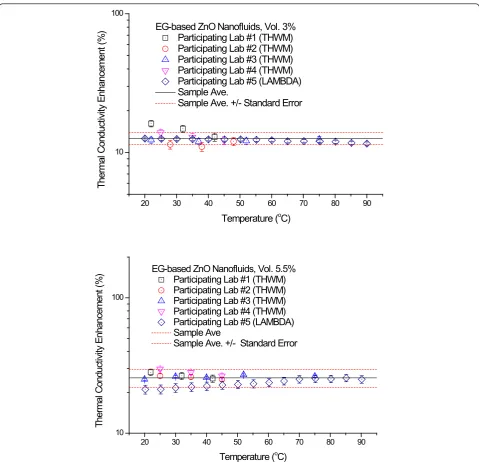
Figure 4a, b shows the thermal conductivity enhance-ments for the 3.0 and 5.5 vol.% ZnO nanofluids that
were measured at each of the five participating labs. The thermal conductivity enhancement is defined as (keff
-kf)/kf, wherekeff andkf are the thermal conductivity of
[image:4.595.60.537.84.581.2]thermal conductivity data show very little dependence on temperature in the 20 to 90°C range.
[image:5.595.57.291.87.315.2]Following the statistical data analysis procedures used in the INPBE study [34], we calculated the sample averages and the standard errors for all the thermal con-ductivity enhancement data. In Figure 4a, b, the sample average is shown as a solid line and the standard errors of the sample mean as dotted lines. As seen in Figure 4a, b, the experimental data obtained by the five partici-pating labs lie within a narrow band about the sample average with only a few modest outliers. The data analy-sis shows that the standard errors of the sample mean for the 3.0 and 5.5 vol.% ZnO nanofluids samples are ±1.24 and ±3.95%, respectively.
Figure 5 shows the thermal conductivity enhancement of EG-based ZnO nanofluids at a temperature of 23°C as a function of nanoparticle volume fraction. Each data point represents the ratio of the ensemble average of enhancements measured by the participating labs at a given volume fraction to the thermal conductivity of base fluid. The error bars show the standard deviation from the ensemble average. The ZnO nanofluids show very significant increases in thermal conductivity, with a nearly 25% increase for 5.5 vol.% ZnO nanoparticles.
Comparison of experimental results with theoretical bounds
[image:5.595.57.291.545.711.2]The Hashin and Shtrikman (H-S) bounds on the ther-mal conductivity of heterogeneous systems [30] have been used for nanofluids to show that the effective med-ium theory can explain the enhancement of nanofluids [27,29]. The H-S upper bound is given by Equation 5 and the H-S lower bound is the classical Maxwell model as given by Equation 6. Recently, Buongiorno et al. [34] used Equation 6, the classical Maxwell model with negli-gible interface resistance, for the upper bound for nano-fluids and Equation 7, the Maxwell model with interface resistance, for the lower bound for nanofluids.
Upper bound of Hashin and Shtrikman [30]
keff≤
1− 3(1−φ)
kp−kf
3kp−φ
kp−kf
kp (5)
Upper bound of the Maxwell Model (no interfacial thermal resistance) [35]
keff
kf
= [kp+ 2kf] + 2φ[(kp−kf)]
[kp+ 2kf]−φ[(kp−kf)] (6) Lower bound of the Maxwell Model (with interfacial thermal resistance) [50]
keff kf
=[kp(1 + 2α) + 2kf] + 2φ[(kp(1−α)−kf)] [kp(1 + 2α) + 2kf]−φ[(kp(1−α)−kf)]
whereα=Rb
rp kf (7)
wherekf, kp,rp, Rb, and are the thermal
conductiv-ities of base fluids and nanoparticles, radius of nanopar-ticles, interfacial thermal resistance, and volume fraction of nanoparticles, respectively.
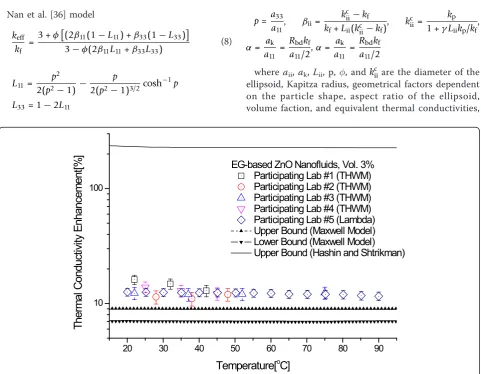
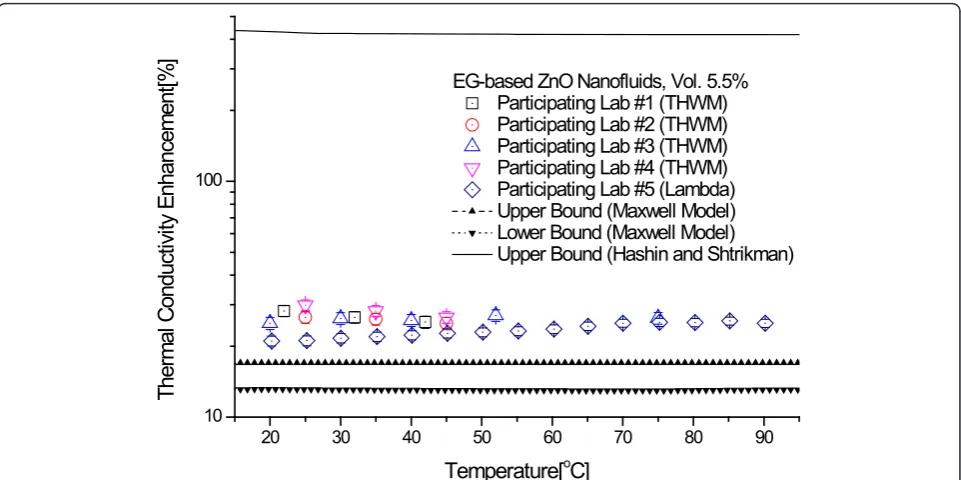
Figures 6 and 7 show comparisons of experimental thermal conductivity enhancements of 3.0 vol.% and 5.5 vol.% ZnO nanofluids with the three theoretical bounds of Hashin and Shtrikman and Maxwell mod-els. The properties, such as the thermal conductivities of EG [49] and ZnO nanoparticles [51], used for cal-culating the theoretical bounds are summarized in Table 2. The upper bound of Hashin and Shtrikman, which was used by Eapen et al. [27] and Kelbinski et al. [29], dramatically overestimates the thermal con-ductivity of ZnO nanofluids. The H-S upper bound Figure 2TEM image of ZnO nanoparticles produced by PWE
process.
20 25 30 35 40 45 50
0.25 0.26 0.60 0.65
Th
er
m
al
C
onduct
ivi
ty
(W
/mK
)
Temperature(oC)
Reference(Water) Reference(EG) DI-Water Ethlyene Glycol
corresponds to large pockets of fluid separated by linked chain-forming or clustered nanoparticles [29]. The long wire-like structures made of perfectly aligned nanoparticles are not realizable with dilute nanofluids with well-dispersed nanoparticles. Furthermore, it is almost impossible to separate fluid by nanoparticle chains in nanofluids, although nanoparticles can be partially aggregated in nanofluids. Therefore, the upper bound given by the H-S model is not applicable to nanofluids. More realistic upper and lower bounds
for nanofluids having low concentration of well-dis-persed nanoparticles are given by Buongiorno et al. [34]. It is clear from Figures 6 and 7 that the thermal conductivity enhancements of EG-based ZnO nano-fluids are larger than the upper bound of the Maxwell model.
In addition, we used the generalized Maxwell model developed by Nan et al. [36] with and without interfacial resistance for the lower and upper bounds for nano-fluids. The Nan et al. model is given in Equation 8.
20 30 40 50 60 70 80 90
10 100
EG-based ZnO Nanofluids, Vol. 3% Participating Lab #1 (THWM) Participating Lab #2 (THWM) Participating Lab #3 (THWM) Participating Lab #4 (THWM) Participating Lab #5 (LAMBDA) Sample Ave.
Sample Ave. +/- Standard Error
Th
er
m
al
C
onduct
ivi
ty
E
nhancem
ent
(%
)
Temperature (oC)
20 30 40 50 60 70 80 90
10 100
EG-based ZnO Nanofluids, Vol. 5.5% Participating Lab #1 (THWM) Participating Lab #2 (THWM) Participating Lab #3 (THWM) Participating Lab #4 (THWM) Participating Lab #5 (LAMBDA) Sample Ave
Sample Ave. +/- Standard Error
Ther
m
al
C
onduct
ivi
ty
E
nhancem
ent
(%
)
[image:6.595.58.538.86.548.2]Temperature (oC)
Nan et al. [36] model
keff
kf
= 3 +φ
(2β11(1−L11) +β33(1−L33)
3−φ(2β11L11+β33L33)
(8)
L11=
p2
2(p2−1)− p
2(p2−1)3/2cosh −1p
L33= 1−2L11
p= a33
a11, βii
= k
c ii−kf
kf+Lii(kcii−kf)
, kcii= kp 1 +γLiikp/kf
,
α= ak
a11
= Rbdkf
a11/2
,α= ak
a11
= Rbdkf
a11/2
whereaii, ak,Lii, p,, andkciiare the diameter of the ellipsoid, Kapitza radius, geometrical factors dependent on the particle shape, aspect ratio of the ellipsoid, volume faction, and equivalent thermal conductivities,
0.00 0.02 0.04 0.06
0 10 20 30 40 50
EG-based ZnO Nanofluids
T= 23oC
Thermal Conductivity Enhancement Upper Bound (Maxwell Model) Lower Bound (Maxwell Model) Upper Bound (Hashin and Shtrikman)
Th
er
m
al
C
onduct
ivi
ty
E
nhancem
ent
(%
)
[image:7.595.58.539.89.323.2]Volume Fraction
Figure 5Thermal conductivity enhancement of EG-based ZnO nanofluids as a function of nanoparticle volume fraction.
20 30 40 50 60 70 80 90
10 100
EG-based ZnO Nanofluids, Vol. 3% Participating Lab #1 (THWM) Participating Lab #2 (THWM) Participating Lab #3 (THWM) Participating Lab #4 (THWM) Participating Lab #5 (Lambda) Upper Bound (Maxwell Model) Lower Bound (Maxwell Model) Upper Bound (Hashin and Shtrikman)
Ther
m
al
C
onduct
ivi
ty
E
nhancem
ent
[%
]
Temperature[
oC]
[image:7.595.58.540.347.721.2]respectively.Rbdis the interfacial thermal resistance, also
known as thermal boundary resistance, or Kapitza resistance.
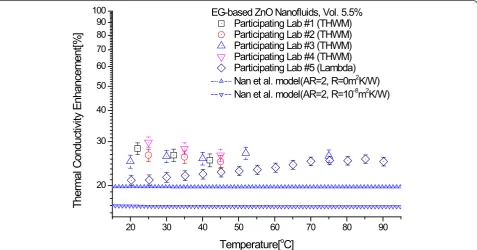
Figures 8 and 9 show comparisons of the experimental thermal conductivity enhancements of 3.0 and 5.5 vol.% ZnO nanofluids with the theoretical bounds of Nan et al. model. The interfacial thermal resistance used for the upper bound is 0 m2K/W and that for the lower bound is 10-8m2K/W [52]. It can be seen clearly that all the thermal conductivity data lie above the bounds pre-dicted by the model of Nan et al.
The comparisons of experimental results with theore-tical models convincingly demonstrate that the large enhancements in the thermal conductivities of EG-based ZnO nanofluids are beyond the lower and upper bounds
calculated using the models of Maxwell and Nan et al. with and without the interfacial thermal resistance the predictions of the effective medium theory for well-dis-persed nanoparticles.
Conclusions
Ethylene glycol (EG)-based ZnO nanofluids containing no surfactant have been manufactured by one-step phy-sical method using the PWE process. Round-robin tests on thermal conductivity measurements of three samples of EG-based ZnO nanofluids have been conducted and the results have been compared with several theoretical bounds on the effective thermal conductivity of hetero-geneous systems. The enhancements of the thermal conductivity of the ZnO nanofluids are beyond the
20 30 40 50 60 70 80 90
10 100
EG-based ZnO Nanofluids, Vol. 5.5% Participating Lab #1 (THWM) Participating Lab #2 (THWM) Participating Lab #3 (THWM) Participating Lab #4 (THWM) Participating Lab #5 (Lambda) Upper Bound (Maxwell Model) Lower Bound (Maxwell Model) Upper Bound (Hashin and Shtrikman)
Ther
m
al
C
onduct
iv
ity E
nhancem
ent
[%
]
[image:8.595.58.539.88.328.2]Temperature[
oC]
[image:8.595.57.543.583.731.2]Figure 7Comparison of experimental thermal conductivity enhancement of 5.5 vol.% ZnO nanofluids with theoretical bounds of H-S and Maxwell models.
Table 2 Material properties used to calculate theoretical bounds
(%) rp(nm) kf(W/mK) [49] kp(W/mK) [51] Rb(m2K/W)
Upper bound/lower bound [52]
Sample 1 1.0 280 0.244
290 0.248
300 0.252
Sample 2 3.0 35 310 0.255 29 0/10-8
320 0.258
330 0.260
340 0.261
Sample 3 5.5 350 0.261
360 0.261
upper and lower bounds of both the Maxwell model and Nan et al. model. Especially, the enhancement of the 5.5 vol.% ZnO nanofluids at 23 C is nearly 25%, while the enhancement predicted by the upper bound of the Maxwell model is at precisely 16.5%. Thus, the
discrepancies in the thermal conductivity of the ZnO nanofluids tested in this study cannot be fully explained by the effective medium theory for well-dispersed nano-particles. Further research is needed to understand and resolve the controversies about contradictory data and
20 30 40 50 60 70 80 90
10 20 30 40 50 60 70 80
EG-based ZnO Nanofluids, Vol. 3% Participating Lab #1 (THWM) Participating Lab #2 (THWM) Participating Lab #3 (THWM) Participating Lab #4 (THWM) Participating Lab #5 (Lambda)
Nan et al. model(AR=2, R=0m2K/W)
Nan et al. model(AR=2, R=10-8m2K/W)
Th
er
m
al
C
onduct
ivi
ty
E
nhancem
ent
[%
]
[image:9.595.59.538.88.338.2]Temperature[
oC]
Figure 8Comparison of experimental thermal conductivity enhancements of 3.0 vol.% ZnO nanofluids with theoretical bounds of Nan et al. model.
20 30 40 50 60 70 80 90
20 30 40 50 60 70 80 90
100 EG-based ZnO Nanofluids, Vol. 5.5%
Participating Lab #1 (THWM) Participating Lab #2 (THWM) Participating Lab #3 (THWM) Participating Lab #4 (THWM) Participating Lab #5 (Lambda)
Nan et al. model(AR=2, R=0m2K/W)
Nan et al. model(AR=2, R=10-8m2K/W)
Ther
m
al
C
onduct
ivi
ty
E
nhancem
ent
[%
]
Temperature[
oC]
[image:9.595.60.538.453.703.2]new mechanisms of enhanced thermal conductivity in nanofluids.
Abbreviations
EG: ethylene glycol; H-S: Hashin and Shtrikman; INPBE: International Nanofluid Property Benchmark Exercise; PWE: pulsed wire evaporation; SMEs: small- and medium-sized enterprises; TEM: transmission electron microscopy; THWM: transient hot wire method; ZnO: zinc oxide.
Acknowledgements
This work was supported by Energy and Resources Technology R&D Program (2008ECM 11P080000) under the Ministry of Knowledge Economy, Republic of Korea. We thank the participants in the round-robin study for their substantial investments of both time and resources. This work could not have been accomplished without their passion and efforts.
Author details
1Energy Efficiency and Materials Convergence Research Division, Korea
Institute of Energy Research, Daejeon, Republic of Korea2Nuclear Materials Research Division, Korea Atomic Energy Research Institute, Daejeon, Republic of Korea3Department of Mechanical Engineering, Kyung Hee University, Yongin, Republic of Korea4Department of Mechanical Engineering, Pusan National University, Busan, Republic of Korea5School of Aerospace and Mechanical Engineering, Korea Aerospace University, Republic of Korea 6Mechanical and Industrial Engineering Department, University of Illinois at
Chicago, Chicago, IL, USA
Authors’contributions
WHL, CKR, LK, JL, SPJ and SC conceived of the study and participated in its design and coordination. KWL, HYB, GJL, CKK, SWH, YK, DK, SHK, KSH, HJK, HJH, and SHL carried out the experiments. SPJ performed the statistical analysis. SPJ and GJL drafted the manuscript. CJC and JHL checked the equations, figures, and references. SC guided the program and revised the manuscript. All authors read and approved the final manuscript.
Competing interests
The authors declare that they have no competing interests.
Received: 30 October 2010 Accepted: 25 March 2011 Published: 25 March 2011
References
1. Eastman JA, Choi SUS, Li S, Yu W, Thompson LJ:Anomalously increased effective thermal conductivities of ethylene glycol-based nanofluids containing copper nanoparticles.Appl Phys Lett2001,78:718-720. 2. Choi SUS, Zhang ZG, Yu W, Lockwood FE, Grulke EA:Anomalous thermal
conductivity enhancement in nanotube suspensions.Appl Phys Lett2001, 79:2252-2254.
3. Patel HE, Das SK, Sundararajan T, Nair AS, George B, Pradeep T:Thermal conductivity of naked and monolayer protected metal nanoparticles based nanofluids: manifestation of anomalous enhancement and chemical effects.Appl Phys Lett2003,83:2931-2933.
4. Das SK, Putra N, Thiesen P, Roetzel W:Temperature dependence of thermal conductivity enhancement for nanofluids.J Heat Transfer2003, 125:567-574.
5. Hong KS, Hong TK, Yang HS:Thermal conductivity of Fe nanofluids depending on the cluster size of nanoparticles.Appl Phys Lett2006, 88:031901.
6. Li CH, Peterson GP:Size effect on the effective thermal conductivity of Al2O3/Di water nanofluids.J Appl Phys2006,99:084314.
7. Chopkar M, Das PK, Manna I:Synthesis and characterization of nanofluid for advanced heat transfer applications.Scripta Mater2006,55:549-552. 8. Jana S, Salehi-Khojin A, Zhong WH:Enhancement of fluid thermal
conductivity by the addition of single and hybrid nano-additives.
Thermochim Acta2007,462:45-55.
9. Pak BC, Cho Y:Hydrodynamic and heat transfer study of dispersed fluids with submicron metallic oxide particles.Exp Heat Transfer1998, 11:151-170.
10. Xuan Y, Li Q:Investigation on convective heat transfer and flow features of nanofluids.ASME J Heat Transfer2003,125:151-155.
11. Wen D, Ding Y:Experimental investigation into convective heat transfer of nanofluid at the entrance rejoin under laminar flow conditions.Int J Heat Mass Transfer2004,47:5181-5188.
12. Ding Y, Alias H, Wen D, Williams RA:Heat transfer of aqueous suspensions of carbon nanotubes (CNT nanofluids).Int J Heat Mass Transfer2006, 49:240-250.
13. Nguyen CT, Roy G, Gauthier C, Galanis N:Heat transfer enhancement using Al2O3-water nanofluid for an electronic liquid cooling system.Appl
Therm Eng2007,27:1501-1506.
14. Kim JK, Jung JY, Kang YT:The effect of nano-particles on the bubble absorption performance in a binary nanofluid.Int J Refrigeration2006, 29:22-29.
15. Choi SUS:Nanofluids: From vision to reality through research.ASME J Heat Transfer2009,131:033106.
16. Wang L, Fan J:Nanofluids research: Key issues.Nanoscale Res Lett2010, 5:1241-1252.
17. [http://www.nanohex.eu/].
18. Zhang X, Gu H, Fujii M:Effective thermal conductivity and thermal diffusivity of nanofluids containing spherical and cylindrical nanoparticles.J Appl Phys2006,100:044325.
19. Putnam SA, Cahill D, Braun PV, Ge Z, Shimmin RG:Thermal conductivity of nanoparticles suspensions.J Appl Phys2006,99:084308.
20. Timofeeva EV, Gavrilov AN, McCloskey JM, Tolmachev YV, Sprunt S, Lopatina LM, Selinger JV:Thermal conductivity and particle
agglomeration in alumina nanofluids: experiment and theory.Phys Rev E
2007,76:061203.
21. Xuan Y, Li Q, Hu W:Aggregation structure and thermal conductivity.
AIChE J2003,49:1038-1043.
22. Yu W, Choi SUS:The role of interfacial layers in the enhanced thermal conductivity of nanofluids: a renovated Maxwell model.J Nanopart Res
2003,5:167-171.
23. Jang SP, Choi SUS:Role of Brownian motion in the enhanced thermal conductivity of nanofluids.Appl Phys Lett2004,84:4316-4318. 24. Prasher R, Bhattacharya P, Phelan PE:Thermal conductivity of nanoscale
colloidal solutions (nanofluids).Phys Rev Lett2005,94:025901. 25. Xuan Y, Li Q, Zhang X, Fujii M:Stochastic thermal transport of
nanoparticle suspensions.J Appl Phys2006,100:043507.
26. Wang L, Wei X:Nanofluids: synthesis, heat conduction, and extension.
ASME J Heat Transfer2009,131:033102.
27. Eapen J, Williams WC, Buongiorno J, Hu LW, Yip S, Rusconi R, Piazza R: Mean-field versus microconvection effects in nanofluid thermal conduction.Phys Rev Lett2007,99:095901.
28. Prasher R, Evans W, Meakin P, Fish J, Phelan P, Keblinski P:Effect of aggregation on thermal conduction in colloidal nanofluids.Appl Phys Lett
2006,89:143119.
29. Keblinski P, Prasher R, Eapen J:Thermal conductance of nanofluids: is the controversy over?J Nanopart Res2008,10:1089-1097.
30. Hashin Z, Shtrikman S:A variational approach to the theory of effective magnetic permeability of multiphase materials.J Appl Phys1962, 33:3125-3131.
31. Murshed SMS:Correction and comment on“thermal conductance of nanofluids: is the controversy over?J Nanopart Res2009,11:511-512. 32. Schmidt AJ, Chiesa M, Torchinsky DH, Johnson JA, Nelson KA, Chen G: Thermal conductivity of nanoparticle suspensions in insulating media measured with a transient optical grating and a hotwire.J Appl Phys
2008,103:083529.
33. Hamilton RL, Crosser OK:Thermal conductivity of heterogeneous two component systems.Ind Eng Chem Fundam1962,1:187-191.
34. Buongiorno J,et al:A benchmark study on the thermal conductivity of nanofluids.J Appl Phys2009,106:094312.
35. Maxwell JC:A Treatise on Electricity and Magnetism.1 edition. Oxford: Clarendon Press; 1873.
36. Nan CW, Birringer R, Clarke DR, Gleiter H:Effective thermal conductivity of particulate composites with interfacial thermal resistance.J Appl Phys
1997,81:6692-6699.
37. Wang Q, Tang H, Shi J, Zou G:One-step synthesis of the nanometer particles ofϒ-Fe2O3by wire electrical explosion method.Mater Res Bull
38. Kim SH, Choi SR, Kim D:Thermal conductivity of metal-oxide nanofluids: Particle size dependence and effect of laser irradiation.J Heat Transfer
2007,129:298-307.
39. Yu W, Xie H, Chen L, Li Y:Investigation of thermal conductivity and viscosity of ethylene glycol based ZnO nanofluid.Thermochim Acta2009, 491:92-96.
40. Moosavi M, Goharshadi EK, Youssefi A:Fabrication, characterization, and measurement of some physicochemical properties of ZnO nanofluids.Int J Heat Fluid Flow2010,31:599-605.
41. Raykar VS, Singh AK:Thermal and rheological behavior of acetylacetone stabilized ZnO nanofluids.Thermochim Acta2010,502:60-65.
42. Shen B:Minimum quantity lubrication grinding using nanofluids.
Doctoral thesisUniversity of Michigan; 2008.
43. Vajjha RS, Das DK:Measurement of thermal conductivity of three nanofluids and development of new correlations.Int J Heat Mass Transfer
2009,52:4675-4682.
44. Xie H, Li Y, Yu W:Intriguingly high convective heat transfer enhancement of nanofluid coolants in laminar flows.Phys Lett A2010, 374:2566-2568.
45. Uhm YR, Kim WW, Kim SJ, Kim CS, Rhee CK:Magnetic nanoparticles of Fe2O3synthesized by the pulsed wire evaporation method.J Appl Phys
2003,93:7196-7198.
46. Abernethy RB, Benedict RP, Dowdell RB:ASME Measurement Uncertainty.
ASME J Fluids Eng1985,107:161-164.
47. Richard SF, Donald EB:Theory and Design for Mechanical Measurements.2 edition. New York: Wiley; 1995.
48. Kim SJ, Jang SP:Experimental and numerical analysis of heat transfer phenomena in a sensor tube of a mass flow controller.Int J Heat Mass Transfer2001,44:1711-1724.
49. Incropera FP, Dewitt DP, Bergman TL, Lavine AS:Fundamentals of Heat and Mass Transfer.6 edition. New York: Wiley; 2007.
50. Hasselman DPH, Johnson LF:Effective thermal conductivity of composites with interfacial thermal barrier resistant.J Comp Mater1987,21:508-515. 51. Touloukian YS:Thermophysical Properties of Matter.2 edition. New York: IFI/
Plenum; 1970.
52. Prasher R, Bhattacharya P, Phelan PE:Brownian-motion-based convective-conductive model for the thermal conductivity of nanofluids.J Heat Transfer2006,128:588-595.
doi:10.1186/1556-276X-6-258
Cite this article as:Leeet al.:Round-robin test on thermal conductivity measurement of ZnO nanofluids and comparison of experimental
results with theoretical bounds.Nanoscale Research Letters20116:258.
Submit your manuscript to a
journal and benefi t from:
7Convenient online submission
7Rigorous peer review
7Immediate publication on acceptance
7Open access: articles freely available online
7High visibility within the fi eld
7Retaining the copyright to your article