Detecting Falls Using Accelerometers by
Adaptive Thresholds in Mobile Devices
Yujia Ge
Department of Software Engineering, Zhejiang Gongshang University Hangzhou, China Email: [email protected]
Bin Xu
Department of Software Engineering, Zhejiang Gongshang University Hangzhou, China Email: [email protected]
Abstract—In this preliminary work, we presented an
effective and efficient algorithm on adaptive thresholds to automatically recognize falls from acceleration signals collected by a single tri-axial accelerometer in a mobile phone. Initial thresholds depend mainly on their carrying position of mobile phones, and then are adjusted automatically by a self-learning process and a classification module. Our researches are designed for carrying phones in casual ways which has not been done in previous researches. An android-based software is designed for experiments and the results show the efficiency of our method and improvements have been made on detection accuracy after having the learning process.
Index Terms— Accelerometer, fall detection, mobile phones,
adaptive threshold
I. INTRODUCTION
Falls are common and dangerous for elderly people over 65 years old, among whom 33% experienced one or more fall per year [1]. Falls are reported as the leading cause of accidental injury and death in the 65 to 80-year-old age people. Falls are responsible of 70% of accidental death in persons aged over 75. Statistics also show that the majority of serious consequences are not the direct result of falls, but rather are due to a delay in assistance and treatment. Thus, an efficient and accurate automatic fall detection system would be significant and necessary in an intelligent surveillance system and could improve their ability of independent living [2].
Plenty of researches have been done in designing fall detection systems or algorithms to increase the independent living ability of the elderly. Currently there are 3 main methods to detect falls: 1) video or image processing, by using several camera to track objects and their movements which usually takes complex computation [3][4]; 2) acoustic recognition, by having devices implanted in the floor and analyzing acoustic frequency to determine the gesture [5]; 3) wearable sensors, mostly accelerometers or gyroscope, by collecting and analyzing kinematic information about the
person and then detect falls [6][7]. The advantage of using wearable sensor is not to bring much interruption to the elderly.
Most of smart mobile phones nowadays carry devices such as accelerometers, gyroscopes, cameras, etc., which enable us to obtain data easily. Furthermore, these mobile phones have high processing capacities to execute complex programs. This feature allows us to recognize human movements using the data from the accelerometer by some reliable methods. When using accelerometer, which is composed of measure of acceleration of the body or parts of the body, it is one of the most extensively-used methods implemented for measuring physical activities to monitor activity patterns. Although human movements could be very complex because many actions can take place both sequentially and simultaneously, there exist apparent features for a specific activity, such as a fall, different from any other daily life activity.
For detecting a fall using accelerometers, currently there are two categories of detection methods: analytical methods and machine learning methods [8]. When using a threshold method, a “false positive” could occur if the threshold is set too low. A threshold also varies on different subjects. Therefore, a learning process could be an option for getting a more accurate threshold. Mathie et al. [9] used an integrated approach of waist-mounted accelerometer. A fall is detected when the negative acceleration is suddenly increased due to the change in orientation from upright to lying position. Bourke et. al [10] proposes using a lower peak value and an upper peak value for using a tri-accelerometer to determine falls and achieves the 100% accuracy rate when the sensor is mounted on the trunk. Kangas et. al [11] determines the thresholds for accelerometry-based parameters for fall detection when the sensors are placed on the wrist, waist and head. The wrist was reported not to be an optimal site for fall detection. Some threshold-based fall applications, such as iFall [12], have similar principle of functions: a fall is detected if the acceleration magnitude of the accelerometer in the smartphone reaches a given threshold; if there are no movements for a certain amount of time, the system sends an alarm to a contact. Classification methods could also be effective for
detecting falls. A wide variety of classification methods are used: KFD algorithms [13], Bayesian and neural networks [14], support vector machines [9][15] or belief network model [16].
In this paper, we describe an effective and simple threshold-based solution to implement an online method to recognize falls using a mobile phone with a single tri-axial accelerometer. Since mobile phones could be positioned in different places, such as on the waist-amounted, in the pocket, on the neck or other places. Most of previous research papers focus on one fixed position and do not adjust thresholds later on. We first investigate the thresholds for different carrying positions. Then an adaptive method is introduced to adjust the threshold automatically. The result shows that our algorithm without learning process could detect fall with sensitivity of 60.4-98.3% and specificity of 65.4%-100% respectively for different accelerometer locations, which is improved to sensitivity of 72.3-98.5% and specificity of 75.2%-100% after introducing the learning process.
II. FALL DETECTION ANALYSIS
In order to understand about a fall, the accelerometer data of a fall is analyzed and features are retrieved. An accelerometer data respects to theory of physics of relationship to gravity, acceleration and motion, which is represented as A= (AX, AY, AZ). AX, AY, and AZ are projection on X, Y, and Z axes respectively. The result from the tri-axial accelerometer sensor built in a mobile phone was retrieved and by taking the root-sum of squares of the signals from accelerometer data. In some research, orientation change is also considered to fall detection. But orientation change does not necessary happen in a fall situation [17] and it also requires that accelerometers are fixed in a specific orientation to a specific body location when detecting daily life activities. So in our algorithm, mobile phone angle change value is not included. Our observation on fall concludes that the fall in general will go through three steps as follows:
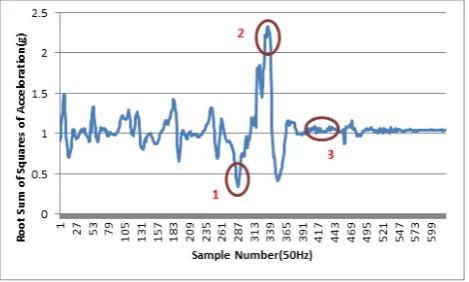
1. A short period of free fall always occurs at the start of a fall. The root-sum of squares of the signals of acceleration tends toward 0 g. The duration of the weightlessness depends on the height of the fall. The vector sum of acceleration will still be substantially less than 1g as shown in stage 1 in Fig 1. A threshold for this “free fall” is named as T_free_fall.
freefall
T
A
A
A
x2+
y2+
z2<
_
(1)The root-sum of squares of the signals of acceleration could be compared with this threshold. If (1) is met, a possible fall is detected.
2. After experiencing weightlessness, the human body will impact the ground or other obstacles. The “impact shock” results in an intense inversion of the polarity of the acceleration vector, which can detect with an accelerometer. The acceleration curve shows this as a large shock as shown in stage 2 of Fig 1. It could actually
be a previously determined fixed threshold, T_shock. Fall generally occurs in a short period in 0.4-0.8 second [12]. Therefore the time between “free fall” and “shock” should be under the value of T_duration.
shock T A A
Ax2+ y2+ z2 > _ (2)
duration T
T
Tshock− free_fall > _ (3)
If (2) and (3) are met, a possible fall is detected.
3. After falling and making impact, human usually cannot rise immediately (if not, the certain fall could be considered as not making a sever harm to subjects) and rather it remains in a motionless position for a short period or longer as a possible sign of unconsciousness. On the acceleration curve, this presents as an interval of flat line as stage 3 in Fig. 1. Therefore, the third step is for determining the motionless situation after the fall, characterized by the 1g flat line at the end of the graph.
Figure. 1 Acceleration data of a typical fall
III. DETERMINING THRESHOLDS WITH DIFFERENT
CARRYINGPOSITIONS
Our preliminary simulated experiments for determining the thresholds in casual ways involved 5 young and 5 old people who perform activities, walking, sitting down, and falling consequently. The young subjects are aged between18 and 25. The old subjects are aged between 50 and 65. The simulated falls are performed onto big mats for protecting purpose. Each subject repeated 10 times for the same activity sequence.
A fall detection software to detect falls on Android operating system is developed and data retrieved from the smartphone accelerometer is stored into database. These subjects carry their own Android phone with our software and finish the guided experiments. If found the retrieved data look apparent abnormal or is suspicious to be wrong. The subject is asked to repeat the activities again. Finally we got 100 valid sample data for each position.
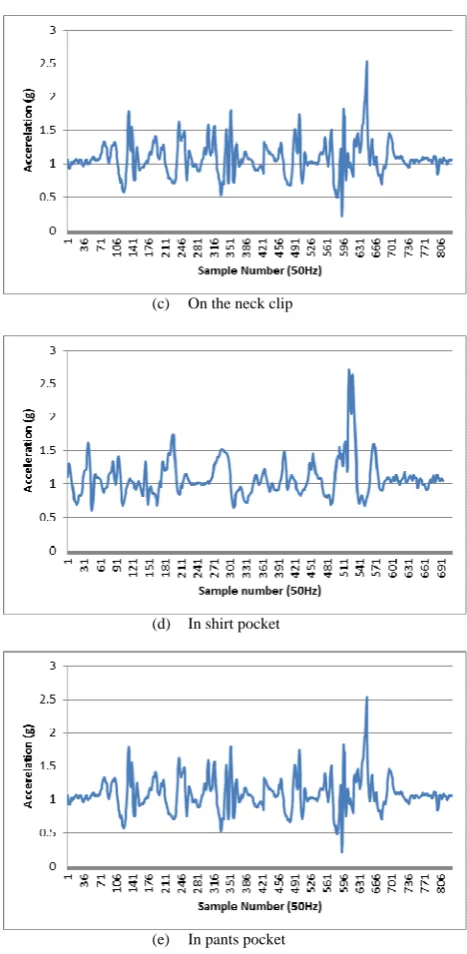
Fig. 2 shows the example data of root sum of squares of the three axis recorded acceleration data when the mobile phone is mounted on different positions, specifically on the belt, in the hand, on the neck clip, in the shirt pocket and in the pants pocket. Data from positions, such as in the hand and on the neck clip are apparent influenced by users’ body movements reacting to a fall. To detect a fall from these two positions are obviously difficult and could get higher false positives compared to other tightly fixed positions, thorough calculation and analysis on data from these positions could be the basis for improving methods on these positions.
(a) On a belt
(b) In the hand
(c) On the neck clip
(d) In shirt pocket
(e) In pants pocket
Figure 2. Sample data with a mobile phone mounted on different positions
duration of maximum acceleration and minimum acceleration in labeled fall data is read and recorded. For all carrying position, maximum value is chosen to set as T_duration.
TABLE I.
THRESHOLDS FOR DIFFERENT POSITIONS
Position On a belt
In pants pocket
In shirt pocket
On neck clip
In the hand
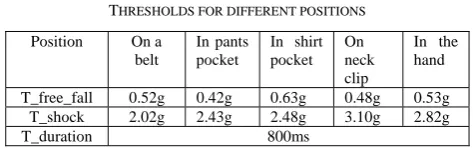
T_free_fall 0.52g 0.42g 0.63g 0.48g 0.53g T_shock 2.02g 2.43g 2.48g 3.10g 2.82g T_duration 800ms
Table 1 shows our calculation results for different carrying positions. T_free_fall is ranged between 0.42g and 0.63g where 0.42g is read “In pants pocket” and 0.63g is read “in shirt pocket”. T_shock is ranged between 2.02g to 3.10g where 3.10g is read “on the neckclip” and 2.82g is read “in the hand”. The results are expected since if the phone is carried on more accelerated body parts, such as the hand and neck, the level of activity is automatically be raised. This causes the T_shock threshold to be greater. Likewise, more stationary spots like the trunk will lower the threshold which accords to the same result in [12]. Not fixed position would also affect T_free_fall by interaction between the carrying object and the smart phones. Calculated thresholds vary according to different carrying positions. So to achieve better fall detection accuracy, our fall detection thresholds are not set initially by software. Our software ask user to choose the position they carry their mobile phones and adjust the threshold accordingly.
To evaluate the performance of our fall detection system, common criteria sensitive and specificity are evaluated. According to [8], sensitivity is the capacity to detect a fall, and is defined as TP/(TP+FN) where TP is the number of true positive, FN is the number of false negative. Specificity is the capacity to detect only a fall and is defined as TN/(TN+FP) where TN is the number of true negative, FP is the number of false positive.
TABLE II.
SENSITIVITY AND SPECIFICITY FOR DIFFERENT POSITIONS
position On a belt
In pants pocket
In shirt pocket
On neck
clip
In the hand
sensitivity 98.3 90.4 75.0 60.4 90.3 specificity 100 97.5 78.2 65.4 92.6
Table II shows the sensitivity and specificity of our threshold-based method for different mobile phone carrying positions which is similar to other research, such as [11]. The result shows the mobile phone mounted on a person’s waist (on a belt) could get better accurate rate compared to other position.
IV. LEARNING PROCESSES
When there exist a number of false positives when relying strictly on the threshold method, some improvements on general are suggested be made to increase the accuracy [19]. By considering smart phone
computing power, a self-learning process and a classification module are added to improve the accuracy of our threshold-based detection algorithm.
A. Self-Learning Process
People are different from each other on their age, weight, height and other personal characteristics. For example, some person can run much faster than others and have different acceleration features. To tune the thresholds by the characteristic of subjects, we introduce a learning process to configure the threshold for our application since it is difficult to tune the threshold by an accurate equation. Our process of configuration is divided into two parts: guiding users to conduct intentional activities and collecting the data to adjust the thresholds; detecting falls and if it is false positive, let users choose types of activities and then the recorded data is used to make another computation for threshold adjustment.
During starting and configuring the application, the users are guided to conduct the activities Walking, Running, Jumping, Sitting, and Falls, 3 times for each activity. Collected data were added to our previous dataset to calculate the thresholds for this user.
During the daily usage of the application, when a fall is detected, users could select the accurate activity he thinks he really performed by choosing Walking, Running, Jumping, Sitting and fall but ok. The accelerometer data is stored into the original data set. After a fall is detected, the options of stopping the false alarm or the user does not want to send the warning message to his contact could be chosen by pressing a stop button. After pressing the stop button, Fig. 3 shows the interface for users to select the category of the previous activity he performed for the system self-learning process. Since one new data will not change any threshold much, our setting is that recalculation will be done after 10 times of false alarms.
Figure 3. UI for activity classification by users after clicking the stop button when a fall is detected
quickly. When sitting on a soft surface such as a bed, mats, a fall-like event is unlikely to be produced. It shows relatively slow oscillations. But an acceleration peak still exists. Sitting on a hard surface could produce more fall-likely event since the body impacts on the hard surface. The acceleration stables quite quickly. Running and jumping could lead to relatively high acceleration peak. We use a classification module to consider a fall-like event as a real fall if its pattern does not correspond to the typical patterns of an ADL. Since fall is an ill-defined process and a thorough description is not easy to achieve [19]. A neural network is used to achieve the classification.
Firstly, 6 features are defined as follows.
(1) Maximum Acceleration, which is the maximum acceleration data found during detection.
(2) Minimum Acceleration, which is the minimum acceleration data found during detection.
(3) Duration, which is the time between Maximum Acceleration(1) and Minimum Acceleration(2).
(4) Free fall or not, which indicates if there is a free fall like procedure, i.e., the acceleration is close to 0g. In our detector, it is set as 0.5g.
(5) Average acceleration variation, which is for differentiating between hitting on hard and soft surface, where sitting on soft surface, acceleration patterns show smooth peaks with slow variations. With hard surface, there is a single sharp peak followed by a rapid stabilization. It is defined as the average of difference between adjacent acceleration data. As reported in [17], it is 0.52g for the falls, 0.23g for sitting.
(6) Average acceleration, which is the average of all of the acceleration data during detection.
Figure 4. Neural Network for Fall Detection
Secondly, a neural network is set up as illustrated in Fig. 4. We use a multilayer feed-forward network and the
training is back-propagation algorithm and the activation function for each layer is the log-sigmoid function.
We use pre-collected data as the training data set and later collected activity data marked by a user during daily life will be added to the training set. Only if the fall classification is identified, the fall detection will give the fall alarm which could be considered double check for falls.
C. Overall Process
(a) The overall fall detection procedure
(b) The analysis part of fall detector (Preliminary detector)
Figure 5. Fall detection procedure
by setting the configuration of the application, including personal information, such as age, height, weight, foot length. Location of mobile device is also required. Then preliminary detector is used to find a possible fall and double check detector is used to reduce false alarms. If a false fall is detected, users are also required to choose the real activity category he is performing. 10 times of possible falls trigger the recalculation of the thresholds and T_shock_adjust, T_free_fall and T_duration_adjust are the newly calculated results. The detailed analysis process for fall detection (preliminary detector) is illustrated in Fig. 5 (b).
D. Evaluation
Evaluation criteria on Section 3 is used for comparing the detection procedure with or without a learning process which is conducted by users’ manually marked data. First, we asked the volunteers, 5 young and 5 old, to carry the phones with fall detector for 4 hours to perform the intentional falls and other activities by themselves. Activities included jumping, running, walking, sitting, lying, hitting the sensor. Then we redid the same experiments as in Section 3. The same evaluation criteria was set, i.e., sensitivity and specificity. The results are shown in Table III.
TABLE III.
RESULTS BY ADDING A SELF-LEARNING PROCESS
position On a belt
In pants pocket
In shirt pocket
On neck clip
In the hand sensitivity 98.5 90 72.3 65.3 92.3 specificity 100 97.5 80.2 75.2 94.2
The results by adding a self-learning process could improve a slight accuracy. Although the improvements seem not much, we believe the learning process is necessary. More intensive experiments should be done especially in real life situations. As real falls did not happen during our experiments, these data could be used only to validate the specificity of our system.
V. CONCLUSION AND FUTURE WORKS
In this preliminary work, we presented an effective and efficient algorithm on adaptive thresholds and automatically recognize falls from acceleration signals collected by a single tri-axial accelerometer. The thresholds depend mainly on the position of the mobile phone. Based on our research, the mobile phone carrying position really affects the thresholds value and accuracy. To improve the accuracy of our system, improvements made on adjusting thresholds automatically by a self-learning process. Experiments show improvements have been made on detection accuracy. In future work, more experiments need to be done especially for real falls in daily life, other than simulated and intentional experiments. The simulated data were all performed indoor. Outdoor activities may have higher peak accelerometer data. In addition, within a moving object, such as cars and elevators, it would have a different situation. Our method could be possibly improved by using some classification algorithms offline. Furthermore,
currently putting mobile phones in shirt pockets for on neck clips could not achieve higher sensitivity and specificity. More studies and analysis could be done further to improve this situation.
ACKNOWLEDGMENT
This work was supported in part by Scientific Research Fund of Zhejiang Provincial Education Department (No. Y201223642) and Zhejiang Provincial Natural Science Foundation (No. LY12F01018).
REFERENCES
[1] S. Luo and Q. Hu, “A dynamic motion pattern analysis approach to fall detection,” 2004 IEEE International Workshop on Biomedical Circuits & Systems, 2004, pp.5-8. DOI: 10.1109/IEMBS.2005.1615321.
[2] M. Eklund, T. Hansen, S. Sastry. “Information technology for assisted living at home: Building a wireless infrastructure for assisted living,” in Proceedings of the 27th Annual International IEEE EMBS Conference, Shanghai, China, 17-18 Jan. 2006. pp: 3931 - 3934. DOI: 10.1109/IEMBS.2005.1615321.
[3] T. Lee and A. Mihailidis. “An intelligent emergency response system: preliminary development and testing of automated fall detection,” J. Telem. and Telecare, 11(4), pp:194–198, 2005. DOI: 10.1258/1357633054068946. [4] S. Miaou, P. Sung, and C. Huang. “A customized human
fall detection system using omni-camera images and personal information,” in Proceedings of the 1st Distributed Diagnosis and Home Healthcare (D2H2) Conference, Arlington, VA, US, 2-4 April 2006. pp: 39–42. [5] M. Popescu, Y. Li, M. Skubic, and M. Rantz. “An acoustic
fall detector system that uses sound height information to reduce the false alarm rate,” in Proceedings of the 30th Annual International IEEE EMBS Conference, August 2008.pp: 4628-4631. DOI: 10.1109/IEMBS.2008.4650244. [6] K. Doughty, R. Lewis, and A. McIntosh. “The design of a practical and reliable fall detector for community and institutional telecare,” J. Teleme. and Telecare, 6(supplement 1), pp: 150–154, 2000.
[7] T. R. Hansen, J. M. Eklund, J. Sprinkle, R. Bajcsy, and S. Sastry. “Using smart sensors and a camera phone to detect and verify the fall of elderly persons,” in 3rd European Medical and Biological Engineering Conference (EMBEC 2005), Prague, Czech Republic, 20-25 November, 2005. pp: 2486-2487.
[8] N.Noury, A.Fleury, P.Rumeau, A.K.Bourke, G.O. Laighin, V.Rialle, J.E.Lundy. “Fall Detection-Principles and Methods,” in Proceedings of the 29th Annual International IEEE EMBS Conference, Lyon, France, 23-26 August 2007. pp:1663-1666.
[9] T. Zhang, J. Wang, P. Liu, and J. Hou. “Fall Detection by Wearable Sensor and One-Class SVM Algorithm,” Lecture Notes in Control and Information Science (345), pp:858– 863, 2006.
[10]A.K. Bourke, J.V. O’Brien, and G.M. Lyons. “Evaluation of a threshold based tri-axial accelerometer,” Gait & Posture (26), pp.194–199, September2007. DOI: 10.1016/j.gaitpost.2006.09.012.
[12]F. Sposaro, G. Tyson. “iFall: an Android application for fall monitoring and response,” in Proceedings of IEEE International Conference on Engineering in Medicine and Biology Society. Minneapolis, US, 3-6 Sept 2009. pp: 6119-6122. DOI: 10.1109/IEMBS.2009.5334912.
[13]T. Zhang, et al. “Fall detection by embedding an accelerometer in cellphone and using KFD algorithm,” Intl J. Comp. Sci. Netw. Security, 6(10) pp.277-284, 2006. [14]E. M. Tapia, S. S. Intille, W. Haskell, K. Larson, J. Wright,
A. King, and R. Friedman. “Real-Time Recognition of Physical Activities and Their Intensities Using Wireless Accelerometers and a Heart Rate Monitor,” in Proceedings of the 11th IEEE International Symposium on Wearable Computers, Boston, US, 11-13 Oct. 2007. pp:37–40. 10.1109/ISWC.2007.4373774.
[15]J. Parera, C. Angulo, and A. Rodriguez-Molinero, “User daily activity 391 classification from accelerometry using feature selection and SVM,” in Proceedings of the 10th International Work-Conference on Artificial Neural Networks, Salamanca, Spain, 10-12 June, 2009. pp.1137– 1144. DOI:10.1007/978-3-642-02478-8_142.
[16]D. J. Willis. Ambulation Monitoring and Fall Detection System using Dynamic Belief Networks. PhD Thesis, School of Computer Science and Software Engineering, Monash University, 2000.
[17]S. Abbate, M. Avvenuti, F. Bonatesta, G. Cola, P. Corsini, A. Vecchio. “A smartphone based fall detection system,” Pervasive and Mobile Computing, 8(6), December 2012, pp. 883–899. DOI:10.1016/j.pmcj.2012.08.003.
[18]A.K. Bourke and G.M. Lyons. “A threshold-based fall-detection algorithm using a bi-axial gyroscope sensor,” Medical Engineering & Physics, vol.30, no.1, pp.84–90, 2008. DOI:10.1016/j.medengphy.2006.12.001.
[19]S. Abbate, M. Avvenuti, G. Cola, P. Corsini, J.V. Light, A. Vecchio. “Recognition of false alarms in fall detection systems,” in Proceedings of the 1st IEEE International Workshop on Consumer eHealth Platforms, Services and Applications, CCNC Workshop CeHPSA, Las Vegas, NV, USA, 9-12 Jan 2011,pp. 538 – 543. DOI: 10.1109/CCNC.2011.5766464.
Yujia Ge was born in Ningbo, China. She is currently a lecturer in College of Computer and Information Engineering, Zhejiang Gongshang University. She received her master degree of Computer Engineering from Zhejiang University, China in 2001 and master degree of Computer Science from Iowa State University, USA, 2004. Her research interests include data analysis under smart home environments and optimizations in software engineering.