ISSN (e): 2250-3021, ISSN (p): 2278-8719
Vol. 09, Issue 11, November. 2019, Series -I, PP 24-30
Support Vector Machine Kernel Functions Performance
Evaluation in Epileptic Seizure Detection from EEG
Kazi Mahmudul Hassan
1, Pronab Kumar Mondal
1, Shila Sharker
1,Selim Al Mamun
11
(Jatiya Kabi Kazi Nazrul Islam University, Trishal, Mymensingh, Bangladesh) *Corresponding author:Kazi Mahmudul Hassan
Received 24October 2019; Accepted 7 November 2019
Abstract:
Epilepsy is the fourth most common neurological disorder that affects almost 1% of the world population.Electroencephalogram contains significant amount of clinical information about epilepsy. Automatic epileptic seizure detection from electroencephalogram is one the most challenging task due to its unknown mechanism and patient specific epileptic pattern. Support vector machine based classifier have been used in several studies to classify epileptic activity from healthy brain activities. In this study, a relative performancesof Support Vector Machine Kernel Functionsare evaluated for epileptic seizure detection. Firstly, electroencephalogram segment is decomposed with empirical mode decomposition method to produce subband signals called intrinsic mode function. Later, two time-domain features Coefficient of Variation and Fluctuation Index are calculated for each subband which are combined to produce a feature vector to feed into the support vector machine classifier. To evaluate the performance of the classifier, the experiment is carried out with several kernel functions and assessing the performance with three statistical parameters called sensitivity, specificity and accuracy.Keywords:
Electroencephalogram, Epileptic Seizure, Empirical Mode Decomposition, Coefficient of Variation, Fluctuation index, Support Vector Machine, Kernel Function;I.
INTRODUCTION
Epilepsy is a type of neurological disorder which is most common now-a-daysaround the world,especially in developing countries [1]. It affects approximately 0.8 billion people around the world. It is a central nervous system disorder. In epilepsy the brain activity becomes abnormal, results a period of unusual behavior, sensations, and sometimes loss of awareness. It can develop in any person at any age, independently on both males and females of all races and ethnic backgrounds [2].
In case of diagnosis epileptic patients, Electroencephalogram (EEG) is an important and most effective tool that contains significant amount of clinical and pathological information [3]. A great number of researchers have developed several methods to detect epileptic seizures by analyzing the characteristics of EEGs time, frequency and other domains. Epileptic seizures detected by manual inspection from EEG has no real-time value and has less contribution in daily work life. It‘s also a time-consuming and tedious job for neurologist especially for long-term EEG monitoring where seizure events are usually rare cases. Because of those reasons, automatic epileptic seizure detection from EEG signals became a demanding task in recent years.
In [4] Ali Shoeb et al. presented a patient-specific classification approach using support vector machine (SVM). Their main contribution was to develop a way to construct discriminating function that maps a feature vector derived from EEG with seizure/nonseizure labeling. In [5] R. Panda et al. proposed SVM based classifier with discrete wavelet transform (DWT) to detect epileptic seizure activity from EEG. The classifier decomposed EEG into subband signals using DWT. Later features like energy, entropy and standard deviation computed from subbands were used to classify seizure/nonseizure events. The proposed method had shown classification accuracy near about 91.2%. Y. Tang and D.M. Durand in [6] proposed a seizure detector that is based on a support vector machine assembly classifier (SVMA). The SVMA improved the detection accuracy compared to other traditional methods by providing an effective tuning strategy for specific patients. In SVMA, a group of SVMs trained with distinct set of weights each where the user have the choice to tune the output of the SVMA classifier. They have reported the best total accuracy of 98.72% applied on the publicly available epilepsy dataset hosted by the University of BONN.
classifier with RBF and Linear kernel function. In [8] M. H. Kolekar et al. developed a seizure detection method using three least square support vector machine (LSSVM) classifier combinedly. Three non-linear features Symbolic entropy, Lempel-Ziv complexity and Sample entropy were used as features in LSSVM classifiers to classify data into ictal, healthy and inter-ictal EEG signals based on maximum score.
Kai Fua et al. in [9] presented a new technique to detect seizure events in EEG by using Hilbert marginal spectrum (HMS) analysis. HMS is derived from the empirical mode decomposition (EMD), it shows the total energy that each frequency value contained within a signal. They have extracted spectral entropies and energy features of intrinsic mode functions (IMFs) using HMS analysis which was used to fed in SVM for seizure detection.In [10] M. A. B. Altaf et al. developed a non-linear support vector machine (NLSVM) based seizure classification (SoC) method where EEG data from epileptic patients were recorded and stored using 8-channel. It was an integrated system that combined a feature extraction (FE) engine, patient specific hardware-efficient NLSVM classification engine, 96 KB SRAM for EEG data storage and low-noise, high dynamic range readout circuits to detect the patient-specific seizure electrical onset.
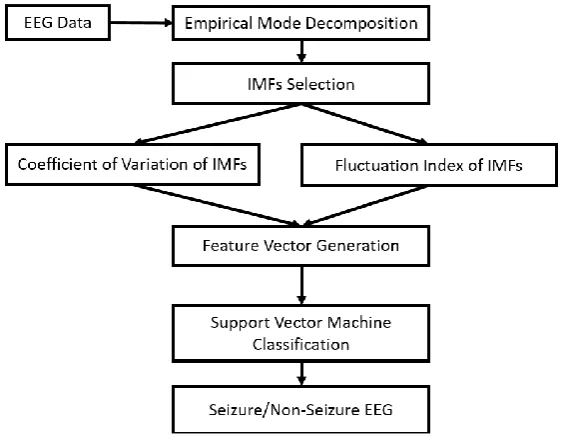
In this paper, we presented a performance evaluation study of SVMkernel functions in epileptic seizure detection using time-domain features of EEG. First, we decomposes EEG epochs with EMD and get several IMFs and selected first five. Secondly, time-domain features coefficient of variation and fluctuation index are calculated from those selected IMFs and generated feature vector from those features. Finally, the feature vector is fed into the SVM classifier with different kernel function and evaluate their performanceson epileptic seizure detection problem. The block diagram of the experiment details is illustrated in Fig. 1.
Figure 1: Block diagram of the experiment
II.
DATA AND METHODS
2.1 Dataset
Figure 2: Sample EEG epoch from each set (A – E)
2.2 Method
2.2.1 EEG Decomposition
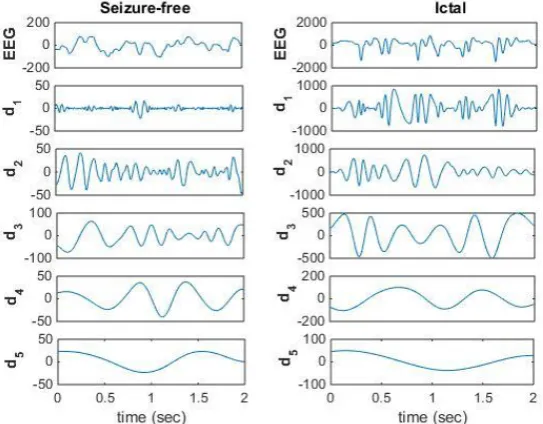
In 1998, N E Huang and et al. developed an adaptive time-space analysis method called Empirical Mode Decomposition (EMD) that get its popularity for analyzing non-linear, non-stationary data series like seismic signal, EEG, EMG etc. effectively [12]. EMD decomposes a series into a group of ‗modes‘ called Intrinsic Mode Function (IMF). Several studies in last few years have used EMD to analyze real world data because of its adaptability, and stochastic nature [13] [14].For a given signal 𝑥(𝑛), EMD can be represented as [15]:
𝑥 𝑛 = 𝑟𝑀 𝑛 + 𝑀𝑘=1𝑑𝑘(𝑛) (1)
Where 𝑟𝑀(𝑛) represents residual and the IMFs {𝑑𝑘(𝑛), k=1, 2, ... , M } are constrained to be zero-mean
AM-FM waveforms [16].Fig. 3 shows extracted IMFs from ictal (seizure) and interictal (seizure-free) EEG epochs by using EMD.
2.2.2 Feature Extraction
Extraction of effective discriminating features contribute significantly to the classifier‘s performance. Statistical features like mean (𝜇), median, variance (𝜎2), standard deviation (𝜎), coefficient of variation (𝑉
𝑐) and
fluctuation index(𝐹𝑖) have already been used in several cases to classify EEG events [17]. Here we have used
coefficient of variation and fluctuation index as distinguishing feature for the seizure event detection from EEG.
2.2.2.1 Coefficient of Variation
The amount of variation in signal amplitude can be easily quantified by coefficient of variation. During epileptic seizure, a large amount of electrons discharge in cerebral cortex which cause a great amount of variation in EEG signal amplitude in a regular basis. That causes a higher𝑉𝑐 in epileptic EEG compare to
interictal/seizure-free EEG signal.
The coefficient of variation𝑉𝑐for one IMF (𝑑) is defined as[17]:
𝑉𝑐= 𝜎
𝜇 (2)
Where 𝜇 and 𝜎:
𝜇 = 1
𝑁 |𝑑(𝑗)|
𝑁−1
𝑗 =0 (3)
𝜎 = 1
𝑁 (𝑑 𝑗 − ( 1
𝑁) 𝑑(𝑗)
𝑁−1
𝑗 =0 )2
𝑁−1
𝑗 =0 (4)
Here 𝑁 is the length of IMF 𝑑.
2.2.2.2 Fluctuation Index
Fluctuation index is a statistical tool to measure the intensity of signal change. Frequent amplitude changing signal have higher fluctuation index. Due to the abnormal firing in neurons during seizures, epileptic EEG has more fluctuations than the seizure-free EEG. That results ictal EEG have higher fluctuation index compared to normal EEG.
The fluctuation index 𝐹𝑖 can be defined as [17]:
𝐹𝑖 = 1
𝑁−1 |𝑑 𝑗 + 1 − 𝑑(𝑗)|
𝑁−2
𝑗 =0 (5)
Where 𝑑 is one of the IMFs with length 𝑁.
2.2.3 Support Vector Machine Classifier
Support vector machine (SVM) is a type of supervised classifier with associated learning algorithm. It was developed in 1995 by C. Cortes and V. Vapnik [18]. Its ultimate goal was to find a hyperplane in a𝑁
dimensional space (𝑁 number of features) that will distinctly classify the data points. Fig. 4 illustrates the working principle of SVM with features 𝑋1 and 𝑋2. A set of mathematical functions that are used by SVM
algorithms to take data as input and transform it into desired form is called Kernel function. In this paper, performances of the SVM based classifier have measured with different kernel functions are shown in Table I.
Figure 4: Working principle of support vector machine [19]
Table I: Support Vector Machine Kernel Selection for Experiments
Experiment No.
Kernel Function
1 Radial Basis Function (RBF) 2 Linear
3 Polynomial
III.
EXPERIMENT RESULTS AND DISCUSSIONS
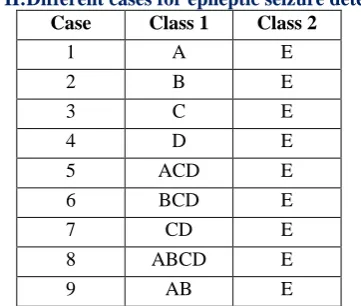
To evaluate the performanceof the classifier, we have divided our experimental dataset into nine groups, each one called ‗case‘. Table II shows the nine cases generated for epileptic seizure detection experiment.
Table II:Different cases for epileptic seizure detection
Case Class 1 Class 2
1 A E
2 B E
3 C E
4 D E
5 ACD E
6 BCD E
7 CD E
8 ABCD E
9 AB E
The performance of the SVM classifier is quantified by three commonly used statistical parameters called sensitivity (𝑆𝐸𝑁), specificity (𝑆𝑃𝐸) and accuracy (𝐴𝐶𝐶) which can be defined as:
𝑆𝐸𝑁 = 𝑇𝑃
𝑇𝑃+𝐹𝑁× 100 (6)
𝑆𝑃𝐸 = 𝑇𝑁
𝑇𝑁+𝐹𝑃× 100 (7)
𝐴𝐶𝐶 = 𝑇𝑝+𝑇𝑁
𝑇𝑃+𝑇𝑁+𝐹𝑃+𝐹𝑁× 100 (8)
Where
𝑇𝑝= total number of epileptic EEG epochs that are correctly detected as
epileptic
𝑇𝑁= total number of seizure-free (interictal) EEG epochs that are correctly
detected as seizure-free (interictal)
𝐹𝑃 = total number of seizure-free (interictal) EEG epochs that are
erroneously detected as epileptic
𝐹𝑁 = total number of epileptic EEG epochs that are erroneously detected as
seizure-free (interictal)
𝐾-fold cross validation is widely used in several studies to minimize the biasness in the experimental process. Here 𝐾 = 5 is taken into account for our experiments [20]. The final classification performance is calculated by averaging the results of 𝐾 folds. The EEG epoch size is considered 10 second because of the clinical applications. Each EEG channel is dividedinto a number of frames with significant amount of portion is overlapping between consecutive frames [21].
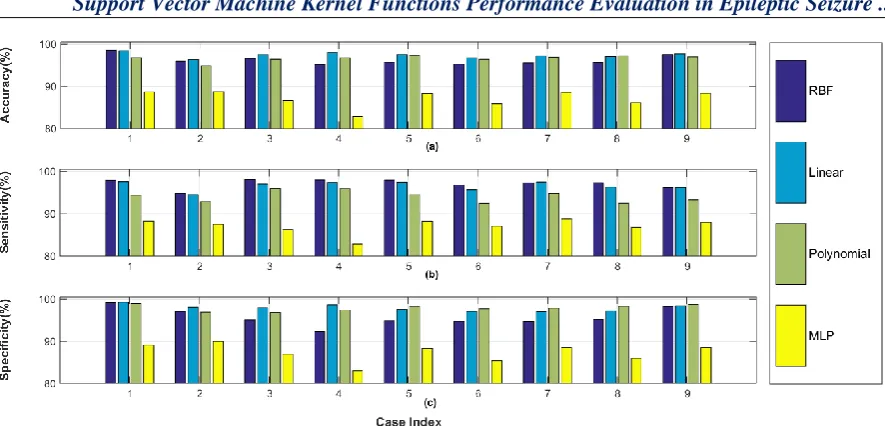
According to our experimental outcome, the performance of different SVM kernel functions in epileptic seizure detection are shown in Fig. 5 and summarizes in Table III and IV. The maximum and minimum accuracy is 98.55% (case 1) and 82.88% (case 4) by RBF and MLP kernel, respectively. The highest average accuracy is 97.38% for Linear kernel, where the second highest one is 96.59% for Polynomial kernel. The average accuracy is taken over all the nine cases.
Figure 5: Performance comparison of SVM kernel functions using statistical parameters (a) accuracy (b) sensitivity and (c) specificity
Table III: SVM Kernel Functions Accuracy in Different Cases
Case Index
SVM Kernel Function
RBF Linear Polynomial MLP 1 98.55 98.43 96.72 88.69 2 95.92 96.33 94.84 88.74 3 96.57 97.53 96.40 86.64 4 95.13 98.03 96.70 82.88 5 95.65 97.55 97.36 88.25 6 95.23 96.71 96.40 85.84 7 95.51 97.16 96.84 88.60 8 95.58 96.99 97.16 86.10 9 97.57 97.70 96.92 88.30
Avg. Accuracy 96.19 97.38 96.59 87.12
Table IV:SVM Kernel Functions Average Sensitivity and Specificity in Different Cases
Parameter
SVM Kernel Function
RBF Linear Polynomial MLP
Avg. Accuracy 96.19 97.38 96.59 87.12
Avg. Sensitivity 97.17 96.65 94.09 87.09
Avg. Specificity 95.68 97.92 97.90 87.30
IV.
CONCLUSIONS
International organization of Scientific Research
30 | Page
REFERENCES
[1] F. Mormann, R.G. Andrzejak, C.E. Elger, K. Lehnertz, ―Seizure prediction: the long and winding road,‖ Brain 130 (2) (2007)314–333.
[2] H. Witte et al, ―Special issue on epileptic seizure prediction, IEEE Transactions on Biomedical Engineering, vol. 50, no. 5, pp. 537–539, May 2003.
[3] J. Gotman, ―Automatic recognition of epileptic seizures in the EEG,‖ Electroencephalogr. Clin. Neurophysiol. 54 (5) (1982) 530 – 540.
[4] Ali Shoeb, John Guttag, ―Application of Machine Learning To Epileptic Seizure Detection,‖ ICML'10 Proceedings of the 27th International Conference on International Conference on Machine Learning, Pages 975-982, Haifa, Israel — June 21 - 24, 2010.
[5] R. Panda, ―Classification of EEG Signal Using Wavelet Transform and Support Vector Machine for Epileptic Seizure Diction,‖ International Conference on Systems in Medicine and Biology, IIT Kharagpur, India, 16-18 December 2010.
[6] Y. Tang, D.M. Durand, ―A tunable support vector machine assembly classifier for epileptic seizure detection,‖ Expert Systems with Applications, 39 (2012) 3925–3938.
[7] Y. Kumar, M. L. Dewal, R. S. Anand, ―Epileptic seizure detection using DWT based fuzzy approximate entropy and support vector machine,‖Neurocomputing 133 (2014) 271–279.
[8] M. H. Kolekar, D. P. Dash, ―A Nonlinear Feature based Epileptic Seizure Detection using Least Square Support Vector Machine Classifier,‖ TENCON 2015-IEEE Region 10 Conference, Page 1-6, 2015.
[9] Kai Fu, Jianfeng Qu, Yi Chai, Tao Zou, ―Hilbert marginal spectrum analysis for automatic seizure detection in EEG signals,‖ Biomedical Signal Processing and Control 18 (2015) 179–185.
[10] M. A. B. Altaf, J. Yoo, ―A 1.83 μJ/Classification, 8-Channel, Patient-Specific Epileptic Seizure Classification SoC Using a Non-Linear Support Vector Machine,‖ IEEE Transactions On Biomedical Circuits And Systems, 2015.
[11] R. G. Andrzejak, K. Lehnertz, F. Mormann, C. Rieke, P. David, and C. E. Elger, ―Indications of nonlinear deterministic and finite-dimensional structures in time series of brain electrical activity: dependence on recording region and brain state,‖ Physical Review E, vol. 64, December 2001.
[12] Huang NE, Shen Z, Long SR, Wu MC, Shih HH, Zheng Q, Yen NC, Tung CC, Liu HH (1971). "The Empirical Mode Decomposition and the Hilbert Spectrum for Nonlinear and Nonstationary Time Series Analysis,‖Proceedings of the Royal Society of London A. 454 (1971): 903–995.
[13] M.K.I. Molla, M. R. Islam, and T. Tanaka, andT. M. Rutkowski, ―Artifact suppression from EEG signals using data adaptive time domain filtering,‖ Neurocomputing, vol. 97, pp. 297-308, Nov. 2012. [14] M. E. Hamid, M.K.I. Molla, X. Dang, T. Nakai, ―Single channel speech enhancement using adaptive
soft-thresholding with bivariate EMD,‖ Hindawi Publishing Corporation, ISRN Signal Processing, Article ID 724378, 2013.
[15] K. M. Hassan, M. E. Hamid and T. Nakai, ―An Improvement in Representation of Audio Signal in time-frequency Plane using EMD-2TEMD Based Approach,‖ Rajshahi University Journal of Science \& Engineering, Vol. 44, Page. 141-150, 2016.
[16] P. Flandrin, G. Rilling, and P. Gonqalves, ―Empirical mode decomposition as a filter bank,‖ IEEE Signal Processing Letters, vol. 11(2), 2004.
[17] S. Li, W. Zhou, Q. Yuan, S. Geng, and D. Cai, ―Featureextraction and recognition of ictal eeg using EMD and SVM,‖ Computers in Biology and Medicine, vol. 43, no. 7, pp. 807– 816, August 2013. [18] C. Cortes and V. Vapmnik, ―Support-Vector Networks,‖ Machine Learning, vol. 20, no. 3, pp.
273-297,1995.
[19] https://www.aitrends.com/ai-insider/support-vector-machines-svm-ai-self-driving-cars
[20] K. M. Hassan, M. R. Islam, T. Tanaka, and M. K. I. Molla, ―Epileptic seizure detection from EEG signals using multiband features with Feedforward neural network,‖ Cyberworlds 2019, Kyoto, Japan (in press).
[21] K. M. Hassan, M. E. Hamid, and M. K. I. Molla, ―A method for voiced/unvoiced classification of noisy speech by analyzing Time-Domain features of spectrogram image,” Science Journal of Circuits, Systems and Signal Processing, vol. 6, no. 2, pp. 6–12, 2017.
![Figure 4: Working principle of support vector machine [19]](https://thumb-us.123doks.com/thumbv2/123dok_us/7799288.1660035/4.595.81.531.425.775/figure-working-principle-support-vector-machine.webp)