The Project Management Process in the Australian Construction Industry
Dr. Richard Fulford
Senior Lecturer
Member, Centre for Innovative Practice School of Business and Law
Edith Cowan University 270 Joondalup Drive Joondalup WA 6027, Australia
Phone: +61 8 6304 5256 Email: [email protected]
Australia
Abstract
Project management in the construction industries of Australia, the USA and many other nations has not resulted in substantial industry productivity improvement for three decades. This paper examines the project management process in the Australian construction industry. Specifically, using a process philosophy approach, the ‘mode’ of project management is outlined and the forces that impel the industry to operate as it does are explained. The paper concludes that for productivity to improve there needs to be a significant change in process, and for this to occur there will need to be alterations in the forces that influence the process.
Keywords: construction industry, construction projects, process philosophy, productivity
Introduction
The Construction industry represented an 8.4% share of total Australian gross value add (GVA) in 2012–13 and since 2007–08 its share has grown significantly (Australian Bureau of Statistics, 2015a). This is mainly due to growth in construction services and heavy and civil engineering construction. However, construction projects are often over budget and late (Fulford and Standing, 2014). Of more concern, is the almost static multi-factor productivity (MFP) in the industry over the last 30 years and that MFP fell by -2.3% in 2014-2015 (Australian Bureau of Statistics, 2015b).
The Australian Bureau of Statistics ascribe the poor productivity to “an increased reliance on intermediate inputs, relative to primary inputs, in the production process” and “the strong growth in intermediate inputs services suggests this decline was due to a change in the way labour is hired, with an increased preference for subcontracted labour services.”(Australian Bureau of Statistics, 2015a).Process philosophers ascribe that it is reasonable to operate in matters of judgments if the subject is not working within the general standards of
our time (Rescher,2006), as construction industry productivity improvement, particularly with regard to capital inputs, has been lower than numerous other industries for many years, it is an applicable philosophy to study the phenomenon.
This paper follows the principles of process philosophy (Helin, Hernes, Hjorth,&Holt, 2014) whereby maintaining an openness the construction project process are reconsidered. The approach is a teleological (Rescher, 2006) one whereby the objective is to improve construction project productivity. The specific elements of process philosophy are “force” and “potentiality” (Helin, et al. 2014, p.5).
The paper comprises an explanation of the application of process philosophy in this research, research questions and method, a‘mode’ of process for
construction project management, proposed forces that influence the industry and potential improvements.
Process Philosophy
view of a phenomenon (Holt, Hernes, Helin, Hjorth, 2014). It views elements as being in a sequence that can be ascertained and delineated. “To be concerned with the process is to take seriously how objects, actions, and settings are continually being made and remade through practical actions”(Helin, Hernes, Hjorth,&Holt, 2014,p.465).
Process philosophy is often described as a broad church (Rescher, 2006) but it is also an umbrella term for a comprehensive domain of theoretical approaches (Hampe,2004).Resche r(2006) states that “process philosophy is a complex and prismatically many-sided project that results in an attempt to fence it in neatly and narrowly in the pre-established program holes of
philosophical textbook typology. The fact of the matter is that process philosophy is as complex and many-sided as to send forth its tentacles into every area of philosophical concern” (p.32).
There are two principal views of process philosophy; teleological and naturalists(Rescher,2006). The naturalist's view is that it is a natural process whereby things occur none objectively, whereas the teleological view sees processes as objective and that influences can vary the processes to change the outcomes (Rescher, 2006). As PM effort is coordinated to reach a particular goal or perform some specific function and is a means-end paradigm with a strong emphasis on goal seeking (Pollock, 2007), a teleological stance has been adopted.
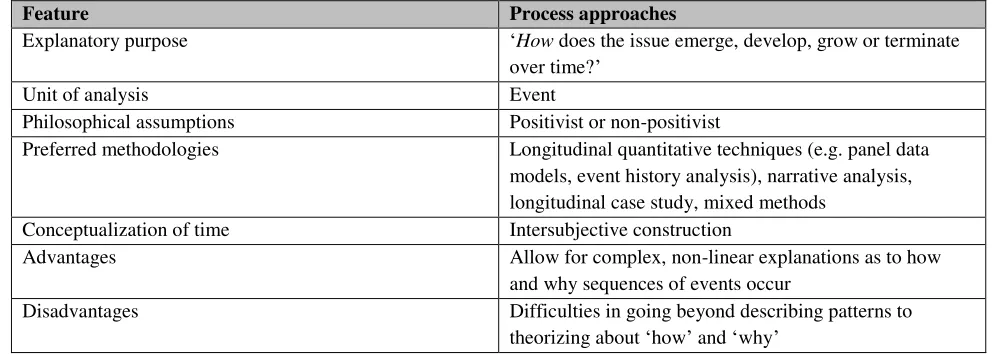
Table 1. Process Philosophy Approach. Adapted from Welch and Paavilainen-Mäntymäki (2014)
This research follows the tenant that process philosophy has two types of questions: 1. “what sort of thing something is”; 2. “how it developed” (Rescher, 2006 p. 1).
Research Method
The research questions that guided this research are as follows:
1. What is the ‘mode’ of project management in the construction industry?
2. What forces, external and internal, shape the project management process?
3.What changes might increase industry-level productivity?
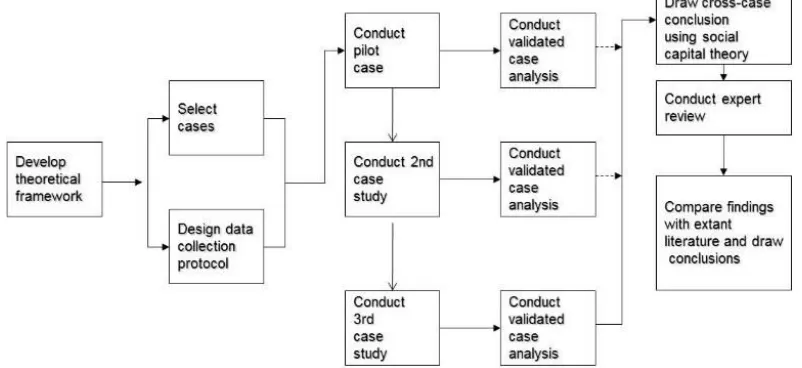
The research to understand the “mode” of project management processes comprises three case studies of large construction organizations. The analysis
consisted of interviews that explicated the project management process. The method was based on structured case analysis (Carrol and Swatman,2000). Figure 1. depicts the structured case method that was followed in this research.
Feature Process approaches
Explanatory purpose ‘How does the issue emerge, develop, grow or terminate over time?’
Unit of analysis Event
Philosophical assumptions Positivist or non-positivist
Preferred methodologies Longitudinal quantitative techniques (e.g. panel data models, event history analysis), narrative analysis, longitudinal case study, mixed methods
Conceptualization of time Intersubjective construction
Advantages Allow for complex, non-linear explanations as to how and why sequences of events occur
Figure 1. Study method
The findings and processes derived from the case studies were reviewed by a panel of industry experts to ensure that the processes posited are accurate and are able to form the basis for a normalized view. The research took Mishler’s(1990) approach that assessments do not occur simply by following procedures but by investigators’ and participants’ judgments.
Project Actualisation
Projects are conceived in many ways. They might be proposed by the government for constructions such as schools, incremental infrastructure development, from organizations such as providers of commodities, long-term Greenfield projects for major resource projects or smaller constructions for residential or commercial buildings. The following procedures concern the first three types of construction: government, infrastructure or major Greenfield construction, and are the generalized processes involved in the construction of these projects.
The client will usually generate an internal capital expenditure request including cost and benefits. The costs are often identified by an analogous or parametric estimating process. The benefits are presented as net present value or internal rate of return valuations. Intangible benefits are not regularly identified.
The next stage is either a tender process where a document, such as the invitation to tender (ITT) or request for proposal (RFP) are produced and distributed, or an internal department will be allocated to manage the project, this generally being an internal program/project management office(PMO). The PMO generally does not have the capability to complete the project and will sub-divide the project into major elements. For large Greenfield infrastructure projects, the breakdown is from a program of works to a number of projects. Each project might be valued in tens of millions of dollars. These sub-elements will then generally become RFPs.
take-offs’. The next stage of the process is to break down the project into distinct work packages such as concrete, plumbing, and formwork. Bills of quantity for the works will then be identified. For major projects, the elements of work will be broken-down into smaller elements and RFPs for these elements produced. The research indicated that for very large projects this might happen up to 12 times with ITTs or RFPs produced at more granular levels through the network of sub-contractors.
Ultimately, a design team identifies contractors who are local to the proposed construction site or ones that are prepared to travel and then request tenders for the works. The contractor that undertakes the work may or may not supply materials. The general approach is for three contractors to quote for each element of work. The total cost is derived from a total of the sub-contractors’ cost and standard costs for certain works; concreting being an example, thereby creating a bottom-up budget for the project. The universal selection criteria for contractors to perform the work are the lowest cost. Other consideration includes OH & S record and the probability that they will be able to undertake the work.
One impediment to the process is that the rough order of magnitude (ROM) can be assigned to estimates at each level of the sub-contractor chain. The ROM is incremented through the chain of contractors, creating an exponential impact upon budgeted cost. This is more noticeable when a project is to be completed at a later date due to the potential for exchange rate and commodity price variations.
Another major restriction to the process is the need for work to be guaranteed by contractors. All contracts require a security guarantee that acts as customer retention. This generally takes the form of a bank guarantee but may also be a bond or insurance contract. The cost of the guarantee is included in the estimate and usually passed onto the customer as a cost of the project. The guarantee is generally 5% to 10% of the project value for the duration of the project, and 50% of the original guarantee for a defects liability period. Contractors have a capped amount they can guarantee which is generally derived from the organization’s asset value. This might become a consideration for the projects they can bid for, as when projects are under guarantee, only the residual amount
of the total guarantee value is available for future projects.
When a proposal is accepted, the chain of sub-contractors and sub-contractors are selected and work then commences. Interestingly, the subcontractors selected may differ to the ones involved in the bid process. The number of personnel on-site from the main contractor varies, but it is generally only small percentage of the overall project team. For example there are between one and three for the construction of a school. It is the contractor who proposes how the work will be measured in terms of percentage of complete. Earned value management calculations are rarely used. Rather the general approach is a physical review of completed work on the Friday of each week.
Depending upon the nature of the contractor, payments will be made on a time and material basis, stage payments or milestone payments. These may differ between client and main contractor, sub-contractor and sub-sub-contractor and sub-sub-contractor and contractor. The main sub-contractor is generally cash flow positive as they usually receive a mobilisation payment of between 5% and 10% of the works. However, cash flow through the remainder of the chain is much less certain.
The percentage complete for project activities is amalgamated across activities through the sub-contractor chain to create an overview of the project. Data is not standardized and spreadsheets are generally used to parse cost information for both the depth and breadth of the project activities. The projects are assessed against timelines and budgets using Gantt charts. Cost baselines are produced from an amalgamation of schedule and cost. Risk assessment is undertaken in terms of late completion and crashing of activities occurs when necessary.
Procurement is difficult to generalize as it changes on a project-by-project basis and differs within projects due to sub-contractor and contractor preferences. There was no evidence of centralized procurement in terms of a team purchasing the majority of the materials for a construction. There was also no evidence of long-term supplier partnerships. Procurement may occur at the lowest level, with the contractor who is undertaking the work of purchasing the material, or with any of the sub-contractors higher up the chain potentially undertaking procurement.
As components of projects are completed, they are capitalized as a financial asset or “traded” to the profit and loss account. The values are accrued from work in process to capital accounts in the balance sheets or traded as a percentage of complete to cost of goods sold, with according revenue accruals made to recognize profit. This process continues throughout the
project and is dependent upon the percentage complete being reported accurately. At times, projects “can go backwards” whereby if work has been miscalculated or an element fails, the percentage complete is reduced and as a result capital value or profit reduces. Organizations have much latitude in percentage complete calculations and it is quite possible to over or understates percentage complete
The way in which contingencies for cost are managed varies from organization to organization but the general approach is for a project to have an overall contingency. Contingencies, as with ROM, can accumulate
through the sub-contractor network and become
overstated.
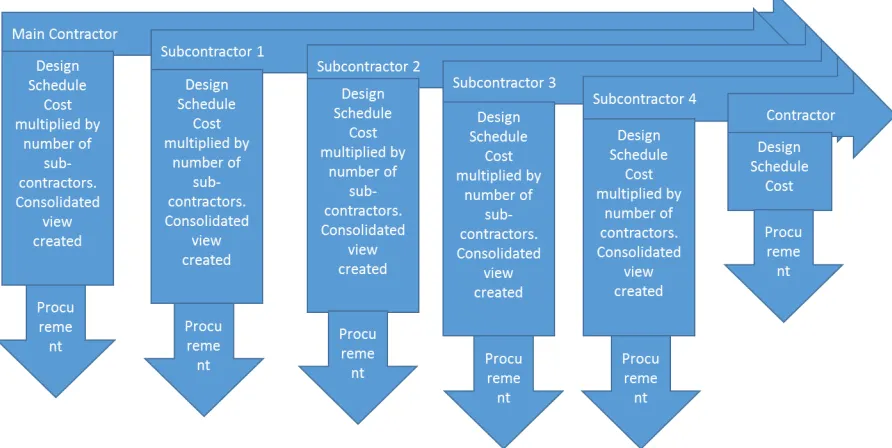
Figure 2, shows the network of a main contractor, four levels of sub-contractors, and contractors, as well as some of the tasks they perform.
Figure 2. Construction Industry Network
Abstraction
The following is a “temporal contextualization” (Rescher, 2006, p. 35) critique of the processes and influences of project management in the Australian construction industry.
The increase in use of sub-contractors is proposed to be caused by the risks that are inherent in the cyclic nature of the industry. The causes of the cycles are macro-environmental, such as: exchange rates, economic changes fluctuations, commodity price
alterations and, to a lesser degree, political policy. Put simply, organizations do not hire ongoing staff due to the implications of having fixed cost in an industry with a high-level of fluctuation of demand. As the cost of sub-contracting is passed onto the client, the approach has become normalized.
significantly to project cost but does not appear to add similar value. The administrative overhead of this practice was estimated by Woodside Energy Ltd chief executive Peter Colemantobe 35% of major constructions (Garvey, 2013). It also adds to the uncertainty of project outcomes (Atkinson,Crawfordand Ward, 2006).
The process of having 12 competitors creating designs and estimates to an intricate level is yet another practice that adds cost but little value. Obviously, only one in 12, or 8%, of the proposed bids is actually accepted, with the remaining 92%being superfluous in terms of value add. The industry absorbs this cost and must recoup it in won projects. It is difficult to determine the cost of project design as a percentage of the overall project cost. Design consists of architecture, structural engineering, services engineer, take-offs and quotes from three suppliers for each element of work. The panel estimated the cost of design to be between 2% and 6% of the total cost. Taking a mid-point of 4%, and 11 lost bids, this process increases industry project cost by 44% with that cost adding no value. The cause appears to be the accepted tender process which seems to be driven by the desire to have alternative designs and a focus on low cost.
The preference for low cost has a major impact on the industry but also other industries. One of the companies contributing to the research explained that a pipeline for gas, which was manufactured in China, it was found to have many small cracks that “cost millions of dollars to locate and weld” and “it would have been much cheaper to buy the pipe locally”. Aninfluence is proposed to be the lack of ongoing ownership of the project by the organizations that provide the project and benefit analysis techniques, which do not sufficiently incorporate cost of ownership.
It is ceteris paribus that there is a consequence for other industries, as the lowest cost process is likely to require the client to perform more maintenance and to have a greater number of service intervals than they might have if there was a greater emphasis on lifecycle costing. The construction industry is, therefore, not absorbing all of its cost and this is impacting productivity in other industries.
The disparate nature of information systems is in contrast to industries that have had improvement in MFP. The productivity improvements gained by organizations implementing ERP applications in the
early1990’s and industry level productivity improvements created by ERP II, which integrated supply chains, in the late 1990’s, have not occurred in the construction industry. Building information modeling applications that have been recognized by governments in other countries, such as the United Kingdom, as being critically important are not being extensively utilized.
There is not a holistic IS solution available that enables project management of large-scale construction projects. “In many project environments, change is common or even constant” (Pollock, 2007, p.271). The continuing maintenance of disparate systems causes unnecessary administrative overhead and has the consequence of misalignment. The cause for the number of systems is difficult to identify but the following elements are believed to be contributors: (1) the tasks of design, costing and scheduling are seen as distinct activities (Atkinson, Crawford and Ward, 2006); (2) the layering of sub-contractors makes IS solutions difficult to build and administer; (3) the industry has “weak” social capital and is highly fragmented; (4) there is a lack of IT capital and technical knowledge (5) there is a lack of awareness of the requirements by major IS vendors.
The lack of maturity of relationships is highlighted by methods of progress reporting. A comparison can be made between the practice in the retail industry, whereby suppliers restock shelves and then invoice, with the reconciliation taking place when products are sold, and with the practice in the construction industries whereby a physical progress check occurs on a Friday indicating the potential for change. The extent of productivity lost on a Friday, due to this practice, and the consequence upon the activities that occur on a Friday are potentially enormous. Simply visiting construction sites on a Friday afternoon is enough to make one believe that much time is being lost to the industry on this day. To sum-up, the process groups can be described as having the following characteristics:
Planning- duplication of effort Executing- cost focused
Monitoring and Controlling-disparate information
Proposition
It is outside of the bounds of this paper to identify major economic and cultural changes for Australia. Nonetheless, it is important to recognize that short-term projections brought about by shareholder led institutions, political change and economic cycles are creating an emphasis for the Australian construction industry that is restricting productivity. A change in process whereby the ultimate client is involved earlier would improve matters considerably, particularly if there was further emphasizes on lifecycle costing.
Main contractors need to be more risk adverse by increasing direct personnel. Contractors need to change their emphasis, as has happened in other industry supply chain initiatives, to focus on quality and reduction of end-user cost through collaborative innovation. This should also include more focus on value adding activities and analysis of the “value” of indirect activities.
The external influences would be improved if the Australian Government edicts the use of BIM systems as has been done in the United Kingdom. This would create a standard for the industry and would also provide the basis for standardization of information. Nonetheless, BIM systems are not, as yet, transactional systems. Other systems, such as ERP, need to develop in order to support the industry. There are two thrusts to this development: 1. Integration of schedule, cost and procurement processes; 2. Integration of the sub-contractor network.
It is important to develop knowledge sharing, trust and cultural aspects of inter-firm relationships (Soderlund, 2004). The lack of information system integration is causing the partnership concepts that are apparent in other industries such as retail and manufacturing, to be lost to the industry. The creation of a platform that enables the integration of design, cost, schedule and accounting across multiple organizations would appear to have tremendous benefits in terms of both efficiency and effectiveness, not least in the potential to improve social capital within the industry, particularly as the industry has been found to be wanting
in terms of social capital (Huang and Newell, 2003; Fulford and Standing, 2014).
The improvements would lead to process groups having the characteristics as follows:
Planning-partnerships, single project view, increased social capital
Executing-partnerships, cohesive procurement, single system
Monitoring and Controlling-standardized information, trust
Closing-cohesive lessons learnt, reduction in cost
Conclusion
The project management body of knowledge contains many exemplary processes for managing projects and importantly highlights the need for lifecycle costing. This paper is part of a process to address the research agenda proposed by Winter Smith, Morris, and Cicmil (2006) to reflect upon the social processes, value creation and project conceptualization in order to create knowledge perceived as useful by practicing managers. The following are recommendations for improvement to practice:
increased direct personnel at main contractors, ongoing partnerships between clients and main
contractors,
partnerships between contractors and suppliers, an emphasis on lifecycle costing,
more focus on value adding activities, an increase in social capital,
cultural change, particularly in terms of a focus on low cost and win/lose relationships,
an increase in the use of building information modeling (BIM) applications,
References
Atkinson, Roger, Crawford, Lynn and Ward, Stephen (2006) Fundamental uncertainties in projects and the scope of project management. International Journal of Project Management,24, (8), 687-698.
Australian Bureau of Statistics, (2015a). 5260.0.55.003 - Information Paper: Experimental Estimates of Industry Level KLEMS Multifactor Productivity,
http://www.abs.gov.au/AUSSTATS/[email protected]/DetailsPage/5260.0.55.0032015?OpenDocument
Australian Bureau of Statistics(2015b). Retrieved July 14. http://www.abs.gov.au/ausstats/[email protected]/mf/5260.0.55.002
Carroll, J. M. and Swatman, P. A. (2000), "Structured Case: A Methodological Framework for Building Theory in Information Systems Research”. ECIS 2000 Proceedings. Paper 42. http://aisel.aisnet.org/ecis2000/42.
Cicmil, S., Williams, T., Thomas, J., & Hodgson, D. (2006). Rethinking project management: researching the actuality of projects. International Journal of Project Management, 24(8), 675-686.
Fulford, R.; Standing, C. (2014). Construction industry productivity and the potential for collaborative practice. International Journal of Project Management. 2014, 32, 315–326.
Garvery, P. (2013). Miners Blamed For Cost Blow Out. The Australian (newspaper), December 24 Business Section, P.1.
Hampe, Michael (2004). History of process philosophy: problems of method and doctrine. In Michel Weber (ed.), After Whitehead: Rescher on Process Metaphysics. Ontos Verlag. pp. 7--94.
Helin, J., Hernes, T., Hjorth, D., & Holt, R. (2014). The Oxford handbook of process philosophy and organization studies. London, England: Oxford University Press.
Holt, R., Hernes, T., Helin, J., & Hjorth, D. (2014). Process is How Process Does. In J. Helin, T. Hernes, D. Hjorth, & R. Holt (Eds.), The Oxford Handbook of Process Philosophy and Organization Studies. (pp. 1-16 ). Chapter 1.Oxford: Oxford University Press. (Oxford Handbooks in Business and Management).
DOI: 10.1093/oxfordhb/9780199669356.013.0001
Huang, Jimmy C and Newell, Sue (2003). Knowledge integration processes and dynamics within the context of cross-functional projects. International Journal of Project Management, 21 (3). pp. 167-176.
Mishler, E. G., 1990. Validation in Inquiry-Guided Research: The Role of Exemplars in Narrative Studies. Harvard Educational Review, 60(4), 415.
Pollack, J. (2007). The changing paradigms of project management.International journal of project management, 25(3), 266-274.
Soderlund, J., 2004. On the Broadening Scope of the Research on Projects: A Review and a Model for Analysis. International Journal of Project Management, Volume 22(8), pp. 655–667.
Welch, C. and Paavilainen-Mäntymäki, E. (2014), Putting Process (Back) In: Research on the Internationalization Process of the Firm. International Journal of Management Reviews, 16: 2–23. doi:10.1111/ijmr.12006