Data Leakage Detection and Dependable Storage
Service in Cloud Computing
Chandu Vaidya Simran Saide
Assistant Professor Department of Computer Science & Engineering Department of Computer Science & Engineering Rajiv Gandhi College of Engineering & Research, Nagpur, Rajiv Gandhi College of Engineering & Research, Nagpur, Maharashtra, India
Maharashtra, India
Suyog Chadawar
Department of Computer Science & Engineering
Rajiv Gandhi College of Engineering & Research, Nagpur, Maharashtra, India
Abstract
The field of cloud computing enables users to remotely store their data and enjoy the on-demand high quality cloud applications without the burden of local hardware and software management. Though the benefits are clear, such a service is also relinquishing user’s physical possession of their outsourced data, which inevitably poses new security risks towards the correctness of the data in cloud. A data distributor has given sensitive data to a set of supposedly trusted agents. Sometimes data is leaked and found in unauthorized place e.g., on the web or on somebody's laptop. The owner of the data is called as distributors and the trusted third parties are called as agents. Sometimes the data loss also occurs. Data leakage happens every day when confidential business information such as customer or patient data, company secrets, budget information etc. are leaked out. When this information is leaked out, then the companies are at serious risk. Most probably data are being leaked from agent’s side. So, company has to very careful while distributing such a data to agents. The method of Data leakage detection and Dependable storage service in Cloud computing is simple yet powerful enough to fit the needs of organizations and clients. Keywords: Data integrity, dependable distributed storage, error localization, data dynamics, Cloud Computing, Cryptography, 3 Data Encryption Standard (3 DES), Secure Hashing Algorithm (SHA 1), Message Digest Algorithm 5 (MD5)
________________________________________________________________________________________________________
I. INTRODUCTION
The company's Information security depends on employees by learning the rules through training and awareness-building sessions. However, security must go beyond employee knowledge and cover the following areas such as a physical and logical security mechanism that is adapted to the needs of the company and to employee use then the procedure for managing updates and finally it needs an up to date documented system.
Cloud Computing:
The term “cloud” was coined from the computer network diagrams which use it to hide the complexity of infrastructure involved. Cloud computing provides software, platform and infrastructure as a service. Its main features include resource pooling, rapid elasticity, measured service, on-demand self-service and broad network access. So, a cloud is a collection of hardware, software and services that runs in a data center and enables the cloud computing model.
A cloud reduces capital investment, hardware cost and software license cost. Cloud computing also raises severe challenges especially regarding the security level required for the secure use of services provided by it. There are no publically available standards specific to cloud computing security [1,2,3].
Cloud Computing Architecture:
Cloud computing architecture refers to the components and subcomponents required for cloud computing. These components typically consist of a front end platform (fat client, thin client, mobile device), back end platforms (servers, storage), a cloud based delivery, and a network (Internet, Intranet, Intercloud). Combined, these components make up cloud computing architecture.
Cloud computing architectures consist of front-end platforms called clients or cloud clients. These clients comprise servers, fat (or thick) clients, thin clients, zero clients, tablets and mobile devices. These client platforms interact with the cloud data storage via an application (middleware), via a web browser, or through a virtual session.
Software as a Service:
SasS applications are designed for end-users, delivered over the web. Platform as a Service:
PaaS is the set of tools and services designed to make coding and deploying those applications quick and efficient. Infrastructure as a Service:
IaaS is the hardware and software that powers it all- Servers, storage, networks and operating systems.
Types of Cloud Computing
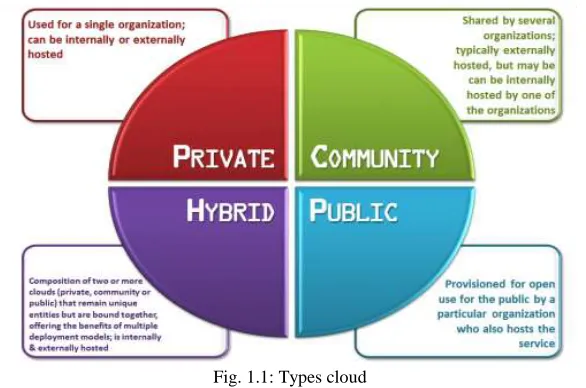
An online network storage where data is stored and accessible to multiple clients, Cloud storage is generally deployed in the following configurations: public cloud, private cloud, community cloud, or some combination of the three also known as hybrid cloud[1,2,3].
This is shown in fig 1.1.
Fig. 1.1: Types cloud
Dependable Storage Service:
Several trends are opening up the era of Cloud Computing, which is an Internet-based development and use of computer technology. The ever cheaper and more powerful processors, together with the software as a service (SaaS) computing architecture, are transforming data centers into pools of computing service on a huge scale. The increasing network bandwidth and reliable yet flexible network connections make it even possible that users can now subscribe high quality services from data and software that reside solely on remote data centers.
Moving data into the cloud offers great convenience to users since they don’t have to care about the complexities of direct hardware management. The pioneer of Cloud Computing vendors, Amazon Simple Storage Service (S3) and Amazon Elastic Compute Cloud (EC2) are both well-known examples [3]. While these internet-based online services do provide huge amounts of storage space and customizable computing resources, this computing platform shift, however, is eliminating the responsibility of local machines for data maintenance at the same time.
As a result, users are at the mercy of their cloud service providers for the availability and integrity of their data. On the one hand, although the cloud infrastructures are much more powerful and reliable than personal computing devices, broad range of both internal and external threats for data integrity still exist. It relies on erasure correcting code in the file distribution preparation to provide redundancies and guarantee the data dependability against Byzantine servers, where a storage server may fail in arbitrary ways.
This construction drastically reduces the communication and storage overhead as compared to the traditional replication-based file distribution techniques. By utilizing the homomorphic token with distributed verification of erasure-coded data, our scheme achieves the storage correctness insurance as well as data error localization: whenever data corruption has been detected during the storage correctness verification, our scheme can almost guarantee the simultaneous localization of data errors, i.e., the identification of the misbehaving servers.
II. CRYPTOGRAPHY
Different types of cryptography can be easier or harder to use and can hide the secret message better or worse. Ciphers use a "key" which is a secret that hides the secret messages. The cryptographic method needn't be secret. Various people can use the same method but different keys, so they cannot read each other's messages.
Triple DES (3DES):
In 1998 a standard ANS X9.52 and named Triple Data Encryption Algorithm (TDEA). 1) Block cipher with symmetric secret key
2) Block length = 64 bits
3) Key length = 56, 112 or 168 bits
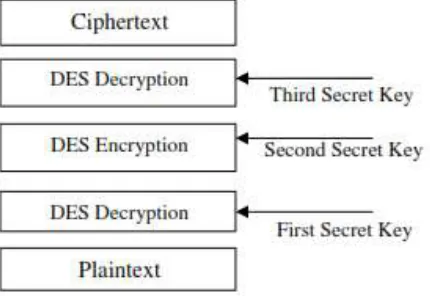
3DES[5] was created because DES algorithm, invented in the early 1970s using 56-bit key. The effective security 3DES provides is only 112 bits due to meet-in-the-middle attacks. Triple DES runs three times slower than DES, but is much more secure if used properly. The procedure for decrypting something is the same as the procedure for encryption, except it is executed in reverse. In DES, data is encrypted and decrypted in 64 -bit chunks. The input key for DES is 64 bits long; the actual key used by DES is only 56 bits in length.
Triple Data Encryption Standard (DES) is a type of computerized cryptography where block cipher algorithms are applied three times to each data block. The key size is increased in Triple DES to ensure additional security through encryption capabilities. Each block contains 64 bits of data. Three keys are referred to as bundle keys with 56 bits per key. \
Fig. 1.2: Block Diagram of 3DES Decryption
The triple DES key length contains 168 bits but the key security falls to 112 bits. There are three keying options in data encryption standards:
1) All keys being independent
2) Key 1 and key 2 being independent keys 3) All three keys being identical
Message Digest Algorithm:
The cryptography is a way of securing message and data over the internet. Data is present on World Wide Web is double day by day to secure these type of data provide a fingerprint for its authenticity.
Message Digest is one way where a master fingerprint has been generated for the purpose of providing a message Authentication code (hash code).
The Data integrity is measured by MD5[6] by the help of 128-bit message, that message is given by user to create a fingerprint message is of variable length; the main thing is that it is irreversible. The Father of this algorithm is Professor Ronald L. Rivets of MIT. This algorithm is best for 32 bit and 16 bit machines the comp-ability of this algorithm can be extended to 64 bit machines also but this type of scheme may be quite slow because of its architecture. MD5 is the extension of MD4 algorithm which is quite faster because of its three rounds and MD5 contains four rounds which makes its slower. It’s a one-way hash function that deals with security features.
Secure Hashing Algorithm :
The SHA[6] Algorithm is a cryptography hash function and used in digital certificate as well as in data integrity. SHA is a fingerprint that specifics the data and was developed by N.I.S.T. as a U.S. Federal Information Processing Standard (FIPS), is intended for use with digital signature applications.
The message which is less than 264 bits in length Secure Hash Algorithm works with that type of messages. Message digest is the output of SHA and length of these type of messages is 160 bits.
III. PROBLEM STATEMENT
As per the literature survey the problems related to the cloud and the supposedly trusted agents are data loss, data leakage and data integrity problems. The organizations which are sensitive towards data cannot afford the events questioning data integrity[4].
Data leakage: If a data distributor has given sensitive data to a set of supposedly trusted agents (third parties). Some of the data is leaked and found in an unauthorized place (e.g., on the web or somebody’s laptop)
Data loss: If the data on the cloud gets deleted or reduced then it is called as data loss.
Thus all the problems with supposedly trusted agents has to be prevented by developing a secure cloud computing system which can detect data loss, data leakage or any events questioning data integrity with a user friendly interface ease of use.
IV. PROPOSED SYSTEM
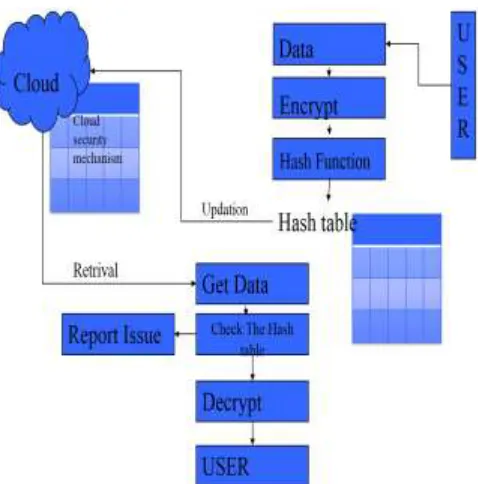
The work has been proposed as per the literature survey, we have decided that the Dependable and secure cloud computing system should be implemented by storage verification schemes or Watermarking to detect data loss incidents and data leakage detection to secure the data of users on cloud.
The data dependable storage services are able to work on any platform. The GUI of the storage system helps in hiding the complexity of the system.
Design Goals:
1) Storage correctness: To ensure users that their data are indeed stored appropriately and kept intact all the time in the cloud.
2) Lightweight: To enable users to perform storage correctness checks with minimum overhead. 3) Methods: We can use any one of the following techniques.
Storage Verification Schemes:
The Hash Table Storage of the outsourced data can be maintained at the user’s end. The name and the size of the file can be taken as hash keys. Using this table, verification of the outsourced data can be done by generating the key and matching with the user’s hash table.
1) Message Digest Algorithm 5 2) Secure Hashing Algorithm 1
Cryptography using 3 DES:
In cryptography, Triple DES (3DES) is the common name for the Triple Data Encryption Algorithm (TDEA or Triple DEA) symmetric-key block cipher, which applies the Data Encryption Standard (DES) cipher algorithm three times to each data block.
The original DES cipher's key size of 56 bits was generally sufficient when that algorithm was designed, but the availability of increasing computational power made brute-force attacks feasible. Triple DES provides a relatively simple method of increasing the key size of DES to protect against such attacks, without the need to design a completely new block cipher algorithm.
V. PROPOSED ARCHITECTURE
Fig: 4.1: Proposed Architecture
VI. DESIGN
Use Case Diagram:
The following diagram shows the clients view towards the software. The client will first have to go through the authentication phase, if the client is an authenticated client then the 3rd party application will allow client to perform operations like uploading and downloading
Fig. 5.1: Use Case Diagram
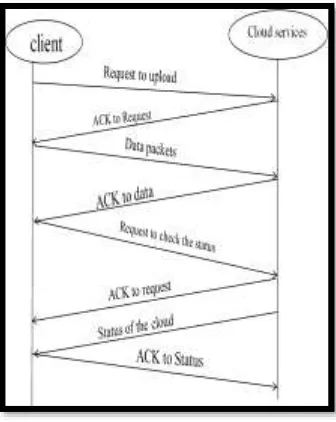
Sequence Diagram:
Fig. 5.2: Sequence Diagram
UML Diagram:
The class Project.php is the main class which implicitly calls the other class in this project. The Project.php makes the call to the Form.php which again makes the call to the Upload.php.
Fig. 5.3: UML Diagram
VII. WORKING
The working of the proposed work is described in 3 modules as follows:
Module 1 -Configuration of cloud
The Xampp has been used to host the cloud server. Xampp provides the Apache and MySQL database. OwnCloud is installed on the xampp and used as the cloud storage.
Module 2 - Cloud as IAAS:
Module 3 -Storage verification scheme and Cryptography:
The Hash Table Storage of the outsourced data can be maintained at the user’s end. The name and the size of the file can be taken as hash keys. Using this table, verification of the outsourced data can be done by generating the key and matching with the user’s hash table.
Storage verification scheme 1) Secure Hashing Algorithm 1) Step 1
Padding
Add Padding to the end of the genuine message length is 64 bits and multiple of 512. 2) Step2
Appending length in this step the excluding length is calculated 3) Step3
Divide the Input into 512-bit blocks in this step we divide the input in the 512 bit blocks 4) Step4
Initialize chaining variables in this step we initializing chaining variables here we initialize 5 chaining variables of 32 bit each=160 bit of total.
5) Step5 Process Blocks
1) Copy the chaining variables 2) Divide the 512 into 16 sub blocks 3) Process 4 rounds of 20 steps each.
MD5 Algorithm:
MD5[2,6] processes a variable-length message into a fixed-length output of 128 bits. The input message is broken up into chunks of 512-bit blocks (sixteen 32-bit words); the message is padded so that its length is divisible by 512. The padding works as follows: first a single bit, 1, is appended to the end of the message. This is followed by as many zeros as are required to bring the length of the message up to 64 bits fewer than a multiple of 512. The remaining bits are filled up with 64 bits representing the length of the original message, modulo 264.
The main MD5 algorithm operates on a 128-bit state, divided into four 32-bit words, denoted A, B, C, and D. These are initialized to certain fixed constants. The main algorithm then uses each 512-bit message block in turn to modify the state. The processing of a message block consists of four similar stages, termed rounds; each round is composed of 16 similar operations based on a non-linear function F, modular addition, and left rotation. Figure illustrates one operation within a round. There are four possible functions F; a different one is used in each round:
Where denote the XOR, AND, OR and NOT operations respectively. Cryptography using 3DES
Triple Data Encryption Standard (DES) is a type of computerized cryptography where block cipher algorithms are applied three times to each data block. The key size is increased in Triple DES to ensure additional security through encryption capabilities. Each block contains 64 bits of data. Three keys are referred to as bundle keys with 56 bits per key[7]. There are three keying options in data encryption standards:
1) All keys being independent.
2) Key 1 and key 2 being independent keys. 3) All three keys being identical.
The triple DES key length contains 168 bits but the key security falls to 112 bits. Algorithm
Run DES three times: ECB mode: If K2 = K3,
This is DES Backwards compatibility known not to be just DES with K4 has 112 bits of security, not 3*56 = 168
Triple DES algorithm uses three iterations of common DES cipher. It receives a secret 168-bit key, which is divided into three 56-bit keys.
- Encryption using the first secret key. - Decryption using the second secret key. - Encryption using the third secret key. Encryption
m = D1 (E2 (D3(c)))
Using decryption in the second step during encryption provides backward compatibility with common DES algorithm. In these case first and second secret keys or second and third secret keys are the same whichever key.
c = E3 (D1 (E1 (m))) = E3 (m) c = E3 (D3 (E1 (m))) = E1 (m)
It is possible to use 3DES cipher with a secret 112-bit key. In this case first and third secret keys are the same. c = E1 (D2 (E1 (m))).
VIII. CONCLUSION
In this paper, we investigated the problem of data security in cloud data storage, which is essentially a distributed storage system. To ensure the correctness of users’ data in cloud data storage, we proposed an effective and flexible scheme with explicit Hashing and security mechanisms. By utilizing the MD5, SHA1 mechanism with 3DES Encryption algorithm, our scheme achieves the integration of storage correctness insurance and data error localization, i.e., whenever data corruption has been detected during the storage correcness verification across the distributed servers, we can almost guarantee the simultaneous identification of corrupted data.
REFERENCES
[1] Chandu Vaidya, Prashant Khobragade,Gaurav Gulhane,Ashish Golghate,"DATA LEAKAGE DETECTION IN CLOUD COMPUTING", International Journal of Pure & Applied Research in Engineering & Technology(IJPRET), ISSN: 1798-1804,Volume 3 (9), April 2016
[2] Chandu Vaidya and Prashant Khobragade, "Data Security in Cloud Computing",International Journal on Recent and Innovation Trends in Computing and Communication, ISSN: 2321-8169Volume:3 Issue:5, PP-167–170
[3] Wenjing Lou, Cong Wang “Towards Secure and Dependable Storage Services in Cloud Computing” IEEE Journal of Computer and Communication, Vol. 95,June 2012
[4] Freeman J., Neely R., and Megalo L. “Developing Secure Systems: Issues and Solutions”. IEEE Journal of Computer and Communication, Vol. 89, PP. 36-45. 1998.
[5] Kartik S., MuruganandamA.“Data Encryption and Decryption by Using Triple DES and Performance Analysis of Crypto System”. International Journal of Scientific Engineering and Research (IJSER), Volume 2 Issue 11, November 2014 Licensed.
[6] Piyush Gupta, Sandeep Kumar ,“A Comparative Analysis of SHA and MD5 Algorithm”. International Journal of Computer Science and Information Technologies (IJCSIT) , Vol. 5 (3) , 2014.
[7] Hamdan.O.Alanazi, B.B.Zaidan, A.A.Zaidan, Hamid A.Jalab, M.Shabbir and Y. Al-Nabhani, “New Comparative Study Between DES, 3DES and AES within Nine Factors”,Journal Of Computing, Volume 2, Issue 3, March 2010, Issn 2151-9617
[8] http://www.dropbox.com/