*Corresponding Author: Dr. Manoj Goyal, Associate Professor,
Dept. of pharmaceutics, IPS College of pharmacy, Gwalior, India
Email: [email protected] Tel. No. +91-9425171687
Review Article
Hydrotropic Solubilization
Priyanka Arjaria
1, Manoj Goyal
2, Suman Jain
31
Shri Ram College of pharmacy,Banmore,Morena, India, 2IPS College of pharmacy, Gwalior, India, 3 SOS Pharama.Scie.,JiwajiUniversity,Gwalior, India
1. INTRODUCTION
Almost more than 90% drugs are orally administered. Drug absorption, sufficient and reproducible bioavailability, pharmacokinetic profile of orally administered drug substance is highly dependent on solubility of that compound in aqueous medium1. It is estimated that 40% of active new chemical entities identified in combinatorial screening programs employed by many pharmaceutical companies are poorly water soluble. Orally administered drugs on the model list of the Essential Medicines of the World Health Organization are assigned BCS classifications on the basis of data available in the public domain2.
1.1 Meaning of Solubility
The term ‘solubility’ can be defined quantitatively as well as qualitatively. Quantitatively it is defined as the concentration of the solute in a saturated solution at a certain temperature. In qualitative terms, solubility may be defined as the spontaneous interaction of two or more substances to form a homogenous molecular dispersion. A saturated solution is one in which the solute is in equilibrium with the solvent3-5.
The pharmacopoeia lists solubility in terms of number of milliliters of solvent required to dissolve 1g of solute. If exact solubilities are not
known, the Pharmacopoeia provides general terms to describe a given range. These descriptive terms are listed in (Table 1)6.
Table-1: Solubility terms as per pharmacopoeia
Descriptive terms Relative amounts of solvents to dissolve 1 part of solute
Very soluble Less than 1
Freely soluble From 1-10
Soluble From 10-30
Sparingly soluble From 30-100 Slightly soluble From 100-1000 Very slightly soluble From 1000-10,000 Insoluble or practically insoluble More than 10,000
1.2 Need of Solubility
Therapeutic effectiveness of a drug depends upon the bioavailability and ultimately upon the solubility of drug molecules. Solubility is one of the important parameter to achieve desired concentration of drug in systemic circulation for pharmacological response to be shown. Currently only 8% of new drug candidates have both high solubility and permeability.Due to advanced research and development, there are varieties of new drugs and their derivatives are available. But more than 40% of lipophilic drug candidates fail to reach market due to poor bioavailability, even though these drugs might exhibit potential pharmacodynamic activities. The lipophilic drug that reaches market requires a high dose to attain proper pharmacological action. The basic aim of the further formulation and developm ent section is to make that drug available at proper site of action within optimum dose7. To increase Abstract
Solubility is the major problem for various drugs in pharmaceutical industry. Many drugs show poor aqueous solubility, which result in poor bioavailability of the drug. Solubility enhancement processes are widely used in pharmaceutical industry to improve the dissolution and bioavailability of poorly water soluble drug. The efficacy of drug response is mainly dependent on dissolution and bioavailability. Almost more than 90% drugs are orally administered. Drug absorption, sufficient and reproducible bioavailability, pharmacokinetic profile of orally administered drug substance is highly dependent on solubility of that compound in aqueous medium. It is estimated that 40% of active new chemical entities identified in combinatorial screening programs employed by many pharmaceutical companies are poorly water soluble. Therapeutic effectiveness of a drug depends upon the bioavailability and ultimately upon the solubility of drug molecules. Solubility is one of the important parameter to achieve desired concentration of drug in systemic circulation for pharmacological response to be shown. Currently only 8% of new drug candidates have both high solubility and permeability. Due to advanced research and development, there are varieties of new drugs and their derivatives are available. But more than 40% of lipophilic drug candidates fail to reach market due to poor bioavailability, even though these drugs might exhibit potential pharmacodynamic activities. Hydrotropy is a unique and unprecedented solubilization technique in which certain chemical compounds termed as hydrotropes can be used to affect a several fold increase in the aqueous solubility of sparingly soluble solutes under normal conditions. This increase in solubility in water is probably due to the formation of organized assemblies of hydrotrope molecules at critical concentrations. A hydrotrope is a compound that solubilizes hydrophobic compounds in aqueous solutions. Typically, hydrotropes consist of a hydrophilic part and a hydrophobic part (like surfactants) but the hydrophobic part is generally too small to cause spontaneous self-aggregation. Hydrotropes do not have a critical concentration above which self-aggregration 'suddenly' starts to occur. Instead, some hydrotropes aggregate in a step-wise self-aggregation process, gradually increasing aggregation size. However, many hydrotropes do not seem to self-aggregate at all, unless a solubilisate has been added.
ISSN (Online) 2249-6084 (Print) 2250-1029
International Journal of Pharmaceutical and
Phytopharmacological Research (eIJPPR)
[Impact Factor – 0.7826]
Journal Homepage: www.eijppr.com
Article info
Article History: Received 2 August 2013 Accepted 25 August 2013
Keywords:
the solubility of poorly water soluble drugs different solubilization techniques have been used.
1.3 Process of Solubilization
The process of solubilization involves the breaking of inter-ionic or intermolecular bonds in the solute, the separation of the molecules of the solvent to provide space in the solvent for the solute, interaction between the solvent and the solute molecule or ion8.
2. HYDROTROPY
Hydrotropy is a unique and unprecedented solubilization technique in which certain chemical compounds termed as hydrotropes can be used to affect a several fold increase in the aqueous solubility of sparingly soluble solutes under normal conditions. This increase in solubility in water is probably due to the formation of organized assemblies of hydrotrope molecules at critical concentrations. Hydrotropes in general are water-soluble and surface-active compounds which can significantly enhance the solubility of organic solutes such as esters, acids, alcohols, aldehydes, ketones, hydrocarbons, and fats9-12.
2.1 Mechanism of Hydrotrope Action
A hydrotrope is a compound that solubilizes hydrophobic compounds in aqueous solutions. Typically, hydrotropes consist of a hydrophilic part and a hydrophobic part (like surfactants) but the hydrophobic part is generally too small to cause spontaneous self-aggregation. Hydrotropes do not have a critical concentration above which self-aggregration 'suddenly' starts to occur. Instead, some hydrotropes aggregate in a step-wise self-aggregation process, gradually increasing aggregation size. However, many hydrotropes do not seem to self-aggregate at all, unless a solubilisate has been added13.
The chemical structure of the conventional Neuberg’s hydrotropic salts (proto-type, sodium benzoate) consists generally of two essential parts, an anionic group and a hydrophobic aromatic ring or ring system. The anionic group is obviously involved in bringing about high aqueous solubility, which is a prerequisite for a hydrotropic substance. The type of anion or metal ion appeared to have a minor effect on the phenom enon. On the other hand, planarity of the hydrophobic part has been emphasized as an important factor in the mechanism of hydrotropic solubilization14, 15. Additives may either increase or decrease the solubility of a solute in a given solvent. These salts that increase solubility are said to ‘salt in’ the solute and those salts that decrease the solubility ‘salt out’ the solute. The effect of an additive depends very much on the influence, it has on the structure of water or its ability to compete with the solvent water molecules16. Other possible mechanisms may be complexation17, changes in the nature or structure of the solvent18.
For aromatic hydrotropes such as nicotinamide, sodium salicylate and sodium p-toluene sulfonate, two main mechanisms have been proposed. One is stacking complexation, and the other is self-aggregation. Strong evidence of complexation between a drug and nicotinamide is that the complexation constants (K1:1 and K1:2) can be obtained from phase-solubility data17, 19. On the other hand, by showing temperature effects on the degree of self-association,
Coffman et al.20 argued that nicotinamide can solubilize riboflavin through a self-aggregation mechanism where aggregates of nicotinamide grow by step wise monomer addition. At low concentrations, dim erization predominates, whereas at higher concentrations, trimerization, tetramerization, and so on, become the predominant equilibria.
2.2 Selection of Hydrotropes for Poorly Water Soluble Drugs In order to select suitable hydrotropes (for sufficient enhancement in solubility) for various poorly water-soluble drugs, an approximate solubility determination method is used. This is a modified form of the m ethod used by Simamora et al. Twenty five ml of distilled water/hydrotropic solution is taken in a 50 ml glass bottle and gross weight (including the cap) is noted. Then, few mg (by visual observation) of fine powder of drug is transferred to the bottle. The bottle is shaken vigorously (by hand). When drug gets dissolved, more drug (few mg by visual observation) is transferred to the bottle and again the bottle is shaken vigorously. Same operation is repeated till some excess drug remained undissolved (after constant vigorous shaking for 10 minutes). Then, again gross weight is noted. From the difference in two readings (of weight), an approximate solubility is determined and solubility enhancement ratios (solubility in hydrotropic solution/solubility in distilled water) are calculated21.
2.3 Advantages of Hydrotropic Solubilization Technique 1. Hydrotropy is suggested to be superior to other solubilization
method, such as miscibility, micellar solubilization, co solvency and salting in, because the solvent character is independent of pH, has high selectivity and does not require emulsification.
2. It only requires mixing the drug with the hydrotrope in water. 3. It does not require chemical modification of hydrophobic drugs,
use of organic solvents, or preparation of emulsion system13.
2.4 Mixed Hydrotropy
Mixed hydrotropic solubilization technique is the phenomenon to increase the solubility of poorly water-soluble drugs in the blends of hydrotropic agents, which may give miraculous synergistic enhancement effect on solubility of poorly water soluble drugs, utilization of it in the formulation of dosage forms of water insoluble drugs and to reduce concentration of individual hydrotropic agent to minimize the side effects in place of using a large concentration of one hydrotrope a blend of, say, 5 hydrotropes can be employed in 1/5th concentrations reducing their individual toxicities.
2.5 Advantages of Mixed Hydrotropic Solubilization
1. It may reduce the large total concentration of hydrotropic agents necessary to produce modest increase in solubility by employing combination of agents in lower concentration.
2. It is new, simple, cost-effective, safe, accurate, precise and environmental friendly method for the analysis (titrimetric and spectrophotometric) of poorly water-soluble drugs titrimetric and spectrophotometric precluding the use of organic solvents. 3. It precludes the use of organic solvents and thus avoids the problem of residual toxicity, error due to volatility, pollution, cost etc22.
2.6 Pharmaceutical Applications of Hydrotropic Solubilization Technique
2.6.1 Quantitative Estimations of Poorly Water Soluble Drugs Various organic solvents like methanol, chloroform, acetone, dimethyl formamide and ethanol have been employed for solubilization of poorly water-soluble drugs to conduct their titrimetric analyses. Drawbacks of organic solvents include their higher costs, toxicities and pollution. Similarly, various organic solvents like methanol, chloroform, ethanol, dimethyl formamide, benzene, hexane, acetone, toluene, carbon tetrachloride, diethyl ether and acetonitrile are widely used in spectrophotometric estimations of poorly water-soluble drugs. Most of these organic solvents are toxic, costlier and sources of pollution. Inaccuracy in spectrophotometric estimations due to volatility of organic solvents is another drawback of these solvents.
worthwhile to make use of hydrotropic solubilization techniques in development of new titrimetric and spectrophotometric methods for the analysis of poorly water-soluble drugs.41
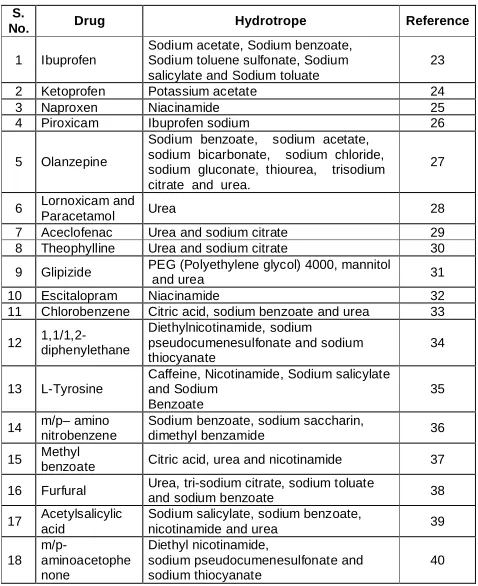
Table 2: Hydrotropic solubilization study of various poorly water-soluble drugs
S.
No. Drug Hydrotrope Reference
1 Ibuprofen
Sodium acetate, Sodium benzoate, Sodium toluene sulfonate, Sodium salicylate and Sodium toluate
23
2 Ketoprofen Potassium acetate 24
3 Naproxen Niacinamide 25
4 Piroxicam Ibuprofen sodium 26
5 Olanzepine
Sodium benzoate, sodium acetate, sodium bicarbonate, sodium chloride, sodium gluconate, thiourea, trisodium citrate and urea.
27
6 Lornoxicam and
Paracetamol Urea 28
7 Aceclofenac Urea and sodium citrate 29 8 Theophylline Urea and sodium citrate 30
9 Glipizide PEG (Polyethylene glycol) 4000, mannitol and urea 31
10 Escitalopram Niacinamide 32
11 Chlorobenzene Citric acid, sodium benzoate and urea 33
12 1,1/1,2-diphenylethane
Diethylnicotinamide, sodium pseudocumenesulfonate and sodium thiocyanate
34
13 L-Tyrosine
Caffeine, Nicotinamide, Sodium salicylate and Sodium
Benzoate
35
14 m/p– amino nitrobenzene Sodium benzoate, sodium saccharin, dimethyl benzamide 36
15 Methyl
benzoate Citric acid, urea and nicotinamide 37
16 Furfural Urea, tri-sodium citrate, sodium toluate and sodium benzoate 38
17 Acetylsalicylic acid Sodium salicylate, sodium benzoate, nicotinamide and urea 39
18 m/p-aminoacetophe none
Diethyl nicotinamide,
sodium pseudocumenesulfonate and sodium thiocyanate
40
2.6.2 Spectrophotometric Estimation of Drugs Determination of Interference of Hydrotropic Agent in the Spectrophotometric Estimation of Drugs
A UV-Visible recording spectrophotometer with 1cm matched silica cells is employed for spectrophotometric determinations. For determination of interference of hydrotropic agents in the spectrophotometric estimation drugs, the absorbances of the standard solutions of drugs are determined in distilled water alone and in the presence of the maximum concentration of the hydrotropic agent employed for spectrophotometric analysis / formulation purpose in the present investigation41.
2.6.3 Regression Equations for Drugs
Stock solution of drug is prepared by dissolving specified quantity of drug in appropriate volume of concentrated aqueous solution of hydrotropic agent and making up the volume by using more water. Stock solution is further diluted with distilled water to get standard solutions containing concentrations of drug in the range of Beers law. Absorbance values of these solutions are noted at λmaxagainst distilled water blank. These values of absorbances of standard solutions are used to obtain regression equation.21
2.6.4 Spectrophotometric Analysis of Marketed Tablet Formulations of Drug using Hydrotropic Solubilization Technique
Twenty marketed tablets of drug are weighed and ground to a fine powder. An accurately weighed tablet powder equivalent to quantity of drug which was used for obtaining regression equation is transferred to a 25 ml volumetric flask. Then volume of aqueous solution of concentrated hydrotropic agent which was used for obtaining regression equation is added and the flask is shaken for about 10 min to solubilize the drug present in tablet powder and the volume is made up to the mark with distilled water. After shaking the volumetric flask to mix thecontents, filtration is done through Whatman filter paper No. 41. Filtrate is collected, rejecting the first few ml and divided in two parts A and B.
Part A is kept at room temperature for 48 h to check its chemical stability and to observe precipitation, if any. Part B filtrate is diluted appropriately with distilled water and is analyzed on UV-spectrophotometer against reagent blank by noting the absorbance at selected wavelength. The drug content of the tablet formulation is calculated using regression equation. After 48h, filtrate of part A is analyzed in the same way, to check the chemical stability of drug in presence of hydrotropic agent. After first analysis, same procedure is repeated for five times more. In these cases, filtrates are not divided in two parts. Filtrates are analyzed in fresh conditions only.
2.7 Recovery Studies of Marketed Tablet formulations Using Hydrotropic Solubilization Technique
In order to validate the proposed method, the recovery studies are performed. For this, preanalyzed tablet powder equivalent to selected quantity of drug is accurately weighed and transferred to a 25 ml volumetric flask. Then, 10 mg of bulk drug sample is added to this volumetric flask, as spiked drug. Then, selected quantity of hydrotropic solution is added and the flask is shaken for about 10 min and the volume is madeupto the mark with distilled water. After shaking the volumetric flask to mix the contents, filtration is done through Whatman filter paper No. 41. Filtrate is collected, rejecting the first few ml. The filtrate is appropriately diluted with distilled water and absorbance of this solution is noted at selected wavelength against respective reagent blank. The recovery studies are performed for six times (using 10 mg spiked drug). Similar recovery studies are performed using 20 mg of bulk drug sample as the spiked drug41.
Earlier history of spectrophotophotometric estimation of water insoluble drugs using hydrotropic solubilization method is as follows:
Pandey S. and Maheshwari R.K. developed a new, simple, environment friendly, cost effective, safe and sensitive spectrophotometric method for the determination of ketoprofen in tablet dosage form using hydrotropic solution. The potassium acetate enhanced the solubility of ketoprofen (more than 210 folds) and hence was used for the solubilization of poorly water soluble drugs24.
Maheshwari et al. developed a new method for spectrophotometric determination of the poorly water-soluble naproxen tablets using niacinamide as hydrotropic solubilizing additive. The result reveals the aqueous solubility of naproxen using 2.0 M niacinamide solution was more than 110 fold. The standard solution (500µg/ml) of naproxen was prepared using 2.0 M niacinamide solution. This solution was further diluted to Beer's law range 50-250 µg/ ml for naproxen. Absorbance was noted at 331 nm. The same procedure was followed for the naproxen tablets determination25.
Maheshwari et al. employed hydrotropic solubilization technique to solubilize the poorly water-soluble NSAID, piroxicam. Determination of solubilities of the drug in 1.5 M ibuprofen sodium hydrotropic solution and distilled water was carried out at 28±1°C. There was more than 50-fold enhancement in aqueous solubility of piroxicam with 1.5M ibuprofen sodium (as compared to aqueous solubility). Therefore, it was thought worthwhile to solubilize the poorly water-soluble piroxicam from fine powder of its tablets to carryout spectrophotometric analysis at 358 nm. Ibuprofen sodium does not show any absorbance above 300 nm. Beerۥs law was obeyed in the concentration range of 5-35
μg/ml. Tablets containing piroxicam have been analyzed
successfully. Recovery studies and statistical data proved the accuracy, reproducibility and the precision of the proposed method. Based on the same principle a large number of drugs having λmax above 300 nm can be estimated by 1.5 M ibuprofen sodium (inexpensive hydrotropic agent)26.
solutions. The selected λmax for Olanzapine was 329.5 nm. The hydrotropic solutions used did not show any absorbance above 306nm, and therefore, no interference in the estimation was seen. The results of analysis have been validated statistically, and by recovery studies. The proposed methods are new, simple, economic, accurate, safe and precise27.
Banerjee et al. developed a simple, sensitive, economical analytical method for the determination of Lornoxicam and Paracetamol in bulk and tablet formulations. Urea solution (Hydrotropic agent) was employed to solubilize, Lornoxicam and Paracetamol (a poorly water soluble drug), from fine powder of its tablets to carryout spectrophotometric analysis. λmax for Lornoxicam and Paracetamol is 384 nm and 244 nm respectively. Both Lornoxicam and Paracetamol obey Beer’s law in the concentration range of 2-10 μg/ml (r2=0.9992) and
20-60μg/ml (r2 =0.9990) in 8M Urea (Hydrotropic agent)
respectively. The developed methods were validated according to ICH guidelines and values of accuracy, precision and other statistical analysis were found to be in good accordance with the prescribed values28.
2.8 Titrimetric Estimation of Drugs
Accurately weighed quantity of bulk drug sample is transferred to a conical flask. The flask is shaken for 5 min after adding 100 ml of hydrotropic solution to solubilize the drug. Titration is performed with selected titrant using suitable indicator. Blank determination is carried out and necessary correction is done to calculatethe drug content. Analysis is performed six times.
2.8.1 Recovery Studies of Marketed Tablet Formulations Using Hydrotropic Solubilization Technique
In order to validate the proposed method, the recovery studies are performed. For this, pre-analyzed tablet powder equivalent to quantity of drug used in titrimetric analysis is accurately weighed and transferred to conical flask. Then, 40 mg of bulk drug sample is added to the conical flask, as spiked drug and whole analysis procedure is repeated to find out the recovery of the added drug sample. This recovery analysis is performed six times41.
Maheshwari et al. used 0.5 M ibuprofen sodium (an economic hydrotropic agent) to solubilize a poorly water soluble drug naproxen for its titrimetric analysis.The proposed method is new, rapid, simple and reproducible. The proposed method of analysis does not involve the use of an organic solvent; hence it is eco-friendly and safe method42.
2.9 Formulations
Solid dispersion technology is one of the methods of increasing the dissolution rate and hence the rate of absorption and/or total bio-availability of poorly water-soluble drugs. The common methods of making solid dispersions are solvent evaporation, fusion and fusion-solvent methods. In the solvent method, an organic solvent (volatile) is used to dissolve the drug as well as carrier. Then solvent is removed by suitable evaporation technique to obtain solid dispersion. Toxicity of residual solvent, cost of solvent and pollution are major drawbacks of this method. Newly developed hydrotropic solid dispersion technology precludes the use of organic solvent. Salient feature of the new method is that the hydrotropic agent (carrier) is water-soluble whereas the drug is insoluble in water. However, in presence of large amount of hydrotropic agent in water, the drug gets solubilized. Then, water is rem oved by suitable evaporation technique to get solid mass (a solid dispersion). Since in absence of hydrotropic agent, water is not a solvent for poorly water-soluble drug, therefore, the proposed method is different from common solvent method and is a novel application of hydrotropic solubilization phenom enon. The so formed solid dispersions shall be denoted as hydrotropic solid dispersions43.
2.9.1 Method of Preparation of Hydrotropic Solid Dispersion It is a relatively new technique in which the drug and selected hydrotropes are taken in different ratio in beaker, distilled water is added at a temperature ranging between 80-85°C. Then the selected hydrotrope is taken and added to water. Then slowly add drug to the beaker and teflon coated magnetic bead is dropped in beaker, temperature is to be maintained for optimum stirring and stirring is continued until semisolid mass is obtained. This semisolid mass is spread on several watch glasses and is placed in oven
maintaining a temperature of 60-65°C. Then the trituration is done with pestle and mortar and after drying passes it through sieve no.100 and kept in desiccators for 6 days30.
Earlier history of formulation of solid dispersions of water insoluble drugs using hydrotropic solubilization method is as follows:
Tiwari et al. prepared solid dispersion of water insoluble drug aceclofenac using mixed hydrotropy. The reason behind using blend of hydroropic agents was to keep the concentration of individual hydrotropic agent below toxic level. They used different ratio of 20%urea+10%sodium citrate29.
Jaikumar et al. used different solubilization techniques like, hydrotropic solubilization, mixed hydrotropy and hydrotropic solid dispersions in order to improve solubility and dissolution rate of theophylline. The objective was also aimed to explore the application of different hydrotropic agents at their optimum concentration; thus decreases the chances of their own toxicity. Result concluded that the toxic level of hydrotropic agents was decreased because their minimum concentrations were found to be sufficient to produced desired results. Solubility enhancement ratio was found to be 89.20 times and 145.26 times more as compared to pure drug (theophylline) in different blends A (5% urea+5% sodium citrate) and blend B (5% urea+10% sodium citrate) respectively. It was also concluded that the solubility of theophylline increased synergistically by mixed hydrotropy.30
Shukla et al. performed a comparative study of solubility of
glipizide by using different
solubilization techniques such as solid dispersion, hydrotropy and micellar solubilization. Solid dispersion of glipizide was prepared by solvent evaporation method; PEG (Polyethylene glycol) 4000, mannitol and urea were use d as carriers. Hydrotropic studies were carried out using differ ent hydrotropic agents (sodium acetate, sodium benzoate an d salicylate) and Micellar solubilization was carried out using different surfactant solutions (sodium lauryl sulphate, tween 8 0 and cetrimide).The solubility enhancement of glipizide by different solubilization technique was observed in decreasing order as hydrotropic solubilization > solid dispersion > micell ar solubilization. It was observed that the solubility increased with the increase in the concentration of hydrotropic agents a nd amongst the various hydrotropic agents used the solubility was glipizide was enhanced greatest to 55 folds with sodium salicylate31.
Choudhary et al. enhanced the solubility enhancem ent of escitalopram oxalate using hydrotrope. In spite of oxalate form it is sparingly soluble in water. The efficacy and bioavailability of Escitalopram oxalate is limited by its poor aqueous solubility and dissolution rate. The effect of hydrotropic (niacinamide) on the solubility of escitalopram oxalate was investigated. The saturation solubility indicate that enhancement in solubility was more than eight folds in 2M niacinamide compared to distilled water. Tablets of escitalopram oxalate with and without niacinamide were prepared and dissolution study was performed. Dissolution studies indicate that dissolution rate was remarkably increased with tablet containing niacinamide compared to tablets without niacinamide32.
2.9.2 Liquid Oral Formulations (Solutions)
The formulation of solutions presents many technical problems to the industrial pharmacist. Special techniques are required to solubilize poorly water-soluble drugs. The final preparation must satisfy the requirements of pharmaceutical elegance with regard to taste, appearance and viscosity. To solve the formulation problems encountered with pharmaceutical liquids, an interesting dichotomy of investigative skill is required. On the one hand, solubility and stability factors can be approached with the precision long associated with the exact sciences; on the other hand flavouring and other organoleptic characteristics remain subjective factors for which the application of the scientific method still plays a distressingly minor role. Thus, the successful formulation of liquids as well as other dosage forms, requires a blend of scientific acuity and pharmaceutical art.
argument can be made for the use of hom ogenous liquids (systems in which the drug or drugs are in solution). With rare exceptions, a drug must be in solution in order to be absorbed. A drug administered in solution is immediately available for absorption and in most cases is more rapidly and efficiently absorbed than the same amount of drug administered in a tablet or capsule.
The oral liquid dosage forms of poorly water-soluble drugs available in market are mostly in the form of suspensions. Liquid oral solutions (syrups) show better bioavailability and quick onset of action in comparison to the suspensions.
Hydrotropic solubilization has been explored to develop liquid oral solutions (syrups) of poorly water-soluble drugs, to give quick onset of action and better bioavailability (in comparison to suspensions).
2.9.3 Procedure for the Preparation of Syrup (Solution)
Hydrotropic agent and warm distilled water (to rapidize the dissolution process) are shaken in a volumetric flask of suitable capacity to dissolve hydrotropic agent. Then bulk drug is added and the flask is shaken to solubilize the drug. After this, preservative and sucrose are added and the flask is shaken tocomplete their dissolution. Then, flask is kept aside for some time. Whenthe temperature is lowered till room temperature; the volume is made up to the mark with distilled water. Flask is shaken to geta homogeneous solution. This syrup is filtered through filter paper. First few ml of syrup is discarded. Filtered syrup is preserved in air-tight glass container44-46.
3.3 Dry Syrups for Reconstitution [Dry Syrup Formulations] Several medicinal agents have insufficient stability in aqueous solutions or suspensions to meet extended shelf-life periods. Thus, the pharmaceutical manufacturers provide them in dry powder or granule form for reconstitution with a prescribed am ount of purified water immediately before use. Several drugs have been developed in the form of dry syrups and their stabilities have also been studied.
In these formulations, a hydrotopic agent is selectedto produce solutions of such poorly water-soluble drugs after reconstitution with water (solutions give better bioavailability than suspensions).
2.9.4 Procedure for the Preparation of Dry Syrup
Sufficient excess of drug, hydrotropic agent, sucrose and preservative are finely powdered and passed through sieve # 100, separately. Weighed quantity of drug, hydrotropic agent, sucrose and preservative are kept in separate containers. Then, drug and preservative are mixed for about 5 min with the help of glass pestle and mortar. Then, about one fifth of sucrose powder is added and contents in m ortar are again mixed for about 5 min by trituration. Remaining sucrose powder is added and again the contents are mixed for about 5 min by trituration. Then, about half portion of hydrotropic agent is added in the mortar and mixed by trituration for about 5 min. Then, remaining portion of hydrotropic agent is added and triturated for about 10 min for proper mixing. While trituration, spatula is used frequently, to remove the powder adhering to the inner wall of the mortar45-47.
2.9.5 Injection Formulation
Maheshwari and Indurkhya investigated the effect of hydrotropes such as urea and sodium citrate and blends (Urea + Sodium citrate) on the solubility of aceclofenac. The enhancement in the solubility of aceclofenac was more than 5 and 25 folds in 30% sodium citrate solution and 30% urea solution, respectively, as compared to its solubility in distilled water. The enhancement in the solubility of aceclofenac in a mixed hydrotropic solution containing ≥ 20% urea and 10% sodium citrate solution was more than 250 folds (compared to its solubility in distilled water). This proved a synergistic enhancement in solubility of a poorly water- soluble drug due to mixed hydrotropy. Synergistic combination of hydrotropic agents can minimize the amount of hydrotropic agents employed, minimizing the chances of their toxicities. Aqueous injection of aceclofenac, using the mixed hydrotropic solubilization technique, was developed and by using the lyophilization method, the problem of inadequate stability of aceclofenac in aqueous solution was overcome. The developed formulation was studied for physical and chemical stability48.
2.9.6 Hydrotropic Polymer Micelle System
Polymer micelles have attracted increased attention as a promising vehicle for poorly soluble drugs53, 54. Polymer micelles are
self-assemblies of amphiphilic block copolymers in aqueous media. Many advantages of using polymer micelles have been demonstrated with their unique core-shell archi-tecture. The hydrophobic cores are segregated by hydrophilic shells from the aqueous exterior. Hydrophobic drugs can be solubilized into the hydrophobic core structures of polymer micelles at concentrations much higher than their intrinsic water-solubility. Polymer micelles are known to have high drug loading capacity, high water-solubility, and appropriate size for long circulation in blood55, 56.
The hydrophilic shell surrounding the micellar core can protect undesirable phenomena, such as inter-micellar aggregation or precipitation, protein adsorption, and cell adhesion. The chemical composition of polymer micelles can be tailor-made to have desirable physico-chemical properties for drug solubilization. In most polymer micelles, hydrophobic drugs are incorporated into the hydrophobic core of micelles by hydrophobic inter-action as well as other additional interactions such as metal-ligand coordination bonding 57, 58 and electro-static interaction59. The extent of drug solubility depends on the compatibility between the drug and the micelle core60. One of the limitations of drug-loaded polymer micelles is low stability in aqueous solution, and the stability becomes even lower as the drug loading content increases61. Therefore, new polymer micelle systems were explored to maintain long-term stability of polymer micelles with high drug loading. A large number of hydrotropic agents were screened and identified for their abilities to increase water-solubility of paclitaxel62. Nicotinamide derivatives were found to increase the water-solubility of paclitaxel by several orders of magnitude. It was also found that low molecular weight hydrotropic agents maintained their hydrotropic property in their polymeric structures (hydrotropic polymers) 63.
In new polymer micelle systems a new hydrotropic polym er, poly (2-(4-vinylbenzyloxy)-N, N-diethylnicotinamide) (PDENA), was used as a building block for constructing amphiphilic block copolymers that can form micelles in aqueous media. Poly (ethylene glycol) (PEG) was chosen as a hydrophilic block for its well-known biocompatibility and unique aqueous properties. The hydrotropic block copolymers self-assembled to form micelles in aqueous media. The size of the prepared polymer micelles was in the range of 30–50 nm, and increased to 100–120 nm after paclitaxel loading. The critical micelle concentrations (CMCs) of the block copolymers were higher by an order of magnitude than those of other typical polymer micelles, due to less hydrophobicity of the hydrotropic blocks. The drug loading capacity and physical stability of the polymer micelles were characterized and compared with those of other polymer micelles. The hydrotropic polymer micelles containing hydrotrope-rich cores showed not only higher loading capacity but also enhanced physical stability in aqueous media. They could be redissolved in aqueous media by simple vortexing and/or a mild heating. The hydrotropic polymer micelles provide an alternative approach for formulation of poorly soluble drugs64.
2.9.7 Aqueous Suspension
Shete et al. enhanced the solubility of griseofulvin using the technique of hydrotropic solubilization technique and converted them into suitable oral liquid dosage form (suspension) useful for enhancement of bioavailability. 0.5M, 1M, 2M of the hydrotropes (tri sodium citrate, urea, sodium acetate, sodium benzoate and sodium salicylates) were used to study the saturation solubility. Solubility was found to be greater with sodium benzoate. Suspensions were prepared by using sodium benzoate solution, greseofulvin, xanthan gum, acacia, sodium alginate as a aqueous phase, dispersed phase and suspending agents respectively65.
3. CONCLUSION
enhancement becom es necessary. It is now possible that to increase the solubility of poorly soluble drugs with the help of various techniques as mentioned above.
REFERENCES
1) Meera C S, Sayyad A B, Sawant S D. Review on various technique of solubility enhancement of poorly soluble drugs with special emphasis on solid dispersion. Journal of Pharmacy Research. 2010; 3(10):2494-2501.
2) Solubility, From Wikipedia, the free encyclopedia,
http.://en.wikipedia. encyclopedia,
http.://en.wikipedia.org/wiki/Solubility.
3) Osol, A. (Eds.) In: “Remington’s Pharmaceutical sciences,” Eastern Pensylvania, Mack Publishing Company, 1990, 18: 203.
4) Martin A, Bustam anate P, Chun AHC. Physical Pharmacy, New Delhi, B.I. Wavely Pvt. Ltd, 1994, 4, 223.
5) Neuberg C.Hydrotrophy. Biochem J. Pharm. 1989; 75(7): 577.
6) Indian Pharmacopoeia, Goverment of India ministry of health and family Welfare, 4th ed., The Controller of Publication, Delhi, 1996, 332.
7) Shiv M. Solubility Enhancement. Need. Pharmainfo.net.2009. 8) Shinde AJ. et al. Solubilization of poorly soluble drugs: A
Review”. Pharm ainfo.net. 2007; 5: 6.
9) Sar Santosh K, RathodNutan.Micellar properties of alkyltrimethylammmonium bromide in aquo-organic solvent media. Res. J. Chem. Sci.2011; 4:22-29.
10) Thenesh-Kumar S,Gnana-Prakash D. Nagendra-Gandhi N. Effect of hydrotropes on the solubility and mass transfer coefficient of 2-nitrobenzoic acid, Pol. J. Chem. Technol., 11,54–58 (2009)
11) Ram esh N, Jayakumar C, Nagendra Gandhi N. Effective separation of Petro products through Hydrotropy. Chem. Eng. Technol.2009; 32(1):129–133.
12) Rodriguez A, Gracini M,Moya ML. Effects of addition of polar organic solvents on micellization, Langmuir.2008; 24: 12785-12790.
13) Jain P, Goel A, Sharma S, Parmar M. Solubility Enhancement Techniques with Special Emphasis OnHydrotrophy. International Journal of Pharma Professional’s Research. July 2010; 1(1): 34-45.
14) Evstigneev MP, EvstigneevVP, Hernandez Santiago AA, Davies, David B.Effect of a mixture of caffeine and nicotinamide on the solubility of vitamin (B2) in aqueous solution.Eur. J. Pharm. Sci.. 2006; 28 (1-2):59-66.
15) Suzuki H, Sunada, H. Mechanistic studies on hydrotropic solubilization of nifedipine in nicotinamide solution.Chem and Pharm Bulletin.1998; 46 (1): 125-130.
16) Da Silva RC, Spitzer M, Da Silva LHM, Loh, W. Investigations on the m echanism of aqueous solubility increase caused by some hydrotropes, ThermochimicaActa. 1999; 328: 161-167. 17) Sanghvi R, Evans D, Yalkowsky SH. Stacking complexa-tion
by nicotinamide: A useful way of enhancing drug solubility. Int J Pharm. 2007; 336:35–41.
18) Bauduin P, Renoncourt A, Kopf A, Touraud D, Kunz W. Unified concept of solubilization in water by hydrotropes and cosolvents. Langmuir. 2005; 21:6769–6775.
19) Rasool AA, Hussain AA, Dittert LW. Solubility enhance-ment of some water-insoluble drugs in the presence of nicotina-mide and related compounds. J Pharm Sci. 80:387–393. 20) Coffman RE, Kildsig DO. 1996. Self-association of
nicotinamide in aqueous solution: Light-scattering and vapor pressure osmometry studies. J Pharm Sci. 1991; 85:848– 853.
21) Maheshwari RK. Analytical techniques using hydrotropic solubilization [Thesis]. Department of Pharmacy, Shri G.S. Institute of Technology and Science, Indore, 2008, 61-62. 22) Maheshwari RK. Mixed hydrotropy in spectrophotometric
analysis of poorly water-soluble drug. Indian Pharmacist. 2007; 6:66-67.
23) Patel SK, Amol DK, WaghmodeP, Dhabale AS. Solubility enhancement of ibuprofen using hydrotropic agents. Int. J. of Pharm. and Life Sci. 2011; 2(2): 542-545.
24) Pandey S, MaheshwariRK. A novel spectrophotometric method for the estimation of ketoprofen in tablet dosage form
using hydrotropic solubilization phenomenon. Journal of Scientific Research. 2010; 6(3):209-212.
25) Maheshwari RK, Lakkadwala S, Vyas R, Ghode, P. Spectrophotometric determination of naproxen tablets using niacinamide as hydrotropic solubilizing additive. Journal of Current Pharmaceutical Research. 2010; 04:11-14
26) Maheshwari RK, Prasad S, PandeyP, WanareG. Novel Spectrophotometric analysis of Piroxicam Tablets Using Ibuprofen Sodium as Hydrotropic Solubilizing Agents.Int. J. Pharma. Sci. Drug Res.. 2010; 2(3): 210-212.
27) Sable PN, Chaulang GM, Bhosale AV, Chaudhari PD. Novel Spectrophotometric Estimation of Olanzepine Using Hydrotropic Solubilizing Agent. Research J. Pharm. and Tech. 2009; 2(2):297-300.
28) Banerjee T, Banerjee B, Jain P. Spectrophotometric Estimation of Lornoxicam and Paracetamol Tablet dosage form using Hydrotropic Solubilizing Agent.International Journal of ChemTech Research. 2012; 4(1):232-239. 29) Tiwari BK, Gupta V, Jain A, Pandey A. Enhancement of
solubility of aceclofenac by using different solubilization technique. Int. J. of Pharm. and Life Sci. March 2011;2(3): 620-624.
30) Jayakumar C, bertiemorais A, Arunodhaya N, Gandhi .N. Solubility enhancement of theophylline drug using different solubilization techniques. International Journal of Pharmaceutical and Clinical Science. 2012; 2(1): 7-10. 31) Shukla M, Rathore P, Jain A, Nayak S. Enhanced solubility
study of glipizide usingdifferent solubilization techniques. Int J Pharm Pharm Sci.2010; 2(2):46-48.
32) Choudhary NH, kumbhar MS, dighe DA, Mujgond P.S, Singh M.C.. Solubility Enhancement of Escitalopram Oxalate Using Hydrotrope.Int J Pharm Pharm Sci, 5(1), 121-125.
33) NatarajanA, Chinnakannu J.Nagarajan N. Effect of Hydrotropes on Solubility and Mass Transfer Coefficient of Chlorobenzene.Res.J.Chem.Sci. 2012; 2(8) :9-13.
34) M. Dhinakaran, Antony B M,Gandhi N. Reflection of hydrotropy technique in the segregation of 1, 1/1,2-diphenylethane.Afr J. Basic and Appl. Sci.2012; 4 (2): 55-59. 35) Rakesh K., JayakumarC,Nagendra Gandhi.Extraction studies
through hydrotropy–l-tyrosine.Int J Chem Sci Tech. 2012; 2(2): 13-19.
36) Dhinakaran M, Bertie AM, Gandhi N. Enhanced solubility and reflection of hydrotropy technique in the segregation of of m/p-aminonitrobenze. Chem Sci Trans. 2012; 1(2):261-268. 37) Senthil N,Jayakum ar C,Gandhi N.Eeffect of hydrotropes on
solubility and mass transfer coefficient of methyl benzoate. Mod Appl Sci.2009; 3(3):101-104.
38) JayaKumarC, Gandhi N.Hhydrotropic study on furfural - comprehensive design-expert plot. Mod Appl Sci. 2009; 3(4):117-130.
39) Thenesh SK, Gandhi N. Aassociation model of hydrotropy for the effect of hydrotropes on solubility and mass transfer coefficient of acetylsalicylic acid. Int J Pharm Pharma Sci.2012;4(3):600-605.
40) Dhinakaran M, Bertie AM, Gandhi N. Separation of m/p-aminoacetophenone using hydrotropy. E J Chem. 2012;9(4):2006-2014.
41) Maheshwari RK. Analytical techniques using hydrotropic solubilization [Thesis]. Department of Pharmacy, Shri G.S. Institute of Technology and Science, Indore, 2008, 73-87. 42) Maheshwari RK, Govil N, Rai M, Rajput MS.New titrimetric
estimation of naproxen bulk drug sample using ibuprofen sodium as hydrotropic solubilizing agent. Int J Pharm Bio Sci.2010; 1(1):1-3.
43) Maheshwari RK. Analytical techniques using hydrotropic solubilization [Thesis]. Department of Pharmacy, Shri G.S. Institute of Technology and Science, Indore, 2008, 107. 44) BoylanJC, In; The Theory and Practice of Industrial
Pharmacy, Lachman L, Lieberman HA,Kanig JL. 3 rd Edition, Varghese Publishing House Mumbai. 1987. p.457.
45) Agashe, H.B., Jain, N.K., In; Pharmaceutical Product Developm ent, Jain, N.K., Editor, 1st Edition, CBS Publishers and Distributors, New Delhi, 2006, 38.
47) Niazi, S.K. Editor, Handbook of Pharmaceutical Manufacturing Formulations: Liquid Products. America: CRC Press; 2004.
48) Maheshwari RK, Indurkhya A. Formulation and Evaluation of Aceclofenac Injection Made by Mixed Hydrotropic Solubilization Technique.Iranian Journal of Pharmaceutical Research. 2010; 9(3): 233-242.
49) Kwon GS, OkanoT. Polymeric micelles as new drug carriers. Adv. Drug Deliv. Rev. 1996;21:107–116.
50) Rosler A, Vandermeulen GM, KlokHA. Advanced drug delivery devices via self-assembly of amphiphilic block copolymers, Adv. Drug Deliv. Rev.2001; 53: 95–108. 51) Trubetskoy VS. Polymeric micelles as carriers of diagnostic
agents. Adv. Drug Deliv. Rev.1999; 37:81–88.
52) Kataoka K, Harada A, Nagasaki Y, Block copolymer micelles for drug delivery: design, characterization and biological significance. Adv. Drug Deliv. Rev. 2001. 47: 113–131. 53) Yokoyam a M, OkanoT, Sakurai Y, Suwa S, KataokaK.
Introduction of cisplatin into polymeric micelle. J. Control. Release.1996; 39:351–356.
54) Nishiyam a N., KatoY., SugiyamaY.,.KataokaK.Cisplatin-loaded polymer-metal complex micelle with time-modulated decaying property as a novel drug delivery system. Pharm. Res. 2001; 18: 1035–1041.
55) Kabanov AV, BronichTK, Kabanov, K. Yu A. Soluble stoichiometric complexes from poly (N-ethyl-4-vinylpyridium) cations and poly(ethylene oxide)-bloc-k-polymethacrylate anions. Macromolecules. 1996; 29: 6797–6802.
56) Kwon GS, KataokaK. Block copolymer micelles as long-circulating drug vehicles. Adv. DrugDeliv. Rev. 1995; 16:295– 309.
57) Burt HM, Zhang X, Toleikis P, Embree L, Hunter WL. Developm ent of copolymers of poly(D, L,-lactide) and methoxypolyethylene glycol as micellar carriers of paclitaxel, Colloids Surf., B Biointerfaces .1999;16:161–171
58) Lee J, Lee SC, Acharya G, Chang C, Park K. Hydrotropic solubilization of paclitaxel: analysis of chemical structures for hydrotropic property. Pharm. Res.2003; 20:1022–1030. 59) Lee SC, Acharya G, Lee J, Park K. Hydrotropic polymers:
synthesis and characterization of polymers con-taining picolylnicotinamide moieties. Macromolecules. 2003; 36: 2248–2255.
60) Huh KM, Lee SC, Cho YW, Lee J, Jeong JH, Park K. Hydrotropic polymer micelle system for delivery of paclitaxel. Journal of Controlled Release. 2005; 101:59–68.