Benchmark Synthetic Training Data for Artificial
1
Intelligence-based Li-ion Diagnosis and Prognosis
2
Matthieu Dubarry 1,*, and David Beck 2
3
1 University of Hawaii, Hawaii Natural Energy Institute; [email protected]
4
2 University of Hawaii, Hawaii Natural Energy Institute; [email protected]
5
* Correspondence: [email protected]
6
7
Abstract: Accurate lithium battery diagnosis and prognosis is critical to increase penetration of
8
electric vehicles and grid-tied storage systems. They are both complex due to the intricate, nonlinear,
9
and path-dependent nature of battery degradation. Data-driven models are anticipated to play a
10
significant role in the behavioral prediction of dynamical systems such as batteries. However, they
11
are often limited by the amount of training data available. In this work, we generated the first big
12
data comprehensive synthetic datasets to train diagnosis and prognosis algorithms. The
13
proof-of-concept datasets are over three orders of magnitude larger than what is currently available
14
in the literature. With benchmark datasets, results from different studies could be easily equated,
15
and the performance of different algorithms can be compared, enhanced, and analyzed extensively.
16
This will expend critical capabilities of current AI algorithms, tools, and techniques to predict
17
scientific data.
18
Keywords: Machine Learning, Training Data, alawa, AI
19
20
21
In recent years, artificial intelligence (AI) has attracted a lot of attention for energy applications
22
[1-4]. For the diagnosis and prognosis of lithium-ion battery (LiB), one bottleneck is the training data
23
that is not populated enough and not representative of the projected sporadic usage [3,5]. This can
24
hinder performance as models can only be as good as the data they were trained with. Most studies
25
had training datasets below 20 samples. Among the studies with more, [5-12], the study by Severson
26
et al. [5,11] stands out with 124 different conditions tested, although only charging conditions were
27
varied. Even though online databases [5,13-18] are a step in the right direction, this is vastly
28
insufficient because LiB degradation is path-dependent and small changes in conditions were shown
29
to lead to drastic differences in durability [19]. This path dependence is an essential aspect to
30
consider for the validation of online diagnosis and prognosis tools [20,21]. With a limited set of
31
training data, the universality of the diagnosis and prognosis tool cannot be proven.
32
The need for high throughput computational data generation was highlighted in recent reviews
33
[1,2], although no effort towards computational cycling training data has been reported. In this
34
work, we will report the first synthetic benchmark training datasets that englobe the entire
35
degradation spectrum. This will be done using computer-assisted voltage curve generation to
36
remove the need for lengthy and costly experimental campaigns. The datasets will be computed
37
using the mechanistic modeling approach we pioneered, along with other groups, in the mid-2000s
38
[22-25]. The approach has been well validated [26-28] and has been intensively used in recent years
39
with the rise in popularity of the electrochemical voltage spectroscopies (EVS) [29,30]. The use of the
40
mechanistic approach will enable the creation of training datasets several orders of magnitude larger
41
than the current ones encompassing all possible degradation scenarios. This is especially important
42
for prognosis tools as battery capacity loss is known to accelerate at some point upon aging. This is
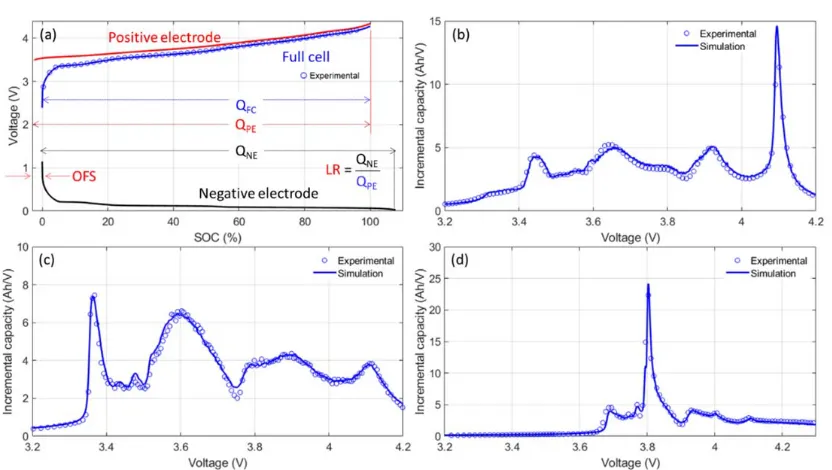
43
the essential feature than any good prognosis needs to capture. This acceleration usually originates
44
from degradations that have an “incubation” period that does not affect capacity [21]. A complete
45
training dataset should contain examples of paths with an acceleration induced by different
46
components of the degradation, whether it is the loss of lithium, losses in active materials, or
47
resistance.
48
49
50
Compared to traditional battery modeling [31,32], the mechanistic framework is a backward
51
modeling approach where the input is the degradation and the output the cell’s voltage and
52
capacity. This makes the method perfect for generating training data and more efficient than
53
electrochemical models because there is no need to find actual physical phenomena that could lead
54
to a given degradation. The initial set up is also simpler without a need for complex
55
parameterization and the only prerequisite being half-cell data versus a reference electrode for both
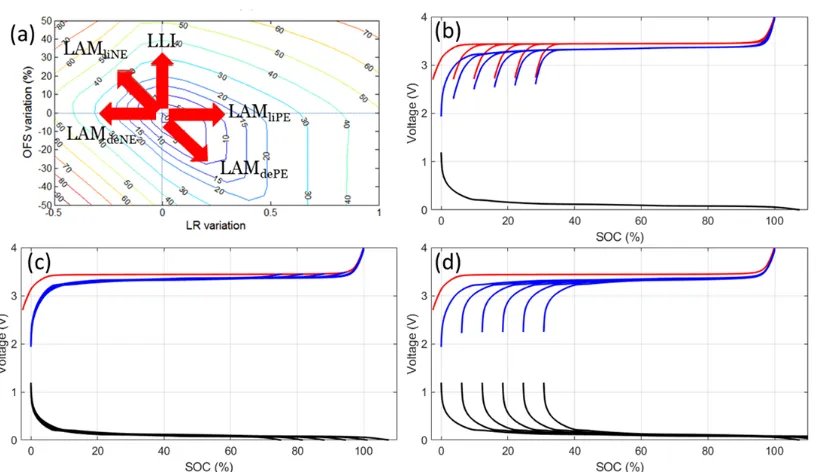
56
electrodes. In 2017, we proposed to use this approach to perform sensibility analyses by simulating a
57
wide range of hypothetical degradation scenarios [20]. This work is building on our previous effort
58
to enable the creation of comprehensive training data.
59
In this work, we will focus on diagnosis and prognosis, two applications that require different
60
sets of training data. To illustrate the difference between the two requirements, one can think of two
61
time-dependent processes, one linear and one exponential, intersecting. At the intersection, the
62
diagnostic will be the same, but the prognosis needs to be different. In addition, we will also address
63
another hurdle for AI algorithms, the quest for meaningful learnable parameters. Although some
64
studies seem to fit the full constant current voltage data [33], most studies favor the use of features of
65
interest (FOI) and only focus on a specific part of the electrochemical response. This could be
66
capacity and resistance evolution [10,34-37], curvature [38,39], sections of the voltage response
67
[8,40-42], electrochemical impedance spectroscopy [43,44], variance [5,11], or EVS [33,45-48]. The
68
latter has attracted a lot of attention in recent years since the early work on the technique [22,49,50].
69
Still, the correlation of the variations with degradation is not trivial and requires significant
70
sensibility analysis to derive universal parameters [20]. Some FOIs proposed in the literature were
71
proven not applicable outside of the tested data [21], which illustrates the need for more extensive
72
training sets and proper sensitivity analysis of the learnable parameters. With controlled and
73
complete training, the theoretical framework to establish relationships between data and models can
74
be explored in much more detail, and results from different studies could be easily equated.
75
The purpose of this publication is to introduce a big data methodology and showcase its
76
possibilities. The optimization of the technique to reduce computation time and its integration with
77
AI algorithms is out of the scope of this work.
78
Methodology
79
The mechanistic approach conceptually follows the one described by Christensen and Newman
80
to simulate cell degradation in the early 2000s [31,32]. Instead of computing-intensive
81
electrochemical models to simulate half-cell electrode behavior, the mechanistic approach [22-25]
82
uses experimental half-cell data for each electrode. Figure 1(a) presents the mechanistic
83
representation of a cell. The matching consists of two parameters, the loading ratio LR between the
84
capacities of both electrodes and their offset OFS that is representative of the amount of lithium lost
85
during the solid electrolyte interphase formation. The circles in Figure 1(a) showcase how the
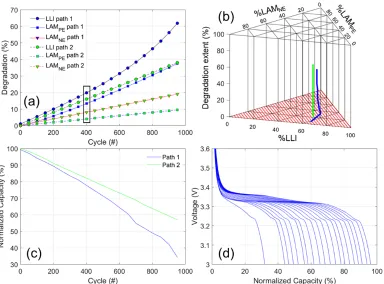
86
experimental data overlap the emulated cell perfectly. To enhance the differences, the same data can
87
be derived and plotted as incremental capacity, dQ/dV = f(V), Figure 1(b-d). For this EVS, each peak
88
represents a phase transformation in one of the electrodes. A perfect match between the emulated
89
and the experimental data proves that the emulated cell is perfectly replicating the experimental cell
90
voltage variations. Figure 1(b-d) presents examples of the quality of the obtainable fits for cells based
91
on different Li-ion chemistries from our previous work [51-53].
92
94
Figure 1: (a) Mechanistic model principles. The full cell response, in blue, corresponds to the
95
response of the positive electrode, in red, minus the one of the negative electrode, in black, after
96
matching. Fit for cells based on (b) a blended Graphite (Gr)-Silicon (Si) NE and Ni.8Mn.1Co.1O2
97
(NMC811) PE [53], (Gr) negative electrodes (NE) and (c) NixAlyCo1-x-yO2 (NCA) [51] as well as a (d)
98
blend of LiCoO2 (LCO) and NCA as (PE) [52].
99
100
While the active materials are considered stable with aging, their quantity, as well as the
101
amount of Lithium reacting, will change upon degradation. Degradation will then not affect the
102
electrode OCV curves, but it will impact their matching. If less active material is available, the
103
loading ratio between the electrodes will change. If some reactant is lost, the synchronicity of the
104
electrodes will change. These matching changes can be rendered in the mechanistic approach via
105
some scaling of the electrode curves and a translation of one electrode compared to the other, in
106
other words changing LR and OFS in Figure 1(a). Figure 2(a) presents the impact of the variation of
107
LR and OFS on cell capacity. In can be seen that there is an infinity of combination of LR and OFS
108
that can lead to any capacity loss; this is the path dependence of the degradation. This also explains
109
why measuring capacity will never be a good enough diagnosis of true degradation. Changes in the
110
amount of active material are referred to as loss of active material (LAM). LAM can occur at the PE
111
and NE. Change in the amount of lithium reacting is referred to as loss of lithium inventory (LLI).
112
The thermodynamic degradation of Li-ion batteries can be decomposed into these three main
113
degradation modes. LLI is inducing translation and the LAMs scaling, Figure 2(b-d). More details on
114
the technique and the associated equations can be found in [25].
115
117
Figure 2: (a) Impact of changes of LR and OFS on the capacity loss. Arrows represent the impact
118
of LLI and LAMs on LR and OFS. (b) Impact of LAMPE and (c) impact of LAMNE with the scaling of
119
the affected electrode compared to the other. (d) Impact of LLI with the translation of the NE
120
compared to the PE. In all cases, the full cell response, in blue, corresponds to the response of the
121
positive electrode, in red, minus the one of the negative electrode, in black, after matching.
122
123
The validity of the predicted impact of LAM and LLI on the electrochemical behavior of
124
experimental cells was verified by independent studies [26-28]. Most notably, Kassem et al. [26]
125
confirmed that LLI does induce electrode slippage between the NE and Schmidt et al. [54] verified
126
that LAM does influence the LR by assembling cells with different amounts of PE versus a constant
127
NE. Moreover, over the past decade, numerous studies [29,30] successfully used this approach to
128
diagnose the degradation of commercial cells. Figure 3(a,b) presents two examples of the fit of the
129
voltage response of aged commercial cells from previous works [53,55]. Figure 3(c,d) presents the
130
comparison of an experimental (from [53]) and a synthetic dataset constructed solely from half-cell
131
data and simple equations that modified the matching of the electrodes based on the quantification
132
of LLI and the LAMs. This highlights how the mechanistic approach is efficient to replicate the
133
voltage variations associated with cell degradation.
134
136
Figure 3: Example of voltage emulation after aging for (a) a Gr//NCA discharge [55] after 1,500
137
equivalent full cycles based on electric vehicle driving and frequency regulation. (b) A
138
Gr//LCO+NCA charges [53] after 1000 full cycles at 1.5C. (c) Experimental [53] and (d) synthetic
139
voltage variations upon aging calculated from simple linear equations extracted from the diagnosis.
140
141
From the mechanistic approach point of view, each thermodynamic degradation can be
142
described by a unique combination of the LLI, LAMPE, and LAMNE triplet. Conversely, scanning
143
every possible combination of the triplet yield any potential degradation from which the voltage
144
response can be reconstructed. This is the unique feature that is used in this work to build synthetic
145
training datasets.
146
For datasets aimed at diagnosis, the approach used in previous work on an automated
147
diagnosis tool for BMS [20] can be expanded. The [LLI, LAMPE, LAMNE] triplets can be normalized so
148
that their sum is equal to one and they can then be represented in a ternary diagram, Figure 4. By
149
scanning every point of this diagram (red dots) between 0 to 100% degradation for each mode
150
(vertical lines), each possible degradation can be represented, and the associated voltage response
151
calculated to be used in a training dataset. E.g., for the [0.5,0.2.,0.3] triplet, LLI would be varied from
152
0 to 100% with 1% increments, LAMPE from 0 to 40% with 0.4% increments, and LAMNE from 0 to
153
155
Figure 4: (a) Mechanistic model principles to emulate every possible degradation. Only partial
156
degradation calculations were represented for illustration purposes.
157
158
For datasets aimed at prognosis, the evolution of each degradation mode needs to be calculated
159
independently as the ratio between the normalized values of the triplet might not be constant. The
160
triplet values could be calculated, per example, for different linear degradation paces, with paces
161
linear combined with exponential variations, or with a delayed exponential increase, more
162
representative of the real degradation of commercial cells [19,56,57]. Since the voltages associated
163
with all the triplet values were already calculated for diagnosis, no additional simulations are
164
actually necessary and the different degradation paths are all inscribed in Figure 4. They can be
165
reconstructed by following the evolution of the triplet values in the ternary design space and the
166
corresponding voltage variations can be accessed. Figure 5 presents an example of the process for
167
two degradation paths for a Gr//LiFePO4 (LFP) cell. Figure 5(a) plots the evolution of the triplets for
168
each path. For each cycle, as exemplified by the black box in Figure 5(a), a triplet value can be
169
determined and the quantification can be used to find the corresponding point in the ternary design
170
space, Figure 5(b). In this example, path 2 (green) was simulated with linear variations for the three
171
components of the triplet, its path is, therefore, vertical as the ratio between the degradation modes
172
is constant. Path 1 (blue) had some exponential component for LLI and LAMPE and, therefore, the
173
path is more complicated. Nonetheless, based on the triplets and the diagnosis dataset, the capacity
174
loss, Figure 5(c), and the voltage variations, Figure 5(d), can be deciphered. This approach for
175
calculating a prognosis dataset will be faster than simulating each degradation path one by one as it
176
178
Figure 5: Example of the prognosis dataset calculation for two different paths for a Gr//LFP cell
179
with (a) the triplet variations, (b) their path in the ternary design space, (c) the reconstructed capacity
180
loss, and (d) the voltage variations for path 1.
181
182
It must be noted that the description above was simplified for narrative purposes and was
183
centered on the thermodynamic degradation observable at low currents and constant temperature
184
for ease of representation. The full mechanistic approach is much more complex [25]. To be able to
185
simulate different levels of usage, an equivalent circuit model (ECM) is included to handle different
186
rates for each electrode [22-26]. For electrode blends, or changes in electroactive phases upon aging,
187
each component of the electrode must be considered separately (i.e., LAMPE will be splat in LAMLCO
188
and LAMNCA for an LCO-NCA blended electrode). Moreover, for datasets at higher currents or
189
different temperatures, some kinetic parameters such as the ohmic and faradic resistance increase
190
must also be scanned as they will influence the voltage response of the cells. Finally, in some cases,
191
lithium plating, both thermodynamic and kinetic, must be taken into consideration [25]. The validity
192
of the mechanistic approach in all of those cases has been proven in the literature [19,58,59]. As
193
explained in [25,58], resistance changes can be accommodated by shifting the voltage curves up or
194
down depending on the electrode and the regime. Kinetic limitations can be handled by modifying
195
the simulated rate while counterbalancing the polarization changes. Simulating higher rates allows
196
emulating slower kinetics. Simulating lower rates allows emulating faster kinetics. This allows to
197
model different rates and temperatures [58]. Figure 6(a) presents an example from [58] where
198
different temperatures were simulated from 25°C data at different rates. For lithium plating, the
199
solution is to simulate the NE as a blend between Gr and metallic lithium with the metallic lithium
200
initially outside of the potential window, Figure 6(b). If LAMGraphite becomes prominent, or if its
201
resistance pushes its potential below 0V, the metallic lithium will then be dragged into the potential
202
window and start interacting with the PE [19,21,25]. As discussed in the literature [5,19,25,57],
203
thermodynamic lithium plating begins when there is enough LAMNE so that the NE is fully lithiated
204
before the PE is delithiated. The amount of LAMNE necessary for that to happen depends on the
205
initial cell configuration (LRini and OFSini) and also on the evolution of LLI and LAMPE [60]. Figure
206
degradation path. Lithium plating will start when LAMNE becomes larger than PT. This does not by
208
itself induce any capacity loss as metallic lithium can be reduced and oxidized. This lithium,
209
however, is usually quickly passivating, which results in additional LLI. To take this effect into
210
account, a correction for LLI can be introduced and the additional LLI is defined as the difference
211
between LAMNE and the PT, when positive, multiplied by a reversibility factor. Figure 6(c)
212
showcases an example of the acceleration in LLI based on different reversibilities. Figure 6(d)
213
presents the associated capacity loss showcasing the acceleration.
214
215
216
Figure 6: (a) Emulation of the impact of temperature at C/5 for a Gr//NCA cell from [58], and (b)
217
Electrode matching with a blended Gr-Li electrode with the Li outside of the potential window as a
218
reserve. Evolution of (c) LLI and LAMNE depending on the reversibility of lithium plating (0%, 50%
219
or 100%) and (d) the associated capacity loss.
220
Proof-of-concept datasets
221
For this proof-of-concept work, a Gr//LFP cell similar to the one used in [20] was chosen
222
because the sensibility analysis of different FOI was already reported and some non-ML diagnosis
223
tools were validated. The data could also be compared to the one from Severson et al. [5].
224
The diagnosis dataset contains more than 500,000 voltage vs. capacity curves. It can be used to
225
train machine learning algorithms, but more importantly, it can also be used to perform sensibility
226
analysis [20] to find out which FOIs are representative of different degradations or if they can be
227
used as universal proxies for capacity loss. An example is presented in Supplementary note 1.
228
The prognosis dataset contains more than 130,000 different degradation paths with upwards of
229
3,000,000 individual voltage vs. capacity curves. It can be used to test the validity of varying FOIs
230
proposed in the literature for early prognosis. An example is presented in Supplementary note 2.
231
Both datasets are available to download (see Data availability section for access information).
232
Limitations and outlook
233
In this work, we presented a proof-of-concept methodology to generate big data training
234
datasets for intercalation batteries. The mechanistic approach combines both modeling and
235
experimental techniques to provide a universal tool for the creation of synthetic voltage curves
236
practically indistinguishable from real data. This approach offers the benefits of the broad
237
applicability of the model to various cell chemistries, designs, and operating modes, as well as the
238
could be applied to the generation of training datasets encompassing the entire degradation
240
spectrum as well as different operating conditions such as rate and temperature. Scenarios leading to
241
lithium plating with adjustable reversibility can be added and the addition of random noise on the
242
data could be considered to make the datasets even more realistic and consider the impact of real-life
243
testing machines' precision and accuracy.
244
As a proof-of-concept, we generated a diagnosis dataset containing more than individual
245
500,000 voltage vs. capacity curves and a prognosis dataset with more than 130,000 individual
246
degradation paths for a commercial graphite//LFP battery. These datasets are more than three orders
247
of magnitude larger than the one currently available in the literature and they could be extended at
248
will. We showcased the use of the proposed datasets for FOI sensibility analysis and a diagnosis
249
technique based on the joint evolution of three FOIs since variations of single FOI were proven
250
inefficient. We also used them to propose an early prognosis method based on the extrapolation of
251
the diagnosis of the degradation modes.
252
Although there is still a lot of work to be done to optimize the technique, results are extremely
253
promising and should accelerate the development of accurate algorithms. The proof-of-concept
254
dataset used in this work were limited to thermodynamic degradations at constant temperature for
255
single-phase electrodes. Taking everything into account (LAMs, LLI, polarization, kinetics, phases,
256
temperatures…) for all the possible evolutions (linear, exponential, delays…) will take enormous
257
calculation time and generate overwhelming datasets. Some optimization and intelligence could be
258
applied to limit the number of degradation paths to test. A solution could be large designs of
259
experiments first to screen the impact of the different parameters then to focus on their
260
representativity in the paths to simulate. Here we provide an open framework to the community to
261
apply advanced optimization techniques to reduce the calculation burden.
262
Finally, we would like to point out that our intent is no way to remove the need for
263
experimental testing all-together. On the contrary, experimental testing is still essential, and the only
264
way, to decipher which conditions cater to specific degradation paths and its input is, therefore,
265
fundamental to decipher the applicability of batteries for a given application. Our methodology can
266
be used alongside to develop the needed algorithms once a cell was selected.
267
268
Methods
269
Half-cell data. Data from four different types of commercial cells were used in this work. The
270
Gr//NCA cell was a Panasonic 3350 mAh NCR 18650B [51,58,60-62]. The Si-Gr//NMC811 was a
271
Samsung-SDI 3350 mAh INR18650-35E [52], the Gr//LCO+NCA was an LG-Chem 2800 mAh
272
ICR18650 C2” [53], and the Gr//LFP was an A123 2300 mAh ANR26650M [19,63]. All were
273
extensively studied in previous work. Interested readers are referred to the original publications for
274
more details. The cells were slowly discharged to 0% SOC before being carefully disassembled in an
275
Argon-filled glove box where the electrodes, separator, and casing will be separated [64]. Electrode
276
discs (18 mm in diameter) were punched from the harvested electrodes and rinsed in a dimethyl
277
carbonate (DMC) solution. The backside of two-sided electrodes was then wiped clean using cotton
278
swabs soaked in nN-methyl-2-pyrrolidone (NMP) solvent before being the electrode was rinsed
279
again in a fresh DMC solution. The electrodes were tested using a lithium counter electrode. Metallic
280
lithium was applied onto a stainless-steel disk. An electrolyte solution of 1.0 M LiPF6 in ethylene
281
carbonate (EC) + DMC (1:1 by weight) + 2% wt. vinylene carbonate (VC) was used to soak the
282
separator, which consisted of one layer of Whatman GF-D fiberglass discs (12.7 mm in diameter,
283
Whatman), Kent, United Kingdom). Once sealed, the half-cells were taken out of the glove box and
284
connected to a multi-channel Bio-Logic VMP3 potentiostat (Bio-Logic, Claix, France) for testing at
285
different rates from low to high. The complete testing protocol can be found in [64].
286
287
Simulations. All simulations were performed under a MATLAB© environment using the ‘alawa
288
toolbox [65]. As in [20], the LFP and graphite electrodes were matched with an LR of 0.95, OFS of
289
The diagnosis training dataset was compiled with a resolution of 0.01 for the triplets and C/25
291
charges. This accounts for more than 5,000 different paths at the base of the triangle in Figure 4. Each
292
path was simulated with 0.85% increases for each degradation up to 85%. This accounts for 100
293
simulations per path. The training dataset, therefore, contains more than 500,000 voltage vs. capacity
294
curves and took around 12h to compute on a standard laptop. The 500MB dataset is available to
295
download (see Data availability section for access information).
296
The prognosis dataset was harder to define as there are no limits on how the three degradation
297
modes can evolve. For this proof of concept work, we considered eight parameters to scan. For each
298
degradation mode, degradation was chosen to follow equation (1).
299
300
% = × + ( × − 1) (1)
301
302
Considering the three degradation modes, this accounts for six parameters to scan. In addition,
303
two other parameters were added, a delay for the exponential factor for LLI, and a parameter for the
304
reversibility of lithium plating. The delay was introduced to reflect degradation paths where plating
305
cannot be explained by an increase of LAMs or resistance [55]. The chosen parameters and their
306
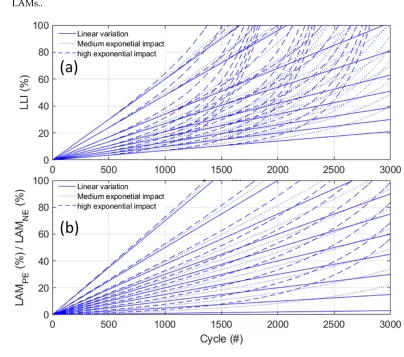
values are summarized in Table S1. Figure S1(a,b) presents the evolution of parameters p1 to p7. At
307
the worst, the cells endured 100% of one of the degradation modes in around 1,500 cycles. Minimal
308
LLI was chosen to be 20% after 3,000 cycles. This is to guarantee at least 20% capacity loss for all the
309
simulations. For the LAMs, conditions were less restrictive, and, after 3,000 cycles, the lowest
310
degradation is of 3%. The reversibility factor p8 was calculated with equation (2) when LAMNE > PT.
311
312
%
= %LLI + 8(
%−
)
(2)
313
314
Where PT was calculated with equation (3) from [60].
315
316
= 100 − 100−%
100× −% ×
(
100 − − %)
(3)
317
318
Varying all those parameters accounted for more than 130,000 individual duty cycles. With one
319
voltage curve for every 100 cycles, it took around 12h to compute on a standard laptop to simulate
320
the more than 3,000,000 voltage vs. capacity curves. The 3GB dataset is available to download (see
321
Data availability section for access information).
322
323
Data availability. The datasets used in this study are available at
324
http://dx.doi.org/10.17632/bs2j56pn7y.1 and http://dx.doi.org/10.17632/6s6ph9n8zg.1 for the
325
diagnosis and prognosis dataset, respectively.
326
Author Contributions: Conceptualization, M.D.; methodology, M.D.; software, M.D.; validation, M.D. and
327
D.B.; formal analysis, M.D. and D.B.; resources, M.D.; data curation, M.D.; writing—original draft
328
preparation, M.D.; writing—review and editing, M.D. and D.B.; visualization, M.D.; supervision, M.D.;
329
project administration, M.D.; funding acquisition, M.D.
330
Funding: This work was funded by ONR Asia Pacific Research Initiative for Sustainable Energy Systems
331
(APRISES), award number N00014-18-1-2127. M.D. is also supported by the State of Hawaii.
332
Acknowledgments: M.D. is thankful to all the past staff that helped define and affine the concepts used in this
333
work, most notably Bor Yann Liaw, Cyril Truchot, Arnaud Devie, George Baure, and David Anseán.
334
Conflicts of Interest: The authors declare no conflict of interest.
335
References
336
1. Chen, C.; Zuo, Y.; Ye, W.; Li, X.; Deng, Z.; Ong, S.P. A Critical Review of Machine Learning of Energy
337
2. Ng, M.-F.; Zhao, J.; Yan, Q.; Conduit, G.J.; Seh, Z.W. Predicting the state of charge and health of
339
batteries using data-driven machine learning. Nature Machine Intelligence 2020,
340
10.1038/s42256-020-0156-7, doi:10.1038/s42256-020-0156-7.
341
3. Vidal, C.; Malysz, P.; Kollmeyer, P.; Emadi, A. Machine Learning Applied to Electrified Vehicle Battery
342
State of Charge and State of Health Estimation: State-of-the-Art. IEEE Access 2020, 8, 52796-52814,
343
doi:10.1109/access.2020.2980961.
344
4. How, D.N.T.; Hannan, M.A.; Hossain Lipu, M.S.; Ker, P.J. State of Charge Estimation for Lithium-Ion
345
Batteries Using Model-Based and Data-Driven Methods: A Review. IEEE Access 2019, 7, 136116-136136,
346
doi:10.1109/access.2019.2942213.
347
5. Severson, K.A.; Attia, P.M.; Jin, N.; Perkins, N.; Jiang, B.; Yang, Z.; Chen, M.H.; Aykol, M.; Herring,
348
P.K.; Fraggedakis, D., et al. Data-driven prediction of battery cycle life before capacity degradation.
349
Nature Energy 2019, 4, 383-391, doi:10.1038/s41560-019-0356-8.
350
6. Klass, V.; Behm, M.; Lindbergh, G. A support vector machine-based state-of-health estimation method
351
for lithium-ion batteries under electric vehicle operation. J. Power Sources 2014, 270, 262-272,
352
doi:10.1016/j.jpowsour.2014.07.116.
353
7. Klass, V.; Behm, M.; Lindbergh, G. Evaluating Real-Life Performance of Lithium-Ion Battery Packs in
354
Electric Vehicles. J. Electrochem. Soc. 2012, 159, A1856-A1860, doi:10.1149/2.047211jes.
355
8. Hu, C.; Jain, G.; Schmidt, C.; Strief, C.; Sullivan, M. Online estimation of lithium-ion battery capacity
356
using sparse Bayesian learning. J. Power Sources 2015, 289, 105-113, doi:10.1016/j.jpowsour.2015.04.166.
357
9. Richardson, R.R.; Birkl, C.R.; Osborne, M.A.; Howey, D.A. Gaussian Process Regression for In-situ
358
Capacity Estimation of Lithium-ion Batteries.
359
10. Pan, H.; Lü, Z.; Wang, H.; Wei, H.; Chen, L. Novel battery state-of-health online estimation method
360
using multiple health indicators and an extreme learning machine. Energy 2018, 160, 466-477,
361
doi:10.1016/j.energy.2018.06.220.
362
11. Attia, P.M.; Grover, A.; Jin, N.; Severson, K.A.; Markov, T.M.; Liao, Y.H.; Chen, M.H.; Cheong, B.;
363
Perkins, N.; Yang, Z., et al. Closed-loop optimization of fast-charging protocols for batteries with
364
machine learning. Nature 2020, 578, 397-402, doi:10.1038/s41586-020-1994-5.
365
12. Cripps, E.; Pecht, M. A Bayesian nonlinear random effects model for identification of defective
366
batteries from lot samples. J. Power Sources 2017, 342, 342-350, doi:10.1016/j.jpowsour.2016.12.067.
367
13. Kollmeyer, P.; Vidal, C.; Naguib, M.; Skells, M. LG 18650HG2 Li-ion Battery Data and Example Deep
368
Neural Network xEV SOC Estimator Script. Available online:
369
https://data.mendeley.com/datasets/cp3473x7xv/3 (accessed on 04/12).
370
14. Kollmeyer, P. Panasonic 18650PF Li-ion Battery Data”, Mendeley Data, v1. Available online:
371
https://data.mendeley.com/datasets/wykht8y7tg/1#folder96f196a8-a04d-4e6a-827d-0dc4d61ca97b
372
(accessed on 04/12).
373
15. Saha, B.; Goebel, K. Battery Data Set. NASA Ames Prognostics Data Repository. NASA Ames Research
374
Center. Moffett Field, CA, USA. Availabe online:
375
https://ti.arc.nasa.gov/tech/dash/groups/pcoe/prognostic-data-repository/ (accessed on 04/12).
376
16. Barkholtz, H.M.; Fresquez, A.; Chalamala, B.R.; Ferreira, S.R. A Database for Comparative
377
Electrochemical Performance of Commercial 18650-Format Lithium-Ion Cells. J. Electrochem. Soc. 2017,
378
164, A2697-A2706, doi:10.1149/2.1701712jes.
379
18. Birkl, C.R.; Offer, G.J. Oxford battery degradation dataset from the Howey Research Group. Availabe
381
online: https://ora.ox.ac.uk/objects/uuid%3a03ba4b01-cfed-46d3-9b1a-7d4a7bdf6fac (accessed on
382
04/14).
383
19. Anseán, D.; Dubarry, M.; Devie, A.; Liaw, B.Y.; García, V.M.; Viera, J.C.; González, M. Operando
384
lithium plating quantification and early detection of a commercial LiFePO 4 cell cycled under dynamic
385
driving schedule. J. Power Sources 2017, 356, 36-46, doi:10.1016/j.jpowsour.2017.04.072.
386
20. Dubarry, M.; Berecibar, M.; Devie, A.; Anseán, D.; Omar, N.; Villarreal, I. State of health battery
387
estimator enabling degradation diagnosis: Model and algorithm description. J. Power Sources 2017, 360,
388
59-69, doi:10.1016/j.jpowsour.2017.05.121.
389
21. Dubarry, M.; Baure, G.; Anseán, D. Perspective on State-of-Health Determination in Lithium-Ion
390
Batteries. Journal of Electrochemical Energy Conversion and Storage 2020, 17, 1-25, doi:10.1115/1.4045008.
391
22. Bloom, I.; Jansen, A.N.; Abraham, D.P.; Knuth, J.; Jones, S.A.; Battaglia, V.S.; Henriksen, G.L.
392
Differential voltage analyses of high-power, lithium-ion cells. 1. Technique and Applications. Journal of
393
Power Sources 2005, 139, 295-303, doi:10.1016/j.jpowsour.2004.07.021.
394
23. Honkura, K.; Honbo, H.; Koishikawa, Y.; Horiba, T. State Analysis of Lithium-Ion Batteries Using
395
Discharge Curves. ECS Transactions 2008, 13, 61-73.
396
24. Dahn, H.M.; Smith, A.J.; Burns, J.C.; Stevens, D.A.; Dahn, J.R. User-Friendly Differential Voltage
397
Analysis Freeware for the Analysis of Degradation Mechanisms in Li-Ion Batteries. Journal of the
398
Electrochemical Society 2012, 159, A1405-A1409, doi:10.1149/2.013209jes.
399
25. Dubarry, M.; Truchot, C.; Liaw, B.Y. Synthesize battery degradation modes via a diagnostic and
400
prognostic model. J. Power Sources 2012, 219, 204-216, doi:10.1016/j.jpowsour.2012.07.016.
401
26. Kassem, M.; Delacourt, C. Postmortem analysis of calendar-aged graphite/LiFePO4 cells. J. Power
402
Sources 2013, 235, 159-171, doi:10.1016/j.jpowsour.2013.01.147.
403
27. Schmidt, J.P.; Tran, H.Y.; Richter, J.; Ivers-Tiffee, E.; Wohlfahrt-Mehrens, M. Analysis and prediction of
404
the open circuit potential of lithium-ion cells. Journal of Power Sources 2013, 239, 696-704,
405
doi:10.1016/j.jpowsour.2012.11.101.
406
28. Birkl, C.R.; Roberts, M.R.; McTurk, E.; Bruce, P.G.; Howey, D.A. Degradation diagnostics for lithium
407
ion cells. Journal of Power Sources 2017, 341, 373-386, doi:10.1016/j.jpowsour.2016.12.011.
408
29. Barai, A.; Uddin, K.; Dubarry, M.; Somerville, L.; McGordon, A.; Jennings, P.; Bloom, I. A comparison
409
of methodologies for the non-invasive characterisation of commercial Li-ion cells. Progr. Energy
410
Combust. Sci. 2019, 72, 1-31, doi:10.1016/j.pecs.2019.01.001.
411
30. Pastor-Fernández, C.; Yu, T.F.; Widanage, W.D.; Marco, J. Critical review of non-invasive diagnosis
412
techniques for quantification of degradation modes in lithium-ion batteries. Renewable and Sustainable
413
Energy Reviews 2019, 109, 138-159, doi:10.1016/j.rser.2019.03.060.
414
31. Christensen, J.; Newman, J. Effect of Anode Film Resistance on the Charge/Discharge Capacity of a
415
Lithium-Ion Battery. J. Electrochem. Soc. 2003, 150, A1416, doi:10.1149/1.1612501.
416
32. Christensen, J.; Newman, J. Cyclable Lithium and Capacity Loss in Li-Ion Cells. J. Electrochem. Soc.
417
2005, 152, A818, doi:10.1149/1.1870752.
418
33. Fath, J.P.; Dragicevic, D.; Bittel, L.; Nuhic, A.; Sieg, J.; Hahn, S.; Alsheimer, L.; Spier, B.; Wetzel, T.
419
Quantification of aging mechanisms and inhomogeneity in cycled lithium-ion cells by differential
420
34. Nuhic, A.; Terzimehic, T.; Soczka-Guth, T.; Buchholz, M.; Dietmayer, K. Health diagnosis and
422
remaining useful life prognostics of lithium-ion batteries using data-driven methods. J. Power Sources
423
2013, 239, 680-688, doi:10.1016/j.jpowsour.2012.11.146.
424
35. Liu, D.; Luo, Y.; Liu, J.; Peng, Y.; Guo, L.; Pecht, M. Lithium-ion battery remaining useful life
425
estimation based on fusion nonlinear degradation AR model and RPF algorithm. Neural Computing and
426
Applications 2013, 25, 557-572, doi:10.1007/s00521-013-1520-x.
427
36. Liu, D.; Pang, J.; Zhou, J.; Peng, Y.; Pecht, M. Prognostics for state of health estimation of lithium-ion
428
batteries based on combination Gaussian process functional regression. Microelectronics Reliability 2013,
429
53, 832-839, doi:10.1016/j.microrel.2013.03.010.
430
37. Lee, C.; Jo, S.; Kwon, D.; Pecht, M. Capacity-fading Behavior Analysis for Early Detection of Unhealthy
431
Li-ion Batteries. IEEE Transactions on Industrial Electronics 2020, 10.1109/tie.2020.2972468, 1-1,
432
doi:10.1109/tie.2020.2972468.
433
38. Lee, J.; Kwon, D.; Pecht, M.G. Reduction of Li-ion Battery Qualification Time Based on Prognostics and
434
Health Management. IEEE Transactions on Industrial Electronics 2019, 66, 7310-7315,
435
doi:10.1109/tie.2018.2880701.
436
39. Fermín, P.; McTurk, E.; Allerhand, M.; Medina-Lopez, E.; Anjos, M.F.; Sylvester, J.; dos Reis, G.
437
Identification and machine learning prediction of knee-point and knee-onset in capacity degradation
438
curves of lithium-ion cells. Energy and AI 2020, 10.1016/j.egyai.2020.100006,
439
doi:10.1016/j.egyai.2020.100006.
440
40. Yang, D.; Zhang, X.; Pan, R.; Wang, Y.; Chen, Z. A novel Gaussian process regression model for
441
state-of-health estimation of lithium-ion battery using charging curve. J. Power Sources 2018, 384,
442
387-395, doi:10.1016/j.jpowsour.2018.03.015.
443
41. Goh, T.; Park, M.; Seo, M.; Kim, J.G.; Kim, S.W. Successive-approximation algorithm for estimating
444
capacity of Li-ion batteries. Energy 2018, 159, 61-73, doi:10.1016/j.energy.2018.06.116.
445
42. Goh, T.; Park, M.; Seo, M.; Kim, J.G.; Kim, S.W. Capacity estimation algorithm with a second-order
446
differential voltage curve for Li-ion batteries with NMC cathodes. Energy 2017, 135, 257-268,
447
doi:10.1016/j.energy.2017.06.141.
448
43. Eddahech, A.; Briat, O.; Bertrand, N.; Delétage, J.-Y.; Vinassa, J.-M. Behavior and state-of-health
449
monitoring of Li-ion batteries using impedance spectroscopy and recurrent neural networks.
450
International Journal of Electrical Power & Energy Systems 2012, 42, 487-494,
451
doi:10.1016/j.ijepes.2012.04.050.
452
44. Saha, B.; Poll, S.; Goebel, K.; Christophersen, J.P. An Integrated Approach to Battery Health
453
Monitoring Using Bayesian Regression and State Estimation. In Proceedings of International
454
Automatic Testing Conference, Baltimore, USA.
455
45. Weng, C.; Cui, Y.; Sun, J.; Peng, H. On-board state of health monitoring of lithium-ion batteries using
456
incremental capacity analysis with support vector regression. J. Power Sources 2013, 235, 36-44,
457
doi:10.1016/j.jpowsour.2013.02.012.
458
46. Li, Y.; Liu, K.; Foley, A.M.; Zülke, A.; Berecibar, M.; Nanini-Maury, E.; Van Mierlo, J.; Hoster, H.E.
459
Data-driven health estimation and lifetime prediction of lithium-ion batteries: A review. Renewable and
460
Sustainable Energy Reviews 2019, 113, doi:10.1016/j.rser.2019.109254.
461
47. Berecibar, M.; Devriendt, F.; Dubarry, M.; Villarreal, I.; Omar, N.; Verbeke, W.; Van Mierlo, J. Online
462
state of health estimation on NMC cells based on predictive analytics. J. Power Sources 2016, 320,
463
48. He, J.; Bian, X.; Liu, L.; Wei, Z.; Yan, F. Comparative study of curve determination methods for
465
incremental capacity analysis and state of health estimation of lithium-ion battery. Journal of Energy
466
Storage 2020, 29, doi:10.1016/j.est.2020.101400.
467
49. Dubarry, M.; Svoboda, V.; Hwu, R.; Liaw, B.Y. Incremental capacity analysis and close-to-equilibrium
468
OCV measurements to quantify capacity fade in commercial rechargeable lithium batteries.
469
Electrochem. Solid-State Lett. 2006, 9, A454-A457, doi:10.1149/1.2221767.
470
50. Berecibar, M.; Garmendia, M.; Gandiaga, I.; Crego, J.; Villarreal, I. State of health estimation algorithm
471
of LiFePO4 battery packs based on differential voltage curves for battery management system
472
application. Energy 2016, 103, 784-796, doi:10.1016/j.energy.2016.02.163.
473
51. Devie, A.; Dubarry, M. Durability and Reliability of Electric Vehicle Batteries under Electric Utility
474
Grid Operations. Part 1: Cell-to-Cell Variations and Preliminary Testing. Batteries 2016, 2, 28,
475
doi:10.3390/batteries2030028.
476
52. Anseán, D.; Baure, G.; González, M.; Cameán, I.; García, A.B.; Dubarry, M. Mechanistic investigation
477
of silicon-graphite/LiNi0.8Mn0.1Co0.1O2 commercial cells for non-intrusive diagnosis and prognosis.
478
J. Power Sources 2020, 459, doi:10.1016/j.jpowsour.2020.227882.
479
53. Devie, A.; Baure, G.; Dubarry, M. Intrinsic Variability in the Degradation of a Batch of Commercial
480
18650 Lithium-Ion Cells. Energies 2018, 11, 1031, doi:10.3390/en11051031.
481
54. Schmidt, J.P.; Tran, H.Y.; Richter, J.; Ivers-Tiffée, E.; Wohlfahrt-Mehrens, M. Analysis and prediction of
482
the open circuit potential of lithium-ion cells. J. Power Sources 2013, 239, 696-704,
483
doi:10.1016/j.jpowsour.2012.11.101.
484
55. Baure, G.; Dubarry, M. Durability and Reliability of EV Batteries under Electric Utility Grid
485
Operations: Impact of Frequency Regulation Usage on Cell Degradation. Energies 2020, Submitted.
486
56. Waldmann, T.; Hogg, B.-I.; Wohlfahrt-Mehrens, M. Li plating as unwanted side reaction in commercial
487
Li-ion cells – A review. J. Power Sources 2018, 384, 107-124, doi:10.1016/j.jpowsour.2018.02.063.
488
57. Yang, X.-G.; Leng, Y.; Zhang, G.; Ge, S.; Wang, C.-Y. Modeling of lithium plating induced aging of
489
lithium-ion batteries: Transition from linear to nonlinear aging. J. Power Sources 2017, 360, 28-40,
490
doi:10.1016/j.jpowsour.2017.05.110.
491
58. Schindler, S.; Baure, G.; Danzer, M.A.; Dubarry, M. Kinetics accommodation in Li-ion mechanistic
492
modeling. J. Power Sources 2019, 440, 227117, doi:10.1016/j.jpowsour.2019.227117.
493
59. Baure, G.; Devie, A.; Dubarry, M. Battery Durability and Reliability under Electric Utility Grid
494
Operations: Path Dependence of Battery Degradation. J. Electrochem. Soc. 2019, 166, A1991-A2001,
495
doi:10.1149/2.0971910jes.
496
60. Baure, G.; Dubarry, M. Synthetic vs. Real Driving Cycles: A Comparison of Electric Vehicle Battery
497
Degradation. Batteries 2019, 5, doi:10.3390/batteries5020042.
498
61. Dubarry, M.; Baure, G.; Devie, A. Durability and Reliability of EV Batteries under Electric Utility Grid
499
Operations: Path Dependence of Battery Degradation. J. Electrochem. Soc. 2018, 165, A773-A783,
500
doi:10.1149/2.0421805jes.
501
62. Dubarry, M.; Devie, A.; McKenzie, K. Durability and reliability of electric vehicle batteries under
502
electric utility grid operations: Bidirectional charging impact analysis. J. Power Sources 2017, 358, 39-49,
503
doi:10.1016/j.jpowsour.2017.05.015.
504
63. Anseán, D.; Dubarry, M.; Devie, A.; Liaw, B.Y.; García, V.M.; Viera, J.C.; González, M. Fast charging
505
technique for high power LiFePO4 batteries: A mechanistic analysis of aging. J. Power Sources 2016, 321,
506
64. Dubarry, M.; Baure, G. Perspective on Commercial Li-ion Battery Testing, Best Practices for Simple
508
and Effective Protocols. Electronics 2020, 9, 152, doi:10.3390/electronics9010152.
509
65. HNEI. Alawa central. Availabe online: https://www.soest.hawaii.edu/HNEI/alawa/ (accessed on
510
December 2019).
511
66. Baure, G.; Dubarry, M. Battery durability and reliability under electric utility grid operations: 20-year
512
forecast under different grid applications. Journal of Energy Storage 2020, 29,
513
doi:10.1016/j.est.2020.101391.
514
Supplementary Tables and Figures
517
Table S1: Summary of scanned parameters for prognosis dataset
518
Parameter Description Values (% per cycle)
p1 Linear coeff. LLI 0.007, 0.010, 0.013, 0.017, 0.021, 0.027, 0.034, 0.048, 0.06
p2 Exp. Coeff. LLI 0.000001, 0.002, 0.0033
p3 Delay exp. LLI 500, 1000, 1500
p4 Linear coeff. LAMPE 0.001, 0.005, 0.01, 0.015, 0.02, 0.025, 0.03, 0.0375, 0.05, 0.07
p5 Exp. Coeff. LAMPE 0.000001, 0.001, 0.0013
p6 Linear coeff.
LAMNE
0.001, 0.005, 0.0,1 0.015, 0.02, 0.025, 0.03, 0.0375, 0.05, 0.07
p7 Exp. Coeff. LAMNE 0.000001, 0.001, 0.0013
p8 Plating reversibility 0, 50, 100
519
Figure S1: Different duty cycles tested for each degradation mode with (a) LLI and (b) the
520
LAMs..
521
522
Supplementary Note 1: Diagnosis Dataset Analysis
525
526
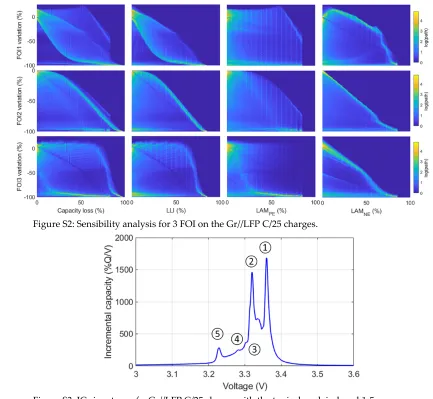
Figure S2 presents an example of the sensibility of 3 FOIs for capacity loss, LLI, LAMPE, and
527
LAMNE. The three selected FOIs were the capacity of the first plateau (area under peak ① on Figure
528
S3), the capacity of everything but the first plateau (area under peaks ②-⑤), and the capacity of the
529
last plateau (area under peak ⑤) [20]. As reported in our previous work, [20], the sensibility
530
analysis showcase that no single FOI can track capacity loss nor one of the degradation modes alone
531
since there is always a spread of values. Nonetheless, as reported in [20], their combined variations
532
might be used. This will be discussed in supplementary note 2.
533
534
535
Figure S2: Sensibility analysis for 3 FOI on the Gr//LFP C/25 charges.
536
537
Figure S3: IC signature of a Gr//LFP C/25 charge with the typical peak indexed 1-5.
538
Supplementary Note 2: Prognosis Dataset Analysis
540
The prognosis dataset can be used to test the validity of different FOIs proposed in the literature
541
for early prognosis. Figure S4 (a,b) presents the evolution of the variance between cycle one and
542
cycle 100 and 500 respectively as a function of cycle life, defined as the cycle at which 20% capacity
543
loss is reached. When considering a multitude of degradation paths, the variance approach seems
544
less effective than proposed in the literature [5,11] with correlation coefficients of -0.56 and -0.43,
545
respectively, when calculated after 100 and 500 cycles. Looking at the capacity loss after 100 cycles,
546
Figure S4 (c), the correlation is better (ρ = 0.63). Still, the error could be huge for low capacity loss as
547
paths with less than 1% capacity loss after 100 cycles were found to induce 20% capacity loss after
548
just 200 cycles. Finally, as predicted [20,21], the evolution of the first LFP plateau capacity (i.e., the
549
area under peak ① in the Gr//LFP IC curves) is not a good indicator with a Pearson coefficient of
550
0.51, Figure S4(d). The dataset could be analyzed further by tracking if specific conditions exist
551
where the FOI is accurate, e.g., the first LFP plateau capacity is likely working well when there is
552
little LAMNE [20,21]. This is out of the scope of this publication and will be investigated in future
553
work.
554
The prognosis dataset can also be used to validate diagnosis techniques. For example, the
555
method proposed in [20] can be tested. As shown in Figure S2 individual FOI information is not
556
enough to reach a proper diagnosis, but their combined variations might be enough. Figure S5
557
presents the diagnosis results based on the combined variations of 3 FOIs for diagnosis after 100,
558
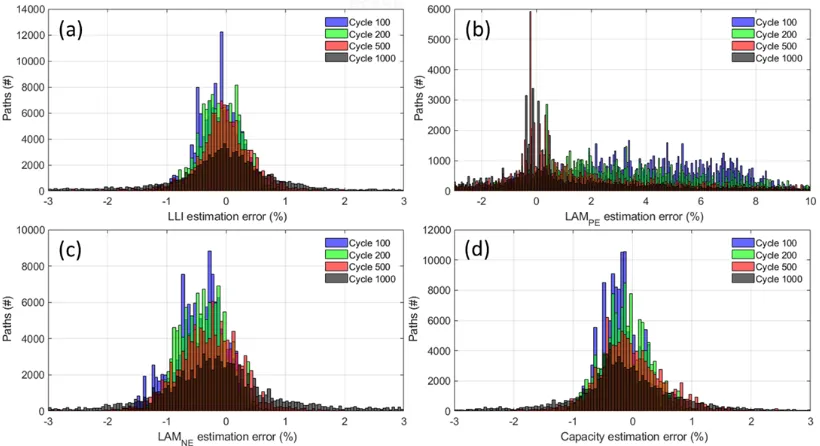
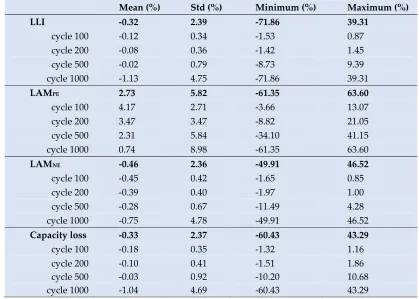
200, 500, and 1,000 cycles for the 130,000 computed duty cycles. Out of the more than 500,000 points
559
tested (4 x 130,000), the average errors for estimation of LLI, LAMPE, LAMNE, and capacity loss were
560
of -0.32%, -2.73%, -0,46%, and -0.33% respectively with standard deviations below 1% for all but
561
LAMPE (6%) for diagnosis up to the 500th cycle. The distribution of the results is presented in Figure
562
S5 and the different statistics summarized in Table S2. For all, but LAMPE, most of the errors are
563
comprised between -1 and 1%, with the minimum average error recorded for the diagnosis after 500
564
cycles and the maximum for the diagnosis after 1,000 cycles. The spread for LAMPE is larger,
565
between -2 and 10%, which was expected since LAMPE is notoriously hard to quantify for LFP cells
566
because of the single voltage plateau [25]. The average LAMPE error decreased with cycle number to
567
0.74% after 1,000 cycles. Looking more into details, the maximum and minimum errors were always
568
recorded for the diagnosis at 1,000 cycles with maximum and minimum errors mostly below 10% for
569
all the other cycles (except for LAMPE). Future work will investigate the specific combinations that
570
led to large errors, although our previous work [20] showed that it was for degradations unlikely to
571
happen under real-life conditions where LLI usually predominates.
572
584
Figure S4: Evolution of the (a) the variance between cycle 100 and 1, (b) the variance between
585
cycle 500 and 1, (c) the capacity loss at cycle 100 and (d) the area of the high voltage IC peak at cycle
586
100 as a function of cycle life (i.e., cycle at which 20% capacity loss is reached).
587
588
589
590
Figure S5 Distribution of the estimation errors for (a) LLI, (b) LAMPE, (c) LAMNE, and (d) the
591
capacity loss based on the evolution of 3 FOIs at cycle 100, 200, 400, and 1000.
592
593
594
595
596
597
598
Table S2: Main error with standard deviation as well as minimum and maximum error for the three
600
degradation modes and the capacity loss.
601
Mean (%) Std (%) Minimum (%) Maximum (%)
LLI -0.32 2.39 -71.86 39.31
cycle 100 -0.12 0.34 -1.53 0.87
cycle 200 -0.08 0.36 -1.42 1.45
cycle 500 -0.02 0.79 -8.73 9.39
cycle 1000 -1.13 4.75 -71.86 39.31
LAMPE 2.73 5.82 -61.35 63.60
cycle 100 4.17 2.71 -3.66 13.07
cycle 200 3.47 3.47 -8.82 21.05
cycle 500 2.31 5.84 -34.10 41.15
cycle 1000 0.74 8.98 -61.35 63.60
LAMNE -0.46 2.36 -49.91 46.52
cycle 100 -0.45 0.42 -1.65 0.85
cycle 200 -0.39 0.40 -1.97 1.00
cycle 500 -0.28 0.67 -11.49 4.28
cycle 1000 -0.75 4.78 -49.91 46.52
Capacity loss -0.33 2.37 -60.43 43.29
cycle 100 -0.18 0.35 -1.32 1.16
cycle 200 -0.10 0.41 -1.51 1.86
cycle 500 -0.03 0.92 -10.20 10.68
cycle 1000 -1.04 4.69 -60.43 43.29
602
The results from Figure S4 raise the important question of whether a single point early
603
prognosis is possible. With the diagnosis approach validated, a possible solution could be to use
604
different diagnoses and extrapolate the evolution of the different parameters to reconstruct the
605
voltage curves using the mechanistic approach, Figure S6. This technique is already used to forecast
606
the evolution of capacity loss for large experimental studies [59,61,66]. Further work is in progress to
607
affine the technique further and to understand under which conditions the estimation is the most
608
accurate.
609
610
611
Figure S6: (a) Schematic representation of possible early prognosis solution using the
612
mechanistic approach.
613
![Figure 3: Example of voltage emulation after aging for (a) a Gr//NCA discharge [55] after 1,500](https://thumb-us.123doks.com/thumbv2/123dok_us/1016855.1601648/5.612.100.513.67.297/figure-example-voltage-emulation-aging-gr-nca-discharge.webp)

![Figure 6: (a) Emulation of the impact of temperature at C/5 for a Gr//NCA cell from [58], and (b)](https://thumb-us.123doks.com/thumbv2/123dok_us/1016855.1601648/8.612.100.521.171.402/figure-emulation-impact-temperature-c-gr-nca-cell.webp)