Techniques for Visibility Recovery
Aswini Prasad
PG Student
Mount Zion College of Engineering, KadammanittaKerala, India
Abstract
Fog removal also known as visibility restoration refers to different methods that aim to reduce or remove the degradation that have occurred while the digital image was being obtained. The degradation may be due to various factors like relative object camera motion, blur due to camera missfocus, relative atmospheric turbulence and others. This paper has focused on the various fog removal techniques. Haze removal has found to be tough task because fog depends on the unknown scene depth information. Fog effect is the function of distance between camera and object. Therefore, the removal of fog requires the estimation of air light map. The current haze removal technique can be categorized as: image enhancement and image restoration however, the image enhancement does not incorporate the reasons of fog corrupting the image quality. The proposed VR technique consists of 3 modules DE module, CA module and VR approach.
Keywords: Visibility Recovery, Depth Estimation, Color Analysis
________________________________________________________________________________________________________
I. INTRODUCTION
II. DARK CHANNEL PRIOR
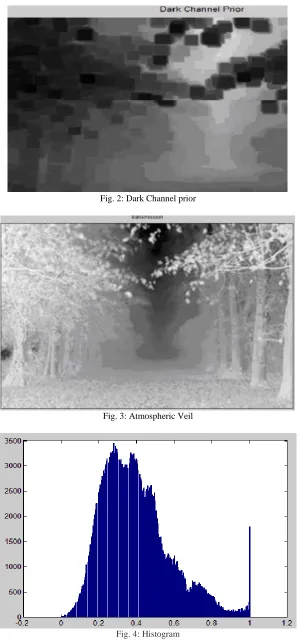
Dark channel prior is used for the estimation of atmospheric light in the dehazed image to get the more proper result. This technique is mostly used for nonsky patches, as at least one color channel has very low intensity at some pixels. The low intensity in the dark channel are predominantly because of three Components: Colourful items or surfaces (green grass, tree, blooms and so on) Shadows(shadows ofcar, buildings etc)Dark items or surfaces(dark tree trunk, stone). As the outdoor images are usually full of shadows and colorful, the dark channels of these images will be really dark. Due to fog (airlight), a haze image is brighter than its image without haze. So we can say dark channel of haze image will have higher intensity in region with higher haze. So, visually the intensity of dark channel is a rough approximation of the thickness of haze. In dark channel prior we also use pre and post processing steps for getting better results. In post processing steps we use soft matting or bilateral filtering etc. Based on these models, we then present three algorithms to interactively deweather a single image. In all these cases, the user provides simple inputs through a visual interface to our physics-based algorithms for restoring contrasts and colors of the scene. The types of input (for instance, approximate direction in which scene depths increase, or a rough depth segmentation or a region of good color fidelity) may vary from scene to scene, but are easy to provide for a human user. We also use similar interactive methods to add physically-based weather effects to images. We show several results that illustrate effective deweathering of both color and gray-scale images captured under harsh weather conditions. Our algorithms do not require precise information about scene structure or atmospheric condition and can thus serve as easy-to-use plug-ins for existing image processing software, such as Adobe PhotoshopTM. we review two single scattering models that describe colors and contrasts of scene points in bad weather. These models are used in our interactive methods to deweather, and add weather to images. The dichromatic atmospheric scattering model states that the color of a scene point E in fog or haze, observed by a color camera, is given by a linear combination of the direction Aˆ of airlight (fog or haze) color, and the direction Dˆ of the color of the scene.
every pixel, the depth estimate d is known, and the sky brightness E∞ is measured. Generally, the atmosphere condition remains constant (or varies slowly) over small distance ranges and fields of view that are relevant to computer vision applications. If we assume homogeneity of the atmosphere, then the scattering coefficient β is constant for all pixels in the image. Urban scenes with strong depth discontinuities and severe occlusions (induced by different buildings) are not suitable for the previous approach where depth trends were smoothly interpolated. In such cases, it is better to provide a rough depth segmentation of the scene. Recall that precise depth information is not needed to deweather images. For instance, the brightness levels of fog for a frontal planar surface are approximately equal to the brightness levels for a curved surface at the same distance. Thus, planar depth segments should suffice for deweathering in urban scenes . The deweathering algorithm is similar to the one presented in the previous section. The depths, however, are provided as approximate planes. In our experiments, we used images from the Columbia Weather and Illumination Database. Orthographic depths were obtained from satellite orthophoto. Once again, the sky brightness E∞ was measured by selecting a region of the sky. Thus far we presented algorithms to remove weather effects from a single image. However, in computer graphics applications, it may be required to add atmospheric effects to images. We now demonstrate the addition of weather effects to a single photograph using a manually provided approximate depth map. We add two types of scattering effects to an image. Note that the intensity of a light ray diminishes when it is scattered by an atmospheric particle. Hence, the number of scattering events each light ray can undergo and still be detectable by the camera, is small. Hence, single scattering models suffice to add weather effects to images of surfaces in the scene.We manually provide depth heuristics and the sky intensities E∞, as described in the previous sections. Then, we segment the light sources in the image. This step can also be done automatically using a simple thresholding operation on image intensities. This step consists of two parts corresponding to the addition of single scattering effects to surfaces and multiple scattering effects to light sources.
III. PROPOSED METHOD
We propose a novel VR approach in order to restore hazy images captured during inclement weather conditions, such as haze, fog, sandstorms, and so on. Our approach involves three important modules: 1) a DE module; 2) a CA module; and 3) a VR module. Initially, the proposed DE module designs an effective refined transmission procedure that takes advantage of the median filter to preserve edge information and thereby avoid generation of block artifacts in the restored image. This is followed by a transmission enhancement procedure, which adjusts the intensity of the transmission map to achieve optimum haze removal results. After these two procedures are accomplished by the DE module, effective depth information can be obtained. Next, in order to recover true color, the color characteristics and color information of the input hazy image are, respectively, analyzed and acquired in the proposed CA module. Finally, the VR module recovers a high-quality haze-free image using the depth and color-correlated information to adequately conceal the atmospheric particles present in various real-world weather.
DE Module
usually experience a loss of edge information when estimation occurs. For this reason, we propose a refined transmission procedure that uses a median filter technique to preserve edge information of input hazy images and thereby avoid generation of halo effects. The flowchart of refined transmission can be observed. The median filter technique performs a nonlinear filtering operation that can effectively suppress impulsive noise components enhanced Transmission: As discussed in the previous section, the dark channel prior depends on the minimum value of the RGB channel and always produces an insufficient transmission map for images captured during sandstorm conditions.
CA Module:
During sandstorm conditions, captured images usually exhibit serious color distortion problems due to the fact that particular portions of the color spectrum are largely absorbed by atmospheric particles. He et al. propose an algorithm with which to recover original scene radiance. However, it uses the same restoration equation for each color channel, thus resulting in recovered images with serious color distortion problem. To solve this problem, we propose utilizing the CA module that uses the gray world assumption to determine whether or not the average intensities of the each color channel are equal.
VR Module:
The obtained color information can be adapted for various weather conditions, including haze, fog, and sandstorms. Finally, the VR module can effectively restore the visibility of input images and obtain high-quality haze-free results via the DE module and the CA module. The experimental results produced by both methods were evaluated by qualitative and quantitative comparisons of images of several realistic scenes with varied weather conditions and features. These analyses illustrate the efficacy of our proposed VR approach.
IV. STIMULATION RESULTS
In contrast, the proposed haze removal method uses the gray world assumption to equalize each color channel and thereby solve the color distortion problem in images captured during sandstorm conditions. This is accomplished by employing the color difference value in the CA module. Moreover, our method significantly increases the efficacy of haze removal through utilization of adaptive gamma correction techniques to redistribute within the dynamic range of the histogram. The DE module uses the median filter of the refined transmission procedure to preserve edge information and avoid generation of block artifacts our method can efficiently remove the haze of input images with color distortion and recover their true color without generation of artifacts.
This section presents a comparison of haze removal results produced via our method and the method of He et al. through qualitative and quantitative evaluations of test images featuring realistic scenes. It contains four major parts:
1) refined transmission results; 2) enhanced transmission results;
3) results of haze removal under varied weather conditions
4) quantitative evaluation. The first part focuses on the advantages of the refined transmission map and the results of haze removal in images, which have complex structures.
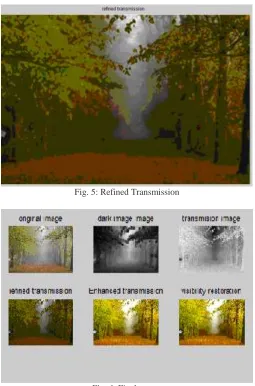
The second part describes the benefits of the enhanced transmission procedure, which is used to ensure sufficient transmission map estimation. The third part presents the results of VR for images featuring different scenes captured under varied weather conditions. The purpose of the final part is to provide quantitative evaluation of images captured under varied weather condition. This section describes the performance of the proposed refined transmission procedure of the DE module and compares it through visual evaluation with the soft matting method proposed. Consequently, a high-quality haze-free image can be produced using the proposed refined transmission map, as shown in the fifth row of. It is evident from the results of haze removal and the estimated transmission map that our proposed refined transmission procedure was successful. In order to verify the performance of the proposed enhanced transmission procedure of the DE module shows the visual evaluation results produced by our method both with and without utilization of the enhanced transmission procedure.
Fig. 2: Dark Channel prior
Fig. 3: Atmospheric Veil
Fig. 5: Refined Transmission
Fig. 6: Final output
V. CONCLUSION
In this paper, we propose a novel VR approach for images captured in varied weather conditions and featuring variable scenes. The proposed approach uses a combination of three major modules: 1) a DE module; 2) a CA module; and3) a VR module. First, the proposed DE module applies a refined transmission procedure to avoid the generation of block artifacts in the restored image using the median filter to preserve the edge information of the image. Subsequently, an effective transmission map is estimated by adjusting its intensity via an enhanced transmission procedure based on the adaptive gamma correction technique. Next, the proposed CA module uses the gray world assumption to analyze the color characteristics of the input haze image. The obtained color information can be adapted for various weather conditions, including haze, fog, and sandstorms. Finally, the VR module can effectively restore the visibility of input images and obtain high-quality haze-free results via the DE module and the CA module. The experimental results produced by both methods were evaluated by qualitative and quantitative comparisons of images of several realistic scenes with varied weather conditions and features. These analyses illustrate the efficacy of our proposed VR approach. Not only can it effectively circumvent significant problems regarding color distortion and complex structure, but it can also produce high-quality hazefree images more effectively than can the method of He et al. To the best of our knowledge, we are the first research group to successfully develop an efficient VR approach for use in images captured during varied weather conditions in realistic conditions.
REFERENCES
[1] S. G. Narasimhan and S. K. Nayar, “Interactive (de)weathering of an image using physical models,” in Proc. Workshop Color Photometric Methods ICCV, Oct. 2003, pp. 1387–1394.
[2] Y. Y. Schechner, S. G. Narasimhan, and S. K. Nayar, “Polarization based vision through haze,” Appl. Opt., vol. 42, no. 3, pp. 511–525, Jan. 2003. [3] S. G. Narasimhan and S. K. Nayar, “Contrast restoration of weather degraded images,” IEEE Trans. Pattern Anal. Mach. Intell., vol. 25, no. 6, pp. 713–724,
Jun. 2003.
[4] S. K. Nayar and S. G. Narasimhan, “Vision in bad weather,” in Proc. 7th IEEE ICCV, vol. 2. Jun. 1999, pp. 820–827.