ISSN (Online): 2320-9364, ISSN (Print): 2320-9356
www.ijres.org Volume 3 Issue 7 ǁ July 2015 ǁ PP.01-07
The design of automatic intelligent home cooking machine based
on GSM network
Zheng Lingxiang Lu Jiahua Sun Chen Huang Xinyou
(College of Mechanical Engineering, Shanghai University of Engineering Science, Shanghai,201620,China)
Abstract:
Put forward a design scheme of automatic intelligent home cooking machine based on GSM network, realized the whole cooking process (weighing, washing, cooking, heat preservation) of full automation, and can be remote controlled in the form of text messages by the GSM network. Introduced, cooking machine structure design, horizontal mobile mechanism and vertical hoisting mechanism design, control system framework design, selection of STM32 chip, pressure sensor and its stability demonstration , GSM mobile phone module TC35 chip peripheral circuit design and using method, software design, uc/OS-Ⅱ real-time operating system using method, design of the main program flow.Key words:
Automatic; remote control; STM32; GSM network; uc/OS-ⅡI.
Introduction
With the rapid development of Internet and software technology, easy and convenient way of cooking is more and more popular with people, intelligent, environmental protection, energy-saving high-end electric rice cooker will become the future of high-profile goods, especially remote controlled automatic intelligent electric rice cooker will be the direction of future development. Convenient rice cooker has gradually become the people daily life indispensable products. In recent years, with the rice cooker industry fast development in our country constantly improve production technology and benefit from the rice cooker industry growing market of downstream demand, the rice cooker industry development situation in the domestic and international market are very bullish on [1].
The function and technology of rice cooker , both thermal insulation automatic type, timing, insulation type and new type microcomputer control [2], working in real time has been rapid development, but in the long time work there are still obvious flaws and shortcomings, on the function from the requirement of people has a larger gap: 1) artificial washing rice, adding water, the different types of rice cooker need different amounts of water and difficult to control, therefore, requires the user to have a certain cooking skills. 2) soaking in water for too long, will cause the processed staple food in terms of shape, texture, can't satisfy people's requirements. 3) long time processing, timing, quantitative processing, only when encountered some food increase or decrease the number of change, can't adjust in a timely and effective manner. 4) long time processing, drenched by not eating on time, the rice cooker is in long time of heat preservation condition, is not in conformity with the nutrition, the basic requirement of environmental protection, energy saving, and large energy consumption. According to the defects of existing products, through the structure innovation, the control method to improve, design a kind of automatic intelligent home cooking machine based on GSM network.
II.
The mechanical structure design
Fig. 1 rice cooker overall frame design
Structure design is shown in Fig. 1, cooking machine include 00 chassis system, 10 stents, 20 rice supply system, 30 weighing system, 40 rice washing device, 50 horizontal moving device, 60 vertical lifting device, 70 cooking equipment, 80 water supply and drainage system and 90 control system. Contact life reality, in order to prevent loss of rice natural nutrition, use two leaf inclined pulp agitator washing rice, stir axial flow of production, not only retained the rich nutrition of rice, but also stirred the residue in rice chaff to the liquid surface so that easy to discharge.
In cooking machine added the horizontal moving device and vertical lifting device. The horizontal moving device is made up of ball screw, optical axis of guide rail and drive motor, used to move the electric rice cooker from the cook position to the rice washing device for getting washed rice and water, then move back to cook position. Vertical lifting device is made up of the elevator slippery course, lifting slider, drawing lines, reels, motor. Vertical lifting device is used to lift the electric rice cooker lid.
Existing patents (such as CN200420093883 CN201010509662) do not have the horizontal moving device, and vertical lifting device and not appear as the layout of the structure, this design mainly has the following three advantages:
(1) Can avoid the rice washing device and the rice cooker directly connected, so that we can set out the electric rice cooker from cooking machine, such as move to dining room, at the same time the rice cooker can be cleaned easily.
(2) Vertical lifting device can lift electric rice cooker lid, so that the cooking machine can make porridge. (3) When washed rice falling into the electric rice cooker, horizontal moving device will drive electric rice
cooker move around a small scale, let rice evenly into the tank.
Working principle: when come to the setting time, rice supply system start to work, weighing device weigh the rice box, concluded the original amount of rice, then the solenoid valve open, rice start falling into the rice washing device, at the same time weight sensor constantly weight rice box, when the amount of rice that fell into rice washing device is equal to the requirement, solenoid valve closed; Then the electromagnetic valve open, water start flowing into the rice washing box, when the amount of water reach the set quantity the electromagnetic valve close, at this point, the agitator began to rotating, later, drainage solenoid valve open, make rice bran floater flow out, then, the drainage solenoid valve closed; After that vertical lifting device lift the electric rice cooker lid up, then horizontal moving device move the electric rice cooker to the rice washing device, washed rice fall into the cooking device, later on, open the water solenoid valve, when the amount of water reach the set quantity, close water solenoid valve; then, move back to cook position and close on the cooking lid. After above operations is completed, heating plate started heat, if cooked porridge, when cooking pot outer wall temperature reached 90 ℃ or higher, vertical lifting device lift the lid up, continue heat until the setting time heat stop.
20 00
90
40
70 10
30
60
50
III.
control system design
ST
M3
2
ma
in
c
on
tr
ol
un
it
Information control module
temperature control module
Time control module
Motion control module
Weight control module
Water control module
Power supply module
GSM mobile phone module
Matrix buttons
LCD
Buzzer alarm
The temperature sensor
Heating control relay
Motion limit switch
Motor drive Pressure sensor
solenoid valve
liquid flow meter
Solenoid valve
Dc voltage regulator module
Electrical isolation elements
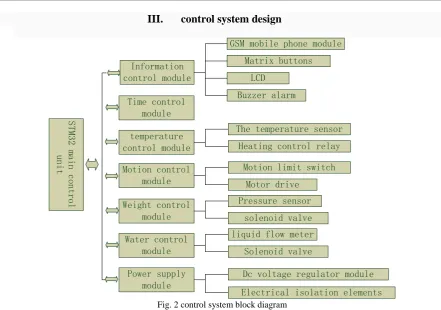
Fig. 2 control system block diagram
Control system block diagram as shown in Fig. 2, is divided into seven modules, the system use STM32F103 series single chip microcomputer of the ARMv7 architecture as main controller, this chip internal resource is rich, good stability and low cost. The kernel of STM32F103 chip is ARM32 Cortex-M3 CPU , highest working frequency is 72 MHz, 1.25 DMIPS/MHz; Single cycle hardware multiplication and division; On-chip integration 32-512 KB of Flash memory, the 6-64 KB SRAM memory; Three kinds of low power consumption modes: sleep, stop, standby mode; Level 2 12 us A/D converter (16 channels), double sampling and retention, four 16-bit timers, 16 six channels of advanced control timer, 5 USART interfaces.
Using high precision resistance strain type pressure sensor, considering the maximum rice storage is 6 kg. choose the pressure sensor weight range of 20 kg. Sensor Model is HL-8 type Izod resistance strain sensor, the choice of a high-resolution ADC within the critical signal conditioning HX711 The chip integrates the peripheral circuits including power supply, on-chip oscillator, and other always require the same type of chips. It has advantages of high integration, fast response, strong anti-interference. Pressure sensor internal schematic diagram is shown in Fig. 3.
R1
R2
R3
R4
Vcc
GND Up
Up
Tensile resistance increases
A B
C
D Vo
Fig. 3 Schematic pressure sensor internal Schematic
Sensor output voltage is BA’s voltage: VOVBDVAD
2
1
2
4
3
4
R
R
V
R
R
R
V
R
CC CC
V
CCR
R
R
R
R
R
R
R
4
3
2
1
3
2
1
4
From (1) shows that, when the bridge resistance satisfy the following conditions:
R
1
R
4
R
2
R
3
(2)The output voltage of the bridge VO0, the bridge is in balance. In order to ensure the accuracy of
measurement, the bridge before the actual need be balance (zero), so that the output voltage changes only to feel the strain gage caused by related.
For appliances remote network control, there are two main ways, based on the TCP / IP Internet protocol network [2] and the use of mobile communication networks for remote control [3]. On the one hand the appliance direct access to the Internet, you need to implement TCP / IP protocol stack on the MCU, hardware for computing speed and storage resources microcontrollers put forward higher requirements will increase the cost of the product; on the other hand home users also need to provide an Internet network interface (access broadband network), and each household appliances also need to have a separate IP address, network coverage in the current conditions, achieve universal product is also difficult. GSM short message digital communication platform utilizes GSM SMS remote wireless communications, it has a low cost of communications, communication lines and regions without restrictions, high security, high reliability, strong anti-interference ability, easy to use, flexible, fast communication, etc. Features. The use of GSM short message system also has a two-way wireless communication data transmission capabilities for remote data transmission and monitoring of communications equipment to provide a strong support platform, remote monitoring system described in this article is based on the completion of this development, mobile communications module TC35i.
TC35 Siemens launched a new - generation wireless GSM module. Comes with RS232 communication interface, it can easily communicate with the PC, even SCM machine. Fast, secure and reliable system solutions in the data, voice transmission, short message service (Short Message Service) and fax. TC35 module operating voltage of 3.3-5.5V, can work in two bands 900MHz and 1800MHz, respectively, where the band power 2w (900M) and 1w (1800M). Module AT command set interface, support for text and SMS PDU mode. Common AT commands as follows:
AT+CMGF (Choose a short message format) Message Format command:
AT+CMGF=<mode> (<mode> Description 0 PDU mode 1 Text mode) AT+CSCA (Short message center addresses)
AT+CNMI (Short Message display signal received) AT+CMGR (Read SMS instructions)
AT+CMGS (Send Message)
Fig. 4 phone remote control module schematics
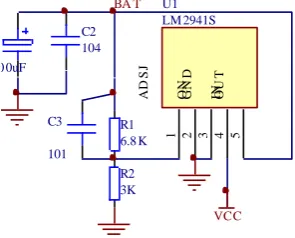
TC35i module supply voltage is typically 4.2V, the system uses LM2941S precision voltage regulator chip, the 5V voltage at 4.2V power to the modules, while at the output capacitor in parallel to compensate for the large transient current shortage and avoid providing a large current voltage drop overtook 0.4V. LM2941S regulator circuit shown in Fig. 5:
Fig. 5 LM2941S regulator circuit
IV.
System software design
Program is designed on KEIL3 MDK software, KEIL3 STM32 family of microcontrollers is dedicated to develop software, carrying the corresponding model chip library functions can be called directly, simplify programming. Program is designed in the method of modular programming, the various functional modules code is packaged, so can be called directly in the main function when used to enhance the readability of the program while reducing redundant code.
Because the system involves a plurality of sensors, a plurality of control objects, in order to better manage the various tasks, use uc / OS-Ⅱ real-time operating system to manage task. uc / OS-Ⅱ by the US Federal Aviation Administration for commercial aircraft, consistent with RTCA DO-178B certification standards in 2000, which proved to have sufficient stability and security. uc / OS-Ⅱ is known, open source real-time kernel, is designed for embedded applications. Most of the code is written in C language, and only a very small part of
BA T 启动 GRXD R4 22K R3 100 K B A T GT XD CCRST CCI O CCCLK CCV CC GN D G N D C C C L K C C V C C C C R S T R6 100 BA T LED LED 2 3 1 Q1 S80 50LT1 R5 10K SYN C SYN C C C V C C 1 C C R S T 2 C C C L K 3 C C G N D 4 V P P 5 C C IO 6 SIM 1 SIM C C IO 1 2 3 4 5 6 7 8 9 10 11 12 13 14 15 16 17 18 19 20 J1
can put it ported to various types of 8 16-bit and 32-bit embedded processor. Based uc/OS-Ⅱ real-time operating system programming paradigm [7] as follows:
void main(void) { ……
OSInit( ); //μC / OS-II is initialization ……
OSTaskCreate (TaskStart,……); // Create a task
OSStart( ); // Start multi-task scheduling }
void TaskStart(void*pdata) {
…… // In this position installation and start μC / OS-II clock OSStatInit( ); // statistical tasks initialization
…… // Create additional tasks in this position for(;;)
{
Initial task TaskStart code }
}
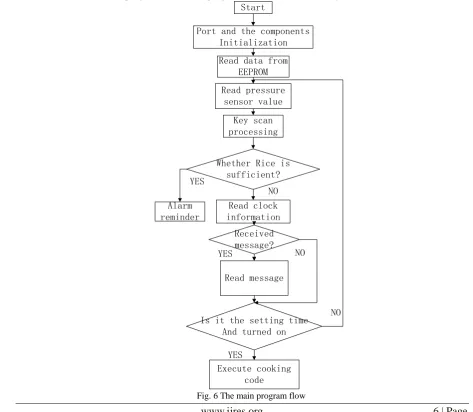
Application developed on the uc/OS-Ⅱ, we need to establish separate tasks for cook machine every step work and every time visit to sensors and set a priority grade for each task according to cooking machine workflow, processing messages delivery problems and resource sharing issues between tasks, After the system task starts all the tasks will be scheduled according to the workflow. According to the actual workflow cooking machine, determined main program flow, main program flow chart shown in Fig. 6.
Start
Port and the components Initialization
Read data from EEPROM
Read pressure sensor value
Read clock information
Key scan processing
Received message?
Read message YES NO Whether Rice is
sufficient?
NO YES
Alarm reminder
Is it the setting time And turned on
YES
NO
Execute cooking code
V.
Conclusion
In this paper, the structural design has innovated, joined the horizontal movement mechanism and vertical lift mechanism, to further expand the porridge function, while allowing the cooking apparatus taken out for cleaning, improve the usability of the device. Introducing uc / OS-Ⅱ real-time operating system task management system, streamlining the process design, while improving timeliness and sensitivity of the system. After the actual test, the set rice quantity compared to the actual amount of rice quantity error is smaller, the precise amount of water, cooking tasks assigned to the cooking machine in the form of mobile phone short message and the system can accept and execute without error, the entire system is stable, operations simple, easy maintenance, low cost, and has broad market prospects.
References
[1] Guo Xiao-nian. The current development of rice cookers Industry - red cooker Case [D] .Kunming: Southwest Forestry University, 2012.
[2] Cai Yi-fan, Ye Hua. Research on cooker temperature control system [J]. Southeast University, 38 (2),2008: 119-122.
[3] Kang Zhi-liang, Li kai-guo, Xu Li-jia. Automatic rice cookers remote control system based on TCP / IP protocol [J]. Control Technology and Instrumentation, 37 (6), 2011: 99-102.
[4] Chen Zhi-yuan, Zhu Ye-cheng, Zhou Zhuo-quan. An intelligent home control systems based on STM32 [J]. Computer-based Technologies and Applications, 38 (9), 2012: 138-140.
[5] Liu Wen-bin. Automatic rice cooker [P] .Chinese patent: CN200420093883. 2005-11-16.
[6] Qiong Xiang. Home-automatic cooking machine [P]. Chinese patent: CN201010509662 .2012-05-16.