Human Journals Vol.:2, Issue:1 Review Article
© All rights are reserved by Yi-Sheng Wang
Social Behavior in WhatsApp Messenger Services: Application
of Grounded Theory
www.ijrm.humanournals.com
Keywords: Social Behavior, WhatsApp Messenger services
ABSTRACT
This study began with a micro view of the WhatsApp services phenomenon, leading to a macro view of social context. To decompose the social behavior in the WhatsApp services, using a three-stage coding process through grounded theory. The contribution of this study is to reveal a theoretically-saturated of a conceptual framework of social behavior and to discover the six theoretical propositions.
Yi-Sheng Wang
Associate Professor, Department of Marketing &
Distribution Management,
Oriental Institute of Technology, New Taipei City,
Citation: Yi-Sheng Wang Ijrm.Human Vol. 2 (1): 97-103.
98
98
98
98
1. INTRODUCTION
According to the definition by Zingales (2017), WhatsApp Messenger (WhatsApp) services
are the services of delivering data to mobile phones via wireless transmissions, such as SMS,
e-mail, multimedia message system, ringtone downloads, news, weather forecasts and stock
quotes, etc.
Fatihi, Belabbes and Janah (2017) found that WhatsApp services can deliver very important
social behavior creation as described in value-based adoption of WhatsApp services: an
empirical investigation. But there a significant breach of insufficiently and limitation when
discussing the micro-view of subjective self-consciousness meanings of the social behavior in
WhatsApp services from the macro view of social behavior and social context. Therefore the
purposes of this research are: (1) through grounded theory, thoroughly decomposing the
meaning of self-subjectivity of the social behavior in WhatsApp services; (2) constructing a
conceptual framework in the WhatsApp services.
2. Literature Review
WhatsApp services became an indispensable technology devices for personal consumption
and recreation, even technology jewelry (Ahad and Lim, 2014). They are not just a part of
many people‟s exterior decoration for their functions (PDA, digital camera, MP3, internet,
etc.) and appearances can be combined to market different smartphone mobile services to
different market segments. Furthermore, the use of WhatsApp services also reflexes the
differences between social categories or economic groups (Anglano, 2014). The use of
WhatsApp services also reflexes the differences between generations (teenagers and
youngsters are the main users) (Sánchez-Moya and Cruz-Moya, 2015), classes or income
levels (conspicuous consumption for upper-class customers and low subscription rate for
lower-class customers) (Yus, 2017), and the differences between genders (special design,
production, marketing, and mobile services advertisement delivery for female customers, to
form female stereotyped impression) and sex appeal (Sanchez-Machin et al., 2015).
WhatsApp services are not products of this company or that company, but also social
products (Ahad and Lim, 2014). There are socioeconomic bases for the spread and use of
WhatsApp services. New behavior model can also be built with the constraints of social
Citation: Yi-Sheng Wang Ijrm.Human Vol. 2 (1): 97-103.
99
99
99
99
screens or dual screens of multi-media, polyphonic ringtones, external or internal digital
cameras, SMS messages, pictures, and other downloads via WhatsApp services, have
encouraged the rend of WhatsApp capitalism commoditization by helping customers get rid
of black-and-white screens and monotone ringtones.
3. Research Design
Research objects are selected from Chunghwa Telecom Co., Ltd. (CHT), the telecom
company with the largest market share in Taiwan. Theoretical sampling was performed and
the WhatsApp service customers were categorized into three groups by their social behavior.
The first group of respondents includes five people in total: the CHT counter supervisor, the
CHT product manager, three selling directors, the second group of respondents includes six
people in total: an enterprise manager, an enterprise assistant manager, two business owners,
a chairman of the board and a CEO, and the third group of respondents includes six people in
total: students with age below twenty five. There are 50 respondents in total. Semi-structured
interviews, recording, and observation were conducted.
4. Text Analysis
The purpose of performing a three-stage coding process through grounded theory is to obtain
the text meanings of social behavior. In order to efficiently deal with a large dataset of 50
respondents, a qualitative coding software package was used for this study to organize and
analyze the results from the three-stage coding.
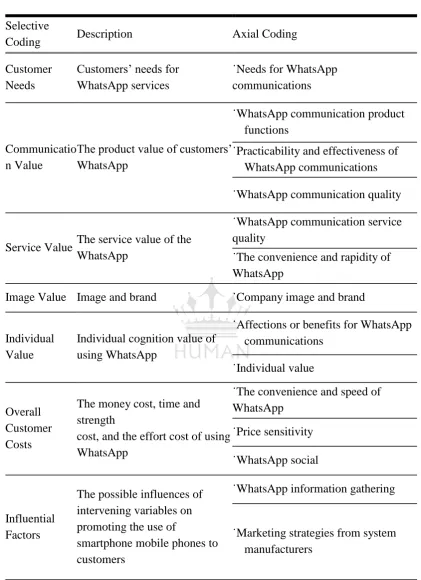
To find out social behavior concepts in choosing WhatsApp services, open coding was
performed on the content of the interviews to define phenomenon and generate concept labels
in this study. Then the axial coding was performed after open coding to induce the concepts
with the same properties into a higher-level context-bound concept. Besides the factors
themselves, the relationships between other factors were also considered when selective
coding was performed, in order to achieve the purposes of selective coding in grounded
theory, which are: (1) to build the relationships between categories. (2) To strengthen the
proof-concept relationships between. (3) To continuously search for the properties of the
main-categories and the sub-categories and to confirm the dimensional locations of the data.
Citation: Yi-Sheng Wang Ijrm.Human Vol. 2 (1): 97-103.
100
100
100
100
Table 1 Selective Coding and Axial Coding
Selective
Coding Description Axial Coding
Customer Needs
Customers‟ needs for WhatsApp services
˙Needs for WhatsApp communications
Communicatio n Value
The product value of customers‟ WhatsApp
˙WhatsApp communication product functions
˙Practicability and effectiveness of WhatsApp communications
˙WhatsApp communication quality
Service Value The service value of the
˙WhatsApp communication service quality
˙The convenience and rapidity of WhatsApp
Image Value Image and brand ˙Company image and brand
Individual Value
Individual cognition value of using WhatsApp
˙Affections or benefits for WhatsApp communications
˙Individual value
Overall Customer Costs
The money cost, time and strength
cost, and the effort cost of using WhatsApp
˙The convenience and speed of WhatsApp
˙Price sensitivity
˙WhatsApp social
Influential Factors
The possible influences of intervening variables on promoting the use of
smartphone mobile phones to customers
˙WhatsApp information gathering
˙Marketing strategies from system manufacturers
With the assistance of a qualitative coding software package, seven text meanings of
Citation: Yi-Sheng Wang Ijrm.Human Vol. 2 (1): 97-103.
101
101
101
101
individual value, overall customer costs, and influential factors. Thus the “subjective
self-consciousness meaning” of customer value had been obtained in this study.
5.A Conceptual Framework
The theoretically-saturated framework built in this study is composed of six inter-textual
thesis concepts. It follows the meanings of the theoretic reference model from grounded
theory. And this structure is also the “hermeneutics meaning” obtained from this study.
Citation: Yi-Sheng Wang Ijrm.Human Vol. 2 (1): 97-103.
102
102
102
102
5.1. Development theoretical propositions
The practicability, effectiveness, and easy-to-use characteristic of WhatsApp services come
from the applications of content value-added services and the universality of use.
Proposition 1: With the easy-to-use characteristic of voice, the practicability of data, and the effectiveness of video, the implementation strategy of WhatsApp capitalism
creates social needs through advertising and all the other channels so that the
capital in the circuit of capital can be consolidated.
Proposition 2: Through WhatsApp interface, mobile service system limits the transmission resolution quality and stability in the frame of WhatsApp, forming social‟
dependency on WhatsApp services. The stronger the social‟ dependency on
WhatsApp services, the stronger the commodification of self-construction is.
Proposition 3:Enterprise customers of WhatsApp services first take security and privacy into consideration. Although WhatsApp services bring huge convenience, it is
also accompanied by the control of surveillance.
Proposition 4: Public praise, product value, and social network are the dynamic factors of the overall social behavior in WhatsApp services. The more dynamic the
relationship quality is, the stronger the driven force of social satisfaction and
trust is.
Proposition 5: WhatsApp service market segmentation can be done by the value-added services of mass-customized digital content. Personalized designs of
WhatsApp services can be achieved by the customization of social behavior.
The customization of digital content and WhatsApp can deliver the
maximization of individual value.
Proposition 6: The production and marketing model and advertising strategies of WhatsApp are the bases of mobile information fetishism and commodity fetishism. The
commodification of self-construction is achieved through products. The
Citation: Yi-Sheng Wang Ijrm.Human Vol. 2 (1): 97-103.
103
103
103
103
6. CONCLUSIONS
In the practical strategy business aspect, by the means of the advertisement, promotions,
brand image, and campaign in mobile information fetishism, marketing effect can be
maximized. There are three key paths of this meaning: (1) WhatsApp service providers must
close the knowledge gap between the information poor and the information rich, especially
the gap between the four-generation and the five-generation. Otherwise, WhatsApp services
would just be fashion commodities for the minority of elites and students. (2) Use customer
curiosity well with experiential marketing. Through experiences, social would actually be
convinced to participate. For example, sending emails through a WhatsApp phone is very
cool, or being able to roam with the same WhatsApp form abroad is very cool. This group of
five-generation users is the largest and shouldn‟t be ignored.
REFERENCES
1. Ahad, A.D. and Lim, S.M.A. (2014). Convenience or Nuisance? The „WhatsApp‟ Dilemma. Procedia - Social and Behavioral Sciences, 155(6), 189-196.
2. Anglano, C. (2014). Forensic analysis of WhatsApp Messenger on Android smartphones. Digital Investigation, 11(3), 201-213.
3. Fatihi, J., Belabbes, S. and Janah, H. (2017). Whatsapp comme outil de télé-expertise interniste pour la gestion à distance de l‟aval des urgencies. La Revue de Médecine Interne, 38(2), 136-137.
4. Sánchez-Moya, A. and Cruz-Moya, O. (2015). Hey there! I am using WhatsApp: A Preliminary Study of Recurrent Discursive Realisations in a Corpus of WhatsApp Statuses. Procedia - Social and Behavioral Sciences, 212(2), 52-60.
5. Sanchez-Machin, I., Guedes, P.P., Perez, R.G. and Victor Matheu, V. (2015). Experience in the Use of Social Media (whatsapp, e-Mail, facebook, website) By Patients. Journal of Allergy and Clinical Immunology, 135(2), 135-139.
6. Yus, F. (2017). Contextual constraints and non-propositional effects in WhatsApp communication. Journal of Pragmatics, 114, 66-86.