RESEARCH ARTICLE
EFFECT OF PASTEURIZATION ON ALCOHOL YIELD AND ASCORBIC
ACID RETENTION IN ORANGE WINE
1,*
Dr. Ram Rakha,
1Arvind Kumar,
1Pracheta, M.K.,
1Harish Kumar Sagar
and
2Prof. Dheer Singh
1
State Institute of Food Processing Technology, 18 –B Ashok Marg Lucknow-226001, India
2
Dean, Engg., and Tech., Bundelkhand University, Jhanshi U.P. -284128, India
ARTICLE INFO ABSTRACT
Orange fruits are acidic fruit which contain healthy nutritional content that works wonders for the body. It acts as a fabulous source of vitamin c and a wide variety of essential nutrients required by the body. Fresh fruits and their hand-squeezed or industrially processed juices contain mostly flavonones and flavones 20, 21.Findings of experiments showed that pasteurization of juice in boiling water for 5mts is considered enough to better yield of alcohol as well as ascorbic acid retention .Time and temperature played important role in case of orange wine regarding alcohol yield and ascorbic retention.
INTRODUCTION
The word orange derives from the Sanskrit word for "orange tree" (naranga), probably of Dravidian origin. The Sanskrit word reached European languages through Persian (nārang) and its Arabic derivative (nāranj) (http://www.collins dictionary .com). The word entered Late Middle English in the fourteenth century via Old French orange (in the phrase pomme d'orenge). The French word, in turn, comes from Old Provençal auranja, based on Arabic nāranj. In several languages, the initial n present in earlier forms of the word dropped off because it may have been mistaken as part of an indefinite article ending in an n sound—in French, for example, une norenge may have been heard as une orenge. This linguistic change is called juncture loss. The colour was named after the fruit, and the first documented use in this sense dates to 1542 (Paterson, 2003). Orange wine was at one time made in Florida from fruits too affected by cold spells to be marketed. It is presently produced on a small scale in South Africa. Orange wine and brandy are made in Brazil from fruits which have been processed for peel oil and then crushed. Nutritional significance of alcoholic beverages depends largely on purification and sugar contents. The wines and beers of developed countries have very limited nutritional properties except for energy.
*Corresponding author: Dr. Ram Rakha,
State Institute of Food Processing Technology, 18 –B Ashok Marg Lucknow-226001, India.
They usually contain no fat and only traces of protein I.e. less than 0.5 g/100gms.Ther is also no vitamin-D and usually no vitamin-C although a little may be Present in cider. Vitamin-B present in the seed is normally utilized during fermentation and therefore absent in the final products but other Vitamins may be present .it is seen that distilled wine contains neither any Vitamin nor any mineral (Muller, 1980). An alcoholic beverage has alcohol percentage in the form of ethyl alcohol.Generally the name of wine is on its fruit. Ethyl alcohol is produced by fermentation of any carbohydrate containing fermentable sugar in the form of mono, di and polysaccharide (Gaylusac, 1810). Wine fermentation is basically the transformation of the various sugars of grape by east under anaerobic condition in to ethanol, carbon dioxide and small amount of byproducts. D-glucose and D-fructose the two principle sugar of grape juice yield essentially equimolar proportion of ethanol, carbondioxide.
C12H22O11 + H2O → C6H12O6 +C6H12O6 C6H12O6+ YEAST (Sacchromyces cerevisiae) → 2c2H5OH +CO2
In the fermentation process the catabolism of sugar is an oxidative process which result production of ethyl alcohol.The alcoholic fermentation took place in the yeast cell by a series of reaction usually referred to as the overall reaction are as fallow. Glucose (2ATP↔2ADP) →Glucose –di phosphate →2-triglyceric phosphate → 2 phospho acetic acid →2 pyruvic acid →2- acetaldehyde → 2C2 H5OH.
Article History:
Received 24th December, 2016
Received in revised form 05th January, 2017
Accepted 14th February, 2017
Published online 31st March, 2017
International Journal of Recent Advances in Multidisciplinary Research
Vol. 04, Issue 03, pp.2363-2367, March, 2017
Keywords:
Orange, Flavonones, Must, Alcohol, Ester,
Nutritional value per 100 g (3.5 oz) (Anonymous, 2011).
Energy 197 kj(47 kcal)
Carbohydrates 11.75 g
Sugar 9.35 g
Dietary 2.4 g
Fat 0.12 g
Protein 0.94 g
Water 86.75 g
Vitamin A equiv 11 µg (1%) Thiamine (vit. B1) 0.087 mg (8%)
Riboflavin (vit B2) 0.04 mg (3%)
Niacin (vit. B3) 0.282 mg (2%)
Pantothenic acid (B5) 0.25 mg (5%)
Vitamin B6 0.06 mg (5%)
Folate (vit. B9) 30 µg (8%)
Choline 8.4 mg (2%)
Vitamin C 53.2 mg (64%)
Vitamin E 0.18 mg (1%)
Calcium 40 mg (4%)
Iron 0.1 mg (1%)
Magnesium 10 mg (3%)
Manganese 0.025 mg (1%)
Phosphorus 14 mg(2%)
Zinc 0.07 mg(1%)
Alcohol should be regarded as food stuff because in the body it acts as concentrated source of energy in form of either carbohydrate or protein and has an available energy value equal to 29.2 Kj/gm. It is also a drug and effects the central nervous system. These two effects must considered together when assessing the desirability of alcohol as a source of energy. The nature of the effect of alcohol on body varies according to its quantity taken when a small amount is consumed less of coordination and even death when a large quantity is taken. Unlike most foods alcohol can be absorbed by the body without prior to digestion thus it provides a source of quickly available energy and it may be used for this purpose in emergency. Alcohol is almost completely absorbed during its passage through the body mainly in small intestine but also through the walls of stomach.
Absorption takes place in one half to two hours depending on concentration of the alcohol in the beverage. An average time of absorption is about an hour. After absorption the alcohol is distributed in the body through blood system and there after it is broken down in a series of oxidative steps with liberation of energy. This breakdown process is controlled by series of enzymes, each step being controlled by its own specific enzyme. Initial oxidation of alcohol to aldehyde is fairly controlled by "aldehyde de-hydrogenase" and as its name indicates that the step involves removal of hydrogen and it is followed by further oxidation to acetic acid. The most important enzyme taking part in this, is "aldehyde dehydrogenase". The initial break down process occurs in liver and thus the acid produced then becomes the part of general body- food and further oxidized in a complex process to carbon-di-oxide (Co2) and water. Alcohol is oxidized in body
rather slowly and only about 7gms can be oxidized in an hour. This means that alcohol is removed from the body at a slow rate and that it can make overall contribution to energy needs
(Brion et al., 1986).
METHODOLOGY
For experiment Fresh, mature Orange were procured from local fruit market, Lucknow.
Blemished and deformed Fruit were discarded .Fruit of each lot were washed in running water thoroughly peeled and extract juice .Starter was prepared by making a malt solution by adding 20% sugar 0.3% tartaric acid, 2% malt extract, 0.2% citric acid, 0.2% di ammonium phosphate in distilled water. The medium was just boiling, cooled and inoculated with pure of Saccharomyces cerevissiae variety ellipsoideus Bargundy 24 hour’s old starter was added to the must @4% level and was allowed to ferment at room temperature. After completion of fermentation all the lots were passed through muslin cloth and both seeds and pomace were discarded. All the five lots were subjected to fermentation till sugar was consumed (to dryness). After clarification packed into clean glass bottles. After racking bottles were sealed and stored at room temperature (25-300 C) for maturation for six months.
PREPARATION OF MUST
For the preparation of the Must fruits juice was divided into five equal lots. Lot no. 3 was diluted 1:3 ratio pulp and hot water. Lot no. 4 was diluted 1:4 ratio pulp and hot water. Lot no. 5 was diluted 1:5 ratio pulp and hot water. Sufficient sugarwas added to raise T.S.S. to 230Brix and citric acid was added to raise acidity level at 0.5%. Yeast nutrient in the form of ammonium phosphate at ratio of 0.2% and 100ppm sulfur-Di-oxide in the form Potassium Meta-bi-sulfite were added in all the 5 lots these must were inoculated with starter at the rate of 4% and fermentation was set at room temperature 23-250C.
All these lots were fermented almost all the sugar was consumed, after setting the wine were racked in glass bottles. The bottles stored at room temperature (250C) for maturation. Juice must and wine sample were analyzed for chemical composition. T.S.S.in B0 was determined with hand refractometer and pH by using a pH meter. Total acidity % (as citric acid), Reducing sugar, Non reducing sugar, Total sugar and Tannin (as tannic acid) were estimation by A.O.A.C. method, volatile acidity %s (as acetic acid), esters (as ethyl acetate), alcohol % v/v(as ethyl alcohol) (Bessey, 1933).
FERMENTATION
After vigorous fermentation all the lots were passed through muslin clothes and both seed and Pomace discarded. All the 5 lots of different treatments were fermented till all the sugar consumed (to dryness). After settling the wines were racked into clean glass bottles of 200 ml capacity and filled up to the brim.
SIPHONING/ RACKING
After settling the fermented wine is siphoned off to separate the wine from the solid deposits.
FINING / FILTERATION
AGEING/MATURATION
The clear wine is filled into bottles, these are sealed air tight and stored at room temperature for maturation (340 – 370C). The wines were racked at for 3 months, these are pasteurized at 650c for about 20 minutes, then cooled and stored
Table-1. Physical Parameters of fresh Orange
S.NO. CHARACTERS VALUE
1 Colour Orange
2 Weight 105.2
3 Length(cm) 11.4
4 Circumference(cm) 22.8 5 Specific gravity 0.96296
6 Flavour Pleasant
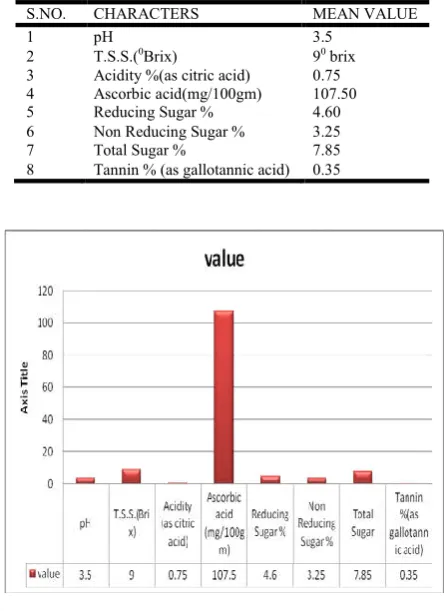
Table 2. Chemical Composition of fresh Orange
S.NO. CHARACTERS MEAN VALUE
1 pH 3.5
2 T.S.S.(0Brix) 90 brix
3 Acidity %(as citric acid) 0.75 4 Ascorbic acid(mg/100gm) 107.50
5 Reducing Sugar % 4.60
6 Non Reducing Sugar % 3.25
7 Total Sugar % 7.85
8 Tannin % (as gallotannic acid) 0.35
Figure. 2
RESULT AND DISCUSSION
Orange were physically and chemically analyzed for colour, weight, length, circumference, specific gravity and flavor were found orange colour, 105.02gm,11.4cm,22.8 and pleasant flavor respectively.
Whereas chemical parameters like pH, T.S.S., acidity, ascorbic acid reducing sugar, non reducing sugar, total sugar and tannin was observed 3.5,9B0,0.75%,107.50mg/100gm, 4.60%,3.25%,7.85%and0.35 respectively. Before setting for fermentation must were also estimated for chemical composition. pH of the must was observed in the range between3.50-3.75.Total soluble solids were found 22B0 in each treatment. Acidity (as citric acid) was found same 0.5% in each treatment. Ascorbic acid was estimated between 65.50-90.25mg/100ml. Reducing sugar was observed maximum 14.25% in T3 while 10.25 % minimum in T3.Non reducing
sugar was estimated in range of 20.75% in T4 and T1
respectively. Whereas total sugar was found 20.75% in T4
maximum and 18.00% minimum in T5.Tannin % as gallotannic
acid was varied between 0.60-0.75. After 6 month of maturation of Orange wine was analyzed for chemical composition .pH of the wine was found 3.75% maximum in T5,where as 3.6% minimum inT1 T2 . T.S.S. was ranges
between 3-6Brix. Acidity ( as citric acid ) was found 0.20% maximum in T2 where as 0.18% 0.10% minimum in
T3,Ascorbic acid observed ranges between 4.66%-7.80
Residual sugar was found 5.50 maximum in T3 where as 4.50
4.25 3.50 2.50 minimum in T2. Volatile acidity (acetic acid)
was found 0.9maximum in T1 where as 0.010 minimum in
T2.Alcohal % was found 9.2% maximum in T1 where as 9.0
minimum inT5.
Esters was found ranges between 25.50%-0.45%. Tannin (as gallotannic acid) was found 0.65% maximum in T5 where as
0.35% minimum in T1T2.T3.&T4 .After maturation of wine
finally organoleptic evaluation of wine was conducted by a Penal of five judges team. Clarity of wine was found 10 mark maximum for T1where as 8.0 minimum for T5.Colour was
found maximum 16.3 marks for T3 where as 5.8 minimum for
T1.Aroma was ranges between 16-13.8, freedom from acetic
acid was found 10 marks maximum in T3 where as 8.5in
T1.Total acid taste was found maximum 8.5 marks inT5 where
as 7.3,6.8,5.5, in T4, T2,T5,&T3 astringency was found ranges
between 8-5.
Extract body found ranges between 4-2, sugar was found 4.1 maximum for T1 where as 3.8 minimum for T3, general taste
found 3 maximum in T3 where as 3 mark overall impression
found 3.8 marks for T1 where as 2.6 minimum for T5,Total
score was recorded 83.80 marks maximum for T1 where as
59.80 minimum for T3.T1 got highest score 83.8 marks in
organoleptic evaluation and alcohol %(v/v) 9.2, ascorbic acid retention in wine 5.10 mg /100 ml were estimated among the treatments .These quantities of alcohol and ascorbic acid were highest in comparison to T4,T5,T2 and T3. Findings of T1 showed that pasteurization of juice in boiling water for 5mts is considered enough to better yield of alcohol as well as ascorbic acid retention.
Table 3.Chemical Composition of Must
S.No. Character Treatment
T1 T2 T3 T4 T5
1 pH 3.50 3.60 3.50 3.75 3.50
2 T.S.S.(B0) 22.00 22.00 22.00 22.00 22.00
3 Acidity%(as citric acid) 0.50 0.50 0.50 0.50 0.50 4 Ascorbic acid(mg/100gm) 80.25 75.10 90.25 65.50 72.40 5 Reducing sugar % 12.50 13.10 10.50 14.25 12.50
6 Non reducing sugar% 6.75 5.25 7.25 6.50 5.50
7 Total sugar% 19.25 18.35 17.75 20.75 18.00
Table 4.Chemical Composition of Orange wine after 6 Month of Maturation
S.NO. Characters TREATMENTS
T1 T2 T3 T4 T5
1 pH 3.50 3.60 3.60 3.50 3.75
2 T.S.S.(B0) 4.00 5.00 6.00 5.00 3.00
3 Acidity%(as citric acid) 0.15 0.20 0.18 0.15 0.10 4 Ascorbic acid (mg/100gm) 6.50 4.50 3.10 4.00 5.10
5 Residual sugar % 3.50 4.50 5.50 4.25 2.50
6 Volatile acidity %(acitic acid) 0.09 0.01 0.08 0.01 0.10
7 Alcohol %(v/v) 9.20 6.50 2.25 8.50 9.00
8 Esters(mg/100 ml ethyl acetate) 18.50 22.25 20.50 25.50 17.50 9 Tannin % (as Gallotannic acid) 0.60 0.55 0.50 0.45 0.65
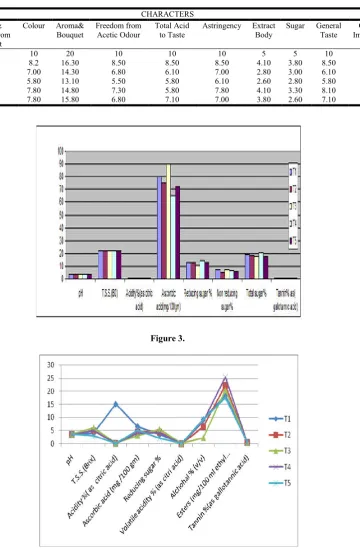
Table 5. Organoleptic Evaluation
CHARACTERS Treatment Clarity &
Freedom From Sediment
Colour Aroma& Bouquet
Freedom from Acetic Odour
Total Acid to Taste
Astringency Extract Body
Sugar General Taste
Overall Impression
Total
Marks 10 10 20 10 10 10 5 5 10 10 100
T1 8.60 8.2 16.30 8.50 8.50 8.50 4.10 3.80 8.50 8.80 83.80
T2 6.80 7.00 14.30 6.80 6.10 7.00 2.80 3.00 6.10 6.50 63.40
T3 5.80 5.80 13.10 5.50 5.80 6.10 2.60 2.80 5.80 6.50 59.80
T4 8.00 7.80 14.80 7.30 5.80 7.80 4.10 3.30 8.10 8.00 75.00
T5 7.80 7.80 15.80 6.80 7.10 7.00 3.80 2.60 7.10 7.10 72.20
Figure 3.
Time and temperature played important role in case of orange wine regarding alcohol yield and ascorbic retention .The experiment based on fermentation of sugars in to C2H5OH and
CO2 (Gaylusac, 1810). The must and wine samples were
analyzed for different constituents (Amerine et al., 1980). In present study Saccharomyces cerrivissae var. ellepsoideus was inoculated in must for fermentations (Ndip et al., 2001).Best Yeast strain producing wine with the highest acceptable score 7.41 from orange volatile component of wine eg. Alcohol and esters were found must abundant volatile compound (Gang Fan et al., 2009). The different parameters are resemble with requirement of base wine to be made has been reported (Sukla
et al., 1991). For the preparation of palatable orange wine
ameliorated the orange juice with cane sugar (Schandrel, 1957). Ascorbic acid showed decreases in wine than fresh orange juice. found negligible vitamin-C in wine because it is utilized during fermentation (Gastineau, ?). Volatile acidity was detected very low. Lower volatile acidity is desirable, indicating soundness of alcoholic fermentation and absence of any acetification (Onkarayya, 1985). The sum of scores of different attribute for each treatment clearly reveals that the highest score has been awarded to the product with 9.20 percent alcoholic content. In an earlier findings sweet product with 15% alcohol were considered the best for plum and sand pear vermouth (Joshi et al., 1991; Attri et al., 1994). The alcohol yield in orange wine is on conformity with the findings (Braverman, 1949). Sensory evaluation showed significant difference in all characteristics in T3 got highest score among
treatments. It was done by a penal of five judge (Amerine, 1960).
REFERENCES
State Institute of Food Processing Technology 18-B, Ashok
Marg, Lucknow-226001(India),
Anonymous, http://www.collins dictionary .com Paterson, Ian 2003. A Dictonary of colour :A Lexicon of the
Language of colour, p.280. ISBN 1-85418-375-3.
Muller, 1980 Nutritional and food processing, 1st Edn. The Avi pub. Co.inc: Westport Connecticut.
Anonymous http://faostat.fao.org/site/33 HYPERLINK "http://faostat.fao.org/site/339"9 (2011).
Gaylusac 1810. www.fermentationtheory. in
Brion, A.I. Hernadez L.F. and Ubeda J.F.1986. Elaboracion de aguardient de melon.Anmentacion Equiposy tecnologia,171,47-52.
Bessey, D. and King, G.C. 1933. The distribution of vit.C in plant & animal tissues & its determitionJ.Biol.chem. 103:687-698.
Gaylusac 1810. www.fermentationtheory.in
Amerine, M.A., Berg, S., Kunkee, R.E., Ough, C.S., Singleton V. L. Webb, A.D. 1980. The technology of wine making IV Ed. The AVI Pubi.co.westport.connecticut.
Ndip, R.N. Akoachere, J.F., Dopgima, L.L., Ndip, L.M. 2001. Appl BiochemiBiotechnol. 95(3): 209-20.
Gang Fan, Xiaoyunxu, Yuqiao, Yong xiaxu, Yun zhang, Li and Sivi Pan 2009. Europian Food research and technology, 228(6) 849-856.
Sukla.K.G.Yadav, M.C. Yadav and Bisht N.S.1991. Jambal wine making: standardization of methology and screening of cultivar.,J.Fd. Sci.Tech. vol.28 142-52.
Schandrel, H. and Koch, J. 1957. Fruit wine production, euge, Ulmar, Stuttgart.
Gastineau, C.F. Draby,W.J. and Turner, T.B. Fermented food beverages in nutrition.,Acadmic press, New York.
Onkarayya, H. 1985. Mango Vermouth-A New alcoholic beverages. Indian Food Packer, 39(1) 40-45.
Joshi, V.K., Attri, B.L.and Mahajan, B.V.C. 1991. studies on the preparation and evaluation of vermouth from plum. J.Fd.Sci.Technol.28 (3) 138-141.
Attri, B.L., Kaushal, B.B.L. & Joshi, V.K. 1994. Preparation and eavaluation of sand pear vermouth. J. Food Sci. Technol. 30(6):435-437.
Braverman J.B.S. 1949. citrus wines, citrus products,
chemical composition and chemical Technology,
Interscience publishers, Inc,New York, 309.
Amerine, M.A. & Cruess, W.V.1960. The tech of wine
making. The AVI publ.com.inc. Connecticut edn.uni.of
California.