Efficient Constellation Design Based on
Improved Non-dominated Sorting Genetic
Algorithm-II
Tengyue Mao1, 21 State Key Laboratory of Information Engineering in Surveying, Mapping and Remote Sensing, Wuhan University, Wuhan, Hubei, China, 430079
2 College of Computer Science, South-Central University for Nationalities, Wuhan, Hubei, China, 430074 E-mail:[email protected]
Zhengquan Xu
State Key Laboratory of Information Engineering in Surveying, Mapping and Remote Sensing, Wuhan University, Wuhan, Hubei, China, 430079
E-mail: [email protected]
Rui Hou
College of Computer Science, South-Central University for Nationalities, Wuhan, Hubei, China, 430074 E-mail:[email protected]
Abstract—Constellation design is a typical multiple peaks, multiple valleys and non-linear multi-objective optimization problem. How to design satellite constellation is one of the key sectors of research in the aerospace field. In this paper, in order to improve the global convergence and diversity performance of traditional constellation optimization algorithm, multi-parent arithmetic crossover and SBX crossover operator of NSGA-II are used to improve searching capability of this algorithm. Meanwhile, Gaussian mutation and Cauchy mutation, with diversity of population, make the algorithm get better behaviors in convergence and diversity of finding solutions. Based on the methods, an improvement NSGA-II is presented to design constellation in the paper. The algorithm uses fixed length chromosome representation. Real coding is adopted for that the problem has both integer continuous variables. Combining the coverage assessment criterions, an orbit parameters optimization framework based on non-dominated sorting genetic algorithm (NSGA-II) was proposed. This method is applied to a detailed example, and result shows that a group of Pareto solutions with good spread can be achieved, which gives strong support to constellation scheme determination.
Index Terms—Multi-objective Optimization, Genetic Algorithm, Non-dominated Sorting Genetic Algorithm, Satellite Constellation
I. INTRODUCTION
LEO satellite constellation has played important practical role in our country and the prospect of its application is promising. LEO regional satellite constellation has important practical significance and
wide application prospects in our country. The goal of constellation design goal is to find a set of constellation parameters, and enable constellations formed by these parameters in designated coverage area not only to obtain optimal constellation performance, but also to save cost in system construction and long-term maintenance costs of constellation [1, 2]. Satellite constellation design includes selecting satellite type (satellite altitude, inclination, eccentricity, etc.), and determining the number of satellites and configurations in the orbital plane so as to achieve the best navigation, positioning and timing.
analytical method lies in its less computation cost. Researchers like Nizar introduced lifecycle cost estimate of a constellation and an optimization tool--- SCORPIO, which with the aid of historical data of hundreds of items in the past three decades, employed regression analysis to establish a model of cost analysis, and made use of the lumped parameter optimization to predict cost and risk of aerospace project. Researchers like Asvial have explored how to use the genetic algorithm to undertake multi-day optimization for NGSO constellation. The goal of optimization is to use the minimum satellites to optimize angle shift among satellites and orbital inclination angle. In China, Liu Huijie researched constellation optimal design and performance analysis of regional satellite positioning system, proposed constellation design method of two-step optimization and conducted optimal design and performance analysis of various constellations like MEO, IGSO, GEO / MEO. Li Zan studied constellation of satellite mobile communication system and inter-satellite link design, with the help of analytical method built the relationship between inter-satellite transmission power and beam width under the vibration, and established an information exchange routing table of constellation which is composed of eight stars. Starting from large system cybernetics, Xiang Kaiheng has explored maintenance of absolute and relative constellation positioning, pointed out that the improvement direction of maintenance strategy of constellation positioning is hierarchical control strategy relative positioning maintains, and according to sub-level coordinated control theory proposed hierarchy control strategy walker-6 constellation positioning maintains, including deciding the algorithm of referred constellation based on optimization principles. Zhang Fan studied optimization design of optical remote sensing small satellite constellation, selected the overall program optimally through the fuzzy multi-objective optimization, and with the help of two-tier disciplinary and multi-objective optimization founded overall optimization model of constellation in which cost, performance, efficiency-cost ratio and reliability have been taken seriously and designed optimally.
The design of regional coverage constellation which involves a number of feature points and optimized indexes is a typical multi-objective optimization problem. The key of design lies in the mutual trade-offs between the structural deployment and performance of the entire constellation. Always based on the overall objectives and constraints, its analysis and design use the lowest cost to meet these requirements and constraints. Global constellation coverage problem has mature design methods, but until now there is yet lack of general and classic design for regional coverage constellation design [3, 4]. In recent years, genetic algorithm has been introduced to the constellation design.
Genetic algorithm is a self-organization and adaptive artificial intelligence technology that simulates the process and mechanism of natural evolution, solve optimization and search problems. Because it is the evolution and operation of the whole groups, the genetic
algorithm focuses on a collection of individuals, while the non-inferior solution of the multi-objective optimization problem is also a collection. This feature of genetic algorithm shows that genetic algorithm this feature is ideal for multi-objective optimization problem [5, 6, 7]. This paper mainly researches non-dominated sorting genetic algorithm and its improved algorithm NSGA-II, the algorithm which develops faster and has better effects of optimization.
With the development of space technology, constellation which is made of multi-satellites has played an increasingly important role in the many fields such as communications and navigation. Since the requirement of the constellation coverage performance is the main basis for design, this paper explores the constellation coverage, and then uses the improving INSGA-II algorithm to achieve the design of satellite constellation. The result shows that a group of Pareto solutions with good spread can be achieved, which gives strong support to constellation scheme determination. Your goal is to simulate the usual appearance of papers in a Journal of the Academy Publisher. We are requesting that you follow these guidelines as closely as possible.
II. SYSTEM MODEL
A. System Description
In order to meet the diversity and stability of the constellation constitutes, the orbital elements of the satellite constellation can be restricted as follows: 1) the satellite constellations should have the same orbital shape, that is to say, the same eccentricity and semi-major axis; 2) the angle of perigee satellites at the same orbital plane is the same; 3) the orbital inclination and the ascending node of right ascension at different orbital plane is preferably determined; 4) the relative position of satellites in the same orbit is preferably determined.
Suppose constellation has N orbital planes in total, with which the number of satellites isQj(j=1, 2, , )" N ,
the total number of satellites in the constellation is
1 N
j j
T Q
=
=
∑
. According to the above constraints, from theoptimization According to the above constraints, the parameters including , , , ( 1, 2, , )
j
j j j jQ
i ω Ω M j= " N , need
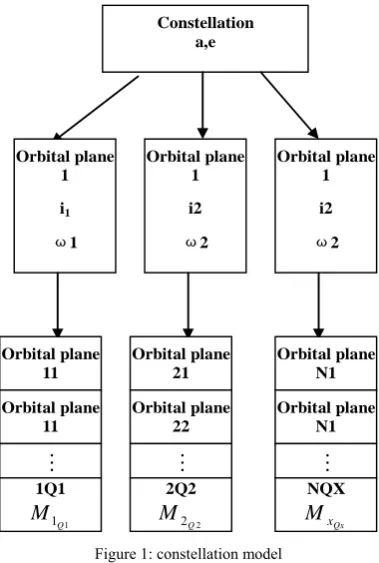
optimizing from the angle of the optimization. The model shown in “Fig. 1” is a simplified schema of satellite constellation. Although simplified, its universe still exists which is the basis of simulation and optimization of the subsequent constellation.
B. LEO satellite constellation parameters
system choose circular orbit, eccentricity ise=0. At this time, argument of perigee isω=0.
When orbit altitude of LEO satellite is below 2 000 km, the height of LEO satellite not only affects the coverage performance, but also the life expectancy of the system, communication performance and so on. When orbit altitude of LEO satellite is below 700 km, the satellite is greatly influenced by air drag and the corrosion of oxygen atom and is short-lived. When the height of ranges from 1 500 to 5 000 km, there exists Van Allen belt which has highly destructive results on the stars so that satellite orbit should avoid this height. In addition, from the perspective of application, it is expected that track of sub-satellite point of satellite have periodic repetition so as to analyze constellation coverage easily. Based on the above mentioned, satellite will have relatively large coverage area on the ground if an orbital altitude is 1 450 km and located below the edge of Van Allen belt. Meantime, the satellite with this orbital altitude has 2-day return cycle, and the number of return cycle is 25 laps. So the orbital parameters can be determined: semi-major axisa=(1450+Re) km.”
III.PROPOSED EFFICIENT CONSTELLATION DESIGN To great degree, NSGA-II has improved NSGA's shortcomings, but the performances of the adopted SBX (Simulated Binary Crossover) crossover and mutation operators are relatively weak so that it limits the search performance of the algorithm to some extent, making diversity and convergence of population unsatisfactory and the distribution of solution not ideal when solving high dimension [8]. Based on the shortcomings of NSGA-II, we propose an improved NSGA-II algorithm --- INSGA---II algorithm.
A. The Improvement of Crossover Operator a. SBX Operator
NSGA-II has used SBX crossover operator. SBX operator simulates the process of binary crossover operator and executes cross-operation on real-coded paternal individuals. To put it differently, in view of given random intersections, exchange the parts of paternal individual on both sides of intersections and enable relevant information model of paternal chromosomes to be protected in the offspring.
The following is the process in which t substitute’s individual (1, )t
i
x 、 (2, )t i
x and produces t+1 to take place of (1, 1)t
i
x + 、 (2, 1)t i x + .
1) Take a random number: [0,1)
i
μ ∈ (1) 2) Calculate evenly distributed factors:
(2, 1) (1, 1) (2, ) (1, )
t t
i i
i t t
i i
x x
x x
β = + − +
− (2) According to the following probability density function, make the area ranging from 0 to
β
qibelow the curve of the probability density equal toμ
i so that βqi can be calculated.3) 1 i 1
2 i>1 0.5( 1)
0.5( 1)
( ) i
i i P η η η β β η β β
β
≤ + + + ⎧⎪ =⎨⎪⎩ (3)
Here the parameterη is a non-negative real number and defined by itself when being used, which is called cross-distribution index. As value of η becomes greater, there is more probability of generating solutions close to paternal individuals. On the contrary, smaller value may generate individual far from paternal individual. The above equation can be used to calculate the value ofβqi, as in (4).
4) 1 1 i 1 1 i (2 ) 0.5
1
( ) >0.5 2(1 ) i i u qi u η η μ μ
β
+ + ≤ −⎧
⎪
=
⎨
⎪⎩
(4)5) Calculate offspring individual:
(1, 1) (1, ) (2, )
(2, 1) (1, ) (2, )
0.5[(1 ) (1 ) ]
0.5[(1 ) (1 ) ]
t t t
i qi i qi i
t t t
i qi i qi i
x x x
x x x
β β
β β
+
+
= + + −
= − + + (5) b. Crossover Operator of Multi-Parent Arithmetic
In this paper, we introduce crossover operator of multi-parent arithmetic into NSGA-II. The crossover way of multi-parent arithmetic is as follows: m individuals are involved in every crossover and m new individuals are obtained. The operating method of getting multi-parent arithmetic crossover through the principle of two individuals’ crossover is as follows. Corresponding to selected m paternal individuals t(1 )
i
x ≤ ≤i m , every time extract m random numbers p p1, , ,2" pmfrom the even distribution between 0 and 1. pm is generated m numbers
1
,
2y y
Constellation a,e Orbital plane 1 i1 ω1 Orbital plane 1 i2 ω2 Orbital plane 1 i2 ω2 Orbital plane 11 Orbital plane 11 1Q1 1 1Q M # Orbital plane 21 Orbital plane 22 2Q2 2 2Q M # Orbital plane N1 Orbital plane N1 NQX Qx x M #so that generated m new individuals should be:
1
1 (m ) /
t t
i j i
j
x+ p x m
=
=
∑
,i=1, 2, ," m.Since the number that evenly distributed random sequence p p1, 2, ," pm may extract is infinitive, the number that generated new individuals may extract is also infinitive.
B. The Improvement of Mutation Operator a. Gaussian Mutation
Mutation operator mainly brings new genes to population in order to restore diversity of individual that is lost due to selecting functions of operators.
(1) Gaussian mutation: introduce Gaussian mutation into NSGA-II.
1) Normal distribution If ζ has density function,
( )
( ) 2 2 2 1 2 p e χ μ σ χ πσ − −= ,−∞ < < +∞x (6)
ζ Obeys the normal distribution parameter σ and parameter μ (Gaussian Mutation), which is denoted as ζ
~N( ,μ σ2).When σ is fixed, the curve shape keeps same,
but position changes with the differentσ . When σ fixed, the curve position keeps same, but shape changes with different σ . The more flat the curve is flat, that is, the more dispersed distribution is and the smallerσ is, the steeper curve is, that is, the more concentrated the distribution is.
2) Standard Normal Distribution If ζ has density function
( )
2 2 1 2 x x e ϕ π −= −∞ < < +∞x (7)
ζ Obeys standard normal distribution and is denoted as
ζ ~ N (0,1) .
Gaussian mutation results from the observation of biological field. Micro is more frequent than macro. Under the influence of Gaussian mutation operator individual variables ( , )xi ηi becomes
' '
( , )xi ηi .
' '
' '
exp( (0,1) (0,1)) (0,1)
i i j
i i i
N N
x x N
η η τ τ
η
= +
= + (8)
In the calculation, (0,1)N is a random variable of
standard normal distribution whose expected value is 0 and variance is 1. Variance shows variation amplitude.
'
τ And τ'are parameters of operate set and are applied in
define the overall and individual step. τ'=( 2 )n −1 (n
refer to the number of variables),τ=( 2 N)−1 (N
refers to population size).
(2) Cauchy mutation: introduce Cauchy mutation into NSGA-II.
One-dimensional Cauchy density function is concentrated near origin, defined as:
2 2 1 ( ) t t f x t x π =
+ , −∞ < < ∞x ,t>0 (9)
C. The Introduction of SA
SA (Simulated Annealing) is an optimization algorithm that simulates the process in which metal materials anneal. This algorithm may not only obtain design variables randomly, but also accept the solution mechanism which is worse than the current solution. As a result, it is likely to jump out of local optimum. Statistical mechanics shows that below temperature T, the probability of an atom in the state of I belongs to Boltzmann probability distribution:
_ 1 ( )
{ ( )} exp( ) ( ) B
E i P E E i
Z T K T
= = − . (10)
In this equation, E i( ) is the energy of atoms at the state
of i, E_ is the possible value. KB >0 is Boltzmann constant. Z T( ) is the normalization factor of probability distribution:
( ) exp( ( ))
j D B
E j Z T
K T ∈
=
∑
− . (11)SA method is a single-point search method. In order to simulate the state of metal objects under some temperature, the algorithm selected a number of points to simulate the different energy states in which metal atoms in the current temperature may be. In reality, algorithm employs Metropolis sampling to complete the extraction process. In this algorithm the new values of design variables can be obtained in the way the current value plus a random number. It accepted both the better new value of the objective function and the worse value through probability p.
( ) ( ) exp( f j f i ) p
T ξ
−
= − < . (12) Where f j( )is target value of new state, f i( )is current
target value, and current value is less than new value. ξis a random number between 0 and 1. SA can be regarded as using Metropolis sampling iteratively at different temperatures and ultimately finding the optimal solution. Generate random number. If the probability is less than Metropolis probability, places accept solutions whose crowding distances are relatively small through a certain probability. Conversely, solutions whose crowding distances are large are accepted.
IV.SIMULATION RESULTS
Combined the structure of chromosomes optimized by constellation, feature points of the target area are defined as F1(112.25 ,36.05 )
D D ,
2(112.48 , 29.94 )
F D D ,F3(112.48 , 24.01 )
D D ,
whose selected coverage performance indicator is coverage rate, requiring the constellation has the largest coverage for three feature points. The whole process of simulation and optimization has taken J2 perturbation
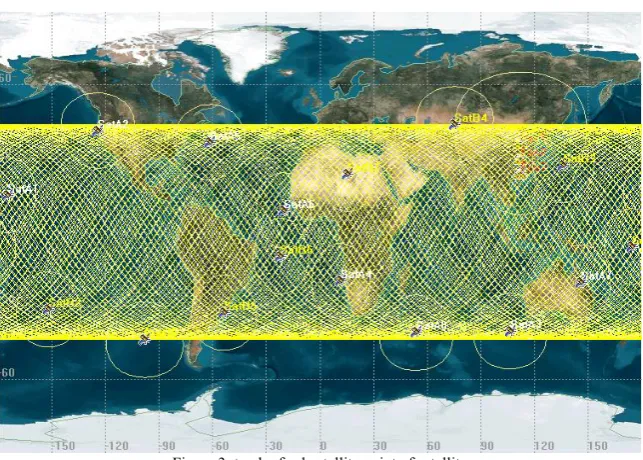
At the end of experiment, we obtain Pareto optimal solutions of a set of low-orbit constellations and coverage rate of three sampling spots. Figures 2 and 3 are
respectively working diagram of constellation and track diagram of sub-satellite point of all satellites in constellations during the simulation.
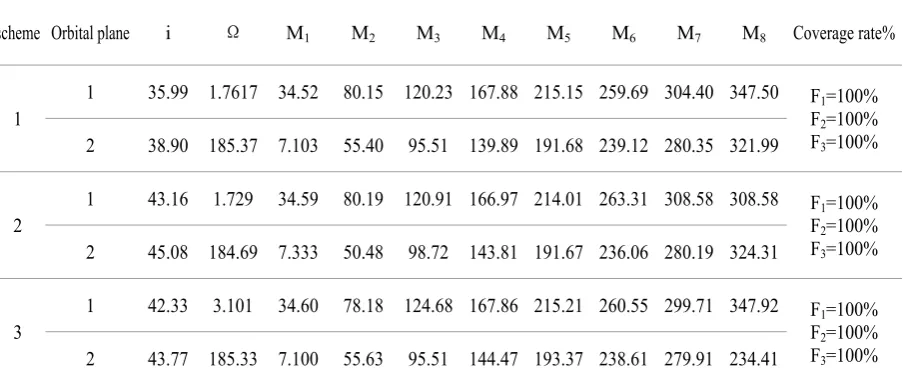
As experimental results in Li Sudan’s literature [9] are calculated by STK [10-13], this paper selects three sets of data Pareto optimal solutions focus on, shown in Table 2, Table 1 shows the experimental results in Li Sudan’s literature Table 3 suggests the experimental results obtained by Li Xiaomeng[14] using improved SPEA2 to solve constellation optimization. Table 4 shows the experimental results obtained by Zheng Wei [15] using OMEA to solve constellation optimization.
Compare the experimental results in Table 1 and Table 2, we can find that the data in this paper is superior to those in Li Sudan’s literature. Li Sudan makes use of NSGA-II algorithm, while we use NSGA-II algorithm. (INSGA-II) that is improved in Chapter III of this paper. INSGA-II is mainly improved from diversity of
population and equal distribution of solutions, uses hybrid cross and hybrid variability, and introduces simulated annealing algorithm into NSGA-II algorithm so as to constitute a hybrid genetic algorithm.
Experimental data show that the results obtained through improved NSGA-II can better meet the test requirements so as to achieve the expected goals. Obviously, in comparison with the result in Li Sudan’s literature [1], solutions obtained though improved NSGA-II (INSGA-NSGA-II) are much closer to ideal pareto frontier of constellation optimization. At the same time, through analysis of tractor factors of constellation in Table 2, we can draw the following features:
Figure 2: working diagram of constellation 3-D
(1) In the same group of satellite constellation data, the orbital inclinations of two orbital planes get very close to each other.
(2) In the same group of satellite constellation data, right ascension difference between the ascending nodes of two orbital planes is about 180 °.
TABLE1
THE CONSTELLATION PARAMETERS OF LI SUDAN LITERATURE
scheme Orbital plane i Ω M1 M2 M3 M4 M5 M6 M7 M8 Coverage rate%
1 1 49.94 108.28 26.71 73.12 120.23 163.82 207.42 253.12 298.82 345.23 F1
=99.28% F2=95.54%
F3=82.39%
2 49.76 287.57 30.23 73.82 118.12 165.93 212.34 256.64 296.01 343.12
2 1 37.46 106.17 25.31 70.31 115.31 161.01 206.01 251.71 296.01 343.12 FF12=89.87% =97.43%
F3=100%
2 36.58 285.46 31.64 75.93 122.34 166.64 209.53 255.93 301.64 347.34
3 1 41.62 104.76 25.31 70.31 115.31 161.71 205.31 250.31 296.01 340.31 FF12=95.38% =99.63%
F3=97.54%
2 43.20 286.87 40.78 82.26 127.26 172.26 220.07 266.48 312.18 355.07
TABLE2
CONSTELLATION PARAMETERS BASED ON IMPROVED NSGS-II
scheme Orbital plane i Ω M1 M2 M3 M4 M5 M6 M7 M8 Coverage rate%
1
1 44.54 191.43 278.20 2.79 354.39 53.45 328.14 230.49 169.55 114.06 F1=99.82%
F2=98.83%
F3=98.55%
2 41.32 7.52 101.56 281.46 52.27 331.07 1.62 145.28 117.47 224.74
2
1 36.19 230.99 251.11 160.92 349.64 19.19 71.08 300.24 206.67 115.43 F1=91.25%
F2=100%
F3=100%
2 39.24 53.11 43.32 89.57 314.11 268.18 180.28 352.98 225.64 133.63
3
1 31.16 194.59 278.40 5.69 114.06 53.44 328.14 226.89 168.53 354.91 F1=97.26%
F2=99.90%
F3=100%
2 28.08 359.99 101.37 281.52 224.75 338.09 0.40 160.18 187.12 43.99
TABLE3
THE EXPERIMENT RESULTS OF CONSTELLATION OPTIMIZATION USING SPEA2+
scheme Orbital plane i Ω M1 M2 M3 M4 M5 M6 M7 M8 Coverage rate%
1 1 42.9787 352.768 36.2892 86.2361 304.456 223.559 137.27 181.581 343.775 264.678 FF12=95.52%=98.69%
F3=96.18%
2 42.8987 170.501 197.7 243.053 152.758 101.447 322.178 0 49.4151 286.596
2 1 42.9388 351.088 36.2802 86.8705 304.431 222.519 136.107 181.87 343.775 265.064 FF12=95.95%=98.63%
F3=95.86%
2 43.215 170.313 203.147 243.053 152.725 101.637 321.72 0 49.8298 286.592
3
1 37.48 350.853 36.2523 85.6757 304.509 222.944 135.966 181.706 343.775 263.907 F1=90.38% F2=98.56%
F3=99.03%
Compare the experimental results among Table 2, Table 3 and Table 4, our results are as follows:
(1) The results in Table 4 are 100%, the best results. Table 4 uses OMEA algorithm: it first establish the model through digging distribution rules of population Pareto solutions, then search globally and locally, and making use of orthogonal and key technologies such as k-means and pca in the algorithm. However, OMEA need cluster analysis in evolution of each generation, and spend a large amount of time in the process of stabling probability model for cluster.
(2) Table 3 uses SPEA2+ algorithm, so optimization results do not reach the global optimum. [1] Probably it is because truncation technology of SPEA2 will get rid of a part of same individuals so that diversity of population decreases. [2] Probably it is because we use Gaussian mutation operator so that search ability of SPEA2 for non-continuous Pareto solutions frontier decreases and falls into local optimum.
(3) Table 2 shows the experiment results calculated by improved NSGA-II algorithm (INSGA-II), and coverage rate of three sampling spots can not reach 100%. The reasons may be as follows: Firstly, when individuals are generated at the time of initialization, groups are not designed, and individuals produced at the time of initialization can not be well distributed in the feasible region, so the efficiency is lower; secondly, the algorithm is mainly improved from diversity of population and equal distribution of solutions. The search performance of population has not been considered comprehensively, and convergence of the algorithm needs to be improved.
V. CONCULSION
In this paper, in order to improve the global convergence and diversity performance of traditional constellation optimization algorithm, multi-parent arithmetic crossover and SBX crossover operator of NSGA-II are used to improve searching capability of this algorithm. Meanwhile, Gaussian mutation and Cauchy
mutation, with diversity of population, make the algorithm get better behaviors in convergence and diversity of finding solutions. Based on the methods, an improvement NSGA-II is presented to design constellation in the paper. The algorithm uses fixed length chromosome representation. Real coding is adopted for that the problem has both integer continuous variables. Combining the coverage assessment criterions, an orbit parameters optimization framework based on non-dominated sorting genetic algorithm (NSGA-II) was proposed. This method is applied to a detailed example, and result shows a group of Pareto solutions with good spread can be achieved, which gives strong support to constellation scheme determination.
ACKNOWLEDGMENT
The project was supported by the Special Fund for Basic Scientific Research of Central Colleges, South-Central University for Nationalities under grant of CZZ10004.
References
[1] H. Zhang, D. Wang, and L. Liu, “A Constellation Design for Mobile Satellite Communication System of China,” Journal of University of Science and Technology of China, Vol.30, No.6, pp. 666–670, Dec. 2000.
[2] J. Wu and G. Li, “Engineering Design of Mobile Satellite Communications Constellation,” Journal of PLA University of Science and Technology (Natural Science), Vol.3 No.1, pp.31–35, Feb.2002.
[3] W. J. Mason and C. Victoria, “Optimal earth orbiting satellite constellation via a pareto genetic algorithm,” In: AAS 00-139, AAS/AIAA Astrodynamics Specialist Conference and Exhibit. San Diego: American Institute of Aeronautics and Astronautics Inc, 1998.
[4] J. L. Cohon, “Multi-objective programming and Planning,” New York: Academic Press.1978.
[5] F. Eric and E. Alcatel, “Investigating New Satellite Constellation Geometries with Genetic Algorithmsp,”AIAA 96-3636, AAS/AIAA Astrodynamics Specialist Conference, an Diego, CA, 1996.
TABLE4
CONSTELLATION PARAMETERS OF OPTIMIZING OMEA
scheme Orbital plane i Ω M1 M2 M3 M4 M5 M6 M7 M8 Coverage rate%
1
1 35.99 1.7617 34.52 80.15 120.23 167.88 215.15 259.69 304.40 347.50 F1=100%
F2=100%
F3=100%
2 38.90 185.37 7.103 55.40 95.51 139.89 191.68 239.12 280.35 321.99
2
1 43.16 1.729 34.59 80.19 120.91 166.97 214.01 263.31 308.58 308.58 F1=100%
F2=100%
F3=100%
2 45.08 184.69 7.333 50.48 98.72 143.81 191.67 236.06 280.19 324.31
3
1 42.33 3.101 34.60 78.18 124.68 167.86 215.21 260.55 299.71 347.92 F1=100%
F2=100%
F3=100%
[6] R. Wang, X. Ma, and M. Li, “Optimization of regional coverage satellite constellations by genetic algorithm,” Journal of astronautics, Vol.23, No.3, pp. 24–28, May. 2002.
[7] T. J. Lang, E. A. Williams and W. A. Crossley, “Average and maximum revisit time trade studies for satellite constellations using a multi-objective genetic algorithm,” Journal of Astronautical Sciences, 49(3):385-400, 2001. [8] K .Deb, S .Agrawal, A. Pratap and T .Meyarivan, “A Fast
Elitist Non-dominated Sorting Genetic Algorithm for Multi-object Optimization: NSGA- ,” Parallel Problem Solving from Nature VI (PPSNVI), 849-858, 2000. [9] S. Li, J. Zhu and G. Li, “Multi-object optimization of LEO
regional communication satellite constellation with GA algorithm,” Journal of PLA University of Science and Technology(Natural Science) , Vol.6 No.1, pp. 1–6, Feb.2005.
[10] Q. Wang, J. Yuan and Z. Zhu, “Exploring Constellation Coverage of China,” Journal of Northwestern Polytechnical University, Vol.24 No.4, pp. 427–430, Aug.2006.
[11] K. Xiang and Y Xiao, “Study of System Simulation of Satellite Constellation,” Journal of Beijing University of Aeronautics and Astronautics, Vol.25, pp. 629–633, June.1999.
[12] H. Xiang and Y. Zhang, “Design and Realization on System of Design, Analysis, Simulation for Satellite Networking and Constellation Control,” Journal of System Simulation, Vol.18, pp. 691–695, Aug.2006.
[13]J. Wang, R. He, and Y. Tan, “Satellite System Design Optimization Based on STK,” Computer Simulation, Vol.23, pp. 61–66, Nov.2006.
[14]X. Li, “Research and Application of Pareto Algorithm in the Optimal Design of Constellation,” China University of Geosciences Master’s degree paper, May.2007.
[15]W. Zheng, “Research an Application of OMEA in the Optimal Design of Constellation,” China University of Geosciences Master’s degree paper, May.2007.
Tengyue Mao received the B.E.
degree in electronic technology and the M.S. degree in computer application from Wuhan University (WHU), Hubei, China, in 1998 and 2002, respectively, and he is currently pursuing the Ph.D. degree in communication and information system at WHU. Since 2006, he has been on the faculty in computer school at South-Central University for Nationalities, and he is currently a lecturer in the Department of Computer Application. His research interests include multimedia information security, and multimedia network communication technology. Mr. Mao was awarded two scientific and technological progress prizes and one invent patent applying.
Zhengquan Xu received the B. E.
degree in radio technology and information system and M.S. degree in communication and electronic system form Tsinghua University, China, in 1985 and 1988, respectively, and the Ph.D degree in biomedicine engineering form Hong Kong Polytechnic University, in 1998.From 1988 to 1999, he was on the faculty in the department of Electronics and Information at the Huazhong University of Science and Technology. In 1995, he was selected to the Hong Kong Polytechnic University (HKPU) by the State Education Ministry. During the period, he was selected to Stanford University as a short-term visiting scholar by the” Areas of Excellence” plan of the HKPU. Since 1999, he has been on the faculty in Wuhan University (WHU).He is currently the director of multimedia communication engineering center of state key laboratory of information engineering in surveying, mapping and remote sensing at WHU. He is the expert of government affairs information construction engineering of Wuhan City, and the expert of government affairs information construction engineering of Hubei Province. His research interests include space and multimedia information processing, multimedia information security, and multimedia network communication technology. Mr. Xu has presided or participated in a variety of more than 20 research projects and was awarded five scientific and technological progress prizes: three Ministerial-level and two Municipal-level awards respectively.
Rui Hou received the B.M.E., B. L.,