Signcryption Techniques based on Various
Cryptographic Algorithms
Sonika Bhatnagar Mr. Gambhir Singh
M. Tech. Student Associate Professor
Department of Computer Science & Engineering Department of Computer Science & Engineering H.R. Institute of Technology, Ghaziabad, India H.R. Institute of Technology, Ghaziabad, India
Abstract
This paper presents a signcryption scheme in view of Elgamal cryptography and discrete logarithms accordingly giving the message confidentiality, integrity and authentication. Signcryption with private key undeniable nature that is being talked about in the up and coming parts has been proposed in the paper. The proposed scheme could be used to elevate the liberation of usage of computationally force gadgets like cell telephones and some more.
Keywords: Cryptography, Signcryption, DES, RSA, AES
________________________________________________________________________________________________________
I. INTRODUCTION
In the prior days cryptography was just engaged with the secrecy of message i.e. the methodology for secure transmission was just thought with the transformation of intelligible information unit into unfathomable information frame and back again to unique structure on the beneficiary side with help of shared secret key. That implies without the learning of shared secret key it is just useless piece of information bits for spies or interceptors. The field of encryption/decryption has been stretched out from customary classification to confidentiality, integrity, authentication, non-repudiation and in addition availability.
In the Computing world information (processed data) is the most significant resource we can have, so safeguarding its security is the matter of concern for us, yet how to perform this undertaking is a billion dollar question. Some researchers are in progress in this course but as we know everything has its own limitations. All the outlined security ideal models are limited with some constraints. So during the transmission of information over open or shaky channel we should guarantee the confidentiality, integrity, authentication and non-repudiation of transmitting information on the grounds that these are the four most vital parts of security. Our security standards ought to have the capacity to safeguard against versatile assailant as well.
II. RESEARCH GAP
As plenty of researches have already been done in this field, it is impossible to cover the entire prospect here. The signcryption schemes which are presented here certainly do not constitute an exhaustive list, but instead are intended to give an overview of the various research directions which have been explored so far the material presented here is, for the most part, a unified presentation of existing work. However, some new material is presented, mainly in the form of proofs which were omitted from the original research papers. These proofs are indicated as such where they appear. A few veins of research are explicitly not considered here. The most notable is identity-based signcryption, which is an adaptation of identity based encryption to the case of signcryption.
III. OBJECTIVES
The aim of this research is to speeding the encryption/decryption process, and is used for increasing the level of security of the internet end-user. And it could be done by providing strong signcryption algorithm(s) which are used nowadays for various security purpose.
Increase the security level provided by the strong signcryption algorithm(s).
Figure out the best tuned and strongest signcryption algorithm(s).
Implement some efficient sequential cryptographic algorithms various versions from recent papers.
IV. PROPOSED WORK
V. PROPOSED SCHEME I
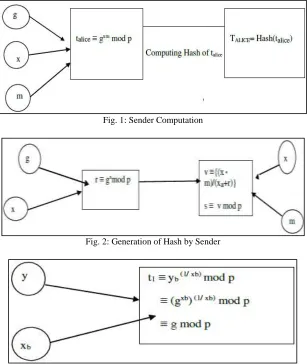
For Signcryption
m = message(plaintext) H(m) = Hash of message “m”.
(Here we are using SHA-1 as one-way hash function) Alice randomly chosen x ɛ Zq We have
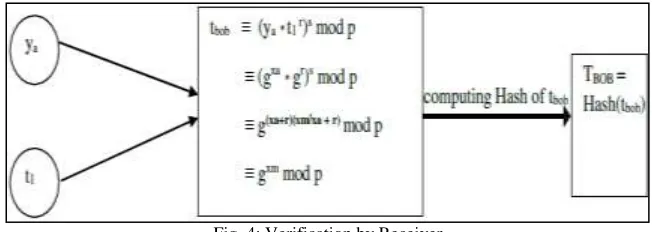
r ≡ gx mod p v ≡{(x * m)/(xa+r)} s ≡ v mod p talice ≡ gxm mod p TALICE= Hash(talice)
Sender will sent (H(m),r,s,TALICE) to receiver.
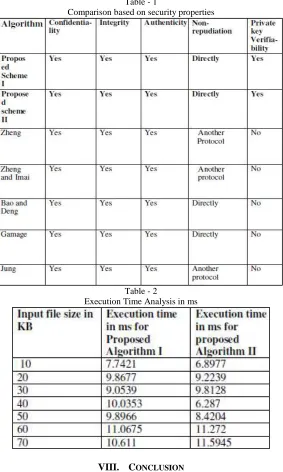
For Unsigncryption
Bob computes t1 ≡ yb (1/ xb) mod p ≡ (gxb) (1/ xb) mod p
≡ g mod p
It implies that only expected beneficiary can decode the real value of t1 in light of the fact that with the assistance of intent recipient private key (xb). On the channel the public key of collector (receiver) yb is accessible however because of inaccessibility of xb it is not practical for unapproved client to figure out the genuine value of t1.
Fig. 1: Sender Computation
Fig. 4: Verification by Receiver
Message Decryption after Signature Verification
From our work for message decryption (or message retrieval) receiver will compute following: As receiver have tbob ≡ gxm mod p
Take log both the sides with base g, generator of gp| logg tbob ≡ xm mod p
W ≡ xm mod p (we can say logg tbob =W)
So, there an integer z such that (W – xm) that will be divisible by p. It means p|(W – xm),
TBOB = Hash(tbob)
{Where z is any integer}.
(W – xm) = zp {By using law of divisibility} W – zp = xm
m = (W – zp) / x
Hence, the message “m” is obtained on the receiver side.
VI. PROPOSED SCHEME II
Proposed scheme II is proxy signcryption. Proxy Signcryption is the mix of proxy signature and encryption. Here proxy (agent) perform the work(computationally costly) required by the first sender having low computational force, i.e. the signcryption done by the proxy server for the benefit of client. This work depicts how computationally feeble client can enjoy the same state of security with the assistance of computationally solid and trusted third party (proxy). Here, we show private key evident proxy signcryption calculation for accomplishing validation, secrecy and honesty of the message through an unsecured channel, for example, open PC system or open network (internet). The proposed plan depends on obstinacy of discrete logarithm and factorization calculation (which is NP-Hard). In the proposed plan the association between unique sender and proxy might be unsecured channel. The new calculation is stronger, vigorous and can give complete security to unique sender against the versatile assailant. Confirmation is required if there exist a dispute or an occurrence of question or keeping up Non-Repudiation.
Fig. 5: Proxy signcryption with verifier
VII.RESULTS
Table - 1
Comparison based on security properties
Table - 2
Execution Time Analysis in ms
VIII. CONCLUSION
This paper presents two DLP based signcryption plans for secure and confirmed message conveyance, which satisfies all the elements of advanced signature and encryption with a cost not as much as that required by the present standard signature then-encryption strategy. The constraints of the present plan are that even private key verifiability is very expensive. So, expense of our proposed plans is relatively lower than current plans as far as computational and correspondence overhead are considered. DLP has been utilized for the execution of our calculation in light of its one of a kind unmanageable property which is altogether more troublesome. Proposed plans spare more computational expense for the sender to suit the use of confined computational gadgets like smart card based applications, cell phones, and so forth.
IX. FUTURE WORK
We have proposed provably secure signcryption plan in view of Elgamal and discrete logarithmic functions. This plan is exceptionally alluring in that it delivers extremely minimal signcryption with minimal additional computational expense.
REFERENCES
[1] Zheng, 1997 Y.Zheng: “Digital Signcryption or how to achieve cost( signature+encryption)”in advances in cryptography-CRYPTO1997, vol-1294 of lecture notes in computer science,springer –verlag.
[2] Y. Zheng, “Digital Signcryption or How to Achieve Cost (Signature & Encryption) << Cost(Signature) + Cost (En-cryption),” Full Version, 2011. http://www.sis.uncc.edu/yzheng/papers/
[3] LI Xiang-xue, CHEN Ke-fei, LI Shi-qun, “Cryptanalysis and improvement of signcryption schemes on elliptic curves”, Wuhan University Journal of Natural Sciences, Vol. 10, No. 1, 2005, 231-234.
[4] J. H. An, Y. Dodis and T. Rabin, “On the Security of Joint Signatures and Encryption,” In: L. Knudsen, Ed., Ad-vances in Cryptology—Eurocrypt 2002, Lecture Notes in Computer Science, Vol. 2332, Springer, Berlin, 2002, pp. 83-107.
[5] C.-P. Schnorr, “Efficient Signature Generation by Smart Cards,” Journal of Cryptology, Vol. 4, No. 3, 1991, pp. 161-174. doi:10.1007/BF00196725 [6] Lawrence C. Washington, "Elliptic Curves: Number Theory and Cryptography", CRC Press, 2003.
[7] C. Gamage, J. Leiwo, Y. Zheng, “Encrypted message authentication by firewalls”, Proceedings of 1999 International Workshop on Practice and Theory in Public Key Cryptography (PKC’99), LNCS 1560, Springer-Verlag, 1999, pp. 69–81.
[8] M. Toorani and A. A. B. Shirazi, “LPKI—A Lightweight Public Key Infrastructure for the Mobile Environments,” Proceedings of the 11th IEEE International Conference on Communication Systems, Guangzhou, 19-21 November 2008, pp. 162-166.61
[9] S. Han, E. Chang, Chaotic map based key agreement with/out clock synchronization, Chaos, Solitons & Fractals 39 2009, 1283–1289