270 | P a g e
TRAFFIC CONGESTION DETECTION WITH COMPLEX EVENT
PROCESSING IN VANET
Priyanka Shinde
Department of Electronics and Telecommunication, Ramrao Adik Institute of Technology (RAIT),
Navi Mumbai 400706 University of Mumbai
Manoj M. Dongre
Department of Electronics and Telecommunication, Ramrao Adik Institute of Technology (RAIT),
Navi Mumbai 400706 University of Mumbai
Abstract—Magnitude of urban population and unplanned development of cities have led to road traffic congestion in major cities and added increasing pressure on overall road transport and road related infrastructure. Nowadays, intelligent transportation systems such as Vehicular Ad Hoc Networks (VANET) are used for distributed road traffic. VANET is a wireless network that gathers complex and randomly generated data related to distributed traffic along with other information such as weather con ditions on real time basis. In this paper, the Author has attempted to implement a system on Event Driven Architecture (EDA) to detect complex but similar levels of traffic congestion which resembles real life traffic situation. The system is designed with the help of a technique called Complex Event Processing (CEP) that treats all messages in the network from corresponding vehicles as an event. The effectiveness of this system can be observed by using different performance metrics.
Keywords—Complex Event Processing (CEP), Event Driven Architecture (EDA), Traffic Congestion, Vehicular Ad Hoc Networks (VANET)
I. INTRODUCTION
The rapid growth in urban population and unplanned development has led to traffic congestion in major cities and towns. The traffic congestion not only makes driving experience stressful for vehicle-operator but also detrimental to the environment and causes economic losses to the society at large.
Thus, detection of traffic congestion is a major problem on urban roads and highways. The intelligent transportation systems are increasingly used in identifying the traffic congestion. One of the intelligent transportation systems is vehicular ad hoc network (VANET) through which inter-vehicular communication is usually achieved. A VANET is a mobile network whose nodes are vehicles that drive on a road and communicate each other through wireless technology. In addition, each vehicle of the network broadcasts data messages at regular time intervals called beacon messages, which comprise, among other data, vehicle’s current speed and position. This way, each vehicle of the VANET manages to detect other vehicles in its surrounding; however, handling of beacon messages from various vehicles on a continuous basis would imply a high volume of events across the VANET that each vehicle of the network must deal with. To process such a large amount of events, Event-Driven Architecture (EDA) is used. EDA is a software architecture pattern promoting the production, detection, consumption of, and reaction to events. Thus, a
high volume of events could easily be processed with minimum delay. Currently, EDAs play a pivotal role in many business areas such as financial industries or supply chain management.
Major component of EDA is a complex event processing (CEP) which deals with events of the network. For example, given a road area where an Information System (IS) is used to detect traffic congestion, relevant real-world vehicles’ movements are reflected as events in the lowest layers of the IS. Overall, these events form complex relationships that establish particular patterns. CEP enacts such a way that it is possible to become aware of a particular pattern of real-world vehicles’ movements by monitoring the IS and looking for the predefined patterns i.e. vehicles’ speed to identify traffic jam The key task of CEP is the continuous identification of complex event patterns in the streams of events that flow through the IS. A CEP system can be seen as a sophisticated form of EDA that deals with a large number of heterogeneous events from different streams and perform event aggregation and correlation in a very short time. Such systems are suitable for distributed environments specially road traffic, whose dispersed elements act as data sources, and as a result, a great deal of global heterogeneous data is generated; hence, CEP could be used to get insight into these streams and detect useful information. Thus, VANETs are a clear example of that kind of environments.
Thus, here we have designed a programmed CEP based EDA. Further, through simulation, random events are generated which resemble a real life traffic congestion situation. The vehicles are assumed to be equipped with VANET. Thus, Vehicles are broadcasting beacon messages to other vehicles. With the help of CEP, the complex events are broken in sub-activities that match with predefined patterns. As a result, traffic congestion points are identified on a motor road. Further, the system performance is measured in terms of the packet delivery ratio, throughput of the network and amount of delay in receiving and sending messages between vehicles.
II. RELATED WORK
271 | P a g e to control the dissemination area and survival time of the congestion information. However, the proposed scheme only focuses on real-time local traffic detection and rapid congestion relief. In ref [3], it aims to identify a strategy to control traffic congestion with the help of vehicle-to-vehicle (V2V) and vehicle-to-vehicle to infrastructure (V2I) communication. This is achieved by transmission of messages which alerts the drivers about possible traffic breakdown. The message transmitted will guide the driver so as to take the decision needed to control the traffic congestion explained in.
In Ref [4] the existing routing protocols for VANETs and categories them into a taxonomy based on key attributes such as network architecture, applications supported, routing strategies, forwarding strategies, mobility models and quality of service metrics. The use of CEP-based EDAs in the TIS scope has also arisen in recent researches, in ref [5]. In that work, the authors propose EDAs that are fed with data gathered from infrastructure sensors along a road. Later, such EDAs make up high-level events that are useful for detecting traffic problems on the road.
III. COMPLEX EVENT PROCESSING (CEP)
CEP concept is widely used in various fields of business domains. CEP concept lies at the central of EDA. Essentially, EDA system deals with various events that have complex relationships with many of the elements are involved in the network. Often, the complex relationships establish particular patterns. Hence, CEP play important role in the EDA as it handles activities like tracking and analyzing of streams of events on an ongoing basis. It continuously reads the events of the networks and compares/ matches the events with the pre defined Event Processing Rules (EPR). If the event at hand is matches or meets the criteria of EPR then CEP performs set of activities defined by users or sends a response to the users to take a course of action based on the event.
In the test cases, CEP is extensively used to track and analyse the events like movement of the vehicles, identifying the traffic congestion nodes, throughput of messages and packet delivery ratio. When vehicles are increases, speed decreases during time period and the patterns are generated in CEP system as event processing rule (EPR). EPR performs filtering, aggregation. EPR is described using an event processing language (EPL). To run the EPR event processing agents (EPAs) are designed and it does certain level of abstraction. An event processing network (EPN) makes combine of EPAs.
IV. DESIGN METHODOLOGY
A. Design of Traffic Congestions Detection System
EDA is made up of event generator/ agents, event consumer/receiver, and event channels. Event generator mainly performs detection of events, collecting and transferring events. The consumer (receiver) is taking action immediately on received events. When event comes at CEP system, firstly it identifies activities i.e. real world situations then that system is programmed to detect. Taking into account both the activities and the rough
events, it is possible to design the structure of the different EPAs, EPRs, and complex events that compose the EDA.
a) Target Traffic Activities
The programmed EDA generates a series of complex events that reflect certain sub-activities related to the lifetime of traffic congestion or the so-called traffic jam, usually starts in a certain lane of the motorway due to several reasons, for example an accident between vehicles, an obstacle on the road, or a bottleneck in the road infrastructure. In that sense, when the EDA runs as part of onboard equipment, the vehicle
where a particular EDA instance is currently running is called an ego vehicle (EgoV). Assuming that EgoV are interested only in the traffic congestions along their route, each instance of the EDA detects only the activities related to traffic congestions.
b) Expected Road Environment
In the test case, it is assumed that all vehicles are equipped with VANET. The VANET system is mounted on the vehicles which sends and receives beacon messages to other vehicles of the network. Further, it is assumed that the messages are promptly spread along the traffic route.
Figure 1: EDA Schematic [1]
c) Architecture Overview
272 | P a g e the beacon messages; consequently, the EPAs work in a cooperative way, and a hierarchy is composed.
d) EPA Goals
The event filter agent (EFA) it is mainly used for discarding events. A new stream of valid location events is created.
The slow traffic agent (STA) it monitors the traffic conditions along the motorway. It creates a slow vehicle group event that contains the number of vehicles driving at very low speed.
The traffic congestion agent (TCA) it detects a high density of slow traffic and generates a traffic congestion event.
The traffic alarm agent (TAA) takes the stream of traffic congestion as input and categorizes them into different levels of congestion.
The external source agent (ESA) mainly deals with the information from external source such as weather conditions etc.
The adaptation agent (AA) used for deciding the operation mode such as lane (or) raw mode.
V. SIMULATION ENVIRONMENT
The network simulator (NS-2) is used for analyzing the results on RadHat Linux platform. The data of same size of data packets is transmitted within 30 nodes and the performance analysis is done for different parameters and the comparison is done among the existing AODV and EDA protocol.
Here we considered that vehicles move on the road with a distributed speed. In addition, no maneuvering, breaking or even acceleration occurs during the simulation. Each simulation run starts with an initialisation phase, in which vehicles have zero speed (no mobility) and only exchanges beacon packets (no data) to build their neighbor tables.
A. Performance Metrics Packet delivery Ratio
Throughput
It is the amount of data received at the destination.
End to End delay
The average end-to end delay for all successfully received packets at the destination. It is calculated for each successfully received data packet by subtracting sending time of packet from received time at the destination.
VI. SIMULATION RESULTS
Figure 2 shows the snapshot of network animator which is used for visualization purpose for 30 nodes performs in EDA, which are distributed. Communication is done by using the designed protocol.
Figure 2: Network Animator snapshot
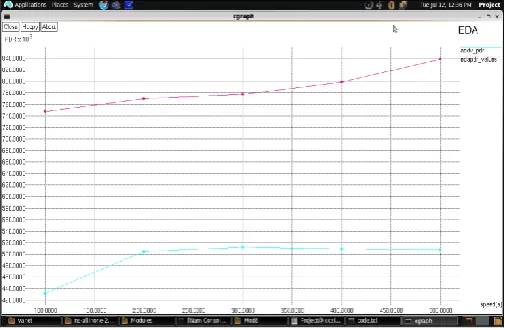
Figure 3 shows the graph of comparison of packet delivery ratio (PDR) between 30 nodes using EDA and AODV protocol at simulation time 50 sec and varying speed from 100 to 500 m/sec. In the graph, X axis is representing speed in a measurement unit of m/sec; Y axis represents PDR value. PDR of AODV protocol is plotted on graph with red color line and PDR of EDA is plotted with green color line. From graph, we can infer that PDR values are consistently better for EDA as compare to AODV protocol.
Figure 3: Packet Delivery Ratio
TABLE I. PACKET DELIVERY RATIO
No. of Nodes
(vehicles) Speed of vehicle (m/sec)
PDR value of
AODV
PDR Value of
EDA
30 100 200 0.4319 0.5048 0.7482 0.7698
300 0.5119 0.7773
400 0.5089 0.7987
500 0.5071 0.8389
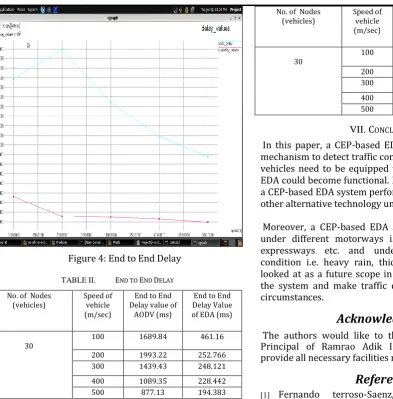
273 | P a g e Figure 4: End to End Delay
TABLE II. END TO END DELAY
No. of Nodes
(vehicles) Speed of vehicle (m/sec)
End to End Delay value of
AODV (ms)
End to End Delay Value of EDA (ms)
30 100 1689.84 461.16 200 1993.22 252.766 300 1439.43 248.121 400 1089.35 228.442 500 877.13 194.383
Throughput is nothing but the amount of data received at the destination. Figure 5 shows the graph of comparison of throughput between 30 nodes using EDA and AODV protocol at simulation time 50 sec and varying speed from 100 to 500m/sec. From figure, it is observed that the throughput values are consistently better for EDA as compare to AODV protocol.
Figure 5: Throughput
TABLE III. THROUGHPUT
No. of Nodes
(vehicles) Speed of vehicle (m/sec)
Throughput value of AODV (ms)
Throughput Value of EDA
(ms)
30 100 414.23 821.63 200 427.98 990.56 300 456.8 1594.26 400 518.50 1964.26 500 544.68 2004.26
VII.CONCLUSION
In this paper, a CEP-based EDA system is proposed as a mechanism to detect traffic congestion on a motorway. The vehicles need to be equipped with VANET through which EDA could become functional. Based on simulation results, a CEP-based EDA system performs significantly better over other alternative technology under varying vehicles’ speed.
Moreover, a CEP-based EDA system for traffic detection under different motorways i.e. single lane, multi lane, expressways etc. and under varying environmental condition i.e. heavy rain, thick fog conditions could be looked at as a future scope in this area which will enrich the system and make traffic detection possible in wider circumstances.
Acknowledgment
The authors would like to thank the management and Principal of Ramrao Adik Institute of Technology to provide all necessary facilities required for this research.
References
[1] Fernando terroso-Saenz, Mercedes Valdes-Vela,
Cristina sotomayor-Martinez, Rafael Toledo-Moreo, and Antoni F. Gomez- Member, IEEE, “A cooperative approach to traffic congestion detection with complex event processing and VANET,” IEEE Transactions on intelligent transportation system, Vol.13 No.2, June 2012.
[2] Quan Yuan, Zhihan Liu, Jinglin Li, Junming Zhang,
Fangchun Yang, “A traffic congestion detection and information dissemination scheme for urban
expressways using vehicular networks
Transportation,” Research Part C 47 (2014) 114–127, 2014 Elsevier.
[3] Thirupathi Lingala, Ashok Galipelli, Mahesh Thanneru,
“Traffic Congestion Control through Vehicle-to-Vehicle and Vehicle to Infrastructure Communication,” (IJCSIT) International Journal of Computer Science and Information Technologies, Vol. 5 (4) , 5081-5084, 2014.
[4] [4] Venkatesh, A Indra, R Murali , “ Routing Protocols
for Vehicular Adhoc Networks (VANETs): A Review,” Journal of Emerging Trends in Computing and Information Sciences, Vol. 5, No. 1 January 2014. [5] J. Dunkel, A. Fernández, R. Ortiz, and S. Ossowski,
“Event-driven architecture for decision support in traffic management systems,” Expert Syst. App., vol. 38, no. 6, pp. 6530–6539, Jun. 2011.
[6] Disha Shrivastava, Arun Agrawal, “Traffic congestion detection in vehicular adhoc networks using GPS,” 2014 IEEE International Conference on Computational Intelligence and Computing Research, IEEE conference
publications, Pages: 1 - 7, DOI:
10.1109/ICCIC.2014.7238543, year 2014.
274 | P a g e
Networking Workshop (MED-HOC-NET),IEEE
Publications, Pages: 203 - 210, DOI:
10.1109/MedHocNet.2014.6849125 Cited by: Papers (6), 2014.
[8] Vimlesh Kumar, Anurag Singh Baghel, Priyank Mishra, “Performance evaluation of DSDV, AODV and LSGR protocol in ad-hoc networks,” 2016 International Conference on Electrical, Electronics, and Optimization Techniques (ICEEOT), Pages: 4261 - 4266, DOI: 10.1109/ICEEOT.2016.7755522, 2016.
[9] Abhishek Srivastava, Gaurav Kapoor, Aman Gupta, “Solving traffic congestion — An application of
VANET,” 2016 International Conference on Innovation and Challenges in Cyber Security (ICICCS-INBUSH), Pages: 323 - 326, DOI: 10.1109/ICICCS.2016.7542307, year 2016.
![Figure 1: EDA Schematic [1]](https://thumb-us.123doks.com/thumbv2/123dok_us/7802019.1660573/2.595.306.562.365.564/figure-eda-schematic.webp)