Research article
Available online
www.ijsrr.org
ISSN: 2279–0543International Journal of Scientific Research and Reviews
Comparison of Different Symbol Detection Techniques with SA-BFO
Algorithm in MIMO Systems
Kaur Ramanpreet*
1and Goyal
Sonia
21Student, Department of ECE, UCoE, Punjabi University Patiala, Punjab, India 2
Assistant Professor, Department of ECE, Punjabi University Patiala, Punjab, India
ABSTRACT:
Multi-Input Multi-output (MIMO) technique has attracted numerous research interests in the area of wireless communication due to its capability of providing high data rates through spatial multiplexing. In this paper comparative study of different detection techniques such as Maximum Likelihood (ML), Zero Force Equalisation (ZFE), Self-adaptive Bacterial Foraging Optimization (SA-BFO), Vertical Bell Labs Layered Space-Time (V-BLAST), Genetic Algorithm (GA) is presented. While an optimal Maximum Likelihood (ML) detection using an exhaustive search method is prohibitively complex, simulation results show that the SA-BFO optimized MIMO detection algorithm results in near optimal Bit Error Rate (BER) performance , with significantly reduced complexity.
KEYWORDS
: Multi-Input Multi-Output system (MIMO), Bit Error Rate (BER), Self-adaptive Bacterial Foraging Optimization (SA-BFO), Maximum Likelihood (ML), Genetic Algorithm (GA)* Corresponding Author
Ramanpreet Kaur
1. INTRODUCTION
The growing demands of multimedia services and the growth of internet related contents lead
to increasing interest to high speed communications. Initially higher bandwidth was used to support
such high data rate applications. However, the increase in bandwidth is an impractical method and an
alternate solution is to adopt some spectral efficient techniques like Multi-Input Muti-Output
(MIMO) systems1. Wireless communication using MIMO antenna architecture also referred to as
spatial multiplexed system which promises to play a key role in realizing the tremendous growth in
the field of communication. Fading is the one of the major aspect which is considered in the receiver.
To cancel the effect of fading, channel estimation and equalization procedure must be done at the
receiver before data demodulation 2
The inter-symbol interference caused by multipath MIMO channels distorts the MIMO transmitted
signal which causes bit errors at receiver.
Optimization problems defined by functions for which derivatives are unavailable or available at a
prohibitive cost are appearing more and more frequently in computational science and engineering.
Increasing complexity in mathematical modelling, higher sophistication of scientific computing, and
abundance of legacy codes are some of the reasons why derivative-free optimization is currently an
area of great demand 3. In this paper comparative study of different detection techniques such as
Maximum Likelihood (ML), Zero Force Equalisation (ZFE), Self-adaptive Bacterial Foraging
Optimization (SA-BFO), Vertical Bell Labs Layered Space-Time (V-BLAST), Genetic Algorithm
(GA) is presented.
2. MIMO SYSTEM MODEL
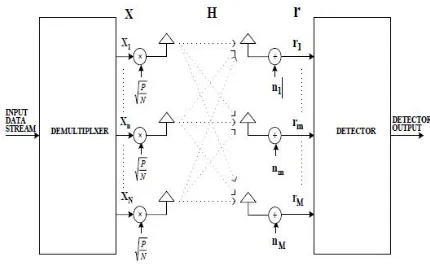
MIMO channel model is assumed to be quasi-static. Consider the MIMO system shown in
fig.1 where N different signals are transmitted and arrive at an array of M (N ≤ M) receivers via a
rich-scattering flat-fading environment1. The block transmission is assumed to contain one symbol
i.e. L=1. Baseband equivalent model of received signal vector at each sampling instant can be
represented as:
r = √ / Hx + n (1)
Where r is an Mx1 vector of received symbols at each antenna, x is an Nx1 vector of symbols
transmitted by each antenna, and n is an Mx1 vector of complex Additive White Gaussian Noise
(AWGN) random variables seen at each receive antenna. The channel matrix H is an MxN matrix,
from transmit antenna ‘j’ to receive antenna ‘i’. P is total transmit energy for one transmit antenna
system and is normalized for N transmit antenna system.
The receiver is also assumed to have perfect knowledge of the channel coefficients. This is a
reasonable assumption when the fading is slow enough to allow estimation of the CSI with negligible
error, as in the case of fixed wireless systems4.
Fig 1. MIMO system model with N transmit and M receive antennas
3. SA-BFO BASED DETECTION FOR MIMO SYSTEMS
A
.Steps for SA-BFOA
1) Chemotaxis: This process simulates the movement of an E.coli cell through swimming and
tumbling via flagella. Suppose θi(j, k, l) represents the ith bacterium at jth chemotactic, kth
reproductive, and lth elimination–dispersal step. C (i) is a scalar and indicates the size of the step
taken in the random direction specified by the tumble (run length unit). Then, in computational
chemotaxis, the movement of the bacterium may be represented by
i
(j + 1,k,l) = i(j,k,l) + C(i) ∆( )
∆^ ( )∆( ) (2)
where Δ indicates a unit length vector in the random direction.
2) Swarming: Interesting group behaviour has been observed for several motile species of bacteria
including E.coli and S. typhimurium, where stable spatiotemporal patterns (swarms) are formed in
semisolid nutrient medium. A group of E.coli cells arrange themselves in a traveling ring by moving
up the nutrient gradient when placed amid a semisolid matrix with a single nutrient chemo-effecter.
The cells when stimulated by a high level of succinate release an attractant aspartate, which helps
them to aggregate into groups and, thus, move as concentric patterns of swarms with high bacterial
3) Reproduction: The least healthy bacteria eventually die while each of the healthier bacteria (those
yielding lower value of the objective function) asexually split into two bacteria, which are then
placed in the same location. This keeps the swarm size constant.
4) Elimination and Dispersal: To simulate this phenomenon in BFOA, some bacteria are liquidated
at random with a very small probability while the new replacements are randomly initialized over the
search space3.
B. Step-by step algorithm:
[Step 1]Initialize parameters n, S, Nc, Ns, Nre, Ned, Ped, C(i) (i=1,2,…,S), i. Where,
n: Dimension of the search space,
S: The number of bacterium,
Nc: chemotactic steps,
Ns: swim steps,
Nre: reproductive steps,
Ned: elimination and dispersal steps,
Ped: probability of elimination,
C(i): the run-length unit during each run or tumble.
[Step 2] Elimination-dispersal loop: l = l+1.
[Step 3] Reproduction loop: k = k+1.
[Step 4] Chemotaxis loop: j = j+1.
[substep a] For i = 1=1, 2,…, S, take a chemotactic step for bacteria i as follows.
[substep b] Compute fitness function, J (i,j,k,l).
[substep c] Let Jlast = J(i,j,k,l) to save this value since we may find better value via a run.
[substep d] Tumble: Generate a random vector
Δ(i) Rnwith each element Δ m(i), m = 1, 2, …, S, a random number on [-1, 1].
[substep e] Move: Let
i
(j + 1,k,l) = i(j,k,l) + C(i) ∆( )
∆^ ( )∆( ) (3)
This results in a step of size C(i) in the direction of the tumble for bacteria i.
[substep f] Compute J(i,j+1,k,l) with i (j+1,k,l).
(i) Let m = 0 (counter for swim length).
(ii) While m < Ns (if have not climbed down too long)
• Let m = m+1.
• If J(i,j+1,k,l) < Jlast, let Jlast = J(i,j+1,k,l). then another step of size C(i) in this same direction will
be taken as equation (1) and use the new generated i (j+1,k,l) to compute the new J(i,j+1,k,l).
• Else let m = Ns.
[substep h] Go to next bacterium (i+1): if i≠S go to (b)
to process the next bacteria.
[Step 5] If j < Nc, go to step 3. In this case, continue
chemotaxis since the life of the bacteria is not over.
[Step 6] Reproduction:
[substep a] For the given k and l, and for each i = 1, 2, …, S, let Jhealth be the health of the bacteria.
Sort bacterium in order of ascending values.
J ihealth = ∑ ( , , , ) (4)
[substep b] The Sr bacteria with the highest Jhealth values die and the other Sr bacteria with the best
values split and the copies that are made are placed at the same location as their parent.
[Step 7] If k < Nre go to step 2. In this case the number of specified reproduction steps is not reached
and start the next generation in the chemotactic loop.
[Step 8] Elimination–dispersal: For i = 1, 2, …, S, with probability ped, eliminate and disperse each
bacteria, which results in keeping the number of bacteria in the population constant. To do this, if a
bacterium is eliminated, simply disperse one to a random location on the optimization domain. If l <
Ned, then go to step 2; otherwise end.
In SA-BFO evolution process, each bacterium displays alternatively two distinct search states:
(1) Exploration state, during which the bacterium employs a large run-length unit to explore the
previously unscanned regions in the search space as fast as possible.
(2) Exploitation state, during which the bacterium uses a small run-length unit to exploit the
promising regions slowly in its immediate vicinity. Each bacterium in the colony permanently
maintains an appropriate balance between Exploration and Exploitation states by varying its own
improvement and no improvement registered lately. The criteria that determine the adjustment of
individual run-length unit and the entrance into one of the states are the following:
Criterion-1: if the bacterium discovers a new promising domain, the run-length unit of this
bacterium is adapted to another smaller one. Here “discovers a new promising domain” means this
bacterium register a fitness improvement beyond a certain precision from the last generation to the
current. Following Criterion-1, the bacterium’s behavior will self-adapt into Exploitation state.
Criterion-2: if the bacterium’s current fitness is unchanged for a number Ku (user-defined) of
consecutive generations, then augment this bacterium’s run-length unit and this bacterium enters
Exploration state. This situation means that the bacterium searches on an un-promising domain or the
domain where this bacterium focuses its search has nothing new to offer5.
4. LINEAR MIMO DETECTORS
4. 1 Zero-Forcing (ZF)
The ZF algorithm attempts to null out the interference introduced from the matrix channel by
directly inverting the channel with the weight matrix .
5. NON-LINEAR MIMO DETECTORS
5.1 VBLAST
:VBLAST is the improvement of BLAST receiver. The detection algorithm associated with
the BLAST architecture is the successive cancellation (SUC) algorithm. Rather than jointly decoding
all of the transmitted symbols, this nonlinear detector decodes the first transmitted symbol by
satisfying the ZF or MMSE performance criterion while treating the rest of the data symbols as
interference; then it cancels out its contribution to obtain a reduced order integer least-squares
problem with t-1 unknowns. The process is repeated until all the symbols are detected. In general,
this algorithm performs better than the ZF or MMSE receivers, but it suffers from error propagation;
its performance quickly degrades if that first symbol was incorrectly decoded. A suggested
improvement is the use of ordered successive cancellation (OSUC), an algorithm associated with the
VBLAST architecture (6) The main idea behind OSUC is that rather than selecting the symbols to be
decoded in thei natural order as in SUC, the symbols at the beginning of each decoding stage are
ordered in terms of decreasing signal-to-interference noise ratio (SNR), and the symbol with the
highest SNR is selected for decoding.
5.2 ML detector:
Maximum Likelihood detector is optimal but computationally very expensive.5.3 GA based detection for MIMO systems
GA is an inspiration based on principles of natural genetics and selection. Algorithm starts by
defining optimization variables, optimization cost and the cost function. Convergence/Fitness test
follows different components of algorithm, as explained.
5.3.1 Initializatin of GA
All potential solutions of a problem are encoded in bit level to simplify the following GA
recombination operations. In MIMO detection x χ that form the ML search space are coded as
binary strings called chromosomes. It is common to select the initial population randomly from
solution space or derive from a linear/non-linear detector output. Each chromosome is a combination
of the probable solution for all transmit antennas. Normally, the population size Npop is taken as the
product between N, the number of transmit antennas, and C, the number of all possible solutions of
each transmit antenna.
Npop= 2b × N
5.3.2 Fitness evaluation using cost function
Each member of the population at each generation is evaluated, and according to its fitness
value (output of the cost function), it is assigned a probability to be selected for reproduction.
Following equation acts as the cost function to evaluate the fitness of each chromosome:
f = rHx 2 (8)
The optimal solution of eq.8 should yield a minimum value. ML detector evaluates xX results
in computation time that varies exponentially with the number of transmit antennas. As will be
explained, the use of GA in a MIMO system can reduce the computation times of eq.8 significantly.
The best chromosome in a generation should have the least value of the objective function. If the
value of the best chromosome in the present generation is larger than its counterpart in the previous
generation, the chromosome with the largest value of the objective function in the present generation
will be replaced by the best chromosome of the previous generation. This operation ensures that at
least the useful information contained in the present generation is passed on to the next.
5.3.3 Optimality
If the optimal criterion is satisfied, that is, when any one of all f in the population is less than
a predetermined threshold, or if the generation number has exceeded a predefined value, which is
also commonly taken as the product between N and C, then go to 5.3.8. Otherwise, go to Step 5.3.4.
5.3.4 Selection
This process uses fitness value and serves to provide chromosomes for the subsequent
mating, and bottom Npop– Nkeepare discarded to make room for new offspring. Deciding how many
chromosomes to keep is arbitrary and normally 50% (Psel = 0.5) of population survives ‘Selection’
process after chromosomes have been sorted by cost. This new population of Nkeep chromosomes
forms mating pool of good parents.
5.3.5 Reproduction
This step is intended to replace the chromosome with largest objective function value by the
best chromosome of the same generation. The Offspring to replace the bad parents is created by the
processes of ‘Crossover’ and ‘Mutation’.
5.3.6 Crossover
Crossover operation is applied to pairs of selected parents and creates offspring. Process of
mating by applying crossover operator creates two offspring by combining subparts of bit strings of
two selected parents6. The crossover point is randomly selected along the chromosome lengths and
portions up to that point are exchanged between two parents. Probability of crossover pc is user
controlled and usually set to a high value.
5.3.7 Mutation
These offspring are mutated through mutation operator and new members of next generation
are produced. Mutation operator simply alters each bit of the binary chromosome randomly with a
user-controlled probability pm7. Generally, the crossover probability pc is close to 1 and the mutation
probability pm is close to 0. New individuals replace members of previous populations with worst
fitness values. Algorithm iterates until optimization of objective function is achieved. For given
predefined number of generations and population size, the computation times of eq.8 vary linearly
with (Npop X Ngen) for GA based detector, which is much smaller than the factor of 2NXbin the ML
detection. The improvement is clearly significant.
5.3.8 Decision making
If the defined optimality criterion is met the algorithm terminates its execution and output is
generated8.
6. SIMULATION RESULTS AND DISCUSSION
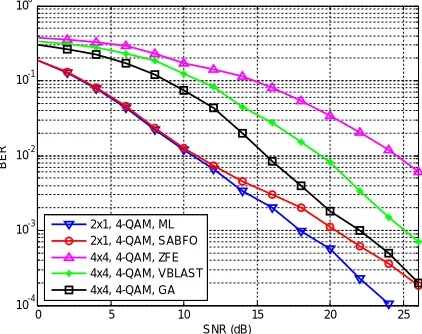
We consider a MIMO systems designed for an underlying 4-QAM and 4-PSK constellation
with up to 4 transmit and 4 receive antennas. We assume a quasi-static Rayleigh fading channel
model which is constant over a frame and varies independently between frames. We assume that the
channel exhibits a quasi-static frequency flat Rayleigh fading over the frame duration. Thus, it is
performance comparison, we consider MIMO system which has specifications same as the system
described above, the only difference being in the detection/decoding of the received symbols which
is done via maximum likelihood (ML) Viterbi decoder. We show that SABFO based detector gives
near optimal results with much lower complexity level as compared to the ML detector.SA-BFO
gives better results than ZFE and V-BLAST systems if PSK modulation scheme is used.
Fig 2. BER performance comparison for 2×1 and 4×4 System using 4-PSK and 4-QAM technique
Fig 3. BER performance comparison for 2×1 and 4×4 System using 4-QAM technique.
From fig 3. It is clear that for QAM modulation technique SA-BFO gives better results than Genetic
algorithm.
7. CONCLUSION
In this paper, Self-Adaptive Bacterial Foraging Optimization algorithm for symbol detection
is presented. SA-BFO based MIMO detector uses a simple model and has lesser implementation
complexity. For larger number of antennas and higher modulation schemes, the proposed SA-BFO
0 5 10 15 20 25
10-4 10-3 10-2 10-1 100
SNR (dB)
B
E
R
2x1, 4-PSK, ML 2x1, 4-PSK, SABFO 4x4, 4-QAM, ZFE 4x4, 4-QAM, VBLAST 4x4, 4-QAM, GA
0 5 10 15 20 25
10-4 10-3 10-2 10-1 100
SNR (dB)
B
E
R
algorithm is expected to give near optimal results with much lower complexity level as compared to
the ML detector. For QAM modulation technique SA-BFO gives better results than Genetic
algorithm as well as ZFE and V-BLAST system.
ACKNOWLEDGEMENT
I express my sincere thanks to Er. Sonia Goyal, Assistant Professor, Electronics and
Communication Department, UCoE, Punjabi University Patiala for the Technical Assistance.
REFERENCES
1. Bhasker Gupta and Davinder S. Saini, “ BER analysis of SFBC MIMO-OFDM systems using
different Equalizers in quasi-static mobile radio channel”,Communication Systems and
Network Technologies (CSNT), IEEE International Conference , 2011;520 - 524
2. K. Elangovan, “Comparative study on the channel estimation for OFDM system using
LMS,NLMS and RLS algorithms ” Pattern Recognition, Informatics and Medical
Engineering (PRIME), IEEE International Conference , 2012; 359 - 363
3. Nitin Kumar Jhankal and Dipak Adhyaru, “Bacterial Foraging Optimization Algorithm: A
Derivative free technique”, Engineering (NUiCONE), IEEE Nirma University International
Conference , 2011;1-4.
4. Sajid Bashir, Muhammad Naeem and Syed Ismail Shah, “An Application of GA for symbol
detection in MIMO communication Systems”, Natural Computation, IEEE Third
International Conference , 2007; 2:404-410.
5. Hanning Chen, Yunlong Zhu and Kunyuan Hu, “Self-Adaptation in Bacterial Foraging
Optimization Algorithm”, Intelligent System and Knowledge Engineering , 3rd International
Conference , 2008;1: 1026-1031
6. Rafik ZAYANI, Mohamed L. AMMARI, “ Neural Network Equalization For Frequency
Selective Nonlinear MIMO Channels”, Computers and Communications (ISCC), IEEE
Symposium, 2012; 000018 - 000022
7. Cheng-Yu Hung, Wei-Ho Chung and Chiao-En Chen, “ A Monte Carlo MIMO Detection
Via Random Noise Generation”, Wireless Communications and Networking Conference
(WCNC), IEEE, 2012; 3: 903-907
8. Cheng-Yu Hung and Ronald Y. Chang, “A Hybrid MMSE and K-Best Detection Scheme for