to
Capture User Web Navigation Patterns
Jose Luis C abral de M oura Borges
A dissertation submitted in partial fulfilment of the requirements for the degree of
Doctor of Philosophy of the
University of London.
D epartm ent of C om puter Science University College London
UCL
ProQuest Number: 10608952
All rights reserved
INFORMATION TO ALL USERS
The qu ality of this repro d u ctio n is d e p e n d e n t upon the q u ality of the copy subm itted.
In the unlikely e v e n t that the a u th o r did not send a c o m p le te m anuscript and there are missing pages, these will be note d . Also, if m aterial had to be rem oved,
a n o te will in d ica te the deletion.
uest
ProQuest 10608952
Published by ProQuest LLC(2017). C op yrig ht of the Dissertation is held by the Author.
All rights reserved.
This work is protected against unauthorized copying under Title 17, United States C o d e M icroform Edition © ProQuest LLC.
ProQuest LLC.
789 East Eisenhower Parkway P.O. Box 1346
This thesis proposes a formal data mining model to capture user web navigation pat terns. Information characterising the user interaction with the web is obtained from log files which provide the necessary data to infer navigation sessions. We model a collec tion of sessions as a hypertext probabilistic gram m ar (HPG) whose higher probability strings correspond to the navigation trails preferred by the user. A breadth-first search algorithm (BFS) is provided to find the set of strings with probability above a given cut-point; we call this set of strings the maximal set. The BFS algorithm is shown to be, on average, linear in the variation of the number of iterations performed with the gram m ar’s number of states. By making use of results in the field of probabilistic regu lar grammars and Markov chains, the model is provided with a sound foundation which we use to study its properties. We also propose the use of entropy to measure the sta tistical properties of a HPG.
Two heuristics are provided to enhance the m odel’s analysis capabilities. The first heuristic implements an iterative deepening search wherein the set of rules is incremen tally augmented by first exploring the trails with higher probability. A stopping param eter measures the distance between the current rule-set and its corresponding maximal set providing the analyst with control over the number of induced rules. The second heuristic aims at finding a small set of longer rules com posed of links with high prob ability on average. A dynamic threshold is provided whose value is set in such a way that it can be kept proportional to the length of the trail being evaluated.
This thesis was funded by the University of Porto and by a grant from JTNICT. I also ac knowledge the Department of Computer Science at UCL and the UCL Graduate School for the financial support given to attend conferences.
A very special word goes to Mark Levene, my supervisor, for the advice, encour agement, and friendship he was always available to give. I am also grateful to Tony Hunter, my second supervisor.
My thanks to all the people of GEIN for their support. A special thanks to Joao Falcao e Cunha whose help was crucial in my decision of doing the PhD abroad.
My thanks to the fellow students at UCL whose daily presence and sharing of ex periences were very important to make my stay in London an invaluable experience. I would like to name Rafael Bordini, Ethan Collopy, Antonio Liotta, Hugh Mallinson, Joao Oliveira, Jorge Ortega-Arjona, Alberto Souza, Manlio Valdivieso-Casique, Kanta Vekaria and Nadav Zin. I also thank all the friends from Portugal whose frequent visits were much appreciated.
Contents
1 Introduction 13
1.1 Problem D e f in itio n ... 13
1.2 Contribution of the Thesis ... 15
1.3 Structure of the T h e s i s ... 17
2 Background 19 2.1 Hypertext and H y p e rm e d ia ... 19
2.1.1 The World-Wide-Web and Search Engines ... 20
2.1.2 The Navigation P r o b le m ... 23
2.1.3 Hypertext M o d e llin g ... 24
2.1.4 Hypertext Visualisation T o o l s ... 25
2.1.5 Adaptive H y p e rte x t... 26
2.1.6 Web Navigation Assistants and Agents ... 27
2.1.7 HTML and X M L ... 29
2.2 Data Mining and Knowledge D is c o v e r y ... 30
2.2.1 Data Mining T e c h n iq u e s ... 31
2.2.2 Mining Association Rules and Sequential Patterns ... 32
2.3 Web Data M in in g ... 33
2.3.1 Web Content M i n i n g ... 35
2.3.2 Web Structure M i n i n g ... 36
2.3.3 Web Usage M n i n g ... 37
2.3.3.1 Log Files and Data Preparation Issues ... 38
2.3.3.3 This Thesis A p p r o a c h ... 46
2.3.4 Privacy Issues in Web Data M i n i n g ... 49
2.4 Probabilistic L an g u ag es... 50
2.4.1 Context-Free and Regular G r a m m a r s ... 51
2.4.2 Probabilistic Regular G r a m m a r s ... 53
2.4.3 Finite Automata ... 55
2.4.4 Markov Chains to Model Probabilistic Regular Grammars . . 57
2.5 Hypertext Probabilistic Automata ... 59
2.6 Information T h e o r y ... 60
2.7 S u m m a r y ... 62
3 Hypertext Probabilistic Grammars 64 3.1 Formal D e fin itio n ... 64
3.2 HPG as a Markov Chain ... 76
3.3 The Ngram M o d e l ... 79
3.4 Incremental M o d e l ... 86
3.5 Exhaustive Computation of All Rules ... 88
3.6 The Entropy of a HPG ... 92
3.7 S u m m a r y ... 94
4 Experimental Evaluation 96 4.1 Synthetic Data Experiments ... 96
4.1.1 Synthetic Data Generation M e th o d ... 96
4.1.2 Experimental R e s u lts ... 98
4.2 Real Data E x p e r im e n ts ... 101
4.2.1 Real Log F i l e s ... 101
4.2.2 Experimental R e s u lts ... 102
4.3 /Vgram A n aly sis... 112
4.4 Entropy A n a l y s i s ... 114
Contents 7
5 Heuristics for M ining High Quality Navigation Patterns 117
5.1 M o tivatio n... 117
5.2 Iterative Deepening H e u ris tic ... 119
5.2.1 Synthetic Data E x p e r im e n ts ... 122
5.3 Fine-Grained Iterative Deepening H e u r i s t i c ... 123
5.3.1 Experimental E v a lu a tio n ... 130
5.4 Inverse Fisheye H e u ris tic ... 134
5.4.1 Experimental E v a lu a tio n ... 140
5.5 S u m m a r y ... 146
6 Operations on Hypertext Grammars 147 6.1 M o tiv ation ... 147
6.2 Inferring a HWG from a HPG ... 149
6.3 Grammar Equality and S u b -g ra m m a rs ... 154
6.4 Primitive Methods ... 155
6.5 Binary Operations on G r a m m a rs ... 159
6.6 S u m m a r y ... 172
7 Summary and Conclusions 174 7.1 Summary of the T h e s i s ... 174
7.2 Directions for Future R e s e a r c h ... 176
7.2.1 Incorporating Relevance Measures in H P G ... 178
7.3 Applications of the HPG m o d e l... 179
7.4 Final R e m a rk s ... 181
A Details of the HPG Implementation 182
Bibliography 187
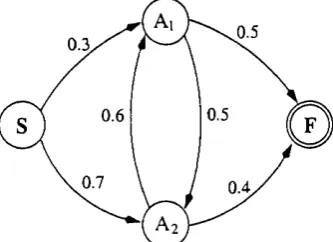
2.1 An example of a regular gram m ar... 52 2.2 An example of a probabilistic regular g r a m m a r ... 55 2.3 The finite automaton corresponding to the gram m ar in Figure 2.1. . 56 2.4 The transition diagram for the finite automaton in Figure 2.3.... 56 2.5 Examples of Markov chains... 58 2.6 The Markov chain equivalent to the gram m ar given in Figure 2.2. . 59 2.7 Entropy decomposition property... 62
3.1 An example of a web topology... 65 3.2 An example of a collection of user navigation trails... 65 3.3 The methodology of the hypertext probabilistic gram m ar model. . . 66 3.4 The production rules of the hypertext gram m ar corresponding to the
web topology in the running exam ple... 67 3.5 The transition diagram for the hypertext weighted gramm ar corre
sponding to the collection of trails in the running exam ple... 71 3.6 The production rules of the hypertext probabilistic gramm ar corre
sponding to the collection of trails in the running exam ple... 72 3.7 The strings in the language generated by the gram m ar in the running
example for several values of the cut-point and of the a parameter. . 75 3.8 An example of a H PG ... 77 3.9 The absorbing Markov chain corresponding to the HPG in Figure 3.8. 77 3.10 The irreducible Markov chain corresponding to the H PG in Figure 3.8. 78 3.11 An example of a HPG whose equivalent irreducible M arkov chain
L ist o f Figures 9
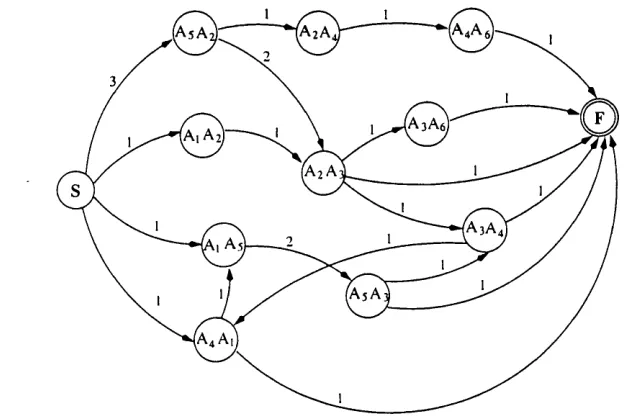
3.12 The trigram HWG for the collection of trails in the running example. 81
3.13 An example of the computation of the x 2 lest... 84
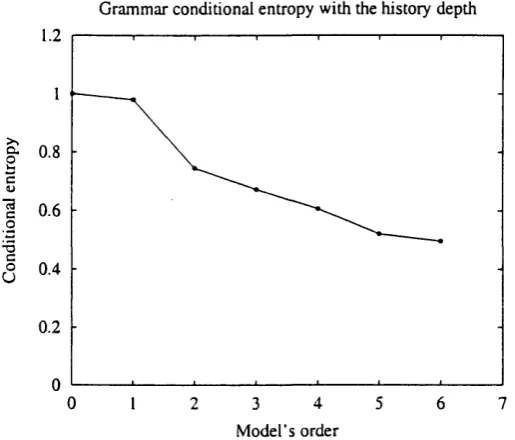
3.14 An example of a conditional entropy plot... 86
3.15 The BFS exploration tree for a = 0 and A = 0 .6/6 = 0.1... 89
3.16 Two HPGs to exem plify the entropy rate definition... 94
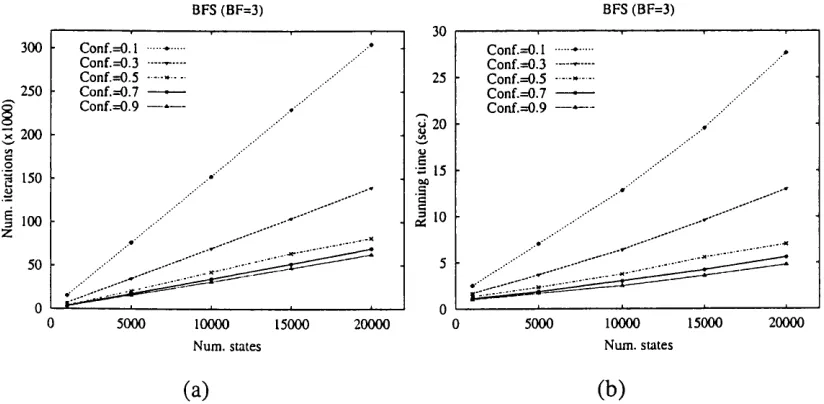
4.1 The variation of the number of iterations and the running time with the number of states... 98
4.2 The variation of the number of iterations with both the branching fac tor and the confidence... 99
4.3 The variation of the number of induced rules with the number of states. 100 4.4 The effect of the distribution parameter for the links weights in the number of iterations and the variation of the average rule length with the number of states... 101
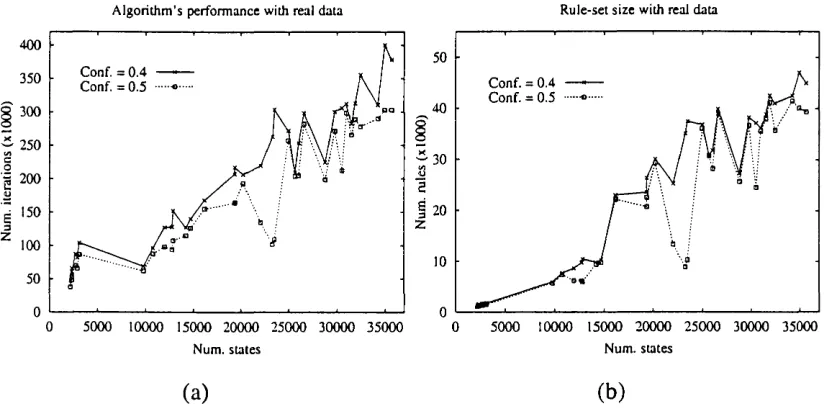
4.5 The variation of the number of iterations and the num ber of rules with the number of states for the real data... 103
4.6 The variation of the number of induced rules and their length with the confidence threshold... 103
4.7 The top-ten pages for several values of the a param eter... 105
4.8 Characteristics of the rule-sets induced with N = 2 and 5 = 0.5 for several values of a ... 106
4.9 The percentage of pages in the web site covered by the best X % of the induced rules... 107
4.10 URL codification... 108
4.11 Example of real data rules mined with 8 = 0.5, 0 = l / n , and a = 1. 109 4.12 Variation of the gramm ar size with the history depth and an histogram for the sessions’ length... 113
4.13 The x 2 test for some of the weeks in the real data... 114
5.1 Characteristics of the rule-set induced by the BFS algorithm ... 118
5.2 Example of an exploration tree obtained with the ID heuristic for k = 2 and A = 0.15... 121
5.3 Variation of the stopping parameter and of the percentage of rules mined with the exploration depth... 123
5.4 An example of an exploration tree obtained with the fine-grained heuristic when using the greedy criterion for k = 5 and A = 0.15. . . 126
5.5 The contents of the sets of trails induced by the FG heuristic when using the greedy criterion for A = 0.15... 129
5.6 The contents of the sets of trails induced by the FG heuristic when using the best-trail criterion for A = 0.15... 129
5.7 The variation of the number of rules and the length of the rules with the fine-grained stopping criterion when the heuristic is applied to the synthetic data... 131
5.8 The performance of the fine-grained heuristic with the synthetic data. 132
5.9 The variation of the number of rules and the size of the rules with the fine-grained stopping criterion when applied to the real data...133
5.10 The evolution of both the set of candidate trails and the rule-set with the stopping criterion for the real data... 134
5.11 An exploration tree for the inverse fisheye heuristic with 9 = 0.49 and S = 0.6... 138
5.12 The characteristics of the rule-set induced by the Inverse fisheye heuristic with synthetic data... 141
5.13 The performance of the inverse fisheye heuristic with synthetic data and comparison between the rule-sets obtained with the inverse fish eye and the BFS algorithm for real data... 142
5.14 Evolution of the characteristics of the rule-set obtained with the geo metric version of the inverse fisheye heuristic with real data...143
5.15 Distribution of the rules’ length with synthetic data... 144
L ist o f Figures 11
5.17 Distribution of the rules’ length for real data with 9 = 2 / n... 145
6.1 An example of a generic H PG ... 150
6.2 An example of a HPG and its corresponding H W G ... 151
6.3 The relationship between HPGs, HWGs, and uH W G s... 153
6.4 Examples of HW Gs... 155
6.5 Two alternative interpretations when adding a link traversal to a HWG. 156 6.6 Two alternative interpretations when removing a link traversal from a HW G... 158
6.7 Example of two HWGs to illustrate the operations... 162
6.8 Example of the computation of the sum of two H W G s... 162
6.9 Example of the computation of the union of two H W G s...165
6.10 Two examples of the computation of the difference between two HWGs. 167 6.11 An example of the drawbacks of adopting a strict definition for the computation of the difference between two H W G s... 168
6.12 An example of the consequences of adopting a strict definition for the computation of the intersection between two H W G s... 170
6.13 An example of the computation of the intersection of two HWGs. . . 171
A .l A list of the classes in the HPG model im plem entation... 182
A .2 The more important methods in the HPG class... 183
A.3 The methods in the R u l e S e t class... 184
A.4 The methods in the R u l e class... 184
3.1 The pseudo-code for the incremental algorithm to infer a HWG from a collection of trails... 87 3.2 The pseudo-code for the Breadth-first search algorithm ... 90 5.1 The pseudo-code for the fine-grained heuristic with the best-trail criterion. 128 5.2 The pseudo-code for the geometric version of the inverse fisheye
heuristic... 139 6.1 The pseudo-code for the method to increment the weight of a link in a
H W G ... 157 6.2 The pseudo-code for the method to decrement the weight of a link in a
H W G... 159 6.3 The pseudo-code for the method to compute the sum of two HWGs. . 163 6.4 The pseudo-code for the method to compute the union of two HWGs. 165 6.5 The pseudo-code for the method to compute the difference between two
HW Gs... 167 6.6 The pseudo-code for the method to compute the intersection of two
Chapter 1
Introduction
1.1 Problem Definition
The explosive growth of the world-wide-web (known as the web) in recent years has turned it into the largest source of available online data. Recent studies estimate the web as having over one billion pages (Inktomi, 2000), and pages are being added and deleted every day. The web is an unstructured collection of pages and hyperlinks, and pages are accessed and provided by a wide variety of people with different backgrounds and interests. Moreover, the web doesn’t provide its users with a standard coherent page design across web sites (or even within a site). The web is heterogeneous in its contents both in relation to the information available and to its quality. Currently, web pages are mainly designed using HTML. With HTML the definition of the structure of a web page is severely limited, therefore, the analysis of the content of web pages by automated tools is a challenging and difficult task. All these facts together im ply that it is difficult for a user to find relevant information on the web.
of a web site, or at providing the individual user with navigation assistant tools that help
to manage web data. In web data mining there are mainly three research directions be ing followed:
(i) web content mining,
(ii) web structure mining, and
(iii) web usage mining.
Web content mining is a research field focused on the development of techniques to assist a user in finding web documents that meet a certain criterion, see for exam ple (Craven et al., 1998). Mining the link structure aims at developing techniques to take advantage of the collective judgem ent of web pages’ quality which is available in the form of hyperlinks, see (Chakrabarti et al., 1999a), where links on the web can be viewed as a mechanism of implicit endorsement. Finally, web usage mining focuses on techniques to search for patterns in the user behaviour when navigating the web, see (Borges and Levene, 2000a).
1.2. Contribution o f the Thesis 15
be used as a prediction technique to prefetch in advance pages the user may be interested in. In addition, the user would benefit from being able to com pare and/or exchange his navigation patterns with those of his peers and, for example, identify the preferred trails which are unknown to him but are among the preferences of his peers.
When web users interact with a site, data recording their behaviour is stored in web server logs, which in a medium sized site can amount to several megabytes per day. Moreover, since the log data is collected in a raw format it is an ideal target for be ing analysed by automated tools. Currently, several commercial log analysis tools are available (Stout, 1997; Mena, 1999). However, these tools have limited analysis capa bilities producing only results such as summary statistics and frequency counts of page visits. In the meantime the research community has been studying web usage mining techniques to take full advantage of information available in the log files. There have so far been two main approaches to mining for user navigation patterns from log data. In the first approach log data is mapped onto relational tables and adapted versions of stan dard data mining techniques, such as mining for association rules, are invoked, see for example (Chen et al., 1998). In the second approach techniques are developed which can be invoked directly on the log data, see for example (Borges and Levene, 2000a) or (Spiliopoulou et al., 1999).
In this thesis we propose a new model for handling the problem of mining navi gation patterns from log data. We model the user navigation records, inferred from log data, as a hypertext probabilistic gramm ar whose higher probability generated strings correspond to the user’s preferred trails.
1.2 Contribution of the Thesis
chains in order to provide the model with a sound theoretical foundation.
We model a collection of user navigation sessions as a hypertext probabilistic grammar (HPG) whose higher probability strings correspond to the user preferred nav igation trails. A HPG is within the class of regular grammars and can alternatively be viewed as a finite Markov chain. We make use of the Ngram concept to model the as sumed user’s memory when browsing the web. A chi-square test is used as the method to assess the order, N , of the /Vgram model that gives the required trade-off between the model size and its accuracy in representing the user navigation sessions.
A breadth-first search (BFS) algorithm is provided to com pute the set of grammar strings having probability above a given cut-point; we call such strings rules. We prove that the BFS algorithm is, on average, linear in the variation of the number of iterations with the gram m ar’s number of states. The results of extensive experiments with syn thetic and real data are reported. The cut-point enables the analyst to determine the minimum probability that a string must have in order to be considered a rule and con sequently the size of the rule-set. However, a high value of the cut-point results in a small set of very short rules and a small value of the cut-point results in a very large set of rules. The manipulation of large rule-sets limits the m odel’s performance; therefore, two heuristics are proposed which enhance the HPG capabilities by providing flexibil ity in the way a set of rules is induced from a HPG. Using these heuristics it is possible to analyse the contents of a HPG from different perspectives.
1.3. Structure o f the Thesis 17
A set of binary operations on HPGs is defined, which gives the ability to compare the contents of two distinct HPGs. The operations defined are union, sum, intersection, difference and complement. Given two HPGs, each characterising the interaction of a user with the web, their intersection gives the subset of the web that was visited by both users. Such a gramm ar can be further analysed and the high probability strings identified by using the algorithms we have provided. The gram m ar resulting from the union or the sum of two grammars enables to identify the high probability strings in a grammar that represents the overall users’ navigation history. Finally, the difference between two grammars is useful to discover strings that are am ong the favourites of one user but are unknown to the other user.
A HPG provides a com pact way to incrementally store log data and, in addition, algorithms to extract useful patterns from a HPG are provided. The HPG model can be useful to the web site owner, since understanding the users navigation patterns can provide insight on how to improve the site’s topology. The gram m ar’s operations can be useful to assess the evolution of the users access patterns over time. When used as a browser plug-in, a HPG can be useful to the individual user, where the u ser’s log data can be collected via a local proxy. In this scenario the HPG works as a compact repre sentation of the user’s knowledge of the web, making it possible to share that knowledge with others. In fact, by using the HPG operations and the provided algorithm s a user is able to compare his navigation preferences with those of his peers.
1.3 Structure of the Thesis
After this introduction, in Chapter 2 we discuss related work in the field of web tech nologies which aim at enhancing the user navigation experience. We briefly review search engines technology, web visualisation techniques, adaptive hypertext and web navigation assistants. Then, we focus on the field of data mining and we pay particular attention to techniques developed in the field of web usage mining. Finally, we present the relevant concepts on formal language theory, discrete M arkov chains and inform a tion theory which are used throughout the thesis.
(HPG) model and the analysis of its basic properties. An algorithm to infer a HPG from a collection of sessions is given as well as an algorithm to find its strings with probabil ity above a cut-point. In addition, the IVgram extension to the model in given together with a statistical test to determine the order of the model.
In Chapter 4 we present the results o f the extensive experiments conducted in order to assess the performance and effectiveness of the HPG model.
Two novel heuristics are presented in C hapter 5 which extend the m odel’s analysis capabilities. The first heuristic implements an iterative deepening search wherein the
set of rules is incrementally augmented by first expanding the trails with high probabil ity. The second heuristic makes use of a dynamic threshold to find longer rules com posed of links with above the average probability. Results of the experiments conducted with both real data and synthetic data are presented and analysed.
Chapter 6 presents the formal definitions of several binary operations on hyper text probabilistic grammars, whose aim is to provide the analyst with techniques for com paring the contents of two grammars. The operations defined are: sum, union, dif
ference, intersection, and complement.
Chapter 2
Background
In this chapter we discuss related work and present the relevant background concepts for the thesis. We start by presenting the basic concepts com m on in research in hy pertext and the world-wide-web. We give examples of models proposed for hypertext systems and of different types of navigation assistants, which aim at helping the user overcome the navigation problem (see Section 2.1.2). We then present relevant research in the field of data mining and knowledge discovery and its application to web tech nologies. We pay particular attention to techniques developed in the field of web usage mining. Finally, we present basic relevant concepts on formal language theory, discrete M arkov chains, and information theory which are used throughout the thesis.
2.1 Hypertext and Hypermedia
A hypertext system, (Nielsen, 1990b), is an information managem ent system which has the information stored in a network of nodes and links. The nodes contain the informa tion and links connect related concepts. The user accesses the contents of a hypertext system by means of an interface that provides the ability to brow se the information in a non-sequential way. A hypertext system whose nodes also contain audio, video, or images is often called a hypermedia system.
of Memex was a process which enabled to tie together two pieces of information, in a manner that emulates the associative way the mind works. This feature enabled its owner to construct trails of pieces of information containing related concepts, and store them for future reference. In a following paper, (Bush, 1991) written in 1959, the author revisited his Memex machine and new features were described. The im proved Memex was able to identify trails that were followed frequently. In addition, the system could build new trails by searching the stored information for items containing a given set of keywords; the items found were tied together to form a new trail. A collection of B ush’s publications on his Memex machine is available in (Nyce and Kahn, 1991).
The word hypertext was coined by Nelson in (Nelson, 1965) to mean a body of written and pictorial material interconnected in such a way that could not conveniently be presented or represented on paper. He proposed a system (later named Xanadu)
which aims at being a repository of everything anybody has ever written. An im ple mentation of the system is being developed whose source code is about to become an open source.
Since this early research the interest in the hypertext concept has grown steadily and several hypertext systems were implemented; a survey of the hypertext history can be found in (Conklin, 1987). The research into hypertext systems provided the founda tions for the world-wide-web.
2.1.1
The World-Wide-Web and Search Engines
2
.1. H ypertext and Hypermedia 21and at the same time by a young student taking the first steps in learning a programming language.
The web is the largest information resource available. A ccording to recent esti mates, in February 1999 the web contained about 800 million pages on about 3 million
different servers, see (Lawrence and Giles, 1999). The number of web servers was esti mated by sampling and testing random IP address numbers and determining the fraction of such tests that successfully located a web server. The estimate of the average num ber of pages per server was obtained by crawling a sample of the servers identified in the first experiment. A recent update (Inktomi, 2000) verified the existence of over one billion unique indexable pages on the web. In addition, a previous study aimed at eval uating the usefulness of caching techniques on the web, (Douglis et al., 1997), verified
that 16.5% of the pages accessed were modified every time they were accessed. This last results were obtained from the analysis of the log traces from two large corporate networks.
and cannot be reached from it. The four com ponents present a sim ilar size, measured by the number of pages.
One problem that users face when navigating the web is that of finding relevant in formation from the enormous pool of web documents. There are essentially two types of service to help a user deal with this problem, which are: directories o f resources and
search engines. The most well known exam ple of a directory of resources is the Yahoo web site (www. y a h o o . com). A directory of resources is basically a classification of web sites into a hierarchy of categories. A user can browse the hierarchy of concepts and, once the required category is found, he is supplied with a set of links to sites con taining relevant information. The advantage of this type of service is that the pages are classified into categories under human supervision. Therefore, only pages with high
quality and focused contents are included. On the other hand, since human interven tion is required these type of sites struggle to cope with the fast pace with which new web sites become available.
A search engine consists essentially of a repository of pages, each indexed by key words characterising its contents, and an interface to allow users to query the repository, (Brin and Page, 1998). The repository of pages is collected by web crawlers that period ically traverse the web in search for new or modified pages, (Chakrabarti et al., 1999b; Cho et al., 1998). Each page is downloaded and has its contents parsed and analysed in order to identify the keywords that characterise it. When a user submits a query to a search engine references to the relevant pages are selected from the repository and ordered according to a ranking criterion.
2
.1. H ypertext and H ypermedia 23monitors users’ queries and the links they subsequently choose to follow. The set of pages containing the submitted keywords are ranked according to their popularity, the pages on top are the more popular among the users, (Hotbot, 1998).
Several studies were performed to assess to what extent the repository indexed by a search engine covers the web, see (Lawrence and Giles, 1999; Lawrence and Giles, 1998; Bharat and Broder, 1998). In the more recent published study (Lawrence and Giles, 1999) the authors conclude that a single search engine indexes between 2.2% and 16.0% of the estimated web size. The com bined coverage of all search engines considered in the study is no more then 42% of the estim ated web size.
To take advantage of the combined coverage of several search engines (Selberg and Etzioni, 1995) proposed the MetaCrawler, which makes use of the meta search en gine concept. The M etaCrawler provides an interface for specifying a query which, once submitted, is posted to several search engines in parallel. The results obtained from the search engines used are merged and presented to the user. More recently, (Lawrence and Giles, 1998) proposed the Inquirus meta-search engine. This tool posts a query to several search engines and each returned page is dow nloaded and analysed. The quality of each page is re-evaluated by the Inquirus own relevance criterion and the results are shown progressively, so that the user doesn’t have to wait for all the pages to be analysed. Each link to a page is given with the local context around the query search terms displayed in order to enable the user to assess the relevance of the pages by himself.
2.1.2 The Navigation Problem
Search engines and directories of resources are invaluable for the provision of high quality entry points for web navigation. However, no indication is given on what further pages lie ahead to assist the user in choosing which link to follow. In addition, current web browsers provide little support for dealing with the huge am ount of choices a user faces while navigating the web. This often frustrates the user and leads to the feeling of getting lost in hyperspace, (Conklin, 1987).
feeling the user experiences when unable to identify how his current position relates to the overall display network. This feeling leads to difficulties in deciding where to go next and it results in a decrease in perform ance in the com pletion of the task at hand. In the web the problem of getting lost is more evident due to its huge size and to the variety of both the design and contents of pages. The problem of getting lost in a hypertext sys tem was identified by Nielsen in (Nielsen, 1990a) as one of the most im portant usability problems in hypertext, and is commonly referred to as the navigation problem .
2.1.3 Hypertext Modelling
In order to formally study the characteristics of hypertext systems the research com munity has proposed formal models. In (Frisse and Cousins, 1992) the authors stress the need for formal models for hypertext structure, for the semantics o f such a system, and for the browsing semantics that govern the hypertext use. Furtherm ore, in (Halasz, 1998) the author noted the need for mechanisms to query both the structure and infor mation in a hypertext system.
A hypertext system is often referred as a hypertext database or a database of text, (Tompa, 1989). The definition of a hypertext database according to (Levene and Loizou, 1999c) now follows.
Definition 2.1 (Hypertext database). A hypertext database 7~i is an ordered pair, <
S , 71 > , where S is a set of pages and 7Z is a set of links between pages. The set of pages and links corresponds to a directed graph in which the links define the reachability relation, 71, between states. The collection S = { s lv . s;v} is a finite set of states, each corresponding to a page in the hypertext system, and 7£ is a binary relation in S such that whenever (s,-,
Sj) e
71 there is a link in the hypertext system from s t-, the anchornode, to s j, the destination node.
2
.1. H ypertext and Hypermedia 25disconnected and the value one if the network is com pletely connected. The stratum is another global metric which measures the linearity of the system ’s structure. Two node metrics are: the depth, which measures the distance of a node to the root; and the im bal ance, which measures the variation in the number of out-links per page on the sub-tree of which the node is the root.
In his work, Park (Park, 1998) uses formal language theory to investigate the hy pertext system structure and, for example, to recognise regular sub-structures that are em bedded in the overall hypertext system structure. In (Stotts et al., 1998) a mecha nism for answ ering queries concerning a docum ent’s dynamic properties is proposed. The browsing semantics of a hypertext system is modelled as an automaton (called the link-autom aton) that allows one to verify w hether or not the link structure of a system will exhibit the desired properties when browsed. The properties of a hypertext system are formalised with a temporal logic notation, which enables one to specify properties. For example, the property that all long browsing sessions must visit page X at some time after page Y was visited.
In (Levene and Loizou, 1999c) the authors propose a hypertext query language to enable the user to specify trail queries. The output of a trail query is the set of trails that are relevant to a given set of keywords. The set of all admissible trails in a hypertext system is m odelled as a hypertext finite automaton. The problem of finding a trail that answers a given query is proven to be, in general, NP-complete. Therefore, in a sub sequent w ork the authors enrich the model with probabilities which assign a degree of im portance to each trail. The probabilistic model consists in a hypertext probabilistic automaton (see Section 2.5), which reduces the search space by using a cut-point for the trail probability.
2.1.4
Hypertext Visualisation Tools
played in which only documents whose score passes a given threshold are included. The concept was later enhanced in (Tochtermann and Dittrich, 1992) to take into ac count the particularities of a hypertext system.
More recently, visualisation tools to build overview diagram s of the web have been proposed. Building such diagrams for the web is a challenging task due to its com
plex underlying structure. In (M ukherjea and Foley, 1995) the authors propose a Nav igational View Builder for reducing the inform ation space by, for exam ple, clustering pages by contents and/or by structure, or by filtering the network by contents and/or structure. Using such techniques, an abstract view of the web can be built by display ing documents which are representative o f the clusters.
In (Kreutz et al., 1999) a platform independent toolbox of Java applets is described which enables the automatic generation of maps of the web site topology. The toolbox also provides a link preview function to assess the contents of a page w ithout visiting it. Moreover, the toolbox enables the characterisation of several link types and selective com pilation; therefore, it is possible to disable or enable a specific type of links before the compilation, in order to setup a hypertext system focused on a given audience.
2.1.5
Adaptive Hypertext
Adaptive hypertext, (Brusilovsky, 1998) is a research field focused on improving the user navigation experience. The development o f a hypertext system to suit users with different goals and preferences is a challenging task. Adaptive hypertext systems pro vide a personalised interface for each user. In such systems, a model of the u ser’s goals, his previous knowledge of the system, and his preferences are built to provide the nec essary knowledge to adapt the page design to the individual user.
2
.1. H ypertext and Hypermedia21
In (Perkowitz and Etzioni, 1997) the authors challenge the AI com m unity to make use of artificial intelligence techniques in the creation of adaptive web sites. Adaptive web sites are defined to be sites which automatically improve their organisation and presentation by learning from user access patterns. The authors suggest the use of web server log files as suppliers of the information characterising the users access patterns.
One example of a system which focuses on the implem entation of an adaptive pre sentation is proposed in the AVANTI project, see (Fink et al., 1996). In this system a user model is built from information explicitly provided by the user and from observing the user interaction with the system. Based on the user model, the system predicts what the user wants to see next and adapts the displayed inform ation accordingly. In (Bollen and Heylighen, 1997) a system is presented which uses navigation paths to dynami cally update the structure of its hypertext network. The system consists of a hypertext network in which each connection between pages is associated with a measure of its strength. The strength of a link is inferred from the navigation patterns and is updated as new paths are traversed. When a page is presented its links are ordered according to the connection strength, the strongest at the top.
2.1.6 Web Navigation Assistants and Agents
Ngu and Wu propose the SiteHelper as a local agent that acts as the housekeeper of a web server, in order to help a user to locate relevant inform ation within the site, (Ngu and Wu, 1997). The agent makes use of log data to identify the pages viewed by a given user in previous visits to the site. The keywords characterising the contents of such pages are incorporated into the user profile. W hen that user returns to the site the agent is able, for example, to show the changes that took place in pages that are known to be of interest and also to recommend any new pages.
In (Chen and Sycara, 1998) the authors describe a tool nam ed WebMate; a proxy agent that monitors the user web navigation while building his profile. Each time the user finds an interesting page he points the page to the agent. The agent analyses the contents of the page and classifies it into one of a predefined set of classes. In this way, the user profile is inferred from a set of positive training examples. In off peak hours the agent browses a set of URLs the user wants to have m onitored in search for new relevant pages. If the user does not specify URLs to be monitored the agent uses a set of chosen keywords to query popular search engines and assess the relevance of the returned pages.
In (Aberg and Shahmehri, 1999) the authors propose the concept of a human as sistant working in an electronic shop. When browsing the shop, a user can ask for help and a human assistant establishes contact with the user by means, for exam ple, of a chat window. By both having access to a database characterising the user’s previous interac tions with the shop and being able to monitor his current actions on the site the assistant can provide invaluable help.
2
.1. H ypertext and Hypermedia 29currences, and which were not recently used, are ranked and suggested to the user. The repository of paths can be individual or shared by several users.
2.1.7 HTML and XML
Presently, most of the pages available on the web are written in HyperText M arkup Lan guage (HTML), (M usciano, 1998). The HTML language consists mainly in a small set of tags that identify the different types o f components in a page; examples o f page com ponents are the title, a table, and a figure. Each component is displayed according to its type definition. Because HTM L has a fixed syntax and limited com plexity it is easy to learn and it is relatively simple to implement a tool to display docum ents formatted with it. These characteristics were im portant in promoting the w idespread use of the web. However, as the web has grown the weaknesses of HTML have becom e evident. In fact, the HTML syntax provides a rigid formatting of a page, ignores syntax violations, doesn’t provide the means to deal with out-dated links and, more im portantly, doesn’t allow a detailed definition of the docum ent’s structure.
Recently, an extensible M arkup Language, (XML), has em erged aiming to over come the HTML weaknesses, (Mace et al., 1998; Bosak, 1997). The three major as pects in which XM L differs from HTML are: being an extensible language, allow ing the definition of the docum ent’s logical structure, and allowing the enforcement of structure validation. The adoption of XM L will enable the definition and validation of new document types. The docum ent type-definitions can help autom ated tools to under stand the logical structure of docum ents and provide an enorm ous potential to improve the accuracy of search engines’ technology. X M L also enhances the way inform ation is displayed on the user browser, for example, by providing different ways to view a doc um ent’s components w ithout having to download different versions o f the document. It will also enable the automatic creation of overview diagrams.
that a significant number of HTM L documents will continue to exist on the web.
2.2 Data Mining and Knowledge Discovery
In recent years, the advance in com puter technologies and the decrease in their cost has expanded the means available to collect and store data. As an im mediate consequence, the amount of information stored has been increasing at a very fast pace.
Traditional data analysis techniques are useful to create inform ative reports from data and to confirm predefined hypothesis about the data. However, the huge volumes of data being collected create new challenges for such techniques as businesses look for ways to make use of the stored data to gain an edge over com petitors. It is reasonable
to believe that data collected over an extended period contains hidden knowledge about the business or patterns characterising custom er behaviour. For example, the manager of a large supermarket would like to have answers to questions such as who will buy, what will be bought and in what quantities. To answ er such questions the data analyst needs new tools and techniques to explore the data in search for answers to questions which were not considered when the data was collected. The answers to such questions are, in general, not explicitly available in the data.
Data mining and knowledge discovery is a research field that focuses on the devel opment of tools which search for hidden patterns in large collections of data. In (Fayyad et al., 1996a) knowledge discovery in databases is defined as the non-trivial process of identifying valid, novel, potentially useful, and ultimately understandable patterns in data. The knowledge discovery process is com posed essentially of three different stages: the data preparation, the search for patterns, and the knowledge interpretation and evaluation.
2.2. Data M ining and K now ledge D iscovery 31
of the overall process. The careful analysis of the results given by the data mining step may suggest the necessity for better data cleaning or for different settings of the data mining algorithm parameters. Also, not all patterns extracted from the data are useful and this step aims at identifying the patterns which represent new and potentially use ful knowledge. Overviews of the overall knowledge discovery process are available in (Frawley et al., 1991; Fayyad et al., 1996a; Chen and Yu, 1996).
2.2.1
Data Mining Techniques
We will now present a more detailed characterisation of the data mining stage in the knowledge discovery process. The two main goals of data mining are prediction and description. By prediction we understand the use of attributes whose value is known to predict the value of an unknown attribute. By description we understand the identifica tion of patterns to summarise the contents of a large data set.
Data mining techniques can be divided into five classes of methods (Fayyad, 1998) that are briefly described bellow. The first class is Classification. Classification meth ods aim at finding common properties among a set of objects and m apping those objects into a set of predefined classes. A set of training examples is used to develop a descrip tion of each class, and the resulting class descriptions are used to classify future data. An example is the classification of the clients of an insurance com pany according to the probability of submitting a claim. Clients classified in the higher risk classes have to pay higher premiums.
Clustering is the second class of data mining methods. A clustering technique aims at identifying a finite set of categories to describe a data set. The difference to classifi cation is that in clustering it is not known in advance which classes will be used. A clus tering example is the search for groups of clients (i.e., clusters of clients) with similar spending habits in a supermarket. The third class is the class of Summarisation tech niques. These techniques aim at inferring a com pact description of a large data set. A common example is the application of the association rules technique to a big database of sales transactions. The inferred association rules show which items have high prob ability of being bought together in a transaction.
finding a model describing dependencies between variables. An exam ple would be the methods focused on finding functional dependencies between attributes o f a relational database. The fifth and last class is Deviation detection. This class contains techniques aimed at detecting unusual changes in the data relatively to the expected values. Such techniques are useful, for example, in fraud detection, where the inconsistent use of credit cards can identify situations where a card is stolen. The inconsistent use of a credit card could be noted if there were transactions perform ed in different geographic locations within a given time window.
2.2.2 Mining Association Rules and Sequential Patterns
The data mining techniques most relevant to our w ork are those for the discovery of
association rules in a database of transactions, (Agrawal et al., 1993; Park et al., 1995; Agrawal et al., 1996). An association rule is a statem ent of the form A => £?, where A
and B are sets of attributes. A rule that holds in a collection of transactions means that transactions which contain A have a certain probability o f also containing B .
A typical application area for the association rules techniques w ould be a database of supermarket sales transactions. In this type o f scenario a rule is a statement of the type “40% of the supermarket customers that buy bread and ham also buy lettuce”. Each transaction is characterised by a custom er ID and the items the user bought in a visit to the supermarket. The set of transactions has to be converted into a table of binary attributes, such that each row corresponds to a transaction and each column to a product. If a transaction contains a 1 in a given colum n it means that the corresponding product was bought in that visit to the supermarket. If the attribute has the value 0 it means that the product w asn’t bought in that same visit. M oreover, an association rule
A =$> B is characterised by both its support and its confidence. The support of a rule is given by the percentage of all transactions that contain all the attributes in A and B .
The confidence of a rule is given by the percentage o f the transactions containing A that also contain B .
item-2.3. Web Data M ining 33
sets. The second step consists in com puting for each large itemset the confidence for all
its expressions with the form of a rule; the expressions whose confidence is above the confidence threshold are the rules. The second step of the process is trivial, therefore, the problem of mining association rules can be viewed as the problem o f finding all
the itemsets with support above a given threshold. The most well known algorithm to perform such task is the Apriori algorithm, which is described in (Agrawal et al., 1996).
Another type of useful patterns in a database of sales transactions are the sequen tial patterns, (Agrawal and Srikant, 1995; Srikant and Agrawal, 1996). W hile the as sociation rules technique searches for items that were bought together in a transaction, sequential patterns search for items that were bought by the same custom er but not nec essarily in the same transaction. An exam ple of a sequential pattern could be “A user who has rented the video of Return of Jedi in a subsequent visit to the store is likely to rent the video of Star Wars”. (Note that the rents d o n ’t need to occur in consecutive visits.)
A sequence is defined as an ordered list of itemsets. For each custom er the transac tions are ordered by transaction time and viewed as a sequence, the customer-sequence. A custom er supports a sequence if that sequence is contained in the customer-sequence. The support of a sequence is given by the percentage of custom ers’ sequences that con tain that sequence. The problem of finding sequential patterns consists of finding all sequences with support above a given threshold. An efficient algorithm used to search for sequential patterns is given in (Srikant and Agrawal, 1996).
2.3 Web Data Mining
Web data mining has been defined as the application of data m ining techniques to web data, (Etzioni, 1996; M ena, 1999). Research in web data mining is guided by two long term goals: the development of techniques to aid the design o f good web sites and the development of techniques to assist the individual user when navigating the web.
is the design of web sites which achieve business objectives, for example, a site that leads a user to pages with products having higher profit margins. M oreover, the analysis of network traffic is important in the determ ination of the hardw are requirements for achieving the desired quality of service.
On the other hand, the research com munity is also driven by the goal of providing the individual user with tools and services aimed at enhancing the navigation experi ence. A user will benefit by having access to search engines with im proved search tech nologies, to web sites with personalised interfaces, and to personal tools that help him deal with the vast amount of information and navigation options on the web. These are areas of research that, if successful, can help the user overcom e the navigation problem and consequently have a better web experience.
In web data mining there are currently three main research directions:
(i) mining for information,
(ii) mining the web link structure, and
(iii) mining for user navigation patterns.
M ining for information focuses on the developm ent of techniques for assisting a user in finding documents that meet a certain criterion, see for exam ple (Craven et al., 1998). M ining the link structure aims at developing techniques to take advantage of the collective judgem ent of web page quality which is available in the form of hyperlinks. In fact, links can be viewed as a mechanism of im plicit endorsem ent, see (Chakrabarti et al., 1999a). Finally, mining for user navigation patterns focuses on techniques which study the user behaviour when navigating the web, see (Borges and Levene, 2000a).
Note that some actual search engines use techniques from the three categories de scribed above; however, a search engine has a m ore general approach in which every document craw led is indexed and ranked. Therefore, search engines are usually not classified as tools which performs web content mining. Surveys of the research being carried out in web data mining are available in (Cooley et al., 1997; Garofalakis et al.,
2.3. Web Data M ining 35
2.3.1
Web Content Mining
Web content mining focuses on techniques for searching the web for documents whose content meets a certain criterion. The documents found are used to build a local know l
edge base. One approach to this problem is the definition of query languages focused on resource discovery on the web, see for exam ple (M endelzon et al., 1996; Zai'ane and Han, 2000). In (M endelzon et al., 1996) the authors model the pages and links on the web as a relational database with two tables, the first table characterises the pages and the second the links between pages. An SQL-like language is defined for the context. Links are characterised according to their locality and the cost of a query is com puted as a function of the cost of the links necessary to traverse in order to answer the query. Zai'ane and Han make use of a multi-layered database model to transform the unstruc tured data on the web into a form amenable to database technology, (Zai'ane and Han, 2000). Specialised tools are used to extract inform ation from web pages in order to identify relevant documents. Abstract characterisations of the relevant documents are stored in the local database. A query language is provided which enables the querying of high level characterisations in the local database and, if more detail is needed, the actual web resources are queried via a search engine.
The approach taken by (Craven et al., 1998) consists in developing techniques to automatically create and maintain a com puter-understandable knowledge base whose contents mirrors that of the web. A set of docum ent classes is specified and training examples are provided. Subsequently, a craw ler traverses the web, or a web site, in search of documents that fit into the predefined classes. The docum ents found are stored in the database and traditional query techniques can be used to query the repository. In (Brin, 1998) a system for extracting a relation from the web is proposed. An exam ple of such relation is a list of all the books referenced on the web. The system contains a function which converts a set of training examples into a list of patterns. Those patterns are then used to search the web for similar docum ents. A nother application of this tool could be to build a relation with the name and address of restaurants referenced on the web.
2.3.2
Web Structure Mining
Web structure mining is a research field focused on using the analysis of the link struc ture of the web in order to identify relevant documents. The underlying idea is to see a hyperlink as a form of endorsement and therefore, take advantage o f the collective judgem ent of a page in the assessment of its quality.
In (Spertus, 1997) the author proposed the use of the inform ation contained in hy pertext links to find relevant pages. For example, a page that is one link away from an index page related to com puter science has a considerable probability of being relevant to the subject. For pages two or three links away the probability is low er but it should be higher than a random page on the web. In addition, the author proposes the use of the hierarchy information contained in the URL to categorise links as upw ard, downward, crosswise or outward. For example, pages in Yahoo contain mainly dow nw ard and out ward links. If links are crosswise or downward they will probably lead to pages whose contents is a specialisation of the original page, outw ard links should lead to pages on the same subject. The author argues that the use of this type of inform ation, when com bined with the results returned by a search engine, can be useful in finding individual homepages or new locations of moved pages.
The Google search engine makes use of the web link structure in the process of determining the relevance of a page, see (Brin and Page, 1998; Page et al., 1998). The pages matching a set of keywords are ranked according to a m easure of the human in terest and attention devoted to each page. The human interest in a page is measured by the quantity of links pointing to it; note that this m easure is query independent. To de termine the page popularity the authors make use of a random surfer that browses the web at random. When browsing the web at random the num ber of times a page is visited should be proportional to the num ber of pages that have links to it; pages visited more often are more popular. The Google search engine achieves good results because while the keyword similarity analysis ensures high precision the use of a popularity measure ensures high quality of the pages returned.
2.3. Web Data M ining 37
cation of authoritative sources of inform ation about a given topic, (Kleinberg, 1999; Chakrabarti et al., 1999b). An algorithm called HITS is proposed which computes a list o f hubs and authoritative pages. A hub is defined as a page providing links to a col lection of sites on a common topic. An authority is a page that is pointed to by many good hubs. The algorithm starts by building a sample of the web that should be rich in authoritative pages for a topic specified by a set of keywords. This step is done by querying a search engine and the set of pages returned is called the root set. The root set is then expanded in order to include all pages that are linked to by pages in the root set, and all pages that link to pages in the root set. This step assumes that the author itative pages on the subject should be in the root set, be linked by a page in the root set, or link to a page in the root set. Each page in the extended root set is assigned a non-negative hub-weight and a non-negative authority-w eight. An iterative process in then carried out in which pages pointed to by many good hub pages have the authority- weight increased, and pages that point to many good authorities have the hub-weight increased. The process continues until the weights converge, and the pages with higher authority-weight are returned as the authoritative pages in the topic.
2.3.3
Web Usage Mining
Web usage mining is a research field that focuses on the developm ent of techniques and tools to study users’ web navigation behaviour. U nderstanding the visitors’ navigation preferences is an essential step in the study of the quality of an electronic commerce site. In fact, understanding the most likely access patterns of users allows the service provider to custom ise and adapt the site’s interface for the individual user (Perkowitz and Etzioni, 1997), and to im prove the site’s static structure within the underlying hy pertext system, (Rosenfeld and M orville, 1998).
W hen web users interact with a site, data recording their behaviour is stored in
2.3.3.1
Log Files and Data Preparation Issues
A log file is a text file in which every page request made to the web server is recorded. For each request the corresponding log file contains the following inform ation:
1. IP address of the computer making the request;
2. userlD, (this field is not used in most cases);
3. date and time of the request;
4. a status field indicating if the request was successful;
5. size of the file transferred;
6. referring URL, that is, the URL of the page which contains the link that gen erated the request;
7. name and version of the browser being used.
This information can be used to reconstruct the user navigation sessions within the site from which the log data originates. In an ideal scenario each user is allocated a unique IP address whenever he accesses a given web site. M oreover, it is expected that a user visits the site more than once, each time possibly with a different goal in mind. Therefore, a user session is usually defined as a sequence of requests from the same IP address such that no two consecutive requests are separated by more than X minutes, where X is a given parameter. In (Catledge and Pitkow, 1995) the authors report an experim ent conducted with a web browser that was modified in order to record, among other things, the time interval between user actions on the b row ser’s interface. One interesting result of the study revealed that 25.5 minutes corresponded to 1.5 standard deviations of the average time between user actions, meaning that the probability of a user staying more than 25.5 minutes w ithout placing any page request is very low. As a result of the study many authors have adopted the value of 30 m inutes for the time limit between requests within a session, i.e. X = 30 minutes.
2.3. Web Data M ining 39
considerable effort and several authors have been studying this problem , (Pirolli et al., 1996; Pitkow, 1997; Cooley et al., 1999). We will now briefly discuss some aspects of log data preparation.
The first task when using log data is data cleaning, which consists in identifying the useful log entries. The file transfer protocol used on the web requires the establishment of a separate connection for each file requested. Therefore, a H TM L page containing images, sound, or video, will originate a request for each file it contains. In most cases the log entry of the HTML file is the only entry corresponding to a file explicitly re quested by the user, and all other log entries can be ignored.
Another relevant aspect to take into account when using log data is the widespread use of cache and proxy servers on the web. As a result, not all page requests made to a server are recorded in the log file. In fact, if the brow ser finds in its cache a copy of a document being requested by the user, the request is not made to the server and the stored copy of the document is displayed. Therefore, although the page is viewed by the user the request is not recorded in the server log file. A sim ilar thing can occur at the proxy level. In addition, the use of proxies raises difficulties in the identification of the requests made by a given computer. A proxy server can be configured in such way that, when a copy of a requested page is not available in the local memory, the page is requested by the proxy to the content provider on behalf of the user. In such cases, the IP address recorded in the log file corresponds to the proxy and not to the user. Note that more than one user can be using the same proxy to browse the same site at the same time. Moreover, it is possible to have different users sharing the same IP address, and some internet service providers dynam ically allocate different IP addresses to a single user during a single connection.
In addition, the use of cookies provides a way to track an individual user within a site. If cookies are enabled, when a document is requested by a new user the response includes an unique user identifier which the browser stores in the u se r’s hard disk. All subsequent requests made by the browser to that same site will include the cookie infor
mation and therefore, allow the service provider to recognise the user. However, the use of cookies is only possible with the user’s consent and its use has raised privacy con cerns, which are discussed in Section 2.3.4. Note that cookies only identify browsers and not individual users.
Another technique which is currently being used by some online shops consists of appending a unique identifier to the URL of the first page requested within the site. In addition, all URLs in the page displayed are modified in order to include the same
unique identification. This way, every requested URL will uniquely identify its origi nator, enabling the content provider to keep track of a user within the site. If the user proceeds to the checkout and provides his identification in the paying process, he will enable the service provider to relate the current session with previous sessions of the same user. The user navigation sessions can be accurately reconstructed with this tech nique since the use of modified URLs can, in general, delude both caches and proxies.
Finally, in a scenario where a browser is setup to record a personal log file, by means of a local proxy, the data characterising the web navigation o f a given user can
be accurately collected if the brow ser’s cache is disabled.
In conclusion, we note that the accuracy of user sessions inferred from server log files can be severely affected by the use of cache, proxy servers, and IP address sharing. Therefore, techniques such as cookies and URL m odification are essential for the iden tification o f requests from the same user in order to enable the accurate reconstruction of the user navigation sessions from log data.