Simple Additive Weighting Method In The Triage
Decision Support System
Tri Sagirani, Moch. Ghifar Virawan, Vivine Nurcahyawati
Abstract: The Islamic Hospital in Surabaya is one of the private hospitals operating. Like other hospitals, the Islamic Hospital also h as many facilities; one of them is the Emergency Room. This space functions as the initial room for patients who come to the hospital in emergency conditions. Triage is a method commonly used in determining a patient's emergency when entering an emergency room. However, not all health workers ha ve good ability in determining the emergency of patients because to master the method requires experience and adequate knowledge about triage. To overcome those problems, the Triage Decision Support System was made using the Simple Additive Weighting (SAW) method which will help health workers who do not have many experiences in determining patients' emergencies. This Decision Support System is made to be web -based so that later this system can be applied on various computer devices. The results of the simulation and experiment of the system showed that the system can pe rform the SAW Calculation process on the triage examination criteria that are used and determine the triage color category, and this system can also produce patients’ and response time reports.
Index Terms: Triage, SAW method, emergency, Decision Support System
—————————— ——————————
1.
INTRODUCTION
THE Islamic Hospital in Surabaya is one of the private hospitals. The hospital was established in 2002. The business process at The Islamic Hospital begins with the registration of new patients who come for the first time at The Islamic Hospital to have a medical examination. This process can be skipped if the patient has previously registered himself as a new patient. The next process is the registration for the initial examination to then classify the patient's condition or Triage. The results of the initial examination will be a reference for the next treatment of the patients.In every business process in the hospital, there is always a triage process. Triage is a process that aims to classify and categorize emergencies and determine the priority treatment for each patient who needs emergency care [1-3]. This process is used as an early detection of the emergency condition of the patient. The use of the triage method is very commonly used in hospital emergency departments, including in the Islamic Hospital in Surabaya. The triage method is very necessary in the emergency room because it is very useful when many patients come to the emergency room at the same time. Using this method, doctors or health workers can ascertain which patients are treated first based on their emergency [1-3]. Triage comes from the French word "Trier". The word has the meaning of grouping or choosing. In detail, triage is done to classify or choose treatment priorities based on emergencies. In every hospital, the triage process is always a procedure that must be performed. The triage method is used to classify, categorize and determine the priority of handling patients who need emergency help [1-3]. In conducting triage, health workers must perform according to the ABCDE standard (Airway, Breathing, Circulation, Disability, and Exposure). Competency in the ABCDE standard is required for working in
the emergency department. There is knowledge on how the ABCDE approach is applied to medical patients [4]. The Airway, Breathing, Circulation, Disability, Exposure (ABCDE) approach is a systematic approach to the immediate assessment and treatment of critically ill or injured patients [5]. In hospital business processes, triage becomes one of the processes that have a high level of risk, because medical personnel must examine the patient's condition as accurately and as soon as possible. Some failure factors in handling emergency cases are lack of adequate facilities, lack of experience, knowledge and skills of health workers in recognizing high risk situations early [1-3]. One problem is that not all medical personnel have the ability to determine triage accurately. This is reasonable, because the triage process requires sufficient knowledge and experience. Based on the explanation above, the decision support system developed can assist medical staff in determining the patients’ treatment priorities based on the level of emergency of each patient. However, this system requires the results of the examination to obtain results in the form of priority level of patients’ treatment. Therefore, we use the Simple Additive Weighting method, which is a method of calculating the value of the results of the examination with the criteria that have been weighted [6-9]. With the decision support system, medical staff can quickly determine the patient's triage based on the results of the initial examination and determine the priority of patient’s treatment. Decision support system is a system created to support the decision making. Decision support systems use data, which are then processed into decisions that can be chosen by decision makers. Decision makers can also combine their thinking with the results of decision support systems [10-12].
2 METHOD
Analysis and design of this triage decision support system applies the Waterfall Model of Development System Life Cycle (SDLC) [13]. The Waterfall model is used to describe the stages of work carried out in system development. The stages to be carried out in the analysis and design of the system are adjusted to the method of the waterfall, namely at the stages of communication, planning, modeling, construction and deployment.
————————————————
Tri Sagirani is a researcher and lecturer in Department of
Information System, Universitas Dinamika, Surabaya, Indonesia, PH-062318721731. E-mail: [email protected]
Moch Ghifar Virawan is student’s undergraduate degree program in
Department of Information System, Universitas Dinamika, Surabaya, Indonesia, PH-062318721731. E-mail: [email protected]
Vivine Nurcahyawati is a researcher and lecturer in Department of
3009 2.1 Communication Stage
This process begins with direct observation at The Islamic Hospital in Surabaya, as well as conducting interviews with the head of the Information Technology division of The Islamic Hospital in Surabaya to find out more about the business processes in the hospital emergency department, and how the triage process takes place. From the results of observations, interviews, and literature studies, the analysis of business processes, user needs, software requirements and data requirements are made. At the stage of business process analysis, an analysis of existing business processes is carried out. The triage process can be illustrated in Figure 1 below.
The triage process aims to determine the patient's emergency through several criteria for checking vital signs, including the Glasgow Coma Scale [14-15], blood pressure, respiratory rate, pulse per minute, body temperature and pain scale. The inspection criteria are then processed to produce a triage color category that represents each level of emergency. Patients will get a color that matches the examination of each of these criteria. User Needs is a requirement that has been adjusted to the duties of each user including duties as admin, registration officer, doctor / nurse / health worker, head of emergency department, and patient / family of the patient. From the analysis of user needs, some data needed to support the system are obtained. There are 10 data needed to support the system, including patient data, user data, access rights data, room data, sequence number data, triage type data, triage value data, color classification data, observation variable data and examination data. The functional requirements of a triage decision support system can be conveyed in 15 functions, namely: 1) The function of adding User Data, 2) The function of adding Data Right of Access, 3) The function of adding Room Data, 4) The function of adding Patient Data, 5) The function of printing Patient Examination Results, 6) The function of printing Sort Number, 7) The function of adding
Triage Type Data, 8) The function of Observation Variable Data entry, 9) The function of Triage Inspection Data entry, 10) The function of Advanced Examination, 11) The function of Viewing Examination Result, 12) The function of Adding Triage Color Category, 13) The function of Viewing Patient Examination Report, 14) The function of Viewing Report, and 15) The function of Response Time Inspection Result.
2.2 Planning Stage
The process in this second stage is to make plans for the system, starting from making schedules, activities that must be done, resources needed, and risks that may occur.
2.3 Modeling Stage
The modeling process aims to illustrate how the system operates, the flow that runs on the system and how the data structure design will be used on the system. At this stage, the design of development models, functional process, database, and User Interface will be carried out.
2.4 Construction and Deployment Stage
This process includes making the system (coding) in accordance with the design model that has been made. Coding itself is a translation of design in a language that can be recognized by computers. After the process of making system is complete, it will be tested (testing) to test whether all functions in the system can run properly. The last stage in this cycle is deployment, which is the stage carried out by the user in utilizing the applications that have been prepared. At this stage periodic maintenance is also carried out.
3 RESULT AND DISCUSSION
Meanwhile, the process of the SAW method in this system is explained in Figure 2 below. Figure 2 above explains the process of input to output in the SAW method in the Triage Decision Support System.
The process that occurs is calculating the normalization. This process is carried out after the inclusion of six scale values resulting from the triage inspection using the following formula:
(1)
xij = value of each triage variable
Max xij = maximum value of each triage variable
The next step is calculating the sum of Overall Triage Normalization Values. After calculating, the next step is using the formula as follows
(2)
wj = normalized triage variable value rij = value of triage criteria weighting
The final process is classifying the patients’ emergencies. This is the final process where after the sum of all triage values, the value is translated to the color classification in the triage. This Triage Decision Support System Application can be run with minimal requirements of hardware and software. Minimum hardware requirements that will be used in accessing web-based integrated information systems are as follows:
Processor: Intel Core i3 or the like; RAM: 4GB; Hard Disk Drive: At least 120GB or 120GB Solid State Drive (SSD); Monitor: Resolution 1366 x 768; Input / output devices: Mouse
and Keyboard / printer.
The minimum software requirements to be used in accessing a triage decision support system are as follows:
Operating System: Microsoft Windows XP and above; Web Browser: Google Chrome or another equivalent web browser; Database: MySQL version 10
In the construction phase, a triage decision support system is generated, in the form of application display with some of the main features as follows.
Login
The first thing a user must do to enter the system is to log in by entering the correct username and password. Each incoming account will access the system page in accordance with their respective access rights.
Print of Serial Number
A serial number print page is a page that is used to print the patients’ serial number which can only be done by users with the registration access rights. Later the serial number will be used to match the examination data and the patient data entered by the account with different access rights.
Examination
An Examination Page is a page used to enter an inspection data into a database. This page can only be accessed by users with access rights for health workers. From the added examination form, the next result obtained is the examination results that can be printed.
Patient List
The patient list page is the page that is used as the patient data master. Adding patient data can only be done by users with registration access rights. One of the processes is adding new patient data.
Advanced Examination
The advanced examination page is the page used to carry out the next examination process after triage. This page can only be accessed by users who have access rights as health workers. The following examples below are examples of alerts to remind users whether they have completed an examination.
Print of the Examination Results and the Patients’ Data This page is a print page of the examination result with user data. Printing the page of examination result and the patients’ data can only be done with a user with registration access rights.
Patient Report
This page is a print page of response time report. Printing the examination results page and patient data can only be done with a user with Emergency Department Chief access rights.
Response Time Report
This page is a print page of response time report. Printing the examination results page and patient data can only be done with a user with Emergency Department Chief access rights.
Triage Examination Trial
The trial of the triage examination page aims to find out whether the triage examination page can display the saved examination data, add new examination data, and print the results of the examination properly. This process begins by selecting initial observational data that is appropriate for the patient's condition. Each initial observation data has its own priority scale which will later be translated into color triage. An explanation of the priority scale and triage color, (1-Blue, 2-Red, 3-Yellow, 4-Green, 5-Black).
3011 entering triage data. When triage data is entered into the
system, the system will automatically adjust the weight per type of triage used to calculate by using SAW method. In this case study, the weights assigned to each criterion by following
the formula explained.
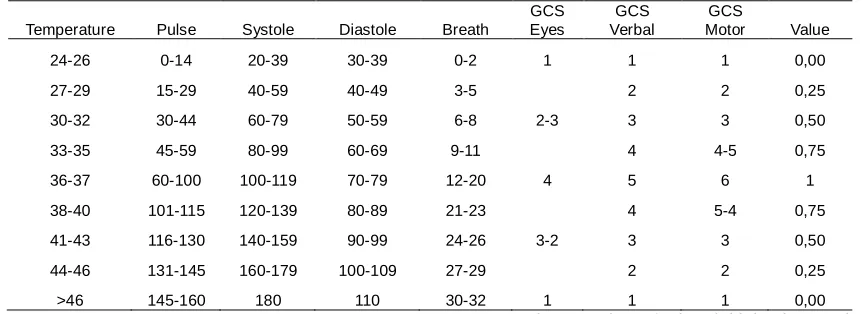
The next process is to change the input data for each type of triage into the values presented in table 2.
Table 2. List of Conversions in the Value of Each Triage Type
Temperature Pulse Systole Diastole Breath
GCS Eyes
GCS Verbal
GCS
Motor Value
24-26 0-14 20-39 30-39 0-2 1 1 1 0,00
27-29 15-29 40-59 40-49 3-5 2 2 0,25
30-32 30-44 60-79 50-59 6-8 2-3 3 3 0,50
33-35 45-59 80-99 60-69 9-11 4 4-5 0,75
36-37 60-100 100-119 70-79 12-20 4 5 6 1
38-40 101-115 120-139 80-89 21-23 4 5-4 0,75
41-43 116-130 140-159 90-99 24-26 3-2 3 3 0,50
44-46 131-145 160-179 100-109 27-29 2 2 0,25
>46 145-160 180 110 30-32 1 1 1 0,00
The next step is to normalize each triage data. In the system, there is one data that is used for comparison in finding the maximum normalization value for each type of triage. Ex amination data used for comparison can be seen in Figure 3.
From the results of the calculation process using the SAW method, the color category and priority scale are obtained. Then these results are compared with the results from the initial observation data. From these comparisons, the smallest priority scale will be searched to produce the color categories obtained from patient’s examination. At this stage, the results of a triage examination from the system will be matched with the results of a triage examination conducted by a doctor with a case study that can be seen in table 3. The final step is to
compare the results of the initial observations with the calculated results of the SAW method to find the smallest priority scale (verbal, eye, motor, breathing, temperature, pain scale, blood pressure, color results). Based on the results of trials of the entire test case conducted, it can be determined whether every function in the system has been running properly and as expected. In trials that have been carried out using 37 test cases, it can be concluded that every function in the system has been running well and there are no errors. These are the results of the system test evaluation:
1. Every function in the system has been connected to each other, both in the user section, access rights, room, patient, type of triage, color triage, examination, and the reports.
2. The system helps health workers who do not have much experience in determining patient emergencies.
3. The system can provide serial numbers that will later connect the patients’ data and the examination data. 4. The system helps to make reports on the number of
patients coming within a certain period and monitor the response time of each color classification.
From the results of the discussion of testing the system, the advantages and disadvantages of the system are obtained. The strength of the system is that it can help health workers who have no experience in determining emergencies to determine the emergency classification of each patient examined. In addition, the presence of response time reports can help monitoring the response time of each color classification whether it is according to standard or not. The weakness of this system is that there is no form to enter the examination data after the triage examination is done.
Tabel 3. The Calculation in Case Study
Name Observasi GCS
Eyes
GCS Verbal
GCS Motor
Pulse Breath Temper ature
Pain scale
Blood pressure
Color results
P-1 able to walk 4 5 6 98 20 37 2 131/91 Green
P-2 Able to walk 4 5 6 84 22 36.6 2 160/99 Green
P-3 Breath frequency above 30 KPM
4 5 6 120 30 38.9 4 110/70 Red
P-4 Able to do basic commands
4 5 6 80 20 36.7 4 130/70 Yellow
P-5 Breath frequency above 30 KPM
4 CONCLUSIONS
After the system planning, design, implementation and testing were analyzed, in making the Triage Decision Support System, it can be concluded as follows:
1. The system can handle patient data, room data, triage data, and color triage data
2. The system can handle the calculation of examination data into triage color classification
3. The system can generate reports of the number of patients entering the emergency room based on a certain time period and can produce a response time report to monitor the average response time in each triage color classification
REFERENCES
[1] Fry, M., and Burr, G., Current triage practice and influences affecting clinical decision-making in emergency departments in NSW. Australia, Accident and Emergency Nursing, 9, 4, 227–234 (2001)
[2] Gerdtz, M. F., and Bucknall, T. K., Triage nurses’ clinical decision making. An observational study of urgency assessment. Journal of Advanced Nursing, 35, 4, 550–561 (2001)
[3] Mirhaghi, A., Kooshiar, H., Esmaeili, H., and Ebrahimi, M., Outcomes for emergency severity index triage implementation in the emergency department. Journal of Clinical and Diagnostic Research, 9, 4, 4–7 ( 2015) [4] Olgers, T.J., Dijkstra, R.S., Drost-de Klerck, A.M., and
Maaten, J.C., The ABCDE primary assessment in the emergency department in medically ill patients: an observational pilot study. The Netherlands Journal of Medicine, 75, 3, 106-111 (2017)
[5] Troels, T., Niels, H. V. K., Erik, L. G., Claus, V. R., and Bo L., Initial assessment and treatment with the Airway, Breathing, Circulation, Disability, Exposure (ABCDE) approach. International Journal of General Medicine, 5, 117-121 (2012)
[6] Alireza, A., Majid, M. and Rosnah, M. Y., Simple Additive Weighting approach to Personnel Selection problem. International Journal of Innovation, Management and Technology, 1, 5, 511-515 (2010) [7] Dede, W. T. P., Adrian, A. P., Comparison Analysis of
Simple Additive Weighting (SAW) and Weigthed Product (WP) In Decision Support Systems. Proc. The 2nd International Conference on Technology, Innovation, Society and Science-to-Business, (2018)
[8] Karlitasari. L., Suhartini, D., and Benny., Comparison of simple additive weighting (SAW) and composite performance index (CPI) methods in employee remuneration determination. IOP Conf. Series: Materials Science and Engineering, IOP Publishing, (2017)
[9] Lazim, A., and Rabiatul, A.C.W., Simple Additive Weighting Methods of Multi criteria Decision Making and Applications: A Decade Review. International Journal of Information Processing and Management(IJIPM), 5, 1, 39-49 (2014)
[10] Power, D.J., Decision support systems: concepts and resources for managers. Westport, Conn., Quorum Books (2002)
[11] Tripathi, K. P., Decision Support System is a Tool for Making Better Decisions in The Organization. Indian
Journal of Computer Science and Engineering (IJCSE), 2,1, 112-117 (2011)
[12] Nastaran, G. K., and Masoome, M. H. S., Decision Support System (DSS), Singaporean Journal Of Business Economics, and Management Studies,1, 6, 95-102 (2013)
[13] Pressman, R. 2015. Software Engineering A Practitioner's Approach Seventh Edition . Yogyakarta: Andi
[14] Borgialli, D.A., Mahajan, P., Hoyle, J.D., Powell, E.C., Nadel, F.M., Tunik, M.G., Foerster, A., Dong, L., Miskin, M., Dayan, P.S., Holmes, J.F., and Kuppermann, N., Performance of the Pediatric Glasgow Coma Scale Score in the Evaluation of Children With Blunt Head Trauma. Pediatric Emergency Care Applied Research Network (PECARN), Acad Emerg Med, 23, 8, 78-84 (2016)