DESIGN OF PROBABILITY E-LKPD
ACCORDING TO PROBLEM BASED LEARNING
MODEL TO ENHANCE CREATIVE THINKING
SKILLS
Ahmad Asrori, Suparman
Abstract— Creative thinking skills are the skills needed in the present era, particularly in the industrial age 4.0 as it is today, with the powers of creative
thinking will facilitate students in solving problems in life. The purpose of this study was to design a probability material for PBL based teaching materials to enhance students' creative thinking skills. The purpose of this study was to develop the draft teaching materials for learners based on Problem Based Learning to improve the ability to think creatively to improve the skills of eighth-graders. This study using ADDIE development model which includes five phases: analysis, design, development, implementation, and evaluation. This study only reached the stage of design. The subjects were eighth-graders SMP Muhammadiyah Banguntapan. The object of this research is the students' characteristics, evaluation of instructional materials and curriculum. This research resulted in design analysis Worksheet learners consisting of the first part (cover, preface, table of contents, the instruction on the materials Worksheet learners, directions for use Worksheet learners, concept maps, core competence and basic competences), part content (learning activities using the steps in problem-Based learning, summary and evaluation) and final chapter (glossary and bibliography).
Index Terms— ADDIE, Creative thinking, E-LKPD, Problem-Based Learning.
—————————— ——————————
1 INTRODUCTION
One of the objectives of Education Indonesia is to develop a potential of students to talk, creative thinking, creative thinking, innovative; it is by the learning process contained in the curriculum of 2013, in which learning is implemented in an interactive, inspiring, fun and challenging for students and teacher. So it can be used to motivate students and actively participate in providing adequate space for students to bring up the students' creativity and independence according to their talents, interests, and physical and psychological development of studentsIn this globalization era, the possibility of students' thinking skills is very inclined towards creative thinking abilities of the students to solve mathematical problems related to everyday life so that the demands in mathematics education to generate ideas and new solutions in solving problems related to the problem.The aim of this study can be solved correctly. In mathematics, can be solved with the questions that are given and required creativity of the students to come up with new ideas that creativeCreative thinking is thinking about how to gain new knowledge, new approaches, a new angle, or a new way to understand something. The ability to think creatively also provides an opportunity for students to develop their full potential, such as interests and talents hidden [1], creativity level is still at a basic level [2] He assumes mathematics as a human activity and should be taught in sequence to be useful [3]Creative thinking is a mental process that involves the cognitive processes [4] reveals that innovative thinking is one of the high-level thinking skills are very important fordevelopment in the 21st century in mathematics is very difficult if there are no instrument skills that trigger century 21. In this research skills that will be improved is the ability to think creatively [5], Creative thinking will produce creative generation has the potential to solve social and environmental problems are complex. Creativity is two interactions including personal mental operations and motivational factors, personality traits mentioned are, science and the environment, social science and culture to form unique and useful concepts to solve a problem. Creativity is a process where problem-solving is done with creative thinking [6]. To achieve this learning objective, there should be a learning model that can facilitate the development of HOTS and character of students. One model of learning that may be recommended, in connection with the event, is a model of Problem-Based Learning (PBL) [7], PBL is a learning approach that includes constructivists with many advantages that still have problems for some students who have no interest in learning mathematics. The teacher needs to consider a potential student, and one possibility is intelligence.
The learning model Problem Based Learning (PBL) is innovative [8], Problem-based learning (PBL) has been applied for more than twenty years in various fields in Indonesia education in many countries. Problem-based learning is often understood only as a method [9].Kartika [10] said film star every individual have all capacities and intelligence by combining means. Gardner states that there are nine types of information, namely linguistics, music, logical-mathematical, spatial, kinesthetic, intrapersonal, interpersonal, naturalist, and existential. Thus it's called a lot of intelligence. The theory of multiple intelligences believes that each student is unique and has at least one intelligence. There is also a clear link between creativity and problem solving because when everyone should solve problems, creativity is activated when making the task [11].There are three essential aspects of creative thinking [12], Among which fluency, ————————————————
Ahmad Asrori is currently pursuing master’s degree program in mathematics education at Ahmad Dahlan University, Indonesia, PH-+6289514758955. E-mail: [email protected]
flexibility, and the novelty/originality. Aspects of fluency can be seen from the students' ability in determining the answers were varied and true. Aspects of flexibility can be seen from the student's ability to answer the problem in a different way. Aspects novelty/originality can be seen from the students' ability in responding to problems with some answers that are not usually done by the students.Thinking is an activity experienced by someone when dealing with a problem or a related situation must be resolved. reveals there are some common sense thinking: (1) reflection is a process involved in mental operations such as induction, deduction, clarification and reasoning, (2) thought is a symbolic representation process (through language) various objects and real events that are used to find a symbolic representation of very important principles. (3) thinking is the ability to analyze creatively and make generalizations [13], problem-based learning is rooted in the social constructivist view of education if knowledge is socially constructed and mediated by language and interaction under the guidance of a facilitator [14], the thought process that not only memorize and reiterated the information already known. Therefore, the ability to think creatively, including high-level thinking skills [15]. Creative thinking is thinking how to gain new knowledge, new approaches, new angle, or a new way to understand something. The ability to think creatively also provides an opportunity for students to develop their full potential, such as interests and talents hidden. With the ability to think creatively indirectly familiar students generate new ideas that will be able to make them successful. But in fact, the creative thinking skills of students in the learning of mathematics is still unexplored wellStudents' creative thinking abilities are different from one another and require learning conditions that involve experience in the learner so that the potential for creative thinking can develop. All students with different academic abilities can develop their creative thinking skills if the learning environment provides opportunities for the development of this thinking skills [16]; Yusnaeni in [17] said stated that the learning environment is a necessary resource for creative thinking.The medium of learning in the learning process also greatly assist learners and teaching media in the form of Worksheet Students (E-E-LKPD) means for students to help understand and learn the material and can be studied independently and E-E-LKPD as the most effective media in learning because it is a medium which is very simpleWhen the principles and processes of Problem Based Learning (PBL) is checked, it became clear that the learning strategy to actualize the elements as proposed by Cole, Sugioka, and Yamagata-Lynch. PBL embodies the principle of learning based on starting when students are driven by as a group to find solutions to real-world problems [18], This has affected the effective learning at all educational levels. Education faces many challenges in terms of the performance of students, especially in mathematics and this is as a result of the introduction of new topics into the curriculum that teachers find difficult to teachSurya [19] said There are four steps in solving problems, namely: (1) understand the problem: in this activity is to formulate: what is known, what is being asked, whether the information is sufficient, condition (condition) must be met, restate the original problem in a more operational (solvable). (2) planning the solution: the activities carried out in this step
is trying to find or remember the problems you have completed it has in common with the property that will be solved, look for patterns or rules, arrange settlement procedures. (3) to implement the activities plan in this step is a procedure that has been created in the previous step to completion. (4) to re-examine the procedures and results of the settlement:Yuniza in [20] said PBL influence on the approach to creative thinking skills through problem-based learning, pedagogy and classroom practice techniques. These findings reveal that excessive student creativity is marked by originality and smoothness. Students who score high on originality demonstrated the ability to generate ideas that are unpredictable, while students who score high on fluent showed the ability to produce a large number of ideas in response to problem-solving situations. However, the flexibility score indicates that most students are not flexible in their approach in relation to learning and acquiring knowledge. The main purpose of the PBL approach is to provide the construction of knowledge, to improve students' problem-solving skills [21], Problem-based learning (PBL) is a student-centered pedagogy where learning is done through problem-solving That PBL goal is to help students develop flexible knowledge, effective problem-solving skills, intrinsic motivation, collaborative and independent learning [22] Many students are unsure what to think as a destination for learning and education, and thus the question, which requires thinking, very challenging. In the modern world, to improve the capacity of students in problem-solving and creative thinking are presented as the purpose of education in all fields [23]Indonesia general ability to think creatively curriculum requires students to produce and evaluate knowledge, clarify concepts, look for the possibilities, consider alternatives and resolve the problem. In a national collaboration with the goal of education has developed a continuum of learning the skills of creative thinking, throughout the curriculum, so that students can meet to become learners confident and independent [24]
thinking skills believed to be positively associated with academic achievement [25], The diversity of the student intelligence does not mean that teachers should do Learning activities of individuals, but the different types of intelligence students have to be used as capital for teachers to develop teaching methods and developing tools to facilitate student learning through a variety of intelligence that is only possessed by students. Zetriuslita in [26] said it has the following benefits:
1) Motivation PBL make students feel in learning because they are programmed to respond to dissonance and because they feel empowered to have an impact on the results of an investigation
2) Relevance and Context PBL offers students a clear answer to the questions, "Why do we need to learn this information?" and "What am I doing in school have to do with anything in the real world?"
3) Higher-Order Thinking Scenarios ill-structured problem calls so creative and creative thinking of suspending a guessing game of "What is the right answer the teacher wanted me to find?"
4) Learning How to Learn PBL promotes metacognition and independent learning by asking students to produce their own strategies for problem definition, information gathering, data analysis, and the development and testing of hypotheses, comparing with these strategies for and sharing with students and other mentors strategy.
In the context described above, Problem Based Learning can be considered, even a priori, efficient modalities through which the students can be helped to acquire basic competencies in science, and in the field or other curricular fields. Research carried out in recent years underlines once again the fact that the traditional teaching (sometimes by excessive dispositive method) produces passivity among students, which "placed" in hypostasis become mere consumers of knowledge that has been made, they alone. The effort is to recognize, memorize them (often by mechanical means) and then reproduce them in the context of evaluative [27].
2
RESEARCH
METHOD
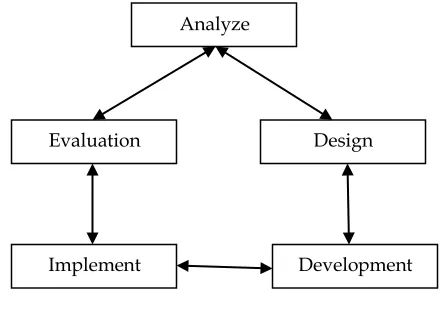
Type of research is the development of research. Products that will be developed in this research is to improve the creative thinking skills of students in eighth grade, which is designing the E-E-LKPD based on Problem Based Learning (PBL).ADDIE Model directs research on the optimization of the process for measuring the measurable results [28], Research and development methods that use Analysis, Design, Development, Implementation, and Evaluation of the model (ADDIE) [29]The research model using ADDIE development model which includes five phases: analysis, design, development, implementation, and evaluation. Analysis of data using Miles and Huberman consisting of data reduction, appearance, and conclusions. The subject of research including eighth-grade students of SMP Muhammadiyah Banguntapan object of this research is the students' characteristics, evaluation of instructional materials and curriculum. Instruments to collect data using manual observation, interview, and questionnaire. Guidelines for observation was conducted to determine the learning process
with the curriculum and the students' characteristics. That interview guide is used to retrieve data about resource evaluation of teaching materials. Stages of development in this case study can be seen in
Figure 1. This study has been carried out through the design phase
Figure 1. Stages ADDIE
3 RESULTS
AND
DISCUSSION
3.1. Stages of Analysis
This research study to find the effect of PBL in mathematics high school students reasoning ability in whole or in accordance with the previous mathematical ability (high, medium, and low). Theoretically, this research contribute to and enrich the educational domain of mathematics, especially the extent to which PBL strong force and to help students develop their reasoning skills. Practically, this research proposes a constructivism-based teaching model in order to build habits and skills in high-level thinking [30].To determine the appropriate teaching material with the characteristics required of students as well as students, to develop students' creative thinking ability in mathematics. Starting with the analysis of problems in the classroom, curriculum analysis, analysis of learning resources, analysis of student characteristics and analysis of student difficulties during the learning of mathematics. Based on interviews with teachers of math class VIII in SMP Muhammadiyah Banguntapan, the teacher said that the conventional learning which until now are still dominant applied in class, It is also expressed by some students of SMP Muhammadiyah Banguntapan, students lazy to learn math because they feel pay attention to the teacher bored with conventional learning,
a. Analysis of Curriculum
Analyzing the curriculum aims to determine whether the material taught in accordance with the expected competencies. The purpose of learning is the attainment of behavioural changes in learners after participating in learning activities. The learning objectives are formulated based on basic competence (KD) specific. Based on interviews with teachers efficacy Math class VIII, learning
Evaluation
Analyze
Design
resources used in schools in accordance with the Competency Standards (SK), Core Competence (KI), and the Basic Competency (KD) on the Curriculum 2013, which comes directly from the government, the handbook for teacher and student.
b. Analysis of Learning Resources
Based on interviews with teachers efficacy Mathematics VIII class learning resources used by teachers during the learning process in the form of textbooks and worksheets, learning resources that exist not facilitate students to think creative, so teachers need of teaching materials to train the ability to think Creative students, learning need for a device in the form of teaching materials by using problem-based learning (PBL) While the results of interviews with students.
c. Analysis of Student Characteristic
Some students are still lacking in readiness to learn, but most students can attend a conducive learning process, only a few students who take an active role in answering questions from the teacher. But some students are less enthusiastic about participating in math. As teachers provide sample questions, seen some students do not pay attention to lessons delivered by teachers, so students cannot understand the material very well for him to confuse and when the teacher gives matter, some students jump right without waiting for orders from the teacher, and not a few others students who prefer not to work on the matter. In the discussion of the matter, the teacher provides the opportunity for students to ask questions, but only a few students who want to ask, many students who prefer to discuss and asked his friend, and there are also students who prefer silent and did not ask at all. By the time the teacher tries to get students to work on the problems in front of the exact same as exemplary, students cannot do the problem because in the beginning students do not pay attention to what has been delivered by the teacher.
Students are still difficulties in applying the formula that has been studied to solve a problem. Students are difficult to understand the material presented by the teacher because of a lack of understanding on the concept of the material. This resulted in students not being able to know and understand the given problem, students are not able to make a precise model of problem solving, students are not able to use the right strategy to solve the problems, and students cannot provide proper conclusion to these problems. Therefore, Problem-based learning is a method that presents a real problem. it takes a learning device, such E-LKPD,
3.2. Student Cover
The authors designed an LKPD design composed of cover, preface, table of contents, until the bibliography. Preparation of LKPD design is based on the aspect of indicators to facilitate and validity. In addition, the formulation LKPD design is based on the results of a needs analysis has been done. Here is the cover design can be seen in Figure 2
Figure 2. Cover Design
Microsoft cover image created by this Word made as attractive as possible to prepare students to be motivated to use a worksheet developed.
3.3. Preference
The introduction contains a statement of thanks to those who helped complete the student worksheet. Introduction can be seen in Figure 3
Figure 3. Introduction
3.4. Concept Map
Concept maps consist of mapping material will learn map concept can be seen in Figure 4
Figure 4. Map Concept
3.5. Basic Competencies (KD) and Core Competencies
KD and KI provides an indicator of what is to be achieved students. Basic Competence student worksheet (KD) and Core Competence (KI) can be seen in Figure 5
Figure 5. Syllabus
3.6. Learning Activities Based on Problem-Based
Learning
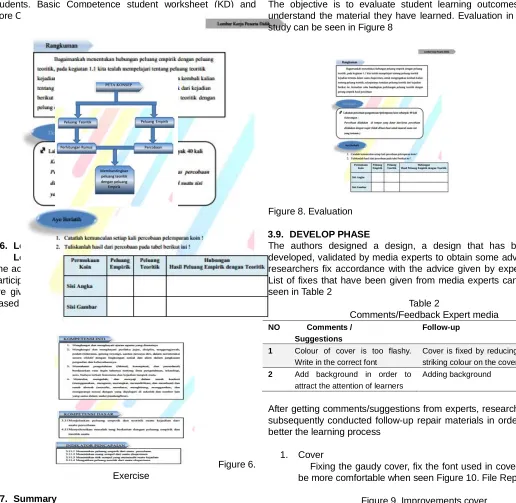
The activities contain exercises and practice questions so that participant students can understand the material. Examples are given problem in accordance with the steps of Problem Based Learning
Figure 6. Exercise
3.7. Summary
Summary briefly summed material Summary probability can be seen in Figure 7.
Figure 7. Summary
3.8. Evaluation
The objective is to evaluate student learning outcomes to understand the material they have learned. Evaluation in this study can be seen in Figure 8
Figure 8. Evaluation
3.9. DEVELOP PHASE
The authors designed a design, a design that has been developed, validated by media experts to obtain some advice, researchers fix accordance with the advice given by experts. List of fixes that have been given from media experts can be seen in Table 2
Table 2
Comments/Feedback Expert media
NO Comments / Suggestions
Follow-up 1 Colour of cover is too flashy.
Write in the correct font
Cover is fixed by reducing the striking colour on the cover
2 Add background in order to attract the attention of learners
Adding background
After getting comments/suggestions from experts, researchers subsequently conducted follow-up repair materials in order to better the learning process
1. Cover
Fixing the gaudy cover, fix the font used in cover, to be more comfortable when seen Figure 10. File Repair
2. Background
Fixing the background to look attractive. Figure 10. Shows the background repai
Figure 10. Background Fix
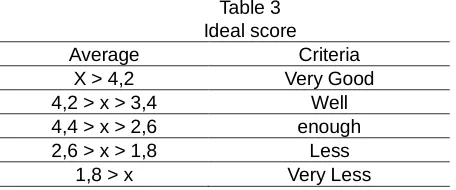
The research data obtained is converted into a qualitative value by comparing the scores of media experts with the ideal score is calculated using the provisions in Table 3:
Table 3 Ideal score
Average Criteria
X > 4,2 Very Good
4,2 > x > 3,4 Well 4,4 > x > 2,6 enough 2,6 > x > 1,8 Less
1,8 > x Very Less
Formation of a sequence of learning media and in terms of development indicators of achievement of competencies include a description, by the standards of student worksheets issued by the Ministry of Education, student worksheets integrating indicators to build understanding, and contain Steps Guided problem-based learning. design of the instrument used to measure the performance of products have been developed. There validation experts, media validation, and testing. In the validation phase of experts, the assessment is conducted to determine the validity of the developed design worksheets. Students have an existing worksheet design has been approved by the supervisor then validated by a validator, the teacher. Design validation worksheets students use assessment instruments that have been reviewed by the teacher in class VIII, Supriyadi and Master Class VIII, Muh. Rizki after a valid instrument can be used by experts of material and media experts to assess the students' worksheets were developed. Here is some feedback and advice from subject matter experts are summarized in the Table 4.
Table 4
Assessment Questionnaire
Based on the results that have been obtained can be seen that the teaching materials to be eligible to obtain an average value of 4.35 with the criteria very well.
4 CONCLUSION
Based on a study on the needs analysis can be concluded that: creative thinking abilities of students still in the low category, students are still difficulties in applying the formula that has been studied to solve a problem, students need instructional materials math according to the characteristics of students, teachers and students need instructional materials math which can improve the ability of creative thinking of students, teachers and students need instructional materials in the form of E-LKPD as it relates to solving real problems
ACKNOWLEDGMENT
To improve creative thinking skills eighth graders can be done by developing Based Problem Based Learning Worksheet. This research can be developed to the stage of development, implementation and evaluation so as to determine the appropriateness and effectiveness of the worksheet in the learning process
REFERENCES
[1] M. Kahveci and M. Orgill, ―A ective Dimensions in Chemistry Education.‖
[2] M. N. Pratiwi and Suparman, ―Mathematical module design to improve creative thinking skills based on problem-based learning,‖ Int. J. Sci. Technol. Res., vol. 8, no. 10, pp. 3380–3384, 2019.
[3] N. L. Fitri and Suparman, ―Designing worksheet using the context of sugarcane,‖ Int. J. Sci. Technol. Res., vol. 8, no. 10, pp. 3369–3372, 2019.
[4] A. Duran Corebima, ―Creative Thinking of Low Academic Student Undergoing Search Solve Create and Share Learning Integrated with Metacognitive Strategy,‖ 2017.
[5] L. F. Nuari and Suparman, ―Designing worksheets for the mentally retarded student in multiplication operations,‖ Int. J. Sci. Technol. Res., vol. 8, no. 10, pp. 3579–3584, 2019.
[6] C. S. Lin and R. Y. W. Wu, ―Effects of Web-Based creative thinking teaching on students’ creativity and learning outcome,‖ Eurasia J. Math. Sci. Technol. Educ., vol. 12, no. 6, pp. 1675–1684, Jun. 2016. [7] G. Gorghiu, L. M. Drăghicescu, S. Cristea, A.-M.
No Name Position Score Critera
Quantitative Data
1 Muh. Rizki Math
Teacher
4,3 Very Good
2 Supriyadi Math
Teacher
4,4 Very Good
Petrescu, and L. M. Gorghiu, ―Problem-based Learning - An Efficient Learning Strategy in the Science Lessons Context,‖ Procedia - Soc. Behav. Sci., vol. 191, pp. 1865–1870, Jun. 2015.
[8] M. Faulina and Suparman, ―Design guided discovery student worksheets to construct the understanding of the blind,‖ Int. J. Sci. Technol. Res., vol. 8, no. 10, pp. 3385–3389, 2019.
[9] E. Supriyadi and Suparman, ―Design problem based student worksheet to improve student problem solving abilities Indonesia,‖ Int. J. Sci. Technol. Res., vol. 8, no. 10, pp. 3064–3069, 2019.
[10] A. Kartikasari and D. B. Widjajanti, ―The Effectiveness of Problem-Based Learning Approach Based on Multiple Intelligences in Terms of Student’s Achievement, Mathematical Connection Ability, and Self-Esteem,‖ in Journal of Physics: Conference Series, 2017, vol. 812, no. 1.
[11] M. F. Ayllón, I. A. Gómez, and J. Ballesta-Claver, ―Pensamiento matemático y creatividad a través de la invención y resolución de problemas matemáticos,‖ Propósitos y Represent., vol. 4, no. 1, Apr. 2016. [12] T. Y. E. Siswono, ―Level of student’s creative thinking
in classroom mathematics,‖ Educ. Res. Rev., vol. 6, no. 7, pp. 548–553, 2011.
[13] A. U. Hidayati and H. Retnawati, Effectiveness Problem Based Learning And Scientific Approach To Improve Higher Order Thinking Skills., Proceeding Of 3 Rd International Conference On Research, Implementation And Education Of Mathematics And Science Yogyakarta
[14] A. P. Rehmat, ―Engineering the Path to Higher-Order Thinking in Elementary Education: A Problem-Based Learning Approach for STEM Integration Repository Citation,‖ 2015.
[15] R. R. Sihaloho, S. Sahyar, and E. M. Ginting, ―The Effect of Problem Based Learning (PBL) Model toward Student’s Creative Thinking and Problem Solving Ability in Senior High School,‖ IOSR J. Res. Method Educ., vol. 07, no. 04, pp. 11–18, 2017. [16] R. Widyatiningtyas, Y. S. Kusumah, U. Sumarmo, and
J. Sabandar, ―The impact of problem-based learning approach tosenior high school students’ mathematics critical thinking ability,‖ J. Math. Educ., vol. 6, no. 2, pp. 30–38, 2015.
[17] Y. Yusnaeni, A. D. Corebima, H. Susilo, and S. Zubaidah, ―Creative thinking of low academic student undergoing search solve create and share learning integrated with metacognitive strategy,‖ 2017.
[18] I. Junaedi, A. Suyitno, E. Sugiharti, and C. K. Eng, ―Disclosure Causes of Students Error in Resolving Discrete Mathematics Problems Based on NEA as A Means of Enhancing Creativity,‖ Int. J. Educ., vol. 7, no. 4, p. 31, Dec. 2015.
[19] E. Surya and E. Syahputra, ―Improving High-Level Thinking Skills by Development of Learning PBL Approach on the Learning Mathematics for Senior High School Students,‖ Int. Educ. Stud., vol. 10, no. 8,
p. 12, Jul. 2017.
[20] C. Yuniza Eviyanti, E. Surya, E. Syahputra, and M. Simbolon, ―Improving the Students’ Mathematical Problem Solving Ability by Applying Problem Based Learning Model in VII Grade at SMPN 1 Banda Aceh Indonesia.‖
[21] J. A. Orozco and R. T. Yangco, ―Problem-Based Learning: Effects on Thinking Skills in Biology Problem-Based Learning: Effects on Critical and Creative Thinking Skills in Biology,‖ 2016.
[22] L. Tarhan and Y. Ayyildiz, ―The views of undergraduates about problem-based learning applications in a biochemistry course,‖ J. Biol. Educ., vol. 49, no. 2, pp. 116–126, Apr. 2015.
[23] A. B. Abubakar and M. Y. Arshad, ―Collaborative learning and skills of problem-based learning: A case of Nigerian secondary schools chemistry students,‖ Asian Soc. Sci., vol. 11, no. 27, pp. 53–62, Dec. 2015. [24] B. B. Yazar Soyadı, ―Creative and Critical Thinking Skills in Problem-based Learning Environments,‖ J. Gift. Educ. Creat., vol. 2, no. 2, pp. 71–71, Dec. 2015. [25] S. Sanders, ―Critical and Creative Thinkers in
Mathematics Classrooms,‖ 2016.
[26] Z. Zetriuslita, W. Wahyudin, and J. Jarnawi, ―Mathematical Critical Thinking and Curiosity Attitude in Problem Based Learning and Cognitive Conflict Strategy: A Study in Number Theory course,‖ Int. Educ. Stud., vol. 10, no. 7, p. 65, Jun. 2017.
[27] E. Apino and H. Retnawati, ―Developing Instructional Design to Improve Mathematical Higher Order Thinking Skills of Students,‖ in Journal of Physics: Conference Series, 2017, vol. 812, no. 1.
[28] S. com Suhendri and suparman@pmat uad ac id Suparman, ―Development mathematics modules based on guided discovery learning to improve creativity skills of blind students,‖ Int. J. Sci. Technol. Res., vol. 8, no. 10, pp. 1169–1173, 2019.
[29] S. Solihati and Suparman, ―Design of mathematics module development based on pmri to improve critical thinking ability students of class viii junior high school in indonesia,‖ Int. J. Sci. Technol. Res., vol. 8, no. 10, pp. 3373–3379, 2019.