Palladium-Hydrogen
System
STRUCWRES
NEAR
PHASE
TRANSITION
AND
CRITICAL
POEW!3
By
E
A.
Lewis
School of Chemistry, The Queen's University of Belfast
A wide ranging survey is presented updating information and opinions on the correlations which occur between structural change and hydrogen pressure-hydro- gen content-temperature ( p - c ( n )
-
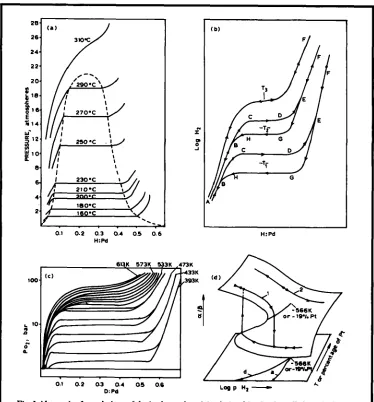
T ) relationships in the palladium-hydrogen and other related systems. Particular attention is directed to problems of the estimation and definition of the limits of composition over the a t;,p p h a s e transition region and near to designated critical points.The representation of temperature dependent forms of the families of hydrogen pressure-com- position (p-c(n)) isotherms of the palladium- hydrogen system is still quite commonly shown by the diagram in Figure 1 (a), which is a result of important and gradual systematic develop- ment of relevant information obtained by Sieverts and colleagues (1). In a sense, this Figure is a consolidating point in the develop- ment of such diagrammatic representations, after a period of improvements in basically sim- ilar outlines (2-5). The outlines were produced quite soon after the initial observations of the substantial absorption (occlusion) of hydro- gen by palladium, without it destroying the essentially metallic characteristics of the face centred cubic (f.c.c.) palladium matrix (2-6).
The p-c(n)-T Diagram: Experimental
Advantages and Developments
The quite comprehensive form of the rela- tionship shown in Figure 1 (a) often appears in textbooks as a representation of the palla- dium-hydrogen system and of other systems which exhibit non-stoichiometric characteris- tics (7).
The preferential development of relative com- prehensiveness for the particular case of the pal- ladium-hydrogen system, Figure l (a), proba- bly results from the conveniently accessible experimental ranges of temperature (- 160 to 3 1 O O C ) and hydrogen pressures (- 1 to 35 atmos- pheres) needed to cover the whole of the data
in the Figure. Also experimentally attractive were the generally quite reasonable times required to reach equilibria under various hydro- gen pressures. Ready equilibration resulted from high values for the coefficients of hydrogen dif- fusion (2-12) combined with acceptable effi- ciencies for the surface catalysis at compara- tively low temperatures.
However, during the ensuing time interval up to the present, there have been considerable extensions to the range of data in Figure 1 (a) in regard to higher and lower ranges of both tem- perature and equilibrium hydrogen pressure. For general descriptive convenience, however, the diagrammatic representation of p-c(n) rela- tionships shown in Figure 1 (a) has continued to be a commonly utilised background illus- tration (2-7).
Amplification of Information
on
the
p-c(n)-T and Allied Relationships
In addition to accompanying the general improvement in experimental techniques, the extended scope of the p-c(n)-T relationships has been increasingly co-ordinated with com- plementary measurements of other physical and structural parameters and with information on specimen characteristics: including geometric forms, surface:volume ratios and surface cat- alytic activities.
Significant consolidation has been made with compatible results of the p-c(n) relationships, derived from thermodynamically equivalent
26
2 4
22
0.1 0.2 0.3 0 4 0.5 0.6
H:W
H:Pd
Fig. 1 Alternative formulations of the isothermal p-c(n) relationship for the palladium-hydrogen
system; (a) after Ref. (1); (b) after Ref. (2); (c) after Refs. (31) and (32); and (d) after Ref. (42)
components found from potentials measured by electrodes (2, 5). Hydrogen contents have continued to be represented in various ways; but they seem most unambiguous when denoted by the atomic ratio hydrogen:palladium, gen- erally synonymous with the commonly used symbols, n (2, 3, 13) or the alternatives r (1 4, 15% p (15, 16) or c ( 17, 18).
A generalising factor of structural importance has been acceptance of the findings, fkom neu- tron scattering (19) and channelling (20) tech-
niques, that the hydrogen entities which expand the lattice, occupy preferentially the octahedral interstices of the f.c.c. palladium lattice.
Hysteresis
A central and basic elaboration to the p-c(n) relationship of Figure 1 (a) has been the early observed discovery (1-6) that, at temperatures below about 3 1 O"C, plots of the results form a "hysteresis loop". The shape of the loops, shown in Figure 1 (b), is dependent upon whether the
respective measurements have been made by a succession of increases (absorption) in, or decreases (desorption) in, hydrogen content. Such regions of hysteresis are paralleled by anal- ogous hysteretic differences in plots of hydro- gen content and lattice parameters (2,2 l), and also hydrogen content and various physical parameters, such as electrical resistivity (2,22, 23) and magnetic susceptibility (2, 3, 24).
As
Figure 1 (b) indicates, the extent of the hys- teretic differences formally decreases in mag- nitude with increasing isothermal temperature. This is shown by sequence: TI+
T,
+
T3 whereT3 represents a formally denoted critical tem- perature T,(a,
p)
above which absorption and des- orption relationships involving pressure or other parameters ostensibly seem to be coincident.Comments on Figures l(a) and l(b) In commonly accepted correlations of the main features in Figures 1 (a) and 1 (b) the initial "reversible" lower hydrogen content p-c(n) regions, such as AB in Figure 1 (b), are regarded as corresponding to areas where the solid solu- tion of hydrogen occupies octahedral intersti- tial positions in the f.c.c. lattice (for example References 1-10, and 13-22). The ranges of hysteretic irreversibility diagrammatically rep- resented by BCDEFGH in Figure 1 @), have generally been associated with regions of coex- istence (transition) of a-phase and
p
(a')phase hydride structures.Finally, formally reversible p-c(n) regions, such as EF in Figure 1 (b), (with higher hydrogen con- tents than those where the hysteresis loops are closed, at points such as
E)
have been associ- ated with regions where the solid solution of hydrogen occupies the residual octahedral inter- stices (which could be regarded as in a defective sodium chloride lattice) up to values of n-
1.0 that may be attained (at 25°C) in equilibrium with very high hydrogen pressures (2, 25).Phase Regions of Apparent
Reversibility of p-c(n) Relationships
If it may be assumed that the influence of sub-surface hydrides and lattice defects (2, 3, 5) can be neglected and if bulk lattice palladiumhydride is regarded as a point of reference, then regions such as
AB
in Figure 1 (b) may be broadly defined as ranges where Sieverts' Law applies:n = constant x dp
Extrapolations of t h i s form of relationship have been employed to estimate upper limits of these regions, which are conventionally defined as oa,
(2, 3).
Up to these formal a-phase limits a measure of effective overall reversibility in the physical properties of the specimens, over numerous hydrogen absorption and desorption cycles, has been shown in the course of work on elec- trolytic hydrogen isotope diffusion, separation and exchange (2, 9, 26).
Interpretations
of Hysteresis
Since the early recognition of such hysteresis phenomena (1, 2, 3-5, 14, 27-29) there has been substantial additional information (2, 3, 5,30-32) about the limitsof the hysteresis loops, about estimates of values of the associated crit- ical temperatures and about variations in the geometric and particulate forms of the palla- dium sample.
There have also been ongoing discussions as to whether measurements taken during a hys- teresis loop have corresponded to conditions of thermodynamic equilibrium.
In principle, when both a- and p-phase hydrides are present the corresponding hydro- gen pressure during the phase transition is expected to remain invariant, from considera- tion of the Gibbs Phase Rule in the form:
F = C + 2 - P
corresponding to only one permitted degree of freedom, F, in conditions of 2 components C and 3 phases P.
Universal Thermodynamic
Equilibrium Viewpoint
Nevertheless, Ubbelohde argued quite early on (33), after considering the available relevant experimental results (1, 2), that from a ther- modynamic standpoint it was jusaed to regard the hysteresis phenomena in palladium-hydrogen
and allied condensed phase systems by a mod- ified form of the Phase Rule:
F = C + 2 - P + h
where 21 represents a thermodynamically per- mitted inclusion of terms appropriate to involved factors, such as elastic strain conditions and par- ticle size. Such an extension of the Phase Rule would allow possibilities for establishing true thermodynamic equilibrium within a wide range of experimental conditions, including each sec- tion of the hysteresis loops.
This extended perspective is consistent, for example, with measurements of electrode poten- tial E, hydrogen pressure p and relative elec- mcal resistance
R&
recorded together during formulations of p-c(n) (1-3,22-30,27,30-32),E-n (2,22,23,34) and of important associated W%-n relationships, being independent of the length of the equilibration times. These inter- relationships all can exhibit substantial hysteretic differences between the absorption and des- orption data, including the strikingly clear find- ings of “hydrogen content shut-in“ effects (34).
Statistical Thermodynamic
Approach
Explanation based on an extended Phase Rule have since, however, been largely discounted, in preference to the arguments of a statistical ther- modynamical analysis (14, 27) in which both absorption and desorption p-c(n) isotherms have been regarded as representing conditions of merely quasi-equilibrium. Limitations to establishing effective states of thermodynamic equilibria for either the absorption or desorption isotherms also seem to have been accepted in analyses of recent hysteresis studies where it has been broadly advanced that the hysteretic Merences are largely associated with irreversible processes of fissur- ing and deformation resulting from the genera- tion of complex dislocation networks ( 5 2 8 ) .
Current
Interest
in Hysteresis Energetics
Irreversible dissipation of energy is certainly involved in the deformation and fissuring of specimens. This factor does, however, repre-
sent a different effective variable from the more elastically reversible factors, such as those asso- ciated with the structure differences between regions with the same total hydrogen content but different combinations of precise structural compositions (22).
A quite recent appreciation of Ubbelohde’s approach to the problem by Baranowski has seemed, however, to provide an initiative for a more quantitative form of analysis (29), based on associating hysteresis with calculations of energetic differences which complement the stresses produced by the hydrogen.
Gorsky Effect Involvements
in Hydrogen Systems
This more recent energetically-centred approach (29) has encouraged a rather similar explanation, based on a strain gradient differ- ence factor, which is related to interpretations of Uphill Effect studies of hydrogen permeation along lines of strain, that involve the intersti- tial diffusion mechanism introduced earlier by Gorsky (35).
Thus, for absorption isotherms during the course of the a
-+
P
phase transitions, supple- mentary energy components may be necessary to override the addition of stress energy equiv- alents to strain gradients between a-phase regions of low hydrogen content and substan- tially more expanded P-phase regions (2-5).Hysteretic differences which have been found for the p-c(n) desorption isotherms may then be attributed to a reduced influence from the strain gradient in the
P
+
a phase transition region, and lower desorption hydrogen content in the P-phase component domains during the desorption cycle, at the same overall hydrogen content (22).Substantial experimental evidence of the influ- ence and complex operation of strain gradient participation, has recently been obtained from hydrogen diffusion processes occurring within a and a
+
P
phase hydride compositions of pal- ladium membranes (10, 26-39).The increasing interest and quite quantitative information now available on stress and strain factor participation in hydrogen interstitial
thermodynamics (10,29,35-39) has appeared to support Ubbelohde's essential hypothesis that, in principle, all sections of hysteresis loops can represent points of establishment of thermody- namic equilibrium (33).
Relationships "Supercritical"
toApparent Hysteresis Elimination
Over latter years, Wicke and colleagues have presented several series of reports of detailed absorption and desorption p-c(n) isothermal relationships of both the palladium-hydrogen and palladium-deuterium systems (3, 24, 30-32). Detailed measurements of the depen- dence of magnetic susceptibility on the hydro- gen and deuterium contents have been reported in conjunction (3,24,31-32).
The example illustrated in Figure 1 (c), for the palladium-deuterium system (3 1,32) provides a clear demonstration of the gradual reductions, with increasing isothermal temperature, of the extent of the p-c(n) hysteresis loops. However, Figure 1 (c) also illustrates the strong persistence of very similar s-shaped forms of the relation- ship over a substantial range of temperatures, extending above a cited critical temperature TJa,
p)
of 556 K (283OC), that has been asso- ciated with an apparent total elimination of hys- teresis (31, 32).Somewhat analogous extended temperature ranges of p-c(n) isotherm plots bearing close similarity to critical forms have also been recorded in the p-c(n) relationship of several palladium alloy hydrogen systems. In these cases,
the range of supercritical temperatures of isotherms exhibiting pronounced stretches of s-shaped plots has been so prolonged as to sug- gest their alternative descriptions as regions of "quasi two-phase'' or "ghost-two-phase'' coex- istence (2, 22, 25).
Other attention has been drawn to an essen- tially analogous pattern of high temperature p-c(n) relationships in the palladium-hydrogen system, which had been considered in con- junction with the shape of the elecmcal resis- tivity hydrogen content (R&-n) relationships. These latter relationships were indicated to be only gradually modified from the forms char-
acteristic of well designated regions of a t)
p
phase transitions at lower temperatures (2,25, 40). Such combined evidences for extended supercritical p-c(n) region retentions of indi- cations of domain or quasi P-phase structures also would seem to fit in with current inter- pretations of the dependence of elastic energy dissipation (Q-') peaks on hydrogen content, in palladium-silver alloys, and of interpretations of similar trends in the R&-n relationships with alloy composition for both the palladium- silver-hydrogen and the palladium-gold- hydrogen systems (40, 4 1).
Catastrophe Theory Representations
It has been suggested (2, 42) that the reten- tion at higher temperatures of s-shaped regions above T,(a,p),
in combination with the hys- teretic differences between absorption and des- orption p-c(n) isotherms at lower temperatures, may be suitably accommodated and represented by a cusp catastrophe type of format, as illus- trated in Figure 1 (d).In Figure 1 (d) the ratio a$, of conmbutions from the a- and &phase hydride structures, has been adopted as the composition variable for which finite values continue to persist (curve 2) at temperatures higher than T,(a,
p),
-
566 K, for p-T relationships in the palladium-hydro- gen system, and also in comparison with an anal- ogous critical percentage at 25°C of approxi- mately 19 per cent platinum in the hydrogen pressure-percentage of platinum relationship of the palladium-platinum-hydrogen system (42).Extensions of Limits
of Hysteresis Loops
It was also established early (1, 22, 25) that boundaries of p-c(n) hysteresis loops, such as DEG and CBH in Figure l(b), extended beyond the limits of the more horizontally lin-
ear sections of the loops, as for example the CD and H G regions in the same Figure.
Further confirmation of the continuation of the loops (for instance the CBH region in Figure 1 (b)) has been provided by evidence, from X-ray lattice parameters, of the appearance of &phase structures at hydrogen contents and pressures
\y
5.73.i.p\, 2.79.Wt6.60V. Pt
0 2 4 -2 -i 0 ; o 0.5 I . ’
Log FUGACITY, bar n
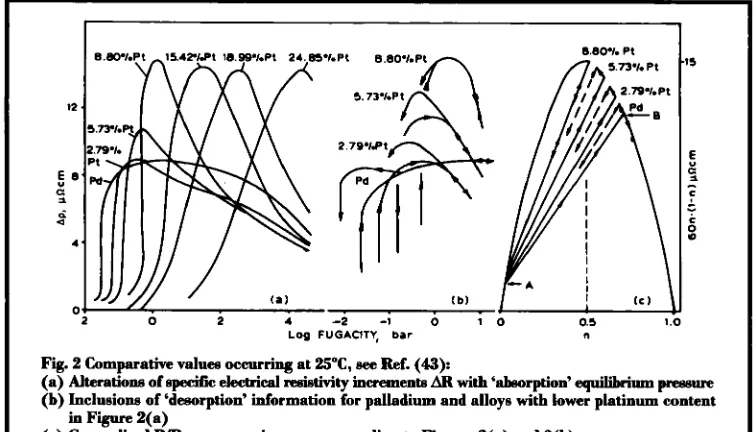
Fig. 2 Comparative valuee occurring at 25”C, see Ref. (43):
(a) Alterations of spedic e l d c a l resistivity increments AR with ‘aasOrption’ e q d b r h n prepawe
(b) Inclusions of ‘desorption’ information for palladium and alloys w i t h lower platinum content
(c) Generahsed m - n comparisons corresponding to F- 2(a) and 2(b)
in F y2(a)
in advance of their anticipated appearances (2, 21) over the main a t)
b phase transition region
(for example CD in Figure 1 (b)).
Complementary evidence was also obtained of a-phase spectral line appearances within regions (such as EG in Figure I@)) of higher hydrogen content and pressure than over the main linear regions of the t) a phase transi-
tion, for example GH in Figure 1 (b) (2 1). These phase relationship and crystallographic indi- cations of regions of hysteresis loop extensions also have appeared to be paralleled by seem- ingly analogous findings from electrical resis- tance measurements (22,23,34). Here features of desorption m - n relationships indicative of the nucleative emergence of a-phase regions have interconsistently appeared at hydrogen contents corresponding again to ranges of n (such as EG in Figure 1 (b)) higher than those of the main (for example GH in Figure 1 (b))
regions of the desorption transition.
Extension into Regions
of
Seeming
Reversibility
The importance of continuing the hysteretic differences into the more obviously extended regions of the hysteretic loops (represented by
regions CBH and DEG in Figure l(b)) has been further endorsed by an analysis of an extensive study of the phase relationships for the palladium-platinum-hydrogen system (25, 42). For this system, patterns of changes in the p-c(n) and the R&(AR)-n relationships with the content of platinum are partly illustrated in Figures 2(a) and 2(b).
An extension of the arguments, which are based upon the information represented in the diagram shown as Figure 1 (d), have recently produced explanations for the obvious hys- teretic features that are illustrated in Figure 2(b) (43).
In addition a computational analysis, which is based upon the proposition of extensions to the regions of coexistence of the a-phase and $-phase domain structures beyond the more generally accepted hysteresis limits, (and focused on the outline models of the cata- strophe theory that are shown in Figure 1 (d)), has been used to account for the p-c(n) rela- tionships of the palladium-hydrogen system, and then also to complementarily explain the forms of the relationships of the palladium-plat- inum-hydrogen system, which are illustrated in Figures 2(a) to 2(c) (43).
Refei
1 H. Briining and A. Sieverts, Z. Phys. Chem. A , 1933,163,409
2 See for example: F. A. Lewis, Flatinum Met& Rev.,
1960, 4, (4), 132; ibid., 1961, 5, (l), 21; “The Palladidydrogen System”, London, New York, Academic Press, 1967; Flatinurn M e d Rev., 1982, 26,20,70, 121; Z. Phys. Chem. Neue Folge, 1985, 146, 171; PureAppl. Chem., 1990,62,2091 3 E. Wicke, H. Brodowsky and H. Ziichner, Epics
Appl. Phys., 1978,29, 73
4 R. Lisser, Phys. Rev. B., 1984,29,4765; 2. Phys. Chem. Neue Folge, 1985, 143,23
5 T. B. Flanagan and W. A. Oates, Ann. Rev. Muter. Sci., 1991,21, 269
6 T. B. Flanagan and Y. Sakamoto, Platinum Metals Rev., 1993, 37, (l), 26; Int. J. Hydrogen Energy, 1994,19,15 1
7 See, for example, R. Burch and F. A. Lewis,
Platinum MetalsRev., 1971, 15, (l), 21 8 J. Volkl and G. Alefeld, “Hydrogen in Metals” I,
Springer, Berlin, 1978, p.321
9 R. V. Bucur, Scr. Metall. Muter., 1993, 29, 457 10 F. A. Lewis, X. Q. Tong, K. Kandasamy, R. V. Bucur and Y. Sakamoto, Thermochim. Acta, 1993, 218,57
1 1 J. Cermak, A. Kufudakis and F. A. Lewis, 2. Phys. Chem., 1993,181, 233
12 F. A. Lewis, S. G. McKee and R.-A. McNicholl,
2. Phys. Chem., 1993, 179, 63
13 G. J. Zimmermann, J. Less-Common Met., 1976, 49,49
14 J. R. Lacher, Proc. Roy. SOC. A , 1937,161, 525 15 Y. de Ribaupierre and F. D. Manchester, J. Phys.
C, Solid State Phys., 1974, 7 , 2126, 2140; ibid., 1975,8,1339
16 F. D. Manchester,J. Less-Common Met., 1916, 49, 1
17 S. Dietrich and H. Wagner, 2. Phys. B , 1979, 36, 121
18 R. Feenstra, R. Griessen and D. G. de Groot, J.
Phys. E Metal Phys., 1986, 16, 1933
19 K. Sklod and G. Nelin, J. Phys. C h . Solids, 1967, 28,2369
20 H. D. Carstanjen, J. Dunstl, G. Lob1 and G. Sizmann, Phys. Status Solidi a, 1978,46, 529 21 P. Wright, Proc. Phys. SOC., 1950, 56, 52
rences
22 F. A. Lewis, W. D. McFall and T. C. Witherspoon,
Z . Phys. Chem. Neue Folge, 1973, 84, 31; ibid., 1979,114,239
23 R.-A. McNicholl and F. A. Lewis, Z. Phys. Chem., 1993,181,239
24 H. Frieske and E. Wicke, Ber. Bunsenges, Phys. Chem., 1973, 71,48
25 B. Baranowski, F. A. Lewis, S. Majchrzak and
R. WiSniewski, J. Chem. SOC., Faraday Trans. I , 1972,68,653; B. Baranowski, F. A. Lewis, W. D. McFall, S. Filipek and T. C. Witherspoon, Proc. Roy. SOC. A , , 1983,386,309
26 F. A. Lewis, W. F. N. Leitch and A. Murray, Surj
Technol., 1978, 1, 385
27 D. H. Everett and P. Nordon, Proc. Roy. SOC. A , 1960,249,341
28 T. B. Flanagan, C. N. Park and D. H. Everett,J.
Chem. Education, 1987, 64, 944
29 B. Baranowski, J. Alloys Compdr., 1993,200,87 30 E. Wicke and G. H. Nernst, Ber. Bunsenges. Phys.
Chem., 1964, 68,224
31 E. Wicke, 2. Phys. Chem. Neue Folge, 1985, 143, 1
32 E. Wicke and J. Blaurock, J . Less-Common Met., 1987,130,351; see also H. Buck and G. Alefeld,
Phys. Status Solidi b, 1972, 49, 217
33 A. R. Ubbelohde, Proc. Roy. SOC. A , 1937, 159, 295,306
34 J. A. S. Green and F. A. Lewis, Trans. Faraday SOC., 1966,62, 971
35 W. S. Gorsky, Phys. Z. Sowjetunion, 1935,8,457 36 F. A. Lewis, J. P. Magennis, S. G. McKee and P
J. M. Ssebuwufu, Nature, 1983,306,673 37 X. Q. Tong, K. Kandasamy and F. A. Lewis, Scr.
Metall. Muter., 1990, 24, 1923
38 Y. Sakamoto, X. Q. Tong and F. A. Lewis, Scr. Metall. Muter., 1991, 25, 1629
39 Y. Sakamoto, H. Tanaka, F. A. Lewis andX. Q.
Tong, Int. J. Hydrogen Energy, 1992, 17, 965 40 F. A. Lewis, F. M. Mazzolai and A. Obermann,
Int. J. Hydrogen Energy, 1982, 7, 183
41 F. A. Lewis, Platinum Metals Rev., 1993, 37, (4), 220
42 F. A. Lewis, I. Lewis and S. G. McKee,
3.
Less-Common Met., 1984, 101, 503
43 F. A. Lewis, S. G. McKee and R.-A. McNicholl,
J. Alloys Compdr., 1993,190,165
Dispersion Strengthened Platinum-Based Alloys
Mechanical Properties of Metallic Composites, Materials Engineering 7
EDITED BY s. O c k , Marcel Dekker, New York, 1994, 808 pages,
-
ISBN 0-8247-9116-9, U.S. $195
This book sets out to provide state-of-the-art coverage of both dispersion hardened alloys and fibre reinforced alloys with particular attention to the principal mechanisms, processing and applications. Chapter 15 consists of thirty-one pages devoted to dispersion strengthened plat-
inum and platinum alloys, and is a slightly con- densed version of papers that have previously appeared in Platinum Metals Review. In con- junction with the information given in the other chapters, this will serve as a worthwhile refer- ence for materials scientists and engineers.