1
Is there such a thing as a “finished idea”?
Complex Philosophy
Carlos Gershenson
School of Cognitive and Computer Sciences University of Sussex
1. Introduction
As science, knowledge, and ideas evolve and are increased and refined, the branches of philosophy in charge of describing them should also be increased and refined. In this work we try to expand some ideas as a response to the recent approach from several sciences to complex systems. Because of their novelty, some of these ideas might require further refinement and may seem unfinished1
, but we need to start with something. Only with their propagation and feedback from critics they might be improved.
We make a brief introduction to complex systems, for then defining abstraction levels. Abstraction levels represent simplicities and regularities in nature. We make an ontological distinction of absolute being and relative being, and then discuss issues on causality, metaphysics, and determinism.
2. Complex Systems
Since complex systems can be found almost everywhere and in a wide variety of contexts, it is very difficult to abstract them into a well-defined, crisp-bounded concept. But a loose-defined, fuzzy-bounded concept is good enough for our purposes. More specific definitions can be made in specific contexts. So, a complex system consists of elements, which interact with each other, with global properties of the system which are not found on the elements which emerge from these interactions. The complexity of the system is directly proportional to the number of elements it has, to the number of their interactions, and to the complexities of the elements and the complexities of their interactions.
Let us now see some examples of complex systems.
• A cell is formed by proteins and molecules, which are not considered to be alive. But the elements of the cell are organized in such a way that as external observers, we judge that the cell is alive. Life emerges from the interactions among different proteins and molecules.
2
“Atom” comes from the Greek “J@:Z” (division) and with the negative prefix “a” literally means “indivisible”.
• A society presents many properties that its members cannot have by themselves, such as collective behaviours, beliefs, and misbeliefs, that may emerge from simple interactions among the members (Gershenson, 2001).
• Cellular automata, such as the “Game of Life” (Conway, 1970; Gershenson, 1997), consist of matrixes where each element has a state or value. This state is modified through time taking into account the states of the neighbour elements. Very simple rules for modifying states yield to emergent complex global behaviour in the system. A complex system may consist of only two elements (which in turn might be also complex systems). An example could be a symbiotic relationship between two animals. Each animal would not survive as it does if it would not be because of the relationship with the other, so we can say that their survival emerges from their interactions.
One of the main reasons for studying complex systems is that this approach allows us to understand the behaviour of the system by understanding the behaviours and interactions of the elements. Following Newtonian determinism, this lead people to believe that if we could understand the “simple basic elements” of the world (similar to the Greek concept of atom), we could be able to understand all the world. But physicists in search of these “simple basic elements” have found more and more complexity in subatomic particles. Well, there is no reason for why shouldn’t we be able to divide anything, no matter how small it is. So, in theory, we could say that we will never stop finding smaller elements of our world, never finding the “real” atoms2
.
But if we can find simple phenomena in different contexts, ¿where does this simplicity comes from? Similar to complexity, it also emerges. So we can speak about emergent simplicity and emergent complexity (Bar-Yam, 1997). In a system, when the number of elements and interactions is increased, the emergent complexity is also increased, but not ad infinitum. Many complex systems are characteristic because they present self-organization. These systems are called complex adaptive systems (CAS). Self-organization is given when regularities begin to occur in the system. These regularities give rise to emergent simplicity. How these regularities occur is a very interesting question addressed by researchers, but there is more than one answer in dependence of the system. Some regularities arise by bounds or limits of the system or of its elements, others emerge from local rules that yield to a uniform behaviour of the elements, and others we still do not have a clue.
3. Abstraction levels
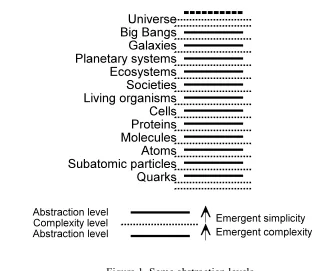
simplicity allow us to have clear concepts of them, even when they might be composed of many complex systems, because their global behaviour is “simple”. Elements represented in abstraction levels interact giving emergent complexity, until new regularities arise, and we can distinguish another abstraction level. Figure 1 shows some abstraction levels that can be identified. From an abstraction level a complexity level arises by emergent complexity, and then another abstraction level arises from the complexity level by emergent simplicity. Complexity levels represent the complexity perceived in objects, but they are not well defined concepts. We draw two complexity levels below quarks because we suppose quarks are divisible, and thus be a product of emergent simplicity, but there is no first abstraction level. We believe that the universe (in the ethimological sense, this is, everything) is infinite (and if not, it behaves as if it would be (we have not found limits)). Therefore, it can be considered as an abstraction level and as a complexity level at the same time. We can have a concept of it, but not because of its regularities, but because of generalization. And the behaviour of the universe as a system can be as complex and as simple as we want to define it, because we cannot perceive such behaviour. We call “big bangs” to phenomena similar to the one it seems most of the matter we can perceive came from. But since we believe the universe has no limits in space or time (what would be on the other side, then?), we believe that there should be an infinite number of big bangs in different stages. Some people call our big bang universe, but as we said, we understand for universe everything.
Figure 1. Some abstraction levels
interactions, and to the complexities of the elements and the complexities of their interactions”. Just like this, the definition is far from being practical. Well, since we cannot find a “first” abstraction level, the recursion in the definition has no end, so we cannot speak of an absolute complexity. But we can take any abstraction level as a point of reference that fits our needs, and then we can have a finite recursion, but we would speak of a relative complexity. Emergent simplicity does not affect the definition of complexity, but it should affect the reference point. For example, we could say that the behaviour of a planet orbiting around a single star is less complex than protein interactions in the cell. But this is because the planet is simple at an abstraction level, and this is its reference point. The proteins are far from their closest minor abstraction level because of their number and interactions. But if we want to study a planet in terms of proteins, it would be much more complex than a cell.
It has not much sense in studying, following the previous example, a planet in terms of proteins, or quoting Herbert Simon, a sheep in terms of quarks. This is not because a quark cannot affect the behaviour of the sheep, but because the effect of the quark can be perceived in every abstraction level until reaching the sheep. Causality cannot jump abstraction levels. But can we speak about causality among abstraction levels? Yes, but very carefully. First we need to make a small distinction.
4. Ontology
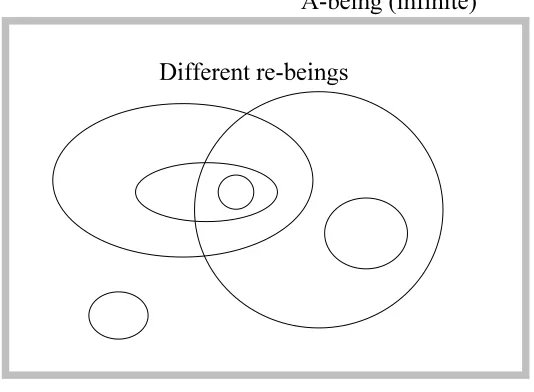
We can define two types of being: absolute and relative. Let us call the absolute being a-being and the relative re-being. The a-being is the being which is independent from the observer, and is for and in all the universe. Therefore, it is infinite and uncomprehensible, although we can approximate it as much as we want to. The re-being is the being which is for ourselves, and it is different for each individual, and therefore dependent from the observer. It is relative because it depends on the context where each individual is, and this context is different for all individuals, and even the context of an individual is changing constantly, with his or her representations of what re-is. The re-being depends on experience, reason, and beliefs, which in turn depend on each other.
Figure 2. A-being and re-beings.
Another way of representing these ideas would be with the following example: we have a ball, which a-is 50% white and 50% black. But we can only see it from one perspective. So, for some of us the ball will re-be completely white, for others it will re-be completely black, or 70% black and 30% white, etc. This is because each one of us has a different perspective (context). And our contexts do not affect the colour of the ball. We can only get an idea of the complete colour of the ball by taking into account as much perspectives (re-beings) as we can. (Note that a usual ball is not infinite as the a-being is). Figure 3 shows three perspectives of this supposed ball.
Figure 3. Which colour the ball a-is?
re-3W e are not saying that independent individuals have the same capabilities than their societies, but that
all the individ uals, interacting, a-are the society.
4
Rem ember we are speaking about causality among abstraction levels, not about causality in time.
being: “I think, therefore I “am” (re-am)”. No wonder why there was a strong debate if they were speaking about different things trying to use the same concept.
5. Causality
Returning to our discussion about abstraction levels: can there be causality among them? There re-is, but there a-is not. Let us elaborate this idea. There can re-be causality among levels because we define the abstraction levels. We define the concepts that are used for identifying causality. For example, from one point of view the behaviour of a society depends on the behaviour of the individuals, but from another point of view the behaviour of the individuals depends on the behaviour of the society. We can speak about this if we have a reference point, individuals in the first case and societies in the second. But the a-being has no reference point. There a-is no causality between individuals and societies, because they a-are the same thing. Individuals and societies re-are concepts that re-were abstracted because of their regularities, but independently from us, a society and the members that compose it a-are the same thing3
. Generalizing, if we take a concept from a certain abstraction level, the elements from lower abstraction levels that compose it a-are the same thing. For example, a planet a-is all the atoms of the planet interacting between them, producing several emergent complexities and simplicities, allowing us to perceive several abstraction levels. So, among abstraction levels we can speak about relative causality, but not about absolute causality4
.
Can we speak about matter, then? Everything seems to a-be only emergent properties of smaller complex systems, but there is not a “basic essential” class of elements. Everything a-is
an infinitude of nothings.
5We u se the notation |A/B| when we m ean “A and B at the same time”.
6
Let us note that w e are not saying that m etaphysics is not u seful or needed. On the contra ry. W e are just noticing its limits.
6. Metaphysics
Metaphysics can be seen as the axioms of philosophy and thought. That is to say, metaphysics are the ideas we believe in and base our reasoning upon. Our reason cannot prove our beliefs in the same way that theorems derived from axioms cannot prove the axioms (Gödel, 1931; Turing, 1936).
For thinking and reasoning, we need basic ideas in order to begin thinking. These basic ideas would be our metaphysics. We can then build new ideas over our metaphysics, but this does not mean that our metaphysics cannot change, even by the ideas based on them.
But if in the universe there a-is no essence, |and/or|5
everything a-is the essence, how can our metaphysics, and all the ideas based on them be valid? They a-are not. They cannot a-be, because they are finite, and our universe is not6
. The question is to see if they re-are valid. And the answer will be always yes, because the ideas were created according to a specific context, and they fit in that context. People do not make non-valid ideas by their own will. Every idea is valid in the context it is created. It is when we take an idea out of its context that it might or not might be valid.
So all ideas have the same degree of validness? Of course not. We can say that an idea is less incomplete as it is valid in more contexts. The more contexts an idea is valid in, and the wider these contexts are, will make the validness of the idea higher. An idea will never be complete, but we can make our ideas as less incomplete as we want to. We can see that the search for truth is obsolete if it is not relative to a reference point, because an absolute truth a-is infinite.
7
Or could it? Only if the universe would be self-affine (M andelbro t, 199 8), bu t it seem s it is not...
their context. Once our culture evolves, and contexts are enhanced, their incompleteness will make them obsolete. Any context, no matter how not-incomplete it is, it will never be complete, so it will not stop being relative. It is fortunate, otherwise we would kill Philosophy. So, if all ideas are relative to their context, and none can be absolutely valid, how can we make science? Well, it seems that science does not intend to find absolute truths, but to approximate them. Many ideas are valid in all our contexts. We still cannot say that they a-are valid, but we have a very high certainty of them. Anyway, if they re-are valid in all our contexts, and they re-are not valid in others we do not know about, we can be indifferent about it.
7. Determinism
Let us return to our statement from § 5, “everything is an infinitude of nothings”. Is there determinism then? Well, we cannot say if there a-is or a-is not, but we can see that there can re-be. Taking the popular Heisenberg example from quantum mechanics: if we cannot know the position and the velocity of a particle without changing it, the behaviour of the particle re-is uncertain. If the behaviour of all particles in the universe re-is uncertain for us, can we speak of determinism? It can re-be, because of emergent simplicity. The same regularities that allow us to create abstraction levels make the phenomena we call “simple” deterministic. Subatomic particles or quarks may not a-be deterministic per se, but their uncertainty does not affect us. We do not know if they a-are deterministic or not. Since they present emergent simplicity, we can perceive determinism in systems emerging from their interactions. Also it seems than non-deterministic behaviour is much harder to abstract. We can say that there is a relative determinism where we have abstraction levels, which tends to re-be non-deterministic as it reaches a complexity level. In this case, by non-deterministic we do not mean random, but incomputable in a practical time. We cannot determine the behaviour of the system not because we cannot know “how it works”, but because its complexity exceeds our computing or perceptual capacities.
Are the emergent properties of a complex system deterministic? We could say that they are if the elements of the system from which the properties emerge are deterministic. But since there a-is no “first” level of abstraction, we cannot say if things a-are deterministic or not. But because of emergent simplicity there are regularities in abstraction levels that re-are deterministic to our eyes. So we can say that phenomena re-are deterministic if our models are congruent with our perceptions “completely”. This means that models simulate all the properties we perceive, which does not imply that models a-are congruent with things.
We could say that one of the objectives of science is to close the breaches between abstraction levels. This does not mean that we will understand an abstraction level completely, precisely because abstractions levels are incomplete, but again we can make them as less incomplete as we want to. It does not matter how much we increase our computing capacities. A computer, a subset of the universe, cannot contain more information than the universe itself7
8
Using mu ltidim ensio nal logic operators (Gershenson 1998; 1999), we can see that paradoxes (wh ich are true and false) are more “stable” than som ething which is on ly “tru e” or “false”, be cause their negation is their equivalent (negation and equivalence are multidimensional logic operators). Multidimensional logic resources can be fou nd at http://132.248.11.4/~carlos/mdl
8. Conclusions
If science is enlarging our contexts, we need to update our ideas in order to make them valid for our ever expanding contexts. The present work is an attempt for achieving this in the case of complex systems.
The distinction made between a-being and re-being clarifies the indistinct and even more ambiguous use of “being”. Apart from the ideas exposed, we can conclude from this distinction things already noticed before, for example that we cannot speak of an absolute good or evil (Schopenhauer, Nietzsche), but only of good and evil relative to a reference point. We have also developed ethics and aesthetics making this distinction of being.
But how to deal with the contradiction of having two types of being? Logic cannot accept contradictions. Well, instead of trying to change situations according to our logic, let us change logic according to our situations. Logic is just a tool for reasoning, and does not determine what things are (Schopenhauer, 1819). Paraconsistent logics (Priest and Tanaka, 1996) can deal with contradictions. An example of them is multidimensional logic (Gershenson 1998; 1999), where instead of having a truth value for a proposition, we have a truth vector whose elements may be contradictory. The result is that we can handle contradictions by adding dimensions to contain them.
We stated that the ideas exposed here will not be valid as our contexts evolve. If they become invalid, then our prediction will be true. If they not, the ideas will be valid. This is a paradox, but it can be comprehended with paraconsistent logics. And it seems that if we want to be less incomplete, paradoxes cannot be avoided anymore, but they need to be comprehended8
.
Another important conclusion is that since all our ideas are relative, we should not search for the truth of our ideas, but for their less-incompleteness. All ideas are valid in the context they were created in, and no idea is completely valid, since our contexts are finite and our world is not.
9. Acknowledgements
I would like to thank Nadia Gershenson, Antonio Gershenson, and Gottfried Mayer-Kreiss for their valuable comments.
This work was supported in part by the Consejo Nacional de Ciencia y Tecnologia (CONACYT) of Mexico.
10. References
Bar-Yam, Y. (1997). Dynamics of Complex Systems. Addison-Wesley. Conway, J. (1970). The Game Of Life.
Gershenson, C. (1997). El Juego de la Vida en Tres Dimensiones. Memorias X Congreso Nacional Sobre Informática y Computación, ANIEI. Monterrey, México.
Gershenson, C. (1998) Lógica multidimensional: un modelo de lógica paraconsistente. Memorias XI Congreso Nacional ANIEI, pp. 132-141. Xalapa, México.
Gershenson, C. (1999). Modelling Emotions with Multidimensional Logic. Proceedings of the 18th
International Conference of the North American Fuzzy Information Processing Society (NAFIPS ‘99), pp. 42-46. New York City, NY.
Gershenson, C. (2001). Artificial Societies of Intelligent Agents. Unpublished BEng Thesis. Fundación Arturo Rosenblueth, México. http://132.248.11.4/~carlos/asia/asia.html
Gödel, Kurt (1931). Über formal unentscheidbare Sätze der Principia Mathematica und verwandter Systeme, I. Monatshefte für Mathematik und Physik, vol. XXXVIII, pp. 173-198.
Mandelbrot, B. (1998). Multifractals and 1/f Noise: Wild Self-affinity in Physics (1963-1976). Springer. New York.
Priest, G. and Tanaka, K. (1996). Paraconsistent Logic, Stanford Encyclopedia of Philosophy. Schopenhauer, Artur. (1819). Die Welt als Wille und Vorstellung.
Turing, A. M. (1936-7). On Computable Numbers, with an Application to the Entscheidungsproblem.