Molecular
Design for
Long-Range Electronic
Communication between Metals
POLYYNE AND ETHYNYLATED AROMATIC SYSTEMS AS MOLECULAR WIRES
IN BINUCLEAR RUTHENIUM P-DIKETONE COMPLEXES
By
Yoshimasa Hoshino
Department of Chemistry. Faculty of Education, Nagasaki University, 1-14 Bunkyo-rnachi, Nagasaki 852-8521, Japan
To construct molecular devices it is necessary to use mixed-valence metal complexes which have a large metal-metal separation distance and which exhibit strong coupling between the metals, so that errors which might arise from electrostatic interaction between the metal ions are prevented. Bridges, or spacers, are needed between two metal terminal sites to operate as effective molecular wires when one metal terminal site is in the excited state, and/or when both the terminal components are in the ground state. Binuclear ruthenium complexes, consisting of tris(P-diketonato)rutheniurn(III) units, which are suitable as the terminal redox sites, can be used to evaluate how well the bridges function as molecular wires in the ground state. This is because their Ru(III)-Ru(II) and Ru(IV)-Ru(III) mixed-valence states are accessible for experimental use. In this article, a polyyne system and an ethynylated aromatic system are evaluated as molecular wires, using the binuclear (P-diketonato)ruthenium(llI) complexes containing these systems as the bridges. In the Ru(IV)-Ru(III) mixed-valence state, the ruthenium complexes show relatively strong electronic interactions between the metul centres. This is interpreted by a superexchange (through-bond) hole transfer mechanism via the highest occupied molecular orbitals of the bridge. Molecular orbital calculations provide a guide to the molecular design of bridging ligands for long-range electronic coupling.
Mixed-valence binuclear complexes have been actively studied since 1969 when Creutz and Taube reported the fascinating mixed-valence ion, [~H3)5Ru~-pz)Ru(NH3)5]5+ @z = pyrazine), the
so called ‘Creutz-Taube ion’ (1). Studies on mixed-
valence complexes are closely related to the
kinetics of electron transfer reactions, and provide valuable information on the degree of interaction between two metal sites. In such studies, three dasses of symmetrical binudear systems may be distinguished, depend.tng on the degree of the elec- tronic coupling between the two metal ions (2,3).
In the Class I system, the electronic coupling is so weak that the mixed-valence complex exhibits only the properties of the isolated mononudear complexes. The Class I1 system has electronic cou-
pling to some extent, so the mixed-valence
complex exhibits slightly perturbed mononudear characteristics but also has obvious properties not associated with the isolated units. This system
remains ‘valence trapped‘ or charge localised. In the Class I11 system, the coupling is so large that the properties of the isolated mononuclear com- plexes are absent and only new properties are discerned. This is the delocalised case.
We can estimate the extent of the metal-metal interactions by the stability of the binudear com- plex formed in a ‘comproportionation’ (reverse of disproportionation) reaction, in which the oxida- tion numbers of the metals mix. The com- proportionation reaction for the Class I1 system is:
M(Z+l)-M(Z+l)
+
M(Z)-M(2)KC
v- N(Z+l)-M(z) (i) 2
where M represents the metal and Z the oxidation number. The comproportionation constant (equi- librium constant of Equation (i)), K,, and the free
energy change for the comproportionation, AGc,
are calculated from the difference in the reversible
c. 1-2 nm
bridging ligands
connecting spacers
connecting
P-diketonate
molecular wire
terminal redox site
*
electrons terminal redox site
<
holes
I
I
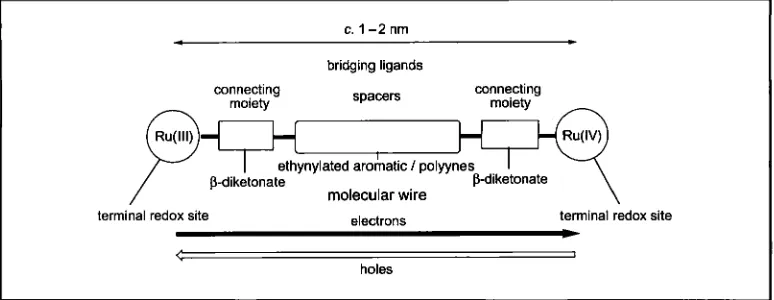
Fig. I Scheniatic diagram of the moleculur wire system showing its structure; the ruthenium centres, which are terminal redox sites, are connected via the Pdiketonate moieties with eihynyluted aromatic/polyyne groups as the spacers. In this svstem electrons move to ihe right and holes to the lefi
half-wave potentials between the two reduction potentials AEw = (EI/z(~) - E ~ 4 2 ) ) .
M(Z+l)-M(Z+l)
+
e- = M(Z+l)-M(2) Ellz(1) (ii)M(Z+l)-M(Z)
+
e- = M(2)-M(2) E1/2(2) (G)K, = exp(A&/Z F I R T )
09
AGc = - A E i / 2 F
(4
The fiee energy change of the comproportiona- tion, AG,, is expressed by the Equation:
AG, = AG,
+
AG,+ AGi + AG,
where AG, is an entropy factor, AGe is an electro- static factor arising from the repulsion of the two similarly charged metal centres, A G is an inductive factor dealulg with the competitive coordination by metal ions for the bridgmg Itgand, and AGr is the free energy of resonance exchange which rep- resents the actual metal-metal couplmg (3,4).
For a strongly coupled system with a large
metal-metal distance ( d ( M - w
>
-
1.5 nm), theresonance exchange term (AGJ dominates AG,,
because the electrostatic factor (AGJ exponential- ly decreases with the increasing charge separation, the entropy factor (AG,) has a constant value of -RTln4, and the contribution of the inductive fac- tor (AG,) is generally small. In such a system the degree of the metal-metal coupling can be estimat- ed by the K, value.
Thus the value of the comproportionation con- stant K, is important for the design of bridgmg W d s . Studying mixed-valence systems with large
metal-metal distances which show strong metal- metal couplmg is needed to gather information about electron transfer in inorganic and biological
systems and to aid construction of molecular
devices. In constructing molecular devices the through-space distance between the donor and acceptor should be big (not the through-bond dis- tance) in order to prevent errors a r i s i n g from any electrostatic interaction. Mixed-valence ruthenium complexes have been reported, which despite hav- ing a metal-metal distance d(M-hl) > 1.0 nm, have relatively strong metal-metal couplmg, that is, large
comproportionation constants (Kc > lo3) (4b, 5).
However, to the author’s knowledge, large K, val- ues have never been reported for any binuclear complex (not an organometallic compound) with a metal-metal distance d ( k - M ) > 2.0 nm.
One of the a i m s of our research, therefore, is to produce a guide that can be used in the design of molecular bridgmg W d s which will be able to achieve good metal-to-metal communications over a long metal-metal distance.
Spacers between the Metal
Terminal Sites
The polyyne system is one of the most effective spacers for potential long-range electronic com- munication between two redox centres. In fact, butadiyne (C, spacer)- and octatetrayne (C, spac- er)-bridged diiron organometallic compounds, where the polyynes directly connect to the metal
HCECSiMe3
-Cul, Et3N
-
L2R?$ Pd(PPh3),, or(CHzCO)2NI
‘0
M e M~ PdC12(PPh3)2
1
M e M e
M e Me
3
HC=CSiMel L2R/{C=C-CZCSiMq n-BuqNF/THF
CUCI-TMED, O2 ‘0
Me
M e
L =[Me3CCOCHCOCMe3]-
0 TMED- N, N, N: N’-tetramethylethylenediamine
LzR[$ CEC-C=CH
M e
Scheme I
Introducing an ethynyl group into a Pdiketonate chelate and oxidative coupling of ethynyl compounds showing how ethynyl links can be used for elongation for wires
centre, exhibit quite large K , values: 1.60 X 10” for the C4 spacer and 2 x lo7 for the Cg spacer (6). Furthermore, the Clz and Cj6 ppolyynediyl dirhe-
nium complexes exhibit two one-electron
oxidation steps in their cyclic voltammograms: for the Ctz spacer AEllz is 0.19 V, and for the C16 spac- er A E l l z is 0.09 V (7). However, ethynyl and butadiynyl bridges actively promote long-range electronic couplrng between remote cationic units when illuminated with visible light (8).
It has not been proved that the polyyne system in the ground state of mixed-valence systems, where polyynes indirectly connect to the metal centre, operate as molecular wires between the redox metal sites; the K, values of the diruthenium complex bridged by bis(4pyridyl)acetylene (9) and of the ruthenium and osmium polypyridyl com- plexes linked by bridging polyynes (10) are very small.
The functioning of the polyyne system as mol- ecular wires in the ground state of mixed-valence complexes depends on the characteristics of the
connecting moiety between the bridges and the metal centres, see Figure 1. To evaluate the
polyyne system P-diketonate was chosen as the
connecting moiety because the P-diketonate
chelate has aromaticity and a p n conjugated sys- tem, which can interact with the dn orbitals of a metal centre. The distance between a metal and a
terminal carbon of the polyyne bridge (at the y-
position of a P-diketonate
ring)
is shorter than any involving pyridine rings used previously (except at carbons adjacent to ligating nitrogen atoms). Thus, we chose tris(P-diketonato)ruthenium(III) units as the redox sites. These can be electrochemically oxi-dised and reduced to give ruthenium(W) and
rutheniumQI) species (11). Therefore, the degree of interactions between two redox sites bridged by
a polyyne system and an ethynylated aromatic sys-
tem in two kinds of mixed-valence states,
Ru(IV-Ru(III) and Ru(III)-Ru(II), can be found.
Syntheses of
Binuclear
Ruthenium
Complexes
Because of the quasi-aromatic reactivity of the ?I-methyne of a P-diketonate chelate ring, it should be possible to introduce an alkyne group at the ?I-
position. No such synthesis has yet been described,
M e M e
,
Me
5
Me
3 Me
I
Me M e
n - Z f o r R u Z R u , 3 f w R u 3 R u , 4 tor R u 4 R u
L :[MejCCOCHCOCMe3]- R u A n R u
TMED = N. N, N', N'- tetrarnethylethylenediamine
Scheme I1
Binuclear linked complexes can be prepared by coupling reactions of the ethynylated ruthenium complex with the analogous complex, halogenated thiophene, or anthracene
although a wide variety of y-substitution reactions are known, for example, halogenation, nitration and acetylation (12). We have successfdy intro- duced an ethynyl group into this y-position, u s i n g
Sonogashira reaction-type palladium catalysts (13). Ethynyl links can be elongated by oxidative cou-
pling (14), see Scheme I, (15). Binuclear
complexes, including ethynylated thiophene-
bridged (S) and anthracene-bridged (An)
complexes, can be prepared by similar couplmg reactions, see Scheme 11, (16). These complexes
have been characterised by 'H NMR and IR spec-
troscopies and by mass spectrometry (13,16). The
'H NMR spectra of these binudear complexes
show paramagnetic shift because of an unpaired electron in the Rum metal centre, and do not con- tradict the spectra derived from the expected structure.
The IR spectra show the characteristic
C S
stretchmg vibrations in the region from 2100 to
2200 cm-'. In their FAB mass spectra, the
observed parent peaks correspond to the molecu-
lar weight of these binudear complexes. Preparing
single crystals of these complexes has often been attempted, but insufficient crystals for X-ray struc-
ture analysis have been obtained.
Electrochemical Properties
A typical cyclic voltammogram of a binudear
ruthenium complex (RuAnRu) is shown in Figure
2. The two pairs of peaks on the positive side of
the voltammogram correspond to two consea-
tive, Nernstian, one-electron oxidation steps (one pair of peaks (A and D) corresponds to the Ru"-
RU"/RU"-RU'"
couple, and the other pair of peaks (E3 and C) correspond to the RU"-RU"/RU"-RU~ couple). T h e pair of peaks @ andF)
on the nega- tive side can be assigned to two overlapping one-electron reduction processes. The reductionsteps of RuAnRu and
RuSRu
can be assigned tothe reduction of the metal centres, while the oxi- dation steps correspond to metal-based oxidation and not to llgand-based oxidation (16). Values for the reversible half-wave potentials (Ellz), K , and
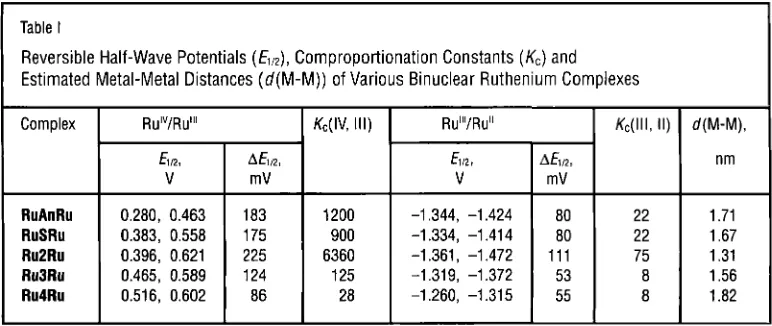
for the estimated metal-metal distances in the complexes are given in Table I (13, 15, 16).
U
U .-
e
1
I
0
5 U
g
3
Complex
I
-1.0 0 10
(E vs. A g l O 01 rnol drn-3 A g N O l In CH3CN), V
Rul"/Ru"l Kc(lV, Ill) Ru"~/Ru"
612, AEin, €112,
V mV V
Fig. 2 The cvclic
r.oltanimogrum for
RuAnRu I N 0.1 mol dni
'
oj (CdHu),NBF,- CH2C12 011 a platinirrndisk electrode at 25°C. The sweep rate ~ t a s
0.1 v s '
RuAnRu RuSRu RuPRu Ru3Au
Ru4Ru
Five oxidation states, includtng the original oxi- dation state of these binuclear complexes, are electrochemically accessible as expected: Ru(II)- Ru(II), Ru(IIQ-Ru(II), Ru(III)-Ru(III), R u m - Ru(I1I) and Ru(lV)-RuO. The bridgmg ligands containing the polyyne and the ethynylated aro- matic groups can now be evaluated as molecular wires in the two mixed-valence states, R u m - Ru(III) and Ru(III)-RuQI).
0.280, 0.463 0.383, 0.558 0.396, 0.621 0.465, 0.589 0.516, 0.602
K ,
Values for the (111,II)
and (IV, 111) States
The K Q I ,
Il)
values are significantly smaller than the K,(IV, 111) values; K,(III, 11) values ofRu3Ru and Ru4Ru in particular are close to the
183 175 225 124
86
statistical limit (Kc = 4).
This
indicates that the free energy change of the comproportionation, A G Q I , II), which is the stabilisation of the Ru(I1I)-RuQI) mixed-valence system, is small, and also that the electron resonance exchange term, AG,(III, 11) is only a minor factor contributing to AGJII, 11), see Equation (vi). On the other hand, AG,(IV, III) is a major factor contributing to theAG,(IV, 111) of the Ru(IV)-Ru(I1I) system. Therefore the degree of the electronic coupling between the metal centres in the Ru(lV)-Ru(lII) state is much larger than that in the Ru(III)-Ru(II) state.
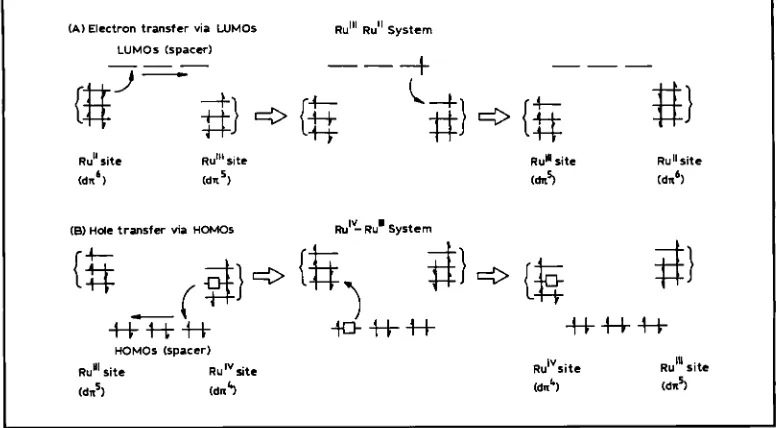
In the present systems, see Figure 3, it is ener- getically favourable for a hole to move from the
1200 900 6360 125 28
Table I
Reversible Half-Wave Potentials (
EIIp),
Comproportionation Constants (Kc) and Estimated Metal-Metal Distances (d(M-M)) of Various Binuclear Ruthenium ComplexesI
-1.344, -1.424 -1.334, -1.41 4 -1.361, -1.472 -1.31 9, -1.372 -1.260, -1.31 5
Phtintn Met& Rev., 2001, 45, (1) 6
A h
mV
80 80 111
53 55
KC(III, II) d(M-M),
nm
22 1.71
22 1.67
75 1.31
8 1.56
(A) Electron transfer via WMOS
LUMOs (spacer)
R U ~ " RU" System
c3
-l-
L
#}
Fig. 3 Superexchange mechanisms for the intramolecular transfer of electrons and holes. Electron transfer is shown from the dn6 Ru(l1) site via the lowest unoccupied molecular orbitals (LUMOs) of the bridge to the d x 5 Ru(ll1) site.
Hole transfer is shown from the dn4 Ru(1V) site via the highest occupied molecular orbitals (HOMOs) of the bridge to the d d Ru(ll1) site
dn
orbital of the r u t h e n i u m 0 site to one of the ruthenium(III) sites via the highest occupied mol- ecular orbitals (HOMOs) of the bridge in theground state of the RuO-Ru(TII). On the other
hand, in the RuO-Ru(n> system, electron transfer from the ruthenium(Il) site to the ruthenium(I1I) site via the lowest unoccupied molecular orbitals (LUMOs) of the bridge is favourable. Such a hole- or electron-transfer mechanism is called a
'through-bond' mechanism and often called the
'superexchange' mechanism (17).
The large difference between the AG,(IV, 119
and AGr(III, Il) indicates the large difference between the degree of electronic couplulg for the hole transfer and for the electron transfer.
This
large difference between hole and electron transfer can be interpreted by the difference in character of
HOMOs and LUMOs of the bridging e d s , as mentioned below.
Recently, we have prepared the following: (a) a new metal coordination polymer of rutheni- um(III) p-diketone units linked by a butadiyne bridge;
@) a mononuclear complex p~"'(mErna)~]
(&ma- = 3-ethyn$-2,4-pentanedionate ion) as the
s t a r t i n g material for the polymerisation (1 8) and (c) their electrochemically reduced products,
poly-p~"(mEma)~]- and [Run(mEma)3]-.
To our surprise, spectroelectrochemical mea- surements showed that the visible spectra for the poly-[Ru"(mEma)3]- (new band at 499 nm) and the
pun(mEma)3]- (new band at 497 nm) are approx-
imately the same. The new band of pu"(mEma)3]- is assigned to metal-to-ligand charge transfer
- a transition from the metal dx level to the ligand &ma- R* orbitals, while the new band of poly-[Ru"(mEma)3]- comes from the combina-
tion of two of the MLCT bands; one band
corresponds to transitions from the dn levels to the terminal mEma- R* orbitals and the other is transitions from the dn levels to the bridging +d, the tahdf 7c' orbitals (tahdf- = 1,1,6,6- tetraacetyl-2,4-hexadiynate dianio;). In spite of the combination, the shape of the absorption bands of poly-~u'(m~rna)~]- are consistent with those of [Ru"(mEma)3]-: both bands have a shoulder near 460 nm. With this observation, it is possible to
predict that the energy levels of the tahdf R*
orbitals are approximately equal to those of the mEma-
n*
orbitals.c-0
c-0
Me’o
d
LUMO -8.21 eV
LUMO
-8.20 eV
Fig. 4 Schematic of the lowest unoccupied molecular orbitals (LUMOs) of [Nrr(mEnin)] md [Nndtuhrl~)]
To c o n k this prediction, extended Hiickel
molecular orbital (EHMO) calculations were car-
ried out for pa(mEma)] and [Na&~hdy)] as
model compounds for [R~(rnEma)~] and poly-
[Ru(mEma)3], respectively (18). The calculations show that the LUMO energy level of [Naz(tahdy)]
is approximately equal to that of pa(mEma)].
Both of the LUMOs have a node on the 3-position carbon atom of the P-diketone ring, see Figure 4,
so that there is no wavefunction on the ethynyl carbons of [Na(mEma)] or on the butadiynyl car- bons of FJaz(tahdy)]. Therefore, the LUMO of paz(tahdy)] is essentially the same as that of pa(mEma)]. O n the other hand, the 7c-conjugated system in the second highest occupied molecular orbital (SHOMO) of paz(tahdy)] is extended through the entire bridging ligand (18).
Consequently, the atomic orbitals of the ethynyl bridge do not contribute to the LUMO of the tahdq- bridging ligand. The LUMOs of the other analogous tetraketonate bridging hgands in this study should have a node, so the superexchange would not operate for electron transfer via LUMOs of the bridge in the ground state of the Ru(III)-RuO systems.
Metal-to-Metal Communication
in the
Ru(1V)-Ru(II1)
State
Accordmg to the Marcus-Hush theory (19)
(which links the rate of electron transfer of elec- trons &om one molecule to another, or from part of a molecule to another, in terms of structural changes in the molecule. For a large molecular rearrangement the rate of electron transfer will be slow, while for small molecular rearrangements the
rate will be fast) and superexchange theory (Sc, 20):
-AGr = 2H,b2/h (vii)
Hab = (H& exp[-PR/2] (viii)
Hab = C a . C p / 8 E (k)
Here, AGf depends on the electronic coupling
matrix element, & , , where (&)O is the matrix ele-
ment when donor and acceptor orbitals are in contact, and
h is the reorganisation parameter;
p
reflects the efficacy of the medium during donor- acceptor coupling and R is the length of the bridge;c, is the atomic orbital coefficient for the c o u p h g between the donor and the bridge, and cp is the atomic orbital coefficient for the coupling between bridge and acceptor; 6E represents the energy gap between the appropriate orbitals on the donor(acceptor) and the bridge.
For the homologous series of RunRu (n = the
number of ethynyl groups = 2,3, and 4), the Kc(IV, 111) values decrease exponentially with the increas- ing number of ethynyl bridges; in particular, the Kc(IV, III) value for Ru4Ru is close to the corre- sponding Kc(III, 11) value (15). This result is in accord with the distance,
R,
dependence of H a b(Equation (viii)) (21). Thus, strong electronic cou- pling is not expected for the RunRu system when
n > 4 with polyyne as the bridge and the p-diketo- nate chelate as the connecting moiety. Therefore,
an increase in the K,W,
IIl)
value with decreasing6E was planned by inserting another conjugated
moiety with electron-donor ability, that is thio- phene and anthracene units, into the ethynyl bridges (16).In fact, although the d(M-M) of RuAnRu (1.71
nm) and RuSRu (1.67 nm) are both longer than
H2BL (X)* E h , eV
HzAn (CI4He) -10.60
HzS (CIHZS) -10.83
H22 (none) -1 1.22
H23 (Cz) -1 1.22
H24 (C,) -1 1.22
*BL denotes bridging ligand
XC12 Complex MK,( IV, I I I ) t l n
0.1 96 RuAnRu 2.67
0.1 85 RuSRu 2.61
0.1 98 Ru2Ru 2.96
0.158 Ru3Ru 2.20
0.138 Ru4Ru 1 .83
that of R d R u (1.56 nm), the K$V, III)values for
RuSRu
and RuAnRu are larger than that for Ru3Ru by a factor of about 10. This indicates that metal-to-metal communication in the R u O - R Umixed-valence state, that ~ is, the electronic coupling, is amplified by inserting other conjugat- ed moieties with electron-donor ability into thetwo ethynyl groups.
This
amplification seems to be caused by decreasedSE,
due to the presence of the electron-donor groups in the bridge.This
can be confirmed by EHMO calculations for a series oftetraketones, HzBL, whose dianions are net bridg-
ing ligands (BL). The SHOMO energies (Eh),
which correspond to thepn HOMO energies of
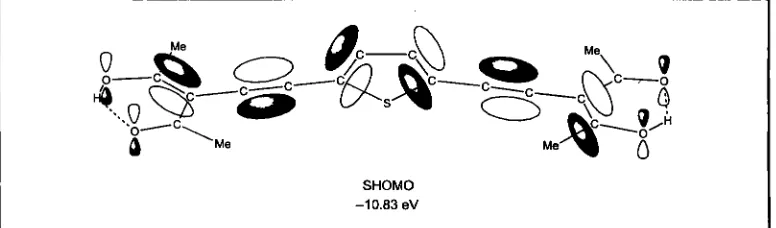
the b r i m llgands in the complexes, are given in Table 11 (22). The n-conjugated system in the SHOMO of H2S is extended through the entire
bridgmg llgand, see FigUte 5. The SHOMO energy
levels of H& and H2S are lugher than that of H23. From these calculations we can foresee that the energy gap between the
dn
orbitals of the metal centres and t h e p HOMO of the b r i m +ds in RuAnRu arid RuSRu becomes smaller com-pared with that in Ru3Ru.
On the other hand, the SHOMO energies ( E h ) of the HD system, see Table
II,
are in good agree-ment with each other (= -11.22 ev) and are
constant.
This
result predicts that the energy gapSHOMO -10.83 eV
Fig. 5 Schematic of the second highest occupied molecular orbital (SHOMO) of H2S. The n-conjugated system in the SHOMO of HzS is extended through the entire bridging ligand
Pkdnnm Me&? REX, 2001,45, (1) 9
Table II
RuPRu
.
/
/
2 0.14 0.16 o m 0.20
k,’
,
Fig. 6 The linear relationship between the square root o f 1 n K c ( N III) values, for various hinuclear ruthenium complexes, and the sum of the squared extended Huckel
MO coeflcients Ec,’ in SHOMO at the terminal carbons
(C(1)) of the triple bond in tetraketones, is clearly seen. This relationship can be used as a guide f o r designing molecular wires based on this system
(SET) between the
dn
orbitals of the metal centresand the
p n
HOMO of the bridgmg hgands inRunRu is almost constant. Therefore the decrease in the K,(IV,
III)
values in the RunRu system (&om 6360 to 28) as the number of ethynl groups (n) increases (2 to 4) cannot be interpreted bychanges in
6E. According to the superexchange
mechanism (Equation (ix)), when the
6E values
for a series of binuclear complexes are almost con- stant, H& is then directly proportional to the product of ca and cp (couplmg strength terms). Therefore, it is expected that the square root of
InK,(IV, 111) bears a linear relationship to the prod- uct of ca and cp (Equations (iv), (v), (vii) and (ix)):
{InKcW, Iq))”’ 0~ ca.cp
(4
Here, cu (or cp), which describes the coupling between the donor (or acceptor) and the bridge,
can be considered as the orbital coefficient at the terminal atom of the bridge, because the magni- tude of the coupling firstly depends on the probability density of finding the electron at the terminal atom.
Figure 6 shows the linear relationship between values of square roots of InK,(IV,
Irz)
and Zclz, thesum of the squared extended Huckel MO coeffi-
cients, see Table 11, for SHOMO at the terminal
carbons (C(1)) of the mple bond in the tetrake- tones. This relationship can thus be used as a guide for the molecular design of mixed-valence (tetra-
ketonato)diruthenium complexes with long-range
hole transfer.
Conclusions
The evaluation of a polyyne system and an ethynylated aromatic system as molecular wires using binuclear ruthenium P-diketone complexes has been discussed. Binuclear species based on
tris(P-diketonato)ruthenium(IIr) units can be used
to evaluate bridges as molecular wires as their RuQII)-RuO and RuQV-RuQIl) states are exper- imentally accessible within the potential window of common supporting electrolyte solutions. The bin- uclear complexes are also useful for inveswting the superexchange mechanism, as the absence of wavefunctions on the bridge in the LUMOs of the bridging ligands simplifies the mechanism into a single pathway - a hole transfer process. In fact, the mixed-valent properties of dimeric rutheni-
umQII) complexes containing sulfur-substituted bridging P-diketonate rings are currently under investigation by Professor Shimizu’s research
Molecular orbital calculations performed on bridging ligands containing a connecting moiety between a bridge and a metal centre provide a lin- ear relationship between the square root of M,, substituted for the electronic coupltng, and the
sum of the squared extended Huckel MO coeffi-
cients, E l 2 , substituted for the product of atomic
orbital coefficients ( c a q ) . Using this relationship, mixed-valence complexes with even longer metal- metal distances (> 2.0 nm), with strong electronic coupling (large K, values) can be designed. group (23).
Acknowledgements
It is a pleasure to express my appreciation to Associate Professor Yasuhiko Yukawa, Niigata University, Japan, for read- ing and commenting on the manuscript.
References
1 C. Creutz and H. Taube,J. Am. Chem. Sac., 1969,91, 3988
2 M. B. Robin and P. Day, Adv. Inatg. Chem. Radixhem., 1967,10,247
3 C. Creutz, Pmg. Itiatg. Chem., 1983,30, 1
4 (a) J. E. Sutton and H. Taube, Inotg. Chem., 1981,20, 3125; @) A. R Rezvani, C. Bensimon, B. Cromp, C. Reber, J. E. Greedan, V. V. Kondratiev and R. J.
Ciutchley, Inotg. Cbem., 1997,36, 3322
5 (a) I. S. Moreira and D. W. Franco, J. Cbem. Soc.,
Cbem. Commun., 1992,450; @) I. S. Moreira and D. W. Franco, Inoig. Cbem., 1994,33, 1607
6 (a) N. Le Narvor and C. Lapinte, J. Cbem. Sac., Cbem. Commun., 1993, 357; @) N. Le Narvor, L. Toupet and C. Lapinte, J. Am. Cbem. Soc., 1995, 117, 7129; (c) F. Coat and C. Lapinte, Oiganometakcs, 1996, 15, 477
7 T. Bart&, B. Bart&, M. Brady, R Dembinski and J.
A. Gladysz, Angew. Cbem., Znt. Ed EngI., 1996, 35, 414
8 (a) V. Grosshenny, A. Harriman and R Ziessel,
Angw. Cbem., Ink Ed EngI., 1995, 34, 2705; (b) A. Harriman and R Ziessel, Cbem. Commnn., 1996, 1707; (c) V. Grosshenny, A. Harriman, M. Hissler and R Ziessel, Phtinsm Metah Rev., 1996,40,26 and 72
9 J. E. Sutton and H. Taube, Inoig. Cbem., 1981, 20, 3125
10 V. Grosshenny, A. Harriman, F. M. Romero and R
Ziessel, J. Pby. Cbem., 1996,100,17472
11 (a) A. Endo, Y. Hoshino, K. Hirakata, Y. Takeuchi, K. Shimizu, Y. Furushima, H. Ikeuchi and G. P. Sat6, Bull. Cbem. SOC. Jpn., 1989, 62, 709; @) Y. Hoshino, Y. Yukawa, T. Maruyama, A. Endo, IC Shimizu and G. P. Sat6, Inotg. Cbim. Actu, 1988,150, 25
12 R. C. Mehrotra, R Bohra and D. P. Gaur, “Metal
p-
Diketonates and Allied Derivatives”, Academic Press, London, 1978, p. 3113 Y. Kasahara, Y. Hoshino, M. Kajitani, K. Shimizu
and G. P. Sat6, Oiganametdkcs, 1992,11, 1968 14 A. S. Hay, J. Oig. Cbem., 1962,27,3320
15 Y. Hoshino. T. Nishikawa. K. Takahashi and K Aoki, Denki.Kgaku Oyoobi I&abutsni Kaguku, 1993, 61,770
16 Y. Hoshino, T. Suzuki and H. Umeda, Inotg. Cbim.
Ada, 1996,245,87
17 G. L. Closs and J. R Miller, Science, 1988,240,440 18 Y. Hoshino and Y. Hagham, Inoig. Chm. A&, 1999,
292,64
19 (a) R A. Marcus, J. Cbem. Pbys., 1956,24,966; @) R A. Marcus, Annu. Rcv. Pbys. Cbem., 1964,15,155; (c) R A. Marcus and N. Sutin, Biocbim. Biqbys. A&, 1985, 811, 265; (d) R A. Marcus and P. Siders, J. P/rv. Cbm., 1982,86,622; (e) R A. Marcus, and N.
Sutin, Inoig. Cbm., 1975, 14, 213;
(9
N. Sutin, J. Photacbem., 1979, 10, 19; (g) N. S. Hush, Pmg. Inaig. Cbem., 1967,8,391; (h) N. S. Hush, Efednwbim. Ada, 1968, 13, 1005; (i) N. S. Hush, Coo& Cbem. Rm, 1985,64,13520 (a) B. E. Bowler, A. L. Raphael and H. B. Gray, Pmg. Inatg. Cbem., 1990,38,259; @) R. Kosloff and M. A. Ratner, Iruef J. Cbem., 1990, 30, 45; (c) M. D. Newton, Cbem. Ra., 1991,91,767
21 A distance required by Hush theory is the effective donor-acceptor separation distance
(4,
assumed to be related to dipole moment expectation values byr =
I
p, - prI
/en, where p, and p~r are the dipole moments of the localised initial and final states in a mixed-valence system, respectively, and where e is the electronic charge and n is the number of elec- trons in the system. On the other hand, R in Equation (viii) dedved by the superexchange mech- anism may be defined in terms of the actual bond lengths for the through-bond sequence perdnent to the pathway being modelled (20c). The Ru-Ru sepa- ration (d@-M)) approximately reflects the length of the bridge in the present systems. In Class II binu- clear metal complexes, when the metal-metal coupling is not very strong (probably K , < 107, the metal-metal separation is usually used instead of the dipole moment length (24).22 Y. Hoshino, H. Umeda and Y. Kamo, Abstracts of papers at the 44th Symp. on Coordination Chemistry of Japan, Yokahama, 1994, p. 178 23 T. Hashimoto, A. Endo, N. Nagao, G. P. Sat6, K.
Natarajan and K Shimizu, Inoig. Cbem., 1998, 37, 521 1
24 (a) S. S. Isied, A, Vassilian, J. F. Wishart, C. Creutz, H. A. Schwarz and N. Sutin, J. Am. Cbem. Soc., 1988, 110, 635; (b) M.-A. Haga, Md. M. Ak, S. Koseki, A. Yoshimura, K. Nozaki and T. Ohno, Inatg. Cbim. A&, 1994,226,17; (c) A.-C. Ribou, J:P. Launay, K. Takahashi, T. Nihira, S. Tarutani and C. W. Spangler, Inotg. Cbem., 1994, 33, 1325; (d) A. R. Rezvani, C. Bensimon, B. Cromp, C. Reber, J. E. Greedan, V. V. Kondratiev and R J. Crutchley, Inarg. Chm., 1997,36,3322; (e) Y. J. Chen, C.-H. Kao, S. J. Lin, C.-C. Tai and K. S. Kwan, Inoig. Cbem., 2000, 39, 189;
(9
R C. Rocha, K. Araki and H. E. Toma, Inotg. Cbim. Actu, 1999,285,197; (g) IC D. Demadis, G. A. Neyhart, E. M. Kober, P. S. White and T. J. Meyer, Inaig. Cbem., 1999,38,5948The Author
Yoshimasa Hoshino is an Associate Professor in the Department
of Chemistry, Faculty of Education, Nagasaki University, Japan. His main interests are in the molecular design of binuclear and polynuclear metal complexes with strong metal-to-metal communication and of rotaxane and polyrotaxane metal complexes for molecular switches.
Rapid
Synthesis
of Colloidal
Clusters
Scientists from PCLCC, Institute of Chemistry, Chinese Academy of Sciences, Beijing, China, have synthesised uniform and stable polymer-stabilised colloidal clusters of platinum, iridium, rhodium, pal- ladium, ruthenium and gold by microwave irradiation
(W. Tu and H. Liu, J. Matm Cbem., 2000, 10, (9), 2207-2211). As microwave heating has uniform and fast heating characteristics only a short irradiation time was needed. The colloidal dusters formed have s m a l l average diameters and narrow size distributions. Stable colloidal ruthenium clusters without boron were prepared using ethylene glycol as the reductant.
![Fig. 4 Schematic of the lowest unoccupied molecular orbitals (LUMOs) of [Nrr(mEnin)] md [Nndtuhrl~)]](https://thumb-us.123doks.com/thumbv2/123dok_us/8622084.1411792/7.522.69.456.54.172/schematic-lowest-unoccupied-molecular-orbitals-lumos-menin-nndtuhrl.webp)