1210306-5757- IJET-IJENS @ Dece mber 2012 IJENS I J E N S
Novel PAPR Reduction Technique Based On
Conventional Partial Transmit Sequence (PTS)
Maha* Gaber Ahmed Mahmoud. , Ghouz*** H. H. M. , Nelly** M.Hussien.
*M. Sc student in Electronics and communication dept., Arab Academy for Science, Technology and Maritime Transport Cairo,
Egypt, [email protected]
*** Associate Professor in Electronics and communication dept., Arab Aca demy for Science, Technology and Maritime
Transport Cairo, Egypt, [email protected]
** Lecturer in communication dept - Modern Academy for Engineering and Tech.- Cairo, Egypt,
Abstract-- In this paper, a novel approach combining two well known signal processing techniques with traditional partial transmit sequence (PTS ) has been proposed and analyzed. This includes convolutional code (CC) and repeating clipping filtering (RCF) techniques. The main objective is to reduce the peak-to-average power ratio (PAPR) of orthogonal frequency division multiplexed (OFDM) signal. The proposed PAPR method is referred to as convolutional-repeating clipping filtering PTS technique (CRCF_PTS ). Simulation results show that our proposed PAPR achieved better power reduction factor as compared to the con ventional PTS technique (about 2.3 dB). In addition, the overall bit error rate (BER) of OFDM system has been evaluated with and without our proposed PAPR for different standard channel models (Additive Gaussian Noise and Rayleigh fading channels). The results show that our PAPR technique has insignificant slightly changes in the bit BER in case of fading channel model. Therefore, proposed CRCF_PTS technique is practically feasible for OFDM system with no additional processing time.
Index Term-- OFDM, PTS , and PAPR reduction techniques
I. INT RODUCT ION
Orthogonal Frequency Division Multiple xing (OFDM ) is an
attractive technique for Ultra- wideband wireless
communicat ion applications. Ho wever, a we ll- known problem of OFDM is the casual occurrence of high peak-to-average power ratio (PAPR) in the t ime doma in signal [1]. This leads to non- linear distortion occurred at the output of power a mp lifier. Many methods have been developed in order to mitigate this ma in dra wback. This includes: Go lay and Reed-Muller coding [2-3], selective mapping (SLM ) [4], partia l transmit sequence (PTS) [5-6], filtering and clipping [7-8-9] and etc. All of these techniques can be classified to two ma in categories: linear and nonlinear. Usually, linear methods lead to increase in computational comple xity of co mmunication system. On the other hand, nonlinear methods increase the overall system BER. In fact, a good PAPR reduction technique is the one that compro mise between comple xity and the BER obtained at receiving end. In th is paper a novel approach combining nonlinear and the linear methods, has been proposed, and referred to as clipping and filtering with partial transmit
sequence denoted by Convolutional Repeating Clipping
Filtering _ PTS. The ma in objective is to reduce the peak-to-average power rat io (PAPR) and to keep an acceptable BER of the OFDM system. Our proposed technique has been achieved a significant reduction in PAPR, and very
slightly changes to the BER perfo rmance as compared to the original OFDM system. The rest of the paper is organized as follows: In Sect ion II, a brief description of PAPR concept in OFDM system is e xpla ined. The novel Clipping and Filtering and PTS algorith m a lso, is introduced in this section. Simu lation results of our proposed PAPR technique are presented in section III. Performance evaluation and analysis of OFDM system with and without the proposed CRCF_PTS technique are also presented in section III. Finally, the presented paper is concluded in section IV.
II. OFDM SYSTEM With PAPER PROBLEM
In contrast to the single carrier, OFDM technology summed up a number of sub carriers modulated by group of data symbol. Therefo re, transmitted signal may have a relat ively large peak power which leads to high PAPR. The PAPR can be defined as follows [10]:
( ) {| | }
{| | }
(1)
is time do ma in data symbol obtained via IFFT given as follows:
∑ ( )
(2)
Where: is frequency domain data symbol obtained at
source output and to modulate sub- carrie r nu mber k. In case
of BPSK = {1,-1} whereas in case of QPSK modulation,
= {1,-1, j, -j}. N: is the total number of sub- carriers.
In OFDM system, N sub-carriers are summed with phase
shifts as given in equation (2) in order to ma intain orthogonality in frequency doma in. In this case, the signal
peak Powe r is N times greater than the mean powe r (in the
worst case) which could be described as follows [10]:
( )
(3)
For e xa mple, if the nu mber of sub-channels varies between
64 and 256, upper limit of the
( )
value in OFDMsystem varies between 18dB and 24dB.
The normalized co mp le x base band symbols are of OFDM is given by [10]:
( )
√
∑
( )
(4)
Where, epresents the modulated symbols of the nth
sub-carrie r, and is frequency spacing between successive sub-
carrie rs. According to the Centra l limit theore m, as long as
1210306-5757- IJET-IJENS @ Dece mber 2012 IJENS I J E N S 1
determine the rea l and imaginary parts of x(t). In this case, they follow Gaussian distribution, the ze ro Mean, and 0.5 variance (real and imaginary separately parts half of the entire signal). The cu mu lative distribution function (CCDF) has been used in our simu lation to evaluate the PAPR of OFDM symbols. In general, a co mp le mentary formu la of CCDF given by [10]:
P{PAPR > z}= 1− P{PAPR ≤z} = 1− (1− ) (5)
Where, z represents a specific threshold power to evaluate the PAPR in OFDM.
A. Clipping And Filtering Technique
In OFDM, signal contains high peaks (exceeding a certain threshold) will be applied to c lipping and Filtering processes (CAF) as illustrated in fig. (1). In the Clipping part, when amp litude e xceeds a certain threshold, the a mplitude is hard-clipped while the phase is saved [13-14].
In fig., vector , ] obtained after
oversampling stage is first transformed using an oversize inverse fast Fourier transformation (IFFT). For an
oversampling factor denoted by IF, is e xtended by
adding ( ) ze ros in the middle of the vector. This
results in a trigonometric interpolation of the signal time domain signal [I]. The interpolated signal is then clipped. In this paper, hard-limit ing is applied to the a mplitude of the comple x values at the IFFT output. However, any other form of nonlinearity could be used. The clipp ing ratio, CR, is defined as the ratio of the clipping level value to the root mean square value of the unclipped signal. The c lipping is followed by filtering to reduce out-of band power. The filter consists of two FFT operations. The forward FFT transforms the clipped signal back into the discrete
frequency domain resulting in vector . The in- band
discrete frequency components of
, ⁄ ⁄ ], a re passed unchanged to the inputs of the second IFFT while
the out-of-band co mponents , ⁄ ⁄ ] are
nulled. In systems where some band- edge subcarriers are unused the components corresponding to these are a lso nulled. The resulting filter is a time-dependent filter, which passes in-band and rejects out-of-band discrete-frequency components. This means that it causes no distortion to the in-band OFDM signal. Since the filter operates on a symbol-by-symbol basis, it causes no Inter-symbol interference. The filtering does cause some peak to re -growth. Clipping method sets a clipping threshold, when the amp litude of the signals over the threshold, then cut the high peak power. According to the system acquire ment, the following function has been used to calculate the clipping
ratio. PAPR0=10logCR, where, PAPR0 is the threshold value, and CR is the clipping ratio. Due to the relation between PAPR0 and the system BER, PAPR0 is selected to be inverse ratio to BER. In this case, proper threshold value should be selected carefully.
B. Proposed PAPR rdeuction Method
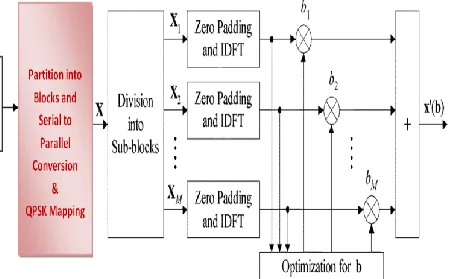
The Block diagra m of conventional PTS is shown in Fig.2. The basic princ iples of practica l pa rtia l trans mit sequence
(PTS) is as follows. First of all, we use vector data X to
define the symbols. Second, div ided this vector into M
groups, denoted by { , m=1, 2… M}. Then the M group
summed up as follows [12-15]:
( ) ∑ (6)
Where, { , m=1, 2… M} is the weighted coefficient, so
that , ∈ [0,2π] wh ich are considered au xiliary
informat ion. Then we adopt IDFT (Inverse Discrete Fourie r
Transform) to ( ), so we obtain =IDFT{ ( )}.
Refe rred to the IDFT instruction, we use of M separate
IDFT given as follows [12-15]:
( ) ∑ * += ∑ (7)
Choose appropriate weighted-coeffic ients { m=1, 2…
M} corresponding to min imu m PAPR of sequence ( )
described as follows [12-15]:
* + * + ( |∑ |)
(8)
Where, argument (.) represents the sentence condition which ma kes the function to achieve the min imu m value. Thus we
use M-1 IDFT to search the optimized we ight
coeffic ients * +, and to achieve the purpose of reducing
the PAPR value in OFDM system.
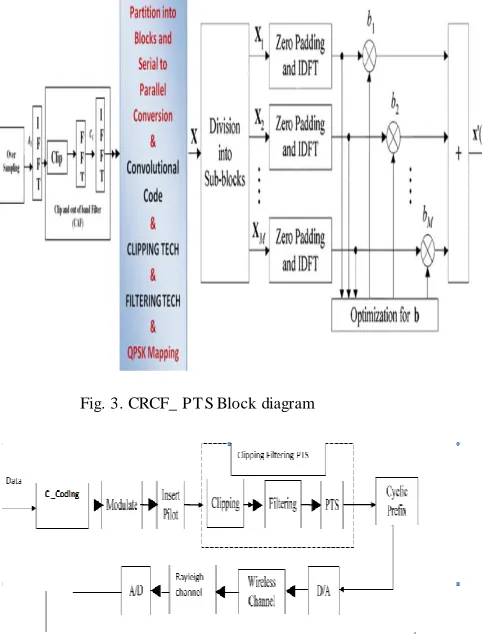
In the proposed OFDM s ystem, we have co mbined the use of convolutional code and RCF (Repeating Clipping and Filtering) as shown in Fig.3. The ma in idea of the proposed PAPR method (CRCF_PTS) is to use three main signal processing steps to reduce the PAPR value. First is to use the convolution code with the OFDM transmitter. Second, the merit of nonlinear clipping method is used to cut the high power va lue of these minority symbols. Third, a filter module is added after c lipping p rocess to reject the out -of-band signals. Finally, a conventional PTS module is applied to the clipped and filtered symbols . Stages of OFDM transceiver with the proposed CRCF_PTS is illustrated in Fig.4.
1 Xk
C lip and out of band Filter (CAF) O ve r
Sampling
I
F
F
T
Clip
F
F
T
I
F
F
T
Fig.1. Repeating clipping and filtering technique
1210306-5757- IJET-IJENS @ Dece mber 2012 IJENS I J E N S
0 2 4 6 8 10 12
10-4 10-3 10-2 10-1 100
PAPR0 [dB]
CCDF (P
r[PAP
R>
PAPR0]
)
IF=2
Orignal C PTS
After4 clip&filter+CPTS PTS
0 2 4 6 8 10 12
10-4 10-3 10-2 10-1 100
PAPR0 [dB]
CCDF (P
r[PAP
R>
PAPR0]
)
IF =1
Orignal
CRCF PTS at 1Clip&Filter CRCF PTS at 2Clip&Filter CRCF PTS at 3Clip&Filter CRCF PTS at 4Clip&Filter PTS Only
C PTS
10-4 10-3 10-2 10-1 100
CCDF (P
r[PAP
R>
PAPR0]
)
Orignal C PTS
4 clip&filter+CPTS PTS
4 clip&filter+CPTS
Oversample IF=2
Oversample IF=1
Fig. 4. Proposed PAPR technique (CRCF_PTS) for OFDM system
III. SIMULATIONASSUMP TIONS AND RESULTS
The major simu lation para meters of OFDM system have been assumed as follow. FFT point is 64 (i.e . 64-subcarriers), modulation technique is QPSK, , 16-symbols cyclic pre fix, and convolutional code with code rate 1/3. Two channel models have been assumed. AWGN channel and multipath fading channel model (3 paths, frequency selective, Doppler shift=20Hz, Rayle igh). In case of fading channel, ma ximal ratio channel equalizer is assumed. In addition, other para meters inc luding o versampling factor (IF=1 &2), number of iterations (n = 4), c lipping rat io (CR= 6dB), and number of PTS groups (V = 4) have been considered in our simulation. The overall perfo rmance of OFDM system has been evaluated and investigated with and without the proposed PAPR approach (CRCF_ PTS). The simulation results are shown in Fig.5 through Fig.8.
This lead to one or two clipping and filtering stages at ma ximu m would be enough. The result presented in Fig.5 shows PAPR level obtained at four cases: without PAPR reduction technique, with traditional PTS, with PTS and clipping, and using PTS with clipping and filtering . Fig.5 shows CCDF of PARP versus reference PARP denoted by
(PAPR)0 using CRCF_PTS technique. It is c lear fro m th is
fig.; a reduction of about 2.5 d B has been achieved by the proposed PAPR however, increasing the number of repeating stages added insignificant power reduction.
Ne xt set of curves shown in fig. 6 illustrate the effect of clipping and filte ring nu mber of stages in the proposed PAPR reduction technique denoted by CRCF PTS. As shown in this fig., PAPR is decreased by increasing number of cascaded clipping and filtering stages following PTS algorith m. Fro m this fig. it is very clea r that the lowest PAPR is obtained by applying proposed PAPR reduction technique when compared with the other three cases.
In the ne xt set of fig.s shown in fig. 7, the e ffect of oversampling order IF on the PAPR level is handled. As illustrated in this fig., by using IF = 1 obtained PAPR leve l will be lower than case of applying IF = 2. The reason is because of reduction happen in the average value of OFDM transmitted symbol when the number of zero padding
Fig. 3. CRCF_ PT S Block diagram
Fig. 6. Effect of filtering and clipping stages number on PAPR level compared with the same cases presented in Fig.5 Fig. 5. “ PAPR level in four cases: without reduction technique,
1210306-5757- IJET-IJENS @ Dece mber 2012 IJENS I J E N S
0 2 4 6 8 10 12
10-4 10-3 10-2 10-1 100
PAPR0 [dB]
CCDF (P
r[PAP
R>
PAPR0]
)
Orignal C PTS
4 clip&filter+CPTS PTS
4 clip&filter+CPTS
Oversample IF=2
Oversample IF=1
increases. Co mplete OFDM transceiver, with stages shown in fig. 4, has been simu lated and obtained results are presented in Fig.8. A p ilot signal has been inserted to help us exactly recover the data at the receive part. Repeating clipping and Filtering is used with PTS (CRCF_PTS) method to process the modulated sequence, and then add cyclic pre fix to e liminate the interference between each OFDM sub-carrie rs. After D/A conversion, the signal is sent into the wireless channel. The ma in drawback of PAPR reduction is the negative effect on BER performance, but actually in our case the proposed PAPR reduction technique didn’t affect on BER level in both fading and noisy only
channel cases. Summarization of simu lation results of our
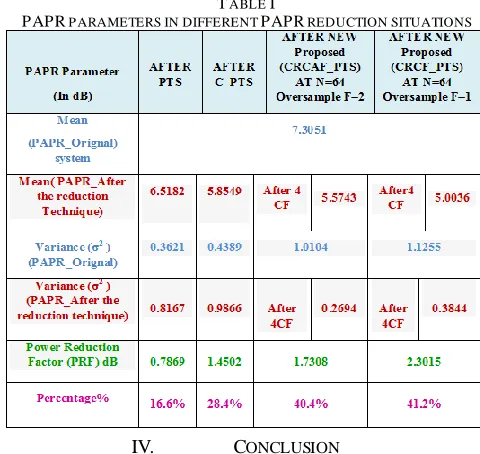
novel technique has been presented in Table I.
IV. CONCLUSION
A novel PAPR reduction scheme based on repeating clipping and filtering, convolutional code, and conventional PTS has been proposed to reduce the peak- to- average power rat io of transmitted OFDM signal. Proposed PAPR
reduction technique is denoted by (CRCF_PTS).
Performance of CRCF_PTS has been evaluated using diffe rent clipping ratio and oversampling factor in case of AWGN and fading channel models . Simulat ion results showed that the proposed scheme resulted in system performance enhancement in terms o f powe r reduction factor as we ll as BER. The presented PAPR technique provided an e xce llent powe r reduction with an acceptable additional processing delay for c lipping and filtering technique as well as convolutional code. The presented PAPR method in this paper is strongly enhanced the OFDM system performance with acceptable comple xity as well as processing time delay.
REFERENCES
[1] S. H. Han and J. H. Lee, “An overview of peak-to-average power ratio reduction techniques for multicarrier transmission,”
IEEEWireless Com munications, vol. 12, no. 2, pp. 56–65, 2005.
[2] A E Jones, T A Wilkinson and S K Barton,”Block Coding Scheme for Reduction of Peak-to- Mean Envelope Power Ratio of Multicarrier Transmission Scheme [J]”, Electronics Letters, Dec. 1994, 30(22):2098-2099.
[3] JA Davis and J.Jedwab, “Peak-to-Mean Power Control and ErrorCorrection for OFDM Tran- smission Using Robert Buml, Robert Fischer and Johannes Huber, Golay Sequences and Reed-Muller Codes [J]”, Electronics Letters, Feb. 1997, 33(4):267-268 [4] “ Reducing the Peakto- Average Power Ratio of Multicarrier
Modulation by Selected Mapping [J]”, Electronics Letters,October 1996, 32(22): 2056-2057.
[5] Leonard J Cimini Jr. Nelson R Sollenberger. Peak-to-average power ratio reduct- ion of an OFDM signal using partial T ransmit sequences, IEEE Communications Letters, March2000, 4:86-88.
[6] T.Ya-fei, D.Rong-hua, Y.Xiao-an and T .Hai-wei,“ PAPR Reduction of OFDM Signals Using Modified Partial Transmit Sequences,” 2nd International Conference on Image and Signal Processing, 2009, CISP’09, pp.1-4 .
[7] X.LiandL.J.Cimini,Jr. Effects of clipping and filtering on theperformance of OFDM. IEEE Commun. Lett. vol.2 , no. 5,1 31-133,May1998.
[8] J Armstrong, Peak-to-Average Power Reduction for OFDM By Repeated Clipping and Frequency Domain Filtering [J] ElectronicsLetters, Feb.2002, 38(8):246-247.
[9] Jianping Wang, Xianwei Zhou, Yongxia Xu, Wen Wang. Performance Improvement of OFDM-ROF System with Clipping and Fig. 8. BER performance versus variation in SNR for transmission
over standard channel models
TABLE I
PAPR P ARAMETERS IN DIFFERENT PAPR REDUCTION SITUATIONS
Fig. 7. PAPR level obtained by changing oversampling value IF=1, 2 compared with cases of study presented in
1210306-5757- IJET-IJENS @ Dece mber 2012 IJENS I J E N S FilteringT echnique. Consumer Electronics, IEEE Transactions on
Publication, May 2008, 2 (54):296-299.
[10] H. Ochiai, H. Imai. On the distribution of the peak -to-average power ratio in OFDM signals. IEEE Trans. On Commu. , Feb. 2001:49(2): 282~289.
[11] Huang Shumei. Zhu Jinyu, Liu Haiyan. Reducing the peak -to-average power ratio of OFDM System by union algorithm. International Journal of AUTOMATION AND COMPUTING 2007, 27 (08):1874~1876.
[12] L. Yang, R. S. Chen, Y. M. Siu,K. K. Soo. PAPR Reduction of an OFDM Signal by Use of PT S with Low Computational Complexity.IEEE Transactions on broadcasting, 2006, 1(52):83~86. [13] S. Leung, S. Ju, and G. Bi, “Algorithm for repeated clipping and
filtering in peak-to-average power reduction for OFDM,” Electron.
Lett., vol. 38, no. 25, pp. 1726–1727, Dec. 2002.
[14] D.Qing and Z.Hongsheng, “ An Improved Algorithm to Reduce PAPR Based Clipping and Filtering”Wireless Communications,Networking and Mobile Computing,2008. WiCOM’08International Conference,pp.1-4.
[15] T. T. Nguyen and L. Lampe, “On partial transmit sequences to reduce PAR in OFDM systems,” in Proceedings of IEEE Global
Telecommunications Conference (GLOBECOM ’06), pp. 1–6, San
Francisco, Calif, USA, November-December 2006.
Hussein Hamed Mahmoud Ghouz was born in Alexandria, Egypt, in 1959. He received the B.Sc. and M.Sc. degrees in radar and communication systems engineering (Distinction and Honors) from the Military Technical College (MTC) in 1983 and 1990 respectively. He received his Ph.D. degree in electrical engineering from Arizona State University, Tempe in 1996. Doctor Ghouz was a lecturer in the department of radar and Guidance, MTC, Cairo, Egypt from 1996 to 2000. He joined Modern Academy for engineering and Technology, Maady, Egypt, as lecturer in communication department from 2000 to 2009. From 2009 up till now. Dr. Ghouz is associate professor in electronics and communication department, Arab Academy for Science, Technology and Maritime Transport (AAST), Cairo, Egypt. His research interest includes modeling and design of flip-chip interconnects in passive MMIC circuit applications, numerical techniques, adaptive space-time filtering techniques, and anti-jamming techniques in pulse Doppler radar systems. In the recent years, Dr. Ghouz is working in the area of analysis and design of compact planar antennas including microstrip, coplanar and stripline circuits for 3G/4G applications.
Maha Gaber Ahmed Mahmoud received the B.Sc. degree in industrial electronic and automatic control engineering from Faculty of Electronic Engineering / Menoufeya University in 2003. She received a diploma from Cairo University in power electronics in 2006 and another diploma in networks & telecommunication networks from National Telecommunication Institute (NTI)/ Ministry of Communication & Information Technology in 2007. She joined Modern Academy for engineering and Technology, Maady, Egypt, as instructor in communication department from 2004 up till now. She joined Arab Academy for Science, Technology and Maritime Transport, Cairo, Egypt (AAST ) in 2008 as M. Sc student in Electronics and communication department. Her research interest includes the different techniques utilized in reducing the peak average power ratio in OFDM systems.
Nelly Muhammad Hussein, Ph.D. from Faculty of Engineering , Communication department, Cairo University 2010, Lecturer in M odern Academy for Engineering and Technology, Communication Dept. Interesting in mobile and digital communication fields. All my researches are focusing on mobile generations’ evolution and reception process
enhancement. Published 5 single author papers mentioned as follows:
1. “Applying Channel Equalization Techniques to STBC OFDM – CDMA System in The Presence of Multi-Path Frequency Selective Channel Fading” , Vol. 5, No. 4, April 2009. 2. “Performance Enhancement of STBC OFDM - CDMA System
Using Channel Coding Techniques over M ultipath Fading Channel” ,Vol. 5 No. 5, May 2009.
3. “LTE System Performance In Frequency Selective Fading Channel with aid of STBC Technology”, UNIASCIT, Vol 1 (2), 2011, 54-62.
4. “Wavelet Transform Effect on M IMO-OFDM System Performance”, Cyber Journals: Multidisciplinary Journals in Science and Technology, Journal of Selected Areas in Telecommunications (JSAT), September Edition, 2011. 5. “Performance of OFDM - CDMA System using Modified