EFFECTS OF SALT IN DYEING OF JUTE FABRIC WITH
REACTIVE AND BASIC DYE
Md. Mahbubur Rahman1, Jagannath Biswas2
1. INTRODUCTION
The technical jute fiber consists of strands i.e. bast bundle fiber assemble in parallel manner with overlapping to produce filaments throughout the length of the stalk. It is also physically coarse, meshy, harsh, and irregular in length and diameter. Jute fiber bundle contains cells or ultimate fibers which are joined together with natural cementing materials as lignin and hemi-cellulose etc. Similarly, each ultimate fiber is composed of a large number of smaller units known as fibrils and these are arranged in right-handed spirals. The fibrils are again made up of molecular chains, closely held together. These are known as micelles. Though lignin and other non-cellulosic materials are abundant in the middle lamella, they are also found in other parts of the cell wall [1]. The uses of jute materials are gradually decreasing due to keen competition from synthetic products. The presence of wax, pectin and mineral matters in jute creates some problems in dyeing, printing and finishing [2]. The dyeing of these fibers is generally done with reactive dyes due to its brilliancy, variety of hue, high wet fastness, and versatile applicability [3]. Dyeing of a reactive dye depends upon various parameters like electrolyte, alkali, liquor ratio, pH of the dye bath and temperature. Generally, exhaustion of reactive dye depends upon the amount of electrolyte and reactivity of a dye [4]. The dyeing with reactive dyes is performed in the presence of an alkali such as soda ash, caustic soda, Na2SO4 etc. The ionization of OH group in cellulose fibers is accelerated with an increase in PH, which favors their reaction with reactive dyes. On the other hand, reactive dyes also react with OH group of water and are increasingly hydrolyzed, which is unfavorable for dyeing. In practical dyeing, therefore it is necessary to maintain proper dyeing condition i.e. the types and concentration of alkali, salt, time, and temperature. In this way, it can be minimized the hydrolysis of dyes and maximize the reaction of reactive dyes with cellulose fibers [5]. In recent years, reactive dyes have been most commonly used due to their advantages over other dyes due to better dyeing processing conditions and bright colors [6]. The reactive site of the dyes reacts with functional group on fiber under influence of alkaline condition and temperature. Reactive dyes react with the cellulosic fiber in the presence of alkali to form a strong covalent bond between a carbon atom of the dye molecule and oxygen atoms of the hydroxyl group in the cellulose [7]. The reactive dyes, in particular, require large amount of electrolyte for exhaustion. In addition, inadequate dye bath exhaustion and dye fixation pose the problem of effluents treatment [8]. In reactive dyeing, auxiliaries are added into the dye bath in order to facilitate the dyeing process. Also, salt is added to the reactive dye bath to assist the exhaustion of the dyes into the fiber. The commonly used salts are NaCl (common salt) and Na2SO4 (Glauber’s salt). There are numerous mechanisms have been established by many researchers how dyes are penetrated into the fibers. J. Suesat mentioned that, in the dye bath solution, the dye molecules ionize into negatively charge molecules. The surface of the cellulosic fibers also ionizes in water into negative charges, restricting entry of the dye molecules due to the charge barrier. Thus, salt is added to the dye bath to neutralize the negative charges on the fiber surface so that the dyes can diffuse more easily into the fiber [9]. Once the dye molecules have been properly exhausted onto the fiber, alkali is added and the fixation of the dye molecules on the fiber takes place. Dyeing of jute with basic dyes is done with the help of Glauber salt and glacial acetic acid [10]. This research investigated the influence of Glauber salt concentrations on the exhaustion of reactive dyes and basic dyes by jute fabric and analysis the various fastness result by changing the amount of Glauber salt concentration which were reported in this paper.
1,2Department of Textile Engineering, Green University of Bangladesh, Dhaka, Dhaka, Bangladesh
DOI: http://dx.doi.org/10.21172/1.133.06
e-ISSN:2278-621X
Abstract- This research investigated the influence of Glauber salt concentrations on the exhaustion of reactive dye and basic dye by jute fabric. The dyeing of the jute fabric is done using standard process and the dyeing curve is also incorporated in this study. The variations in concentrations of salt have enormous impact on the color fastness properties of jute fabric dyed with both reactive and basic dye. Various fastness (color fastness to wash, water, dry and wet rubbing, light) properties of jute fabric were studied and reported in this paper. From the results, it can be claimed that the effect of salt concentration has a remarkable influence in exhaustion of both types of dyes by jute fabric.
2. MATERIALS AND METHODS
2.1 Materials-
Scoured and bleached, optical brightener free 100% jute used for dyeing and a range of commercial reactive dyes from different manufacturers were used.
2.2 Equipment-
Dyeing was carried out on Lab Dyer 212 machine which is from India and made by the company of MAG Solvics Private Limited.
Color fastness to washing carried out in Rota-wash machine and color fastness to rubbing carried out in crock-meter. Color fastness to light carried out in light fastness tester.
2.3 Methods-
Dyeing process of Jute fabric with reactive dyes:
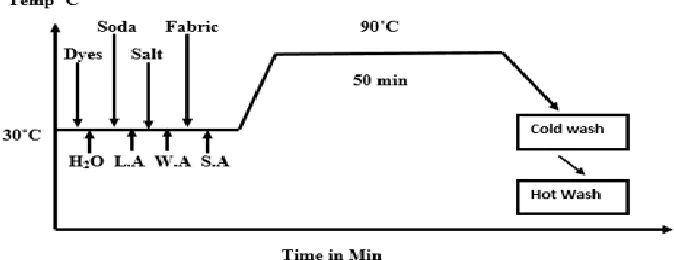
Dyeing of jute fabric is done using reactive dyes with varying Glauber salt concentration. The concentrations are 25g/l, 35 g/l and 45 g/l. We have used Cibacron Turkish Blue. The shade percentage considered for dyeing process is 2%. The dyeing curve is given below.
Figure 1. Process curve (Dyeing of Jute fabric with reactive dyes)
Dyeing process of Jute fabric with basic dyes:
Dyeing of jute fabric is done using Basic dyes with varying Glauber salt concentration. The concentrations are 25g/l, 35 g/l and 45 g/l. We have used Basic Blue. The shade percentage considered for dyeing process is 2%. The dyeing curve is given below.
Figure 2. Process curve (Dyeing of Jute fabric with basic dyes)
2.4 Evaluation of Color Fastness-
Color Fastness to Washing: Color fastness to washing test is done here. We have used ISO 105 C06 A2S method for testing color fastness to washing.
Color Fastness to Rubbing: Color Fastness to rubbing test is done here. We have used ISO 105 X12 method for testing color fastness to rubbing.
Color Fastness to Light: Color fastness to light test done here. We have used ISO 105 B02 method for testing color fastness to light of the fabric.
3. RESULTS AND DISCUSSIONS
3.1 Color fastness to washing-
Color fastness to washing is the common quality parameter, which is considered very important from the point of view of consumers. This test determines the loss & change of color in the washing process by a consumer and the possible staining of other garments or lighter portion that may be washed with it. This test is used to predict the performance of any dyed or printed textile product to the common washing process using a standard detergent and additives.
Sample no. Amount of Glauber salt Acetate Cotton Nylon Polyester Acrylic Wool Decision
Reactive 25g/l 4/5 4/5 4/5 4/5 4/5 4/5 Excellent
Basic 25g/l 4/5 3/4 4/5 4/5 4/5 4/5 Excellent
Reactive 35g/l 4/5 3 4/5 4/5 4 3 Very Good
Basic 35g/l 4/5 3/4 4/5 4/5 4 4/5 Excellent
Reactive 45g/l 4/5 3/4 4/5 4/5 4 4/5 Excellent
Basic 45g/l 4/5 3/4 4/5 4/5 4/5 4/5 Excellent
Table 1. Result of color fastness to washing
From the table 1, we have found that jute fabric shows excellent color fastness to washing when dyed with basic dyes irrespective to Glauber salt concentration but it shows comparatively poor (although very good) fastness to washing when dyed with reactive dyes and Glauber salt concentration is 35g/l.
3.2 Color fastness to Light-
The purpose of Color fastness to light test is to determine how much the color will fade when exposed to a known light source. It is an off line quality assurance system. Generally, man wears the fabric and goes outside of the home for doing their job. During day time, sun light falls on the fabric surface. So, it needs to know how much protection ability have a fabric to sun light. It is determined by an experiment called color fastness to light. To measure the color fastness a blue scale is used. After completing the test, sample is compared with the blue scale.
Dyes Name Amount of Glauber salt Rating Decision
Reactive 25 g/l 3/4 Moderate
Basic 25 g/l 3/4 Moderate
Reactive 35 g/l 3/4 Moderate
Basic 35 g/l 3/4 Moderate
Reactive 45 g/l 3 Fair
Basic 45 g/l 3 Fair
Table 2. Result of color fastness to light
0 0.5 1 1.5 2 2.5 3 3.5 4
Reactive Basic
R
ating o
f l
ig
h
t
fas
tn
e
ss
Test
Types of Dyes
Salt 25 g/l Salt 35 g/l Salt 45 g/l
From the table 2, it was found that jute fabric dyed with both reactive and basic dyes showed moderate color fastness to light when Glauber salt concentration is 25g/l and 35g/l but it shows fair color fastness to light when Glauber salt concentration is 45g/l.
3.3 Color fastness to rubbing-
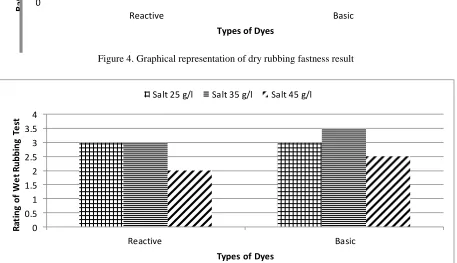
Evaluation of the transfer of colorants from the surface of a colored fabric to another surface or to an adjacent area of the same fabric when it is applied to surface friction or rubbed against a rough surface is called rubbing fastness test. From the table 3 we observed, the change of concentration of Glauber salt affects the color fastness to rubbing properties of jute fabric. The result shows acceptable range for dry rub in different salt concentrations but in wet rub the result was little deviated.
Dyes Name Amount of Glauber salt Rating for Dry Rub Decision Rating for wet Rub Decision
Reactive 25 g/l 4 Good 3 Average
Basic 25 g/l 4 Good 3 Good
Reactive 35 g/l 3/4 Good 3 Average
Basic 35 g/l 4 Average 3/4 Average
Reactive 45 g/l 4 Good 2 Moderate
Basic 45 g/l 4 Good 2/3 Moderate
Table 3. Result of color fastness to rubbing
0 0.5 1 1.5 2 2.5 3 3.5 4
Reactive Basic
R
ating o
f D
ry
R
u
b
b
in
g
Test
Types of Dyes
Salt 25 g/l Salt 35 g/l Salt 45 g/l
Figure 4. Graphical representation of dry rubbing fastness result
0 0.5 1 1.5 2 2.5 3 3.5 4
Reactive Basic
R
at
in
g
of
W
e
t
R
u
b
b
in
g
Te
st
Types of Dyes
Salt 25 g/l Salt 35 g/l Salt 45 g/l
3.4 Color Fastness to Water-
Color fastness to water is designed to measure the resistance to water of dyed, printed, or otherwise colored textile yarns and fabrics. This method is used to assess the degree of cross staining which may occur when garments are left in contact when damp. The test measures the resistance to water of any colored textiles.
Sample No. Amount of Glauber salt Acetate Cotton Nylon Polyester Acrylic Wool Decision
Reactive 25g/l 2/3 3 2 2/3 3 3 Slightly fair
Basic 25 g/l 2/3 2 3 3 3 3 Moderate
Reactive 35g/l 2/3 3 2/3 3 3 3 Slightly fair
Basic 35g/l 2/3 2 3 3 3 3 Moderate
Reactive 45g/l 3 2/3 2/3 3 3 3 Moderate
Basic 45 g/l 3 2 3 3 2/3 3 Moderate
Table 4. Result of color fastness to water
From the table 4, we found that, when jute fabric is dyed with reactive dyes it shows slightly fair color fastness to water when Glauber salt concentration is 25g/l and 35 g/l but it shows moderate color fastness when Glauber salt concentration is 45 g/l. Whereas, basic dyes shows moderate color fastness to water in all the three Glauber salt concentrations.
4. CONCLUSION
This research highlighted the influence of Glauber salt concentrations on jute fabric with reactive dyes and basic dyes. We have found some excellent results in color fastness to wash in different salt concentrations for both reactive dyes and basic dyes except 35g/l salt concentration of reactive dyes. The results of color fastness to light is also nicely representable except in high salt concentration. Incase of rubbing fastness, the result shows acceptable range for dry rub but in wet rub the result was little deviated. The result is also nicely noticeable for color fastness to water in higher salt concentration. After all, from these results, we can easily claim that the effect of salt concentration has a massive impact in exhaustion of both types of dyes by jute fabric.
Abbreviation: [g/gm=gram, l= liter, min.= minutes, S. A= sequestering agent, L. A= leveling agent, W. A = wetting agent]
5. REFERENCES
[1] Dr. Abu Bakar Siddique, Dr. Hosne Ara Begum, Md. Sharif Ahmed and Sourav Rashed, “Introduction to Textile Engineering”. [2] Arthur D. Broadbent, “Basic Principles of Textile Coloration”.
[3] K. Singha, S. Maity and M. Singha, “The Salt-Free Dyeing on Cotton: An Approach to Effluent Free Mechanism; Can Chitosan be a Potential Option”, International Journal of Textile Science, pp. 69-77, Vol. 1(6), 2012.
[4] A. N. Ahsanul Haque, “Effect of Dyeing Parameters on Dyeing of Cotton Fabrics with Fluoro Chloro Pyrimidene Reactive Dyes”, IJRET: International Journal of Research in Engineering and Technology, pp. 125-128, Vol. 03, Issue. 04, Apr-2014.
[5] M. A. Qadir, M. R. Adil and K. Mahmood, “ Effects of Various Buffers and Salt on Color Strength of Reactive Dye Sumifix 3RF”J. Chem. Soc.Pak, pp. 7-10, Vol. 31, No. 1, 2009.
[6] Q. Saeed, I.A. Bhatti, M. Zuber, S. Nosheen, M. A. Zia, M. Abbas,“Study of Application of Mono azo Reactive Dyes on Cotton by Exhaust method and Printing Properties”, International Journal of Basic & Applied Sciences IJBAS, pp. 191-197, Vol. 12, No. 06, December 2012.
[7] M. Rahman1, A.K.M. A. Hosne Asif, A. B. Siddiquee and Md. Rokonuzzaman, “Effect of Shade Percentage on Various Properties of Cotton Knitted Fabric Dyed With Reactive Dyes”, IJRET: International Journal of Research in Engineering and Technology, pp. 339-343, Vol. 03, Issue: 02 ,Feb-2014.
[8] D. P. Chattopadhyay, “ Cationization of Cotton for Low Salt or Salt Free Dyeing”, Indian Journal of Fibre and Textile Research, pp. 108-115, Vol. 26, March-June 2001.
[9] J. Suesat, “The Influence of NaCl Concentration on the Build-Up Properties and Aggregation of Reactive Dyes”, Kasetsart J. (Nat. Sci.), pp. 558 – 568, Vol. 42, 2008.