ISSN(Online): 2319-8753 ISSN (Print): 2347-6710
I
nternational
J
ournal of
I
nnovative
R
esearch in
S
cience,
E
ngineering and
T
echnology
(A High Impact Factor & UGC Approved Journal)
Website: www.ijirset.com
Vol. 6, Issue 8, August 2017
Dyeing Effects of Wool/Acrylic Blended Yarn
in One-bath and Two-bath Process Using 1:2
Pre-metallised and Basic Dyes
Mohammad Mahbubul Alam1, Nahida Akter2, Md Al-Amin3, Jubair Ahmed Ahad4, Nazia Nourin Moury5
Assistant Professor, Department of Textile Engineering, Ahsanullah University of Science and Technology,
Dhaka, Bangladesh1
Assistant Professor, Department of Textile Engineering, Ahsanullah University of Science and Technology,
Dhaka, Bangladesh2
Bachelor Students, Department of Textile Engineering, Ahsanullah University of Science and Technology,
Dhaka, Bangladesh3,4,5
ABSTRACT: In this work, dyeability of wool/acrylic blended yarn in one and two bath process was studied. Here two different types of dyes were selected for two different components i.e. 1:2 pre-metallised dyes (Tainaset series) were used for dyeing wool part and basic dyes(Taiacryl series) were used for dyeing acrylic part in one and two bath process along with different shades such as 0.5%, 1.5%, 3.0% for blue, red, and yellow hue. Fixing chemical was also applied on dyed samples. Emphasize was given to find out the variation on colour strength (K/S value) and different colour fastness properties such as washing, rubbing, dry cleaning before and after using fixing chemical in both processes. The result of this study revealed that, the samples dyed in two bath dyeing process shows better colour strength (K/S value) than that of one bath dyeing process. Samples dyed in two bath process had almost similar rubbing fastness compare to the samples dyed in one bath process. In case of washing fastness, samples dyed in one bath showed slightly better result. But the results of both processes were closely comparable. Dry cleaning fastness ratings were excellent for the both processes. After applying fixing chemical, there were a slight improvement in washing and rubbing fatness ratings.
KEYWORDS: Blended,Colour strength, Fixing chemical, Rubbing fastness.
I. INTRODUCTION
Wool is an expensive high value fibre with natural softness and elegance. The luxury image of wool has great importance among the natural fibres and as more as wool is used by designers for fashionable fabrics and apparel, as more we see a trend to combine wool with either natural or synthetic fibres [1]. Wool has limited tensile strength and abrasion resistance, possesses marked differences both in root-to-tip dyeing properties, and also in cross-section, with a hydrophobic exterior sheathing a hydrophilic interior. Dyeing concepts and procedures have to be carefully considered because the wool fibre is very sensitive to many dyeing conditions which are applied on other fibres. The apparent deficiencies of wool as a textile fibre are countered by its desirable properties like warmth, comfort, handle, good drape etc [2]. Acrylic fibre is a less expensive alternative to wool and in many respects, replaced wool. The outstanding physical and chemical properties of acrylic fibres, such as high strength, good abrasion and insect resistance, have led to many applications in apparel as well as in theproduction of wool/acrylic fibres, which are widely used in knitwear [3].
ISSN(Online): 2319-8753 ISSN (Print): 2347-6710
I
nternational
J
ournal of
I
nnovative
R
esearch in
S
cience,
E
ngineering and
T
echnology
(A High Impact Factor & UGC Approved Journal)
Website: www.ijirset.com
Vol. 6, Issue 8, August 2017
wool portion and cationic dyes for the acrylic portion, are the general rule. The dyeing methods which have been recommended for wool–polyacrylonitrile fibre blends are one-bath and two-bath, depending on the depth. The dyes normally employed for the wool are milling acid, 1:2 metal-complex or reactive [4]. A one-bath process is cheaper and less time consuming but is possible only if reaction between the two types of dye in the dye bath can be avoided [5]. If wool/acrylic blends are dyed with 1:2 pre-metallised and basic dyes in one-bath, one-step method then chemicals known as compatibilizers need to be used. Otherwise they easily react with one another to form insoluble anion or cation complex salts in the dye bath [6].
1) Reasons for the Development of Fibre Blends
There are some reasons which have been put forward to justify the replacement of ahomogeneous textile material by a blend:
Economy: The dilution of an expensive fibre by blending with a cheaper substitute.
Physical properties: a compromise to take advantage of desirable performance characteristics contributed by both fibre components.
Appearance: The attainment of attractive appearance and tactile qualities using combinations of yarns of different lustre, crimp or denier, which still differ in appearance even when dyed uniformly to the same colour.
Colour: The development of novel garment or fabric designs incorporating multicolour effects.
Durability: The incorporation of a more durable component to extend the useful life of a relatively fragile fibre [6].
2) Classification of Binary Blends
All binary blends can be split into ten groups - AA,AB, AC, AD, BB, BC, BD, CC, CD and DD.AB binary blend types are wool/acrylic, nylon/acrylic, nylon/cationic dyeable nylon. In AB type blend, the two fibres involved are of the opposite ionic type so anionic and cationic dyes both are needed for dyeing [8].
3) General Techniques for Blend Dyeing
One-bath, one-step method, i.e. dyeing of wool and acrylic simultaneously. One-bath, two-step method, i.e. dyeing of wool and acrylic in succession in the same bath. Two-bath method, i.e. dyeing of wool and acrylic in succession in two baths [9].
4) One-bath Dyeing Process
One-bath dyeing process is more economical. Less time is required. Good potentiality to saveenergy and materials. Possibility of cross-staining. Limitations in the dyeing of blends containing fibres that have different sensitivity to acids and alkalis. Opposite charges carried by the dyes can lead to incompatibility in one-bath dyeing. Reduction clearing is not possible in one-bath dyeing. Mainly useful for pale to medium depths of moderate fastness [10].
5) Two-bath Dyeing Process
ISSN(Online): 2319-8753 ISSN (Print): 2347-6710
I
nternational
J
ournal of
I
nnovative
R
esearch in
S
cience,
E
ngineering and
T
echnology
(A High Impact Factor & UGC Approved Journal)
Website: www.ijirset.com
Vol. 6, Issue 8, August 2017
6) Factors Affecting the Choice of Blend Dyeing Methods
A list of factors which dictate the choice of conditions under which particular blends might best be dyed: Colour effects and fastness properties required. Compatibility of dyes from different application categories with one another. Behaviour of the different fibres in the blend towards different dyes and dye bath conditions. Degree of anticipated cross-staining of each fibre. Stability of the dyeing to finishing processes. Type and availability of dyeing equipment. Cost of the dyes and chemicals involved [12]. Economics of the overall process.
7) 1:2 Pre-metallised Dyes for Wool
Although the wet fastness properties of 1:1 metal-complex dyes on wool are lower than those of mordant dyes, their excellent migration and penetration character, ease of application, good light fastness and comparatively bright shades, secured their considerable use on wool for over 25 years, until the introduction of 1:2metal-complex acid dyes [13]. 1:2 pre-metallised dyes have two molecules per metal atom and molecular structures may be symmetrical, with two identical dye ligands or unsymmetrical, with two different dyes.
8) Basic Dyes for Acrylic
The most common anionic group attached to acrylic polymers is the sulphonate group, SO3−, closely followed by the
carboxylate group, –COO−. These are either introduced as a result of co-polymerisation, or as the residues of anionic polymerisation inhibitors. It is this anionic property which makes acrylics suitable for dyeing with cationic dyes, since there will be a strong ionic interaction between dye and polymer. Acrylic fibre can be dyed by an ion exchange mechanism using cationic dyes [13, 14]. In dyeing acrylic fibre with basic dyes, it is not easy to obtain a uniform distribution of dye in the substrate. These dyes rapidly adsorb on all available surfaces of the acrylic fibres because of the polymer’s negative surface potential in water.
II MATERIALS AND METHODS
Blended yarn that comprises wool (30%) and acrylic (70%) used in this work that scoured and bleached with hydrogen peroxide at 70°C for 50 minute and followed by washing and rinsing steps. In one bath dyeing process, the material was dyed at 100°C for 50 min with levelling agent for both wool and acrylic part and anti-precipitating agents was also used. The pH of the dye bath was 4.5 (adjusted with acetic acid), material to liquor ratio 1:10. After dyeing, the material was washed at 60°C for 15 min followed by soaping with a soaping agent and ammonia water. Fixing chemical was also used after soaping at 70°C for 15 min at pH 4.5.
Whereas, in two bath dyeing process, the acrylic yarn was dyed at first with a levelling agent and acetic acid. The dye bath temperature was 100°C for 15 min with a pH 4.5. The dyed yarn was hot washed and soaped respectively. The wool yarn was dyed after that with levelling agent and acid at 100°C for 15 minute followed by hot washing and soaping of the material. The fixing chemical also used in this process.
(a) Kubelka-Munk Principle
The Kubelka-Munk equation relates the reflectance of a coloured substrate to the absorption (K) and scattering (S) co-efficients of the colourants present.
R
R
S
K
2
)
1
(
2
ISSN(Online): 2319-8753 ISSN (Print): 2347-6710
I
nternational
J
ournal of
I
nnovative
R
esearch in
S
cience,
E
ngineering and
T
echnology
(A High Impact Factor & UGC Approved Journal)
Website: www.ijirset.com
Vol. 6, Issue 8, August 2017
(b) Washing Fastness
According to the test method ISO 105-C02,the dyed specimen measuring (10 cm×4 cm) was sewn together with a multifibre fabric of the same size. The test was carried out using a wash wheel for 45 minutes at (50±2)°C, using 5 g/l standard soap solution at a liquor ratio of 1:50. No soda ash and steel balls were used during process. The treated composite samples were rinsed thoroughly in cold tap water and after squeezing the stitching was removed on the two long sides and one short side, leaving the dyed specimen and the adjacent multifibre fabric sewn together only along one short side. The pieces were opened out and dried in air at a temperature not above 60°C. The change in colour of the specimen and the staining of the adjacent undyed multifibre fabric were assessed visually by grey scales and also by spectrophotometer.
(c) Rubbing Fastness
According to ISO 105-X12, the crocking cloth is clamped on the crock finger. Specimens are positioned on the base of the crock meterand held in place with the sample holder. The rubbing action is done by a "finger". The finger exerts a downward force of (9±0.2) N, moving to and fro in a straight line along a (104±3 mm) track. Specimens of the textile are rubbed with dry and wet crocking cloths. The sample size for rubbing fastness test is 14 cm×5 cm. A layer of parallel strands is produced by wrapping the tested yarn length ways on a cardboard. The size of the crocking cloth is 5 cm×5 cm. Rubbing was carried out a rate of one cycle per second, rub to and fro in a straight line 20 times, 10 times to and 10 times fro along a track long. Any extraneous fibrous material that might interfere with the rating was removed from the crocking cloth. After rubbing, the crocking cloth was removed from the instrument and assessed the staining of the crockingcloths visually with the grey scale for staining and also by the spectrophotometer.
(d) Dry Cleaning Fastness
ISSN(Online): 2319-8753 ISSN (Print): 2347-6710
I
nternational
J
ournal of
I
nnovative
R
esearch in
S
cience,
E
ngineering and
T
echnology
(A High Impact Factor & UGC Approved Journal)
Website: www.ijirset.com
Vol. 6, Issue 8, August 2017
III RESULTS AND DISCUSSION
(a) Colour Strength (K/SValue)
Table 1: K/S values for blue, red and yellow hue
Hue Shade One-bath without
fixing chemical One-bath with fixing chemical Two-bath without fixing chemical Two-bath With fixing chemical
Blue Light (0.5%) 9.1718 10.318 10.939 11.742
Medium (1.5%) 27.250 26.915 33.553 32.704
Dark (3.0%) 43.883 37.634 44.927 42.195
Red Light (0.5%) 11.543 11.552 15.283 18.248
Medium (1.5%) 34.881 33.562 36.959 33.634
Dark (3.0%) 41.116 35.690 41.914 35.690
Yellow Light (0.5%) 8.8406 10.059 10.314 10.634
Medium (1.5%) 25.586 24.701 27.371 25.387
Dark (3.0%) 33.227 31.905 35.235 33.251
From table 1 shown that the K/S value increased in two-bath process in comparison to one-bath process for blue, red, and yellow hues and this trend was same in both fixing and without fixing chemical. The darker shades obtained in two-bath dyeing which may be due to dyeing carried out at suitably individual dyeing conditions. The K/S values increased after using fixing chemical for all light shades. In case of all medium and dark shades, the K/S values get decreased in both one-bath and two-bath processes.
(b) Rubbing Fastness
Figure 1: Rubbing fastness rating for blue, red, yellow and black hue
1 2 3 4 5 L igh t M edi um D a rk L igh t M edi um D a rk L igh t M edi um D a rk D a rk
Blue Red Yellow Black
ISSN(Online): 2319-8753 ISSN (Print): 2347-6710
I
nternational
J
ournal of
I
nnovative
R
esearch in
S
cience,
E
ngineering and
T
echnology
(A High Impact Factor & UGC Approved Journal)
Website: www.ijirset.com
Vol. 6, Issue 8, August 2017
From the figure 1, it was observed that dry rubbing fastness ratings were same (excellent) in both one-bath and two-bath processes for blue, red, yellow and black hues when fixing chemical was not applied. After applying fixing chemical, there were also no significant change in the rating, so it can be said that there was no impact of fixing chemicals on dyed samples in case of fastness to dry rubbing.
(c) Wash Fastness on Staining
Figure 2: Washing fastness on staining rating of blue, red, yellow and black hue
From figure 2, it was found that washing fastness ratings (staining)were same or slightly better in one-bath process compared to two-bath process when fixing chemical was not used. After applying fixing chemical, staining ratings showed same or better in every bath for blue, red, and yellow hues.
(d) Wash Fastness on Colour Change
Figure 3: Washing fastness rating on colour change for blue, red, yellow and black hue
1
2
3
4
5
DiacetateBleached cottonPolyamide Polyester Acrylic Wool
One-bath without fixing chemical One-bath with fixing chemical Two-bath without fixing chemical Two-bath with fixing chemical R a ti n
1
2
3
4
5
L igh t M edi um D a rk L igh t M edi um D a rk L igh t M edi um D a rk D a rkBlue Red Yellow Black
ISSN(Online): 2319-8753 ISSN (Print): 2347-6710
I
nternational
J
ournal of
I
nnovative
R
esearch in
S
cience,
E
ngineering and
T
echnology
(A High Impact Factor & UGC Approved Journal)
Website: www.ijirset.com
Vol. 6, Issue 8, August 2017
From figure 3, it was seen that the washing fastness ratings for colour change were same (good) for most samples. There was no dramatically change in before and after washed samples.
(e) Dry Cleaning Fastness
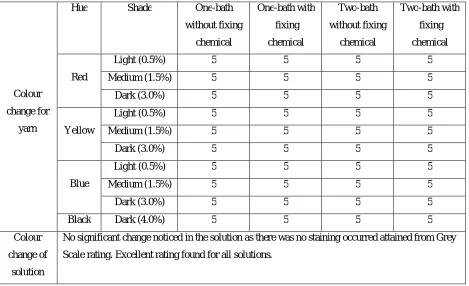
Table 2: Table for dry cleaning fastness rating for blue, red, yellow and black hue
Colour
change for
yarn
Hue Shade One-bath
without fixing
chemical
One-bath with
fixing
chemical
Two-bath
without fixing
chemical
Two-bath with
fixing
chemical
Red
Light (0.5%) 5 5 5 5
Medium (1.5%) 5 5 5 5
Dark (3.0%) 5 5 5 5
Yellow
Light (0.5%) 5 5 5 5
Medium (1.5%) 5 5 5 5
Dark (3.0%) 5 5 5 5
Blue
Light (0.5%) 5 5 5 5
Medium (1.5%) 5 5 5 5
Dark (3.0%) 5 5 5 5
Black Dark (4.0%) 5 5 5 5
Colour
change of
solution
No significant change noticed in the solution as there was no staining occurred attained from Grey
Scale rating. Excellent rating found for all solutions.
The dry cleaning fastness ratings for staining were same (excellent) in one-bath without fixing chemical, one-bath with fixing chemical, two-bath without fixing chemical and two-bath with fixing chemical for blue, red, yellow and black hues. Dry cleaning fastness ratings for colour change of the solution were also same (excellent) for both baths.
IV. CONCLUSION
The study was firmly based upon the dyeing of wool/acrylic blended yarns in one-bath and two-bath processes and to compare the change in one-bath and two-bath by K/S value and different fastness properties. The fixing chemical behaviour was also observed in this study. One-bath process involves shorter dyeing times and simpler dyeing procedures and consequently increases productivity, such a method is preferable for industry. But the dye uptake and colour yield is better in two-bath process. This work is very much related with practical work as popularity of wool/acrylic blends is increasing day by day.
Limitation
ISSN(Online): 2319-8753 ISSN (Print): 2347-6710
I
nternational
J
ournal of
I
nnovative
R
esearch in
S
cience,
E
ngineering and
T
echnology
(A High Impact Factor & UGC Approved Journal)
Website: www.ijirset.com
Vol. 6, Issue 8, August 2017
REFERENCES
[1] Grüner F. Dyeing fibre blends-A challenge for the wool dyer. InProc. 10th Int. Wool Text. Res. Conf. 2000. [2] Doughty SM. The dyeing of polyester/wool blends. Coloration Technology. 1986 Jun 1;16(1):25-38.
[3] El‐Shishtawy RM, El‐Zawahry MM, Ahmed NS. One‐bath union dyeing of a modified wool/acrylic blend with acid and reactive dyes. Coloration Technology. 2011 Feb 1;127(1):28-38.
[4] Lemin DR. Some Observations on the Dyeing of Acrylic—Wool Blends. Coloration Technology. 1975 Jun 1;91(6):168-76.
[5] Xie K, Hou A. One‐bath dyeing of wool/acrylic blends with reactive cationic dyes based on monofluorotriazine. Coloration technology. 2004 Nov 1;120(6):307-10.
[6] Shore J, Society of dyers and colourists (GB). Blends dyeing. Bradford: Society of Dyers and Colourists; 1998.
[7] Akrman J, Přikryl J, Burgert L. Dyeing of polypropylene/wool blend in a single bath. Coloration Technology. 1998 Jul 1;114(7‐8):209-15. [8] Clark M, editor. Handbook of Textile and Industrial Dyeing: Applications of Dyes/Edited by M. Clark. Woodhead Publishing; 2011
[9] Leube H, Rüttiger W, Kühnel G, Wolff J, Ruppert G, Schmitt M, Heid C, Hückel M, Flath HJ, Beckmann W, Brossmann R. Textile dyeing. Ullmann's Encyclopedia of Industrial Chemistry. 2000.
[10] Kramrisch B. Recent Developments in the Dyeing of Acrylic Fibres. Coloration Technology. 1961 Jun 1;77(6):237-44. [11] Broadbent AD. Basic principles of textile coloration. West Yorkshire: Society of Dyers and Colourists;2001
[12] Aspland JR. Textile dyeing and coloration. North Carolina, USA: American Association of Textile Chemists and Colorists; 1997. [13] Lewis DM, Rippon JA, editors. The coloration of wool and other keratin fibres. John Wiley & Sons; 2013 May 20.