e-ISSN: 2278-067X, p-ISSN: 2278-800X, www.ijerd.com
Volume 9, Issue 6 (December 2013), PP. 62-68
Self Compacting Concrete Containing Shell Lime
B.H.V.Pai
1, Philip George
21Associate Professor of Department of Civil Engineering,Manipal Institute of Technology.Manipal- 576104,
Karnataka, India.
2Student of Master of Technology,Department of Civil Engineering, Manipal Institute of Technology.
Manipal- 576104, Karnataka, India
Abstract:-This work outlines the preliminary results of researchaimed at evaluating SCC, produced by incorporating shell lime powder as filler, in terms of its properties like compressive strength, split tensile strength, modulus of rupture, and shrinkage strain.
Keywords:-Self-Compacting Concrete (SCC), Shell lime powder, Compressive strength, Split tensile strength, Flexural strength, Shrinkage strain.
I.
INTRODUCTION
SCC was developed in Japan in the late 1990's to be mainly used for highly congested reinforced structures in seismic regions. Recently, this concrete has gained wide use in many countries for different applications and structural configurations. Use of SCC offers substantial benefits in enhancing construction productivity reducing overall cost and improving working environment. The use of SCC has many advantages such as : reducing the construction time and labour cost, eliminating the need for vibration, reducing the noise pollution, improving the filling capacity of highly congested structural members[1,2].
SCC consists of the same components as conventionally vibrated concrete, which are cement, aggregates and water, with the addition of chemical and mineral admixtures in different proportions .The first point to be considered when designing SCC is to restrict the volume of the coarse aggregate so as to avoid the possibility of blockage on passing through spaces between steel bars. This reduction necessitates the use of a higher volume of cement which increases the cost besides resulting in a greater temperature rise. So cement should be replaced by high volume of blast furnace slag or fly ash or shell lime powder[3,4].
Usually, the chemical admixtures used are high-range water reducers (super plasticizers or HRWR) and viscosity-modifying agents(VMA), which change the rheological properties of concrete. Mineral admixtures are used as an extra fine material, besides cement, and in some cases, they replace cement. Saving in labour cost might offset the increased cost,but the use of mineral admixture such as fly ash, blast furnace slag or shell lime filler could increase the slump of the concrete mixture without increasing its cost[5,6,7].
II.
EXPERIMENTAL PROGRAMME
A. MATERIALS
1)Powder: The powder content indicated on a volume basis will translate to about 210-220 liters which means that if cement alone is used as powder it will amount to 750-800 kg/m3. However such high cement content is neither desirable nor necessary. For the concrete of M20 grade a cement content of 290kg/m3 should be enough. Therefore the remaining powder volume of about 100-110 liters should be made up by either fly ash or ground slag or lime stone powder. The powders used in SCC are all the fine materials with a size of less than 0.125mm.
2)Cement: All types of cement complying with Indian standards are suitable for SCC. The cement used in this experiment is the 43 grade Ordinary Portland Cement.
3)Shell lime powder: The shell lime powder is obtained by burning a combination of shell lime and coal in a furnace. It has a specific gravity of 3.09. Advantages of using shell lime are that it blends in the mix easily and forms a very good cohesive mix. It also acts as a good viscosity modifier for fresh concrete paste. Heat of hydration is too high, so the use of retarder is a must.
4)Aggregate: Sand can be finer than normal, as the material <150micron may help increase cohesion, there by resisting segregation. Sand used was crushed river sand of specific gravity 2.62 and an absorption capacity of 0.03%. Crushed stone with a size ranging from 10mm to 20mm was adopted as coarse aggregate having a specific gravity of 2.64 for 20mm and 2.67 for 10mm.
5)Admixtures:
TABLEI:THE ADMIXTURES
Stucturo 100 FOSROC Water reducing admixture (reducing up to 25%) Plastiment Sika Retardant to maintain plastic properties for a longer period Structuro 485 FOSROC Viscosity Modifying Admixture
Stabilizer Sika Viscosity Modifying Admixture
B. THE MIX PROPORTIONING
The total cementitious material in the mix is kept constant(say 500kg/m3). In this, the cement is partially replaced by shell lime powder. The total water to be added is calculated keeping a fixed water to cement ratio(say 0.33 to 0.42) and making necessary corrections for the moisture content and the water absorption of the aggregates available. The ratio of fine aggregate(FA) to coarse aggregate(CA) is assumed as 60:40 (FA:CA). The dosage of the water-reducing admixture is kept as per the specification of the manufacturer. The VMA dosage is adjusted as per the needs. Once a satisfactory mix is arrived at, it is tested in the lab for properties like slump, flowing ability and blockage using Slump cone, L-Box, U-Box, and V-funnel apparatus. About 11 trials (numbered S1 through S11) were performed in these experiments and the satisfactory mixes were tested for both their fresh and hardened properties.
TABLEII:MIX PROPORTION FOR 1m3OF SCC(IN kg).
Mix Cement
Shell
lime FA
CA Total
water HRWR VMA Retarder Water/ Powder
ratio 20mm 10mm
S1 490.3 207.6 754.7 - 688.1 207.2 2.65 1.5 - 0.30
S2 408 266 830.7 - 624.7 215.4 3.6 1.8 - 0.32
S3 400 150 903.8 - 726.4 190 1.65 1.5 - 0.35
S4 540 160 753 - 656.2 230 1.6 1.73 - 0.31
S5 450 100 880.6 - 607.9 230 1.65 - 0.55 0.41
S6 390 160 782.4 - 608 230 1.6 - 0.59 0.42
S7 412.5 137.5 800 - 677.3 230 1.65 - 0.55 0.41
S8 500 50 650 - 525 230 1.65 - 0.5 0.42
S9 403.96 146 640 - 504 240 1.65 - 0.55 0.43
S10 500 200 700 233.4 433.4 230 2.1 - 0.7 0.33
S11 550 150 735 230.5 427.5 240 1.95 - 0.65 0.37
C. SELF COMPACTABILITY TESTS ON SCC MIXES
Once a satisfactory mix is arrived at, it is tested in the lab for properties like slump, flowing ability, passing ability and blockage using Slump cone, L-Box, U-Box and V-funnel apparatus. The mixes are checked for the SCC acceptance criteria given in Table 3.
TABLE III:SCCACCEPTANCE CRITERIA [8,9]
Method Unit Range of values
Slump flow mm 650-800
Slump flow T50 cm s 2-5
V-funnel s 6-12
V-funnel T5 min. s 0-3
L-box h2/h1 0.8-1.0
U-box (h2-h1) mm 0-30
TABLE IV:TRIAL MIXES RESULTS
Mix Remarks
S1 Too much viscous. Need to add more water and decrease CA. No bleeding so no VMA is used.
S2 Shell lime used in this mix contained more silica. So in the next trial reduce the sand content.
S4 Good mix, but did not satisfy all the EFNARC specification.
S5 Good mix, but need to add more water.
S6 Mix was good, but need to add retarder as the mix became stiff very soon.
S7 Good mix, satisfied all the EFNARC specifications, and good strength obtained.
S8 Good mix, but failed in EFNARC specification. Good strength is obtained.
S9 Better and can be taken acceptable.
S10 Excellent SCC was formed, good strength gained.
S11 Excellent SCC, better result.
TABLE V:TEST RESULTS OF SCCMIXES
Mix S1 S2 S3 S4 S5 S6 S7 S8 S9 S10 S11
Slump flow(mm) 500 670 720 710 650 690 700 690 590 750 700
T50 slump flow(sec)
8 2.5 2.6 3.2 3.2 3.2 2.1 1.6 4 1.3 2.1
L box (h2/h1) 0.71 0.83 0.81 0.91 0.91 0.95 0.9 1 0.67 0.89 0.92
U box h2-h1 (mm) 58 37 40 35 33 33 25 31 48 15 21
V funnel (sec) 16 19 16 25.28 19.2 14 9 10 13 7.59 7.4 V funnel T5
min.(sec)
20.4 23 19 30.27 23 19 12 14 17 11 11.3
D. TESTS RESULTS ON HARDENED CONCRETE
The tests on hardened concrete include compressive strength, split tensile and flexural strength each for 3 days, 7 days and 28 days curing. In addition to these the shrinkage strain is also evaluated.
TABLE VI:TEST RESULTS ON HARDENED CONCRETE.
Mix S1 S2 S3 S4 S5 S6 S7 S8 S9 S10 S11
Compre-ssive strength (MPa)
3 days 32 19.8 28.4 26.2 22.1 20.4 20.21 38.3 27.3 42 44 7 days 35.7 26.1 33 35.4 28.06 26.4 31.7 40.2 30 49 49 28 days 47 35 42.4 48 32.4 46 46 42 37.4 55 55.5
Split tensile Strength (MPa)
3 days 2.2 2.3 2.9 1.7 2 2 1.9 2.3 1.4 3 2.1 7 days 2.8 2.9 3.2 2.3 2.3 2.7 2.6 3.2 2.5 3.4 2.8 28 days 3.4 3.8 3.5 3 3 3.4 2.9 3.4 3.2 3.6 3.2
Flexural Strength (MPa)
3 days 3.4 2.3 3.5 4.7 3.1 3.2 4.0 4.3 3.6 3.8 3.8 7 days 4.0 3.1 4.0 5.4 3.8 4.5 4.4 4.9 4.5 5.4 3.9 28 days 5.2 3.9 5.3 6.2 4.4 5.0 4.8 6.0 5.1 5.9 4.0
III.
ANALYSIS AND VERIFICATIONS
A. COMPRESSIVE STRENGTH OF SELF COMPACTING CONCRETE
Fig1:Variation in compressive strength with different % replacement of cement.
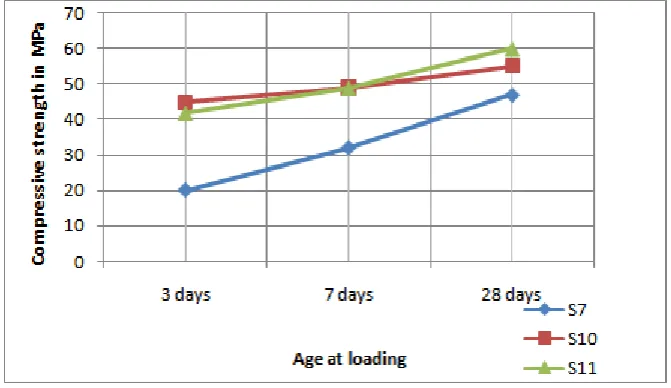
The increase in cement replacement beyond 30% causes a problem of structural instability and show the variation in compressive strength of all-cement SCC to shell lime. The initial rate of gain of strength is good but at later stage the strength development is very little. The variation in compressive strength with age is shown in Fig 2.
Fig 2: Variation in compressive strength with age atloading.
B. EFFECT OF ADMIXTURE ON EARLY AGE STRENGTH OF SCC.
In this study, it is seen by visual observation that the heat of hydration is more when the shell lime powder is used compared to other pozzolanas. Due to this the mix becomes very stiff within 20 minutes reducing its flowing ability. So no viscosity modifying agents were used.
C. EFFECT OF SHELL LIME POWDER.
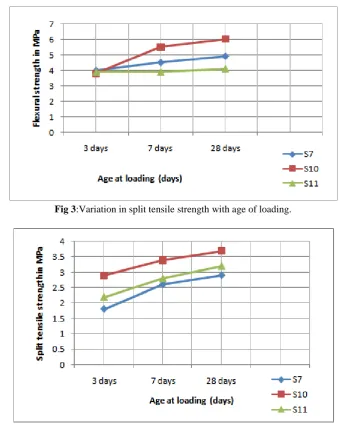
Fig 3:Variation in split tensile strength with age of loading.
Fig 4: Variation in flexural strength with age of loading.
E. SHRINKAGE STRAIN
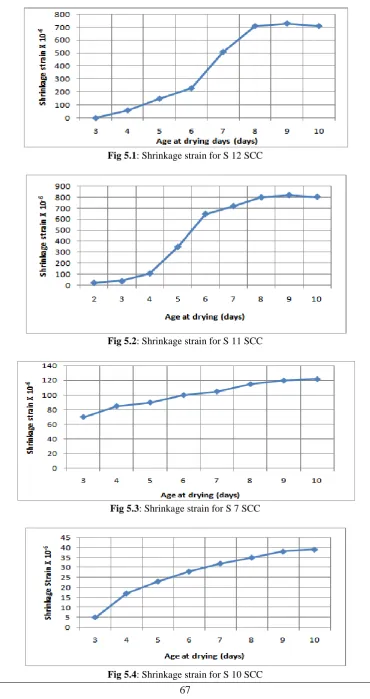
After de-moulding, the specimens were placed in water for thirty minutes. Then they were removed from water, wiped with a damp cloth, and immediately a comparator reading was taken. This reading is called as the initial comparator reading .After three days of curing period, readings were taken at every six hours for the first three days, every twelve hours for the next four days. Shrinkage measurements were obtained using a dial gage comparator with readings measured to an accuracy of 0.002mm. An invar bar of 300.12mm was used for calibration during testing. Based on varying cement content four mixes were analysed for theirshrinkage strains.
Table VII: SCC mixes analyzed for shrinkage strains
S 12 All cement SCC with cement content of 550 kg/m3
S 7 Cement = 412.5 kg/m3 and shell lime powder = 137.5 kg/m3
S 10 Cement = 500 kg/m3 and shell lime powder = 200 kg/m3
S 11 Cement = 550 kg/m3 and shell lime powder = 150 kg/m3
Fig 5.1: Shrinkage strain for S 12 SCC
Fig 5.2: Shrinkage strain for S 11 SCC
Surprisingly, the all-cement SCC(mix 12) has not shown much shrinkage which may be due to the high initial strength gain. When the shrinkage strains of these 4 mixes are compared, it can be seen that the shrinkage strain is minimum for SCC formed with 20% shell lime replacement. Thus it can be concluded that the shrinkage strain is inversely proportional to the cement content in the mix. Also the difference in the shrinkage strain of all-cement SCC and shell lime based SCC is not very substantial due to the high strength characteristics of these concrete mixes.
IV. CONCLUSION
On the basis of the above mentioned study the following conclusions are made with regards to the 4 aspects investigated in this study.
A. EFFECT OF SHELL LIME POWDER.
The heat of hydration was too much which resulted in decreasing the flowability of concrete when kept for sometime. So the retarder was used to maintain the flowability nature of the concrete. Due to the use of shell lime powder as filler the amount of water used was more as compared to other fillers used for SCC.
B. EFFECT OF VMA
In the study, it is seen that the use of shell lime powder has made the concrete mix stuff, so there was no bleed water in concrete, due to which VMA was not used in any of the mixes.
C. MIX DESIGN
Trial and error mix design is adopted in this work. So it was easy to find the perfect SCC after some trials were executed.
D. SHRINKAGE
The shrinkage strain of cement SCC and shell lime SCC is not very substantial even though high powder is present. Shrinkage decreased as the amount of cement increased.
REFERENCES
[1]. Bouzoubaa, N., Lachemi, M., "Self Compacting Concrete Incorporating High-Volumes of Class F Fly Ash: Preliminary Results", Cement and Concrete Research, 2001, pp: 413-420.
[2]. BertilPersson, "A comparison between mechanical properties of self compacting concrete and the corresponding properties of normal concrete.", Cement and Concrete Research, 2001, pp: 193-198. [3]. JagdishVengala, R. V. Ranganath, M.S Sudarshan, "Experimental study for obtaining SCC and Mix
proportioning method for SCC" ,Indian Concrete Journal ,2003, pp 1261-1266.
[4]. Ouchi, M., Hibino, M., Ozawa, K. and Okamura, H., "A Rational Mix-Design for Mortar in Self-Compacting Concrete", Proceeding of the Sixth East-Asia-Pacific Conference on Structural Engineering and Construction, Taipei, Taiwan, 1998, pp. 1307-1312..
[5]. K. H. Khayat and Z. Guizani, "Use of Viscosity-Modifying Admixture to Enhance Stability of Fluid Concrete", ACI Materials Journal, 1997, Vol. 94, No. 4, pp. 332-341
[6]. Mr. A. Yahia, Mr.Tanimura, Mr.Shimabukuro, "Effect of Rheological Parameters on SCC Containing Various Mineral Admixture", Central Research Lab, Osaku, Japan, 1999, pp 523-535.
[7]. Japan Society of Civil Engineers, "Recommendation for Construction of Self Compacting Concrete", 1998 pp.157- 164.
[8]. EFNARC, "Specification and guidelines for Self Compacting Concrete" website :http://www.efnarc.org/