e-ISSN: 2278-067X, p-ISSN: 2278-800X, www.ijerd.com
Volume 9, Issue 2 (November 2013), PP. 13-21
Reliability Study on Spark Plugs Using Process Failure
Mode and Effect Analysis
J. Arun
1, S. Pravin Kumar
2, M. Venkatesh
3, A.S. Giridharan
41,2,3,4UG Graduate, Department of Mechanical Engineering, Government College of Technology, Coimbatore,
India.
Abstract:- Failure Mode and Effect Analysis (FMEA) is a systematic tool for identifying the effects or consequences of a potential product or process failure and to eliminate or reduce the chance of failure occurring. The FMEA is a proactive approach in solving potential failure modes. Ideally, FMEAs are conducted in the product design or process development stages, although conducting an FMEA on existing products and processes can also yield substantial benefits. This paper provides the use of FMEA for improving the reliability of spark plugs in order to ensure the engine efficiency which in turn improves the bottom line of automotive industries. Thus the various possible causes and their effects along with the prevention are discussed in this work. Severity rating, Occurrence rating, Detection rating and Risk Priority Number (RPN) are some parameters, which are to be determined. These are the steps taken during the design phase of equipment to ensure that the reliability requirements have been properly allocated and that a process for continuous improvement exists. Here, the FMEA technique is applied on the spark plug operation and the defects are found. This work serves as a failure prevention guide and also would improve the reliability of spark plug and thus ensuring the effective vehicle performance.
Keywords:- FMEA, Spark Plug, Failure Modes, Severity rating, Occurrence rating, Detection rating, Risk Priority Number.
I.
INTRODUCTION
In today’s market, the expectancy of the customer towards high quality, reliable and cost effective products is really high. So this expectancy proves a burden for the manufactures as they strive to satisfy the customers with defect free, reliable product. So the manufacturers switch to a newer technique which helps them to achieve the expected standards. The challenge is to design a quality and reliability product early in the development cycle. Such challenges are met with latest techniques and strategies implemented in both the design and product manufacturing. One such technique is Failure Mode and Effect Analysis (FMEA). Failure Mode and Effect Analysis (FMEA) is used to identify potential failure modes, determine their effect on the operation of the product, and identify actions to mitigate the failures [1], [2].
This project is about the reliability of spark plug (an automotive component) by using FMEA technique which identifies how the product or process will fail and how to eliminate or reduce risk of failure.
A. FAILURE MODE & EFFECT ANALYSIS
Failure Mode and Effect Analysis (FMEA) was first developed as a formal design methodology in the 1960s by the aerospace industry with their obvious reliability and safety requirements. The purpose of FMEA is to identify possible failure modes of the system, evaluate their influences on system behavior and propose proper countermeasures to suppress these effects. FMEA enhances further improvisation of both the design and manufacturing processes in the future as it serves as a record of the current process in formations [3]. It reduces costs by identifying system, product and process improvements early in the development cycle. It prioritizes actions that decrease risk of failure.
B. IMPORTANCE OF FMEA IN SPARK PLUG
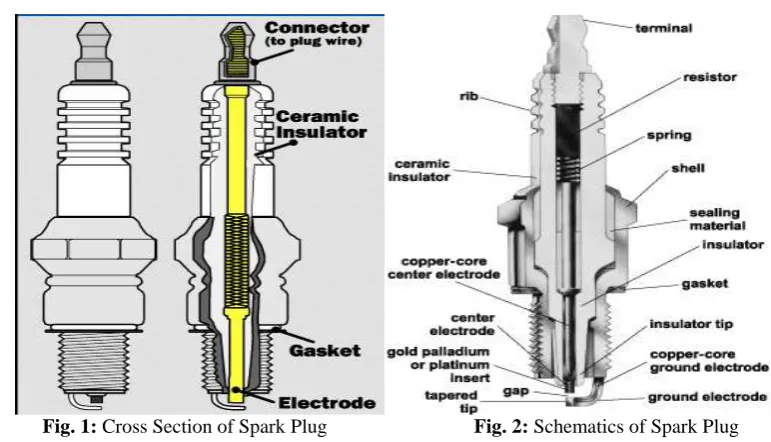
Spark plugs were a key invention for the production of an effective spark-ignition engine. A spark plug is a device for delivering electric current from an ignition system to the combustion chamber of a spark-ignition engine to ignite the compressed air/fuel mixture by an electric spark, while containing combustion pressure within the engine. Various components contribute to the accuracy, reliability of the product. When these components are defective, this leads to the failure of the product. These may result in unfavorable consequences like failure of the product/system and production of inaccurate products. Hence it is essential to conduct a FMEA on this product so that the failure is avoided totally or reduced. Prior notification of these failures can prevent them by following control measures.
II.
LITERATURE REVIEW
A. Failure Mode and Effect Analysis (FMEA)
In 1977, Ford Motors introduced FMEA to address the potential problems in the R&D and the early stage of production and published the Potential Failure Mode and Effects Analysis Handbook in 1984 to promote the method. Later on the automobile manufacturers in America also introduced the FMEA into the management of suppliers, and took it as a key check issue. Some researches on FMEA have been carried out by previous researchers but still a lot of applied research in the above field is required so as to explore the successful utilizations of the FMEA technique in the area of manufacturing and design.
Failure Mode and Effects Analysis (FMEA) is a methodology designed to identify potential failure modes for a product or process, assess the risk associated with those failure modes and prioritize issues for corrective action and identify and carry out corrective actions to address the most serious concerns [4]. In FMEA, failures are prioritized according to how serious their consequences are, how frequently they occur and how easily they can be detected. Ideally, FMEA begins during the earliest conceptual stages of design and continues throughout the life of the product or service. Results can be used to identify high-vulnerability elements and to guide resource deployment for best benefit. An FMEA can be done any time in the system lifetime, from initial design onwards. The various steps in Process Failure and Effect Analysis are as follows
Reviewing the process
List the potential effects and modes of failure
Assign a severity rating
Assign an occurrence rating
Assign a detection rating
Calculate the risk priority number (RPN) for each mode of failure
Take action to eliminate or reduce the high-risk failure modes
Calculate the resulting RPN as the failure modes are reduced or eliminated [3].
B. SPARK PLUG
Fig. 1: Cross Section of Spark Plug Fig. 2: Schematics of Spark Plug
The efficiency of the engine is strongly dependent on the firing efficiency of the plugs, requiring an intense, localized spark, which is typically formed between sharp edges or protuberances on the electrode surfaces; ‘‘diffuse’’ arcs form if such protuberances are absent, producing a distribution of the spark in a series of small, individual arcs along the edge of the electrodes [8], [9]. In general, a spark plug design with high firing efficiency results in a limited lifetime. It is therefore desirable to reduce initial efficiency in favour of improved lifetime efficiency. Hence, in order to improve its design and functioning qualitatively, FMEA is carried out. The major failures occurring in spark plug are shown in Fig 3 and Fig 4. Thus by implementing the FMEA technique, the reliability of failure and effect for the spark plug can be reduced.
Fig. 3: Carbon Fouling Fig.4: Overheating of Spark Plug
Although FMEA analyses vary from hardware to software and from components to systems, the goal is always the same: to design reliability into the equipment. Thus, a functional analysis to FMEA on a component or equipment is appropriate to use as a case study for the purposes of this guideline.
III.
FMEA PROCESS FLOW
A. SPARK PLUG SYSTEM
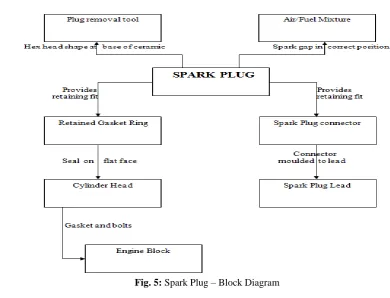
Fig. 5: Spark Plug – Block Diagram
B. POTENTIAL EFFECTS & FAILURE MODES
Based on the trials conducted the failures are listed. In this, previously recorded failures are also added. The effects of these failure modes are also tabulated. These failure modes and their effects are charted separately for the sake of calculating and assigning the ratings and risk priority numbers. With the failure modes listed on the FMEA Worksheet, each failure mode is reviewed and the potential effects of the failure should it occur are identified. For some of the failure modes, there is only one effect, while for other modes there may be several effects. This step must be thorough because this information will feed into the assignment of risk rankings for each of the failures. It is helpful to think of this step as an if-then process: If the failure occurs, then what are the consequences [3].
C. SEVERITY RATINGS
The severity ranking is an estimation of how serious the effects would be if a given failure did occur. In some cases it is clear, because of past experience, how serious the problem would be. In other cases, it is necessary to estimate the severity based on the knowledge of the process. There could be other factors to consider (contributors to the overall severity of the event being analyzed) [3]. Calculating the severity levels provides for a classification ranking that encompasses safety, production continuity, scrap loss, etc. user. Each effect is given a severity number (S) from 1 (no danger) to 10 (critical). A failure mode with severity number of 10 results in severe dissatisfaction of the customer and may even result in the physical injury due to the failure. Severity ratings in the range of 4-6 result in mild dissatisfaction of the customer whereas those in the range of 1-3 are not so severe and may even be not detected [2], [1-3], [10]. Table 1 gives the guidelines based on which severity ratings were given.
Table 1: Severity Ratings
SEVERITY RATING DESCRIPTION
1-2
Failure is of such minor nature that the customer (internal or external) will probably not detect the failure.
3-5
deterioration of part or system performance.
8-9
Failure will result in high degree of customer dissatisfaction and cause non-functionality of system
10
Failure will result in major customer dissatisfaction and cause non-system operation or non-compliance with regulations
D. OCCURANCE RATINGS
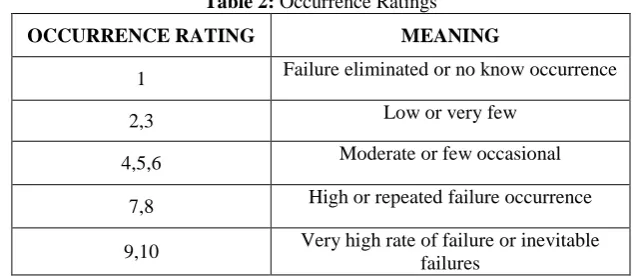
Occurrence ratings denote how often such failures occur. In this step it is necessary to look at the number of times a failure occurs. This can be done by looking at similar products or processes and the failure modes that have been documented [3]. A failure mode is given an occurrence ranking (O), again 1–10. If a failure is inevitable or occurs often, then it is given a rating in the range of 8-10. Those with mild occurrences are given 4-6 whereas those with low or eliminated failure have 1-3 occurrence ratings [2], [3], [10]. Table 2 gives the occurrence ratings based on which FMEA table is designed in this paper.
Table 2: Occurrence Ratings
OCCURRENCE RATING MEANING
1 Failure eliminated or no know occurrence
2,3 Low or very few
4,5,6 Moderate or few occasional
7,8 High or repeated failure occurrence
9,10 Very high rate of failure or inevitable failures
E. DETECTION RATINGS
This section provides a ranking based on an assessment of the probability that the failure mode will be detected given the controls that are in place. The proper inspection methods need to be chosen. The probability of detection is ranked in reverse order. For example, a "1" indicates a very high probability that a failure would be detected before reaching the customer; a "10" indicates a low – zero probability that the failure will not be detected [2], [3], [10]. Table 3 shows the guidelines based on which the detection ratings of a product are given.
Table 3: Detection Rating
DETECTION RATING DESCRIPTION
1 Very certain that the failure will be detected
2-4 High probability that the defect will be detected
5-6 Moderate probability that the failure will be detected
The risk priority number (RPN) is simply calculated by multiplying the severity ranking times the occurrence ranking times the detection ranking for each item.
Risk Priority Number = Severity × Occurrence × Detection
The total risk priority number should be calculated by adding all of the risk priority numbers. This number alone is meaningless because each FMEA has a different number of failure modes and effects. The small RPN is always better than the high RPN. The RPN can be computed for the entire process and/or for the design process only. Once it is calculated, it is easy to determine the areas of greatest concern. There could be less severe failures, but which occur more often and are less detectable. These actions can include specific inspection, testing or quality procedures, redesign (such as selection of new components), adding more redundancy and limiting environmental stresses or operating range. Once the actions have been implemented in the design/process, the new RPN should be checked, to confirm the improvements [1], [2], [10].
Table 4: FMEA Table for Spark Plug
S. N o
Problem Effects
Severi ty Ratin g Occurre nce Rating Detecti on Rating
Causes Solutions RPN
1 Fouling - Carbon Fouling and Oil Fouling
Misfiring 7 4 5 Faulty injector Check the condition of injector 140 Weak ignition system voltage
4 6 Clogging of air cleaner element
Clean the air filter
168
Poor cylinder compression
3 7 Delay in ignition timing Check ignition system and oxygen sensor 147 Hard starting
2 7 Plug heat range too high
Make sure the plug has correct heat range / thermal rating
98
5 5 High oil consumption
Check the valves for proper seating
175
Check and or replace oil seals Make sure gasket ring is leak-proof 7 5 Rich air/fuel
mixture
Maintain correct air/fuel ratio
245
injection system 2 7 Reduced
insulation resistance
98
6 3 Too cold a spark plug is used
Use a hotter spark plug in the specified range
126
2 Flashover Wear of terminal electrodes
8 2 3 High
compression pressure Maintain optimal compression pressure 48 Misfiring and hard starting
4 3 Contaminatio n in the ignition leads
Avoid contamination by
replacing/clean ing dirty spark plugs
96
Deterioratio n of plug cap
Check O-rings at the bottom of the lead 2 6 Worn out
insulator boots
Check the insulator boots for proper fit
96
7 3 Widened spark gap
Adjust the gap precisely
168
2 5 Torn rubber gasket
Replace the rubber gasket
80
3 5 Plug cable material hardens Replace plug cable periodically 120
1 3 High ignition voltage
Check the ignition coil
24
Maintain the spark gap at the desired level
3 Spark Plug overheatin g
Abnormal combustion
9 3 4 Ignition timing too far advanced Adjustment of ignition timing is required 108 Melting of spark plug electrodes
3 2 Air/fuel mixture(A/F) too lean
Adjustment of air fuel ratio (A/f) is required 54 May cause pre-ignition Check fuel injectors for proper functioning
turbo engine 3 3 Insufficient
tightening of spark plug Tighten to specified torque 81
2 2 Use of too hot a spark plug
Use colder spark plug in the given range
36
5 5 Block or leak in intake manifold Clean or replace the intake manifold 225
4 Spark plug deformatio n / damage
Thread damage
9 2 2 Spark plug inserted at an improper angle
Tightening the plug by hand first instead of using a wrench from the start
36
Metal shell damage
3 5 Excessive tightening
Tighten to the specified tightening torque 135 Insulator breakage
2 4 Spark plug wrench used at an angle or it slipped
Use a hexagonal socket wrench that does not slip easily
72
Avoid rounded or loose wrench 2 6 Gasket too
loose or too tight
Make sure gasket is tightened to the recommended tension
108
5 Electrode wear
Engine starting problems
8 4 4 Plugs have been left in the engine too long Replace the spark plugs 128 Misfiring during running Follow the recommended maintenance schedule Maximum power cannot be obtained from the engine
1 6 Incorrect spark plug selection
Replace with spark plugs of the required heat range
48
4 5 Inadequate engine servicing (fuel and ignition systems) Follow the service chart periodically 120
plug and fuel filter periodically and maintaining a constant A/F mixture. The latter may lead to melting of electrode and reduced efficiency of engine hence the sparkplug overheating is to be avoided. The spark plug can be maintained at a prescribed range of temperature by means of cleaning the air filter periodically and doing a periodical check for any blocks in the fuel passage and the intake manifold. The defects such as spark plug deformation and the electrode wear have the least the least probability of occurrence if the above mentioned defects are avoided. The flashover is likely to be eliminated at the design level itself but it also have to be taken in too consideration for the worst cases. Thus, the spark plug would have an increased running time if the above described precautionary measures are to be adopted.
V.
CONCLUSION
The present work deals with the Process FMEA study of a spark plug. Thus the spark plugs used in various automotives have been analyzed and the expected failure modes have been duly observed and tabulated. The potential effects of failures are evaluated with their severity value and then the causes and their prevention are calculated along with their occurrence rating. By assigning the detection rating to the failure mode, the value of risk priority number is calculated. The risk priority numbers are specified which indicates the necessity of care for the reliability of spark plug. From the results of the critical analysis, the failure modes with greater risk priority number have been selected. The causes, effects and possible alternate solutions are given along with the ratings and priorities of action that decrease risk failure. Thus this process analysis will serve as a helpful tool to detect the occurring of failure modes and also assures in the effective functioning of the spark plugs.
This study provides a well documented method for selecting a spark plug with a high probability of successful operation and safety. As a result of this FMEA analysis, the down time of the vehicle is reduced by improving the reliability of spark plug. This approach can be well suitably applied to consumer products like automotives and their components, home appliances, etc., and other fields such as manufacturing, aerospace, instrumentation, medical, chemical processing, etc.
REFERENCES
[1]. V Janarthanan, D Rajenthira Kumar. Root Cause analysis & process failure mode and effect analysis of TIG Welding on SS 3041 material (Proceeding of NC MISAA 2013, copyright 2013 PSGCT)
[2]. Aravind P, Rooban Babu R, Arun Dhakshinamoorthy, Venkat Prabhu N, Subramanian SP¸ An integrated approach for prediction of failures by process failure mode and effect analysis (PFMEA) in MIG Welding-a predictive analysis (ISBN-978-93-82208-00-6)
[3]. Robin E. McDermott, Raymond J. Mikulak, Michael R. Beauregard. The basics of FMEA-Productivity press (1996)
[4]. Virtanen S. and Hagmark PE. Simulation and Calculation of Reliability Performance and Maintenance Costs. IEEE, Proceeding: Annual Reliability and Maintainability Symposium (RAMS). January 22 – 25, 2007. Orlando, FL, USA. pp. 34 – 40.
[5]. Taylor CF. Internal combustion engine in theory and practice: vol. 2: combustion, fuels, materials, design. Boston: MIT Press; 1985
[6]. Javan S, Hosseini SV, Alaviyoun S. An experimental investigation of spark plug temperature in bi-fuel engine and its effect on electrode erosion. International Journal of Automotive Engineering 2012; 2:21–9.
[7]. Armando Ortiz, Jorge L. Romero, Ignacio Cueva, Vıctor H. Jacobo, Rafael Schouwenaars. Spark plug failure due to a combination of strong magnetic fields and undesirable fuel additives. Case Studies in Engineering Failure Analysis 1 (2013) 67–71.
[8]. Lin HT, Brady MP, Richards RK, Layton DM. Characterization of erosion and failure processes of spark plugs after field service in natural gas engines. Wear 2005; 259:1063–1067.
[9]. Soldera F, Lasagni A, Mucklich F, Kaiser T, Hrastnik K. Determination of the cathode erosion and temperature for the phases of high voltage discharges using FEM simulations. Computation Materials Science 2005; 32:123–39.