Abstract—The emersion of computer applications in construction such as Building Information Modeling (BIM) has evolved the estimating process. Many studies have evaluated the benefits of using BIM in preconstruction phase, however, no researches have been conducted for Iranian construction industry where companies are obligated to follow the National Bill of Quantity (NBQ) book as the standard classification in the bid process and estimating for government projects. Current BIM tools are adaptive with major construction classifications such as Uniformat. This paper evaluated the possibility of aligning current BIM tools with the Iranian NBQ using a case study. A 3D model was created considering the items defined in NBQ. The quantities were extracted from the model and a cost analysis was performed to determine the resources required for this project. The result of this study shows that it is practical to incorporate NBQ classification in current BIM tools in the estimation process.
Index Terms—Building information modeling, cost estimation, tender, structural modeling, 3D modeling, quantity takeoff.
I. INTRODUCTION
Cost estimation for tendering of building projects generally consists of three major processes. Classifying all construction products that constitute a building project into assemblies or items, taking off the quantities for these assemblies or items, and computing the project cost [1]. Recently, great amount of software applications became available for cost estimation. These applications have greatly improved the working efficiency of estimators. However, in practice, when design is in 2D formats, estimators still have to manually extract useful information from printed drawing sets or CAD drawings, or manually rebuild a specific 3D model for cost estimation [2]. Due to complexity of these processes, cost estimation is still time-consuming and prone to error [3].
Building Information Modeling (BIM) technology enables a potential solution to these problems through an updated model throughout the project lifecycle [4]. Theoretically, all the information can be shared directly among different phases with the support of open data exchange standards for BIM, such as the Industry Foundation Classes (IFC) standard [5]. Thus, information contained in the BIM-based design model can be shared directly in cost estimation, which can reduce the heavy human workload and manual errors in traditional work.
Manuscript received October 31, 2017; revised March 23, 2018.
Milad Ashtab is with Shahid Beheshti University, Iran (e-mail: [email protected]).
Mohammad Reza Farzad is with Texas A&M University, USA (e-mail: [email protected]).
A. Quantity Take off and BIM
One of the most important tasks that can be automated through BIM is quantity takeoff (QTO). A BIM-based model is an assembly of objects defined by specific properties, some of which are the elements’ geometric attributes. Most BIM tools contain routines to perform calculations using the elements’ geometric properties and provide spatial quantities like area and volume in text form. BIM-based QTO is reported to provide simpler and yet more detailed and accurate cost estimates of the project, reducing time and expenses [6].
Several studies have revealed that BIM-based cost estimation is more efficient and accurate than that based on the traditional design [3], [7]. Some BIM-based software applications have emerged like Autodesk Navisworks in which the BIM-based design model can be imported to conduct effective cost estimation. These applications are unable to solve two major problems; First of all, though construction products can be classified into assemblies or items according to certain conditions in this program, it is still a manual process because estimators have to set such conditions to adapt with a certain classification of their own. Second, their quantity takeoff completely depends on the quality of imported design model [8].
B. Aligning BIM with work items of bill of quantities
There are numerous researches based on developing ontologies using OWL languages. Ma et al. performed researches on the possibility of automatic or semi-automatic work item extract based on ontology. First one consists of analyzing national bill of quantity of china and related ontologies to them in OWL language and developing a prototype tool to facilitate item extraction only in case of concrete beam in various conditions [1]. They also related these items to IFC classes to perform a semi-automatic item extraction using BIM tools and by defining the add-on using IFC classes [9]. Lee et al. worked on an ontology based work item extraction considering best construction method for each item which was limited to the scope of work for tiling [10] and brick walls [11]. Practicality of using ontologies for quantity takeoff has also been surveyed by developing OWL based semantic approaches [12].
II. LITERATURE REVIEW
In order to comprehend the estimation practices in Iran, the National Bill of Quantity as the standard classification has been reviewed. Furthermore, the usage of this bill in each step of estimation was scrutinized. Additionally, BIM-based tools for estimation and their alignment with classifications have been reviewed.
Aligning Tender Cost Estimation Practices in Iran with
BIM
A. Brief Introduction to Iranian Bill of Quantities
Every year, the Management and Planning Organization of Iran publishes various nationwide bills of quantities (NBQ) as a standard classification for different fields such as buildings, road construction, electrical facilities etc. These bills consist of items, units of measurement and suggested price of items. Projects in which government act as the owner, the NBQ should be considered for pricing in consultant cost estimation for tenders. Alongside that, contractors should perform their own cost analysis based on the items and their units of measurement in bill of quantities. The analysis should consider cost of labor, equipment and material for each item. However, the government issues National Cost Analysis Book (NCAB) as a suggested resource for cost analysis. Since government is one the greatest owners of projects in Iran, NBQ plays a significant role in Iranian building and construction industry.
Each NBQ includes multiple sections which are specified for a group of similar functions. For instance, section 5 and 6 of NBQ for buildings is assigned for wooden and steel frameworks for concrete, respectively. Unlike some of the other classification systems all over the world, such as Uniformat which is product-based, NBQs are activity-based. It means for each product of building, estimator should match it with multiple work items. For example, for cast in place (CIP) concrete beams, the estimator would need activities from wooden frameworks section (sec. 5), CIP concrete section (sec. 8), and reinforcements section (sec. 7). So, multiple sections might be used for a building product which is not necessarily a complex one. This feature makes NBQ difficult to adapt with BIM tools such as Autodesk Revit and Autodesk Navisworks which are mainly object-based software applications.
B. BIM Based Cost Estimation and Quantity Take off
Cost estimation is the process of predicting project costs and resource requirements. First, estimators identify technical requirements such as building elements and finishing materials. These requirements, depending on the project type, influence costs related to required equipment, total hours of labor, or costs incurred by the need to obtain special building permits. The technical requirements decide what work items will be needed based on work conditions. This step requires in-depth knowledge and experience, and thus was the least structured step in the estimation process. Third, applicable unit costs are found from an external unit cost data base. The data base includes types of resources, quantities of resources, and unit cost of resources for each work item.
Estimation can be conducted throughout different phases of a project using BIM. The level of detail in the model varies depending on the project phase and requirement. BIM offers the capability to generate takeoffs, counts, and measurements directly from a model. The main benefit of applying BIM-based tools to estimate project costs occurs during the quantity takeoff step [13]. Particularly, BIM has the following requirements [14]:
• Enough detail must be provided to generate an estimate. • Estimators must be allowed to extract quantities of building components grouped by the company's work breakdown structure (WBS).
C. Construction Classification Systems and BIM
Construction Classification Systems are established worldwide to organize and standardize building elements and activities. For instance, Uniclass in UK, BSAB in Sweden and Uniformat, Masterformat and OmniFormat in the United States [15]. Different classifications can be valuable in different phases of the project. Uniformat is known as a classification that categorizes buildings into elements and sub-elements which made this classification suitable for object based BIM-applications such as Autodesk Revit [2]. To standardize the discussed estimation process, it is necessary to strictly comply with certain classifications to develop an effective and accurate estimate for tendering. Despite the numerous features that BIM software applications provide, it is questionable if they can accommodate for local classifications such as NBQ.
This paper will concentrate on Iranian national mandatory specification for cost estimation and probability of lining it up with Autodesk Navisworks as an object-based estimating application.
III. METHODOLOGY
A. Research Method
The main motive of the research was to evaluate the practicality of aligning Iranian cost estimation method and current BIM tools. This paper discusses implementation of Iranian NBQ in an BIM-based application that enables the object-oriented quantity takeoff. In order to achieve the goal of this research, a case study was developed. Consequently, the following steps were conducted:
First, the NBQ for cost estimation was introduced as the classification for the project and it was interpreted into a computer process-able format. Furthermore, the case study was modeled according to the items in NBQ. Moreover, using the model, the quantity takeoff was performed to capture the items depicted in NBQ. In addition, the suggested NCAB was utilized to break down the quantities into resources required to perform the project. Finally, the results were evaluated to capture the practicality of using this system.
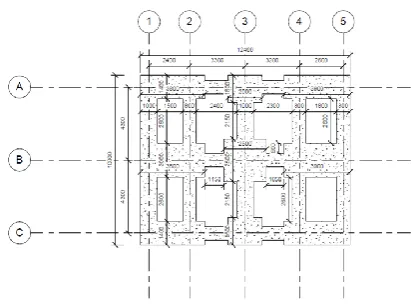
Fig. 1. Structural plan of the project.
B. Case Study
important phase of the construction in Iran which was similar for most of the buildings. For the matter, the phase of site excavation and foundation construction was selected. Furthermore, a typical foundation system for a multistory residential building was selected for this study. This system consists of 9 isolated footings which are tied together by strap beams. Fig. 1 shows the plan for this foundation system:
C. Level of Detail (LOD) of Items in NBQ
To develop the suitable model for this quantity takeoff, the LOD for each element of the project was determined. Each item of the work was identified and was broken down to the smallest detail available in NBQ. This case study includes 10 items which can be extracted from 5 sections of NBQ. These 5 sections are: soil excavation, material transportation, formwork for foundations and beams, reinforcement and cast in place concrete.
Each item includes multiple activities and the quantity of labor, material and equipment for the item can be calculated separately using multipliers provided in the suggested NCAB.
In order to quantify the excavation related items, the purpose of excavation, soil material and net cut/fill volume of soil had to be considered.
In items related to transportation of soil, the important factors are soil volume and distance of the excavation site from transport destination.
As there are two separate sections for formworks in Iranian NBQ, it is important to define formwork material in model specially in cases with both methods of formwork. For either methods, the unit for quantification is square meters, so, the area of formwork should be considered while modeling this item.
For the reinforcement section, all the work is quantified based on the weight of reinforcement in the project. The unit of measurement is kilograms which can also be calculated by quantifying the length of reinforcement bars. To achieve an accurate calculation for rebar length, the reinforcement model must have the highest LOD.
Finally, for concrete related items the only important factors are concrete’s compressive strength and volume. The information extracted form NBQ and determined level of detail for each item are shown in table below (table I):
TABLE I: INFORMATION FROM NBQ WHICH SHOULD BE CONSIDERED IN MODEL
Code Item Effect on model
100020 103
Excavation for foundation in hard soil
Excavation place/Soil Composition/ Soil Volume
100020 104
Excavation(machinery) foundation in hard soil
Excavation place/Soil Composition/ Soil Volume
100030 701
Transportation less than 100m
Project Location/Destination/ Soil Volume
100030 702
Transportation less than 500m
Project Location/Destination/ Soil Volume
100030 703
Transportation less than 10km
Project Location/Destination/ Soil Volume
100050 101
Foundations and beams Elevation Code/Formwork Material/ Formwork area
100070 201
Stirrups Reinforcement Detail & length/Steel Material/Ribbed or simple 100070
202
Rebar Reinforcement Detail & length/Steel Material/Ribbed or simple
100080 105
20Mpa Concrete for foundation
Compressive Strength/ Components Vol/ Cement Volume
100080 104
16Mpa Concrete for foundation
Compressive Strength/ Components Vol/ Cement Volume
D. 3D Modeling
Autodesk Revit was utilized to create the building information model of this system. Each item was modeled as a separate object to be quantified individually.
The excavation had two phases of machinery excavation and hand excavation. In order to model the machinery excavation, the top of the foundation was defined as the bottom of the excavation a generic mass created considering 45 degrees slope for the excavation.
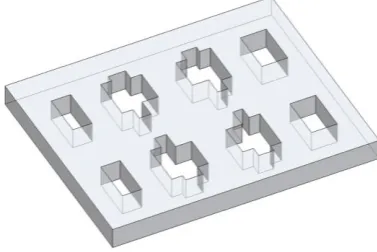
Hand excavation was modeled as a separate mass. The figure 1 drawing was extruded from top of the foundation level to bottom of the foundation level (Fig. 2).
Fig. 2. Generic 3D model of structural foundation.
The foundation system was divided in isolated foundations and strap beams. Since each section of the foundation had a unique dimension, multiple family types were created to represent each foundation. Foundations were placed based on the Fig. 1 drawing and connected to each other using concrete beams representing strap beams (Fig. 3).
Fig. 3. Considering foundation beams in model.
Using Revit, the rebar can be placed by groups or individually. Howeverو the process can be time consuming. In order to place the rebar inside the concrete foundation, Rex 2017, a Revit plugin was used. Fig. 4 shows the rebar model.
Furthermore, concrete wooden forms are wooden planks that are quantified based on their area. These forms can be represented as a thin one layered wooden wall family. The wall was modeled on the perimeter of the concrete foundation (Fig. 5).
Fig. 5. Formwork modeling foundation.
E. Takeoff
Autodesk Navisworks was used as a BIM enabled application which has the ability to takeoff Building Information Models by categorizing each item. The quantification feature gives the ability to assign model instances to different items and extract quantities from the model. Items of the foundation system were inserted in the XML template to be imported into Navisworks as a catalog (Fig. 7).
Fig. 6. Consisting work items based in NBQ.
Fig. 7. Model properties through NBQ measurement units.
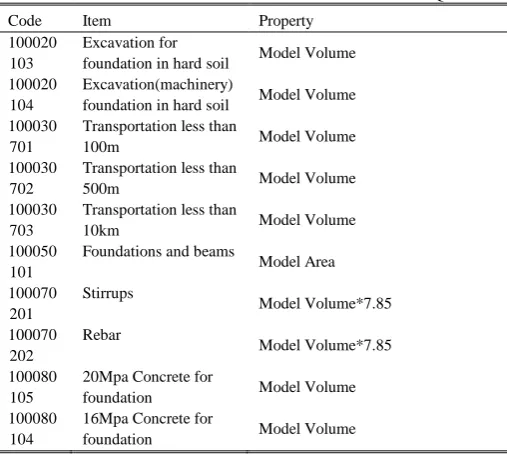
Moreover, the Revit model was imported into Navisworks. In order to takeoff the necessary quantities of each item, the related property of the model was identified using the properties section. Properties such as length, area and volume could be extracted from each item accordingly. In addition, some properties calculated using predefined formulas in the item catalog such as the rebar weight. The weight was calculated by multiplying the reinforcement volume of the
rebar by its density which is 7.85 Kg/m3 (Fig. 8).
The following table II shows the properties that was used for each item:
TABLE II: PROPERTIES OF MODEL FOR EACH ITEM OF NBQ
Code Item Property
100020 103
Excavation for
foundation in hard soil Model Volume 100020
104
Excavation(machinery)
foundation in hard soil Model Volume 100030
701
Transportation less than
100m Model Volume
100030 702
Transportation less than
500m Model Volume
100030 703
Transportation less than
10km Model Volume
100050 101
Foundations and beams
Model Area
100070 201
Stirrups
Model Volume*7.85
100070 202
Rebar
Model Volume*7.85
100080 105
20Mpa Concrete for
foundation Model Volume
100080 104
16Mpa Concrete for
foundation Model Volume
Furthermore, resources were defined based on the suggested NCAB for each item and were added to the catalog to calculate the labor, material and equipment. The amount of resources used in each item can be different which is defined by a multiplier on the NCAB. The multipliers were incorporated to the catalog while the resources were assigned to each item (Fig. 9).
Fig. 8. Resource allocation based on cost analysis of NBQ.
IV. RESULTS
The study depicted the process of identifying work items based on NBQ for a typical multi-story building’s foundation system in Iran. Since those items could be quantified by either length, area, volume or weight, the LOD for modeling could be adjusted for each item to fulfil the accuracy needed for quantification. The BIM-Based application had the flexibility to quantify similar objects for different work items using variable multipliers. Also, being able to add resources to the quantification, assisted to incorporate cost analysis and calculation of total labor, material and equipment needed by their categories. As a result, this study shows that it is practical to use BIM tools in quantity takeoff in alignment with Iranian NBQ classification.
V. DISCUSSION
A. Cost Analysis Based on BIM Estimation
The procedure which is prevalent in pre-bidding cost estimations in Iran, completely depends on items proposed by government in mandatory classification for construction works. To determine the bidding base price, the consultant should prepare bill of quantities for projects based on these items and calculate prices which recommended for each item by the government through surveying practical prices for construction activities. Contractors should analyze each item through their logistics and procurement capabilities to determine their bidding price. Knowing the existing standards for the construction in Iran, all construction activities can be defined as items in BIM applications and corresponding quantities can be assigned to these items using the information that is incorporated in the model. This approach can help the contractors to cover all the required items on their bill of quantities by marking them visually on the model while quantifying the items. Also, it can improve the accuracy of the estimation since the calculations are done automatically based on the model’s information. However, a poor and inaccurate 3D model can impact the quantities significantly.
B. Level of Detail in Model Development
Moreover, other important issue about NBQ is the heterogeneous level of detail concerning each work item. As it was discussed in the literature review, building information models could be developed in different LODs based on information needed for that part of the work such as estimation, conceptual design or models for extracting as-built drawings. The required LOD for detailed estimation is defined as LOD 300. Although most of the items in NBQ contain information equal to LOD 300, but some of items contain information less than the required level.
This issue causes problem in extracting work items from NBQ based on the model which is prepared for estimation. As NBQ items lack sufficient information in comparison to the model, it can lead to confusion in choosing between two or more work items applicable for a part work. There might be elements in the model that cannot be covered by a single NBQ work item. Alongside that, some of items have unnecessary information which restrict contractors’ ability to choose the method of work.
Hence, it is necessary to determine the work items prior to developing the 3D model or adjusting the existing. 3D models can be developed by designers for presentation purposes which are not necessary accurate and might have LOD different from the requirements. Contractors should be responsible for developing models based on actual construction documents.
C. Defining the Quality of Services
BIM based applications have been designed to create information models useful for various stakeholders in various phases of construction. However, the current procedure of cost estimating in Iran is unable to take advantage of all of BIM capabilities. In the traditional approach, using the generic items from the NBQ restricts contractors to provide different quality options in their pricing. BIM makes contractors capable of defining the qualities of the services, material or equipment which are used in their model and potentially their proposal and helps the owner to make a better decision knowing the quality of service each pricing will deliver. In other words, current way of bidding in Iran hampers quality evaluation possibilities enabled by BIM in bidding and estimating.
In addition, BIM estimating brings more flexibility to the contractors to change geometry, material and method of construction. While the process is set up, changes can be done resulting in accurate quantities which makes the contractor able to perceive the impact of changes instantly.
D. Quality Control in BIM Estimating
The estimation process in Iran can be completely quantitative. Fulfilling the requirements indicated in the NBQ will be sufficient to place bids by the contractors. The NBQ items determine general qualities of work and enable the contractor to lower the quality of work in construction without any provable deviation from the requirements. If the building information model is used as a part of contractor’s bid, the owner is able to control and track the quality of services using this tool. The model should contain information of vendors, details of construction and must be part of a tender process and used as criteria to evaluate contractor performance.
E. BIM Does not Solve the Qhole Issue
Although the accuracy of estimation can improve using BIM, the most accurate cost estimate can still be highly deviated from the actual cost of the project. The main reason creating this deviation in Iran is the high and fluctuated inflation rate. All projects face this issue and some regulations developed to cover possible contractors’ losses. These regulations which are called modifications, adjust cost of contract by considering inflation of rates for materials and man-power. It is important to understand that BIM could only make takeoffs more accurate and can’t help to predict the actual cost of the project considering inflation.
VI. CONCLUSION
have been introduced and implemented in the industry. Each application has its limits and advantages, however, all of them are designed to facilitate the work processes in the industry. Despite the beneficial feature of the BIM, industry standards vary based on the location and environment of each project.
The paper’s main objective was to figure out if current BIM tools could be used by contractors in cost estimating process in Iranian construction industry. Alongside that, identifying potentials and obstacles in utilizing BIM in Iran construction environment was prominent. Therefore, the detailed cost estimation procedures before and while bidding in Iran needed to be analyzed. Both consultant and contractor have to use mandatory NBQ for work items published by government as the main reference, in order to create bill of quantities which is essential both as a tender document and a part of contractor’s bid. Thus, usefulness of BIM in cost estimation in Iran could be verified by answering this question: Are BIM estimating tools compatible with Iranian mandatory classifications for work Items. To answer this question, similar studies which identified or utilized BIM tools for estimation were reviewed. BIM abilities in automating quantity takeoffs and automated rule-checking, identified as valuable features which could extricate estimation process. To perform the study to evaluate the practicality of aligning BIM with Iranian NBQ, a section of a real apartment building was chosen as a prototype to be estimated. The building was modeled based on identified work items while the NBQ’s items were translated to a computer readable format. Finally, the quantities were extracted from the model and the result of work was evaluated to recognize the practicality of this process. This study demonstrates that the bill of quantities based on NBQ could be semi-automatically created using BIM based applications, though there might be some difficulties in aligning some of the work items of NBQ with BIM model and minor adjustments or manual calculations might be necessary. In addition, determining the LOD for modeling the building before performing the quantification is a key factor. Each work item would require a different LOD which can significantly impact the accuracy of estimation, whereas, in some cases higher LOD creates redundancy and potentially makes confusion and duplication. Further, BIM brings flexibility to cost estimation and gives the contractor the opportunity to compare different approaches of work in a short amount of time. Also, it improves the quality control process in the construction phase by providing useful details to the owner in bidding phase. Moreover, aligning other classifications to current BIM tools can cause errors if the models are not developed based on the required items or not treated as actual construction documents. To conclude, it is practical to use BIM as a tool to assist the owners and contractors utilizing Iranian NBQ to increase the accuracy, speed and quality of their estimation in bidding process for building construction.
This study focused on practicality of using BIM in alignment with Iranian NBQ. Knowing that estimation process can be done using BIM in the Iranian construction industry, future studies can be conducted to evaluate the experiences of the users using BIM for estimating in comparison to traditional approaches in Iran,.
REFERENCES
[1] L. Sabol, "Challanges in cost estimating with building information modeling," 2008.
[2] C. E. Firat, D. Arditi, J. Stenstrand, and J. P. Hmlinen, "Quantity takeoff in model-based systems," in Proc. CIB W78 2010: 27th
International Conference, Cairo, Egypt, 2010.
[3] National Institute of Building Sciences, "National building information modeling standard, version 2," 2012.
[4] Building Smart International Ltd. [Online]. Available: URL http://www.buildingsmarttech.org/specifications/ifc-overview. [5] A. Monteiro and J. P. Martins, "A survey on modeling guidelines for
quantity takeoff-oriented BIM-based design," Automation in
Construction, pp. 238-253, 2013.
[6] Z. Shen and R. R. A. Issa, "Quantitative evaluation of the BIM-assisted construction detailed cost estimates.," ITcon, vol. 15, pp. 234-257, 2010.
[7] B. Hardin and D. McCool, BIM and Construction Management
Proven Tools, Methods, and Workflows, Indianapolis, Indiana: John
Wiley & Sons, Inc, 2015.
[8] Z. Ma, Z. Wei, and Z. Liu, "Ontology-based computrized representation of specifications for construction cost estimatio," in
Proc. of the 30th CIB W78 International Conference, Beijing, China,
2013.
[9] Z. Ma, Z. Wei, and X. Zhang, "Semi-automatic and specification-compliant cost estimation for tendering of building projects based on IFC data of design model," Automation in
Construction, pp. 126–135, 2013.
[10] S. Lee, K. Kim, and J. Yu, "Ontological inference of work item based on BIM data," KSCE Journal of Civil Engineering, pp. 538-549, 2015. [11] S. Lee, K. Kim, and J. Yu, "Ontological inference of work item based on Bim data," KSCE Journal of Civil Engineering, pp. 538-549, 2015. [12] H. Liu, M. Lu, and M. Al-Hussein, "Advanced engineering informatics," Advanced Engineering Informatics, pp. 190–207, 2016. [13] C. Eastman, P. Teicholz, R. Sacks, and K. Liston, “A guide to building information modeling for owners, managers,” Designers, Engineers,
and Contractors, John Wiley & Sons, 2011.
[14] T. Hartmann, M. Hendrik, N. Vossebeld, and A. Adriaanse, "Aligning building information model tools and construction management methods," Automation in Construction, pp. 605–613, 2012. [15] K. Afsari and C. M. Eastman, "A comparison of construction
classification systems used for classifying building product models," in
in Proc. 52nd ASC Annual International Conference Proceedings,
Atlanta, Georgia, 2016.
Milad Ashtab was born in Urnia, Iran in 1991. He graduated from Shahid Beheshti University of Tehran, Iran in 2014 with a bachelor degree in architectural engineering. He received his master of science in Project and construction management degree from Shahid Beheshti University in June 2017. He is working as estimator for Kalamshirno consultant in Urmia since 2014. Furthermore, he is in charge of model based quality control since 2016.
Mohammad Reza Farzad was born in Ahvaz, Iran in 1991. He graduated from Shahid Beheshti University of Tehran, Iran in 2014 with a bachelor degree in architectural engineering. He received his master of science in construction management degree from Texas A&M University in College Station, Texas, USA in May 2016.
He started working with Gilbane Building Company as a project engineer on DC Clean Rivers - Anac ostia River Tunnel project in Washington, DC, USA in summer 2016. He is currently working with Gilbane Building International in Nava, Mexico as a VDC engineer starting summer 2017. Mr. Farzad has published a conference paper in collaboration with Dr. Julian Kang and Menghong Wang in 2016 titling: “Creating a 3D Model of the Building Interior using Photogrammetry Technology” in Annual International Conference on Architecture & Civil Engineering in Singapore. He is interested in fields of building information modeling, estimating, remote sensing and facilities management.